8
A CRITICAL ANALYSIS OF TECHNIQUES FOR
REQUIREMENT PRIORITIZATION AND
OPEN RESEARCH ISSUES
1AAQIB IQBAL, 2FARHAN M, KHAN, 3SHAHBAZ. A. KHAN
1,2 Research Scholar, DCS, International Islamic University, Islamabad, PAKISTAN 3Asst. Professor, DCS, International Islamic University, Islamabad, PAKISTAN
Email:1[email protected],2[email protected], 3[email protected]
ABSTRACT
Requirement prioritization facilitates requirement engineering process. It also helps requirement engineer’s makes crucial decisions about requirements in a software development process. Requirement prioritization process is used to determine which candidate requirement of a software project should be included in a certain release, for this purpose different techniques are used. These techniques use different approaches and consider different factors for prioritization e.g. cost, value, risk, benefit etc. This paper describes an evaluation of most commonly techniques used for requirement prioritization and also a new approach is described that shows how requirement prioritization process should be carried out.
Keywords: Requirements Prioritization, Quantitative Prioritization, Requirements Engineering, Requirements Prioritization Techniques, Evaluation.
1. INTRODUCTION
Main goal of requirement prioritization is to prioritize requirement i.e. which requirement should implement first. There are many approaches used for requirement prioritization, each approach address different constraints e.g. value-oriented prioritization (VOP) considers business values and compare each requirement with the business values. These techniques are used in different context and for different environment. It is an important decision to select prioritization technique according to the environment.
It is essential to decide what is important before these requirements are incorporated into the software development process. By addressing the high-priority requirements before considering the low-priority ones, one can significantly reduce both the costs and duration of a project [1]. In 2004 the Standish Group [2] surveyed 50,000 completed commercial and governmental
software projects. Of all projects surveyed only 29% were found to finish close to or on
time/budget, while 18% failed to produce a usable product. The remaining 53% were classified as challenged, meaning they finished late and/or over-budget. Reasons for these overruns include unrealistic goals, inaccurate estimates, an ill-defined system, poor monitoring of project status and poor project management [3]. Through the implementation of an honest and reliable release plan the chance of completing a project within the allocated time and budget can increase considerably [4].
2. TECHNIQUES FOR REQUIREMENT PRIORITIZATION
9
Analytical Hierarchical Process (AHP)
The analytic hierarchy process (AHP) is a decision-making method [5]. Using AHP to prioritize software requirements involves comparing all unique pairs of requirements to determine which of the two is of higher priority, and to what extent. In a software project comprising n requirements, n.(n - 1)/2 pair-wise comparisons are consequently required by a decision maker. On the one hand AHP is a demanding method due to the dramatically increasing number of required pair-wise comparisons when the number of requirements grows. On the other hand AHP is very trustworthy since the huge amount of redundancy in the pair-wise comparisons makes the process fairly insensitive to judgmental errors. Another advantage is that the resulting priorities are relative and based on a ratio scale, which allows for useful assessments of requirements. Prioritizing software requirements using AHP involves all three stages of a prioritizing session:
(1) As preparation, outline all unique pairs of requirements.
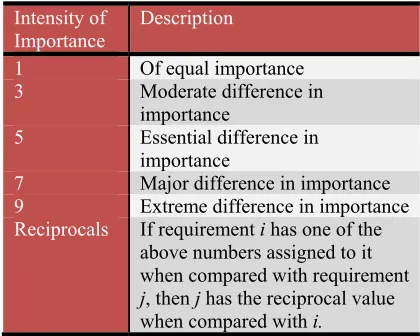
(2) As execution, compare all outlined pairs of requirements using the scale in Table 1.
(3) As presentation, use the ‘averaging over normalized columns’ method (based on the pair-wise comparisons) to estimate the relative priority of each requirement. Calculate the consistency ratio of the pair-wise comparisons using methods provided by AHP. The consistency ratio is an indicator of the reliability of the resulting priorities, and thus also an estimate of the judgmental errors in the pair-wise comparisons.
Table 1: Fundamental scale used for pair-wise comparison in AHP
Intensity of
Importance Description
1 Of equal importance
3 Moderate difference in importance
5 Essential difference in importance
7 Major difference in importance
9 Extreme difference in importance
Reciprocals If requirement i has one of the above numbers assigned to it when compared with requirement
j, then j has the reciprocal value when compared with i.
10
SERUM
SERUM (Software Engineering Risk: Understanding and Management) [15] uses estimations for cost, benefit, development risk, and operational risk reduction to inform the
prioritization process. The process as illustrated in Figure 1 starts with a business analysis from which the requirements have arisen. These requirements are refined by assessing risks in the current system (Stage 1) and ensuring that new requirements are created or amended to reduce those risks, where appropriate. Similarly since the requirements define the proposed system, the risks associated with the proposed system are assessed and where possible the requirements amended or new ones created (Stage 2). The requirements for the new system are defined in more detail in Stage 3, and cost-benefit analysis is carried out in Stage 4. This is a high-level assessment using a simple scoring system. In Stage 5 a risk assessment is made concerning the development of each requirement. Thus we have the following variables for each requirement: (i) the development risk; (ii) the risk reduction in moving from the current system to the proposed system, as calculated from Stages 1 and 2; (iii)
the cost of the requirement; and (iv) the benefit from the requirement. (Note that (iii) and (iv) could be combined as cost-benefit ratio.) Using these estimations, a prioritization is determined in Stage 8. In practice Stage 8 is carried out by
giving preference to the most important criteria, but alternative viewpoints can be made, ultimately the choice of approach being up to the user. From industrial studies (Greer et al., 1999a [17]), the favored criteria is often the benefit accrued from the requirement, although in mission, critical systems risk reduction may be more important. The risk plans in Stages 9 and 10 are useful by-products of the process.
SERUM does not at present formally handled dependencies between requirements, although this and a means to better support the final decision making process are subjects of current research. (For a comprehensive description of SERUM, see Ref. [12] [15]).
11
EVOLVE
EVOLVE [6] combines the computational strength of genetic algorithms with the flexibility of an iterative solution method.
We can now formulate our problem as follows [12]:
For all requirements ri א Rk determine an
assignment ω*: ω*(ri) = m of all requirements ri
to an increment ω*( ri) = m such that
1) Σr(i) א Inc(m) effort(ri , Rm) ≤ Sizem
for m = k, k+1, … (Effort constraints)
2) Σ r(i) Inc(m) risk(ri, Rm) ≤ Riskm
for m = k,k+1,… (Risk constraints)
3) ω*(r
i) ≤ω*(rj) for all pairs (ri. rj) אΨk
(Precedence constraints)
4) ω*(ri) = ω*(rj) for all pairs (ri. rj) אξk
(Coupling constraints)
5) card({ri א Rk: iא I(t)}) ≤ resource(t)
for all releases k and all sets I(t) related to all resources t(Resource constraints) 6) A = Σp=1…,qλp [Σr(i)אR(k)benefit
(ri,Sp,ω*)] ֜ L-max! with
benefit(ri,Sp,Rk,ω*) = [σ-prio(ri,Sp,Rk)
+1][τ - ω*(rj,)+1] and τ = max{ω*(ri): ri
א Rk}
The function (6) is to maximize the weighted benefit over all the different stakeholders. For any stakeholder the benefit from the assignment of an individual requirement to an increment is the higher, the earlier it is released, and the more important it is judged. L-max means to compute a set of L best solutions (L>1) so that the uncertainty of the inputs is taken into account and the analyst retains the decision-making power.
At each iteration, a genetic algorithm [6] is applied to determine an optimal or near-optimal (related to the objective function (6)) assignment of requirements. Only assignments satisfying constraints (1) – (3) are considered.
Maximization of objective function (6) is the main purpose of conducting crossover and mutation operations. This function composed of (4) and (5) is computed at each optimization step of the genetic algorithm. The algorithm terminates when there is no further improvement
12 in the solution. This is calculated as no improvement in the best fitness score achieved within 0.5% deviation over 600 simulations.
EVOLVE is an evolutionary approach. At iteration k; a final decision is made about the next immediate increment Inck and a solution is
proposed for all subsequent increments Inck+1;
Inck+2, … The reason for the iterative part in
EVOLVE is to allow all kinds of late changes in requirements, prioritization of requirements by stakeholders, effort estimation for all requirements, effort constraints, precedence and coupling constraints as well as changes in the weights assigned to stakeholders. This most recent information is used as an input to iteration
k+1 to determine the next increment Inck+1 as
‘firm’ and all subsequent ones Inck+2; Inck+3, …
as tentatively again. This is shown in Fig2. For all iterations, there is the next ‘firm’ increment, the one that will certainly be implemented in that iteration (solid border in Fig2). There may also be other ‘tentative’ increments (dashed border), representing plans for future iterations. For iterations following the first one, implemented increments are shown grayed.
The aforementioned process can be considered as infinite, i.e. the number of iterations (and the number of increments) has not to be defined upfront. This is considered to be the default situation for the formulation of the model. However, it is also possible that a fixed number of iterations are taken into account from the very beginning. The EVOLVE approach remains completely the same, with the only difference that there are some minor modifications in the computation of (6). If the number of releases is limited, then it might be possible that some requirements are excluded by a given solution. In other words, the increment number assigned to a requirement will be greater than the maximum number of increments. In such cases the stakeholder priority penalty is multiplied by a user-specified factor larger than one. This is to reflect the negative impact on the stakeholder concerned if that requirement is omitted from the project. Solutions generated by EVOLVE are
optimal or near-optimal. Genetic algorithms, in general, cannot guarantee optimality. There is a great variance in the solutions generated by different runs of the solution algorithm. This variation concerns both changes in mutation and crossover rate. But even for fixed mutation and crossover rates, different solutions are obtained if the algorithms are applied several times. However, as known from empirical evaluations, there is a great likelihood to have the optimal solution among the ones generated, especially if a larger number of computations with varying parameters are conducted. (For a comprehensive description of EVOLVE, see Ref. [6] [12]):
VOP
VOP [8] uses a framework that gives requirement engineers a foundation for prioritizing and making decision about requirements. It provides visibility for all stakeholders during decision making, eliminating lengthy discussions and arguments over individual requirements by emphasizing the core business values.
13 Using the core business values and risks, VOP constructs a prioritization matrix. Table A illustrates such a matrix, incorporating five business values and two types of risks. In this matrix, Vi is the weight of business value i and Rj is the weight of risk j.
VOP then weights each requirement relative to each specific business value and risk; the weighting scale is 0 (not important) to 10 (critical). Wi,jis the weight as- signed to requirement ri with respect to business value Vj. Likewise, W_i,j is the weight assigned to the
requirement ri with respect to Rj. Formally, we can express the score, Sr, for each requirement, r,
in the set R of all possible requirements, as the sum of its contribution to core business values minus the sum of its perceived risks. The total core business value contribution is simply the product of each value’s weight times the weighting of that requirement with respect to that
core value. Likewise, the sum of a requirement’s
perceived risks is the product of each risk’s weight times the requirement’s weighting with respect to that risk. Table B shows an example of applying business value and risk weights within the VOP framework. In the example, requirement r2 has a higher overall score than
requirement r1, so it has a higher priority and is a
more logical choice for inclusion in the project’s core requirements set. (For a comprehensive description of VOP, see Ref. [8] [10]):
3. EVALUATION OF TECHNIQUES
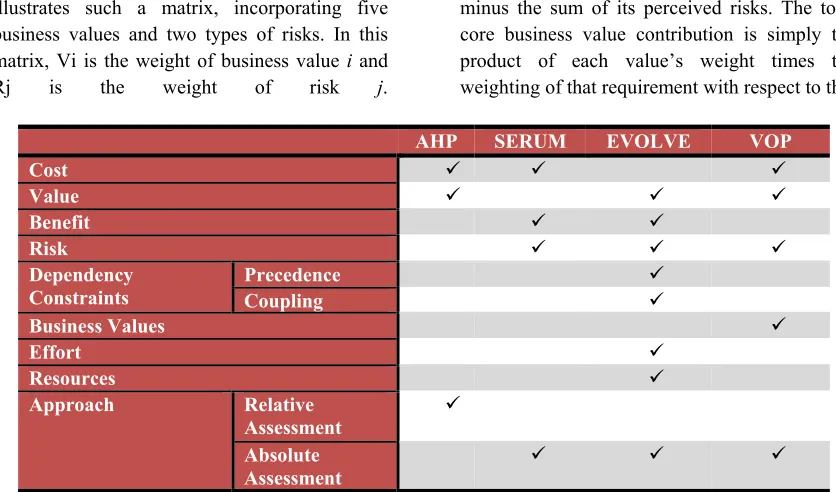
Table below shows the techniques and factors that each technique used for prioritization:
Cost
Cost is the cost of successfully implementing the candidate requirement. In practice, software developers often calculate cost purely in terms of money [13]. The implementations of different requirements have different development or life-cycle costs. Given limited budgets, cost can be an important and even overriding factor when prioritizing requirements. Thus, the highest
AHP SERUM EVOLVE VOP
Cost 9 9 9
Value 9 9 9
Benefit 9 9
Risk 9 9 9
Dependency
Constraints Precedence Coupling 99
Business Values 9
Effort 9
Resources 9
Approach Relative
Assessment
9
Absolute
Assessment 9 9 9
14 priority requirements may be those that the project can afford to implement first [7].
Except EVOLVE all three methods evaluates cost factor. VOP estimate the cost while estimating the risk. After prioritizing the requirements VOP process starts from the top of the ranked requirements list and assess the risk and cost of implementing each requirement. High cost and/or risk rules out form the final requirement list. SERUM uses cost-benefit analysis and risk associated with current and proposed system to prioritize changes. AHP uses pair-wise comparison method to assess the relative cost of implementing each candidate requirement.
Value
One of the major factors to consider in requirement prioritization process is calculating the value of each requirement. Almost every prioritization technique use values of individual requirements to compare them with other requirements or criteria’s. Value shows the importance of each requirement in the software product. All requirements are not equal in terms of importance. Some are very important and some are less important. It is crucial to determine the importance and value of each requirement so that the requirements that are most important should implement first.
All requirement prioritization techniques shown in table 1 calculate value of each requirement except SERUM. AHP uses pair-wise comparisons of requirement to determine which of the two is more important. In both VOP and EVOLVE stakeholders assigns the value to each requirement and then requirements are evaluated according to there own methods. SERUM does not calculate value of requirements. It uses cost and benefit analysis for prioritization.
Benefit
Priorities provide management and engineering with a rough estimate of the benefit of the different requirements, which is useful when performing cost/benefit analyses of the
requirements to determine where best to expend limited project resources in preparation for requirements negotiation [7].
SERUM and EVOLVE calculate the benefit associated with implementing the requirements. SERUM uses cost-benefit analysis and risk associated with current and proposed system to prioritize changes. And EVOLVE evaluates benefits of different release plans containing different releases to tell which release plan is most beneficial for the organization.
Risk
Risk calculation is an important factor during requirement prioritization. It may well make sense to prioritize requirements by the risks associated with their implementation. For example, one can attempt to implement those requirements having the highest risk first so as to deal with the resulting problems during development. On the other hand, it may make sense to implement the lowest risk requirements first in order to maximize the amount of the system implemented by ensuring that limited resources are not wasted on trying to implement high risk aspects of the system that may be impossible to successfully implement. Postponing the implementation of high risk requirements can also maximize the time available to research the risks and determine appropriate risk mitigation approaches [7].
SERUM, EVOLVE and VOP considers risk factor. SERUM calculates risk associated with the current system, proposed system and also assesses development risk and then performs risk reduction activities. EVOLVE calculate risk associated with each release. VOP uses a framework that supports the weighting and identification business risk categories [8]. AHP does not calculate any type of risk.
Dependency Constraints
15 on another requirement or set of requirements. Dependency Constraints are of two types Precedence and Coupling Constraints.
Precedence Constraints: Precedence constraints occur when one requirement can only be started if another is completely finished. Consider we have two requirements R1 and R2. Requirement R1 can only start if requirement R2 is completely finished. There is a precedence constraint between requirements R1 and R2.
Coupling Constraints: Such requirements that must be implemented in the same increment. Consider we have four requirements R1, R2, R3, and R4. Requirements R1 and R2 must be in the same increment. So there is a coupling constraint between requirement R1 and R2.
Only EVOLVE methods considers both precedence and coupling constraints between requirements.
Business Values
A value is a belief, a mission, or a philosophy that is really meaningful to the organization. An example of a business value is: "Customer Satisfaction." Another example of a value is "Being Ethical and Truthful." Every organization has one or more values, whether they are consciously aware of it or not.
Another way of saying it is that a value is a statement of the company's intention and commitment to achieve a high level of performance on a specific qualitative factor [9]. Some of the business values are [9] [10]:
• Continuous Improvement
• Creativity
• Customer Delight
• Develop People
• Resourcefulness
• Trust
• (A Will to ) Succeed
• Being a market leader in terms of sales;
• Being of being the first to market with a product;
• Customer retention;
• Attracting new customers; and
• Incorporating the latest technology.
Only VOP considers business values during prioritization process. VOP evaluates requirements according to their impact on specific business values an organization recognizes [8].
Effort
Effort estimation is another major issue that has to be address while prioritizing requirements. Effort estimation includes estimation of total effort available and overall required effort for releases.
Estimate effort led by the technical leader and architecture team, the development team that must actually implement the requirements creates and records realistic estimates of the effort required to implement each requirement [7].
Only EVOLVE method calculate the effort required for all releases.
Resources
The majority of companies (86%) sited resource constraints as one of their top 3 strategic challenges with Organizational Alignment (49%) and Time To Market Agility (43%) following. This was consistent across companies regardless of the number of employees, revenues or number of products being sold [11].
16
Approach
There are two types of approaches for requirement comparisons: Absolute and Relative assessment.
Absolute Assessment: In absolute assessment every requirement is assessed against each criterion. VOP, EVOLVE and SRUM uses absolute assessment approach for requirements comparison with some criteria’s.
Relative Assessment: In Relative assessment approach each every requirement is compared with very other requirement. AHP uses relative assessment, pair-wise comparison in which each requirement is compared with all other requirements.
4. PROPOSED APPROACH FOR REQUIREMENT PRIORITIZATION
Requirement Prioritization is the most important step in requirement engineering process. Without assigning proper and accurate requirement to
each release, it is almost impossible to complete project on time and within budget. In a review of the state of the practice in requirements engineering, Lubars et al. [18] found that many organizations believe that it is important to assign priorities to requirements and to make decisions about them according to rational, quantitative data. Still it appeared that no company really knew how to assign priorities or how to communicate these priorities effectively to project members.
According to me all the factors listed in (Table 2) should be considered while prioritizing requirements. It is better to spend time in choosing the right requirements for releases rather than choosing the wrong ones and wasting time, budget and resources. The proposed approach describes below addresses all the important factors that should be consider while requirement prioritization process.
Before starting prioritizing requirements first of
17 all check the dependencies between requirements (Dependency Constraints). If dependencies between requirements are not taken properly it gets very difficult to select an appropriate requirement sets for the releases, because it is highly possible that you are selecting a requirement in the current release and leaving another for the next release but both requirements should be in the same release. Therefore, the first step is to check dependency constraints between requirements.
After checking the dependencies between requirements step 2 is to prioritize the requirements using Value-Oriented Prioritization (VOP) [8]. VOP is one of the best approach for requirement prioritization. It evaluates requirements according to their impact on core business values. It also supports identification and weighing of business risks and cost of implementing each requirement. VOP builds a prioritization matrix using the core business values, requirements values and risk. This matrix shows the priority of each requirement and the requirements that has higher priority is a more logical choice for inclusion in the requirement set for the current release. The output of VOP process is the requirement set that should be implemented in the current release, but there are still few major factors that are not judged in this process: the effort and resources required for each requirement and the benefit of implementing the requirement set.
In step 3 calculate the implementation effort required for each requirement of the requirement set produced by step 2. If required effort is greater than available effort than exclude some requirements or make some tradeoff between requirements from the current requirement set and then calculate effort again, else move to step 4.
In step 4 calculate resource constraints for the requirement set produced by step 3. Same is the case here, if the required resources are greater than available resources than make some adjustments in the requirement set until the required resources are less than available
resources. It may be possible that some requirements are asking for the same resource.
Then in the last step calculate the benefit of implementing the requirement set, if it is not beneficial for the organization than reconsider the requirement set and again make some tradeoff and finally you’ll get the most accurate and reliable requirement set for the current release. And all the requirements in this set are within resources, effort and cost and also beneficial for organization. Risk factor is also calculated. This process is also invisible to stakeholders because they themselves select the requirements at the first place for the current release.
The main objective of this approach is to calculate the important factors that are necessary to address while prioritizing requirements. Major drawbacks of previous techniques are that none of them considers all these factors.
5. CONCLUSION
It is almost impossible to implement all the requirements in one release. That is why some sort of prioritization process is needed to implement the most important requirements in the first release and leave the less important ones for the future releases. Requirements prioritization helps requirement engineers in this complex and crucial decision making situation. This paper analyze four major methods (AHP, SERUM, EVOLVE, VOP) used for requirement prioritization. The analysis shows different factors that each method addresses while prioritizing requirements.
6. FUTURE WORK
18 stakeholders to gain their interest and confidence, understandable to non-experts, reliable, efficient, scalable and flexible. Lots of factors can be added to this list. And most of the methods and techniques that are available now-a-days are for small development organization. If the scale increases, these techniques get very difficult to implement and are less accurate. Hence lot of work has to be done in this field. Such techniques can be developed that uses all major factors listed above for prioritization, regardless of organization size, i.e. supports all size of development organizations.
REFERENCES
[1] Hofmann, H.F., Lehner, F., 2001.
Requirements engineering as a success factor in software projects. IEEE Software
[2] Johnson, J., “My Life is Failure: 100 Things You Should Know to be a Successful Project Leader”, Standish Group International. 2006.
[3] Charette, R., “Why Software Fails”, [website]
http://spectrum.ieee.org/sep05/1685
[4] Cohn, M., “Agile Estimating and Planning”, Prentice Hall, 2006
[5] T.L. Saaty, The Analytic Hierarchy Process, McGraw-Hill, Inc. (1980).
[6] Greer, D., & Ruhe, G. (2004). Software release planning: An evolutionary and iterative approach. Journal Information and Software Technology, 46(4), 243-253.
[7] Donald Firesmith (2004). Prioritizing Requirements. Journal of Object Technology.
[8] J.Azar, R.K. Smith, & D. Cordes, " Value-Oriented requirements Prioritization in a Small Development Organization", IEEE Software, Jan/Feb 2007, pp. 32-73.
[9]
http://www.rapidbi.com/created/businessval ues.html
[10] J.Azar, R.K. Smith, & D. Cordes, " Value-Oriented requirements Prioritization, tech. report, Department of Computer Science, Univ. of Alabama, 2006;
http://cs.ua.edu/research.Reports.asp
[11] Software Development Practices within the Commercial Software Industry, published by QAVantage, 33 Drummond Place, Red Bank, NJ 07701, 1-800-573-1983, www.qavantage.com
[12] D. Geer, Requirements prioritization for incremental and iterative development, Quenns University Belfast, UK.
[13] Karlsson, J., K. Ryan, “A Cost-Value Approach for Prioritizing Requirements”,
IEEE Software, Sept. 1997, pp. 67-74.
[14] https://buildsecurityin.us-
cert.gov/daisy/bsi/articles/best-practices/requirements/534-BSI.html
[15] Greer, D., Bustard, D., & Sunazuka, T. (1999b). Prioritization of system changes using cost-benefit and risk assessments,
Proceedings of the Fourth IEEE International Symposium on Requirements Engineering, 180-187. (SERUM)
[16] Joachim Karlson, Claes Wholin, Bjorn Regnell “An evaluation of methods for prioritizing software requirements”.
[17] Greer, D., Bustard, D., & Sunazuka, T. (1999a). Effecting and measuring risk reduction in software development. NEC Journal of Research and Development, 40(3), 378-38.