Time-stamped Generalized Predictive Control of
Networked Control Systems with Random Delay
Yi Liu
Liaoning University of Technology / Computer Center, Jinzhou, China Email: [email protected]
Abstract—The key point of the networked control systems is that conventional generalized predictive control algorithm cannot deal with random delays, packet losses and vacant sampling. In this paper, the time-stamped generalized predictive control (TSGPC) with fuzzy rectification is proposed to deal with this problem. The TSGPC use time-stamped to calculate the real delay and the LMS adaptive recursive algorithm of weight coefficient are used to estimate the induced delay. In order to reduce the transmission times between the controller and the actuator, a threshold that is set in advance would be used to decide whether the control information are sent to the actuator or not. The control information is ensured optional or sub-optional by using this method. The fuzzy rectification is used to control the increasing of the prediction error. The simulation results show that the TSGPC with fuzzy rectification can trace the desired output precisely.
Index Terms—networked control systems, time-stamped, TSGPC, fuzzy rectification
I. INTRODUCTION
Networked control systems (NCS) are distributed feedback control systems closed via a shared band limited digital communication network, which connects sensor nodes, actuator nodes and controller nodes together to exchange information and control signals [1-3]. Such NCS have received increasing attentions in recent years due to their low cost, simple installation and maintenance, and high reliability. The study of NCS is an emerging interdisciplinary research area, combining among others control theory, communication theory and computer science. Significant research work has been done within the last decade on NCS, making available systematic stability analysis and design tools from a different point of view [4].Despite lots of advantages the network brings to the control system, potential issues such as network induced time delays and packet dropouts arise that may degrade system performance and even cause system instability [5-7].
Three main issues raised in NCS are network-induced delay, data transmission dropout, and bandwidth and packet size constraints. As is known, network induced delay can significantly degrade the performance and even lead to instability of NCS, so the maximum allowable size of network-induced delay are an important indexes in the sense of guaranteeing system stability. Many researchers have studied stability analysis and controller
design for NCS with linear controlled plant (namely, linear NCS) in the presence of network-induced delay [8-10]. The stability problem of NCS with short time delays is studied and the constant stabilizing state feedback gain is obtained [11]. Time based time delay analysis of the NCS is provided to explain how it affects network systems and an adaptive Smith predictor control scheme is designed [12]. Time delay is considered in an independent layer to design a stabilizing controller based on model predictive control approach [13]. The maximum allowable delay bounds are obtained for the stability of NCS and are used as the basic parameters for a scheduling method for NCS [14]. So far, the stability synthesis for the NCS with time delays has not been fully investigated.
Fuzzy control is a useful approach to solve the control problems of nonlinear systems. Takagi-Sugeno (T-S) fuzzy system [15] is a popular and convenient tool to approximate nonlinear systems because of its simple structure with local dynamics. Descriptor system, which are also referred to as singular systems, implicit systems , generalized state-space systems, differential algebraic systems, have been extensively studied for many years. A fuzzy model [16] in the descriptor form is introduced, and stability and stabilization problems for the system are addressed. Recently, more and more attention has been paid to the study of fuzzy descriptor systems [17-19]. Therefore, it is meaningful to employ fuzzy descriptor model in NCS systems design. However, to the best of our knowledge, the fuzzy descriptor NCS with time-delay has not yet been fully investigated.
Generalized predictive control algorithm that based on model predictive control is another more successful application of control algorithms [20]. Since a larger sampling period is used, GPC particularly suit to the constraint conditions of communications. However, the traditional generalize predictive control algorithm can not effectively deal with the random delays and packet losses in the networked control systems [2, 21], so in this paper, the generalized predictive control algorithm based on the time-stamped function with fuzzy rectification is proposed. Using this algorithm, TSGPC is extended to handle random delays, packet losses and vacant sampling in networked control systems.
delay. The main results are presented in section III. Number examples are included to demonstrate the power of this method in Section IV. And finally in the section V some conclusion remarks are given.
II. PROBLEM STATEMENTS
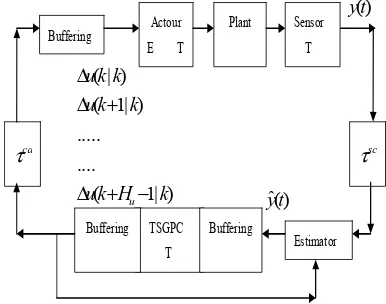
Figure 1 gives the networked control systems structure with a time-stamped of generalized predictive control function. where sc
τ
is the delay from the sensor to the controller and caτ
is the delay from the controller to the actuator, the computational delay of the processor is usually small when compared to network-induced delays since processor coded with the control algorithm works at a higher speed; hence, for the sake of simplicity, it is usually ignored in the analysis of NCS. Sensors, actuators and controllers keep time synchronization, single packet is transmitted. It is assumed that the sensor node, the actuator node, and the controller have an identical sampling period h. T represents time-driven, E represents event-driven.The sensor node samples the outputs, combines them into one data packet (Note: sensor-to-controller data packets contain the
τ
ca information, which is determinedby the actuator, and then
τ
cawhich is passed on to the sensor node is to be sent back to the controller node), and then transmits the data packet to the controller node. Each data packet is time stamped so that the delay information can be extracted at the controller node so as to indicate how old the received measurement is. At the controller, the received sensory data are stored in a shared memory. The model predictive controller and the identifier use these stored data history. At each sampling interval,
τ
scis determined first, the number of measurements that need to be estimated by the minimum effort estimator to fill in the missing sensory data up to the current k-th sampling instant, is determined using
τ
scand the age of the latest sensor data. Then the output of the estimated system is updated into the shared memory. Besides using in the subsequent computations of control actions, the predicted output can be used in the next sample instant if there is an event of vacant sampling or data losses. Figure 2 gives
the timing diagram of the networked control systems. Where sc 2 , ca 2
h h
τ
=τ
=Ⅲ. DESCRIPTION OF THE ALGORITHM
The predictive networked control strategy developed in this paper assumes the packet losses will happen if the delay exceeds a pre-set time interval. It should be noted that with sensory data estimation and actuator buffering, the developed networked control strategy treats the event of out-of-order data and the event of vacant sampling the same as packet losses. This is because at a particular time instant, older data that arrive at the controller is used to replace the data histories for use in prediction and estimation. On the other hand, older data that arrive at the actuator will be discarded if newer data are available. This is true as long as the sequential occurrences of out-of-order data, vacant sampling, or packet losses, are within the worst-case delay.
Generalized predictive control use a polynomial type estimator and employs a multivariable input-output model of the CARIMA [20, 22, 23] form to describe the object that interfered by the random events:
). ( ) ( 1 ) 1 ( ) ( ) ( )
( 1 1 1
k e z c k
u z B k y z
A − − −
Δ + −
= (1)
Where
y
,
u
,
e
is the control input vector, and theoutput vector, and zero-mean white noise, z−1 is the
postpone operator, Δ=1− −1
z is the different operator,
) (z−1
A and C(z−1) are
p
×
p
Matrix polynomialmatrices, B(z−1) is a
p
×
m
polynomial matrix.A. Delay Estimator Design
AR model and the LMS [24-26] algorithm are used to track the random time delays in the networked control
systems. Γkcan be defined as:
1
n
k i k i
i
δ τ
− =Γ =
∑
, whereδ
iis a weighting coefficients for i>0,
ε
i can be defined ask k k
=
τ
−
Γ
ε
, whereε
i is a fitting residual. In order to make the varianceε
i is very small,δ
i need to be dynamically adjusted. At the k-th sampling instant, the weighting coefficients vector form is expressedTSGPC ) | 1 ( .... ...
) | 1 (
) | (
k H k u
k k u
k k u
u−
+ Δ
+ Δ Δ
Buffering Actour Plant
ca
τ
Estimator
sc
τ
Sensor
) ( ˆt y
) (t y
E T
Buffering Buffering
T
T
Figure 1. The structure of Networked Control Systems.
as T nk k
k
k
[
δ
1,
δ
2,...,
δ
]
δ
=
, n of delayed data up tothe k-th instant is expressed as:
[ 1, 2,..., ] .
T
k k k k n
T =
τ τ
− −τ
− (2) The AR model about time delayed on network is obtained as:1
.
n
T
k ik k i k k
i T
δ τ
−δ
= Γ =∑
= (3)In which T k
k k
k
τ
δ
T
ε
=
−
[ ]2 [ ] 22 T T .
k k T k k TT k
E
ε
=Eτ
− Rτδ δ
+ Rδ
(4)In which T
k n k k k k k k k T
E
T
E
R
]
,....,
,
[
]
[
21
τ
τ
τ
τ
τ
τ
τ
τ − − −=
=
⎥
⎥
⎥
⎥
⎦
⎤
⎢
⎢
⎢
⎢
⎣
⎡
=
=
− − − − − − − − − − − − − − − − − − n k n k k n k k n k n k k k k k k n k k k k k k T k k TTE
T
T
E
R
τ
τ
τ
τ
τ
τ
τ
τ
τ
τ
τ
τ
τ
τ
τ
τ
τ
τ
...
...
...
...
]
[
2 1 2 2 2 1 2 1 2 1 1 1Using (4), the mean square error of delay is a quadratic function of weights coefficients and a parabolic shape surface function with a unique minimum value, hence, gradient method can be used to seek the minimum value. According to the steepest descent method,
δ
k+1 can be defined asδ
k+1=
δ
k−
μ
∇
(
k
)
,μ
is a very small number named convergence factor,max
1
0≺μ≺ λ , in which:
λ
max is the maximum eigenvalue ofR
TT. It is very difficult to calculate the∇
(
k
)
accurately, so the actual calculation is replaced with its estimate of∇
ˆ
(
k
)
:k k k k k k
T
E
k
)
ˆ
[
ε
]
[
ε
]
2
ε
[
ε
]
2
ε
(
ˆ
=
∇
2=
∇
2=
∇
=
−
∇
,the LMS adaptive recursive algorithm of weight coefficient is obtained as:
δ
k+1=δ
k− ∇μ
ˆ ( )k = +δ
k 2με
kTk. (5)Once the networked delay has been estimated, the value is rounded. The estimate value can be used to control the NCS, at the same time, the new measurement of time delay is used to replace the data histories which has been stored in the controller memory.
B. TSGPC Design
In order to predict the required j-step-ahead future control signal that will drive the system to track a desired trajectory, an extension to the multivariable Generalized Predictive Control [27] is used for this purpose. Here an optimal set of current and future changes in control signal:
) (k j
u +
Δ for j=0,1,2,...,Hu is sought to continuously
minimize the quadratic cost function:
2 1 1 2 2 2 1 ( , , ) ( | ) ( )
( 1) .
u
k u
H
r
j H Q
H
j R
V H H H
y k j k y k j
u k j
∗ = = = + − + + Δ + −
∑
∑
(6)Where y∗(k+j|k) is the j-steps ahead-predicted system
outputs based on the history up to the time instant k, and )
(k j
yr + are the reference future trajectories.
u H H
H1, 2 are, respectively, the minimum and maximum prediction horizons, and the control horizon, where
2 2
1
1≤H ≤H Hu ≤H . The weighting sequence
matrices Q and R are diagonal and positive definite. The Diophantine equation:
) ( )
( )
( −1 Δ −1 + − −1 =E z A z z F z
Im kj j jk
Combining the Diophantine equation and (1) yield,
1
1 1
( | ) ( ) ( )
( ) ( ) ( 1).
k j
k j
y k j k F z y k
E z B z u k j
∗ −
− −
+ = +
Δ + − (7)
Where 1 )) ( deg( 1 − = − j z Ek j )). ( deg( )) (
deg(Fk z−1 = Az−1
j
This term can be separated into two parts by introducing the new equation:
( 1) ( 1) k( 1) j k( 1).
j j
T z− = ΔA z− E z− +z F− z− (8) In which: i n i i j k j i j i i j k
j z e z F z f z
E a − = − − − = − = +
∑
=∑
0 , 1 1 1 ,1) 1 ( )
(
T(z-1) is defined as filter polynomial, and generally the first order,
Here
1 1 ( 1) 1
( ) ( ) ( ).
k k j d k
j j j
G z− =G z− +z− − + E z− (9)
In which: ca sc b k j k j b k j k j k j d n E d j G j n G z E z B z G
τ
τ
+ = − = − = − + = = − − − 2 deg deg 1 deg ) ( ) ( )( 1 1 1
Combining (8), (9) and (1) yield,
1
1 1
1
( | ) ( ) ( )
( ) ( 1) ( ) ( )
( ) ( ) .
k
j f
k k
j f j f
k k
j f j
y k j k G z u k j d
E z u k F z y k
G z u k j d F
∗ − − − − + = Δ + − + Δ − + = Δ + − + (10) In which ) ( / ) ( ) ( ) ( / ) ( )
(k =y k T q−1 u k =u k T q−1
yf f
) ( ) ( ) 1 ( )
( 1 1
k y z F k u z E
F k f
j f k j k j − − Δ − +
= is the free
Figure 3. The block diagram of TSGPC with fuzzy rectification
1 1
1 ( ( )) ( ) ( ).
k k
j j
F+ =z I− ΔA z− F +B z− Δu k+ j (11)
With F0 y(k)
k
= and Δu(k+ j)=0for j≥0.
Considering the three prediction horizons H1, H2 and Hu, where j=H2-H1, the matrix form of the j-step-ahead prediction is obtained as:
12 12
12 H H H
H G U F
Y
u
uΔ +
=
∗ (12)
[
( 1) ( 1 1) ... ( 2)]
12
H k y H
k y H k y Y
T T
H
+ +
+ +
=
∗ ∗
∗ ∗
] ,..., ,
[
] ) 1 (
,..., ) 1 ( , ) ( [
2 1
1
12 1
T k H T
k H T k H H
T u T
T H
F F
F F
H k u k
u k u U
u
+ =
− + Δ +
Δ Δ = Δ
u
u u
u u
mH H H p
H H H
H
H H H
H
H H H
H H
G G
G
G G
G
G G
G G
× + −
− −
−
+ − −
− −
−
ℜ ∈
⎥ ⎥ ⎥ ⎥ ⎥
⎦ ⎤
⎢ ⎢ ⎢ ⎢ ⎢
⎣ ⎡
=
) 1 (
2 1
1 1
2 1
1 2
2 2
2
1 1
1
1 1
1 12
...
.... .... ... ...
... ...
With Gq =0p×m for
q
≺
0
. Using the matrix notation of (2), the TSGPC quadratic cost function can be written as:12 12 12 12
2 1
1 2 1
1 2
( ) (
)
( , ,..., )
( , ,..., ).
u u u u
u u
u
k
T
H H H r H H
T
H r H H
H H
H
V
G U F y Q G U
F y U R U
Q diag Q Q Q
R diag R R R
− +
=
Δ + − Δ
+ − + Δ Δ
= =
(13)
By performing either quadratic programming or analytical differentiation to minimize Vk with respect to
the optional sequence of control action are obtained as:
12 12 12 12
1
( ).
u u u u
T T
H H H H r H
U ⎡G QG R⎤−G Q y F
Δ =⎣ + ⎦ − (14)
C. Fuzzy Rectification
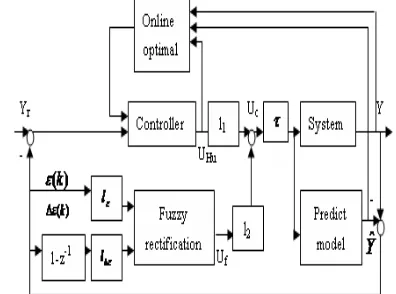
The prediction error of the TSGPC is also increased with the increasing length of the prediction step, so, the fuzzy rectified [28, 29] method is used to improve the control precision. Figure 3 shows the block diagram of TSGPC with fuzzy rectification.
Define the estimation error asε(k)=yˆ(k)−yr(k) and the gradient of ε(k) asΔε(k), both of them are the
inputs of the fuzzy rectification, lε is the normalized
parameter of the
ε
(k), lΔεis the normalized parameter of theΔ
ε
(
k
)
, the rectified equation:ΔUc= Δl U1 Hu + Δl2 Uf. (15)
The parameter
l
1andl
2can be adjusted to improve the control precision. Fuzzy membership function adoptuneven distributed triangle. Based on the following analysis, we develop 49 fuzzy rules.
If
ε
(
k
)
andΔ
ε
(
k
)
are both positive numbers, it indicates that the prediction error trend will increase, and then we can deduce that the input control is too small, so the output control (Δ
U
f ) will be increased.If
ε
(
k
)
is positive number, andΔ
ε
(
k
)
is zero, it indicates that the prediction error trend will remain unchanged, and then the input control can be properly reduced, the output control (Δ
U
f ) is middle center.If
ε
(
k
)
is positive numbers, andΔ
ε
(
k
)
is negative number, it indicates that the prediction error trend will reduce, and then the input control can be reduced to theminimum, the output control (
Δ
U
f) is small.Ⅳ. SIMULATION
In order to demonstrate the validity of the proposed methods, a numerical example is involved to illustrate the effectiveness of the proposed criteria. TrueTimel.5 is the simulation software.
A. Time Delay Prediction
Figure 4. Network delay distribution map
Figure 5. Network delay forecast map of LMS
Figure 7. The output trajectory of time delay
Figure 8. The output trajectory with fuzzy rectified B. TSGPC Algorithm Simulation
The networked control system consists of the sensor nodes, the actuator nodes, the controller nodes and an interference node. Fig.6 is a good example of a platform design.
The transfer function of controlled plant is defined as ( ) 400 / ( 2 5 200)
G s = s + +s , the discrete model
is ( 1) ( ) ( 1) ( 1)
A z− y k =B z− u k− , in which
1 1
2 1
1
4063
.
0
4422
.
0
)
(
7788
.
0
355
.
1
1
)
(
− −
− −
−
+
=
+
−
=
z
z
B
z
z
z
A
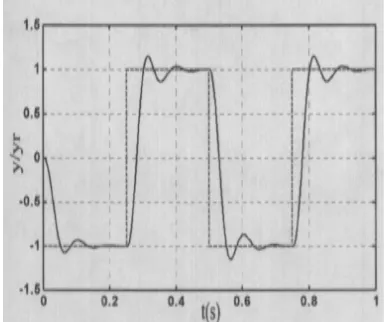
The reference signal is square signal. The square signal simulation results are shown in figure 7 and figure 8.
We conclude that using the present method, the capacity of tracking the reference signal has been remarkably improved.
Ⅴ. CONCLUSION
According to the characteristics of packet losses, vacant sampling and random delay, the time-stamped Generalized Predictive Control (TSGPC) with fuzzy rectified control is proposed from the perspective of generalized predictive control. The algorithm is derived theoretically; simulation results show that the algorithm has a strong identification capabilities and tracking predict abilities. In short, TSGPC with fuzzy rectified control significantly improves the performance of networked control systems.
ACKNOWLEDGMENT
This work was supported in part by the School Foundation from Liaoning University of Technology of China (Grant NO. X201218).
REFERENCES
[1] Park, H.S., Kim, Y.H., Kim, D.S., and Kwon, W.H., “A
Scheduling Method for Network-Based Control Systems”,
IEEE Trans. Control Systems Technology, 2002, vol.10,
no.3, pp.318–330.
[2] Walsh, G.C., Ye, H., and Bushnell, L.G., “Stability
Analysis of Networked Control Systems”, IEEE Trans.
Control Systems Technology, 2002, vol.10, no.3, pp. 438–
446.
[3] Guerrero, J.M., Matas, J., de Vicuna, L.G., Castilla, M.,
and Miret, J., “Wireless-Control Strategy for Parallel
Operation of Distributed-Generation Inverters”, IEEE
Trans. Ind. Electron., 2006, vol.53, no.5, pp. 1461–1470.
[4] M. S. Branicky, V. Liberatore, and S. M. Phillips,
“Networked control system co-simulation for co-design”,
Proceedings of the American Control Conference, 2003,
vol.4, pp.3341–3346.
[5] Jingyang Wang, Min Huang, Haiyao Wang, Liwei
Guo,Wanzhen Zhou, “Research on Detectable and Indicative Forward Active Network Congestion Control
Algorithm”, Journal of Software,2012,Vol.7,No.6,
pp.1195–1202.
[6] Jiang Chang-jiang, Shi Wei-ren, Tang Xian-lun, etal,
“Energy-Balanced Unequal Clustering Routing Protocol
for Wireless Sensor Networks”, Journal of Software,
2012,vol.23, No. 5, pp.1222–1232.
[7] Fan Lin, Wenhua Zeng, Jianbing Xiahou, Yi Jiang,
“Optimizing for Large Time Delay Systems by BP Neural
Network and Evolutionary Algorithm Improving”, Journal
of Software, 2011, vol.6, no.10, pp. 2050–2055.
[8] W. Zhang, M. S. Branicky, S. M. Phillips, “Stability of
networked control systems”, IEEE Control System
Magazine, 2001, vol. 21, pp.84–99.
[9] M. S. Branicky, S. M. Phillips, W. Zhang, “Stability of
networked control systems: Explicit analysis of delay”,
Proceedings of American Control Conference, Chicago,
2000, pp.2352–2357.
[10]B.G. Marieke, Nathan van de Wouw, “Stability of
networked control systems with uncertain time-varying
delays”, IEEE Trans. on Automatic Control, 2009, vol.54,
pp.1575–1580.
[11]Xie, G. and Wang, L., “Stabilization of Networked Control
Systems with Time-Varying Network-Induced
Delay”,Proc. 43rd IEEE Conf. Decision Control, 2004, pp.
3551–3556.
[12]Lai, C.-L. and Hsu, P.-L., “Design the Remote Control
System with the Time-Delay Estimator and the Adaptive
Smith Predictor”, IEEE Trans. Ind. Information, 2010,
vol.6,no.1, pp. 73–80.
[13]Guinaldo, M., Sanchez, J., and Dormido, S., “Co-Design
Strategy of Networked Control Systems for Treacherous
Network Conditions”, IET Control Theory Appl., 2011,
vol.5, no.16, pp. 1906–1915.
[14]Kim, D.S., Lee, Y.S., Kwon, W.H., and Park, H.S.,
“Maximum Allowable Delay Bounds of Networked
Control Systems”, Control Eng. Pract., 2003, vol.11,
no.11,pp. 1301–1313.
[15]T. Takagi, M. Sugeno, “Fuzzy identification of systems
and its application to modeling and control”, IEEE Trans.
On Systems, Man and Cybernetics, 1985, vol.15, pp.116– 132.
[16]K. Tanaka, M. Sano, “A robust stabilization problem of
fuzzy control systems and its application to backing up
control of a truck-trailer”, IEEE Trans. Fuzzy Systems,
1994, vol.2, pp.119–134.
[17]Z. Hongbin, S. Yanyan, F. Gang, “Delay-dependent
stability and H∞ control for a class of fuzzy descriptor
systems with time-delay”, Fuzzy Sets and Systems, 2009,
vol.160, pp.1689–1707.
[18]Y. Jun, Z. Shouming, X. Lianglin, “A descriptor system
approach to non-fragile H∞ control for uncertain fuzzy
neutral systems”, Fuzzy Sets and Systems, 2009, vol. 160,
pp.423–438.
[19]T. Weihua, Z. Huaguang, “Optimal guaranteed cost control
for fuzzy descriptor systems with time-varying delay”,
Journal of Systems Engineering and Electronics, 2008,vol.
19,pp.584–591.
[20]Clarke. D. W., C. Mohtadi, and P.S.Tuffs., “Generalized
predictive Control Part I and II,” Automatic, 1987, vol.23,
no. 2, pp. 137–160.
[21]Yao Yuan, Dai Yaping, and Liu Xiuzhi, “Active
Variable-period Sampling in Networked Control Systems,”
Transactions of Beijing Institute of Technology., China, 2013, vol.33, no. 9, pp. 970–975.
[22]Wu, J. and Chen, T.W., “Design of Networked Control
Systems with Packet Dropouts”, IEEE Trans. Automatic.
Control, 2007, vol.52, no.7, pp. 1314–1319.
[23]Ye, X., Liu, S., and Liu, P.X., “Modeling and Stabilization
of Networked Control System with Packet Loss and
Time-Varying Delays”, IET Control Theory Appl., 2010, vol.4,
no.6, pp. 1094–1100.
[24]Yang Liqin, and Gu Lan, “Time series analysis and
dynamic data modeling”, Beijing Institute of Technology
Press, China, 1986.
[25]Li Chunmao, “Research on adaptive predicted control for
network control system”, Ph.D. Dissertation, College of
Electrical Engineering, Southwest Jiaotong University, China, Chengdu: 2007.
[26]W. Qian, S. Cong, Y. X. Sun and S. M. Fei, “Novel robust
stability criteria for uncertain systems with time-varying
delay”, Applied Mathematics and Computation, 2009, vol.
215, pp. 866–872.
[27]Camacho. E. F., and C. Bordons., “Model Predictive
Control”, Springer-Verlag, London, UK, 1998.
[28]Wu, Y., Yuan, Z.H., and Wu, Y.P., “LMI-Based Tracking
Control for Networked Control Systems with Random
Time Delay and Packet Dropout”, JDCTA, 2012, vol.6,
no.21, pp. 364–373.
[29]Baoping Ma, and Qingmin Meng, “Delay-dependent
Robust H∞ Control for T-S Fuzzy Descriptor Networked
Control System with Multiple State Delays”, Journal of
Computers, 2011, vol.6, no.3, pp.571–577.
Yi Liu was born in China in 1971. She received the B.S. degree
in Systems Engineering from Shanghai University of Technology in 1994, M.S. degree in Computer Application Technology from Liaoning Project Technology University in 2004 and Ph.D. degree in Control Theory and Engineering from Hebei University of Technology in 2011, respectively.