Original Research Article.
Evaluation of Knowledge and Practice of Hairdressers in Men's Beauty
Salons in Makkah about Occupational Health Hazard in 2014 and 2015
Muhammad Siddiqui
1, Osama Hafez
1, Rami Magliah
2, Saeed Balubaid
2, Ahmad Rashed
2,
Muath Mohammed
2*, Ahmad Bugis
2, Maher Alhafithi
21Department of Community Medicine, Umm Al-Qura University, Makkah, Saudi Arabia.
2Department of Community Medicine, College of Medicine, Umm Al-Qura University, Makkah, Saudi Arabia. ABSTRACT
Introduction: People used to perform combined haircutting up to the fifteenth century. Subsequently, the hairdressing business appeared and this occupational group consider as a critical because of the spread of blood borne diseases such as HIV, HBV and HCV by reusing the same instruments between customers without sterilization. Hence the awareness about health hazards among barbers was playing a vital part in prevention and control of many infectious diseases. Our study aim to assess awareness and practice of health hazards in salons among barbers profession.
Methodology: A cross sectional study was conducted in Makkah city involving around 232 barbers with help of interview questionnaire, including the personal details, knowledge and practice about health hazards associated with barbers profession, and salon health equipment's check list. Data collected was tabulated in Microsoft excel sheet and statistical analysis was done using Microsoft excel software 2010.
Results: A total of 232 barbers participated in this study. All the 232 participants were males. Out of total participants 144 (62%) were aware about the transmission of blood borne diseases. Out of total participants 187 (80.6%) were knew how to deal with injured customer. Moreover, Out of total participants 94 (40.5%) were not have any organizations to aware them about disease of Barbers. Out of total participants 28 (12%) were used to wear mask during shaving. Out of total participants 172 (74.1%) were repair the ultraviolet lamp but
only 157 (67.6%) were use original ultraviolet lamp. Out of total participants 174 (75%) Care about their health status. Out of total 232 participants 181 (78%) were always wash their hands after every costumer. Out of total participants 32 (13.8%) were not changed the shaving tools to new tools. Out of total participants 122 (52.6%) were use flame or perfume to sterilize the razor.
Conclusion: According to the previous results the health promotion campaigns should be initiated without delay to protect the health of these workers and of the general population.
Key words: Knowledge, Practice, Hairdressers, Occupational Health Hazard.
*Correspondence to:
Muath Mohammed,
Department of Community Medicine, College of Medicine,
Umm Al-Qura University, Makkah, Saudi Arabia.
Article History:
Received: 14-10-2017, Revised: 06-11-2017, Accepted: 21-01-2018
Access this article online
Website: www.ijmrp.com
Quick Response code
DOI:
10.21276/ijmrp.2018.4.1.060
INTRODUCTION
People used to perform combined hair cutting up to the fifteenth century. Subsequently, the hairdressing business has appeared. At that time, barbers had many activities as performed circumcision, tooth extraction, bloodletting with leeches and acted as community physicians. The number of barbers opening up barber-shops started increasing gradually with the spread of hair-fashion and the increase in the use of cosmetics.1,2 This
occupational group considered as a critical group, because of the spread of some health problems among the population. Guidelines were established to improve the health and reliability of performance in barbershops, hairdressing and beauty centers.3
Practitioners in barbershops, hairdressing and beauty centers are more vulnerable to contact with blood through applications such
as shaving, manicure, pedicure and skin care. There are many studies showed that both customers and employees are under the risk of transmission of certain diseases if the necessary care has not applied for individual hygiene, decontamination of working equipment, disinfection and sterilization, disposal of waste and the cleanliness of the work area.4,5 In developing countries, it is very
important for barber and hairdressing salons not to reuse the same instruments of another customer without sterilization, espe-cially in terms of diseases spread through the blood.6,7 In our
country, it reported that the carriage-frequency of HBV is between 4–5%.8 HCV infection was 0.8% within the normal population in
Turkey.9 In a study that applied among Chinese barbershops
than in the control group.10 In a study that applied among Italian
barbershops showed that a relationship was found between shaving in barbershops and hepatitis.11 In Italy, in hairdressing
care processes the risk of hepatitis B for the population found to be 1.7% and risk of hepatitis C was 1.8%. It was estimated that 15% of acute hepatitis B cases and 11.5% of hepatitis C cases resulted from this type of exposure.12 The aim of this study is to
assess the awareness, practice and attitude of employees at barbershops, hairdressing and beauty centers concerning the occupational risks of blood-borne diseases and the effect of health education on knowledge of hepatitis B and C.
METHOD
A cross sectional study was conducted in Makkah city involving around 232 barbers with the help of pretested questionnaire by
interview method. It was conducted in July 2014. Ethical approval was obtained from the Umm-alqura university ethical committee. The purpose of the study has explained to the participants and it was clear that their participation was voluntary. An informed consent was obtained from the willing participants. Only the consented participants were involved. A structured and pretested questionnaire was used for the study, which included the personal details such as age education, duration of profession and knowledge about health hazards associated with their profession. Data was collected by interview method and by informal inspection of workplace after informed consent was taken. Data collected was tabulated in Microsoft excel sheet and statistical analysis was done using Microsoft excel software. Chi-square test was applied for proportions P <0.05 was considered for level of significance.
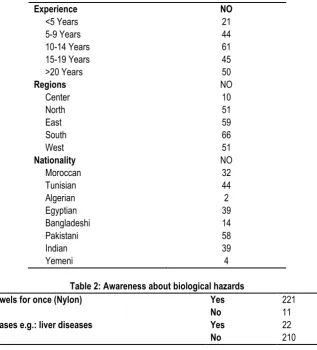
Table 1: Sociodemographic factors frequency
Table 2: Awareness about biological hazards
Using the towels for once (Nylon) Yes 221 95.3%
No 11 4.7%
Chronic diseases e.g.: liver diseases Yes 22 9.5%
No 210 90.5%
Table 3: Awareness about biological hazards
Knowledge about the diseases that transmit due to shaving Yes 144 62.1%
No 77 33.2%
Sometimes 11 4.7%
know how to act if the patient get wounded Yes 187 80.6%
No 18 7.8%
Sometimes 27 11.6%
Means of protection from the diseases Yes 125 53.8%
No 57 24.5%
Sometimes 50 21.5%
Any places for awareness about diseases related to shaving Yes 126 54.3%
No 94 40.5%
Sometimes 12 5.2%
Experience NO
<5 Years 21
5-9 Years 44
10-14 Years 61
15-19 Years 45
>20 Years 50
Regions NO
Center 10
North 51
East 59
South 66
West 51
Nationality NO
Moroccan 32
Tunisian 44
Algerian 2
Egyptian 39
Bangladeshi 14
Pakistani 58
Indian 39
RESULTS
Socio Demographic Characteristics of Barbers
A total of 232 barbers participated in this study. All the 232 participants were males. Only 22 (9.4%) out of total barbers were have experience of less than five years. Out of the total participants, 10 were in the Center of Makkah, 51 in the North, 59 in the East, 61 in the South and 51 in the West. 32 of total participants were Moroccan, 44 were Tunisian, 2 were Algerian, 39 were Egyptian, 14 were Bangladeshi, 58 were Pakistani, 39 were Indian and four were Yemini. Only 22 (9.5%) have chronic diseases, more info in Table 1 and Table 2.
Knowledge of Barber's Biological Hazards Related to Their Work
Based on the knowledge questions prepared for biological hazards a 144 (62 %) of total barbers were aware about the
disease that can be transmitted through the Barbershop including HBV, HCV & HIV. Of the total participants 187 (80.6%) were knew how to deal with injured customer. Moreover, 125 (53.8%) of total participants were aware about methods of protection. 94 (40.5%) of total participants were not have any organization to aware them about disease of Barbers. (Table 3)
Practice of the Barbers towards Prevention of Biological Hazards Related to Their Work
179 (77.1%) were always use plastic razors for once. Out of total participants only 28 (12%) were used to wear mask during shave. A 172 (74.1%) of total participants were repair the ultraviolet lamp but 157 (67.6%) were use original ultraviolet lamp. Out of total participants 209 (90.1%) were knew the benefit of the ultraviolet lamp. 174 (75%) were periodically check for their health. (Table 4)
Table 4: Practice of the barbers towards prevention of biological hazards related to their work
Using plastic razors for once Yes 179 77.3%
No 53 22.8%
Wearing a mask during the shave Yes 28 12.2%
No 204 87.9%
Commit with maintenance of the blue light Yes 172 74.1%
No 38 16.4%
Sometimes 22 9.5%
Blue light original Yes 157 67.6%
No 69 29.7%
know the benefit of the blue light UV* Yes 209 90.1%
No 20 8.6%
Sometimes 3 1.3%
Care about your health status (routine check-up)
Yes 174 75%
No 23 10%
Sometimes 35 15%
*ultraviolet light
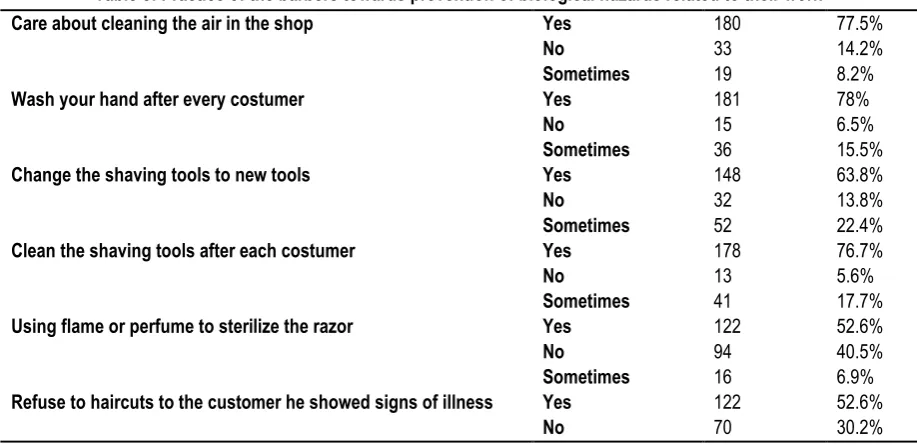
Table 5: Practice of the barbers towards prevention of biological hazards related to their work
Care about cleaning the air in the shop Yes 180 77.5%
No 33 14.2%
Sometimes 19 8.2%
Wash your hand after every costumer Yes 181 78%
No 15 6.5%
Sometimes 36 15.5%
Change the shaving tools to new tools Yes 148 63.8%
No 32 13.8%
Sometimes 52 22.4%
Clean the shaving tools after each costumer Yes 178 76.7%
No 13 5.6%
Sometimes 41 17.7%
Using flame or perfume to sterilize the razor Yes 122 52.6%
No 94 40.5%
Sometimes 16 6.9%
Refuse to haircuts to the customer he showed signs of illness Yes 122 52.6%
No 70 30.2%
Knowledge of Barbers towards Infectious Control Related to Their Work
A 180 (77.5%) cared about cleaning the air in the shop. Out of total participants, 181 (78%) were always wash their hands after every costumer. 32 (13.8%) of total participants were not changed
Knowledge of Barbers towards Infectious Control Related to Their Shop
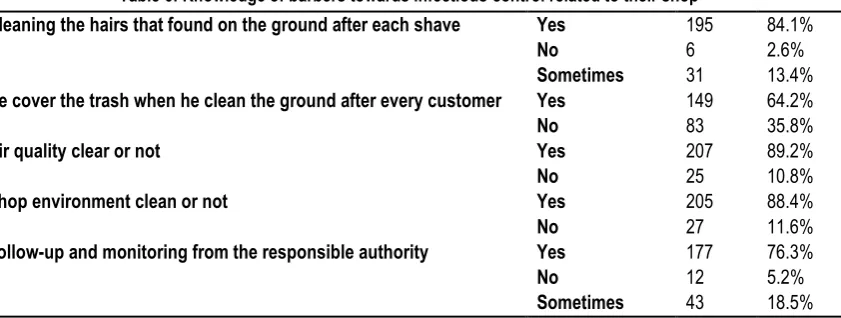
Out of total participants, 195 (84.1%) clean the hairs that found on the ground after each shave. 194 (64.2%) were always cover the trash when they clean the ground after every customer.
Only 25 (10.8%) of total participants were not have a clear air quality in the shops but 205 (88.4%) said that their shop environment is clean. Out of total participants, 177 (76.3%) said that there is a health follow-up and monitoring from the responsible authority. (Table 6)
Table 6: Knowledge of barbers towards infectious control related to their shop
DISCUSSION
This study disclosed the awareness of barbers regarding diseases transmitted by their profession and their practice, which affect the process of disease transmission. The vast majority of the barbers displayed lack of knowledge about the means of protection from diseases. Moreover, in Bagalkot, Karnataka as 95.6% were of the opinion that necessary precautions by them will make a difference in disease transmission7, and lesser in Isfahan as 30.41% of them
reported that they beware but 56.25% of them sometimes do.8
Out of total study participants those who had awareness about transmitted diseases was close to the study conducted in Isfahan 65% hairdresser were having desirable knowledge level.8 In
Kharian city of district Gujrat, 42% had heard about hepatitis and AIDS9, but higher in Adiyaman Provincial, which 72.9% of the
participants knew that HBV infection was a blood-borne disease, 24.4% of them knew that HCV infection was a blood-borne disease and 21.9% of them knew that HIV infection was a blood-borne disease.2 In Kumasi, Ghana, 7% who knew HBV could be
transmit by sharing razor blades or hair trimmers.1 In Bahra Kahu,
Islamabad–Pakistan, 38% who replied in affirmative when they were asked about their knowledge regarding hepatitis B & C transmission and routes of infection.3 In District of sukkur, Sindh,
regarding the knowledge about transmission routes of hepatitis B, 59.0% were knew that hepatitis spreads by contaminated blood.6
In Bagalkot, Karnataka 26.7% were aware that their profession had a risk of transmission of diseases.7 In Lahore, Pakistan the
Knowledge of other diseases transmitted by barber equipments about Ring worm (12%) Head louse (22%) Staphylococcal infection (8%) Scabies (2%) All Diseases+ (48%).9 In Izmir, their
answers to the hepatitis-B transmission ways jointly used razors, scissors and epilating needles, manicure-pedicure devices.11
Many reasons could be listed for such a difference; few of them state worthy are educational status, exposure to media and cultural beliefs. No statistical significance has seen regarding awareness about diseases transmitted among different age group barbers and with different education level.
The shop environment was observed by the data collectors, which most of the barbershops had satisfactory cleanliness and the
remaining were ranked poor in cleanliness. Altogether, regarding Pakistan only 36% had clean environment and 16% considered not clean at all.10
Hairdressing salons should have mechanical ventilation to reduce exposure to hazardous substances throughout the salon. Regarding having an air conditioning or proper mechanical ventilation beyond windows, we had nearly the same result of female Palestinian hairdressers which 77% of their salons had a ventilation system, while only 23% salons had no mechanical ventilation at all; the ventilation method included windows (84%), air conditioning (14%) and small openings, such as holes in the walls (2%).5
It was noteworthy that in our study, the subjects know how to act well if the patient got wounded. Unlike in Adıyaman, Province only 33.6% had first aid cabinets in their work places to manage injuries immediately.2 The result of study conducted in Izmir,
35.9% those who using bloodstone for coagulation, 44.4% those who applying dry cotton and 19.7% those who applying cologne with cotton.11 The study conducted in District of Sukkur, Sindh,
66.4% those who clean with an antiseptic and 30.6% those who apply a cotton swab.6
In our study, those who clean the shaving tools after each costumer was the highest number among the other studies. In Adıyaman Province 23.8% those reported using different materials for each customer and washing the materials with detergent solution after use. It was noteworthy that 23.1% of the participants reported using the same materials on all customers until the materials get dirty.2 But in Bagalkot, Karnataka, 71.1% disinfect
the instruments after use.7 In Kharian city, Pakistan, 48% neither
used new blades neither used sterilized instruments for next customer.9 In Pakistan, disinfection of clippers and combs, use of
neat and clean towels and aprons for customers and wearing of neat and clean clothes were seen in 52%.10
The sterilization method of the razor in our sample was mostly by using the flame and perfume, note that the majority knows the benefit of the blue light UV, but in Kumasi, Ghana, 46.5% of barbers using ultra violet (UV) radiation, 29% used 70% alcohol, and 23 % used antiseptic solution.1 In Bagalkot, Karnataka, 45%
Cleaning the hairs that found on the ground after each shave Yes 195 84.1%
No 6 2.6%
Sometimes 31 13.4%
He cover the trash when he clean the ground after every customer Yes 149 64.2%
No 83 35.8%
Air quality clear or not Yes 207 89.2%
No 25 10.8%
Shop environment clean or not Yes 205 88.4%
No 27 11.6%
Follow-up and monitoring from the responsible authority Yes 177 76.3%
No 12 5.2%
those who disinfect the instruments after use.7 In Isfahan, 30.4%
use alcohol burner for disinfection of the tools and 80.8% use alcohol for disinfection of the tools.8 In Izmir, use of ultraviolet
cleaner (80.9%), washing and soaking (9.2%), boiling (13.9%), immersion in disinfectant (12.7%). The use of dry heat sterilization was very low.8 Personal protective equipment was found in most
of the salons that the barbers are wearing a mask during the shave, but few provided masks or goggles by 7% of female hairdressers in Palestine.5
It has observed that much of the barbers were using new apron for each customer. In contrast, in Kharian city Pakistan, they did not change the apron.9 In Iran, 60% of participants are using fresh
towel or tissue for each client.8 None of the participants stated that
they used single-use towels in each of Ghana1 Adıyaman
Province2 and Bagalkot, Karnataka.7
CONCLUSION
Our study reveals that most of the participants had low knowledge about disease transmission. Majority of them do not aware about unhealthy working practices in barbering and transmission of infection to their customers. They are also not aware about disease transmission from their customers. A behavioral change communication campaign should be initiated without delay to protect the health of these workers and of the general population.
ACKNOWLEDGMENT
We are thankful to Mazin Almoanna, Majdi Alzahrani, Khalel Alkhadyde, Ahmed Abdulshakur, Jaber Alsulami, Abdullatif Binjabi, Reda Saifaldeen, Mohammed Alshamrani, Abdullah Alsulaimi, Rayan Niyazi, Ziyad Turkistani, Hassan Aljumiai, Ayman Falemban, Ibrahim Muzaffar, Abdulrahman Baqasi, Abdulaziz Alharbi, Mohammad Shaheen, Hassan Felemban, Mohammed Alshareef, Faisal Alqurashi, Naif Alhowaiti, Abdulrahman Alharbi.
REFERENCES
1. Wazir, Mohammad Salim, et al. Awareness among barbers about health hazards associated with their profession. J Ayub Med Coll Abbottabad 2008; 20(2): 35-8.
2. Moore, John E., and B. Cherie Miller. Skin, hair, and other infections associated with visits to barber's shops and hairdressing salons. American journal of infection control 2007; 35(3): 203-204. 3. Oberdorfer, Aurmporn, et al. Skin penetration operators' knowledge and attitudes towards infection control. American journal of health behavior 2003; 27(2): 125-134.
4. Ruddy, M., M. Cummins, and Y. Drabu. Hospital hairdresser as a potential source of cross-infection with MRSA. Journal of Hospital Infection 2001; 49(3): 225-227.
5. Tumminelli, Francesco, et al. Shaving as potential source of hepatitis C virus infection. The Lancet 1995; 345(8950): 658. 6. Khaliq, Amir Abdul, and Raymond A. Smego. Barber shaving and blood-borne disease transmission in developing countries. South African Medical Journal 2008; 95(2): 94.
7. Goudey, Ramon E., and Sandra C. Thompson. Evaluation of infection control in registered tattooing premises in Victoria, 1994. Australian and New Zealand journal of public health 1997; 21(1): 22-28.
8. Shepard, Colin W., et al. Hepatitis B virus infection: epidemiology and vaccination. Epidemiologic reviews 2006; 28(1): 112-125.
9. Daw, Mohamed A., et al. Prevalence of hepatitis C virus antibodies among different populations of relative and attributable risk. Saudi medical journal 2002;23(11): 1356-1360.
10. She, S. L., et al. Seroepidemic study of hepatitis B virus infection among barbers in Huangshi City Hubei China. Microbiol Immunol 1998; 32: 229-33.
11. Mele, Alfonso, et al. Beauty treatments and risk of parenterally transmitted hepatitis: results from the hepatitis surveillance system in Italy. Scandinavian journal of infectious diseases 1995; 27(5): 441-444.
12. Mariano, Andrea, et al. Role of beauty treatment in the spread of parenterally transmitted hepatitis viruses in Italy. Journal of medical virology 2004; 74(2): 216-220.
Source of Support: Nil. Conflict of Interest: None Declared.
Copyright: © the author(s) and publisher. IJMRP is an official publication of Ibn Sina Academy of Medieval Medicine & Sciences, registered in 2001 under Indian Trusts Act, 1882. This is an open access article distributed under the terms of the Creative Commons Attribution Non-commercial License, which permits unrestricted non-commercial use, distribution, and reproduction in any medium, provided the original work is properly cited.