e-ISSN: 2278-067X, p-ISSN: 2278-800X, www.ijerd.com
Volume 14, Issue 3 (March Ver. I 2018), PP.01-08
Effect of Position and Syllable Structure on Vowel Duration in
Madurese
Maolin Wang
College of Chinese Language and Culture / Institute of Applied Linguistics, Jinan University, Guangzhou, China
Corresponding Author: Maolin Wang
ABSTRACT:- In this study, the temporal pattern of vowels under various syllable types, word positions and neighboring syllables are analyzed. It is found that, under the effect of final lengthening, the vowel of the second syllable is longer than the first syllable. It is also found that when the structure of the neighboring syllable is CV, the vowel of the second syllable is the longest, while that of the first is the shortest. This is due to the mechanism that, the first syllable tends to be unstressed, while the second syllable tends to be stressed. Results show that when there are two or more than two consonant segments in the second syllable, the vowel of the first syllable tends to be very short, which is due to the compensation effect.
KEYWORDS: Duration, syllable, vowel
--- ---
Date of Submission: 19 -02-2018 Date of acceptance: 06-03 2018
---
---I.
INTRODUCTIONDurational properties of the speech signal have been well-studied for a variety of languages, including English, Swedish, Estonian, and Dutch [1-8]. Factors known to influence segment and word durations range from phonetic and phonological factors to syntactic and semantic factors. In this paper, we will concentrate on the effect of position and syllable structure on vowel durations. Early studies typically focused on segmental duration in a linear model. For example, Klatt [9] proposed that each phonetic segment had an inherent duration and that the phonetic duration of a given segment was the result of a sequence of ordered rules operating on inherent duration as a function of the context in which each phonetic segment occurred. Recent developments in phonological theory have given research on timing a new perspective. Contrary to previous linear representations,current non-linear phonological approaches recognize levels for the representation of length, timing, or syllable weight. These approaches also suggest that, in addition to intrinsic segment duration, higher levels of the prosodic hierarchy, such as syllable, foot, and phrase, all jointly determine phonetic duration.
Since current phonological theory explicitly makes reference to notions of timing, it is of great theoretical and practical importance that the mapping between phonological and phonetic timing be investigated in detail. Findings by Port et al [10] suggest that the mora is a temporally defined unit in the phonetic implementation of Japanese, in that Japanese word durations are almost entirely predicted by the number of moras in a word. Hubbard [11] also argues that for the Bantu languages Runyambo and Luganda, mora count is a more relevant timing factor than syllable count. Hubbard adopts a model in which phonological and language-specific phonetic rules form part of the linguistic grammar. In Hubbard’s model, phonetic duration is assigned on a language-specific basis at the end of the phonological derivation. That is, languages may differ in terms of what phonological unit has the highest priority in contributing to duration. In a language like English, the highest priority would be to assign greater duration to stressed syllables, while in Runyambo it would be to assign duration to segments dominated by a mora.
Lahiri and Koreman [12] analyzed the duration of Dutch. According to their analysis, the difference in moraic structure between long-vowel and short-vowel words may be compatible with the compensatory effect. In moraic phonology, the mora is a phonological unit involved in the determination of syllable weight, such that light syllables are represented by one mora and heavy syllables by two moras. Syllable weight has been shown to play an important role in the phonological systems of natural languages, not just for stress assignment, but also for segmental processes. What counts as a heavy or a light syllable varies across languages. Dutch seems to have an exceptional weight opposition, whereby closed VC syllables are heavier than open long vowel syllables. This weight distinction is problematic in view of the well-established universal generalization that languages that treat closed syllables as heavy will always treat long vowel syllables as heavy as well. They therefore rejected the traditional moraic representation in which weight and quantity are represented by the same phonological unit. Instead, they argue that the weight distinction of VC versus VV syllables is to be represented separately from the quantity distinction between long and short vowels.
This is represented by means of a hybrid representation consisting both of a skeletal (CV) tier and a moraic tier. The skeletal tier can be used to represent long vowels as bi-positional, whereas the moraic tier can be used to represent long vowels as mono-moraic. The generalization that short vowels must be in closed syllables can be accounted for by requiring syllable nuclei to dominate at least two skeletal positions, or timing slots. It is shown that an adequate model of timing must be hierarchical in nature, relating timing at least at the segmental, moraic, syllabic, and word levels. Phonetic research on timing shows that word length is correlated more directly with mora count than syllable count. However, the segment must also play a role, as illustrated by the fact that onsets do not bear weight, yet have intrinsic durations. In addition, phonetic research has shown at least a trend toward isochrony at the word level. Research by Campbell and Isard [13] suggests that there are three domains which jointly determine phonetic duration: phrase, syllable, and segment. Along these lines, it is argued that a more fine-grained hierarchical model, within the prosodic hierarchy, where duration is assigned at several different levels. Relevant levels include at least the number of phonemes and syllables, the nature of the stressed nucleus (long versus short vowel), the moraic representation of the syllable, the position of the syllable in the foot, and the prosodic word.
It is claimed that the presence of a long stressed vowel seems to result in a compensation on the order, which is distributed across all segments following that vowel. The relative reduction in overall word duration is primarily carried by C2 and C3, which are shorter in the long vowel words than in the short vowel words. However, for the CV(:)CVC words, the medial consonant does not participate in this compensation: its duration is unaffected by the duration of the preceding vowel. It is argued that the difference has to do with the phonological status of the medial consonant. The C2 is clearly a coda consonant while C3 clearly is an onset. In contrast, the medial consonant following a short vowel is ambi-syllabic; that is, it is both a coda and an onset at the same time. This ambiguous role apparently prevents the ambi-syllabic consonant from behaving like either a coda or onset in terms of its durational patterning.
It is indicated that the final consonant in CV(:)C words did not show any compensatory effects either. Dutch does not allow open CV syllables with a short vowel. In a word such as [port], the final [t] is optional since the /r/ already ensures that the syllable is well-formed. In contrast, in a word such as [tak], the final [k] is obligatory since the syllable would be phonotactically illegal without a final consonant. It is suggested that compensatory effects show up when the consonant(s) under investigation are not part of the minimum syllable. However, when the target consonant is obligatory, as in [tak], no compensatory effects are observed. Thus, the crucial parameter here may be not so much ambi-syllabicity versus tauto-syllabicity but rather obligatoriness versus optionality.
Madurese is a language of the Madurese people of Madura Island and eastern Java, Indonesia, and it is also spoken on the neighboring small Kangean Islands and Sapudi Islands, as well as from migrants to other parts of Indonesia, namely the eastern salient of Java, the Masalembu Islands, and even some on Kalimantan. The Kangean dialect may be a separate language. It was traditionally written in the Javanese script, but the Latin script and the Pegon script is now more commonly used. The number of speakers, though shrinking, is estimated to be 8–13 million, making it one of the most widely spoken languages in the country. A variant of Madurese that is Bawean is also spoken by Baweanese descendants in Malaysia and Singapore. Madurese is a Malayo-Sumbawan language of the Malayo-Polynesian language family, a branch of the larger Austronesian language family. Thus, despite apparent geographic spread, Madurese is more related to Balinese, Malay, Sasak, and Sundanese, than it is to Javanese.
II.
METHODOLOGYA. Studying materials
In Madurese, there are five common syllable structures, as are listed below,
V: emas (gold) apoy (fire); VC: asli (true) endek (be willing) CV: bejik (hate) takok (fear); CVC: tempat (place) sodhut (corner) CCV: bhuchor (to leak) bherek (west);
The length of vowel is variable in Madurese. Within a word, the vowel may in the first syllable, or in the second syllable, and the neighboring syllable may be of various types, like CV, or CVC. In this study, only vowel durations of two-syllable words are investigated. The variables of syllable position, i.e., first syllable and second syllable, and syllable types, like CV or CVC, will be taken into consideration.
2.2. Procedure and measurements
This study aims to investigate the temporal pattern of vowels of two-syllable words in Madurese, so durations of vowels of various syllable position and various neighboring syllable types are investigated. The end points of each segment are marked on the software of Praat [14]. The durations of vowels at different word positions and different neighboring syllable structures are compared.
III.
RESULTA. V syllable
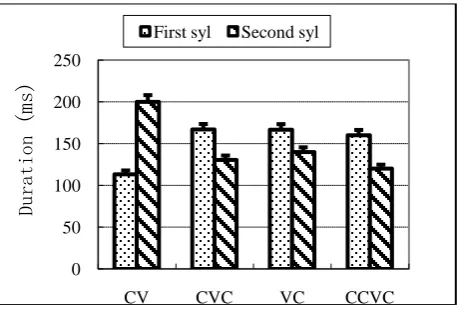
Figure 1 display the durations of vowel in syllables with no accompanying consonants. Vowel durations of the two syllable position, and of various neighboring syllable structures, are shown separately. It is demonstrated from Figure 1 that, when the structures of the neighboring syllables are CVC, VC and CCVC, vowel duration is longer when in the first syllable than the second. However, when the structure of the neighboring syllable is CV, vowel duration is longer when in the second syllable. In this condition, the vowel of the second syllable is the longest, while that of the first is the shortest.
Fig. 1 Vowel duration of V syllable
B. VC syllable
As for VC syllables, Figure 2 shows the vowel durations in this syllable structure. Different from the V syllable, in the VC syllable, no matter which structure the neighboring syllable is, vowel in the second syllable is always longer than in the first syllable. When the structure of the neighboring syllable is CV, the vowel in the second syllable is much longer than that in the first syllable. If the structure of the neighboring syllable is VC, the vowel in the first syllable is longer than under other conditions, and the vowel in the second syllable is also very long. The vowels in the first and the second syllables are the shortest when the structure of the neighboring syllable is CCV.
0 50 100 150 200 250
CV CVC VC CCVC
Duration
(ms
)
Fig. 2 Vowel duration of VC syllable
C. CV syllable
Figure 3 graphs the vowel durations in the CV syllable under various conditions. Similar to that of the VC condition, no matter which structure the neighboring syllable is, the vowel of the second syllable is always longer than the first syllable. Consistent to the results of the V and VC syllable, when the structure of the neighboring syllable is CV, the vowel of the second syllable is much longer than that of the first syllable. The vowel of the second syllable is very long when the structure of the neighboring syllable is CCV, and those of the first syllable are very short when the structures of the neighboring syllables are CCV and CCVC.
Fig. 3 Vowel duration of CV syllable
D. CVC syllable
Regarding to CVC syllables, Figure 4 shows the vowel duration of this syllable structure. It is found that, vowels are shorter than those of the V, VC and CV syllables. Similar to the pattern of the VC and CV syllables, the vowel of the second syllable is always longer than the first syllable. When the structure of the neighboring syllable is CV, the vowel of the second syllable is much longer than the first, which is consistent to the VC and CV syllables. The vowel of the second syllable is the shortest when the structure of the neighboring syllable is VC. For the first syllable, the vowel is the shortest when the neighboring syllable is CV, and longest when it is CCVC.
0 50 100 150 200 250
CV CVC VC CCV
Duration
(
ms
)
First syl Second syl
0 50 100 150 200 250 300
CV CVC CCV CCVC
Duration
(ms
)
Fig. 4 Vowel duration of CVC syllable
E. CCV syllable
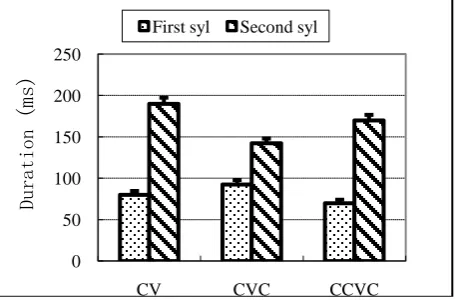
Coming to the CCV syllable, Figure 5 displays the vowel duration of this syllable structure. As CCV syllables are not as common as the other types of syllable in Madurese, there are only CV, CVC and CCVC syllables for the neighboring syllable. From Figure 5, it is shown that, similar to the VC, CV and CVC syllable, the vowel is always longer in the second syllable than the first. When the structure of the neighboring syllable is CCVC, the vowel of the second syllable is very long, while that of the first syllable is very short.
Fig. 5 Vowel duration of CCV syllable
IV.
DISCUSSIONResults from the previous section shows that, first of all, the vowel of the second syllable is much longer than the first syllable. We speculate this is due to final lengthening effect. Phonetic studies of many languages have shown that word-final sounds are usually longer than their word-medial counterparts. This lengthening effect has been shown to be cumulative such that segments in final position of larger prosodic domains are characteristically longer than those in final position of smaller domains. For examples, in their study of English, it is observed that there is a hierarchical lengthening effect such that Intonation Phrase-final vowels are longer than their counterparts in final position of smaller phrases, which in turn are longer than vowels in word-final phrase-medial position.
The study of final lengthening in an iambic stress language expands the set of prosodic systems in which final duration has been explored. Final lengthening has been identified in tone languages such as Taiwanese, languages with a single prominent syllable per word, such as Greenlandic Eskimo, and languages with trochaic stress patterns, such as English. It is also found that there is a final lengthening effect in Creek, which has a prominence system that is sensitive to an iambic parse, but which is pitch-accentual rather than stress-based and lacks iambic lengthening. Investigation of final vowels also has implications for metrical stress theory. If final vowels do not lengthen, this means that final position would be the only context in which stressed syllables may be light (CV). Furthermore, the blocking of iambic lengthening in final position would mean that the inventory of feet must be expanded to include CVCV feet, an otherwise unattested type of foot.
0 50 100 150 200
CV CVC VC CCVC
Duration
(
ms
)
First syl Second syl
0 50 100 150 200 250
CV CVC CCVC
Duration
(ms
)
data from a single language, it has the virtue of reconciling two apparently contradictory patterns: the pervasiveness of final phonetic lengthening and the reported lack of lengthening of final stressed vowels. One could argue that the lengthening is closely linked to foot structure, since the additional length in final syllables may be viewed as a strategy for ensuring that feet end in a heavy syllable, in keeping with the general word- internal requirement that stressed syllables be heavy. It is possible that the additional length associated with final position is responsible for the attraction of stress by final syllables, since all heavy syllables are stressed in Madurese. Alternatively, it could be that final vowels are lengthened because they are stressed, in response to the general requirement that stressed syllables be heavy. The latter position is unlikely to be the entire story, since long vowels also lengthen despite presumably already being heavy enough to attract stress.
The nature of final lengthening in Madurese parallels effects observed in other languages, though the prosodic constituents triggering lengthening vary from language to language. For example, English distinguishes several levels in terms of final lengthening. It is observed that there is a hierarchical lengthening effect such that word-final phrase-medial vowels are shorter than accentual phrase-final vowels, which in turn are shorter than intermediate phrase-final vowels, which in turn are shorter than Intonational Phrase-final vowels. Other languages for which final lengthening has been found for at least one prosodic level are numerous, including Creek, Finnish, etc.
When the target vowel is in the V syllable, the vowel of the first syllable is longer than the second, except when in adjacent to the CV syllable. This is due to the effect of initial strengthening. It is well-known that in a monosyllabic CVC word, the initial consonant can be pronounced differently than the final consonant, the initial consonant being longer and having greater articulatory magnitude. Some interesting acoustic studies have extended this line of inquiry above the syllable and word level to phrasal levels. For example, at the LabPhonII conference, it is presented in a study the researchers used acoustic measures of breathiness to show that /h/ is more consonant-like when it is phrase-initial than when it is phrase-medial. Similarly, the Voice Onset Time (VOT) of /t/ is longer phrase-initially. The pattern can be called “domain-initial strengthening” because the lingual articulations appeared to be stronger for consonants at the beginning of each prosodic domain. Some possible mechanisms have been proposed, including articulatory undershoot of shorter segments, overshoot of consonants after lengthened domain-final vowels, coarticulatory resistance by segments in initial positions, and overall greater articulatory effort for initial segments. It has also been outlined how this strengthening could aid a listener in prosodic parsing and feature extraction. The idea that longer durations allow articulatory targets to be more closely approximated, while shorter durations result in undershoot of those targets can readily be related to initial strengthening.
It is also found that when the structure of the neighboring syllable is CV, the vowel of the second syllable is the longest, while that of the first is the shortest. This is due to the mechanism that, for the CV syllable, the first syllable tends to be unstressed, while the second syllable tends to be stressed. Stressed syllable tends to be lengthened, and it is known that in English, lengthening occurs within stressed words. In English, it is well established that constituents of stressed words are lengthened. It has been asserted that there is an inverse relationship between stressed vowel duration and word length, and polysyllabic shortening effect has been shown to arise largely from the attenuation of the accentual lengthening of the stressed syllable in longer words. In English, there are no phonemic distinctions cued by vowel duration alone and thus no phonological constraint on the degree of prosodic variation in vowel duration. Many languages do, however, have a phonemic distinction between long and short vowels and consonants cued wholly or largely by duration. This suggests a constraint on prosodic timing effects: short vowels may not be lengthened, or long vowels shortened, so much as to cause perceptual ambiguity at the segmental level.
It may be suggested that Madurese stressed syllables are bimoraic, while unstressed syllables are monomoraic. The dependence of vowel length on stress will allow us to assume that there are no underlying moraic representations for Madurese syllables. Bimoraicity and restricted occurrences of trimoraicity are the result of Weight-by-Position, i.e., the projection of moras by coda consonants or Sress-to-Weight, i.e., a bimoraicity requirement on those syllables that are stressed by regular footing. The analysis presented here differs from van Oostendorp in that quantity is part of the phonological representation of Madurese vowels in the present treatment, while van Oostendorp persists with mora-less representations up to the surface representation. Indeed, it will be shown that moraic representations of vowels are part of the lexical phonology of Madurese, and moreover, that a description of the prosodic structure of Madurese words is impossible if the moraic structure is left unspecified.
moras, while diphthongs are bimoraic by virtue of the fact that they contain two segments in the nucleus. It is assumed that there is a default markedness constraint whereby syllables are monomoraic. This will make sure that long vowels are in fact short in weak positions.
The bimoraicity of syllables with short lax vowels is ensured by the fact that such a vowel is obligatorily followed by a tautosyllabic consonant. Constraint L AX +C, a reformulation of part of a constraint proposed by van Oostendorp, requires a lax vowel to be monomoraic and be followed by a consonant in the same syllable. The moraicity of the coda consonant is ensured by high-ranking Weight-by-Position. As shown by van der Hulst, a consonant after a short lax vowel is ambisyllabic in Madurese if it is required to be in the onset of the next syllable by constraints like Onset. It is suggested that the long tense vowel in the forms results from the effect of a constraint that maximizes the sonority of the syllable peak: if other constraints don’t prevent this, the moraic part of the syllable will be [-cons]. The relevant constraint, given as SonPeak can be seen as part of the family of HNuc. SonPeak must be ranked below Lax+C, to prevent short lax vowels from lengthening.
The quantity of Madurese [i, y, u] is partly determined by the segmental context: when appearing before [r] in the same foot, these vowels are long. When [r] is in the next foot over, the high vowels are short. The constraint High-V reflects the widespread tendency for high vowels to be shorter than non-high vowels, and can be motivated on articulatory grounds: the greater distance between the tongue body and the roof of the mouth in the case of non-high vowels is generally believed to cause this effect. To ensure that [i, y, u] are long before [r] in the same foot, we postulate Pre-r. The articulatory motivation for this constraint is probably to be found in the conflict between a vocalic tongue posture and the tongue posture for a coronal, for which the front is held in a concave shape behind a tongue tip which curls up. The articulatory transition from a vocalic posture to that required for [r] will thus take more effort than a transition to the position for post-vocalic, for which the front of the tongue may, but need not be concave.
Results show that when there are two or more than two consonant segments in the second syllable, the vowel of the first syllable tends to be very short. This is due to the compensation effect. It is stated that there is an overall timing strategy which seeks to equalize the temporal interval between syllables, i.e., shorter vowels before geminates are normal for a syllable-timed language, as a type of compensation. Mora-timed languages do not need to equalize intervals between syllables, so there is no need to shorten vowels before geminates. If the aim is to create morae of equal length, we would expect compensatory phenomena within morae. According to Beckman, there is no consistent evidence that such compensation takes place. More convincingly explained by other factors, such as oral pressure, affrication, and measurement errors.
V.
CONCLUSIONPhonetic studies of many languages have shown that word-final sounds are usually longer than their word-medial counterparts. Lengthening of stressed vowels in final position is not the same phonetically as lengthening of stressed medial vowels. It is possible that the additional length associated with final position is responsible for the attraction of stress by final syllables, since all heavy syllables are stressed in Madurese. The nature of final lengthening in Madurese parallels effects observed in other languages, though the prosodic constituents triggering lengthening vary from language to language.
When the target vowel is in the V syllable, the vowel of the first syllable is longer than the second, except when in adjacent to the CV syllable. This is due to the effect of initial strengthening. It is well-known that in a monosyllabic CVC word, the initial consonant can be pronounced differently than the final consonant, the initial consonant being longer and having greater articulatory magnitude. Stressed syllable tends to be lengthened, and it is known that in English, lengthening occurs within stressed words. It may be suggested that Madurese stressed syllables are bimoraic, while unstressed syllables are monomoraic. The dependence of vowel length on stress will allow us to assume that there are no underlying moraic representations for Madurese syllables. Phonological representations of vowel quantity are reflected in phonetic duration, so it is proposed that the long vowels are bimoraic in stressed position and monomoraic in unstressed position.
ACKNOWLEDGMENT
The research reported here is partially supported by China National Social Science Fund, No. 16ZDA211.
REFERENCES
[1]. Nooteboom, S. G. and Cohen, A. Spreken en verstaan. Assen: van Gorcum, 1984.
[2]. Jongman, A. and Sereno, J. A. On vowel quantity and post-vocalic consonant duration in Dutch, Proceedings of the XIIth International Congress of Phonetic Sciences, 1991, vol. 2, pp. 294–297.
[6]. Braunschweiler, N. Voicing and vowel length in spoken German: production and perception experiments to determine the acoustic Schlu, MA thesis, University of Konstanz, 1994.
[7]. Suomi, K., Meister, E., Ylitalo, R. and Meister, L. Durational patterns in Northern Estonian and Northern Finnish, Journal of Phonetics, 2013, 41, pp. 1–16.
[8]. Jongman, A. Effects of vowel length and syllable structure on segment duration in Dutch, Journal of Phonetics, 1998, 26, pp. 207– 222.
[9]. Klatt, D. H. Linguistic uses of segment duration in English: Acoustic and perceptual evidence. Journal of the Acoustical Society of America 59, 1976, 1208-1221.
[10]. Port, R.,Dalby, J. and O'Dell, M. Evidence for mora timing in Japanese. Journal of the Acoustical Society of America 81, 1987, 1574-1585.
[11]. Hubbard, K. Mapping phonological structure to phonetic timing: moras and duration in two Bantu languages. Proceedings of the Berkeley Linguistic Society 19, 1993, 182-192.
[12]. Lahiri, A. and Koreman, J. Syllable weight and quantity in Dutch. Papers from the West Coast Conference on Formal Linguistics 7, 1988, 217-228.
[13]. Campbell, W.N. and Isard, S.D. Segment durations in a syllable frame. Journal of Phonetics 19, 1991, 37-47. [14]. Boersma P. Praat, a system doing phonetics by computer, Glot International, 2001, 5:9/10, pp. 341–345.