RESEARCH ARTICLE
ARSENIC MITIGATION APPROACH IN SOIL BY SOME INDIGENOUS SOURCES OF BIOCHAR OF
DIFFERENT PYROLYSIS TEMPERATURE
1
Priyanka Dey Suchi,
2Nishat Ferdousi,
2Nadia Noor,
3Imamul Huq, S. M.,
1Badhan Saha and
1, *
Mohammad Moniruzzaman
1
Soil and environment section, BCSIR Laboratories, Dhaka, Bangladesh Council of Scientific and Industrial
Research, Bangladesh
2
Department of soil, water and environment, University of Dhaka, Bangladesh
3
University of Barisal, Bangladesh
ARTICLE INFO ABSTRACT
Water-soluble inorganic pollutants may constitute an environmental toxicity problem if their movement through soils and potential transfer to plants or groundwater is not arrested. Biochar has recently been used to sequester carbon and remediate soil with both heavy metal and organic pollutants. The characteristics of biochar are influenced mainly by the preparation temperature and biomass sources. Biochars were produced from three different sources (viz., cow dung, poultry manure, and sewage sludge) at two different temperatures (low temperature - +250ºC and high temperature - +450º C). Different physical (e.g. surface area, SEM, EDX), chemical (CEC, organic carbon, N, P, K, S, As) and physicochemical (pH) properties of the prepared biochars were measured. Two sets of experiment (Arsenic treated and non-treated soils) were done. The capability of biochars
produced at different temperature to abate arsenic (As) accumulation in plants (Ipomoea aquatica)
was carried out in pot culture experiment. Biochars were applied at 5 t/ha to soil spiked with 1 mg/L of As solution (80% arsenite + 20% arsenate). Plants were grown for 45 days after germination. Incubation study was also done to see the sorption of water soluble arsenic (As) by biochars with time. To alleviate arsenic accumulation in plant the efficacy of biochar was in order of Sbch>Pbcl>Cbcl for
arsenic non-treated soil and in arsenic treated soil the order was in Sbch>Pbch>Cbcl.
INTRODUCTION
Arsenic poisoning can be minimized through biological immobilization and stabilization using a range of organic compounds, such as biochar, which is a form of environmental black carbon, produced by using the pyrolysis of C-based
biomass (Verheijen et al., 2010). Application of biochar to soil
has been considered as to having great potential to enhance long-term carbon sequestration because most carbon in biochar has an aromatic structure and is very recalcitrant in the environment (Lehman, 2007). Typically biochar has a high pH value and cation exchange capacity, and can enhance soil
productivity (Jeffery et al., 2011; Kookana et al., 2011). A
number of studies have also demonstrated that biochar has a
high capacity to absorb pollutants in soils (Beesleyet al., 2011;
Yuan and Xu, 2011). However the effect of biochar on arsenic (As) mitigation is not revealed yet. It becomes relevant to find out its effect on As alleviation and pyrolysis temperature of biochar preparation modify its characteristics. Antal and Gronli
(2003) and Uchimiyaet al. (2011) found that pyrolysis
temperature can affect the presence of surface functional
*Corresponding author: Mohammad Moniruzzaman
Soil and environment section, BCSIR Laboratories, Dhaka, Bangladesh Council of Scientific and Industrial Research, Bangladesh
groups on biochars and thus control their heavy metal sequestration ability in soils. Recent studies have also suggested that conversion/production methods can also play an
important role in controlling biochar properties (Libra et al.,
2011). The biochar derived from relatively low-temperature pyrolysis is characterized by a high content of volatile matter that contains easily decomposable substrates, which can
support plant growth (Robertson et al., 2012; Mukherjee and
Zimmerman, 2013). In contrast, the structure of biochar derived from high temperature pyrolysis is characterized by a large surface area and aromatic-carbon content, which may increase the adsorption capacity (a desirable property for bioremediation) as well as the recalcitrant character (for carbon sequestration) (Lehmann, 2007). The type of feedstock material is another important factor that determines the final application of the biochar and its effect on soil, because its properties are affected by the nature of the original material
(Lehman et al., 2006). Decrease of atomic ratios H/C and O/C
resulted from removing H- and O-containing functional groups with increasing temperature will produce high aromaticity and
low polarity biochars (Ahmad et al., 2013). The diverse range
of biochar applications depends on its different properties, which are governed by the pyrolysis conditions (heating
temperature and duration) and the original feedstock (Enders et
Article History:
Received 22nd March, 2018
Received in revised form 19th April, 2018
Accepted 26th May, 2018
Published online 30th June, 2018
International Journal of Recent Advances in Multidisciplinary Research
Vol. 05, Issue 06, pp. 3905-3914, June, 2018
Keywords:
al., 2012). The objective of this work was to find out the difference in various characteristics of biochar produced from three different sources of biomass at two different temperatures (high and low) and their impact on the phytoavailability of arsenic (As) in soil.
MATERIALS AND METHODS
Biochar and soil sample Preparation
Biochar was produced from biomass sources both at low (+250ºC) and high temperature (+450ºC) pyrolysis process. The low temperature pyrolysis process was carried out
following the method as described in Mahmud et al. (2014).
The high temperature pyrolysis was carried out in an aluminum pot containing the biomass and covered with an aluminum lid and was heated by gas burner. In both cases, oxygen was not allowed to enter into the pot. A portion of produced biochar samples were then sieved through a 0.25 mm sieve for various chemical and physicochemical analyses. Soil sample was collected from the agricultural field of Manikgonj Sadar Upazila in Manikganj district (23°51.884’ N and 90°06.219’ E), Bangladesh. It is young Brahmaputra floodplain soil belonging to the Melandaha series. According to the USDA soil taxonomy the soil is a typicendoaquepts and according to the FAO-UNESCO legend it is a Gleysol. The bulk of the soil samples (0-15 cm) were collected by composite soil sampling method (USDA, 1951) and processed (Huq and Didar, 2005).
Pot culture experiment
Kalmi plant (Ipomoea aquatica) was used as a study plant in
pot culture experiment using the following 7 treatments including control arranged in a completely randomized design (Table 3). Urea, Muriate of potash, TSP (Triple Super
Phosphate) and Gypsum (CaSO4) fertilizer were applied at the
rate of 0.12 t/ha, 0.05 t/ha, 0.04 t/ha and 0.008 t/ha respectively to the soil. The application rate of biochar was 5 t/ha in the soil. After the germination of the Kalmi seeds, arsenic dose (80% arsenite + 20% arsenate) at a rate of 1mg/Kg was applied through irrigation water. The experiment was carried out for arsenic treated and non-treated soil.
Incubation Study
An in vitro incubation study was also conducted to see the
sorption and desorption of arsenic at field condition for 0, 15, 30 and 45 days of incubation period and the experimental setup was similar to that of the pot culture experiment.
Background Analysis
Various properties i.e. pH, CEC (Cation Exchange Capacity), O.C. (Organic Carbon), Nutrient Status (N,P,K,S) of soil and biochar were analyzed according to Huq and Alam (2005). Arsenic analysis was accomplished according to the method
described in Mahmud et al., 2014.
Physical Properties
a. Surface properties: The surface area, total pore volume, mean pore diameter of biochar was measured by BET plot method (Table 2).
b. Morphology: Surface morphology of biochar was measured by SEM (Scanning Electron Microscope) and elemental content (Carbon and Arsenic) by EDX (Energy Dispersive X-ray Spectroscopy)
RESULTS AND DISCUSSION
Basic soil characteristics (Table 1) such as pH, CEC, O.C., texture, Arsenic, available N, P, Kand Swere analyzed. Basic biochar characteristics (Table 1) were analyzed to see the effect of two pyrolytic temperature on the properties of different sources. Higher temperature increased the CEC of biochar except for cowdung. pH, carbon content, phosphorus and potassium content enhanced with the increasing
temperature. Biochars produced at higher pyrolysis
temperatures have higher CEC, higher pH (Bagreevet al.,
2001; Novak et al., 2009a). Nitrogen content (38.27%) was
higher in cow dung biochar produced at high temperature and it was lower for other two sources of biochar compared to low temperature biochars. The content of nitrogen decreased with the increasing temperature (Lei and Zhang, 2013).Arsenic
content was highest in Sbcl (6.82 ppm) and lowest in Cbch (1.22
ppm). Higher temperature increased the arsenic content of biochar than lower temperature.
Surface properties: The original biomass structure strongly influences the final biochar structure and its eventual physical characteristics. Most typically pyrolysis reactions lead to a number of structural and physical changes. The most commonly observed feature is pore structure. High pyrolysis temperature leads to greater specific surface area and
aromaticity of biochar than low temperature does (Ahmad et
al., 2012). The surface area of biochar (Table 2) was measured
by BET plot method. Cbcl(12.335 m2 g-1) and Sbcl (6.4659 m2 g
-1
) possess higher surface area than biochar produced at high
temperature. For Pbc (3.6042 m2g-1) surface area was higher at
high temperature. Total pore volume was highest Cbcl (3.8888
cm3g1) and lowest for Cbch (1.5490 cm3g1). Mean pore diameter
was higher for high temperature biochar.
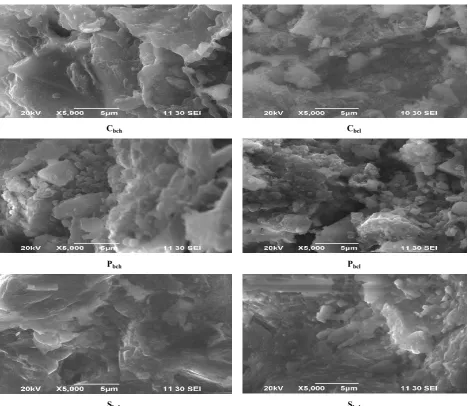
SEM (Scanning Electron Microscope): Scanning electron microscopy (SEM) is a microscopic technique to determine image for macroporosity and physical morphology of solid substances (Angin, 2013). The figure 1 shows the micrographs
(X5000) of Cbch, Cbcl; Pbch, Pbcl; Sbch, Sbcl. Surface morphology
was well defined for high temperature biochar. Sharp edges and plate like structure were observed in biochar produced at high temperature. Low temperature biochar were found mostly in cloded state.
EDX: EDX spectrumrepresents the content of carbon and arsenic content in saturated and unsaturated condition. Different sources of biochar were saturated with arsenic solution (1ppm) for 15 days to see the sorption capacity of arsenic for two temperatures.
Saturated condition: In saturated condition (fig. 2), sorption
of arsenic was higher in Cbch (As=11.2 and C= 88.2 in weight
%,) and it was lower in Pbch (As=2.9 and C= 97.1 in weight %)
and sorption capacity was almost same for Sbch(As= 9.2, C=
Table 1: Some physical, chemical and physicochemical properties of the soil and biochar
Properties Soil Cbcl Pbcl Sbcl Cbch Pbch Sbch
pH 6.61 8.13 7.64 6.46 8.13 8.26 7.09 CEC(me/100g) 0.23 39.8 16.9 6.35 26.43 18.7 15.5 Textural Class Silt loam _ _ _ _ _ _ Moisture content (%) 21.54 _ _ _ _ _ _ Organic carbon (%) 1.3 92 94 89 94 96 92 N (%) 0.097 8.47 41.49 18.59 38.27 17.04 12.26 P (ppm) 3.23 1.08 0.71 0.21 2.36 1.92 0.68 K (me/100g) 0.11 1.48 1.48 2.69 39.96 33.52 47.18 S (ppm) 10.17 11.4 15.0 81.07 1.35 0.76 5.62 Arsenic (ppm) BDL* 0.93 1.35 6.82 1.22 1.61 1.90 Cbcl, Pbcl, Sbcl= cow dung, poultry manure and sewage sludge biochar respectively produced at low
temperature; Cbh, Pbh, Sbh= cow dung, poultry manure and sewage sludge biochar respectively
produced at high temperature
Table 2. Surface Area, pore volume and mean pore diameter of Biochar produced at low and high temperature
Sample Surface Area ( m2g-1) Total Pore Volume (cm3g-1) Mean Pore Diameter (nm)
Cbcl 12.355 3.8888 12.590
Pbcl 2.8330 2.5350 35.792
Sbcl 6.4659 4.5399 28.085
Cbch 1.7151 1.5490 36.127
Pbch 3.6042 3.1211 34.638
Sbch 5.1371 4.5124 62.596
Cbcl, Pbcl, Sbcl= cow dung, poultry manure and sewage sludge biochar respectively produced at low
temperature; Cbh, Pbh, Sbh= cow dung, poultry manure and sewage sludge biochar respectively
produced at high temperature
Cbch Cbcl
Pbch Pbcl
Sbch Sbcl
Cbch
% C As
weight 88.2 11.2
Atomic 98.0 2
Cbcl
% C As
weight 96.4 3.6
Atomic 99.4 0.6
Pbch
% C As
weight 97.1 2.9
Atomic 99.5 0.5
Pbcl
% C As
weight 94.3 5.7
Atomic 99 1
Sbch
% C As
weight 90.8 9.2
Atomic 98.4 1.6
Sbcl
% C As
weight 90.5 9.5
Atomic 98.3 1.7
C
bch% C As
weight 95.9 4.1 Atomic 99.3 0.7
C
bcl% C As
weight 99 1 Atomic 99.8 0.2
P
bch% C As
weight 90.6 9.4 Atomic 98.4 1.6
P
bcl% C As
weight 98.2 1.8 Atomic 99.7 0.3
S
bch% C As
weight 96.9 3.1 Atomic 99.5 0.5
S
bcl% C As
weight 82.5 17.5 Atomic 96.7 3.3
Figure 4. Arsenic accumulation in Kalmi plant for As non
Figure 5. Arsenic accumulation in Kalmi plant for Astreated soil
Figure 6. As availability in non
0 1 2 3 4 5 6 7 8
As
co
n
ce
n
tra
tio
n
(
p
p
m
)
Treatments
0 2 4 6 8 10 12 14
Co
Cbcl Cbch Pbcl Pbch
As
co
nc
ent
ratio
n
(p
pm)
Treatments
Arsenic accumulation in Kalmi plant for As non-treated soil
Arsenic accumulation in Kalmi plant for Astreated soil
Arsenic non-treated soil
Arsenic treated soil
As availability in non- treated and treated soil at different incubation days
0 10 20 30 40 50 60
Co
Cb
cl
Cb
ch
As
u
p
tak
e
(µg/1
00
p
lan
ts)
Treatments
Sbcl Sbch Treatments
0 20 40 60
Co
Cbcl Cbch
As
u
p
tak
e
(µg/1
00
p
lan
ts)
Treatments treated soil
treated and treated soil at different incubation days
Pbcl Pbch Sb
cl
Sb
ch
Treatments
Unsaturated Condition: In unsaturated condition Sbcl (17.5 in
% weight) had the highest arsenic content and lowest carbon content (82.5 in % weight) among all the biochars (Fig. 3). For other two sources of biochar i.e. poultry manure (9.4 in % weight) and cow dung (4.1 in %weight), arsenic content was higher for high temperature than low temperature biochar.
Plant Growth
Fresh and dry matter production: Different biochars have different effect on the growth of kalmi plant (Table 3). In arsenic non-treated soil, high temperature biochars were more effective on the growth of plant than low temperature
biocharexcept Pbchwhereas in arsenic treated soil, low
temperature biochars were more effective. Among all the
biochar treatments Sbchwassupposed to be the best treatment
for As non-treated soil and in As treated soil, Cbcl appeared to
be the best treatment. Blackwell et al. (2009)and Lehman et al.
(2003) mentioned that biochar can be used as an amendment to improve soil quality and crop production in a variety of soils.
Table 3. Fresh and dry weight production of Kalmi plant (g/100 Plants)
Treatments As non- treated soil As treated soil Fresh weight Dry weight Fresh Weight Dry weight
Co 101.4 5.32 98.5 6.75
Cbcl 80.67 4.3 112.2 7.56
Pbcl 111.53 6.82 96.0 7.3
Sbcl 99.3 6.03 103.1 6.50
Cbch 99.5 7.3 107.23 7.22
Pbch 96.78 5.53 95.87 5.93
Sbch 113.31 10.2 99.2 5.22
Cbcl, Pbcl, Sbcl= cow dung, poultry manure and sewage sludge biochar
respectively produced at low temperature; Cbh, Pbh, Sbh= cow dung, poultry
manure and sewage sludge biochar respectively produced at high temperature
ANOVA was done and found that for arsenic non-treated soil, the effect of low temperature biochars was not significant in the production of Kalmi but the treatments (high temperature biochar) effect was significant on fresh weight (P=0.018) production and non-significant for dry weight production. In arsenic treated soil, the effect of high temperature biochars was not significant on the growth of plant whereas the treatments (low temperature biochar) effect was significant on dry weight (P=0.003) production and non-significant for fresh weight (P=0.545) production.
Accumulation of arsenic in plant (As non-treated soil):
Between two temperature (low and high) biochars, low temperature biochar seemed to be the better treatment to diminish the arsenic concentration in plant except sewage sludge (fig. 4). Among high temperature biochars, sewage sludge was the best treatment to decrease the concentration of arsenic in plant.
Accumulation of arsenic in plant (As treated soil): The high temperature biochar increased the concentration of arsenic (fig. 5) but it decreased the uptake of arsenic in plant except for cow dung biochar. Though low temperature biochars decreased the concentration of arsenic plant it increased the uptake of arsenic except cow dung biochar.
Incubation Study: Soil was incubated for 1 and half month to
observe the release pattern of arsenic with increasing time.The
concentration of arsenic recorded at 0,15,30 and 45 days.
Arsenic non-treated and arsenic treated soil: Arsenic concentration was BDL (below detection limit) from 0 to 15 days in poultry manure and sewage sludge biochar treated soil and lower concentration of arsenic in cow dung biochar treated soil. From 15-30 days the availability of arsenic increased and the concentration was at peak at 30 days. The release of arsenic started to decrease when goes from 30 to 45 days. In arsenic
non-treated soil Sbch and in treated soil Pbch and Sbcl showed the
lowest availability. Namgayet al. (2010) reported that the
concentrations of extractable As increased with biochar application rate. The increasing and decreasing arsenic content of plants in biochar treated soil could be due to several reasons. From the background analysis it was observed that the concentration of As in high temperature biochar materials was higher than low temperature biochar except sewage sludge. The surface area (table 2) of biochar may have also played a vital role in the release of As in soil. The feedstock material determines the peak temperatures at which the micropores are
opened up within the biochar(Uchimiyaet al., 2010). This was
reported by James et al.2005, where heating at 820 °C resulted
in reduction of micropores and surface area of wood when compared to that at 700 °C. This indicates that there may be a peak temperature to open all pores (micro-, meso-, macro-) for each feedstock material; exceeding such temperatures may further encourage reduction in distribution of micropores. In As non-treated soil, cow dung and poultry manure biochar produced from low temperature decreased the accumulation but sewage sludge increased the accumulation in plant.
On the other hand, sewage sludge produced from high temperature abated the accumulation. In case of As treated soil, high temperature biochar increased the concentration of As in plant but except cow dung biochar others reduced the uptake in plant. It could be possible that biochar trapped arsenic on its surface. As pyrolysis temperatures increase, volatile compounds in the biochar matrix are lost, surface area and ash increase, but surface functional groups that can provide exchange capacity decrease (Guo and Rockstraw, 2007). The pH condition could be another factor for the increasing arsenic content in the plants.High temperature biochar possess high pH than low temperature and also biomass (Table 1). Chan and Xu (2009)in their work showed that the increased pH in the biochar treated soil increased arsenic (As) solubility by creating an alkaline condition. Biochars have a pH greater than 8 (Yin and Xu, 2009) and it might increase the solubility of arsenic in soil by creating an alkaline condition. O’Neill (1990); Fitz and Wenzel (2002) also reported an increase in arsenic solubility with more alkaline pH at soil pH> 7. Beesley and Marmiroli (2011) did a soil elute test , during the experiment they have found that the solubility of arsenic (As) increased slightly when the soil eluate passed through the biochar but that concentrations were very low from the biochar alone . Indeed they have found no significant correlation between pH of the eluate and As concentrations in the eluate.The CEC of biochar could be another reason to retain As (Table 1). The higher pyrolysis temperature decreased CEC of cowdungbiochar. Recent literature has shown that natural long-term oxidation of biochar in the soil increases the amount of negative charges on the
biochar surface (Cheng et al., 2008). The study suggests that
efficacy. So, the effect of biochar on mitigating arsenic highly depends on the sources and pyrolysis temperature as these two factors determine its behavior.
REFERENCES
Ahmad, M., S.S. Lee, X.M. Dou, D. Mohan, and J.K. Sung, 2013. Trichloroethylene adsorption by pine needle biochars
produced at various pyrolysis temperatures. Bioresour
Technol., 143: 615–622.
Antal, M. J. and M. Gronli, 2003. The Art, Science and
Technology of Charcoal Production. Ind. Engg.Chem.Res.,
42(8): 1619-1640.
Beesley, L. and M. Marmiroli.2011. The Immobilisation and Retention of Soluble Arsenic, Cadmium and Zinc by
Biochar. Environ. Pollut., 159: 474-480.
Beesley, L., E. Moreno-Jiménez, J.L. Gomez-Eyles, E. Harris, B. Robinson, and T. Sizmur, 2011. A review of biochars' potential role in the remediation, revegetation and
restoration of contaminated soils. Environ Pollut, 159:
3269–3282.
Blackwell, P., G.Reithmuller, and M. Collins.2009. Biochar
Application to Soil. In: Biocharfor Environmental
Management Science and Technology (eds. Lehmann, J.
and Joseph, S.). Earthscan, London. pp. 207-226.
Chan, K. Y., and Z. Xu, 2009. Biochar: Nutrient Properties and
their Enhancement. In: Biochar for Environmental
Management: Science and Technology. Earthscan,London.
pp. 67-84.
Cheng, C. H., J. Lehmann, and M. Engelhard, 2008. Natural oxidation of black carbon in soils: changes in molecular
form and surface charge along a climosequence.
Geochimicaet Cosmochimica Acta, 72: 1598-1610.
Enders, A., K. Hanley, T. Whitman, S. Joseph, and J. Lehmann. 2012. Characterization of biochars to evaluate
recalcitrance and agronomic performance, Bioresour.
Technol., 114: 644-653.
Fitz, W. J., and W.W. Wenzel, 2002. Arsenic Transformations in the Soil RhizospherePlant System: Fundamentals and
Potential Application to Phytoremediation. J. Biotechnol.
9: 259-278.
Guo, Y., and D. A. Rockstraw, 2007. Activated carbons
prepared from rice hull by one‐step phosphoric acid
activation. Microporous Mesoporous Mat., 100: 12‐19.
Imamul Huq, S.M. and M.D. Alam, 2005. A Handbook on Analyses of soil, Plant and Water. BACER-DU, University of Dhaka, Bangladesh, pp. 1-246.
James G., D.A. Sabatini, C.T. Chiou, D.Rutherford, A.C.Scott, and H.K. Karapanagioti, 2005. Evaluating phenanthrene
sorption on various wood chars. Wat Res., 39:549–558
Jeffery, S., F.G.A. Verheijen, V.M. Van der, and A.C. Bastos. 2011. A quantitative review of the effects of biochar application to soils on crop productivity using meta-analysis. AgricEcos Environ.,144:175–187.
Kishan Mahmud, M.S. Chowdhury, Nadia Noor and S.M.ImamulHuq.2014. Effect of different sources of biochar application on the emission of a number of gases
from soil. Canadian J. Pure App. Sci., (CJPAS), 8(2):
2813-2824.
Kookana, R.S., A.K. Sarmah, L. Van Zwieten, E. Krull, and B. Singh. 2011. In: Biochar application to soil: agronomic and environmental benefits and unintended consequences.
(ed.Sparks, D.L.). Adv Agro., 112:103–143.
Lehman, J. 2007. Handful of Carbon Nature, 443: 143-144.
Lehmann, J., J. Gaunt, and M. Rondon. 2006. Bio‐char
sequestration in terrestrial ecosystems: A review.Mit.
Adapt.Strat. Global Change, 11(2): 403‐427.
Lehmann, J., J. Pereira, C. Steiner, T. Nehls, W. Zechs, and B. Glaser. 2003. Nutrient Availability and Leaching in the Archaeological Anthrosols and a Ferrasol of the Central
Amazon Basin: Fertilizer, Manure and Charcoal
Amendments. Plant & soil.249: 343-357.
Libra, A., K.S. Ro, C. Kammann, A. Funke, N.D. Berge, Y. Neubauer, M.-M. Titirici, C. Fühner, O. Bens, J. Kern, and K.-H.Emmerich.2011. Hydrothermal carbonization of biomass residuals: a comparative review of the chemistry,processes and applications of wet and dry
pyrolysis. Biofuels, 2: 89–124.
Libra, J.A., K.S. Ro, and C. Kammann. 2011. Hydrothermal carbonization of biomass residuals: a comparative review of the chemistry, processes and applications of wet and dry
pyrolysis. Biofuels., vol. 2(1), pp. 71-106.
Mukherjee, A. and A. Zimmerman. 2013. Organic carbon and
nutrient release from a range of
laboratory-producedbiochars and biocharsoil mixtures.
Geoderma.193:122–130.
Mukherjee, A. and A.R. Zimmerman. 2013. Organic carbon and nutrient release from a range offloboratory-produced
biochars and biochar-soil mixtures. Geoderma. Vol.
193-194. pp.122-130.
Namgay, T., B. Singh, and B.P. Singh, 2010. Influence of biochar application to soil on the availability of As, Cd, Cu,
Pb, and Zn to maize (Zea mays L.). J Australian Soil Res
48:638–647
O’Neil, P. 1990. Arsenic. In: Heavy Metals in Soils (eds.
Alloway, B. J.. Glasgow, Blackie and Sons. pp. 83-99. Robertson, S. J., M.P. Rutherford, J.C. López-Gutiérrez, and
H.B. Massicotte. 2012. Biochar enhances seedling growth and altersrootvsymbioses and properties of sub- boreal
forest soils, Can. J. Soil Sci., 92: 329–340.
Uchimiya, M., I.M. Lima, K.T.Klasson, and L.H. Wartelle. 2010. Contaminant immobilizationand nutrient release by biochar soil amendment: roles of natural organic matter.
Chemosphere.80:935–940
Uchimiya, M., I.M.Lima, K.T. Klasson, S.Chang, L.H. Wartelle, andJ.E. Rodgers. 2010. Immobilization of heavy metal ions (CuII, CdII, NiII, and PbII) by broiler
litter-derived biochars in water and soil. J. Agric. Food
Chem.58:5538–5544.
Uchimiya, M., L.H. Wartelle, K.T. Klasson, C.A. Fortier, and I.M. Lima. 2011. Influence of pyrolysis temperature on biochar property and function as a heavy metal sorbent in
soil. J. Agric. Food Chem.59: 2501–2510.
Verheijen F., S. Jeffery, A.C. Bastos, M. Van der Velde, and I. Diafas. 2010. Biochar Application to soils: A Critical Scientific Review of Effects of Soil Properties, Processes and Functions. IRC Scientific and Technical Reports, EUR 24099- EN, Italy.
Yin, K. C., and Z. Xu. 2009. Biochar: Nutrient Properties and
their Enhancement. In: Biochar for Environmental
Management (eds. Lehmann, J. and Joseph, S.). Earthscan,
U.S.A.pp: 359-500.
Yuan, J.H., and R.K. Xu. 2011. Progress of the research on the properties of biochars and their influence on soil environmental functions. Ecol. Environ. Sci., 20:779–785.