Object Tracking using Modified Mean Shift
Algorithm in A Robust Manner
Miss. Sadaf Khan Dr. Sanjay L. Haridas
PG Scholar Professor and Head
Department of Electronics and Communication Engineering Department of Electronics and Communication Engineering G H Raisoni Academy of Engineering and Technology,
Nagpur, Maharashtra, India
G H Raisoni Academy of Engineering and Technology, Nagpur, Maharashtra, India
Mr. Sanjay. B. Tembhurne
Assistant Professor
Department of Electronics and Communication Engineering G H Raisoni Academy of Engineering and Technology,
Nagpur, Maharashtra, India
Abstract
Object tracking in real time videos is a critical task .So far many algorithms have been proposed to overcome the difficulties which arises from noise, occlusions and changes in the foreground object. But still there is a need for an efficient algorithm that can effectively track the object due to its varying position under various ambient conditions. Among various tracking methods, the mean shift tracking algorithm is a most widely used one due to its efficiency and simplicity. The experimental results show that the method which has been proposed can effectively track an object under the condition of varying illumination and shape deformation. Here the Correlation factor is also used to check the effective working of Mean shift algorithm and to make comparison between RGB and LBP technique.
Keywords: Mean Shift, Local Binary Pattern, Tracking, Correlation, Color Histogram
________________________________________________________________________________________________________
I.
INTRODUCTION
Real-time object tracking is a critical task in and many algorithms have been proposed to overcome the difficulties arising from noise, occlusions, clutters, and changes in the foreground object and/or background environment. Among various tracking methods, the mean shift tracking algorithm is a popular one due to its simplicity and efficiency. The mean shift algorithm was originally developed by Fukunaga and Hostetler for data analysis. Comaniciu and Meer has successfully applied it for object tracking and image segmentation.
The goal of object tracking is to estimate the states of a target object in an image sequence. It plays a critical role in numerous vision applications such as motion analysis, activity recognition, visual surveillance and intelligent user interfaces. While much progress has been made in recent years, still there exist a need to develop a robust algorithm for complex and dynamic scenes due to large appearance changes caused by varying illumination, camera motion, occlusions and shape deformation.
II.
MEAN SHIFT TRACKING ALGORITHM
Target and Candidate Representation A.
In object tracking, a target is usually defined as a rectangle or an ellipsoidal region in the image. Currently, a widely used target representation is the color histogram because of its independence of scaling and rotation and its robustness to Partial occlusions. Denote by { } the normalized pixels in the target region, which is supposed to be centered at the origin point and have n pixels. The probability of the feature u (u=1, 2… m) in the target model is computed as
(1)
where ̂ is the target model, ̂ is the probability of the uth element of ̂, δ is the Kronecker delta function, { } associates the pixel to the histogram bins and k(x) is an isotropic kernel profile. Constant C is a normalization function defined by
Similarly, the probability of the feature u in the target candidate Model from the candidate region centered at position y is given by Equations II.3 and II.4.
(3)
(4)
In order to calculate the likelihood of the target model and the candidate model, a metric based on the Bhattacharyya coefficient is defined by using the two normalized histograms ̂ and ̂ as follows
(5) The distance between ̂ and ̂ is then defined as
(6)
Color Histogram: B.
The second most important thing in object tracking is color feature extraction. This can be done either with the Here color feature is extracted in form of RGB Color space which is divided into equal k-intervals. This interval is known as a bin. Number of bins feature is given by Mc=k^3.Actually the color histogram represent the target region’s discrete probability density function. But the color histogram does not work properly when it is applied alone .But when it is applied alone with the LBP it efficiently tracks the target considering its edge and corner during the motion of an object in a proper manner.
LBP: C.
It is a very effective technique to describe the texture feature. It has got beneficial qualities such as fast computation and rotation invariance. Thus LBP has wide applications in texture analysis, image retrieval image segmentation etc.
Correlation: D.
It is nothing but local averaging. It is a method that uses tracking and image registration techniques for accurate 2D measurements of changes in images. It is somewhat similar to convolution .When the two different signals are correlated it is called as cross correlation while if two similar signal are correlated then it is called as auto correlation.
III.
LITERATURE REVIEW
According to [2], it serve the purpose of robust object tracking MAP based algorithm has been proposed. It is based on a sparse collaborative model. This model can exploit both holistic template and local representations to check for drastic appearance changes. It consist of Sparse Discriminative Classifier (SDC) and Sparse Generative model (SGM) for object tracking. It requires online update scheme to update the templates.
According [4], In order to determine the candidate target region, mean shift algorithm was utilized and then a judgment on the tracking effect was made according to the Bhattacharyya coefficient. In case of tracking failure, the candidate area was matched with the target model by SIFT feature. In the next and final step a new track position was determined.
window, during tracking candidate model is built .Both these models are then compared and then the final judgment is made whether the tracking is correctly done or not. The following steps have been followed to serve the purpose Implementation of calculate the target model with joint color-texture histogram Image which consider 1st frame of video the center of target window and the bandwidth of target window and provide quantification scheme of RGB space which in make target model for tracking. Implementation of mean shift tracking with joint color-texture joint histogram which consider current frame of video and track initial location. To design the tracking window which is in the range of image which provide rmin, rmax, cmin, cmax which is window of tracking result and defines height, width the size of image. To design basic means shift tracking algorithm and to compare with modified mean shift tracking which improve in tracking window capture.
V.
EXPERIMENTAL SETUP
For experimental purpose “MATLAB 2013a” is used to execute all source codes. Here the search window used is 5. The number iterations taken here is 15 and the distance between the two consecutive frame s is 0.3. First a file is converted to .avi file videos in frame. Here the comparison is made between the two techniques RGB and LBP. The conventional mean shift algorithm and modified mean shift algorithm will be compared.
VI.
RESULT
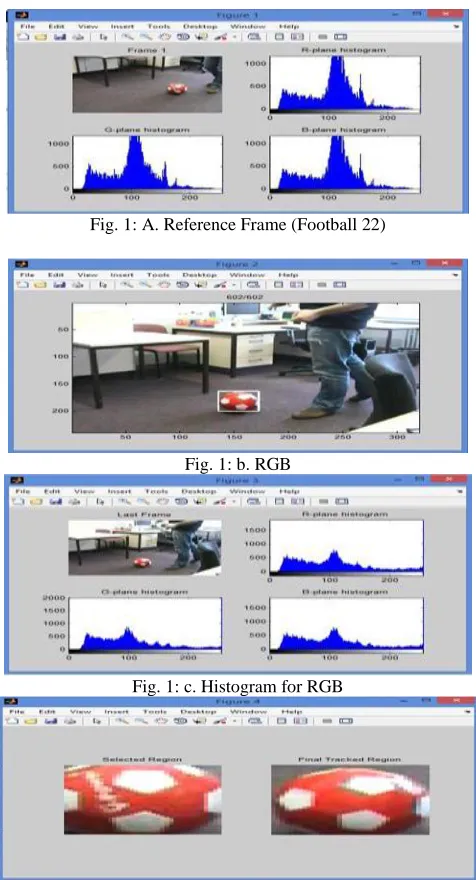
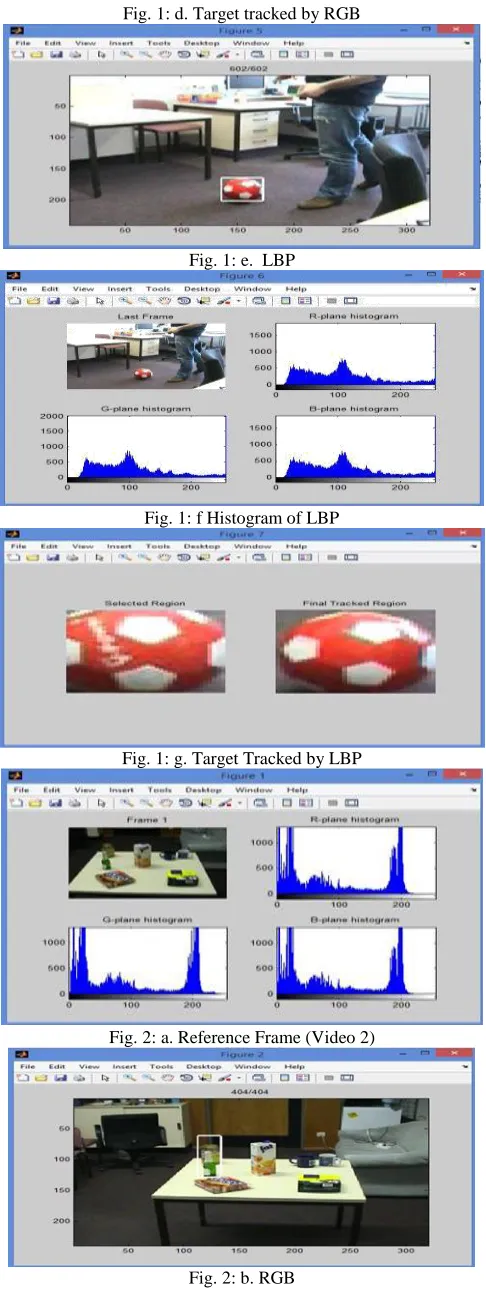
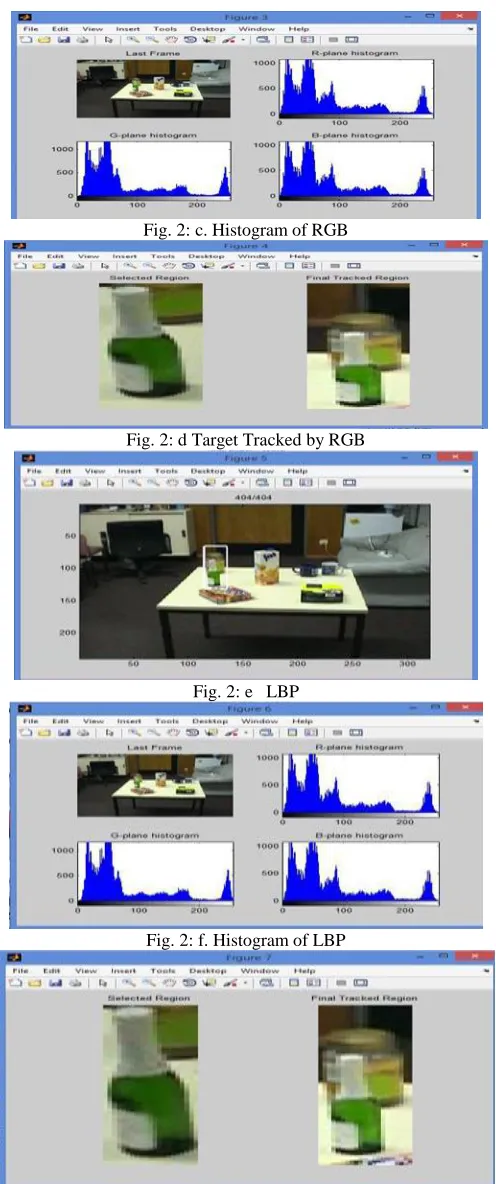
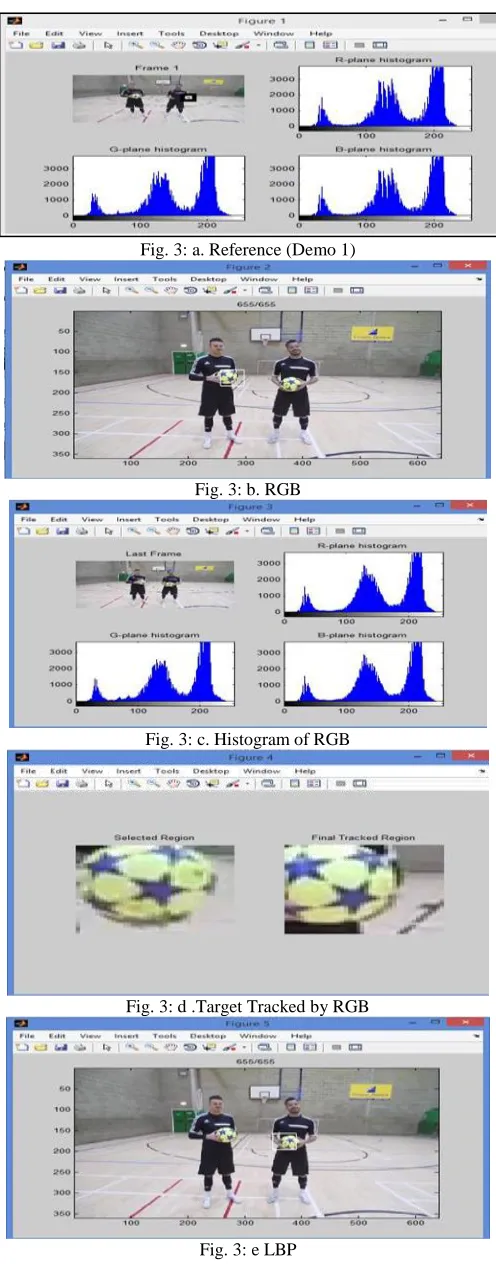
The experimental result has been shown in figure 1, 2 3 and 4.The experiments has been performed on various videos using RGB and LBP technique Along with this Correlation is also used to analyze tracking in inter frame for RGB and LBP techniques
Fig. 1: A. Reference Frame (Football 22)
Fig. 1: b. RGB
Fig. 1: d. Target tracked by RGB
Fig. 1: e. LBP
Fig. 1: f Histogram of LBP
Fig. 1: g. Target Tracked by LBP
Fig. 2: c. Histogram of RGB
Fig. 2: d Target Tracked by RGB
Fig. 2: e LBP
Fig. 2: f. Histogram of LBP
Fig. 3: a. Reference (Demo 1)
Fig. 3: b. RGB
Fig. 3: c. Histogram of RGB
Fig. 3: f .Histogram of LBP
Fig. 3: g. Target Tracked by LBP Table– 1
Correlation Calculation Using Different Videos Reference Correlation Correlation Videos Correlation using RGB using LBP
factor (Average)
Football22 0.5805 0.55311 0.58053 Video 2 0.1685 0.088833 0.1685 Demo 1 0.0644 0.039601 0.064356 Table tennis 0.2316 0.0038215 0.23158
Torch 0.4322 0.36124 0.43221 Inv_1 0.83645 0.74633 0.83646 Charger_1 0.1028 0.25532 0.10284 Demo 2 0.0712 0.12951 0.071155
The above table in figure shows the correlation factor calculated for both the algorithm that is RGB and LBP for different videos.
VII.
CONCLUSION
In proposed method, tracking is done using target object’s features. Combination of color feature and texture feature makes feature extraction quality better. For extracting texture features LBP technique is used. Color features are insensitive to non-rigid deformation, partial occlusion, target rotation and overlap. Texture features can better extract edges and corner features of the target effectively in the target region and more robustly track the target. The user has to give the location in the first frame. With the help of similarity measure function target object is tracked. Exact object location in frame is determined after several iterations .In all the iterations the target window moves towards the denser region. After number of iterations it converges to most dense area of features and thus this estimates the location of target object in current frame. Correlation is also done to find the inter frame tracking done by RGB and LBP techniques. In the future research can be done for using the true shape of the target, instead of an ellipse or a rectangle window selection, for object tracking in amore robust manner.
REFERENCES
[1] A. Yilmaz, O. Javed and M. Shah,“Object Tracking: A Survey”, ACM Comput.Surv.38 (4) (2006)
[2] Wei Zhong, Huchuan Lu, Senior Member, IEEE, and Ming-Hsuan Yang, Senior Member, IEEE, “Robust Object Tracking via Sparse Collaborative
Appearance Model”, IEEE TRANSACTIONS ON IMAGE PROCESSING, VOL. 23, NO. 5, 2356-2368 (MAY 2014)
[3] Xiaowei An, Jaedo Kim, Youngjoon Han Department of Electronic Engineering, Soongsil University, Seoul, Korea, Optimal color-based mean shift
[4] LiangWei, Xie,Xudong Wang,Jianhua, Zhang Yi,Hu, jianming A SIFT-based Mean Shift Algorithm for Moving Vehicle Tracking ,IEEE Intelligent Vehicles Symposium (IV) pp 762-767 Dearborn, Michigan, USA June 8-11, 2014.
[5] Y. Li, H. Ai, T. Yamashita, S. Lao, and M. Kawade, “Tracking in low frame rate video: A cascade particle filter with discriminative observers of different
life spans,” IEEE Trans. Pattern Anal. Mach. Intell., vol. 30, no. 10, pp. 1728–1740 Oct. 2008.
[6] D. Ross, J. Lim, R.-S. Lin, and M.-H. Yang, “Incremental learning for robust visual tracking,” Int. J. Comput. Vis., vol. 77, nos. 1–3,pp. 125–141, 2008.J.
Kwon and K. M. Lee, “Visual tracking decomposition,” in Proc. IEEE Conf. CVPR, Jun. 2010, pp. 1–10.
[7] Wright and G. Hua, “Implicit elastic matching with random projections for Pose-Variant face recognition,” in Proc. CVPR, 2009.
[8] P. Dreuw, P. Steingrube, H. Hanselmann, and H. Ney, “SURFACE: face recognition under viewpoint consistency constraints,”in British Machine Vision
Conference, London, UK, Sep. 2009.
[9] L. Wolf, T. Hassner, and Y. Taigman, “Descriptor based Methods in the wild,” in Proc. ECCV, 2008
[10] Pratibha Sharma, Manoj Diwakar, Niranjan Lal, “Edge Detection using Moore Neighborhood”, International Journal of Computer Applications, Volume
61– No.3, January 2013, Pages 26-30.
[11] Pratibha Sharma, Manoj Diwakar, Sangam Choudhary, “Application of Edge Detection in Brain Tumor Detection”, International Journal of Computer
Applications, Volume 58– No.16, November 2012, Pages 21-25
[12] Swapnil.S.Rajurkar, Mamta Sarde “Detection of Object in scene using Mean Shift Algorithm”, IORD Journal of Science & Technology E-ISSN:
2348-0831 Volume 1, Issue III (MAR-APR 2014) PP 20-23
[13] Xiaojing Zhang, Yajie Yue, and Chenming Sha , “Object Tracking Approach based on Mean Shift Algorithm , Journal of Multimedia, Vol. 8, No. 3, June
2013 pp 220-225.
[14] Andrew G. Backhouse, “ Robust Visual Object Tracking Using Multi-Mode Anisotropic Mean Shift and Particle Filters” IEEE Transactions On Circuit and
Systems for Video Technology, Vol. 21, No. 1, January 2011
[15] Vasileios T. Chasanis,” Scene Detection in Videos Using Shot Clustering and Sequence Alignment” IEEE Transactions on Multimedia, Vol. 11, No. 1,