Statistical Modeling for Network Intrusion
Detection System: A Review
Pratibha Leelkanth Dewangan
Student Assistant. Professor
Department of Computer Science & Engineering Department of Computer Science & Engineering
BCET Durg (C.G.) BCET Durg (C.G.)
Abstract
The Network Intrusion Detection System (NIDS) is progression of observing the measures befalling in a network and investigating them for emblems of possible occurrences. Network security is off vital significance because present data communication is vulnerable to security threats. Machine learning is the emerging field in the various field of computer science. In this paper we will deliberate different methods meant for network intrusion detection, some of them are based on statistical modeling. Most of the researcher uses KDD99 dataset for experimental evaluation. Further in this paper numerous approach are compared based on the value of TPR (True Positive Rate) and FNR (False Negative Rate).
Keywords: TPR, FNR, ML, NIDS
________________________________________________________________________________________________________
I. INTRODUCTION
Malevolent users and crackers pursue weedy targets such as unpatched systems, systems infested with Trojans, and networks running anxious services. The guarantee of reliability and safety should be functional to computer systems and data. Internet has made possible the data flow to the huge extent. Also all together it has to face many threats and assaults. Thus the safety alert is essential to control the attacks and threats. A report must be sent to the administrators and security team members about the numerous threats and attacks which has transpired so that they can react in real-time to the intimidation. Intrusion detection is the process of classifying and responding to malevolent activities targeted at computing and network resources”.
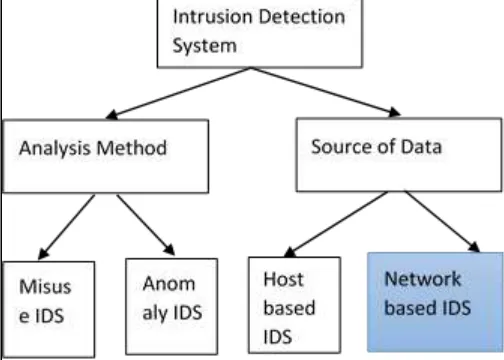
Fig. 1: Classification of Intrusion Detection System
Table – 1 Accuracy Calculation
False Positive Rate (FPR) Normal traffic identified as an attack. FPR = FP/(FP+TN) False Negative Rate (FNR) Attack traffic identified as normal. FNR = FN/(TP+FN)
True Positive Rate (TPR) An attack correctly identified. TPR = TP/(TP+FN) True Negative Rate (TNR) Normal traffic correctly identified. TNR = TN/(TN+FP)
Accuracy TP+TN)/(TP+TN+FN+FP)
Precision TP/(TP+FP)
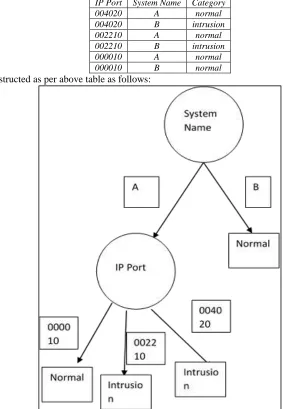
Let’s look at statistical modeling method decision tree applied, Example: A decision tree to detect intrusive behavior based on the data in following table:
IP Port System Name Category
004020 A normal
004020 B intrusion
002210 A normal
002210 B intrusion
000010 A normal
000010 B normal
Decision tree can be constructed as per above table as follows:
Fig. 2: Example Intrusion detection using Decision Tree
Above decision tree turned into following pseudo code: if(System Name == Artemis)
intrusion = false end if
else if(System Name == Apollo) if(IP Port == 002210)
intrusion = true end if
end if
else if(IP Port == 004020) intrusion = true;
else if(IP Port == 000010) intrusion = false;
end if end if
Further in next section-II we will discuss different literature, in section-III motivation towards research, in section-IV we will provide a tabular comparison among different literature based on accuracy of system, at last we will conclude our review.
II. LITERATURE SURVEY
Dikshant Gupta et. al. includes the implementation of different data mining algorithms including Linear regression and K-Means Clustering to automatically generate the rules for classify network activities. A comparative analysis of these techniques to detect intrusions has also been made. To learn the patterns of the attacks, NSL-KDD dataset has been used. Algorithms based on Data Mining were implemented successfully showing different accuracies..NSL-KDD dataset was preprocessed using mean normalization method.Linear regression, surprisingly, proved to be very effective in detecting network attacks with a 80% accuracy. K-Means Clustering being a semisupervised approach showed decent results with a 67.5 % accuracy [IEEE 2016].
A J M Abu Afza et. al. presents a learning algorithm for adaptive network intrusion detection based on clustering and naïve Bayesian classifier, which induces a hybridization of unsupervised and supervised learning processes. The proposed approach scales up the balance detection rates for different types of network intrusions, and keeps the false positives at acceptable level in network intrusion detection. The algorithm first clusters the network logs into several groups based on similarity of network logs, and then calculates the prior and class conditional probabilities for each cluster. In classifying a new network log, the algorithm calculates the similarity of attribute values of network data with each cluster and initialize a weight value for each cluster. Then each cluster classifies the network data with its priori and conditional probabilities that multiply with respective cluster’s weight value. Finally, voting techniques applied for classifying the new network data based on each cluster’s classification result. The performance of the proposed algorithm tested by employing KDD99 benchmark network intrusion detection dataset, and the experimental results proved that it improves the detection rates as well as reduces the false positives for different types of network intrusions [IEEE 2013].
Monowar H. Bhuyan et. al. network anomaly detection is an important and dynamic research area. Many network intrusion detection methods and systems (NIDS) have been proposed in the literature. In this paper, author provide a structured and comprehensive overview of various facets of network anomaly detection so that a researcher can become quickly familiar with every aspect of network anomaly detection. author present attacks normally encountered by network intrusion detection systems. author categorize existing network anomaly detection methods and systems based on the underlying computational techniques used. Within this framework, author briefly describe and compare a large number of network anomaly detection methods and systems. In addition, author also discuss tools that can be used by network defenders and datasets that researchers in network anomaly detection can use [IEEE 2013].
Kathleen Goeschel shown that high accuracy may be maintained while reducing false positives using the proposed model composed of SVMs, decision trees, and Naïve Bayes. First, the SVM is trained based upon a new binary classification added to the dataset to specify if the instance is an attack or normal traffic. Second, attack traffic is routed through a decision tree for classification. Third, Naïve Bayes and the decision tree will then vote on any unclassified attacks. Future work is to write this model as a Java class such that it may be applied in other systems or applications. Further future work is to test this model on other network traffic data sets for more in-depth analysis [IEEE 2016].
Thuy T.T. Nguyen and Grenville Armitage surveys significant works in the field of machine learning based IP traffic classification during the peak period of 2004 to early 2007. Motivated by a desire to move away from port-based or payload-based traffic classification, it is clear that ML can be applied well in the task. The use of a number of different ML algorithms for offline analysis, such as AutoClass, Expectation Maximisation, Decision Tree, NaiveBayes etc. has demonstrated high accuracy (up to 99%) for a various range of Internet applications traffic. Early ML techniques relied on static, offline analysis of previously captured traffic. More recent work is beginning to address the requirements for practical, ML-based real-time IP traffic classification in operational networks. In this survey paper, we have outlined a number of critical operational requirements for real-time classifiers and qualitatively critiqued the reviewed works against these requirements [IEEE 2008].
Abhinav Kumra et. al. said that proposed method was triumphantly tested on the data log fles and the database. The results of the proposed testimony are produce more accurate and irrelevant sets of patterns and the discovery time is less than other approach. As a naïve Bayesian network is a restricted network that has only two layers and assumes complete independence between the information nodes. This poses a limitation to this research work. In order to alleviate this problem so as to reduce the false positives, active platform or event based classifcation may be thought of using Bayesian network [OJCST 2017].
III. MOTIVATION
Network security is of vital significance in the present data communication. Programmers and interlopers can make numerous effective endeavours to cause the crash of the systems and web benefits by unapproved interruption. New dangers and related answers for avert these dangers are developing together with the secured framework advancement. Intrusion Detection Systems (IDS) are one of these arrangements. The principle capacity of Intrusion Detection System is to ensure the assets from dangers. It dissects and predicts the practices of clients, and after that these practices will be considered an assault or an ordinary conduct. Intrusion identification enables association to shield their frameworks from the dangers that accompany expanding system network and dependence on data frameworks. Ought, to, not be regardless of whether to utilize intrusion location yet rather which intrusion discovery highlights and abilities can be utilized.
Machine learning touches our everyday lives from multiple points of view. When you transfer a photo via web-based networking media, for instance, you may be incited to label other individuals in the photograph. That is called picture acknowledgment, a machine learning ability by which the PC figures out how to distinguish facial highlights. Different cases incorporate number and voice recognition applications. From an intrusion discovery point of view, examiners can apply machine learning, data mining and pattern recognition algorithms to recognize typical and noxious network activity. There is lot more has been carried out in this field still with less accuracy of detection henceforth we require an intelligent network intrusion detection system with higher accuracy.
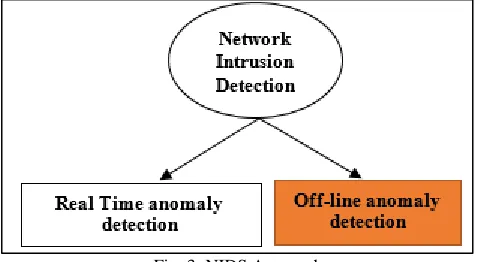
Fig. 3: NIDS Approach
"Network intrusion detection system (NIDS)" monitors traffic on a network looking for doubtful activity, which could be an attack or illegal activity. The intrusion detection techniques based upon data mining are generally plummet into one of two categories: misuse detection and anomaly detection. In misuse detection, each instance in a data set is labelled as ‘normal’ or ‘intrusive’ and a learning algorithm is trained over the labelled data.
IV. COMPARISON
S.No. Author/Title/Year Publication Description Algorithm Used Accuracy
1.
Dikshant Gupta et. al./Network Intrusion Detection System Using various data mining techniques/IEEE
2016
Linear regression and K-Means Clustering to automatically generate the rules for classify network
activities. A comparative analysis of these techniques to detect intrusions has also been made.
To learn the patterns of the attacks, NSL-KDD dataset has been used
Regression +
K-Means Clustering 80%
2.
A J M Abu Afza et. al./Intrusion Detection Learning Algorithm through
Network Mining./IEEE 2013
The algorithm first clusters the network logs into several groups based on similarity of network logs, and then calculates the prior and class conditional probabilities for each cluster. Author present a Dependable Network Intrusion Detection System (DNIDS) by integrating detection method with an
intrusion-tolerant mechanism. Combined Strangeness and Isolation measure K-Nearest Neighbor (CSI-KNN) algorithm 89% 3.
Kathleen Goeschel / Reducing False Positives In Intrusion Detection
Systems Using Data-Mining Techniques Utilizing Support Vector Machines, Decision Trees, And Naive
Bayes For Off-Line Analysis/IEEE 2016
Proposed a model for reducing false positives using data mining techniques by combining support vector machines (SVM), decision trees, and Naïve Bayes.
NB,SVM,J48 99% with constraint
4. Thuy T.T. Nguyen et. al./ A Survey of Techniques for Internet Traffic
Author surveys significant works in the field of machine learning based IP traffic classification
Discussed different algorithm
Classification using Machine Learning/IEEE2008
during the peak period of 2004 to early 2007. Motivated by a desire to move away from port-based or payload-based traffic
classification
5.
Anna L. Buczak et. al./A Survey of Data Mining and Machine Learning Methods for Cyber Security Intrusion
Detection/IEEE 2015
Paper describes the literature review of ML and DM methods used for cyber. Special emphasis was placed on finding example papers that describe the use of different ML and DM techniques in the cyber domain, both for misuse and anomaly detection.
Discussed different algorithm
-
6.
ABHINAv KUMRA et. al./Intrusion Detection System Based on Data Mining Techniques/OJCST 2017
Author has proposed method was triumphantly tested on the data log fles and the database. The results of the proposed testimony are produce more
accurate and irrelevant sets of patterns and the discovery time is less than other approach. As a naïve Bayesian network is a restricted network that
has only two layers and assumes complete independence between the information nodes.
NB
96% with preprocessed
data
V. DATASET
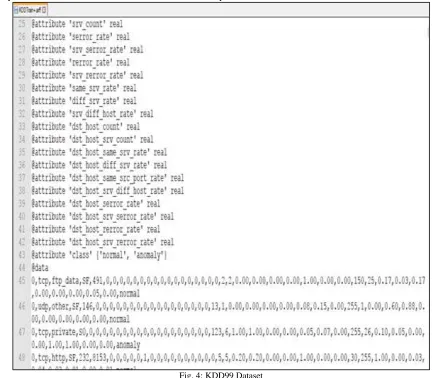
For NIDS system evaluation KDD99 dataset has been used as input dataset.
Fig. 4: KDD99 Dataset
VI. CONCLUSION
An intrusion detection framework expectations to separate between interruption action and ordinary activities. In doing as such, then again, an IDS can acquaint order blunders. A false positive is a delicate contribution for which the framework probably raises a notice. A false negative, interestingly, is a malicious information that the IDS prematurely delivers to report. The suitably grouped info information are ordinarily specified to as evident positives (suspicious assaults) and genuine negatives (ordinary activity). Preprocessing over input dataset can improve the accuracy, algorithm must be time efficient, as input dataset size is too large.
REFERENCES
[1] Dikshant Gupta et. al. Network Intrusion Detection System Using various data mining techniques IEEE 2016. [2] A J M Abu Afza et. al. Intrusion Detection Learning Algorithm through Network Mining. IEEE 2013.
[3] Kathleen Goeschel Reducing False Positives In Intrusion Detection Systems Using Data-Mining Techniques Utilizing Support Vector Machines, Decision Trees, And Naive Bayes For Off-Line Analysis IEEE 2016.
[4] Thuy T.T. Nguyen et. al. A Survey of Techniques for Internet Traffic Classification using Machine Learning IEEE 2008.
[5] Anna L. Buczak et. al. A Survey of Data Mining and Machine Learning Methods for Cyber Security Intrusion Detection IEEE 2015. [6] ABHINAv KUMRA et. al. Intrusion Detection System Based on Data Mining Techniques OJCST 2017.
[7] T. J.Hastie, R. J.Tibshirani, and J. H.Friedman. The elements of statistical learning: Data mining, inference, and prediction, Springer-Verlag, 2001. [8] Tavallaee, Mahbod, et al. "A detailed analysis of the KDD CUP 99 data set."Proceedings of the Second IEEE Symposium on Computational Intelligence for