Implementation of Texture Enhance Histogram
Equalization on a Colour Image
Abhishek Chandra Gangwar Prof. Suresh L. Bharvad
PG Student Assistant Professor
Department of Communication System Department of Communication System L. D. College of Engineering L. D. College of Engineering
Abstract
For the contrast enhancement in the image processing histogram transformation is widely used. One of the applications of the histogram transform is Histogram Equalization (HE) which will change the brightness of input image. With the Global Histogram Equalization (GHE) the mean brightness of the image will not be preserved, so to overcome this Brightness Preserving Bi-Histogram Equalization (BBHE) and Minimum Mean Brightness Error Bi-Histogram Equalization (MMBEBHE) but to overcome the over enhancement and intensity saturation effect new vibrational algorithm will introduce in which first we divide the image into two parts i.e. cartoon and texture by using Total Variational (TV) method with L1 norm. And with the help of texture information we transform the histogram of the image. And we see that we get more information in term of entropy as compared to other HE algorithms.
Keywords: BBHE, GHE, Histogram Equalization, Image Decomposition, MMBEBHE, TV L1
________________________________________________________________________________________________________
I. INTRODUCTION
Histogram equalization is an important part of the contrast enhancement. And computer technology is now playing the crucial role in every field. By use of this we can make the images more and more clear. So, with this view of the emerging technology, this definition was formed. After deciding the definition area, only concerned thing was to select the target audience and the application that should be kept in the vision of the work. There are many techniques of contrast enhancement. But to make it practically useful and adoptable, algorithm to be developed is targeted to get more and more information after the processing.
There is various algorithms for the histogram equalization like GHE, LHE, BBHE, MMBEBHE. Where GHE One of the simplest techniques for the histogram equalization is the global histogram equalization, in this equalization we will apply the total transform on the input image. Its main function is to redistribute the intensity of the input image uniformly over the entire range of gray-levels (i.e. the image’s cumulative histogram is linear) which would result in the enhancement of the low contrast values. As it is the limitation of the GHE that it cannot take the local brightness of the image on which we apply the transform. To overcome this LHE will introduce in which local transform for each and every pixel which is based on the surrounding neighboring pixels. But still in some images mean brightness level did not preserve to overcome this BBHE will introduce This method is the extension of the standard histogram equalization, which can preserve the brightness of image by preserving the mean of the bi-histogram equalization. By this method we can overcome the problem of standard histogram equalization. For preserving more brightness level into the images for the removal of the artifacts this MMBEBHE will be introduced.
The above algorithm will introduces the effects like over enhancement and saturation effects. To overcome the disadvantages of above equalization like saturation and over enhancement there is a new vibrational algorithm called texture enhancement using TV L1 decomposition. In this algorithm first we decompose the image in two parts first is texture and second is cartoon. And simply with the help of the texture information we can transform the histogram of the cartoon and after that we calculate the cumulative distribution of that histogram from which we get the histogram equalization.
II. CONTRAST ENHANCEMENT BASED ON HISTOGRAM EQUALIZATION
To maximize the information that is available in the input image by intensity mapping for the contrast enhancement, histogram transform method will be used. Where the histogram equalization problem can be reformulated in the form of general variational minimization problem[10]. for the contrast enhancement we have to know the function g(.) which is as follows:
p = g(s), s Є K, q Є M
Where s is the intensity pixel values in the input image, and in the contrast enhanced image intensity pixel values is represented by p. K⊆ M is the domain of intensity values in the input image and if we replace the Hc(𝑟) with the histogram of the image we get the histogram equalization.
p(s) = k ∫ Hc s
0
where, k = L ∫ Hc(r)dr
L 0
, L = sup (M)
III. PROPOSED METHOD FOR HISTOGRAM EQUALIZATION
The proposed image processing contrast enhancement algorithm have a many-step algorithm at first we applies the TV-L1 model to decompose the input image into the the cartoon-texture. After getting the cartoon-texture image components contrast enhancement is done by a non-linear histogram warping process that used the texture information for the intensity distribution of the enhanced image.
Fig. 1: Flowchart of the proposed algorithm[2]
IV. IMAGE DECOMPOSITION INTO CARTOON AND TEXTURE[2]
This part in the proposed algorithm for the contrast enhancement is a very important part as it represents the cartoon texture decomposition. The main idea behind this process is to find out texture component from which we get the meaning full pattern of the image and rejected the unwanted intensity transition which is the main factor of variations at illumination condition.
To decomposed the image into cartoon and texture we used the total variational model which can be used for data denoising, like decomposing noisy image into correct image and noise here we use this method to decompose the image(I) into cartoon(a) and texture(t) ( part other than texture is defined as cartoon).
I = a + t
The cartoon image can we determined by minimizing the following expression:
𝑀𝑖𝑛 ∫ Ω |∇𝑎| + 𝜆 ||𝐼 − 𝑎||𝐿1 𝑑Ω
Where
Ω
⊂X2 denotes the domain of the image and || ・ ||L1 symbol defines the L1 norm. The Lagrenge multiplier λ𝜖
R+ will control the TV-L1 variational model which is inversely proportional to data smoothing process strength. PDE based detexture can be taken by the first term and to make intensity nearer to cartoon we will used the second term. Using the calculus of variation we can derive the Euler-Lagrange equation of above equation.𝑎𝑡= ∇. (
∇𝑎 |∇𝑎|) + 𝜆
𝐼 − 𝑎
Where atis the partial derivative of a w.r.t the time t, ∇. Is the divergence and ∇ denotes the gradient operator. To implement the above equation in the discrete image domain requires the approximation of the partial derivatives with central differences where the solution is done by the steepest gradient descent as indicated in below.
aijn+1=aijn+ ∆t
∆x∆y(∇x
- ( ∇x+aijn
|∇aijn|+β) + ∇y - (∇y+aijn
|∇aijn|)) + ∆t (λ Iij-aijn
(Iij-aijn)2)
Where (i, j ) is the pixels position in input image, ∇- is the backward and ∇+ is the forward discrete gradients, gradient with the magnitude is denoted by |∇ai, j |, time step is denoted by
Δ
t, iteration index is denoted by n, and the discrete spatial distance is denoted byΔ
x andΔ
y in the image grid.Selection of the parameters will be depend up on noise presence into the image. For the optimum solution we can change the value of λ till we get the maximum entropy. In the algorithm we get the cartoon image (aλ) just by applying the above equation. If the image is noise free then we simply get the texture image by subtracting the cartoon from the input image.
tλ = I - aλ
λ = 0.1
λ = 0.5
Fig. 1: Decompose Input (Δt = .1, Iterations = 10)[2]
(a) (b) (c) Fig. 2: (a) Input image (b) cartoon image (c) texture image
After cartoon texture decomposition of the colour image we have to decompose the cartoon image into RGV components for the histogram.
V. TEXTURE ENHANCED HE
The second part of the algorithm after the image decomposition is to calculate histogram transform which is used for the contrast enhancement. In this step our objective is to make monotonically increasing function which is continuous in nature which can remove the disadvantages of standard histogram equalization i.e. over enhancement and saturation effects.
In this step after the cartoon texture decomposition our first aim is to find out the strong texture pixels. We have to find the binary texture map:
𝑡𝑖𝑗𝑏= {1 𝑖𝑓 |𝐼𝑖𝑗− 𝑎𝑖𝑗| > 𝜌
0 𝑒𝑙𝑠𝑒 , 𝜌 𝜖 𝑅
+
tb isthe texture mapping in the binary , 𝜌 will be the value which will control the texture information for contrast enhancement. after that when we finalized the texture pixel values then we analysis the neighbour pixels of each texture. Our aim is to finalized the neighbourhood pixel with the extreme intensity which will contribute maximum intensity distribution in the histogram of the cartoon image. The aim is this transform to use the contribution of the local texture for the histogram equalization. The transformed histogram and the original histogram will be shown in the figure.
Fig. 4: Texture enhance histogram for cameraman image, blue line show original transform, red shows the transformed histogram[2] The proposed texture histogram in pseudo code sequence is
for∀(𝑖, 𝑗) ∈ 𝛺
if(𝑡𝑖𝑗𝑏) == 1
construct Г𝑖,𝑗 𝑎𝑛𝑑 𝑐𝑎𝑙𝑐𝑢𝑙𝑎𝑡𝑒 𝑙 = inf(𝑎𝜆), h = sup(𝑎𝜆)
for(𝑝 𝜖 [𝑙, ℎ])
𝐻𝑎(𝑝) = 𝐻𝑎(𝑝) + 1 end
end
M ⊂ [0, 255] defines the domain of the intensity, inf (.) defines infimum and sup(.) is the supremum operators. l will be the lowest intensity value and h is the highest intensity values with in the neighbour Гij.
After this our aim is to find the cumulative distributive function c(s), used in HE process.
𝑐(𝑠) = 𝑘 ∫ 𝐻𝑐(𝑟)𝑑𝑟, 𝑂𝑖𝑗 = 𝑐(𝐼𝑖𝑗)|(𝑖, 𝑗) ∈ 𝛺 𝑠
0
where, k = 𝐿
∫ 𝐻0𝐿 𝑎(𝑟)𝑑𝑟
, 𝐿 = sup (𝑀)
to maps the intensity transform above scaling factor is used with in the interval M.
𝑂
𝑖𝑗|(𝑖, 𝑗) ∈ 𝛺
is the enhance output image.VI. EXPERIMENTAL RESULT
Since entropy will be defined as the avg. information with in the image. So our main aim is to increase the value of entropy up to its maximum value, by varying the value of λ from 0 to 1.
𝐸(𝐻𝑙) = − ∑ 𝐻𝑙(𝑠)𝑙𝑜𝑔2(𝐻𝑙(𝑠)) ∑ 𝐻𝑙(𝑠) 𝑠𝜖𝑀
= 1
𝑠𝜖𝑀
𝜆𝑜𝑝𝑡= 𝜆Є[0,1][𝐸(𝐻𝑙𝑜
𝑎𝑟𝑔𝑚𝑎𝑥
)]
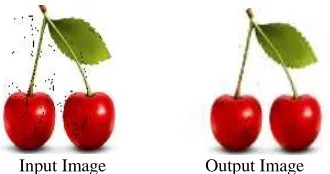
Input Image Output Image
Fig. 5: Entropy for above input image at the output is 3.14521
Input Image 2
Input Image Cartoon Image Texture Image Output Image Fig. 6: Entropy for the Input Image 2 Is 2.80152
VII.CONCLUSION
With the rapid development of sophisticated techniques in the image processing field, numbers of successful applications have been emerged. Among all the possible applications, the algorithm was developed for contrast enhancement to get more information from the image.
The algorithm is divided into two parts: decomposition of image into texture and cartoon and the histogram transform with the help of texture information. After reviewing the papers we find out the texture enhance algorithm gives better result than other algorithm for contrast enhancement done on the basis of histogram equalization to get better entropy. The proposed algorithm can be implemented using MATLAB tool.
REFERENCES
[1] Soong-Der Chen, Abd. Rahman Ramli “Minimum Mean Brightness Error Bi-Histogram Equalization in Contrast Enhancement”, IEEE Transactions on Consumer Electronics, Vol. 49, No. 4, NOVEMBER 2003.
[2] Ovidiu Ghita, Dana E. Ilea, and Paul F. Whelan, “Texture Enhanced Histogram Equalization UsingTV-L1 Image Decomposition”, IEEE TRANSACTIONS ON IMAGE PROCESSING, VOL. 22, NO. 8, AUGUST 2013.
[3] H. Zhu, F. H. Chan, and F. K. Lam, “Image contrast enhancement by constrained local histogram equalization,” Comput. Vis. Image Understand., vol. 73, no. 2, pp. 281–290, 1999.
[4] Kim YT, “Contrast Enhancement Using Brightness Preserving Bi-Histogram Equalization”, Consumer Electronics, IEEE Transactions on, (1997), vol. 43, no.1, pp.1-8.
[5] Chen SD and Ramli A, “Minimum Mean Brightness Error Bi-Histogram Equalization in Contrast Enhancement”, Consumer Electronics, IEEE Transactions on, Nov (2003), vol. 49, no. 4, pp. 1310-1319.
[6] N. M. Kwok, Q. P. Ha, G. Fang, A. B. Rad and D. Wang, “Color Image Contrast Enhancement using a Local Equalization and Weighted Sum Approach” 6th annual IEEE Conference on Automation Science and Engineering Marriott Eaton Centre Hotel Toronto, Ontario, Canada, August 21-24, 2010. [7] Amir Beck and Marc Teboulle , “Fast Gradient-Based Algorithms for Constrained Total Variation Image Denoising and Deblurring Problems”, IEEE
TRANSACTIONS ON IMAGE PROCESSING, VOL. 18, NO. 11, NOVEMBER 2009.
[8] Chambolle “An algorithm for total variation minimization Journal of Mathematical Imaging and Vision, pages 89–97, 2004”, Kluwer Academic Publishers. Manufactured in The Netherlands.
[9] Hoo, “A Literature Review on Histogram Equalization and Its Variations for Digital Image Enhancement”, International Journal of Innovation, Management and Technology, Vol. 4, No. 4, August 2013
[10] Man Altas, John Louis, and John Belward “A Variational Approach to the Radiometric ENHANCEMENT OF DIGITAL IMAGERY” IEEE TRANSACTIONS ON IMAGE PROCESSING, VOL. 4, NO. 6, JUNE 1995
![Fig. 1: Flowchart of the proposed algorithm[2]](https://thumb-us.123doks.com/thumbv2/123dok_us/7822574.1665300/2.612.172.439.162.493/fig-flowchart-of-the-proposed-algorithm.webp)
![Fig. 1: Decompose Input (Δt = .1, Iterations = 10)λ = 0.5 [2]](https://thumb-us.123doks.com/thumbv2/123dok_us/7822574.1665300/3.612.178.434.193.590/fig-decompose-input-dt-iterations-l.webp)