
ISSN (e): 2250-3021, ISSN (p): 2278-8719 Vol. 06, Issue10 (Oct. 2016), ||V1|| PP 33-51
New Ideas for Brain Modelling
Kieran Greer
11Distributed Computing Systems, Belfast, UK.
Abstract: - This paper describes some biologically-inspired processes that could be used to build the sort of networks that we associate with the human brain. New to this paper, a ‘refined’ neuron will be proposed. This is a group of neurons that by joining together can produce a more analogue system, but with the same level of control and reliability that a binary neuron would have. With this new structure, it will be possible to think of an essentially binary system in terms of a more variable set of values. The paper also shows how recent research associated with the new model, can be combined with established theories, to produce a more complete picture. The propositions are largely in line with conventional thinking, but possibly with one or two more radical suggestions. An earlier cognitive model can be filled in with more specific details, based on the new research results, where the components appear to fit together almost seamlessly. The intention of the research has been to describe plausible ‘mechanical’ processes that can produce the appropriate brain structures and mechanisms, but that could be used without the magical ‘intelligence’ part that is still not fully understood. There are also some important updates from an earlier version of this paper.
Keywords:-Neuron, neural network, cognitive model, self-organise, analogue, resonance.
I. INTRODUCTION
This paper describes some biologically-inspired processes that could be used to build the sort of networks that we associate with the human brain. The biological background is probably only what an AI researcher, interested in the area, would know about; but the proposed processes might offer a new way of looking at the problem. So while a computer model or simulator is the goal, the processes map more closely to a real human brain, at least in theory.This paper firstly considers how a more refined processing unit can be constructed from similarbinary-operating components. If studying this topic, it is easy to think in binary terms only, but the question of how our sophisticated intelligence derives from that is difficult to answer. The thought process might try to find a particularly clever or complicated function that works inside of a neuron, to compensate for its apparent simplicity. The computer scientist would also try to use a distributed architecture, to combine several units for an operation, again to make the whole process more complex and variable. That is the direction of this paper, but it will attempt to show that the modeller’s thinking process can begin to look at a collection of neurons as a single unit that can deliver a complex and variable set of values reliably. It can be constructed relatively easily and with some degree of accuracy, by a mechanical process that the simple neuron might not be thought to accommodate.
The second half of the paper gives a detailed review of related work. Some of this is quite old now, but it helps to show that the basic principles for building these neural systems are included. This paper then recaps on some other recent research and is able to demonstrate a new level of detail that integrates the new technology almost seamlessly. A completely new model is not proposed, where the 3-level architecture described in [8] or [11], is still being looked at. That model contains a number of quite abstract components and the recent research can replace those with more detailed ones. That is, they would be able to fit in somewhere, even if the whole picture is not complete. Some mathematical theories help to back this up, and even if the proposed solutions arenot 100% biologically proven, they would be useful for building a computer-generated system. The idea and importance of resonance is outlined and proposed as part of a new theory, even if it is not defined exactly in the current model.
it would be to re-produce the desired activity. Section V describes a plausible process for linking these neurons automatically and in an arbitrary way. Section VIextends section II, listingother related work. Section VIIputs the new neuronand a lot of the earlier research into context and section VIIIadds more detail to the current cognitive model. Finally, sectionIX gives some comments on the work.
II. BACKGROUND TO THE PROPOSAL
A lot of research on this topic has described how neurons and synapses can grow and cluster to form more complex structures. There are also different types of entity with slightly different functionality, but it is still very unclear what exactly goes on and it is difficult to map the processes onto basic computer models. The superficially simplisticnature of neurons is written about in [26] for example, which discusses that a binary signal is limiting. It then explains that adding more states to a single unit comes at a price and that it has been worked out mathematically that the binary unit with 2 states is the most efficient. This is because the signal also needs to be decoded, which is expensive. Therefore, if more states can be achieved through different connection sets instead, this would be desirable and it might also add new knowledge to the network. Also in [26] chapter 2,it is explained how any logic function can be built from the McCulloch-Pitts neurons[22] and also a hint at the new architecture in this paper, by pointing out that any weighted neuron can be replaced by an unweighted one, with additional ‘redundant’ connections. A weight value of 3, for example, can be replaced with a single connection that is split into 3 inputs, but that is definitely a different design. The authorhas listed a number of papers ([6]-[12]) that were investigated separately, but might still provide a coherent view over all of them. Theyhave made lots of suggestions that also turn out to be mostly established theories. For example,hierarchies, reasons for duplicating, use of patterns, timing and how to cluster; which are also of course, the established theories.There are also one or two more radical ideas however, including this paper, which could change the failure of a previous theory.
With regard to automatic network construction, there has been a lot of research looking at modelling the brain neuron more closely, includingbinary units with thresholds and excitatory or inhibitory inputs. The paper [28] is one example that focuses on dynamic stimulus-driven models. It describes one equation for the firing rate that includes external sensory inputs, as well as from other neurons. It also states that for the firing to be sustained, that is, to be relevant, requires sufficient feedback from other firing neurons. Once the process starts however, this can then excite and bring in morefiring neurons, when inhibitory inputs also need to fire, to stop the process from saturating. They note that the network must be sensitive to external stimuli, but useful forms of signal propagation must also be generated internally. The paper [16] shows evidence of a chemospecific steering and aligning process for synaptic connections.That is, there may be some purpose behind how synapses grow and connect. It describes however that this is only the case for certain types of local connection, although other researchers have produced slightly different theories there. The paper [2]gives an argument that a mechanical process, more than an electro-chemical one, is responsible for moving the signals around the brain. This includes mechanical pressure to generate impulses. In [26], only an Ion pump is described, where the activity results solely from Ions moving through a fluid environment. It is argued in [2] however that this is not sufficient to explain the forces involved and some form of mechanical process, controlling pressure, is also required. This can also help linking appendages to grow, as it can influence fluid movement.
of the neuron itself and consider how to model the pattern-forming mechanisms and the interactions between them.
III. REFINED NEURONAL UNIT
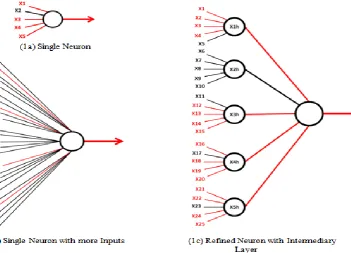
To explain the theory, a simplified model will be used, with neurons connected only by synapses. The term synapse will cover all of the connectors – including dendrites or axons, for example. Consider a single neuron with a number of inputs from other neurons and a single output. That neuron will be called the ‘main’ neuron here. Each input transmits a signal with a strength value of 1. The activation function is stepwise, where if the threshold value is met, the neuron outputs a signal with a strength value of 1 and if not, it outputs nothing, or 0.This is essentially a binary function and is being called a ‘course’ neuron here. All neurons are therefore the same and operate in the same simplistic way.Consider structures that then use these course neurons, as shown inFigure 1. The most basic is a single main neuron with a number of inputs, 5 for example and its own output (1a). If the threshold value is 4, then 4 of the 5 inputs must fire for the neuron itself to fire. Consider a second scenario where the neuron has 25 other neurons that wish to connect with it through their related synapses (1b). In this case, if all of the input neurons connect directly, then only 4 of the 25 neurons need to fire to trigger the main neuron. This is a very low number of inputs and might even cause the concept that the neuron represents to lose most of its meaning.
Figure 1.From Course to Refined Neuronal Unit Structure.
aggregating idea. Processing a larger number of neurons does add stability, because once set, it is more difficult for it to change significantly. It might also trend towards average calculations over specifics, because a greater variety can produce the same result.
Adding intermediary units has also made the structure more analogue, as each input neuron is now represented by a fraction of its true signal strength. In effect, each input neuron now sends a signal represented by one quarter of its true value. This new entity will be called a ‘refined’ neuron (ReN). The term does not relate specifically to a single neuronal component or to a specific set of them. The term relates, slightly abstractly, to the main neuron plus its set of would-be inputs that have now been converted into a more analogue set of values. The inputs could have derived from any number of other neuron sources. The process can be further modified by allowing some neurons to connect directly, while others go through one or more intermediary layers. Therefore, each input can have a very different weight or influence over the result of another neuron firing and it can all be controlled using the same simple units, but with a more complex set of connections.
IV. ALTERNATIVE FEEDBACK MECHANISM
While a hierarchical structure is included in most research work on this topic and therefore the ReN architecture must also be implicit, it is difficult to recall a paper that suggests looking at a group of neurons in this way. The importance shifts more to the synaptic connection and structures, with the operation of the neuron itself regarded as more simplistic and constant. The paper [22] notes that synapses can vary in size and transmission speeds and even that the threshold of a neuron can be changed. This could lead to different firing rates for the neuron as well, but for a reliable system that works over and over again, the simplest configuration is the best. This would be to change the relatively static synaptic structure and have the neurons firing, mostly under one state or condition, without additional ‘moving parts’ that might be prone to damage over time.In [14] it is described how feedback to the same region is more common than signals in one direction only. This is realisedby sending a neuron’s output signal, back into the input areas again. The idea being that this confirms what the correct patterns are, by completing a circuit and therefore producing reinforcement.This paper will suggest a slightly different form of feedback, but one that must work in conjunction with the cyclic feedback. Instead of completing circuits or cycles, a firing eventresults in information flowing back up the same synapse channel that it originated from. As will be suggested in later sections, there are in fact some practical advantages to this form of feedback. A repulsive force might simply be the rejection of the Ion channel, when there is too much input,which is consistent withFigure 1. This theory therefore prefers a more physical movement, related to pressure changes.
A. Signal Behaviour after Firing
B. Feedback Equation Set
This theory is intended for a computer simulation and it should be possible to create some mathematical equations to model the main process relatively easily. For example, to calculate an amount that might get rejected by a neuron can be as simple as:
Let N be the number of direct input synapses from other neurons. Let Tm be the threshold for the main neuron.
Let Is be the input signal from a single direct synapse.
Let Isn be the total input signal from all direct synapses.
Let AEsn be the average excess input value, for each input synapse.
Let δ be the distance from the firing neuron, with relation to the feedback signal.
Let AEsnδ be the average excess input value, for each input synapse, at distance δ from the point of repulsion.
Then: Isn= 𝐼𝑠𝑁
AEsn = (Isn – Tm) / N.
Each input synapse can be assigned the default value of 1, for example. The main neuron threshold can also be assigned some value, set it to 5 in this case. Therefore after the main neuron itself fires and collapses, rejecting any other signals during that time, it will reject for each synapse the calculated AEsn value. This looks
OK mathematically, as it is proportional to the total number of inputs N, where more inputs will give a larger average rejection value. It is easy to imagine that as the rejection value becomes larger, it will counter any signal flowing forwards with a force that might cause a disturbance and possible subsequent events. For example, if there are 10 inputs, then the excess is (10 – 5) / 10 = 0.5, but if there are 50 inputs, then the excess is (50 – 5) / 50 = 0.9.
This calculation is therefore very easy, but a more complete system would need to include other factors, more specifically with modelling the synapse, how much excess signal a neuron absorbs firing and also how the continuing input signal contributes to the resulting rejection force and turbulence. It should also be noted that a repulsive force will also reduce with distance and so a more accurate measurement of it would need to consider the distance it might travel backwards and also the opposing forces that it might meet.Another consideration could be that the forward moving force is weakened by both the repulsive force and any previously blocked input. There are physical theories (thermodynamics) that cover this sort of fluid interaction however.The simplest case is therefore probably inadequate, but can be formulated as: if there is always the same forward force, the resistance to the repulsive force is constant and refreshed, and so it can be mostly measured using distance and static force amounts, as follows:
AEsnδ= AEsn - (δ×combined forward forces).
As the stopping criterion is known – a balanced state, it would be possible to test randomly, different sets of values, representing different neuron firing configurations or inputs, and measure time and amounts before the whole system does reach a balanced state. The whole system is still relatively simplistic for modelling.
V. AUTOMATIC NETWORK CONSTRUCTION
This section describes a plausible automatic process for constructing a network based on the new neuronal model. It is from a computer science perspective and will suggest mechanical processes that can be simulated in a computer program.
A. Mechanical Network Process
fires and thensimulates the refractory period, by rejecting the excess input that it receives.This excess rejected signal counters more input travelling to the main neuron, where a setof equations relating to sectionIV.B, determines the strength. Then something like the following might happen:
This force causes turbulence and stimulates a ‘sideways growth’of some sort to the synapse. The new synapse growthscan meet and join.
They can also form a new neuron, when only their combined strengths will thenproduce the ‘unit’ output value again.
The new intermediary neuron then links with the main neuron again and the original connection paths can beclosed (or partially closed?).
Note that time is a critical element in the whole process as well, when only neurons firing at the same time will affect each other.
The new neuron layers would lead to a more balanced system that would not upset the overall energy that flows. They would also naturally start to represent (sub)concepts in their own right, adding new information to the brain.
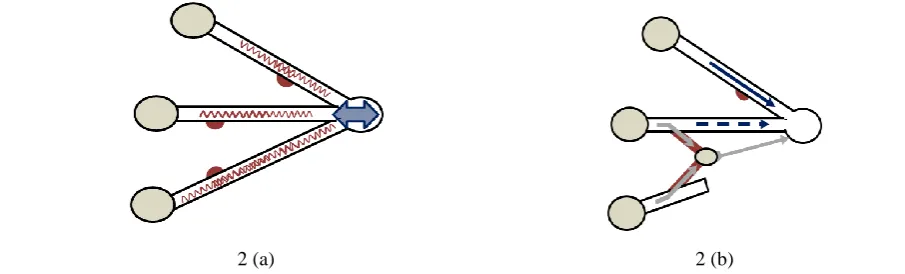
The schematic of Figure 2 illustrates how an intermediary neuron might form. In figure 2(a), there are 3 neurons sending input signals. The red-brown wavy line represents additional turbulence created when there is too much input and some is ejected backwards. The red-brown semi-circles are areas of the synapse that have been influenced by the energy and start to grow. Two of them meet in figure 2(b) and also a new neuron somehow forms. This grows forward through an attractive stimulus, where it finds the main neuron again. Therefore the input from two of the original neurons is reduced to only one input signal through the new intermediary one. In the figure 2(b), in fact, one of the original input paths has closed completely, while the other is still open, but with a reduced signal. This is only a theory of course.
2 (a) 2 (b)
Figure 2.Schematic showing the new Intermediary Neuron formation.
B. SynchronisationProblems
There are one or two obvious synchronisationproblems with this mechanical process. The first problem is: two neurons A and B, trying to join but firing at different times, when neuron B fires more often than the group. For example:
Neuron A fires only with the neuron group that produces the excess input. Neuron B also fires during this time, but also at other times.
Neuron A is part of the excess signal group only and so the main neuron that it connects to needs the re-balancing to adjust for this excess energy. This new intermediary unit does not change the signal that the main neuron receives or when it receives it.
Neuron B however sends signals at other times to the main neuron. This still needs to be sent, even when the new intermediary neuron does not fire.
One answer to this problem is to make the intermediary layer construction primarily time-dependentand influences the closing of the original paths:
If the input signal’s force is strongly countered, the rejected signal collides and causes turbulence or stagnation. If there is an easier route, this might help the path to close.
If the measurementrequires the amount of rejection to be proportional to the amount of closure; then neurons that only fire as part of an excess set, will always receive the repulsive force and close together. Neurons also firing at other times however will be able to complete the original circuit, which might help to keep the path open.
Another factor here could be sets of competing neurons. If they require slightly different movement directions, then a neuron that fires in sync with several groups can get confused, which could delay it joining with any specific group.There is proof that synapses can shrink or enlarge. So it is only when there is too much input and the system becomes unbalanced, that the turbulence becomes enough to force other types of activity.
There is also the other extreme where neuron B fires less often than the excess group, but the excess group always fires when it does. In that case:
Its feedback will occur less often and the excess group will have grown new links more quickly, possibly relieving the additional pressure before the less frequently firing neuron is encouraged to complete the new circuit.
C. Biological Network Comparison Firstly,to summarise the newly discussed ideas:
1. The system will try to self-organise itself through more intermediary units.
2. The intermediary units create a more balanced system, add meaning to the network and can produce a more
varied signal.
3. Neurons firing together can represent a common concept or goal.
4. Synapses firing at the same time cantry to link with each other, or combine forrelated neurons. 5. Resonance is important, where out-of-sync neurons will be able to perform differently.
Neurons need to form and synapses need to find other neurons, as part of any brain construction. Hebb’s law [15] ‘neurons that wire together fire together’, would also suggest that the closer neurons would be more likely to combine into a single unit, while the paper [16] suggests that an attracting stimuluscan control growth direction. So there is a clear set of biological processes that could, at least in theory, map to the mechanical ones.
VI. RELATED WORK
The related work is divided into sections, supporting different aspects of the new view that is described in section VII. The earlier papers ([6]-[11]) might need to be read at some stage, but a general understanding should be possible without reading them first. Specifically, this paper is more biologically-oriented than might be usual. The author is not particularly expert in that area, but the underlying mechanisms need to be compared with the real biological ones. Other neural network models in particular, are described in detail. The relevance of the book by Hawkins and Blakeslee[14] has already been noted in this and other papers.
A. Neural Networks
There are lots of other neural network models and it would not be possible to mention all potentially relevant ones, suggesting that the model(s) of this paper contain(s) some popular features. The classic paper by McCulloch and Pitts[22]for example, gives original research on looking at the human brain as a collection of binary operating neurons. They describe a set of theorems under which these neurons behave, including synaptic links with excitatory or inhibitory connections. They argue that if there is a definite set of rules or theorems under which the neurons behave, this can then be described by propositional logic. Early AI favoured logic and knowledge-based systems. A layered or hierarchical structure is implicit in all of the descriptions and used to explain how a temporal factor can be added and possibly measured, through a spatial structure. They then focus more on behaviour and states, rather than precise mathematical values. So while they show how the neurons might fire, the idea of controlling and measuring the signal value accurately, is not addressed as much.Hebb [15] combined up-to-date data about behaviour and the mind into a single theory. Hebb’s law is often paraphrased as ‘Neurons that fire together wire together’. Positive feedback increases the bond between the firing cells and creates ‘attractors’. A combination of his work finally brought together the two realms of human perception that for a long time could not be connected properly. That is, it connected the biological function of the brain as an organ together with the higher function of the mind, but the exact mechanism for this is still unknown. This paper proposes automatic mechanisms for a lower level of function, but does overlap into some higher-level functionality.
Ultimately, resonance in the excited brain area will be the key to the signal being significant. If the search path finds node groups that can agree on the current state and fire together, causing a stronger signal in some way, then this is what the brain will recognise as positive feedback to asearch process. Adaptive Resonance Theory [4][13] is an example of trying to use resonance, created by a matching agreement, as part of a neural network model. The primary intuition behind the ART model is that object identification and recognition generally occur as a result of the interaction of 'top-down' observer expectations with 'bottom-up' sensory information. The model postulates that 'top-down' expectations take the form of a memory template or prototype that is then compared with the actual features of an object, as detected by the senses. This comparison gives rise to a matching process with existing categories and produces a measure of difference. As long as this difference does not exceed a set threshold called the 'vigilance parameter', the sensed object will be considered a member of the expected class1.The learning process has two stages. An input pattern is matched to existing categories, where the process is self-organising and only one category can fire. Only if the input matches a category, does a training stage take place, to update the related weight values. If there is no match, then an uncommitted neuron is committed and adjusted towards matching the input vector. There are examples of the real human brain using ART methods in some processes [13]. In a theoretical sense, the final model of Figure 6 is quite similar. For that, the bottom-up sensory information is static knowledge, while the top-down observations are dynamic manipulations of the static knowledge.
1
Two other models that are related to Hebbian reinforcement and energy equilibrium states are Hopfield neural networks[18] and the stochastic version called Boltzmann machines[1].These are recurrent neural networks that can also act as (auto)associative memories. Like human associations through similarity, they can retrieve whole patterns when presented with only part of the pattern as input. During training, the only goal is a reduction in the global energy state. Neurons learn the underlying statistical characteristicsinstead of direct adjustments for each pattern.A majority rule can then determine the resulting output. There is evidence that brain activity during sleep employs a Boltzmann-like learning algorithm, in order to integrate new information and memories into its structure[32]. The article also states that ‘Neuroscientists have long known that sleep plays an important role in memory consolidation, helping to integrate newly learned information.’ The middle layer of the cognitive model in [8]or [11]might benefit from a Boltzmann-like machine, although, it would be against the ReN model suggested here, which would also operate in that aggregating layer.But the idea of automatically balancing and reducing the energy state is the same. One point is that the recurrent neural networks have some problems with storage capacity.
There are also examples of other relevant models. If thinking about equilibrium, then other self-organising neural networks include[5] or [20].GasNet[27] neural networks use a method of influencing your surrounding area, even if there is no direct synaptic connection. The neuron emits a ‘gas’ that could be compared to an Ion attraction and it is known to speed up convergence. The paper [5]tries to create a visual pattern recogniser. It is interesting because it tries to copy the brain structure quite closely and has some apparent similarities with theideas of this paper. That model is self-organisingand hierarchical. It also proposes some form of resonance through the backward motion of signals, and includes static and selective learning processes. The problem of noisy input is tackled by allowing a ‘region’ to represent the same thing, instead of a specific point. This is included as part of the learning process and is implemented through layers that can recognise the same pattern point, but at different positions.The theory behind this is described in [3], who describes different ways of implementing it. Note that this does not add understanding and so is mostly statistical, where different images of the same thing would not necessarily be recognised. There is also an implementation of inhibitory units that can suppress a feature if it is not correct. The pattern recognition occurs when both the forward hierarchical categorisation and the backward reinforcement or resonance agree,to produce the resulting output.
The papers [1] and [3] both note that even connectionist systems require sequential and logical processing to successfully model the human brain. This is also written about in [8]. As illustrated by the previous section, as well as the more popular statistical networks, other models try to copy the human brain more closely. The mathematical theories of some of these are written about in[3], which could act as an introductory tutorial.The section III on Statistical Neurodynamics might be particularly useful, for example. As part of one equation set, there is a clearly defined explanation for an end or terminating node that is part of an arbitrarily connected graph. Nodes can therefore be defined individually, or in arbitrarily linked collections, with states defined between either type. The next section Bof this review also describes why terminating nodes are important.
input signals have been learned, a new unit is created half between the two neighbouring units with the highest accumulated errors.’ So this includes the ideas of Hebbian influence, arbitrary structure and the addition of close units to reduce the error.
B. Minsky’s Frames
One of the earlier models by Minsky [24] describes a ‘Frame’ structure for representing objects or concepts and can be made from networks of nodes with relations. Frames appear to be more logic-based and therefore fit better with semantics and formal knowledge structures. It is interesting here because it also contains the notion of terminals or slots that must be filled with specific instances of data. These terminals are more fixed and can be linked to by any groups of the frame nodes. Therefore, there are different paths to the terminals and a crossing-over, or merging, between paths would be likely. The fame-based system deals strongly with logic and knowledge,and would be intended more for higher-level thought processes, than lower-level pattern recognition. While frames are logic-based, the paper does note the requirement for some form of replacement, possibly analogous to a merging or aggregating operation. When a proposed frame cannot be made to fit reality, the network provides a replacement frame. This inter-frame structure makes it possible to represent other knowledge about facts, analogies, and other information useful in understanding. A search through the linked frames or nodes then also involves a matching process, ending with a match on the terminals. So frames can be compared with pattern ensembles and hierarchies.
C. Human Biology
This section is more biologically-oriented. The author is not very expert there and the papers are more of a random selection that might make some relevant points. The paper [5] notes that analog signals can also be sent by using different firing frequencies.The paper [28] is one example that gives an equation for the firing rate that includes external sensory inputs as well as input from other neurons. It also states that for the firing to be sustained, that is, to be relevant, requires sufficient feedback from the firing neurons, to maintain the level of excitation. Once the process starts however, this can then excite and bring in other firing neurons, when inhibitory inputs also need to fire, to stop the process from saturating. A weighted equation is given to describe how the process can self-stabilise if ‘enough’ inhibitory inputs fire. The paper [16] studies the real biological brain and in particular, the chemospecific steering and aligning process for synaptic connections. It notes that there are different types of neuron, synaptic growth and also theories about the processes. Current theory suggests that growth is driven by the neuron itself and also suggests that the neuron is required first, before the synapses can grow to it.This paper requires a charged signal to attract, but it might like a neuron to grow at the end of synapse connections. However, they do note a pairwise chemospecificsignalling process, as opposed to something that is just random and they also note that their result is consistent with the known preferences of different types of ‘interneurons’ to form synapses on specific domains of nearby neurons. Therefore, the idea of an intermediary neuron already exists.
The paper [21] also quotes [23], which investigates differential signalling, based on selective synaptic modifications. They attribute signal changes to changes in frequency andcompare synaptic depression, when it becomes unavailable for use, to the neuron collapse. Differential values can be used to support the idea of analogue values and pressure, and the paper in general shows some support for the ReN ideas. It notes the blocking of channels, that synapses between two neurons can behave differently; and there is some confusion why some block while others facilitate, over what appears to be the same type of neuron.
loss, which is favourable for this paper was well. The paper argues that an Ion pump is not sufficient to explain the forces involved; where one might think that fluid pressure plays a part in the construction of the synapse and also in keeping pathways open, for example. It alsoargues that a steady pressure state must be maintained throughout the brain and; as the brain needs to solve differential equations, it needs to be analogue in that respect. To support this might be the paper [31] that describes how brain perfusion is highly sensitive to changes in CO2 or O2. An increase in blood flow and resulting gases would possibly increase pressure as well, where
their results also challenge conventional theory.
So, there appears to be constructive synaptic processes and these can formmemory structures. Excess signal is definitely produced and must be dealt with. There are different types of neuron and sodium channel, where the sodium channel represents a variable signal. The signal or excitation is normally thought to be a mixture of the Ion channels, more than through pressure from any type of momentum. Intermediate neurons already exist. If there is some evidence for pressure changes, then that is good for this paper. For something the size of a synapse channel however, it would be very small.
VII. MATCHING WITH THE EARLIER RESEARCH
A number of earlier papers ([6]- [11])have been published that describe different aspects of a cognitive model that might resemble a human brain. There was no particular plan to combinethem all, but either by chance or through some common underlying theories, it is possible to put a lot of the previous research together, into a single coherent model. This would be a model that would operate in a way similar to what a real human brain does, but might not model it exactly.Earlier research started with [11] or [12] that looked at how a generic cognitive model might be developed from very simple mechanisms, such as stigmergic or dynamic links. These links are created through dynamic localisedfeedback only and therefore do not rely on any particular rule or piece of knowledge. They are therefore much more flexible, as the feedback would be able to represent anything. The construction process is also largely automatic or mechanical, which is a key requirement. The following sections describe the other related models.
A. Symbolic and Arbitrary
Figure 3.Schematic of a three layer symbolic neural network.
For more realistic data, real-world images for example, might require a more fuzzyform of feedback reinforcement. Lots of intermediary units will be created and destroyed, so for any to survive might require some flexibility on the edges of a cluster, so that the core feature can have slightly different variations at the edges. An alternativeto this would beto make the ‘feedback’ a bit fuzzyinstead and keep the hidden layer nodes as they are. So each unit remains distinct, but the feedback is to an area, not a specific unit, as in the real brain. Therefore, separate clusters that are ‘conceptually’ grouped inside of the selected area can receive common feedback and be updated. As a larger cluster group is rarerbecause of consistency, it makes sense to use nesting this way. In Figure 3, for example, if the group C1, C2, C3 is presented again (t1), a group consisting of C2 and C3 could also be reinforced. One consisting of C1 and C4 would not. This is also interesting because the paper [6] argues for a nested structure for representing concepts.
B. Concept Trees
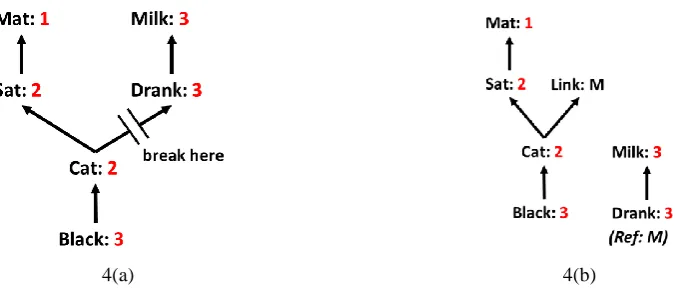
Another paper [7] suggested a way of linking concepts or knowledge that uses a very simple rule that would allow them to be created automatically and be generally applicable. By only allowing concepts that have a lower frequency count value, to be linked to concepts that have higher or equal count values, a sound structure can be generated. If some concept at a tree branch realised a higher count value than its parent, the branch would be broken off to form the base of a new tree. This has a normalising effect on the structure, where the nodes that are used more often, are placed at the tree bases, from where they can be indexed. An example of this is shown in Figure 4, which is similar to the paper diagrams.
4(a) 4(b)
Figure 4.Example of a Concept Tree, with a new base being created.
structures themselves naturally tend towards leaf nodes at the end of terminal branches and it is a bit like the terminals of Minsky’s frames [24]. The search is bottom-up, but the links maintain integrity. Unless ‘black cat’ is asked for, the tree will not be searched, but once started, if there is no ‘M’ branch link, the search cannot go from tree 1 to tree 2.
If trying to use this design as part of a brain structure, then some ideas that are not fully formulated could be the following: Nodes are linked by synapses, where groups can differ from each other. It is also known that some sort of hierarchy exists (for example, [14]). The idea however is that through their natural formation and use, ensembles with many connections and possibly larger collective sizes, will link to other groups with fewer connections and smaller sizes, until the end groups have almost no extensions and are particular in some way. These end points represent final ideas/objects/concepts that the brain knows about and would not need to investigate further. If thinking about a coffee cup, for example, the brain does not try to search further into molecular structures, but stops at the coffee cup concept (usually). If the connection structure naturally tends to smaller and smaller entities, then the search can stop when it hits one of the more singular or end ensembles.This would have to fit in with the traditional theories of completing circuits, but as other theories also note terminal points that should be possible. The dead end is thenthe point from where the resonance can start. As suggested in section VIII however, this might require re-combining concept tree leaf nodes into more singular units again.
C. Memory and Search
A search to retrieve a piece of memory or one to retrieve a process can maybe behave differently. Even if they both start at the concept tree base, retrieving a memory requestcan end at a concepttree leaf, for example. A justification for this can simply be that there is not enough support from a memory request to expand the search into the dynamic processes area, or the neural network of Figure 6. The idea of concept trees, or linking through sub or nested patterns, fits nicely with a memory structure and can be built largely from existing static knowledge. A memory recall is usually quite quick and usually for more simplistic pieces of information. If the design puts these at the end of tree structures, memories are these smaller trees that terminate.A more complex problem might require more than one initial concept to fire and for their searches to combine or agree over a wider range of paths. They would start searching from their bases for associations to the more complex problem and might need to combine to reinforce certain channels or ideas. These combined searches then also need to find common terminating conditions.This more dynamic process is considered again in the following sections.So a concept tree is a static piece of knowledge that gets searched over. It can be created and changed dynamically over time, but that would be a slower process. Searches are very quick, but can only search over the already created knowledge and therefore may need to cross-reference paths, to generate a rich enough pool to start with. Different indexing can be used however to access the initial base tree concepts, or to traverse between trees, providing added levels of dynamism. So the search possibly expands first, before contracting to the terminal states.
D. Aggregations and Stimulus
The papers [6] or[8] and this one describe how stimulus is key to the thinking process and how intelligence might be the result of an ensemble or aggregation of a large number of neurons, all firing together. While this is already known, if it is the case, then that makes it easier to replace one concept in a thought process by another one. We sometimes do this when reasoning, to create new scenarios that never actually existed,but still contain our known elements. It is also a well-known memory technique. The replacement of part of a thought would be easier if all of the neurons fired together in an ensemble. It is difficult to imagine that the brain would surgically move specific concepts as part of the search process. It is more likely to be the case that different neural ensembles would overlap and balance themselves against desired responses. For example, consider listening to recorded music. Each segment of the recorded track is a single noise, but when played in sequence, we can tell each instrument from the other. The brain can separate out from the aggregated sound, the different musical instruments, as the pattern changes.
E. Resonance and Pressure
This is possibly the most controversial or unlikely part of the new model in a biological sense, but usesthe idea is thatneurons in-sync with each other do the same thing. The papers[2] or [5] might also have had similar ideas. For this process to work, it is required that a signal travels in both directions through the synaptic channels. It might be more commonly thought that information flows in a one-way system, but cycles back to complete circuits for reinforcement purposes. Cycling is necessary to sustain the signal and also possibly for history recall, but a direct feedback has other advantages. Consider the experiment for creating a standing wave from a moving rope. It is achieved by two people holding the rope and moving it quickly, up and down, to send waves in opposite directions that collide and combine, to produce the standing wave. So this is the proposed new mechanism for the creation of resonance that the brain signal creates. When a dead end (firing blocked or singular concept) is found, this sends the signal back again, where it combines with the signal flowing in the other direction to produce resonance. The whole search path can be recognised as it gets excited by the feedback. It is almost easier mechanically for the path already created, as part of the search, to receive feedback that tells specific neurons that they are relevant. Figure 5 tries to show these new ideas in action, as part of a search process.This is only one part of a larger search group, is very schematic and is simply trying to illustrate an idea. As the forward and backward signals collide and create turbulence, the whole brain area can get excited and resonate. How a neuron would close or become a terminal one however, is not clear.
Figure 5.The new neuronal model in action.
useful and different neural network models could be tried there, including the new ReN structure that is suggested in this paper. The top level can make use of concept trees [7], or the neural network model of [10], for example. It might be best to view the different levels as functional and not physical. The linking operations are different, but they can all occupy the same physical space and work on the same single structure.
F. Regional and Temporal Feedback
Time is maybe slightly ignored in computer models based on neural networks, but essential for any state-based system[3].Recognising specific areas or regions is also a problem to be solved. The symbolic neural network of section A works well, as it can filter out noisy input, by using very specific clusters. When training however, the reinforcementupdates need to be equally exact. As suggested,a more general structure to the feedback mechanism could be tried.The papers [14] and [21]note the requirement of a temporal feedback, so that historical events are recognised and can then be predicted or reasoned about. Hebb’s rule would suggest that similar groups would form closely to each other, as opposed to far apart, if no other influence is involved. Therefore, instead of the feedback going to one specific cluster set, let it go to a general area and influence all of the relevant cluster groups in that area. A detailed discussion of that is too much for this paper, butit is included to try to keep in-sync with a real biological model. The point is that similar concepts are likely to be grouped closely together and so it makes more sense that a general feedback could influence more than one of them at a time. Think of a line of patterns or states that trigger each other. If the correct result is state 1, then if we also reinforce state 0 or state 2 that is still probably OK.
VIII. ADDING DETAIL TO THE COGNITIVE MODEL
On writing this paper, it has become clear that the neural network and the concept trees can be closely related with each other, both in terms of their structure and also how they are formed and used. While the concept trees are more static and can be built from existing knowledge, the symbolic neural network is more dynamic and influenced by time.A search process might start with specific concepts, broaden out and then narrow to terminating states. A search is also involved for real-world problem-solving or predictions and not just for direct memory retrieval. So another idea of this paper is to join the neural network with the concept tree, to produce a more autonomous system. It is autonomous because full processes are now possible, from the automatic ones previously described. It can be searched over at different levels, store existing knowledge, or produce previously unknown concepts from experience. This is illustrated in Figure 6, where similar types of architecture have probably been proposed before, for example [4], [5] or [13]. To complete the picture, the indexing to the base of the concept trees is provided by a lower level of stimulus. This can be refined using the ReN neurons, for example that act as the indexers to the structured knowledge in the higher level. Each part of the architecture has a construction stage and a usage stage. Time is again key, where node groups presented during the construction stage do not have to be the same as the groups presented during the usage stage. A terminal state might be a conclusion to a process, as in an act and not a physical object, but it is still something that has existed previously.
Figure 6. Integration with the Cognitive Model of [8][11], built from the new clustering structures.
The original cognitive model, described in [8] or [11], for example, already has an upper-level structure for higher-level concepts that can trigger each other. The triggering acts as a form of process creation and allows for more intelligent thought. Integrating the new model components, it is possible to simply allow triggers between the global neural network concepts, as they already represent more complex entities and the sub-entities have not been defined exactly. As a hierarchy is already known about, the lateral connections are just another feature of it. For the concept tree / neural network combination, the same architecture is described in [7], section 7.3. With these two construction processes, one relates to knowledge-based concept trees and to small but specific entities, while the other relates to the event-based clustering and also to self-organising these smaller structures. Following earlier papers’ food examples, you could imagine a human tasting different food types and learning what they are; but when in a restaurant, selecting a menu item based on the food types and discovering some new recipe through the experience. The lower level stimulated area is added to try to complete the picture. The exact functionality there is expanded on in other papers, but is more aggregating in nature. The idea of preferred or more significant neurons is not impossible. As described in section V.B, a neuron that fires more often might be able to keep its direct path. If it is then involved in a firing pattern, it will have more influence, suggesting that it has a more significant value. A stimulus input could even be thought of as the query request, leading to the activation of concept tree bases.
IX. DISCUSSION
would lose some of their meaning. If these are clustered by intermediary units first, then each intermediary unit must represent some sort of abstract concept by itself, even if it is not a real world one. The excess feedback would almost force the creation of these sub-concepts, as part of a self-organising system. If pressure plays a part, then excess amounts would need to be adjusted. There is also the original point of the theory - to produce that apparent analogue set of values, from binary-operating neurons. This type of model is actually less complicated than the real one, but it has the problem of passing a signal in both directions.
Lots of the features that have been mentioned might be found in other models or technologies, but they probably do not appear in exactly the same format as described in these research papers.While the narrowing tree structure of concept trees is not new, the idea that it can be used as a sort of rule for creating linked structures probably is, although, Markov models may also have the same statistical property. The neural network design [10] is possibly new. The construction and usage directions are largely to do with what it represents, where different cluster levels are involved. It might be a question of granularity as to whether other models inherently contain this process as well however. Aggregations and stimulus is commonly accepted, but the idea that a more refined neuron can be automatically and reliably created as part of that might be new.Memory structures are obvious, but the idea of a terminating condition that results in a signal being fed back down the same channel again, appears to be quite radical. The commonly accepted view is one of cycling and completing one-way circuits, because the signal only travels one way through a neuron.While cycling is required,to reinforce the process, there must be some sort of terminating condition, to indicate a successful result. A resonance feedback process can work in harmony with the other established theories, mathematically at least. It is slightly more forceful than the other processes, but also provides slightly different functionality. Circuits, for example, could be more for search and information retrieval[7], while inhibitors can help with timing or process control[6] and so these established methods can work in the same model as the new ideas, without contradiction.
The idea of pressure or force is the most radical. It might be the current thought that the brain is made up more of a kind of amorphous gel that can get electrically charged and then change. The resonance option is that the synapse grows into the gel, but it would be an internal pushing force that controls the process. While the new model might, or might not, be 100% correct biologically, it appears to be mathematically sound. This is important, because it is then possible to build a consistent computer model from it that will do something, even if it does not produce intelligent thought, which is the ultimate goal. As the model simulates the real human brain closely, if it is shown to work in some way, then this will probably have relevance to future research in that area. So there is much here that could be used to build an artificial model of the human brain.
ACKNOWLEDGEMENTS
This paper is a much extended version of the first version ‘The Re(de)fined Neuron’, published on Scribd2(Feb 2013) and also on arXiv3.This version has made some important changes or updates and also added a substantial amount of new information, regarding further supporting arguments and a more complete system. It was originally accepted in 2014 for the IGI JITR special issue on: ‘From Natural Computing to Self-organizing Intelligent Complex Systems’, which was subsequently cancelled.
REFERENCES
[1] Ackley, D.H., Hinton, G.E. and Sejnowski, T.J. (1985). A Learning Algorithm for Boltzmann Machines,
Cognitive Science, Vol. 9, pp. 147-169.
[2] Ales, G. (2008). Electronic, Chemical and Mechanical processes in the Human Brain, 12th WSEAS International Conference on Systems, July 22 - 24, Heraklion, Greece, pp. 637 – 642, ISBN 978-960-6766-83-1, ISSN 1790-2769.
2
http://www.scribd.com/doc/123586190/The-Re-de-fined-Neuron.
3
[3] Amari, S-I. (1990). Mathematical Foundations of Neurocomputing, Proc. IEEE, Vol. 78, No. 9, pp. 1443 – 1463.
[4] Carpenter, G., Grossberg, S., and Rosen, D. (1991). Fuzzy ART: Fast stable learning and categorization
of analog patterns by an adaptive resonance system. Neural Networks, Vol. 4, pp. 759–771.
[5] Fukishima, K. (1988). A Neural Network for Visual Pattern Recognition, IEEE Computer, Vol. 21, No.
3, pp. 65 – 75.
[6] Greer, K. (2014). New Ideas for Brain Modelling 2, in: K. Arai et al. (eds.), Intelligent Systems in Science and Information 2014, Studies in Computational Intelligence, Vol. 591, pp. 23 – 39, Springer International Publishing Switzerland, 2015, DOI 10.1007/978-3-319-14654-6_2. Published on arXiv at http://arxiv.org/abs/1408.5490. Extended version of the SAI'14 paper, Arguments for Nested Patterns in Neural Ensembles.
[7] Greer, K. (2014). Concept Trees: Building Dynamic Concepts from Semi-Structured Data using
Nature-Inspired Methods. Accepted for publication by 'Complex system modelling and control through intelligent soft computations', by: Studies in Fuzziness and Soft Computing, Springer-Verlag, Germany. [8] Greer, K. (2013). Turing: Then, Now and Still Key, book chapter in: ‘Artificial Intelligence,
Evolutionary Computation and Metaheuristics (AIECM) - Turing 2012’, Eds. X-S. Yang, Studies in Computational Intelligence, 2013, Vol. 427/2013, pp. 43-62, DOI: 10.1007/978-3-642-29694-9_3, Springer-Verlag Berlin Heidelberg.
[9] Greer, K. (2013). Artificial Neuron Modelling Based on Wave Shape, BRAIN. Broad Research in Artificial Intelligence and Neuroscience, Vol. 4, Issues 1-4, pp. 20- 25, ISSN 2067-3957 (online), ISSN 2068 - 0473 (print).
[10] Greer, K. (2011). Symbolic Neural Networks for Clustering Higher-Level Concepts, NAUN International
Journal of Computers, Issue 3, Vol. 5, pp. 378 – 386, extended version of the WSEAS/EUROPMENT International Conference on Computers and Computing (ICCC’11).
[11] Greer, K. Thinking Networks – the Large and Small of it: Autonomic and Reasoning Processes for Information Networks, published with LuLu.com, 2008, ISBN: 1440433275. Also available on Google books.
[12] Greer, K., Baumgarten, M., Mulvenna, M., Nugent, C. and Curran, K. (2007). Knowledge-Based
Reasoning through Stigmergic Linking, International Workshop on Self-Organising Systems IWSOS’07, 11-13 September, Lecture Notes in Computer Science (LNCS), Eds. David Hutchison and Randy H. Katz, Vol. 4725, pp. 240 – 254, Springer-Verlag.
[13] Grossberg, S. (2013). Adaptive resonance theory. Scholarpedia, Vol. 8, No. 5, pp. 1569.
[14] Hawkins, J. and Blakeslee, S. On Intelligence. Times Books, 2004.
[15] Hebb, D.O. (1949). The Organisation of Behaviour.
[16] Hill, S.L., Wang, Y., Riachi, I., Schürmann, F. and Markram, H. (2012). Statistical connectivity provides a sufficient foundation for specific functional connectivity in neocortical neural microcircuits, Proceedings of the National Academy of Sciences.
[17] Holland, J.H. (1975). Adaptation in Natural and Artificial Systems, University of Michigan Press. [18] Hopfield, J.J. (1982). Neural networks and physical systems with emergent collective computational
abilities, Proceedings of the National Academy of Sciences of the USA, vol. 79, No. 8, pp. 2554 – 2558. [19] Kandel, E.R. (2001). The Molecular Biology of Memory Storage: A Dialogue Between Genes and
Synapses, Science magazine, Vol. 294, No. 5544, pp. 1030 - 1038.
[20] Kohonen, T. (1990). The self-organizing map, Proceedings of the IEEE, Vol. 78, Issue 9, pp. 1464 - 1480, ISSN: 0018-9219.
[21] Lim, H. and Choe, Y. (2006). Facilitating Neural Dynamics for Delay Compensation and Prediction in Evolutionary Neural Networks, GECCO’06, Seattle, Washington, USA, pp. 167 - 174.
[22] McCulloch, W.S. and Pitts, W. (1943). A Logical Calculus of the Ideas Immanent in Nervous Activity,
Bulletin of Mathematical Biophysics, Vol. 5.
[23] Markram, H.,Wang, Y. and Tsodyks, M. (1998). Differential signaling via the same axon of neocortical
[24] Minsky, M. (1974). A Framework for Representing Knowledge, Massachusetts Institute of Technology Cambridge, MA, USA.
[25] Montes de Oca, M.A., Garrido, L. and Jose L.A. (2005). An hybridization of an ant-based clustering algorithm with growing neural gas networks for classification tasks, ACM Symposium on Applied Computing, Santa Fe, New Mexico, USA, pp. 9 - 13.
[26] Rojas, R. Neural Networks: A Systematic Introduction. Springer-Verlag, Berlin and online at
books.google.com, 1996.
[27] Smith, T., Husbands, P., Philippides, A. and O'Shea, M. (2002). Temporally adaptive networks: analysis of GasNet robot controllers, in Artificial Life VIII, Standish, Abbass, Bedau (eds)(MIT Press), pp. 274 - 282.
[28] Vogels, T.P., Kanaka Rajan, K. and Abbott, L.F. (2005). Neural Network Dynamics, Annu. Rev. Neurosci., Vol. 28, pp. 357 - 376.
[29] Waxman, S.G. (2012). Sodium channels, the electrogenisome and the electrogenistat: lessons and questions from the clinic, The Journal of Physiology, pp. 2601 – 2612.
[30] Weisbuch, G. (1999). The Complex Adaptive Systems Approach to Biology, Evolution and Cognition, Vol. 5, No. 1, pp. 1 - 11.
[31] Willie, C.K., Macleod, D.B., Shaw, A.D., Smith, K.J., Tzeng, Y.C., Eves, N.D., Ikeda, K, Graham, J., Lewis, N.C., Day, T.A. and Ainslie, P.N. (2012), Regional brain blood flow in man during acute changes in arterial blood gases, The Journal of Physiology, Vol. 590, No. 14, pp. 3261–3275.
[32] Wolchover, N. (2013). As Machines Get Smarter, Evidence They Learn Like Us,

![Figure 6. Integration with the Cognitive Model of [8][11], built from the new clustering structures](https://thumb-us.123doks.com/thumbv2/123dok_us/7820411.1664798/16.595.142.489.88.299/figure-integration-cognitive-model-built-new-clustering-structures.webp)
