ISSN (e): 2250-3021, ISSN (p): 2278-8719 Vol. 09, Issue 8, August. 2019, ||Series -I || PP 69-77
A Comprehensive Overview of the Constructive Minutiae of the
Bitcoin - Blockchain
Abigail Christina Fernandez, R. Thamarai Selvi
Department of Computer Science, Bishop Heber College (Autonomous) Department of Computer Applications, Bishop Heber College (Autonomous)
Trichy, India
Corresponding Author:Abigail Christina Fernandez Received 12 August 2019; Accepted 26 August 2019
Abstract: Blockchain is a nifty breakthrough in the field of computer technology, that spans over the varied components that bricks up the wired web and transpires as the new hysteria in the digital world of revolution. The novel approach of Bitcoin is an intuitive paradigm shift of the conventional modus operandi of cryptocurrency and digital cash. This paper unravels the niceties woven around the working of the Blockchain and focuses in detail the meticulous functionality of the Bitcoin mining that builds the chain of blocks agreed in a consensus.
The global community of inclusion, an invitation to participate in an open world free of centralized authority and dominion, ruling out the prevalence and interdependence of the middle intermediaries is the core constraints that mitigate the elaboration of the Block chain and the Bitcoin therein. This new trend has started daunting areas such as exchange of values in terms of assets management and cryptocurrency, through a distributed decentralised arena that is fool proof due to its magnanimous DAO (Decentralised Autonomous Organisation) adapted by the Blockchain.
Index Terms: Blockchain, Bitcoin Mining, Proof of Work, Proof of Stake, Smart Contracts, Distributed Cryptocurrency, DAO, Consensus Algorithms, Applications of Blockchain.
I. INTRODUCTION
The world today revolves around the urge of speed and accuracy. Be it the administration of a medicine to a patient in need, the supply chain of a logistics warehouse, an electoral voting report, the track and maintenance of one’s assets management, intact and update documents handling by a notary. All of these aim at triggering dexterity with optimal swiftness and precision, so as to ensure seamless business transaction. This tangentially includes the transparency and legitimate authenticity of transactions, in a way that they could be cross validated at any point of time. Organisations could ask for nothing more, if all of these are achieved along with the principal and most sort after aspect - a distributed decentralised mode of operation – The Blockchain. It is the strategic invention of technological insurgence, that addresses all problems faced by the prior scenario of centralisation and the need of dependence in business connections.
Blockchain is a decentralized distributed ledger of records in one or many fields of importance, wherein the data conserved is tamper proof and gives the owner the privilege to be rid of dependence of the intermediaries and botheration of trustworthiness of parties involved in a commercial or judicial undertaking. In other words, unintruded transaction of information is made feasible by the decorum of Blockchain. Over the years, under the enterprising umbrella of Blockchain protocol, transpired some expanded attributional augmentations to the decentralised cryptocurrency and business transaction. This led to the contrivance of diversified coined terms of practise in the IT industry which are undoubtedly the off springs of the Blockchain culmination.
This paper briefly provides a digest of the history of the Blockchain, and the take-off of the Bitcoin from that point, after the paper of Satoshi Nakamoto in 2008. The duo relationship between Blockchain and Bitcoin is elaborated. A detailed exploration of the concepts involved in the Blockchain are unscrambled to emerge at a clear working picture of the Blockchain. As Blockchain is in its evolving phase we come to unfold the variegated dimensions of applications it has been producing and is yet to induct in the years to come.
II. BLOCKCHAIN AND BITCOIN– WHICH BEGETS WHAT?
formation of an immutable, append only ledger that is resilient and globally available to a set of mutually untrusting set of participants involved over a business undertaking.
The complete suite of Blockchain is a collective composition of ideas proposed by many researchers over a period of time. The data structure of Blockchain was borrowed from Stuart Haber and Scott Stornetta[1] from their study of timestamped document maintenance of a ledger between 1990-1997. Further extensions to this, such as inclusions of hash pointers, grouping of documents under the same block, threading of documents through Merkle tree where proposed by Josh Benolah and Michael de Mare in 1991. Apparently, came in another intimidating adversary called Byzantine Fault Tolerance(BFT) caused due to misconception of nodes identity, due to network latency thereby disrupting the operation of a distributed ledger. This very same condition was identified by different names such as state replication and resolution of forks. The pertinent consideration was recommended by Lamport, Robert Shostak and Marshall Pease in 1982. Years later, a landmark contribution to BFT was introduced by Miguel Castro and Barbara Liskov in 1999 as practical BFT(PBFT), that has manifold variants, optimizations and other seminal protocols.
Proof of work(POW), the first of its kind as a far as a consensus to a Block chain is concerned, got its origin in 1992 by Cynthia Dwork and Moni Naor. Spam, Sybil Attacks and Denial of service were dealt with under this. This is the same methodology used in Blockchain today. Following suit of Dwork and Naor’s idea came the Hashcash that used hash functions invented by Adam Back in 1997. This played around the guessing of inputs to find the desired outputs of a problem as done in POW. Incidentally, POW was coined only in 1999 by Markus Jakobsson and Ari Juels. This later converged as a hashcash POW introduced by Eran Gaber et al. and Juels and Brainard.
Satoshi Nakamoto [2], the pioneer of Bitcoin, in the year 2008 proposed the concept of a peer to peer(P2P) electronic cash system that was driven on an online system of connected nodes that adhere over a consensus. This incorporates the usage of digital signatures and timestamped transactions through a hash-based POW that dismisses the occurrence of Double spending and invests in a tamper proof distributed decentralised record maintenance of all nodes threaded as a chain. Satoshi however never mentioned the word Block chain in his paper. But the ideology was that of the conception of Blockchain. Thus the duo, Blockchain and Bitcoin transcended from that point as hand in glove convention. Satoshi’s work was further expounded by many researchers and they came up with many other extensions to this, but underlying the same working protocol proposed by Satoshi.
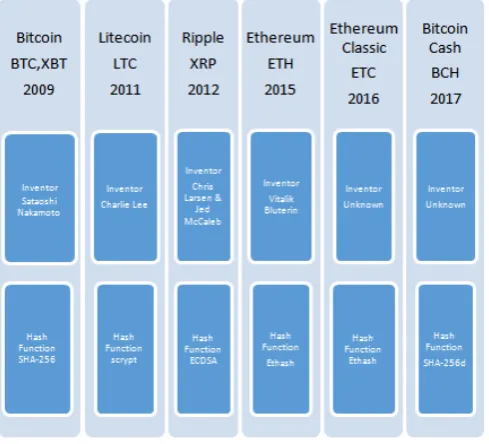
After the inception of Bitcoin came along many other cryptocurrencies with added textures and augmentations. A few significant coins are summarised in the Fig.1. below.
Fig. 1. Cryptocurrencies in vogue
by giving little about the two fundamental properties that operate a successful POW calculation which are the common prefix property and chain quality property that are satisfied with untoward probability.
The robust transaction of functions in the distributed ledger is effectuated on consideration of the chains of variable difficulty [4] a Bitcoin protocol is operated. The dynamic setting of the Bitcoin Backbone Protocol is explained by 3 sub procedures(algorithms) on chain validation, chain comparison and proof of work. These three sub procedures are the basis of the setting up of the bombastic set-up of the Bitcoin Backbone Protocol Algorithm.
Bitcoin stands out despite the many espoused criticisms its receives and the security attribution and the socio-economic factors that supress the evolution of Bitcoin. Apparently, Bitcoin, despite the negative bindings it holds, provides a niche as a virtual currency system shared by a group of untrusted parties with no pre notion identity. This is the key factor that stimulates the operation and development of Bitcoin to varied levels of novel payment protocols, to open resource challenges in the field of cryptocurrencies. Joseph Bonneau et al., further elucidate on the transaction enterprise framework, conservation of value, impact of the consensus, mining minutiae, incentive and mining rewards, network and communication protocol and the relay policy incivility of the denial of service attacks[5]. These prognosticate Bitcoin as a standard achiever amongst other evolving cryptocurrencies.
III. THE COLLECTIVE CONCEPTUALISATION OF BLOCKCHAIN
A secure Blockchain encompasses on aspects such as upcoming self-consistency, g-Chain growth, µ Chain quality [6]. These elements exponentiate the working power of a Blockchain tremendously, despite the many physical and inert adversaries that a Blockchain is inadvertently beset with. Blockchain has rationalised our thinking by leading us into less expensive, enriched experience of a speedy cash flow with a secure maintenance of records. The underlying skeleton is an interconnection of a series of concepts that need to be sufficed to fulfil the ultimatum of a Blockchain and a Bitcoin therein. We will unfold the niceties of the sequence of concepts adapted during the effectuation of the Bitcoin mining operation and Blockchain edifice.
A. How does it work?
Cryptocurrencies hold the promise to a more secure and easier transfer of funds between parties in a transaction. Bitcoin is the first of its kind, that works in a distributed decentralised network that connects parties involved in transactions (of Monetary or Notary value), with no revelation of identity or need for trust amongst the participating entrants of a transaction. Blockchain could be pictured as a chain of nodes(blocks), who are participants or owners of a block that participate in a transaction. They could add a new block to the existing Blockchain by performing a computational problem, in a competitive manner, wherein many miners compete to solve the mathematical puzzle. This is referred to as Bitcoin Mining. Here the owners of blocks are companies or a group of individuals that work together in solving the correct hash. The computation is done by specifically designed computers called Application Specific Integrated Circuits(ASIC). A group of miners called the mining pool combine to crack the right guess of the hash and split the mined Bitcoin amongst them.
B. What is all the complexity about?
A block contains three attributes viz, the data, the hash of the current block and the previous block. To understand this better, it could be thought of as a double linked list. The data stored in a block could be details related to Bitcoins, transactions between person involved in a transaction or values related to assets management, notary documents, health related details or tax payments specifications. This unique value differentiates a block from the rest and this pertains to the value stored in a block. So if the data in a block is tampered the hash value of the block will also change.
The hash value is linked to the next block in the chain and if this hash is modified, thereby altering the hash values of the succeeding blocks and making them invalid. Therefore, if an owner of a block needs to alter the contents of a block, the necessary POW needs to be done for the block under consideration and to all other blocks that tail up in the chain. This is undoubtedly a humungous amount of work, energy and power that needs to be invested and this is what makes the Block chain resilient to change.
C. Consensus – a consent in accordance
try to crack the value of the hash of a block thereby realizing the POW to add a new block. This takes 10 minutes for each new block to be verified.
The block header contains a block version number, a timestamp, hash used in the previous block, hash of the Merkle tree, the nonce and the target hash. Nonce - Number only used once, which when appended to a hashed block makes the difficult level high while rehashing. This is solved by miners, who start off by guessing of the nonce and later append it to the hashed details of the block, which is then rehashed. If this is less than or equal to the target hash a block is added. This whole cyclic process of guessing the nonce is called POW. In recent times, due to the unflinching rise of the number of miners, attempting to decipher the hash, a few consensus algorithms have been appended into the scenario.
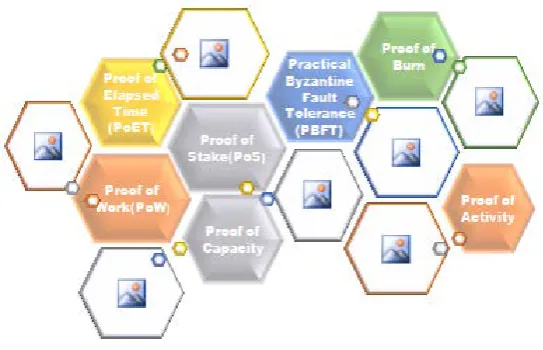
Fig. 2. Types of Consensus Algorithms
The Fig. 2. above lists the different consensus algorithms that have been catapulted into the Blockchain. These algorithms futuristically proposed by researchers aim at categorically minimising expense in terms of energy, power and cost and by making the hustle to solve a puzzle a slight minimal. It also indirectly instigates miners to look on other considerations rather than only to solving computations and winning Bitcoins, but makes it difficult for them to participate in the validation of a block in the very first stride itself. The Proof of Burn(POB), Proof of Elapsed Time(POET), Proof of Capacity(POC), Proof of Activity(POA), Proof of Importance(POI), Practical Byzantine Fault Tolerance (PBFT) all of these lay norms and conditions to miners to check their prospects to participating in a validation. For simplicity we explore the Proof of Stake(POS) in detail due to its agile importance in the field.
A miner or a group of miners could indulge in validating a block depending on the number of coins they hold. This implies that the more number of Bitcoins a miner holds in stake- the more mining power he would possess. This was suggested with the intent to minimise the utilization of power and energy of miners. For theoretically, a miner with low percentage of blocks mines low percentage of blocks thereby saving energy. This unintentionally overcomes the 51% attack of a miner, for if a miner would own 51% stake of Blockchain, he would not indulge in malpractices that deter his holdings in the Blockchain as well.
Bernardo David et al., have recommended a new POS protocol called the Ouroboros Praos[7], in a semi synchronous network to provide an adaptively secure framework, with digital signatures and a verifiable random function(VRF), to maintain randomness under malicious key generation. This works on a current timestamp and a nonce, determined for a stipulated duration of time referred to as epoch. They suggest this protocol to establish a more robust transaction ledger.
Christian Badertscher et al., further extend the POS protocol, by bringing up the Ouroboros Genesis[8] protocol for new or offline miners to join a Blockchain with novel chain selection rule, that enables GUC – Globally universally composable treatment of POS based Blockchain, that could safely allow the bootstrapping of a Blockchain from the genesis blocks called as “Bootstrapping from genesis”. In this same line of thought, “bootstrapped” Bitcoin like Blockchain protocol [9] was proposed by Juan A. Garey et al., that builds block from scratch in presence of the adversarial pre computation. It is further extended to the establishment of a PKI from the start. PKI – refers to Public Key Infrastructure, which is a collection of policies and procedures to securely utilise, hoard and circulate digital certificates and manage encryption.
key is a 12-word recovery phrase and is the key seed to restore access if it has been lost by chance. Elliptic curve multiplication is used by Bitcoin wherein private key is taken as an input to generate and get an output, that is irreversible making the computation secure and robust.
D. Performance Metrics of a Blockchain
The process of measuring the efficacy of a system under study is the performance evaluation. In a Blockchain environment, the performance metrics that are analysed to evaluate the Blockchain are:
A.Test harness – a hardware and software used to run the performance evaluation and depends on the workloads injected by the different clients participating in a Blockchain
B.Client
• Load generating client – that submits the transaction in System under Test(SUT)
• Observing client – that only receives notifications from SUT about the different submitted transactions
C. SUT – a hardware, software, network and configuration amalgamated setup.
D. Nodes – that are virtual entities that communicate and work together to complete transactions. They could be individual or part of a mining pool.
Based on the above, the Blockchain operates over a consensus, solving a bit of computations regarding the transactions and the those that are later committed by a finality term, meaning there is no roll back option. Fig. 3. Shows a list of the common metrics that are applied to Blockchain.
Fig. 3. Key Metrics of Blockchain
IV. NEW INNOVATIONS IN THE DUO (BLOCKCHAIN AND BITCOIN)
A. The BigChainDB
BigChainDB introduced in February 2016, is a database that uses the integral characteristics of Blockchain, making it distributed and decentralised data that is immutable. This is open source, with low latency, richly permissioned with perfect segregation of duties and selection processes and is customisable as well. This uses the MongoDB Database of Big data. As this is a marriage between the intrinsic attributes of Bigdata and Blockchain it is referred to as BigChainDB.
The latest version, BigChainDB 2.0, overcomes issues in relation to Byzantine Fault Tolerance and primary node failure by the use of Tendermint protocol, that uses a Blockchain consensus engine and generic application interface. This ensures transactions to be recorded in the same order and the Application Blockchain Interface(ABCI) aids the dealing out of transactions in any programming language. So BigChainDB has nodes with their own local MongoDB and communication following Tendermint protocols.
B. Bitcoin Duplex Micropayment channels
The scalability of the Bitcoin is enhanced by using offline Blockchain transactions [10] which enables users to process arbitrary transfer without hindering the Bitcoin Network. This could vent a means of Payment Services Providers(PSPs), thereby providing end to end secure and instantaneous transfers through a Duplex Micropayment channels. The earlier methodology of payments consumed 5ms per transaction, thereby causing a scaling that is limited to only 100 transactions per second. Christian Decker et al., suggest that this Duplex Micropayment channelizes payments in a truly scalable imminent Bitcoin.
C. Algorithmic Randomness – Algorand
Algorand [11] is a public ledger initiated by JingChen et al., based on message passing Byzantine agreement. It is called so as they use Algorithmic randomness to select the set of verifiers in charge of constructing the next blocks of valid transactions. It is democratic in nature as all the users are given all powers. Forking maybe likely in Algorand, as the probability of it lies in a one in a trillion transactions.
D. Let go of the Blocks and chains
Blockchain free cryptocurrencies are an improvised version of evoking the functionality of a truly distributed ledger, void the blocks and chains and by adapting a lean graph that authenticates transactions. Xavier Boyen et al., suggest a graph based [12] network that helps provide immediate response rates and the design that holds base for the modern cryptocurrencies in a means of security, consensus and multiple denomination.
Yoad Lewenbug et al., similarly propose the block DAG – Directed Acyclic Graph of blocks [13] that is programmed to accept transactions from conflicting blocks. These conflicting block generally occur due to high block rate creation that hinder the performance of a Blockchain. The block DAG tries to keep this nature aloof from the attackers, who might use this to reverse transactions. The ultimate purpose of this model is to establish connectivity in a highly scalable level of transaction volume and making the tolerate level allowable for many blocks.
E. Cryptocurrencies – a constant filing up
After the ascend of the Bitcoin emanated many coins proposed by the different researchers and business enterprises for variegated modes and criteria such as better scalability, improved security, increased number of coins mined, reduce energy consumption and cost elimination. RSCoin [14], is a scalable cryptocurrency that is a paradigm shift from traditional crypto currencies to centralised cryptocurrency. This provides seamless value transfers of payments.
Botnets, the surging scare on the internet, crewed by botmasters who are cyber criminals who could pose liabilities of financial fraud, malware distribution, spam emailing, identity theft, storing of illegal contact and collapse of a website at large. In order to defend the Blockchain from this perfidious threat of Internet Infrastructure, the Zombie coin [15] was proposed by Syed Taha Ali et al., to overthrow the Botnet effect by a Command and Control(C&C) mechanism that is implemented in Bitcoin. This aims at curbing the avenues of botmasters to desirable extents, nevertheless, it is still in its initial phase of combat.
F. Explosion of the servicing of Blockchain – addressed
The nomenclature of Blockchain is so intense and organised that its services are seeming to surge with the trending publicity and utility it has been earning over the years. This barges a bloat to the services of the existing ledgers due to the single service orientation inherent of the Blockchain that crumble the true ideology of Blockchain which is security and trustless discernibility. Adam Efe Gencer et al., propose Aspen [16], a sharded protocol to address this outburst in services of Blockchain. Aspen provides internet benefits such as conservation of computational power to miners, prevents double spending, improved scalability by freeing non-miner participants. The core properties of Bitcoin are attempted to be achieved using this service oriented sharding technique- Aspen.
Further escalations to the Blockchain and Bitcoin seems to be looming up along way every day. The above cited are just a few interesting extensions.
V. LIMITATIONS OFBLOCKCHAIN AND BITCOIN
Bitcoin, the contemporary and most remarkable inventions in the field of decentralised cryptocurrencies, spans over a wide spectrum of operation which work in harmony following stipulated consensus and majority of which requires the honesty of miners. If the miners fall prey to bribery or incentives, then the malevolent group could easily gain momentum to the majority percentage of the Bitcoin network, dissuading the network therewith. Ittay Eyal et al., in their analysis, have come up with a stature, that Bitcoin becomes vulnerable, if miners tend to be incentive compatible(likely), thereby altering the majority miners in a pool. They demonstrate the selfish mining strategy algorithm of miners and how it is overcome by a backward compatible change to address the problem [17].
Yet another devastation that is likely to hit the Bitcoin drastically is via the Internet routing infrastructure [19]. This is made feasible by manipulating routing advertisements (BGP hijacks) or by naturally interrupting circulation of network through Autonomous systems(ASes). Maria Apostolaki et al., in their research unveil the possibilities of this attack that could lead a significant waste of mining power, loss of revenue and probabilities of double spending. They suggest counter measures such as increased diversity of nodes, appropriate selection of peers prior routing, monitoring round trip time and statistics, allowing churn (refresh of network connections), use of different gateways in ASes, encryption of Bitcoin communication, use of different control and data routes and monitoring connection heartbeats periodically.
Patrick McCorry et al. propose BIP70 – a Bitcoin payment protocol [20] that portrays the authentication vulnerability of Bitcoin payment using Bitcoin wallets. They also advocate a revised BIP70 standard by providing a publicly verifiable proof to hinder the attacks.
Another viable means of Bitcoin abuse is Bitcoin brain of wallets [21] by unlimited guessing of passwords users derive from private keys for transmitting money. It is noted, after examination of around 300 billion passwords, that weaker passwords are cracked faster and that the drain of wallets was accomplished in minutes. They pose a serious threat to Bitcoin security norms.
The protagonist goal of Bitcoin ecosystem is to ensure a trust amidst the characters involved in the currency system [22]. This may go hay way due to conflicting interests and incompatibility of miners involved that could perpetuate or diminish the tangible and intangible benefits of Bitcoin.
The probable ways of attacks to a Bitcoin need to be addressed and counter measured effectively to propel the Bitcoin and Blockchain functionality.
VI. APPLICATIONS OF BLOCKCHAIN
Blockchain revolves around the trade-off financial assets and most interestingly in the bank transaction domains, clubbing the processes and their relationships between organisations. A few value added concepts of Bitcoin are extended to other business ventures apart than the usual Bitcoin enterprise. The concepts behind smart contracts of Blockchain are exaggerated by a strong benefit of code based contracts. This has started its spell in different areas of automation and artificial intelligence and has also made it capable to overcome massive time and money conservation using this smart contracts.
A compare and contrast between the real and virtual world payment makes Bitcoin set a trademark in the field of domestic and international payments. For, finance is the topmost challenging sector to suffice in the current times. If all this was to settle at a pace faster than imagination, undoubtedly the world will march off in the direction with no second thought.
Blockchain finds its area of expertise and utilisation in fields such as finance, supply chain, education, healthcare, real estate, public services, data sources and Internet of Things(IoT). Blockchain technology on being spotlighted under the institution theory, transaction cost theory and agency theory – uproot six possibilities of technology expansion which is very appeasing [23]. They propagate Blockchain worldwide: • Blockchain lowers transaction cost
• Introduction of Blockchain into the trade market
• Third man institutions should be reformed to adopt to Blockchain • No formal institution of Blockchain like trade institution
• Reduced cost and public legitimacy
Blockchain has made a cutting edge in the financial and business arena by providing a solution to the double spending problem. The FITS model adapted by the Blockchain is used to address related problems in business transaction. FITS stands for
• F- Fraud – If a business environment under consideration has been noted for a history propensity of fraudulent activities then blockchain could assist in curbing the likelihood of fraud occurrences. This is why this ideology has been sought after by international financial transactions across the globe.
• I- Intermediaries – The role of intermediaries could be disintermediated in Blockchain if they don’t provide any value of work, thereby getting an average transaction settlement time from 2days to 15 minutes, by eliminating the middleman institutions.
• T-Throughput – The number of transactions per second. Blockchain seemed to process 10 transactions per second which was a low compared to master card and visa card who went up to 80,000 transactions per second. Researchers in recent times have proved that Blockchain could process 400,000 per second. • S- Stable – The stability of data is ensured in Blockchain by making it immutable and non –volatile in terms
Blockchain has manifested the creation of a huge company of organisations that are distributed and automated for the first time in the history with limitless potential to effectuate more lee ways of utility worldwide. A DAO is a Decentralized Autonomous Organisation, that has made the people involved in a transaction, as the nucleus of an operation, who decide on stipulated roles that form a consensus. This would take shape of a smart contract that are deployed later on in the proceedings of the blockchain working whenever required. Thus, A DAO of a blockchain is synonymous to a democratic country that is automatically run. These are the core reasons that make Blockchain sought after the most in current eras.
VII. CONCLUSION
Much to the amusement of the business hub, came into vogue a silent new exemplar shift with an exceptional taxonomy of technology called Blockchain that maneuvered the cryptocurrency Bitcoin. The sphere of influence of Blockchain seemed to penetrate its dominion through a widespread anatomy of computers sharing no affiliation or trust but remain secure to its core. This was a brief about the Blockchain and its counterpart Bitcoin. The functionality of Bitcoin seems to be fathomless and is still being unravelled by patrons and developers in the field of pent research of the resilient flexible distributed ledger of records.
Despite the turbulent attacks that target to pin down the huge leaps the duo has made in varied fields, the Blockchain and Bitcoin aim to transcend the business lane with its stamp through varied enhanced protocols and standards. This would elevate the scalability, security, reliability, accessibility of the Blockchain to stupendous levels making it a benchmark in modern digital terrain invention, bifurcating the underlying cultural and technical community.
REFERENCES
[1]. Narayanan, A., & Clark, J. (2017). Bitcoin's academic pedigree. Communications of the ACM, 60(12), 36-45.
[2]. Nakamoto, S. (2008). Bitcoin: A peer-to-peer electronic cash system Garay, J., Kiayias, A., & Leonardos, N. (2015, April). The Bitcoin backbone protocol: Analysis and applications. In Annual International Conference on the Theory and Applications of Cryptographic Techniques (pp. 281-310). Springer, Berlin, Heidelberg.
[3]. Garay, J., Kiayias, A., & Leonardos, N. (2017, August). The Bitcoin backbone protocol with chains of variable difficulty. In Annual International Cryptology Conference (pp. 291-323). Springer, Cham. [4]. Bonneau, J., Miller, A., Clark, J., Narayanan, A., Kroll, J. A., & Felten, E. W. (2015, May). Sok:
Research perspectives and challenges for Bitcoin and cryptocurrencies. In 2015 IEEE Symposium on Security and Privacy (pp. 104-121). IEEE.
[5]. Pass, R., Seeman, L., & Shelat, A. (2017, April). Analysis of the Blockchain protocol in asynchronous networks. In Annual International Conference on the Theory and Applications of Cryptographic Techniques (pp. 643-673). Springer, Cham.
[6]. David, B. M., Gazi, P., Kiayias, A., & Russell, A. (2017). Ouroboros Praos: An adaptively-secure,semi-synchronous proof-of-stake protocol. IACR Cryptology ePrint Archive, 2017, 573.
[7]. Badertscher, C., Gaži, P., Kiayias, A., Russell, A., & Zikas, V. (2018, October). Ouroboros genesis: Composable proof-of-stake Blockchains with dynamic availability. In Proceedings of the 2018 ACM SIGSAC Conference on Computer and Communications Security (pp. 913-930). ACM.
[8]. Garay, J. A., Kiayias, A., Leonardos, N., & Panagiotakos, G. (2018, March). Bootstrapping the Blockchain, with applications to consensus and fast PKI setup. In IACR International Workshop on Public Key Cryptography (pp. 465-495). Springer, Cham.
[9]. Decker, C., & Wattenhofer, R. (2015, August). A fast and scalable payment network with Bitcoin duplex micropayment channels. In Symposium on Self-Stabilizing Systems (pp. 3-18). Springer, Cham.[11] Chen, J., & Micali, S. (2016). rand. arXiv preprint arXiv:1607.01341.
[10]. Boyen, X., Carr, C., & Haines, T. (2016). Blockchain-free cryptocurrencies: A framework for truly decentralised fast transactions. Cryptology ePrint Archive, Report 2016/871.
[11]. Lewenberg, Y., Sompolinsky, Y., & Zohar, A. (2015, January). Inclusive block chain protocols. In International Conference on Financial Cryptography and Data Security (pp. 528-547). Springer, Berlin, Heidelberg.
[12]. Danezis, G., & Meiklejohn, S. (2015). Centrally banked cryptocurrencies. arXiv preprint arXiv:1505.06895.
International organization of Scientific Research 77 | Page [14]. Gencer, A. E., van Renesse, R., & Sirer, E. G. (2017, April). Short paper: Service-oriented sharding for Blockchains. In International Conference on Financial Cryptography and Data Security (pp. 393-401). Springer, Cham.
[15]. Eyal, I., & Sirer, E. G. (2018). Majority is not enough: Bitcoin mining is vulnerable. Communications of the ACM, 61(7), 95-102.
[16]. Bonneau, J., Felten, E. W., Goldfeder, S., Kroll, J. A., & Narayanan, A. (2016). Why buy when you can rent? bribery attacks on Bitcoin consensus.
[17]. Apostolaki, M., Zohar, A., & Vanbever, L. (2017, May). Hijacking Bitcoin: Routing attacks on cryptocurrencies. In 2017 IEEE Symposium on Security and Privacy (SP) (pp. 375-392). IEEE.
[18]. McCorry, P., Shahandashti, S. F., & Hao, F. (2016, February). Refund attacks on Bitcoin’s payment protocol. In International Conference on Financial Cryptography and Data Security (pp. 581-599). Springer, Berlin, Heidelberg.
[19]. Vasek, M., Bonneau, J., Castellucci, R., Keith, C., & Moore, T. (2016). The Bitcoin brain drain: a short paper on the use and abuse of Bitcoin brain wallets. Financial Cryptography and Data Security, Lecture Notes in Computer Science. Springer.
[20]. Laszka, A., Johnson, B., & Grossklags, J. (2015, January). When Bitcoin mining pools run dry. In International Conference on Financial Cryptography and Data Security (pp. 63-77). Springer, Berlin, Heidelberg.
[21]. Torres de Oliveira, R. (2017). Institutions, Middleman, and Blockchains–Shuffle and Re-Sta