An Overview on Iris Recognition Systems
Sethu Parvathi C M. Tech Scholar
Department of Computer Science & Engineering Lourdes Matha College of Science and Technology
Abstract
Iris is a thin, circular structure in the eye. It is responsible for controlling the diameter and size of the pupil. Hence the amount of light that reaches the retina is also controlled by iris. Eye colour is the colour of iris. The iris pattern is best suited for user friendly, intellectual, consistent person identification. The main aim of this paper is to provide a general framework of iris recognition system and a review of some of the iris recognition techniques developed.
Keywords: Iris, Iris Recognition Framework, Segmentation, Normalization, Feature Extraction, Matching
________________________________________________________________________________________________________
I. INTRODUCTION
The iris pattern proposes a new key that is user friendly, intellectual and consistent for person identification. No two irises in the world are identical. Users must show their eye in front of the iris camera for their enrolment or identification. Unlike finger print recognition, iris images are captured in non-invasive approach. Many iris recognition techniques have been developed that ensures reliability and performance.
Usually iris pattern is stored as a unique mathematical representation which can be treated as a biometric template. Picture of a particular eye known as subject is captured and a template of the corresponding image is created and then compared with other stored templates in the database. When matching templates are found, it means subject is identified or if no match is found subject remains unidentified.
II. IRIS
The iris is the “colored ring of tissue around the pupil through which light enters the interior of the eye”[1]. In anatomy, it is the pigmented muscular curtain near the front of the eye, between the cornea and the lens, that is perforated by an opening called the pupil. The iris is located in front of the lens and ciliary body and behind the cornea. The dilator and sphincter muscles control the size of the iris to adjust the amount of light entering the pupil, [2].
According to Jain et.al (1999) [3], there are seven factors that could be used to identify a person’s physical or behavioural characteristics as a biometric trait and henceforth can be used in biometric applications. They are
1) Universality (ease of availability in an individual) 2) Uniqueness (distinct characteristics)
3) Permanence (stability or durability)
4) Measurability or collectability (ease of acquisition) 5) Performance (quality of being efficient)
6) Acceptability (degree of approval) 7) Circumvention (ease use of a substitute).
Iris satisfies almost all characteristics and hence can be approved as a biometric trait and used in recognition systems.
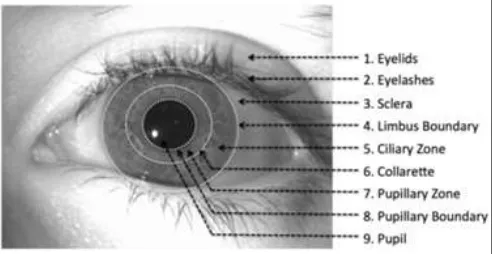
The figure 1 shows major anatomical features of the iris image acquired using near-infrared (NIR) illumination. The opening of the iris is called pupil (9) and it determines how much light is let into the eye. A white region of connective tissue and blood vessels that surrounds the iris is called sclera (3). The surface of the iris is composed of two regions, the central pupillary zone (7) and the outer ciliary zone (5).The border between these two regions is called the collarette(6).
Iris contains unique and rich patterns like furrows, rings, freckles and crypts. Pits near the pupillary margin of the anterior surface of the iris is called Iris Crypts. They are certain relatively thin areas of iris tissue, which may appear near the collarette or in the periphery of the iris. In iris images captured under near infrared (NIR) illumination, the appearance of iris crypts has the following characteristics [4] (see Figure 2):
The interior has a relatively homogeneous intensity that is lower than that of the neighbouring pixels in the exterior. The boundary exhibits stronger edge evidence than either the interior or the exterior.
Fig. 2: Demonstration of the characteristics of Iris Crypts. Four examples of Iris crypts are shown in red boxes.
Iris crypts can be defined as the “minutiae of iris” [5] and hence for recognition systems, iris crypts can be used for detection and matching.
III. GENERAL FRAMEWORK OF IRIS RECOGNITION SYSTEMS
The general framework for Iris Recognition Technique consists of the following stages 1) Image acquisition
2) Preprocessing and Iris segmentation 3) Normalization
4) Feature Extraction 5) Matching
Image Acquisition is the important and complex step of iris recognition system. For Indian people, iris is small in size and dark in color. The biometric cam is used to capture user’s eye image. Acquisition distance is normally b\w 19 to 36 inches and average capturing time is 1.5 seconds. The image acquisition phase should consider 3 main aspects- the lightning system, the positioning system, the physical capture system. Iris recognition system can work well in both outdoor and indoor conditions without any hotspot.
In Iris segmentation or localization process, iris region is segmented or isolated from the eye by performing a pupil separation process and then approximately identifying two circular boundaries- pupillary zone and sclera. The quality of output obtained from the iris segmentation results in better performance of the iris recognition system.
There will be inconsistencies in the size of the segmented iris region due to several reasons like eye ball movement, head tilt of the subject, distance of eye from the scanner etc. The segmented region must be transformed to a region of consistent size in normalization. Generally, they are rectangular iris strips and are called normalized iris images
Later, the visible features in the normalized iris images are translated into some form of feature representation. They are called feature templates. A single iris is said to have more than 266 distinct information in its patterns, where approximately 173 are used in creating templates [6]. The template could be an iris code, or an iris signature or a decision tree.
In the final stage of feature extraction and matching, the featured template is compared using any of the feature matching technique to identify the similarity between two different iris templates. The system calculates a match score between two feature templates. The match score can be a similarity score or a dissimilarity score. The match score is compared to a preset threshold to decide whether the given pair of templates match or not.
IV. DAUGMAN’S IRIS RECOGNITION SYSTEM
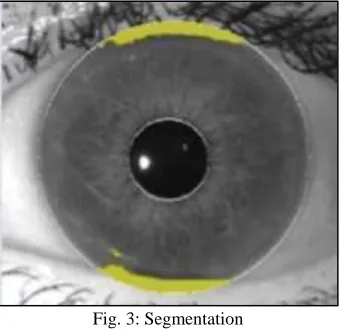
Fig. 3: Segmentation
The segmented region is then mapped to a rectangular region of consistent size for normalization. The segmented region is shown in figure 3 and normalized image is shown in figure 4. Here the iris region is modelled as a flexible rubber sheet [7]. It converts the segmented iris from Cartesian coordinates to polar coordinates. The coordinate conversion is represented as
I(x (r,θ), y(r,θ)) → I(r,θ)
Fig. 4: Normalization
A 2D gabor filter is used to extract the features from the polar coordinate system. The response from each filter is a 2 bit code. The two bit codes from all filters are concatenated into a 256 byte (2048 bit) binary iris code.
Final stage is matching. In this step, the problem is to identify whether the given code belong to a particular subject or not. This is achieved using a metric called “normalised Hamming distance”. This metric is used to calculate dissimilarity scores between two iris codes[7].
EQN
Daugman received a patent for an operational method which performs recognition of iris in identifying a person. In 2004, Daugman proposed another approach [8] as an improvement to his early work. It concentrated on noise disturbances that occur while acquiring iris image of a human eye. In 2007[9], he again proposed an approach where a new algorithm is used during segmentation that handles off-axis iris images.
V. DCT BASED RECOGNITION
The DCT based recognition is proposed by D M Monro[10]. It is based on Discrete Cosine Transform (DCT) technique. Here Hough transform is used to segment the iris image from the eye. The segmented image is normalized into a rectangular image array. Normalization is done using bilinear interpolation of 4 nearest neighbour method.
Individual feature bit and patch position parameter are optimized for matching. For comparing two iris codes, the distance between two feature vectors were measured using the product of sum (POS) of individual sub feature Hamming Distances (HD).To reduce the feature vector length, the most discriminating DCT coefficients were extracted and the remaining ones were discarded. Feature extraction is done using 1D DCT. This system has low computational cost but the searching speed needs to be improved in a huge iris database.
VI. IRIS PATTERN ANALYSIS BASED ON WAVELET AND HNN
The iris pattern analysis based on wavelet and HNN (Hamming Neural Network was proposed by Brehamananth et.al.[11].This approach propose a new key that is user friendly, intellectual, consistent and non-clone for person identification. Here iris images are captured using non-invasive approach. After acquiring the eye image, boundary of both pupil and iris has to be estimated inorder to find out Cartesian coordinates of flash location. Boundary coordinates are useful in anti-spoofing and iris segmentation modules, inorder to find pupil diameters and iris segmentation respectively.
Anti-spoofing ensures that the image is coming from a real source or not. In this technique, a Challenge Response Test (CRT) is implemented based on two biological facts.
1) If bright light, pupil allows less light to reach retina
CRT uses these facts and verifies the response of pupil diameter by varying the illumination levels from the same distance of capturing. The algorithm for computation of pupil diameter is as follows:-
STEP 1: Capture the subject’s eye image in different lighting levels from the same distance.
STEP 2: Measure the pupil diameters from the captured eye images. If divergent, image is coming from real sources. Otherwise artificial sources may be counterfeited.
Thus this method verifies whether the input signal is actually coming from a person or not. Iris feature encoding is a process to convert iris pattern into a set of suitable mathematical codes. Here, Multi Resolution Analysis (MRA) is done using Daubechies wavelet. Iris segmentation is done by selecting portions of iris that are having well distributed patterns and they undergo MRA analysis. Based on this method, feature encoding has proven the ability to provide high coding efficiency, spatial and quality features. Daubechies wavelets is used to decompose the segmented iris portions into multiple resolution subbands. These subbands used to transform complex mispatterns to iris feature code. Before encoding, the iris feature code is decomposed into 4 levels. The iris feature encoding process extracts 135 bit code from each iris patterns. This is termed as Iris feature set. It is used for verification and recognition process in iris recognition.
Iris recognition is based on descriminability. The discriminability is defined as:- d′ = |μ2 − μ1| / σ
Where d’ is discriminability factor, μ1 and μ2 is a mean value when no test set is present and test set is present respectively. Hamming neural network (HNN) is used to recognize the iris features from the trained set. The goal is to decide which trained set feature set is closest to the test feature set. In HNN , there are two layers –Feed forward layer(FFL), used to calculate a maximum score of i/p patterns and Recurrent Layer(RL) used to select the max score of i/p iris patterns. The number of neurons in the FFL is same as number of neurons in the RL. When a test feature is given to FFL, hamming distance b\w test and train sets are measured from the output from each of the neuron in the FFL. The function of RL is to select the neuron with the maximum o/p. The RL is allowed to iterate, and after some iterations all the o/p reaches 0 except for the recognized iris with threshold. The testing process is stopped if there is no change expected in the iteration process.
VII.HUMAN IN THE LOOP RECOGNITION SYSTEM
This is a new approach for detecting and matching iris crypts automatically that capture iris crypts of various sizes. Iris crypts are certain relatively thin areas of iris tissue. In iris images captured under near infrared (IR) illumination, the appearance of iris crypts has the following characteristics:-
1) The interior has a relatively homogeneous intensity that is lower than that of the neighbouring pixels in the exterior. 2) The boundary exhibits stronger edge evidence than either the interior or the exterior.
The detecting and matching of Iris crypts is based ACE-V methodology (Analysis, Comparison, Evaluation, Verification). A recent approach put forward by Shen [12] aimed to automate the A,C,E steps. This method improves the performance of the automated iris recognition process. It is a fully automated approach where the human interpretable features are extracted in the iris image. Then the features are matched with the image in the database to determine the identity.
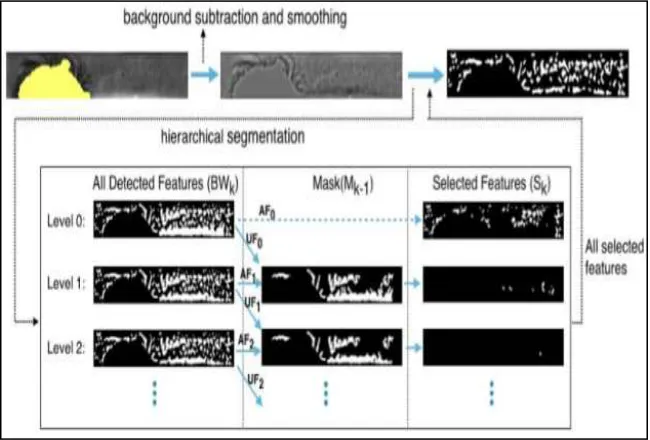
In this automated iris recognition process, there are two main tasks- Crypt detection and Crypt matching. Crypt detection is designed to handle multiscale crypts. Crypt matching is done based on Earth Mover’s Distance (EMD). The matching algorithm is designed so that it performs robustly to segmentation errors and potential appearance or disappearance of small crypts. In Figure 5, feature detection based on segmentation algorithm is shown:-
During matching, it measures the similarity/ dissimilarity between two iris images based on the detected features. Suppose P = { p1, p2,...,pn} and Q = {q1,q2,...,qm} are the detected visible features in two images under comparison, then a score ranging from 0 to 1 will be computed to determine the dissimilarity between P and Q. The smaller the final dissimilarity score is, the more similar the two images.
To measure the dissimilarity between two features or two sets of features, A and B, the following equation is used:- Sim(A,B) = α∗ F1(Sym(A, B)) +(1−α)∗F2(Haus(A, B))
Where Sym(A, B) is the symmetric difference between A and B. Haus(A, B) is the Hausdorff distance between A and B. α is a weight parameter (α = 0.5 in this implementation). F1(∗) and F2(∗) are two sigmoid functions to rescale the symmetric difference and the Hausdorff distance :
F1(t)= 1 1+exp(−10t+5) , F2(t)= 1 1+exp(−t+3)
The smaller the final dissimilarity score is, the more similar the two images will be. EMD is a similarity measure for comparing multidimensional objects. The advantage of using this model is the capability of multiple to-multiple matching of objects and the robustness to deal with various segmentation errors. Experiments were conducted on three datasets, in-house dataset, ICE2005 and CASIA-Iris-Interval (v4), in order to evaluate the proposed iris recognition approach in both the identification and verification scenarios.
VIII. CONCLUSION
This paper discusses about the anatomy of iris, a general framework of Iris Recognition System and a summary of four different iris recognition systems developed. The purpose of this paper is not to review all related research works in detail but to make you understand the core ideas of these four methods and their relationships. Out of them Daughman’s iris recognition system is the basis for most of the iris recognition system. Monro’s recognition system is based on Discrete Cosine Transform technique. Brehmananth et.al proposed a system based on wavelet and HNN. A new approach was forwarded by Shen using human interpretable features known as iris crypts. The system can be called as Human in the loop recognition system. The iris recognition system has been widely applied in several identification systems including Aadhaar, a project of the Unique Identification Authority of India and border control systems in United Arab Emirates. The research for improved iris recognition systems are progressing which concentrates on the practical requirements like cross sensors, large scale identification etc. Neverthless, the future works will be more promising and aims at deploying in various areas like forensics, immigration checking, attendance management systems and forensics.
REFERENCES
[1] C. W. Oyster,” The human eye: structure and function.”, Sinauer Associates, Inc., June 1999
[2] K. W. Bowyer, K. Hollingsworth, and P. J. Flynn. Image understanding for iris biometrics: A survey. Computer Vision and Image Understanding, 110 (2):281–307, May 2008.
[3] A. K. Jain, R. Bolle, and S. Pankanti, “Biometrics: personal identification in networked society”,vol. 1. 1999, p. 434.
[4] J. Chen, F. Shen, D. Z. Chen, and P. J. Flynn, “Iris recognition based on human-interpretable features,” in Proc. IEEE Int. Conf. Identity, Secur. Behavior
Anal. (ISBA), Mar. 2015, pp. 1–6.
[5] F. Shen and P. J. Flynn, “Using crypts as iris minutiae,” Proc. SPIE, vol. 8712, p. 87120B, May 2013.
[6] P. Khaw, “Iris Recognition Technology for Improved Authentication”, SANS Security Essentials (GSEC) Practical Assignment, version 1.3, SANS Institute,
2002, pp.5-8.
[7] J. Daugman. How iris recognition works. IEEE Transactions on Circuits and Systems for Video Technology, 14:21–30, January 2004.
[8] Daugman J,” High confidence visual recognition of persons by test of statistical independence”. IEEE Trans. Pattern Anal. Machine Intell., 15:1148–1161,
1993.
[9] Daugman, John. "New methods in iris recognition." Systems, Man, and Cybernetics, Part B: Cybernetics, IEEE Transactions on 37, no. 5 (2007): 1167-1175.
[10] Monro, Donald M., Soumyadip Rakshit, and Dexin Zhang. "DCT-based iris recognition." Pattern Analysis and Machine Intelligence, IEEE Transactions on29, no. 4 (2007): 586-595
[11] R.Brehmananth,A.Chithra, “A new methodology for person identification system”, Sadhana, Indian Academy of Sciences, Vol.31, Part 3, pp-259-276, 2006
[12] J. Chen, F. Shen, D. Z. Chen, and P. J. Flynn, “Iris recognition based on human-interpretable features,” in Proc. IEEE Int. Conf. Identity, Secur. Behavior