ISSN (e): 2250-3021, ISSN (p): 2278-8719 Vol. 08, Issue 7 (July. 2018), ||V (V) || 01-08
Operational Risk Management Design In X.Ltd Using House of
Risk Method
Ajengretna Maharani
1,Putu Dana Karningsih
21.2.
Department of Industry Management, SepuluhNopember Institute of Technology, Surabaya, Indonesia Corresponding Author: Ajengretna Maharani
Abstract- X Ltd. is an industry that carries out 2 years, 4 years maintenance and repair of train operating in Java Island. But currently X Ltd. has never conducted risk identification and risk management to overcome operational risks that may occur. This research will design a risk management framework for X. Ltd by applying Enterprise Risk Management (ERM). The approach used to implement Enterprise Risk Management (ERM) in this research is SNI ISO 31000: 2011. The risk management design process is through stages of risk identification, risk analysis, risk evaluation, risk treatment, monitoring and review. In this study the method used to analyze the potential operational risks that exist in X. Ltd is the House of Risk model (HOR). The result of risk event identification on operational business process of X. Ltd obtained 22 risk events including 8 risk events in the planning process, 4 risk events on the processes of procurement, storage and distribution of spare part, 6 risk events in the production process, and 4 risk events on quality processing. Then, the result of risk agent identification gotten is 40 triggers of risk agent. After the calculation of phase 1 of HOR model to calculate the ARP value, the next stage using the pareto diagram application. Based on the results from the pareto diagram the cumulative total percentage of ARP was obtained, there is 1 selected risk agent that is (A 37), the employee who was less competent in his work. However, based on brainstorming with the management of X. Ltd the risk agents that will be priority in preventive actions are 13 risk agents with highest ARP value. In the determination of preventive actions, there were 20 preventive actions, which were then incorporated into the Phase 2 HOR model to rank the most effective prevention actions based on cost and resources. From the result of phase 2 HOR, then brainstorming with the management of X. Ltd was conducted, and 10 immediate preventive actions were selected.
Keywords: Enterprise Risk Management, SNI ISO 31000, House of Risk.
--- --- Date of Submission: 11-07-2018 Date of acceptance: 23-07-2018
I. INTRODUCTION
X Ltd. is an industry that carried out 2 years, 4 years maintenance and repair of train operating in Java Island. Currently the policy of the parent company is that the application of Corporate Management (Enterprise Risk Management) and Establishment of Corporate Risk Management Implementation Team (Enterprise Risk Management), so the risk management must gradually be implemented. However, until now X. Ltd has never conducted risk identification and risk management to address possible risks within the company. It was finally realized by X. Ltd because there have been several unexpected and harmful events related to the company's operations. Some of the incidents are excessive amount of buffer stock so there are some idle stock of spare parts, lack or unavailability of spare parts, there is still burdens or return of train repair from depot and monthly production target that is not reached.
Based on the explanation above, the purpose of this research was to design a risk management framework for X. Ltd by applying Enterprise Risk Management (ERM). Implementation of Enterprise Risk Management (ERM) is a very important thing for the company, because the risks that occur can be managed and minimized in achieving the company’s objectives [6]. The approach used to implement Enterprise Risk Management (ERM) in this research is NSI (National Standards of Indonesia) ISO 31000: 2011. The risk management design process is through risk identification stage, risk analysis, risk evaluation, risk treatment, monitoring and review [2]. Potential risks measurement and identification are focused upon existing operations at X. Ltd, because the risks faced can be seen in the company's operations.
treatment the development of Failure Mode and Effect Analysis (FMEA) method. The risk identification phase is the phase in which the risk event and risk agent are identified, measured and prioritized. The risk treatment phase is the phase in which the risk agent being selected, based on high priority level in the output of first phase HOR. After that is identification of the relevant actions to prevent the occurrence of risk and determine the relationship between preventive actions on each risk triggers (risk agent). Then, the calculation of the degree of effectiveness and measurement of the difficulty level of each action that used as a form of response or risk mitigation [5].
By this research on the design of risk management framework it will be expected to assist the company in conducting risk management based on NSI ISO 31000: 2011. So, it can meet the needs of X. Ltd in finding the risks of the company and managing each company’s risk appropriately.
II. RESEARCH METHODOLOGY
2.1 Identification of Fundamental Issues
At this stage the problems were identified with the aim to know and understand the main problem that would be used as an object of research that is the design and analysis of operational risk management at X. Ltd. In addition, at this stage the objectives of the study and the concept of study to be used was being set, including operational risk management by using the method of house of risk. The description of operational business process of X. Ltd is also required to be used as a basis for identification of risk agents and risk events.
2.2 Identify Risk Agent and Risk Event
This stage consisted of identification of risk agents or risk triggers that can cause more than one risk event in the operational activities of X. Ltd. Identification ofrisk eventsthat may occur in each business process. The results of risk agent identification and risk event were obtained from literature study, previous research which discussed operational risks and field observations. The identified risks are then verified by conducting interviews on experts of various fields from the businesses’ each related process unit.
2.3 Risk Analysis
This stage were data collection and recapitulation of operational risk which includedrisk agent and also risk event that was contained in operational activities of X. Ltd. Risk variables that was being used in the study, were obtained from the verification results through interviews on some people who have experience and specific expertise in the fields in accordance with the topic of discussion. Then, the FGD (Focus Group Discussion) with experts of each of the relevant units to determine the magnitude of the level of risk probability (occurrence), the impact of the risk (severity) and the correlation (correlation).
The Impact (severity), the correlation (correlation) between the occurrence of the risk and the risk agent, as well as the possible impact arising (occurrence) were combined to determine the level or risk rating. The process of risk analysis is done by analyzing the cause of the risks that have been identified to calculate the value of Aggregate Risk Potential (ARP) using House of Risk Model Phase 1. This ARP value was obtained from the sum of the multiplication of the severity level with the occurrence level. The results of this risk analysis phase were risk priorities, then they were used as a reference for the preparation of risk management plans.
2.4 Risk Evaluation
The preparation of risk mitigation design served to provide an alternative solution in preventing the occurrence of operational risk with optimum cost. In this study, the design of risk mitigation would be shown in House of Risk phase 2. At this stage, it focused on determining what step that would bethe most appropriate thing to do, first by considering the effectiveness of the resource that would beused and the level of performance of the related object.
2.5 Preparation of Risk Management Framework
III.RESULT AND DISCUSSION 3.1 Determining The Context of Risk
The identification and measurement of the potential risk was focused on existing operational activities in X Ltd., because the risks faced can be seen in the company's operational part. The operational part that is the core business process (core process) in X. Ltd ranging from the maintenance planning process, spare parts procurement process, spare parts storage and distribution process, maintenance and repair production process, quality management process and supporting process (financial administration, work facility management, human resource management, and information technology management).
3.2 Identify Risk Agent and Risk Event
Based on the results of risk identification through literature study and brainstormingwith X. Ltd at the stage of data collection the 22 risk events that influence the sustainability of operations of X. LTD have been obtained. These risk variables were found in each business process: 8 risk events in the planning process, 4 risk events on procurement process, storage and distribution of spare parts, 6 risk events in production process, and 4 risk events in quality management process. Then, the identified risk factor identified 40 risk triggers that came from all units.
3.3 Aggregate Risk Potentials
After identification had been completed, the risk analysis was done by giving the severity rating that is the severity of a risk event, the occurrence assessment is the chance level of the occurrence of a risk agent in accordance with the predetermined scale of within the interval of 1 – 5. Then, correlation assessment was conducted thatin this case isthe assessment of the existence of relationship between the risk event and the risk agent. If the risk agent causes the occurrence of a risk eventthen it is said there is a correlation. The correlationassessmentbased on the correlation values of 0,1,3,9. Where 0 represents no correlation and 1, 3, and 9 represent, respectively, low, moderate, and high correlations.
The next step is data processing by using House of Risk model phase 1. This stage determines the risk agent ranking. The following can be seen in Figure 1. House of Risk Phase 1 model.
Business Proscesses
Risk
Event Risk Agent (Aj)
Severity of Risk
Event
(Ei) A1 A2 A3 A4 A5 i(Si)
Planning E1 R11 R12 R13 S1
Logistic E2 R21 R22 S2
Production E3 R31 S3
Quality
Kontrol E4 R41 S4
Occurance of agent j O1 O2 O3 O4 O5
Aggregate risk
potential j ARP1 ARP2 ARP3 ARP4 ARP5 Priority rank of agent j P1 P2 P3 P4 P5
Figure 1. Model House of Risk Phase 1
Descriptions:
E1, E2, E3, ... En = risk event (identified risk events)
A1, A2, A3, ... An = risk agent identified
R11, R12, ... Rnn = correlation between risk agent and risk event S1, S2, S3, ... Sn = Value of severity risk event
O1, O2, O3, ... On = Occurance risk agent value
ARPj = Aggregate Risk Potential Value (ARP)
P1, P2, P3 = Risk rating agent based on ARPj value
ARPj = ∑ (1)
ARPj value which was determined by the pareto diagram will be the input on HOR phase 2 that is the priority risk agent to be mitigated.
Figure 2. Pareto Diagram Risk Agent
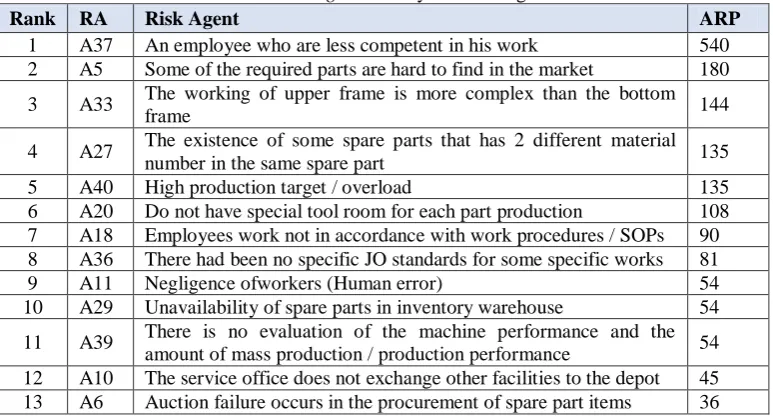
Based on the results of application of the pareto diagram on risk are 80% of the company's losses are caused by 20% risk perceived to impede the company's objectives. By focusing on the perceived 20%, the corporate risk impact of 80% can be resolved. After the application of pareto diagram above, that was obtained from the cumulative total percentage of ARP there is 1 selected risk agent that is (A 37). An employee who are less competent in his work. However, based on brainstorming with the managementof X. Ltd, the risk agentsthat will be the priority risk agent for preventive action are the 13 toprisk agent ranking. Due to the management of X. Ltd that risk agents, was considered to be an obstacle to the goals to be achieved by company.
Table 1.Risk Agent Priority that is mitigated
Rank RA Risk Agent ARP
1 A37 An employee who are less competent in his work 540 2 A5 Some of the required parts are hard to find in the market 180
3 A33 The working of upper frame is more complex than the bottom
frame 144
4 A27 The existence of some spare parts that has 2 different material
number in the same spare part 135
5 A40 High production target / overload 135 6 A20 Do not have special tool room for each part production 108 7 A18 Employees work not in accordance with work procedures / SOPs 90 8 A36 There had been no specific JO standards for some specific works 81 9 A11 Negligence ofworkers (Human error) 54 10 A29 Unavailability of spare parts in inventory warehouse 54
11 A39 There is no evaluation of the machine performance and the amount of mass production / production performance 54 12 A10 The service office does not exchange other facilities to the depot 45 13 A6 Auction failure occurs in the procurement of spare part items 36
3.4 Identification and Prioritizing Proactive Actions
Description:
•
A1, A2, A3 ... An = risk agent selected for mitigation•
PA1, PA2 ... Pan = action / mitigation strategy to be performed•
E11, E12, ... Enm = correlation between mitigation strategy with risk agent•
ARP1 , ARP2..ARPn = Aggregate Risk Potential (ARP) from risk agent•
TE1, TE2 ... TEn = is the total effectiveness of each mitigation action•
D1, D2, D3, ... Dn = the level of difficulty in performing each mitigation action•
ETD1, ETD2, ... ETDn = Total Effectiveness (Tek) with difficulty level Difficulty (Dk)•
R1, R2, R3 ..Rn = rank of each action, ranking based onvalueETD, first rank shows action with highest ETD.
•
Tek = ∑ (2)•
ETDk = (3)Table 2. Model House of Risk Phase 2
Benc hmar king manuf ac tur er of tool s C onduc ti ng the mar ke t sur ve y fir st be fo re pr oc ur ing components De signi ng a spa re pa rts pr oc ur ement pr ogr am thr ee mont hs be for e M aking an ev aluation / moni tor ing of f ac il it ies maintena nc e pr ogr am M aking a punis hment poli cy for wo rks not ac cor ding to S OP S ett ing and appli ca ti ng S OP for tr ea tm ent of mac hine tool s / wor k f ac il it ies De signi ng the cr ea ti on of s pe cial tool r oomi n ea ch pr oduc ti on ar ea C re ati ng M ater ial Numbe r L is t of S pa re P ar ts then noti fy it to L ogis ti cs C enter to de let e it fr om M as ter Da ta li st S AP C ompi lations Ana lyzing M ater ial M ana ge ment P lanning of s ubs ti tut e spa re pa rts that ava il able in the wa re hous e
Preventive Action (PA k)
Risk Agent Risk Agent (Aj) PA 1 PA 2 PA 3 PA 4 PA 5 PA 6 PA 7 PA 8 PA 9 PA 10 Aggregate Risk Potential (ARPj)
Some of the required spare parts are hard to find in the market
A5 9 9 180
Auction failure in the procurement of spare parts items
A6 3 36
The Service Office doesn’t exchange any facilities to Depot
A10 3 45
Negligence of Workers (Human Error)
A11 9 54
Workers didn’t do
Do not have a by Special Tool room for each part of production
A20 3 108
Total effectivity of action k
(Tek) 1620 1620 108 135 1296 270 324 405 486 54
Degree of difficulty
performing action k (Dk) 3 3 4 3 4 4 4 3 5 3 Effectiveness to difficulty
ratio (ETD) 540 540 27 45 324 68 81 135 97 18 Rank of priority 3 4 19 18 7 15 14 9 12 20
The following results of HOR phase 2 in the selection of preventive action that were ranked according to the top ranking of the value of ETD ( Effectiveness to Difficulty Ratio ) among others, (PA 15) transferring employees to other sections according to expertise, (PA 16) increasing the competence and skill of employees, (PA 1) benchmarking Manufacturer of tools, (PA 2) surveying market first before making program, (PA 13) evaluating facility by looking at physical condition of the facility, (PA 19) maximizing the existing supervision, (PA 5) creating a punishment policy to whom that does not perform its work according to SOP, (PA 20) developing a maintenance program according to production capacity, (PA 8) creating a List of material numbersof spare parts to notify them to the Central Logistics to be removed from the master data list SAP components, (PA 18) establishing the performance evaluation of the machine, (PA 12) conducting the organizational structure changes in the production unit, (PA9) analyzing material management, (PA 11) hanging the layout of X. Ltd, (PA 7) designing special tool room in eachproduction area, (PA 6) Preparing a ndapplying SOP in the treatment of machines, tools, or facility, (PA 14) re-evaluating JO standard of each treatment program (PA) 17) scheduling of daily check and preventive actions for prolonging life time of machines, (PA 3) Designing a spare parts procurement program 3 months before, (PA 10) Planning of substitute spare parts that available in the warehouse.
Based on brainstorming with X. Ltd of the 20 (twenty) preventive measures which have been prepared above, but only 10 (ten) preventive actions can be done immediately. Preferred preventive actions include (PA 15), (PA 16), PA 1, PA 2, PA 13, PA 19, PA 5, PA 20, (PA 8), (PA 18). This is due to several factors such as spent expenses, time, and the central office management policies.
3.5 Stage of Control and Monitoring
The last stage are the control and monitoring stage that is done as a process of observing the results of the implementation of the risk response that has been prepared. In this stage, of the probability of new risks are identified as the project progresses. In the process of control, the measurement or evaluation of the effectiveness of the action of each risk response is also carried out. The following are control and monitoring actions that will be undertaken in planning of the implementation of mitigation actions;
Table 3. Action Control and Monitoring
Ranking PA Preventive Action Responsible Monitoring and Control Measures
1 PA15
Moving employees to other sections according to their expertise
General Manager and Head Office
Creating of competency mapping as an information extraction on competence of resources owned by X. Ltd, which will be monitored regularly, and as a justification if the management rolling an employee’s position.
2 PA16
Increasement of employee’s competency and skill
Human Resources Unit
Creating competency mapping as information extraction on competence of resources owned by X. Ltd, to be monitored and evaluated regularly, in order to propose a budget for training each year.
3 PA1
Conducting of benchmarking to tools
manufacturers
Planning Unit
Ranking PA Preventive Action Responsible Monitoring and Control Measures
4 PA2
Conducting of market survey first before making procurement program of parts / components
Work Continuity (Planning Unit)
Coordination with the Depot, in determining the facilities that will go to X. Ltd for maintenance / repair.
5 PA13
Evaluating facilities by looking at the physical condition of the facility
General Manager
Coordination with the head office in preparing the program maintenance / repair facilities at X. Ltd.
6 PA19
Maximizing of supervision of the existing
subordinates
Production Unit
Creating of a work completion target form for each individual in each section, which will then be evaluated during the morning briefing by each assistant manager of each section
7 PA5
Creating of a punishment policy for whom that does not perform its work according to SOP
Human Resources Unit (Human Resources) and Production Unit
Coordination with each unit head unit for routine monitoring to employees who do not perform work according to SOP and give punishment warning if there is a violation.
8 PA20
Arrangement of maintenance program according to production capacity
Palnning Unit and Production Unit
Coordination with head office to consider production capacity at X. Ltd.
9 PA8
Creation a List of spare parts that have double Material number, then notify it to Central Logistics to be deleted from Master Data List of SAP Components
Logistic Unit and Head Office
Coordination with the head office to evaluate the material number on a regular basis of spare parts that has been unused and removed.
10 PA18
Make evaluation of machine
performance
Facilities (Planning Unit)
Monitoring of machines performance on a regular basis, then will be evaluated every month to find out is the level of availability, level of performance, and the level of quality of a machine
IV.CONCLUSION
and implementation of each stage of risk management needs to be monitored to ensure the creation of risk management optimization.
REFERENCES
[1]. Aldhfayan, FS (2008). Project Management Institute. Analysis On The Role Of Standardized Project . [2]. National Standardization Body (2016). Risk Management - Principles and Guidelines for Risk
Management - Principles and Guidelines (ISO: 20019, IDT)
[3]. Fendi, A.2012. Analyze Supply Chain Risk Mitigation Strategy PT. PAL Indonesia (Persero). Skrisption. Adhi Tama Institute. Surabaya
[4]. Hariastuti, BR (2014). ApplicationModelof House of Risk (HOR) for Risk Mitigation On Leather Material Supply.
[5]. Geraldin, LH (2007). Risk Management and Mitigation Action for Creating Robust Supply Chain. Surabaya: Department of Industrial Engineering: SepuluhNopember Institute of Technology.
[6]. NormariaMustianaSirait, USA (2016). OPERasional Risk Analysis Based onApproachEnterprise Risk Management (ERM)at Cardboard Making Company in CV MitraDuniaPalletindo. 3.
[7]. Oktavia, CW, (2005), Risk Analysis and Mitigation withApproachInterpretetive Structural Modeling (ISM), Analytical Network Process (ANP), and House of Risk (HOR) on Procurement Process of Goods and Services at PT. Cement Indonesia (Persero) Tbk, Thesis. Ten November Institute of Technology, Surabaya.
[8]. Pujawan, IN, &Geraldin, L. (2009). House of risk: a model for proactive supply chain risk management. Business Process Management Journal, Vol. 15, No.6, pp.953-967
[9]. Purwandono, DK 2010. ApplicationModelof House of Risk (HOR)for Mitigation of Gempol-Pasuruan Toll Road Project.Thesis.ITS
Ajengretna Maharani "Operational Risk Management Design Inx.Ltd Using House of Risk Method.” IOSR Journal of Engineering (IOSRJEN), vol. 08, no. 7, 2018, pp. 01-08