ISSN: 2231-5381
http://www.ijettjournal.org
Page 2890
Two-Diode Model Performance Analysis of
Photovoltaic Panels
ġaban Yılmaz #1
, Alev Yılmaz *2, Mahit GüneĢ *3 Hasan Rıza Özçalık #4
#
Kahramanmaras Sutcu Imam University1, Kahramanmaraş / Turkey
Abstract— Using of photovoltaic systems is increasing continuously
today, modeling of solar cells is very important as to design the systems more efficiently that requires for the success of simulation studies. Two-diode equivalent circuit is developed and successful model.
To model the photovoltaic (PV) solar cells using two-diode equivalent circuit and comparison of characteristics of catalog values of current voltage and power voltage is the main subject of the article. The model which was created with the help of Matlab is examined how the characteristics will be solar radiation at 1000 w/m2 and 25 °C ambient temperatures.
Keywords: Photovoltaic (PV), Solar Energy, Matlab, two-diode model.
I. INTRODUCTION
The increasing of the productivity in the new generation photovoltaic systems day by day and decreasing in the cost is increased the using of photovoltaic systems significantly. Photovoltaic systems not only the economical energy source for the limited applications like in the past but also becoming an alternative energy source to the traditional methods and producing energy at the range of GWh.
Photovoltaic systems have been the focus of attention because of being environmentally, renewable and long lasting. Planning of photovoltaic systems must be modelled to be planned and optimal using in order to be used optimum.
A solar cell is an electronic device which directly converts sunlight into electricity. Light shining on the solar cell produces both a current and a voltage to generate electric power. This process requires firstly, a material in which the absorption of light raises an electron to a higher energy state, and secondly, the movement of this higher energy electron from the solar cell into an external circuit. The electron then dissipates its energy in the external circuit and returns to the solar cell. A variety of materials and processes can potentially satisfy the requirements for photovoltaic energy conversion, but in practice nearly all photovoltaic energy conversion uses semiconductor materials in the form of a p-n junction.
The generation of current in a solar cell, known as the "light-generated current", involves two key processes. The first process is the absorption of incident photons to create electron-hole pairs. Electron-hole pairs will be generated in the solar cell provided
that the incident photon has energy greater than that of the band gap. However, electrons (in the p-type material), and holes (in the n-type material) are meta-stable and will only exist, on average, for a length of time equal to the minority carrier lifetime before they recombine. If the carrier recombines, then the light-generated electron-hole pair is lost and no current or power can be generated.
A second process, the collection of these carriers by the p-n junction, prevents this recombination by using a p-n junction to spatially separate the electron and the hole. The carriers are separated by the action of the electric field existing at the p-n junction. If the light-generated minority carrier reaches the p-n junction, it is swept across the junction by the electric field at the junction, where it is now a majority carrier. If the emitter and base of the solar cell are connected together (i.e., if the solar cell is short-circuited), the light-generated carriers flow through the external circuit [30].
Figure 1: Cross section of a solar cell[30].
ISSN: 2231-5381
http://www.ijettjournal.org
Page 2891
evaluated two separate models (one-diode and two-diode models) for a solar cell but dependency of the models parameters on environmental conditions has not been fully considered. Hence, the proposed models are not completely accurate. (Sera et al., 2007) have introduced a photovoltaic panel model based on datasheet values; however with some restrict assumptions. Series and shunt resistances of the proposed model have been stated constant and their dependencies on environmental conditions have been ignored. Furthermore, dark-saturation current has been considered as a variable which depend on the temperature but its variations with irradiance has been also neglected. Model equations have been merely stated for a solar panel which composed by several series cells. (De Soto et al., 2006) have also described a detailed model for a solar panel based on data provided by manufacturers. Several equations for the model have been expressed and one of them is derivative of open-circuit voltage respect to the temperature but with some assumptions. Shunt and series resistances have been considered constant through the paper; also their dependency over environmental conditions has been ignored. Meanwhile, only dependency of dark-saturation current to temperature has been considered. (Celik & Acikgoz, 2007) have also presented an analytical one-diode model for a solar panel. In this model, an approximation has been considered to describe the series and shunt resistances; they have been stated by the slopes at the open-circuit voltage and short-circuit current, respectively. Dependencies of the model parameters over environmental conditions have been briefly expressed. Therefore, the model is not suitable for high accuracy applications. (Chenni et al., 2007) have used a model based on four parameters to evaluate three popular types of photovoltaic panels; thin film, multi and mono crystalline silicon. In the proposed model, value of shunt resistance has been considered infinite. The dark-saturation current has been dependent only on the temperature. (Gow & Manning, 1999) have demonstrated a circuit-based simulation model for a photovoltaic cell. The interaction between a proposed power converter and a photovoltaic array has been also studied. In order to extract the initial values of the model parameters at standard conditions, it has been assumed that the slope of current-voltage curve in open-circuit voltage available from the manufacturers. Clearly, this parameter is not supported by a solar panel datasheet and it is obtained only through experiment [32].
II. MATERIAL AND METHOD
Mathematical descriptions of the I-V characteristics of PV cells are available since many years and are derived from the physics of the p-n semiconductor junction.
A crystalline solar cell is, in principle, a large-area silicon diode. In the dark state, the I-V characteristic curve of this diode corresponds to the one of a normal p-n junction diode and it produces neither a voltage nor a current.
Illumination of the PV cell creates free charge carriers, which allow current to flow through a connected load. The so called photocurrent IL is proportional to irradiance. If the circuit is open the photocurrent is shunted internally by the p-n junction diode [31].
The single diode equation assumes a constant value for the ideality factor n. In reality the ideality factor is a function of voltage across the device. At high voltage, when the recombination in the device is dominated by the surfaces and the bulk regions the ideality factor is close to one. However at lower voltages, recombination in the junction dominates and the ideality factor approaches two. The junction recombination is modelled by adding a second diode in parallel with the first and setting the ideality factor typically to two[30].
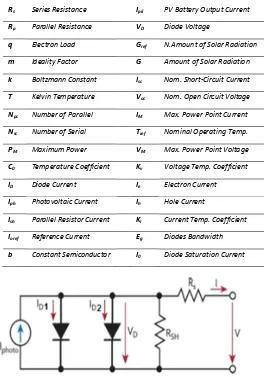
TABLEI
PHOTOVOLTAIC PARAMETERS
Rs Series Resistance Ipil PV Battery Output Current
Rp Parallel Resistance VD Diode Voltage
q Electron Load Gref N.Amount of Solar Radiation
m Ideality Factor G Amount of Solar Radiation
k Boltzmann Constant Isc Nom. Short-Circuit Current
T Kelvin Temperature Voc Nom. Open Circuit Voltage
Npc Number of Parallel IM Max. Power Point Current
Nsc Number of Serial Tref Nominal Operating Temp.
PM Maximum Power VM Max. Power Point Voltage
C0 Temperature Coefficient Kv Voltage Temp. Coefficient
ID Diode Current Ie Electron Current
Iph Photovoltaic Current Ih Hole Current
Ish Parallel Resistor Current Ki Current Temp. Coefficient
Ioref Reference Current Eg Diodes Bandwidth
b Constant Semiconductor I0 Diode Saturation Current
Figure 2: Photovoltaic solar battery two-diode equivalent current [4, 7, and 9]
ISSN: 2231-5381
http://www.ijettjournal.org
Page 2892
parallel resistance is a factor that reduces open circuit voltage and fill factor of the module. The effect of series resistance is a factor that reduces short-circuits current and fill factor of the module [1].
If Kirchhoff current law is applied on the circuit in figure 1;
(1)
The net election current and hole current with Boltzman distribution [2];
(2)
(3)
(4)
q: Electron Load (1.602×10⁻¹⁹ C), k: Boltzmann Constant (1.381×10⁻²³ J/K)
The solar cell equivalent circuit which is shown in figure 1 source current expression is gotten in equation 5 by applying Kirchhoff’s voltage law.
(5)
Solar panels are consists of NPC numbers of parallels panels. Each Npc line is connected in series with each other. The total value of the voltage of photovoltaic which is connected in series to each other calculates by adding together of the current value of each photovoltaic. The total current value of the photovoltaic which is connected in parallel to each other, calculates adding together the current value of that is produced for the same voltage value [2, 3].
Vm, the voltage which is applied to the end of the module Im, module current
VM=Nsc. Vnew (6)
IM=Npc. Inew (7)
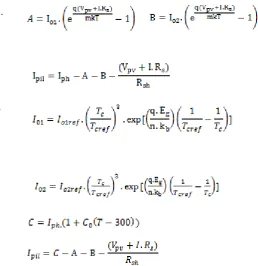
(8)
(9)
(10)
(11)
Eq. (9) is performed by using of Eqs. (10-11) to obtain current of solar cell [1,3,4]
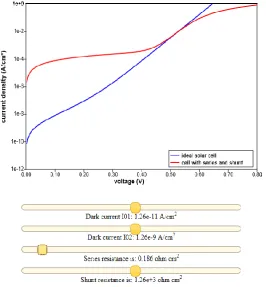
Graph showing the double diode model. The device in gray has no parasitic resistance losses. The device in red has the loss of series and shunt resistance included [30].
ISSN: 2231-5381
http://www.ijettjournal.org
Page 2893
Figure 4: The effect of the parameter-2
Figure 5: The effect of the parameter-3
Figure 6: The effect of the parameter-4
ISSN: 2231-5381
http://www.ijettjournal.org
Page 2894
III.PHOTOVOLTAIC MODELLED PARAMETERS
All paragraphs must be indented. All paragraphs must be justified, i.e. both left-justified and right-justified.
Label values of Sharp NT-S5E1U type photovoltaic panels are power of 185, 0 W, Vmp=36, 21 V, Imp=5, 11 A, Voc=45, 9 V,
Isc=5.75 A, W=15, 5 kg, 1580x808x35 (mm), mono-Si. This type
panel values are applied to our model.
IV.RESULTS
The model which was created with the help of Matlab is examined how the characteristics will be solar radiation at 1000 w/m2 and 25 °C ambient temperatures.
Figure 8: Power-Voltage Characteristics
Figure 9: The difference of Power voltage characteristic
The power voltage characteristics of photovoltaic panel in figure 8, the modal and actual value is seen be very close to each other. For the value of Vmp=36, 21 V PModel =180,301 Watt and
PREAL =186,552 Watt. The fail is %3.22
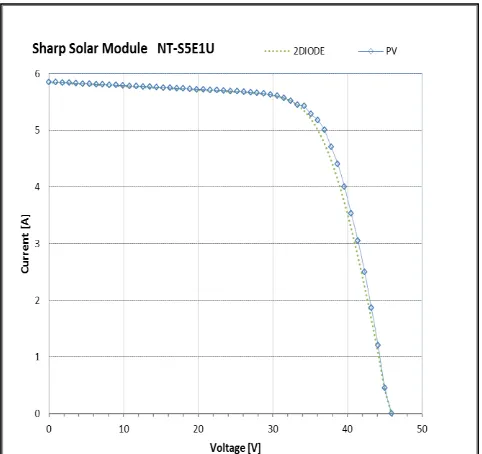
Current –voltage characteristic of photovoltaic panel in figure 10, the model and the actual value is seen be very close to each other. For the value of Vmp=36, 21 V, IModel =5,118 Ampere IREAL
(ACTUAL) =5,182 Watt. The fail is %1, 23
As a result, in the simulation studies which is necessary for photovoltaic systems the two –diode model can be used successfully to model of photovoltaic model.
Figure 10: Current – Voltage Characteristics
ISSN: 2231-5381
http://www.ijettjournal.org
Page 2895
V. REFERENCES
[1] Gökay Bayrak, Mehmet Cebeci, “3,6 kW Gücündeki Fotovoltaik
Generatörün Matlab Simulink Ġle Modellenmesi”, Fırat Üniversitesi, Müh. Fakültesi, Elektrik-Elektronik Müh. Bölümü, ELAZIĞ
[2] Gideon Segev, Gur Mittelman, Abraham Kribus, “Equivalent circuit models for triple-junction concentrator solar cells”, School of Electrical Engineering, Tel Aviv University, TelAviv 69978, Israel, School of Mechanical Engineering, Tel Aviv University, Tel Aviv 69978, Israel, 2011
[3] Kadir Gökhan ġimsek, “ Elektrik Enerjisi Üreten fotovoltaik güneĢ paneli sistemi fonksiyonel modellemesi”, Hacettepe Üniversitesi, Yüksek Lisans Tezi, 2010
[4] Kashif Ishaque, Zainal Salam , Hamed Taheri, Amir Shamsudin, “A critical evaluation of EA computational methods for Photovoltaic cell parameter extraction based on two diode model”, Faculty of Electrical Eng., Universiti Teknologi Malaysia, UTM 81310, Skudai, Johor Bahru, Malaysia,2011
[5] Daniel S.H.Chan Jacob C. H. Phang ,“Analytical Methods for the Extraction of solar-Cell Single- and Double-Diode Model Parameters from I- V Characteristics”, Member IEEE,1987
[6] Erdem CÜCE, “Farklı iĢletme koĢullarında fotovoltaik modüllerin Performans parametrelerinin belirlenmesi”, Karadeniz Teknik Üniversitesi, Yüksek Lisans Tezi, TRABZON, 2009
[7] Mohsen Taherbaneh, A.H. Rezaiea, H. Ghafoorifard, K. Rahimi, M.B. Menhaja and J.M. Milimonfared, “Evaluation of two-diode-model of a solar panel in a wide range of environmental conditions”, Department of Electrical Engineering, Amirkabir University of Technology, Iran, 2010 [8] H.L.Tsai, C.S. Tu, and Y.J. Su, “Development of Generalized Photovoltaic
Model Using MATLAB/SIMULINK”, Proceedings of the World Congress on Engineering and Computer Science, San Francisco, USA,2008 [9] Ġ.H.ALTAġ, “Fotovoltaj GüneĢ Pilleri :EĢdeğer Devre Modelleri ve
GünıĢığı ile Sıcaklığın Etkileri”, Karadeniz Teknik Üniversitesi,1998 [10] Ġ.H.AltaĢ, A.M. Sharaf, “A Photovoltaic Array Simulation Model for
Matlab-Simulink GUI Environment”, Dept. of Electrical and Electronics Engineering, Karadeniz Technical University, Trabzon, Turkey, Dept. of Electrical and Computer Engineering, University of New Brunswick, Fredericton, Canada
[11] Ġ. H. AltaĢ, O. Mengi, “Fotovoltaik GüneĢ Pilleri için Genel amaçlı bir MATLAB/Simulink GUI Modeli “ Karadeniz Teknik Üniversitesi, 2007 [12] K. Ishaque, Z. Salam, H. Taheri, “Simple, fast and accurate two-diode
model for photovoltaic modules” Faculty of Electrical Engineering, Universiti Teknologi Malaysia, UTM81310, Skudai, JohorBahru, Malaysia, 2010
[13] K. Nishioka, N. Sakitani, Y. Uraok, T. Fuyuki “Analysis of multicrystalline silicon solar cells by modified 3-diode equivalent circuit model taking leakagecurrent through periphery into consideration” Graduate School of Materials Science, Japan Advanced Institute of Science and Technology, 1-1 Asahidai, Nomi, Ishikawa, 923-1-1292, Japan,Graduate School of Materials Science, Nara Institute of Science and Technology, 8916-5 Takayama, Ikoma, Nara 630-0101, Japan,2007
[14] M. G. Villalva, J. R. Gazoli, E. Ruppert F.,”Modeling And Circuit-Based Simulation Of Photovoltaic Arrays”, University of Campinas - UNICAMP, Brazil,2009
[15] M. G. Villalva, J. R. Gazoli, E. R. Filho, “Comprehensive Approach to Modeling and Simulation of Photovoltaic Arrays”, IEEE Transactıons On Power Electronıcs, Vol. 24, No. 5, May 2009
[16] ġ. Çamcı, “Konutlar Ġçin, Yakıt Hücresi Ve GüneĢ Pilleri Kullanan, ġebekeden Bağımsız Bir Güç Sisteminin Tasarımı Ve Modellemesi”, Gazi Üniversitesi, Fen bilimleri enstitüsü, Yüksek lisans tezi, 2007
[17] W. D. Soto, S.A. Klein , W.A. Beckman,” Improvement and validation of a model for photovoltaic array performance”, Solar Energy Laboratory, University of Wisconsin-Madison, 1500 Engineering Drive, Madison, WI 53706, USA,2005
[18] Y. Shen, K. Li, N. Majumdar, J.C. Campbell, M. C. Gupta, “Bulk and contact resistance in P3HT:PCBM heterojunction solar cells”, Department of Electrical and Computer Engineering University of Virginia, 351 McCormick Road, Charlottesville, VA22904, USA, 2011
[19] J. S. Kumari, C. S. Babu,” “Mathematical Modeling and Simulation of Photovoltaic Cell, using Matlab-Simulink Environment”, Asst. Professor, Dept of Electrical and Electronics Engg, RGM College of Engg & Tech, Nandyal, India. Professor, Dept of Electrical and Electronics Engg, JNT University, Kakinada, India.
[20] D.Petreus, C.Farcas, I.Cıocan,” Modelling And Simulation Of Photovoltaic Cells”, Technical University of Cluj-Napoca,Faculty of Electronics, Telecommunications and Information Technology,26-28 G. Baritiu Street, Cluj-Napoca, Romania,
[21] ġaban YILMAZ, Mustafa AKSU, Zafer ÖZER, Hasan Rıza ÖZÇALIK, ”
Matlab Ġle GerçekleĢtirilen Fotovoltaik (PV) GüneĢ Pili Modeli Ġle GüneĢ Enerjisi Üretimindeki Önemli Etkenlerin Tespit Edilmesi”, ELECO [22] T. Skočil1, M. P. Donsión, “Mathematical Modeling and Simulation of
Photovoltaic Array”, Department of Electric Power Engineering and Ecology Faculty of Electrical Engineering, University of West Bohemia, Pilsen, Univerzitní Czech Republic, Department of Electrical Engineering, Faculty of Industrial Engineering, University of Vigo, Vigo Campus of Lagoas Marcosende, 36310 Vigo, Spain,
[23] M. Azab, “Improved Circuit Model of Photovoltaic Array”, International Journal of Electrical and Electronics Engineering, 2009
[24] A.Bellini, S.Bifaretti, V.Iacovone, C. Cornaro,” Simplified Model of a Photovoltaic Module”, Dept. of Electronic Engineering, University of Rome Tor Vergata,
[25] D.Petreus, C.Farcas, I.Cıocan,” Modelling And Simulation Of Photovoltaic Cells”, Technical University of Cluj-Napoca,Faculty of Electronics, Telecommunications and Information Technology,26-28 G. Baritiu Street, Cluj-Napoca, Romania,
[26] R.Ramaprabha, B.L.Mathur,” Development of an Improved Model of SPV Cell for Partially Shaded Solar Photovoltaic Arrays” European Journal of Scientific Research ISSN 1450-216X Vol.47 No.1 (2010), pp.122-134 [27] W. Shen, Y. Ding, F. H. Choo, P. Wang, P. C. Loh , K. K. Tan,”
Mathematical model of a solar module for energy yield simulation in photovoltaic systems”, School of Electrical & Electronic Engineering Nanyang Technological University 50 Nanyang Avenue, Singapore 639798 [28] I.L.Alboteanu, S.Ivanov, G.Manolea, “Modelling and simulation of a stand-alone photovoltaic system”, Faculty for Electromechanical, Environment and Industrial Informatics Engineering, University of Craiova, 107, Decebal Bl. 200440, Craiova, ROMANIA
[29] H. I. Cho, S. M. Yeo, C. H. Kim, V. Terzija, Z. M. Radojevic , “A Steady-State Model of the Photovoltaik System in EMTP”
[30] http://pveducation.org/pvcdrom/solar-cell-operation/solar-cell-structure
[31] F. Adamo, F. Attivissimo, A. Di Nisio, A. M. L. Lanzolla, M. Spadavecchia, “Parameters Estimation For A Model Of Photovoltaic Panels”, XIX IMEKO World Congress, Fundamental and Applied Metrology, September 6,11, 2009, Lisbon, Portugal
![Figure 1: Cross section of a solar cell [30].](https://thumb-us.123doks.com/thumbv2/123dok_us/8604065.1725002/1.595.318.565.438.649/figure-cross-section-solar-cell.webp)