1535-9778/07/$08.00⫹0 doi:10.1128/EC.00191-06
Copyright © 2007, American Society for Microbiology. All Rights Reserved.
The Iron-Sulfur Cluster Proteins Isa1 and Isa2 Are Required for the
Function but Not for the De Novo Synthesis of the Fe/S Clusters
of Biotin Synthase in
Saccharomyces cerevisiae
䌤
Ulrich Mu
¨hlenhoff,
1Mathias J. Gerl,
2† Birgit Flauger,
2Heike M. Pirner,
2Sandra Balser,
2Nadine Richhardt,
1Roland Lill,
1and Ju
¨rgen Stolz
2*
Institut fu¨r Zytobiologie und Zytopathologie, Philipps-Universita¨t Marburg, Robert-Koch-Strasse 6, 35033 Marburg, Germany,1and
Lehrstuhl fu¨r Zellbiologie und Pflanzenphysiologie, Universita¨t Regensburg, Universita¨tsstrasse 31, 93040 Regensburg, Germany2
Received 17 June 2006/Accepted 15 January 2007
The yeastSaccharomyces cerevisiaeis able to use some biotin precursors for biotin biosynthesis. Insertion of
a sulfur atom into desthiobiotin, the final step in the biosynthetic pathway, is catalyzed by biotin synthase (Bio2). This mitochondrial protein contains two iron-sulfur (Fe/S) clusters that catalyze the reaction and are thought to act as a sulfur donor. To identify new components of biotin metabolism, we performed a genetic screen and found that Isa2, a mitochondrial protein involved in the formation of Fe/S proteins, is necessary for the conversion of desthiobiotin to biotin. Depletion of Isa2 or the related Isa1, however, did not prevent the de novo synthesis of any of the two Fe/S centers of Bio2. In contrast, Fe/S cluster assembly on Bio2 strongly
depended on the Isu1 and Isu2 proteins. Bothisamutants contained low levels of Bio2. This phenotype was also
found in other mutants impaired in mitochondrial Fe/S protein assembly and in wild-type cells grown under
iron limitation. Low Bio2 levels, however, did not cause the inability ofisamutants to utilize desthiobiotin,
since this defect was not cured by overexpression ofBIO2. Thus, the Isa proteins are crucial for the in vivo
function of biotin synthase but not for the de novo synthesis of its Fe/S clusters. Our data demonstrate that the Isa proteins are essential for the catalytic activity of Bio2 in vivo.
Biotin is a water-soluble vitamin that functions as a pros-thetic group of many carboxylases. It is covalently bound to lysine residues in highly conserved domains of the apoproteins. InSaccharomyces cerevisiae, the best-characterized biotin-con-taining enzymes are acetyl coenzyme A (acetyl-CoA) carbox-ylase, pyruvate carboxcarbox-ylase, and urea amidohydrolase. There are two isoforms of acetyl-CoA carboxylase in yeast. The cy-tosolic Acc1 protein appears to be the dominant form, which is necessary for the generation of malonyl-CoA for fatty acid biosynthesis and elongation (18). Moreover, the mitochondrial protein Hfa1 was recently shown to have acetyl-CoA carboxyl-ase activity and to be essential for the generation of lipoate (21). There are also two isoforms of pyruvate carboxylase (Pyc1 and Pyc2 [56]), but in contrast to the situation in mam-mals, both are cytosolic enzymes in yeast (36, 60). Urea amidohydrolase, produced from theDUR1,2gene, is essential for the utilization of urea as a nitrogen source and harbors two enzymatic activities: urea carboxylase, which depends on bi-otin, and allophanate hydrolase, which is biotin independent (57). Moreover, an additional biotin protein of yeast was re-cently identified to correspond to Arc1, a protein not acting as a carboxylase (30). The covalent linkage of biotin to its target proteins is catalyzed by biotin protein ligase which is encoded by the essentialBPL1gene (8). Since Acc1 is the only essential
substrate of Bpl1, it appears that the essential function of Bpl1 lies in the covalent modification of Acc1 with biotin.
Most strains of S. cerevisiae are classified as biotin auxo-trophs (32). However, the cells are proficient to carry out the last three steps of biotin biosynthesis and generate biotin from the precursors 7-keto-8-aminopelargonic acid (KAPA), 7,8-diaminopelargonic acid (DAPA), and desthiobiotin (also called dethiobiotin) making use of the enzymes encoded by
BIO3 (DAPA aminotransferase), BIO4 (desthiobiotin syn-thase), and BIO2 (biotin synthase). Efficient utilization of KAPA and DAPA requires BIO5, which encodes a plasma membrane permease for both substrates (45). The plasma membrane biotin transporter Vht1 was recently identified inS.
cerevisiae(54) andSchizosaccharomyces pombe (53) where it was also found to mediate the uptake of desthiobiotin. Active biotin uptake is not essential for viability, andvht1⌬mutants are fully complemented by adding high concentrations of bi-otin to the growth medium (53, 54).
The last step in biotin biosynthesis is the insertion of a sulfur atom for two hydrogen atoms at the saturated C-6 and C-9 positions of desthiobiotin, thus creating the thiophane ring of biotin. This reaction is performed by biotin synthase, which is localized to mitochondria. Yeast biotin synthase is related (⬎40% sequence identity) to theEscherichia coliBioB protein, the structure of which has recently been solved and shown to contain a 2Fe/2S and a 4Fe/4S cluster (2). Bio2 carries out a highly complex radical reaction that in vitro requires the pres-ence of a reducing agent (dithiothreitol), flavodoxin,S -adeno-sylmethionine (SAM), and NADPH (2, 11). Although the sul-fur donor for this reaction is still under debate, current evidence strongly implicates the 2Fe/2S cluster of biotin syn-thase as the source of biotin sulfur (2). Thus, biotin synsyn-thase
* Corresponding author. Mailing address: Lehrstuhl fu¨r Zellbiologie und Phlanzenphysiologie, Universita¨t Regensburg, Universita¨tsstrasse 31, 93040 Regensburg, Germany. Phone: 49 941 943 3005. Fax: 49 941 943 3352. E-mail: [email protected].
† Present address: Max Planck Institute of Molecular Cell Biology and Genetics, Pfotenhauerstrasse 108, 01307 Dresden, Germany.
䌤Published ahead of print on 26 January 2007.
495
on September 8, 2020 by guest
http://ec.asm.org/
Downloaded from
on September 8, 2020 by guest
http://ec.asm.org/
Downloaded from
on September 8, 2020 by guest
http://ec.asm.org/
may behave like a reactant which requires the repair of the 2Fe/2S cofactor for subsequent reaction cycles (25). The mi-tochondrial localization of Bio2 necessitates that all reactants required in vivo have to be present in mitochondria. Although the mitochondrial transporter for SAM was recently identified and found to be necessary for biotin synthesis (38), most of the other transport proteins are still elusive. For example, the protein required for desthiobiotin uptake across the mitochon-drial inner membrane is still unknown. Moreover, biotin pro-duced by Bio2 has to be exported to the cytosol where the majority of the biotinylated proteins are found (30).
The goal of the present study was to identify genes that are necessary for the utilization of desthiobiotin byS. cerevisiae
cells. Besides BIO2, we found that biotin biosynthesis from desthiobiotin requires theISA2gene. The encoded mitochon-drial matrix protein Isa2 and the related Isa1 are components of the iron-sulfur cluster (ISC) assembly machinery that cata-lyzes the synthesis of iron-sulfur (Fe/S) clusters and their in-sertion into Fe/S proteins. The ISC assembly machinery is essential for the biosynthesis of mitochondrial Fe/S proteins, and it is also required for the maturation of cytosolic and nuclear Fe/S proteins (35). Most of its members, including the Isa proteins, are related to components encoded by the isc
operon of bacteria (27), and the presence of ISC homologs in virtually all eukaryotic species suggests that this biosynthetic process is highly conserved. Despite this high degree of con-servation, the precise role of the Isa proteins in cellular Fe/S cluster assembly remains unknown. Here, we performed a de-tailed analysis of the role of Isa2 in biotin biosynthesis inS.
cerevisiae.
MATERIALS AND METHODS
Yeast strains and cell growth.The following wild-type strains of Saccharomy-ces cerevisiaewere used: W303-1A (MATaura3-1 ade2-1 trp1-1 his3-11,15 leu2
-3,112), W303-1B (MAT␣ura3-1 ade2-1 trp1-1 his3-11,15 leu2-3,112), and BY4742 (MAT␣his3⌬1 leu2⌬0 lys2⌬0 ura3⌬0). The following strains were derived from W303-1A: Gal-ISA2 (isa2⌬andisa1⌬/isa2⌬) (44), Gal-ISU1/isu2⌬(14), Gal-YAH1 (33), Gal-SSQ1 (39), Gal-ATM1 (31),isa1⌬(29),yfh1⌬(12), Gal-BPL1 (46), Gal-BPL1/bio2⌬(Gal-BPL1bio2⌬::natNT2[23; this work]), and Gal-ISA1 (pISA1::GAL1-10-HIS3[this work]). In strain Gal-ISA1, the upstream region of
ISA1was exchanged for the galactose-inducibleGAL1-10promoter by PCR-mediated gene replacement. The functionality of variousBIO2constructs was tested below (see Fig. 3A) using bio2⌬::kanMX4 cells (BY4742 YGR286C⌬::kanMX4) (EUROSCARF, Frankfurt/Main, Germany). Cells were grown in rich (YP [1% yeast extract, 2% Bacto Peptone]) medium and minimal (synthetic complete [SC]) medium or minimal medium lacking added iron chlo-ride. We refer to this as iron-poor medium because it contains traces of iron from laboratory glassware, distilled water, and various chemicals. Carbon sources were added as required (52). Biotin-free medium was prepared as described previ-ously (53) and supplemented with biotin, desthiobiotin, or KAPA to obtain the desired concentrations. Desthiobiotin, which is chemically synthesized and cer-tified to be free of biotin, was obtained from IBA (Go¨ttingen, Germany).
Mutagenesis of yeast cells.Yeast strain W303-1A was grown in yeast extract-peptone-dextrose, washed in water, and treated with 2% ethylmethane sulfonate for 2 h at 30°C. The cells were plated on SC medium containing 2g/liter biotin. Colonies appearing after 2 days at 30°C were replica plated to SC medium containing either 0.2g/ml biotin or 0.2g/liter desthiobiotin. Colonies forming on the biotin-containing plates but absent from the desthiobiotin-containing plates were purified and backcrossed to W303-1B. Wild-type and mutant spores from the resulting diploid were used in most experiments.
-Galactosidase assays.-Galactosidase assays were performed according to published protocols (28) with minor modifications. Ten OD600(optical density at 600 nm) units of logarithmically growing yeast cells were washed and broken with glass beads in 250l of 50 mM Na phosphate buffer (pH 7.0) containing 4 mM phenylmethylsulfonyl fluoride using a BIO101 FastPrep instrument. After the
addition of 250l of 50 mM Na phosphate buffer (pH 7.0), the extract was centrifuged for 5 min in a microcentrifuge, and the protein concentration of the supernatant was determined by the Bradford assay (5). In parallel, the -galac-tosidase activity of the supernatant was determined with ortho-nitrophenyl--D -galactoside (ONPG) at 37°C as described previously (28). Activities are reported in micromoles of ONPG hydrolyzed per milligram of protein per minute.
Plasmids.To investigate iron binding to Isa2 and Bio2 in vivo, the wild-type genes and the respective mutant alleles ofISA2andBIO2were inserted into the 2m plasmid p426-GPD downstream of the strong constitutiveTDH3promoter or into the low-copy plasmid p416-MET25 where expression is driven from the promoter ofMET25(13). TheBIO2alleles encoding proteins with defects in Fe/S cluster coordination were generated by site-directed mutagenesis using PCR. Replacement of three cysteine residues (C99, C103, and C106) by serine generated the⌬4Fe/4S mutant. Replacement of cysteine 143 by Ala created the ⌬2Fe/2S mutant. Both mutations were combined to obtain a double mutant lacking both Fe/S clusters.
TheBIO2-GFP plasmid was generated by ligation of a PCR product contain-ing 1,000 bp of theBIO2promoter and the entireBIO2open reading frame into theURA3-CEN plasmid YCplac33-GFP (37). This plasmid complements the growth defect ofbio2⌬mutants on desthiobiotin-containing plates and, as as-sessed by fluorescence microscopy, targets green fluorescent protein (GFP) to mitochondria (M. J. Gerl and J. Stolz, unpublished results). The same promoter fragment was fused to a full-lengthlacZgene in a centromeric vector to give the reporter plasmid used in Fig. 5B (46). The yeast genomic library in the
CEN-TRP1vector pRS200 was described before (16) and obtained from the American Type Culture Collection (ATCC 77164).
Miscellaneous methods.In vivo labeling of yeast cells with radioactive55FeCl 3 (ICN) and measurement of55
Fe incorporation into Fe/S proteins by precipita-tion with specific sera and scintillaprecipita-tion counting was carried out as described previously (31, 39). Growth assays on agar plates were performed according to published methods (55). Biotinylated proteins were detected in whole-cell ex-tracts using streptavidin-coupled peroxidase (strep-PO) as described previously (46). To remove strep-PO from desthiobiotinylated proteins, Western blots were incubated for 16 h in TBST (Tris-buffered saline with 0.05% Tween 20) buffer containing 2 mM desthiobiotin and 1% bovine serum albumin. The following published methods were used: manipulation of DNA (50), transformation of yeast cells (15), preparation of yeast mitochondria (10), and immunological techniques (17).
RESULTS
S.cerevisiae mutants with defects in the utilization of
des-thiobiotin.To identify genes that are essential for the
utiliza-tion of desthiobiotin, we performed a genetic screen in which
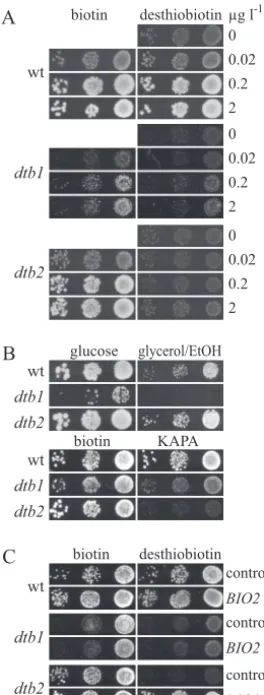
S.cerevisiaecells were treated with the mutagen ethylmethane sulfonate and replica plated on either biotin- or desthiobiotin-containing plates. Two mutants (dtb1 and dtb2) with specific growth defects on desthiobiotin plates were isolated from the pool of 15,000 surviving cells (Fig. 1A). In addition to growth defects on desthiobiotin, dtb1 cells grew much slower than wild-type cells in the presence of biotin. Thedtb1 cells were also unable to use glycerol or ethanol as a carbon source and produced only small colonies on glucose-containing complete medium (Fig. 1B), indicating a defect in respiration (petite phenotype). Thedtb2mutants behaved like wild-type cells and were able to utilize glycerol/ethanol. We also performed growth assays on plates containing the biotin precursor KAPA (Fig. 1B). Whereas wild-type cells were competent to use KAPA,dtb1 mutants showed reduced growth on KAPA and
dtb2 mutants were even more affected. All above-described phenotypes of thedtb1mutants cosegregated in two successive crossings, indicating that they resulted from a single mutation. As expected from the different growth phenotypes, a diploid strain generated by mating of the dtb1 and dtb2 mutants showed full complementation and possessed normal growth on desthiobiotin-containing media (data not shown). Thus,dtb1
anddtb2define different complementation groups.
on September 8, 2020 by guest
http://ec.asm.org/
An obvious candidate for a gene conferring theDtb pheno-type isBIO2, the structural gene encoding biotin synthase. We tested whether the dtb1 or dtb2 cells carried a mutation in
BIO2by transformation with a centromeric plasmid expressing a functional Bio2-GFP fusion protein (see Materials and Methods). Expression ofBIO2-GFP did not correct the growth defect of thedtb1mutant but did correct that ofdtb2cells (Fig. 2C). Crossing of abio2⌬strain with thedtb2mutant resulted in a diploid that was unable to utilize desthiobiotin as a biotin source (data not shown). Thebio2allele fromdtb2cells con-tained a point mutation that substituted Gln189 for a stop codon, truncating the Bio2 protein to about half of its original size. We therefore conclude that the dtb2 cells carry a null mutation in BIO2 (designated bio2-1) and this causes their failure to convert desthiobiotin to biotin.
dtb1carries a mutation inISA2.Next, we addressed the gene
defective in thedtb1mutant. We initially tried, without much success, to complement the growth defect of thedtb1mutant on glycerol-containing plates (Fig. 1B) by transformation with single-copy or multicopy genomic libraries. When we used the same libraries to complement the desthiobiotin defect of the
dtb1mutant on glucose, however, transformations were imme-diately successful and produced 30 colonies that were capable of using desthiobiotin as a biotin source. Plasmids isolated from these cells contained almost identical fragments from chromosome XVI. The smallest plasmid contained a truncated version ofROX1and the genesUBA3,ISA2,HOS1,SPE3, and
MED1. Isa2 was previously identified as a mitochondrial pro-tein involved in the formation of Fe/S clusters (3), and biotin synthase carries two Fe/S clusters that are required for its activity (2, 19). Complementation of a dtb1 mutant with a plasmid expressingISA2from a strong promoter restored the growth of thedtb1mutant on desthiobiotin-containing plates (Fig. 2A), indicating thatISA2was responsible for complemen-tation. Expression ofISA2, however, did not correct the growth defect of thedtb1mutant back to wild-type levels.ISA2 trans-formants still displayed growth retardation relative to wild-type cells on biotin-containing minimal (Fig. 2A) or complete me-dium (Fig. 2B) containing glucose as a carbon source, and they were not able to grow on containing glycerol and ethanol plates (Fig. 2B). It is known that mutation ofISA2leads to a loss of mitochondrial DNA, a defect that cannot be genetically com-plemented (26, 44). This secondary defect of isa2 mutants
FIG. 1. Phenotypic characterization of the dtb1 and dtb2 biotin biosynthetic mutants. (A)S.cerevisiaewild-type (wt) cells (W303-1A) or the isogenicdtb1anddtb2mutants were grown on plates containing 2g liter⫺1biotin, washed, diluted, and plated on SD plates containing
the indicated concentrations of biotin or desthiobiotin. Growth was recorded after 2 days at 30°C. (〉and C) Growth of the same strains used in panel A was assayed on plates containing 0.8 nM (equivalent to 0.2g liter⫺1) biotin, 0.8 nM desthiobiotin, or 0.8 nM KAPA. The
plates in panel B contained YP supplemented with either 2% glucose or 3% glycerol and 3% ethanol (EtOH). Growth on YP plates was recorded after 3 days at 30°C, whereas the other plates were scanned after 2 days. In panel C, complementation tests of thedtb1anddtb2
mutants were performed with theBIO2plasmid YCplac33-BIO2-GFP or with an empty YCplac33 control.
FIG. 2. Cloning ofISA2and characterization of Isa2 from thedtb1mutant. The wild-type (wt) strain,dtb1mutants overexpressingISA2from vector p426-GPD, ordtb1mutants harboring an empty p426-GPD control plasmid were grown in liquid culture containing 2g liter⫺1biotin. The
cells were washed and plated on SD plates containing 0.2g liter⫺1biotin or desthiobiotin (A) or YP plates containing either glucose or a mixture
of 3% glycerol and 3% ethanol (EtOH) (〉). Growth was recorded after 2 days (A) or 3 days (B) at 30°C. (C) Wild-type yeast cells harboring an empty p426-GPD control plasmid or overproducing Isa2 or Isa2 G91D (encoded by theisa2-1allele) from the same plasmid were cultivated in iron-poor minimal medium supplemented with glucose. Cells were labeled with 10Ci55Fe for 2 h, cell lysates were prepared, and Isa2 was
precipitated with a specific antiserum. The amount of radioactivity precipitating with Isa2 was quantified by liquid scintillation counting. A wild-type strain containing the empty plasmid served as a control. Error bars represent the standard deviations.
on September 8, 2020 by guest
http://ec.asm.org/
explains our inability to clone the gene defective indtb1 by complementation of the petite phenotype. A diploid strain generated by crossing thedtb1mutant with aisa2⌬strain was indistinguishable from its two haploid parents, had growth defects on desthiobiotin, and was unable to grow on glycerol/ ethanol plates (data not shown). TheISA2gene fromdtb1cells carried a point mutation that changed the codon for Gly91 to Asp (G91D). Gly91 is part of a conserved sequence motif present in Isa2. This motif (88-GCHGFQY-94) is called ISAI, and Gly91 within this motif is highly conserved in organisms ranging from bacteria to humans (26, 29, 44). These results indicate thatdtb1carries a mutatedISA2allele that encodes a nonfunctional protein.
S.cerevisiaecontains two homologousISAgenes which are not functionally redundant, as yeasts deleted for eitherISA1or
ISA2show virtually identical phenotypes that are not exacer-bated by deletion of both genes (26, 44). We therefore ana-lyzed the growth behavior of anisa1⌬ strain and found that, similar to thedtb1mutant and to theisa2⌬strain, it was unable to utilize desthiobiotin (data not shown). Thus, both Isa pro-teins appear to be necessary for biotin biosynthesis.
Isa2 from dtb1 mutants is not defective in iron binding.
Several members of the Isa/IscA family, including Isa1 fromS.
pombehave been shown to bind iron in vitro (40, 62). Recent crystallographic studies have provided evidence that iron bind-ing is likely mediated by the cysteine-containbind-ing ISAII motif present at the C termini of all known Isa proteins (3, 9). InS.
cerevisiae, mutations of any of the conserved cysteine residues result in loss of function of Isa1 in vivo, suggesting that bound iron is necessary for the function of the Isa proteins (29). We therefore tested whether Isa2 (G91D) showed a reduced af-finity for iron. To this end, wild-type yeast cells were trans-formed with multicopy plasmids that contained either wild-typeISA2or theisa2-1allele under control of the strongTDH3
promoter. Cells were grown in iron-poor minimal medium supplemented with glucose and labeled with55Fe in vivo.
Ex-tracts were prepared, and Isa2 was isolated by precipitation with a specific serum, followed by scintillation counting (Fig. 2C). Similar amounts of iron precipitated with wild-type Isa2 and Isa2 carrying the G91D substitution. Iron binding was specific, as much lower levels of radioactivity were precipitated from cells that did not overexpress Isa2. In summary, this experiment demonstrates that the G91D substitution does not affect iron binding of Isa2 and therefore provides no explana-tion whyisa2mutants are defective in synthesizing biotin from desthiobiotin.
Isa1 and Isa2 are not required for de novo Fe/S cluster
assembly on biotin synthase. IscA and SufA, two bacterial
orthologs of the Isa proteins, have been shown to promote Fe/S cluster assembly on bacterial ferredoxins or biotin syn-thase in vitro (40, 42, 61, 62). We therefore analyzed whether the defect of the dtb1 mutant was the result of a defective maturation of Bio2 in vivo. To this end, we generated two versions of Bio2 in which the ligands of the 4Fe/4S or the 2Fe/2S clusters were replaced. These experiments were facili-tated by the recent determination of the structure ofE. coli
biotin synthase (2), which identified the residues that coordi-nate the 4Fe/4S and 2Fe/2S clusters, all of which are conserved in the S. cerevisiae protein. To construct Bio2 ⌬2Fe/2S, we replaced residue C143 with alanine. The Bio2⌬4Fe/4S protein
resulted from substitution of three closely spaced cysteine res-idues (C99, C103 and C106) each by serine. In addition, these mutations were combined to create a version of Bio2 lacking both Fe/S cofactors. The corresponding open reading frames were inserted into the yeast vector p426-GPD under the con-trol of the strong constitutiveTDH3promoter and tested for functionality by transformation into abio2⌬strain (Fig. 3A). Whereas the cells producing the wild-type Bio2 possessed full growth on plates containing desthiobiotin, expression of the Fe/S cluster mutants showed only background levels of growth. This finding was similar to the results of a mutational analysis of theE. coliBioB protein (19) and indicated that the Bio2 proteins harboring cysteine replacements were not functional in the conversion of desthiobiotin to biotin.
For the analysis of Fe/S cluster assembly, theseBIO2 -con-taining plasmids were introduced into the conditional yeast strain Gal-ISA2. This strain carries the endogenousISA2gene under the control of theGAL1-10promoter, which is induced upon growth in the presence of galactose and repressed by glucose. The use of this strain was necessary, since yeast mu-tants with defective mitochondrial DNA, such as isa2⌬ or
isa2-1, possess pleiotropic phenotypes that frequently interfere with the analysis of Fe/S cluster maturation in vivo (26, 29). Prior to the analysis, Gal-ISA2 cells were grown for 4 days on solid minimal medium supplemented with glucose, and as
FIG. 3. Fe/S cluster formation on Bio2 does not require Isa2 in vivo. (A)S.cerevisiae bio2⌬mutants (BY4742bio2⌬::kanMX) were transformed with plasmids to overproduce wild-type (wt) Bio2, the Bio2⌬4Fe/4S variant lacking the 4Fe/4S cluster, the Bio2 ⌬2Fe/2S variant lacking the 2Fe/2S cluster, or a Bio2 variant lacking both clusters. Dilutions of the cells were spotted on media containing 0.2g liter⫺1of either biotin or desthiobiotin, and growth was recorded after
3 days at 30°C. (B) Gal-ISA2 cells overproducing wild-type Bio2 and mutant Bio2 variants as in panel A were incubated in iron-poor min-imal medium supplemented with galactose (Gal) or glucose (Glc) in order to induce or repressISA2, respectively. Cells were incubated with 10Ci55Fe for 2 h, and Bio2 was precipitated from cell lysates
with a polyclonal serum against Bio2. The amount of radioactivity that coprecipitated with Bio2 was quantified by liquid scintillation counting. Error bars represent the standard deviations. Western blot analysis of the cell lysates for Bio2 and Isa2 is shown below the bar graph.
on September 8, 2020 by guest
http://ec.asm.org/
judged by Western blotting, Isa2 levels were dramatically re-duced by this treatment (Fig. 3B). For the analysis of Fe/S cluster formation, these cells were grown in iron-poor medium supplemented with glucose or galactose for 16 h, labeled with
55Fe in vivo, and harvested, and a cell lysate was prepared.
Bio2 was isolated by precipitation with a polyclonal serum raised against Bio2, and the amount of 55Fe present in the
precipitate was determined. High levels of55Fe were
precipi-tated from Gal-ISA2 cells overexpressing wild-type Bio2 (Fig. 3B). These were specific, as much lower levels of radioactivity were precipitated in strains producing the Bio2 ⌬4Fe/4S
⌬2Fe/2S protein. This residual level of radioactivity likely cor-responds to wild-type Bio2 produced from the endogenous
BIO2locus. Strikingly, iron binding to wild-type Bio2 was sim-ilar in Gal-ISA2 cells grown under permissive (Gal) or repres-sive (Glc) conditions. In the case of Bio2 ⌬4Fe/4S, the net amount of iron incorporation was slightly lower than for the wild-type version and slightly increased in cells depleted for Isa2. Similarly, iron binding of Bio2⌬2Fe/2S was unchanged upon depletion of Isa2. Since the levels of Bio2 were similar in all extracts analyzed (Fig. 3B), these data strongly suggest that Isa2 is not required for the formation of the Fe/S clusters of Bio2 in vivo.
On the basis of in vitro studies, the Isa proteins have been proposed to function as Fe/S scaffolding proteins that may work in parallel with the Isu proteins, the major Fe/S scaffold-ing proteins in yeast mitochondria (14, 40, 43, 62). To further characterize the requirements of the maturation of the Fe/S cofactors of Bio2, we carried out in vivo55Fe labeling
experi-ments of Bio2 with the Gal-ISA1 and Gal-ISU1/⌬isu2strains (14). Under permissive conditions, significant amounts of55Fe
were precipitated by Bio2-specific sera from all cells, regard-less of the overexpression of either wild-type Bio2 or the
⌬4Fe/4S and⌬2Fe/2S versions (Fig. 4A). The net amount of iron incorporated into wild-type Bio2 remained almost un-changed in Gal-ISA1 cells depleted for Isa1 (Fig. 4A). In the
⌬4Fe/4S and⌬2Fe/2S mutants, iron incorporation increased slightly in Gal-ISA1 cells cultivated under repressive condi-tions, where Isa1 was almost absent (Fig. 4A). Thus, our anal-yses with both conditional Gal-ISA strains demonstrated that the Isa proteins play no role in de novo Fe/S cluster formation of Bio2. As a further control, we analyzed55Fe binding to Bio2
in a isa1⌬/isa2⌬double mutant overexpressing the wild-type allele ofBIO2. The amount of55Fe isolated with Bio2 in this
strain was comparable to that observed with ISA1 or Gal-ISA2 cells grown under inducing conditions. An additional observation of the experiments presented in Fig. 3B and Fig. 4A was that the amount of iron bound to the cluster mutants of Bio2 was variable. This fact might result from the different sensitivities of the 2Fe/2S and 4Fe/4S clusters towards contact with air and towards reducing conditions (25), as well as from a possible partial retention of the 2Fe/2S cluster after removal of only one of its cysteine ligands (19). Nevertheless, all forms of Bio2 tested here did not significantly differ in their iron content depending on the presence or absence of the Isa pro-teins. Thus, our findings demonstrate that neither Isa1 nor Isa2 is involved in the net formation of the Fe/S clusters of yeast biotin synthase in vivo.
A different result was obtained when we compared iron incorporation into wild-type Bio2, Bio2 ⌬4Fe/4S, and Bio2
⌬2Fe/2S in Gal-ISU1/⌬isu2cells (Fig. 4B). We observed that the single Fe/S cluster mutants of Bio2 contained high levels of iron whenISU1was expressed. Growth in glucose, however, caused a strong reduction in the levels of Isu1 and strongly reduced the incorporation of55Fe into all forms of Bio2 (Fig.
4B). As judged by Western blotting, the levels of Bio2 were similar in all conditions. Taken together, these data indicate that the net synthesis of both Fe/S clusters of Bio2 requires the Isu proteins but not the Isa proteins in vivo. Moreover, the inability of theisa2-1mutant to convert desthiobiotin to biotin is not caused by a defect in the de novo assembly of the two Fe/S clusters of Bio2.
Expression of BIO2is reduced inisa mutants.The biotin
synthesis defect of theisamutants might be due to a reduced expression of Bio2 to levels that may be too low to support growth in the presence of desthiobiotin. To directly test this hypothesis, we performed Western blotting experiments with
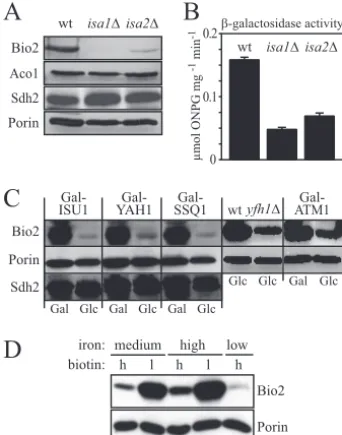
isa1⌬andisa2⌬cells. The amount of Bio2 was in fact severely reduced in mitochondria from bothisamutants compared to the wild type (Fig. 5A). In contrast, the abundance of the mitochondrial Fe/S protein aconitase (Aco1) or the Fe/S pro-tein subunit of succinate dehydrogenase (Sdh2) appeared
un-FIG. 4. Fe/S cluster formation on Bio2 requires Isu1 in vivo. Gal-ISA1 andisa1⌬isa2⌬ double mutants (A) or Gal-ISU1/⌬isu2 cells (B) overproducing wild-type (wt) Bio2 or the Bio2 variants described in the legend to Fig. 3 were incubated in iron-poor minimal medium supplemented with galactose (Gal) or glucose (Glc) in order to induce or repressISA1orISU1. Iron incorporation into Bio2 was analyzed as described in the legend to Fig. 3. Cell lysates were probed for Bio2, Isu1, and Isa1 by Western blotting.
on September 8, 2020 by guest
http://ec.asm.org/
changed in bothisa mutants, as were the levels of the mito-chondrial outer membrane protein porin. This strongly suggests that the low levels of Bio2 in bothisa mutants were specific for Bio2 and not generally observed for other Fe/S proteins.
We next transformed wild-type,isa1⌬, andisa2⌬cells with a reporter plasmid in which the promoter of theBIO2gene was fused tolacZ. This reporter construct allowed us to measure the activity of theBIO2 promoter and to eliminate possible effects of protein or RNA stability that might have influenced the amount of Bio2 detected in Western blots. Figure 5B shows thatlacZactivities in theisa1⌬strain amounted to only 30% of the wild-type control, whereas theisa2⌬strain possessed 43% of the wild-type activity. Thus, the reporter assays qualitatively agree with the results of Western blotting (Fig. 5B) and
dem-onstrate that bothisamutants have reduced amounts of Bio2 because of reduced transcription of theBIO2gene.
The expression of some of the genes of the biotin biosyn-thetic pathway is influenced by iron availability (1, 48, 51). In yeast, defects in cellular Fe/S cluster biogenesis frequently display a deregulated iron homeostasis, which is one of the factors associated with the induction of iron uptake genes that are under the control of the iron-sensing transcription factor
AFT1and the accumulation of iron within the mitochondria (49). In order to find an explanation for the low abundance of Bio2 in cells deleted for ISA1 or ISA2, we tested whether similar low levels of Bio2 could be observed in other mutants with defects in cellular Fe/S protein assembly. To this end, the conditional yeast mutants Gal-ISU1/⌬isu2, Gal-YAH1, and Gal-SSQ1 were grown under inducing and repressing condi-tions, and the levels of Bio2 were analyzed (Fig. 5C). The abundance of Bio2 strongly decreased in all of these mutants under repressive conditions, whereas the levels of the Fe/S protein subunit of succinate dehydrogenase (Sdh2) or porin were similar in all samples analyzed. Low levels of Bio2 were also observed in ayfh1⌬strain lacking the yeast homolog of frataxin. These data suggest that various defects in the mito-chondrial ISC assembly machinery lead to a decreased expres-sion of Bio2. Low levels of Bio2 were also found in Gal-ATM1 cells, which are defective only in the maturation of extramito-chondrial Fe/S proteins (Fig. 5C). Together, these observations indicate that the low Bio2 levels are the result of a deregulated gene expression in response to defects in cellular Fe/S protein maturation.
In order to verify that the abundance of Bio2 is directly influenced by the environmental iron concentration in our strain background, wild-type yeast cells were cultivated in low-, intermediate-, and high-iron media, and these treatments were combined with variation in the biotin concentration, which was either high (2g liter⫺1 as in standard SC medium) or low
(0.02 g liter⫺1). When whole-cell extracts from these cells
were analyzed by Western blotting, we found that Bio2 levels were highest in cells from high-iron media and were hardly detectable in cells grown in low iron (Fig. 5D). Moreover, as observed before (46), Bio2 showed an inverse correlation with the biotin content and was more abundant in cells from low-biotin media. The mitochondrial outer membrane protein porin, in contrast, had a similar abundance in all samples, indicating that the changes in protein levels described above are specific for Bio2. Taken together, these results suggest that the drastically reduced cellular levels of Bio2 in ISC mutants may result from the iron-deplete status prevailing in these cells. Functional defects of the Isa proteins and other ISC components thus indirectly affect biotin synthesis from desthio-biotin via low cytosolic iron levels causing decreased expres-sion of theBIO2gene.
Biotin synthase is not functional inisamutants.If the
ob-served low cellular levels of Bio2 alone were responsible for the inability of the isa mutants to utilize desthiobiotin, this phenotype should be cured by constitutive expression ofBIO2. In order to test this possibility, aisa1⌬/isa2⌬double mutant that expressedBIO2from either a high-copy (p426-GPD) or a low-copy vector (p416-MET25) was depleted of biotin for 40 h and either spotted on minimal medium plates supplemented with desthiobiotin (20g/liter) or diluted into biotin-free
me-FIG. 5. Expression of BIO2 is low in cells with defects in Fe/S protein maturation and under iron-limiting conditions. (A) Mitochon-dria were isolated from wild-type (wt),isa1⌬, andisa2⌬cells, and the abundance of biotin synthase (Bio2), aconitase (Aco1), the iron-sulfur protein subunit of succinate dehydrogenase (Sdh2), and the mitochon-drial porin (Por1) were determined by Western blotting. (B) -Galac-tosidase activities were determined for wild-type,isa1⌬, andisa2⌬cells expressing thelacZgene under control of theBIO2 promoter. The assays were performed in triplicate on soluble cell extracts, and the activities are reported as micromoles of ortho-nitrophenyl--D -galac-toside consumed per milligram of protein per minute. Error bars represent the standard deviations. (C) Gal-ISU1/⌬isu2, Gal-YAH1, Gal-SSQ1, Gal-ATM1, andyfh1⌬cells were grown in minimal medium supplemented with galactose (Gal) or glucose (Glc), and the expres-sion levels of Bio2, porin, and the Fe/S protein subunit of succinate dehydrogenase (Sdh2) were analyzed by Western blotting of whole-cell extracts. (D) W303-1A wild-type cells were grown in standard SC medium (containing 0.74M FeCl3[medium iron]), high-iron medium
[SC medium plus 300M Fe(NH4)2(SO4)2], or low-iron medium (SC
medium plus 100M of the iron chelator 4,7-diphenyl-1,10-phenan-throlinedisulfonate). In addition, medium contained either the stan-dard amount (2g liter⫺1[lanes labeled h for high]) or a reduced
amount of biotin (0.02g liter⫺1[lanes labeled l for low]). Whole-cell
extracts were analyzed by Western blotting using polyclonal sera di-rected against Bio2 or the mitochondrial outer membrane protein porin. Poor growth prevented the analysis of cells grown in low-biotin/ low-iron media.
on September 8, 2020 by guest
http://ec.asm.org/
dium in the absence or presence of moderate (20g/liter) or high concentrations (100g/liter) of desthiobiotin. Neither of the twoBIO2plasmids rescued the growth defect of theisa1⌬/
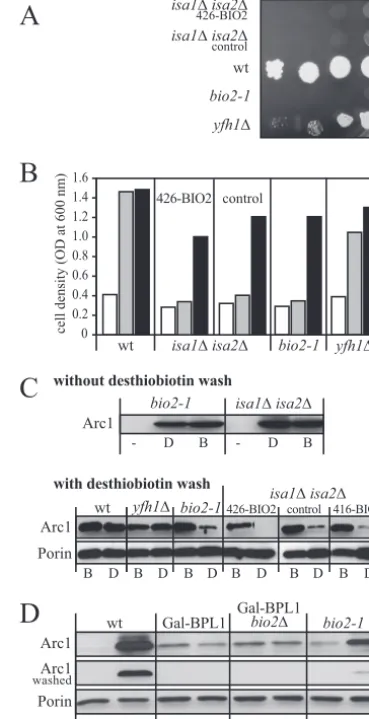
isa2⌬double mutant on media containing only desthiobiotin (Fig. 6A and B). In contrast, theyfh1⌬strain displayed a slow but robust growth in desthiobiotin-containing media, despite having a reduced amount of Bio2 (Fig. 5C) and defects in Fe/S protein maturation (12). This indicates that reduced levels of Bio2 alone are not sufficient to explain the inability of theisa
mutants to thrive on desthiobiotin. In addition, wild-type cells,
bio2-1, yfh1⌬, and isa1⌬isa2⌬ mutants failed to grow in the absence of biotin but recovered in biotin-containing medium, indicating that cells were still viable after cultivation in biotin-free medium for 40 h (Fig. 6B). Taken together, these data strongly suggest that Bio2 is not functional in cells lacking the Isa proteins, despite the fact that iron can be efficiently incor-porated into both Fe/S clusters of Bio2.
To further explore the defects of theisamutants, we isolated cell extracts and detected biotinylated proteins in Western blots using streptavidin coupled to peroxidase. Biotin is co-valently attached to six yeast proteins. Of these, the Arc1 protein is a convenient marker of the biotin status because the abundance of biotinyl-Arc1 strongly depends on biotin avail-ability (46). Thus, when desthiobiotin is provided as a biotin source, the amount of biotinyl-Arc1 reflects the biotin biosyn-thetic activity of the cell and can serve as a marker for Bio2 activity, which is difficult to directly assay in vitro.
As expected, biotin modifications on Arc1 were strongly reduced in cells cultivated without biotin or desthiobiotin (Fig. 6C). In contrast, Arc1 was readily bound by streptavidin when the cells were cultivated in the presence of biotin or desthio-biotin, even when isa1⌬/isa2⌬ double mutants or thebio2-1
mutant that did not contain a functional Bio2 protein were used. Since streptavidin can bind to both desthiobiotin and biotin (20), a possible explanation of these surprising results is that yeast biotin ligase attached desthiobiotin instead of biotin to Arc1. To distinguish between biotinylated and desthiobio-tinylated Arc1, we made use of the fact that the interaction of desthiobiotin with streptavidin is reversible, whereas its inter-action with biotin is stable (20). The streptavidin-decorated blot was washed with desthiobiotin, and the detection proce-dure was repeated (Fig. 6C). We found that washing with desthiobiotin strongly reduced the signal for Arc1 in extracts frombio2-1cells grown in the presence of desthiobiotin (Fig. 6C). A similar loss of streptavidin binding to Arc1 was ob-served in⌬isa1/⌬isa2cells cultivated in the presence of des-thiobiotin, regardless of whether these cells overexpressed
BIO2or not (Fig. 6C). In contrast, in wild-type andyfh1⌬cells that were able to utilize desthiobiotin, streptavidin could not be removed from Arc1 by washing with desthiobiotin, indicat-ing that these cells contained predominantly biotinylated Arc1. To further substantiate that the modification of Arc1 causing the reversible binding of streptavidin was desthiobiotin, the dependence of this modification on the activity of biotin-pro-tein ligase, Bpl1, was analyzed. To this end, we used Gal-BPL1 cells in which the activity ofBPL1can be experimentally con-trolled (46) and additionally deleted BIO2 in these cells to create strain Gal-BPL1/bio2⌬. We then depleted Bpl1 in glu-cose-containing media in these cells and simultaneously de-pleted the cells of biotin. In contrast to wild-type andbio2-1
FIG. 6. Biotin synthase is inactive inisa⌬cells.S.cerevisiaewild-type (wt) cells, aisa1⌬isa2⌬double mutant expressingBIO2from the low-copy plasmid p416-MET25 (416-BIO2) or the high-copy vector p426-GPD (426-BIO2),isa1⌬isa2⌬cells carrying the empty p416-MET25 plas-mid (control),bio2-1, oryfh1⌬cells were grown for 40 h in liquid minimal SD medium lacking biotin. (A) Serial dilutions of yeast strains were spotted on SD plates containing 20g liter⫺1desthiobiotin and incubated
for 3 days at 30°C. (B) Equal numbers of cells were diluted in biotin-free SD medium without further supplementation (white bars) or supple-mented with 20g liter⫺1desthiobiotin (gray bars) or with 2g liter⫺1
biotin (black bars). Cell growth was recorded by measuring the optical density (OD) at 600 nm after incubation for 24 h at 30°C. (C) The cells grown in biotin (B) or desthiobiotin (D) used in Fig. 6B were harvested, cell lysates were prepared, and Arc1 was detected by streptavidin linked to peroxidase (strep-PO) in Western blots. The blots were developed imme-diately after decoration with strep-PO (top blot) or after a subsequent incubation with 2 mM desthiobiotin for 16 h to assess whether strep-PO can be removed (bottom blot). Reduced signal intensities after washing indicate that the strep-PO reactivity resulted from a reversible interaction, likely with desthiobiotinylated proteins on the blot. The extracts were also stained for porin, which served as a loading control. (D) The addition of desthiobiotin to Arc1 requires the activity of biotin-protein ligase. The yeast cells indicated above the lanes were grown for 48 h in glucose-containing minimal medium to decrease the expression ofBPL1in strains containing the Gal-BPL1 allele. The media used contained no biotin source. Cells were shifted for 16 h to the same medium (⫺) or to medium containing 20g liter⫺1desthiobiotin (D). Protein extracts of the cells
were separated by sodium dodecyl sulfate-polyacrylamide gel electro-phoresis, and Arc1 was detected by strep-PO in Western blots. The blots were developed either immediately (top blot) or after washing with 2 mM desthiobiotin for 16 h to remove reversibly bound strep-PO (middle blot). A stain for porin (bottom blot) served as a loading control.
on September 8, 2020 by guest
http://ec.asm.org/
cells, the addition of desthiobiotin to glucose-grown Gal-BPL1 or Gal-BPL1/bio2⌬cells did not result in an increased binding of streptavidin to Arc1 (Fig. 6D). This indicates that the activ-ity of Bpl1 is required for the modification of Arc1, which causes streptavidin binding. The fact that streptavidin binding to Arc1 in bio2 mutants can be reversed by washing with desthiobiotin and that it requires the activity of Bpl1 makes it likely that Arc1 is desthiobiotinylated when a functional form of Bio2 is missing. Thus, wild-type cells that are able to grow on desthiobiotin-containing plates contained a high proportion of biotinylated proteins. In contrast, cells with defects in biotin synthesis, such asbio2mutants orisa1⌬isa2⌬double mutants, possessed mostly desthiobiotinylated proteins that lack cata-lytic activity.
In conclusion, our data demonstrate that the failure of the
isamutants to grow in the presence of desthiobiotin is confined to the last step of biotin synthesis, the insertion of sulfur into desthiobiotin, which is catalyzed by biotin synthase. The fact that the Fe/S clusters of Bio2 were assembled at normal rates in the absence of the Isa proteins indicates that the Bio2 holoprotein is not functional when the Isa proteins are absent. Together, these findings strongly suggest that the Isa proteins play a direct role in the catalytic cycle of biotin biosynthesis. They might be involved in regenerating the 2Fe/2S cluster of biotin synthase in vivo. The mechanism of this reaction is at present not clear, but it would minimally require the replace-ment of a single sulfur atom that is lost from Bio2 for each molecule of biotin formed.
DISCUSSION
We have isolated theISA2 gene in a genetic screen forS.
cerevisiaemutants with defects in the conversion of desthiobi-otin to bidesthiobi-otin. This sulfur insertion reaction is the last step of biotin biosynthesis and is catalyzed by biotin synthase (Bio2), a Fe/S protein from the family of radical SAM enzymes (11, 34). Isa2 is a member of the mitochondrial Fe/S cluster assembly system and itself is an iron-containing protein (35). The amount of iron bound to the G91D form of Isa2 isolated in the screen was similar to that of the wild-type protein, demonstrat-ing that net iron binddemonstrat-ing was unaffected by the mutation. To address the function of Isa2 in biotin biosynthesis, we investi-gated whether the defect of isa2 mutants was caused by a defect in the maturation of the Fe/S clusters of Bio2. Surpris-ingly, our results demonstrated that neither Isa2 nor the paralogous Isa1 protein was required for the net de novo synthesis of any of the two Fe/S clusters of Bio2 in vivo. Studies carried out in vitro have shown thatS. pombe Isa1 and the bacterial IscA or SufA proteins assist Fe/S cluster formation on biotin synthase or 2Fe/2S ferredoxins, in that they may harbor a mobile Fe/S cofactor that can be transferred to apoproteins in vitro (4, 40, 43, 62). Bacterial IscA was found to be tran-siently associated with biotin synthase during Fe/S cluster transfer from IscA to the apoprotein, suggesting a specific catalytic role in this process (43). On the basis of the results of these studies, it has been suggested that the IscA proteins perform a role as scaffold proteins similar to the IscU proteins. However, our experiments fail to demonstrate that the eukary-otic Isa proteins are required for the net synthesis of the Fe/S clusters of Bio2 in vivo.
Evidence for a role of the Isa proteins in Fe/S cluster bio-genesis in vivo was mainly provided by studies carried out with
S.cerevisiaecells. The twoISAgenes are not required for yeast cell viability, and deletion of either gene is associated with identical, mild phenotypes (26, 29, 44). Although these and similar genetic studies of theiscAgene inE.colihave demon-strated the fundamental importance of this class of proteins in Fe/S cluster formation, their precise function has remained unclear. Our study on biotin synthase shows for the first time that the Isa proteins are not generally required for the de novo synthesis of all cellular Fe/S clusters, despite the fact that the Isa proteins are widely distributed and well conserved. In fact, modetailed analyses in yeast have shown that they are re-quired only for a small subset of Fe/S proteins in vivo (U. Mu¨hlenhoff, unpublished data). In contrast, all S. cerevisiae
Fe/S proteins analyzed so far, including Bio2, require the Isu proteins for net Fe/S cluster assembly (14, 39). The Isu pro-teins perform a central role as scaffolds for Fe/S cluster assem-bly in yeast mitochondria. They are essential for viability and show a remarkably high degree of sequence conservation.
Despite the fact that the Isa proteins are not required for the net synthesis of any of the two Fe/S centers of biotin synthase, the failure of theisamutants to utilize desthiobiotin was con-fined to the last step of biotin biosynthesis, which is catalyzed by Bio2. This reaction involves SAM, desthiobiotin, a sulfur source, and a reductant (11, 24). The isa mutants are not impaired in desthiobiotin uptake, as was evident from the fact that their biotin-dependent enzymes were desthiobiotinylated in the absence of biotin. In addition, these cells must be capa-ble of producing SAM, as this is an essential metabolite (58). Sulfur is most likely derived from cysteine and transferred via one of the two Fe/S clusters of biotin synthase (59). This step most likely involves the cysteine desulfurase Nfs1. SinceNFS1
is essential inS.cerevisiae, we can rule out the possibility that this protein is defective in theisa mutants (31). The physio-logical reductant used in yeast mitochondria is unknown, but it likely involves ferredoxin (Yah1), which is also essential for viability (33). In conclusion, it seems unlikely that the failure of the isa mutants to produce biotin from desthiobiotin results from a missing substrate rather than from a loss of functional biotin synthase.
The precise catalytic mechanism of biotin synthase is unre-solved. There is a general agreement that the 4Fe/4S cluster of the active form of biotin synthase mediates the electron trans-fer to SAM, while the 2Fe/2S cluster is considered to be the sulfur donor (11, 22, 24, 34, 41, 59). On the basis of experi-ments in vitro, biotin synthase has been proposed to function as a reactant that is capable of performing only a single sulfur insertion per reaction cycle (11). From the perspective of a living cell, this represents a considerable waste of resources and there is increasing evidence that biotin synthase behaves as an enzyme in vivo which is able to perform multiple rounds of sulfur insertions (6). This requires that the catalytic 2Fe/2S cluster of Bio2 must be regenerated after each round of catal-ysis. On the basis of our experimental results, we suggest that the Isa proteins may function in this regeneration step. This is an attractive idea, as it explains the phenotype of theisa mu-tants and is consistent with the observation that the Isa pro-teins are dispensable for the net synthesis of the Fe/S centers of Bio2. Alternatively, Bio2 may be inhibited by an unknown
on September 8, 2020 by guest
http://ec.asm.org/
substance that accumulates in mitochondria when Fe/S cluster maturation is defective. The latter scenario seems unlikely, as cells deleted for the Fe/S assembly protein Yfh1 are capable of synthesizing biotin in vivo. Experimental proof that will allow us to distinguish between these possibilities will require further work with biotin synthase in vitro.
Our experiments showed thatisamutants and other mutants with defects in the mitochondrial Fe/S cluster biogenesis sys-tem display reduced levels of Bio2. Although these low expres-sion levels may contribute to a reduced biotin production, they alone are not sufficient to explain the failure of theisamutants to synthesize biotin. On the one hand, cells lacking the yeast frataxin homolog Yfh1, similar to the isamutants, displayed low levels of Bio2, but nevertheless, they were able to grow on medium containing desthiobiotin. On the other hand, overex-pression of BIO2 from plasmids failed to rescue the growth defects ofisamutants, indicating that even when produced at high levels, biotin synthase is inactive.
InS.cerevisiae, biotin synthesis genes are regulated by iron availability. This iron-regulated expression is under transcrip-tional control, and BIO2, BIO3, and BIO4 are poorly ex-pressed, whileBIO5andVHT1are induced by iron limitation (51). The physiological meaning of these observations is not understood. In yeast, defects in cellular Fe/S maturation in-duce a deregulated iron homeostasis that results in a constitu-tive induction of iron uptake genes that are under the control of the Aft transcription factors and an accumulation of iron within mitochondria. Proper iron sensing by Aft1 requires the function of the mitochondrial ISC assembly and export systems (49). The constitutive activation of Aft1 in ISC mutants is thus reminiscent of iron-starved cells. The observed low expression ofBIO2in all ISC mutants tested may thus be a physiological consequence of impaired mitochondrial Fe/S cluster assembly and export systems, and the resulting phenotype resembles that of an iron-starved cell. Most likely, the expression of other iron-regulated biotin synthesis genes is also affected. Low tran-scription levels forBIO2and elevated levels ofBIO5andVHT1
were found in yeast cells lacking the ABC transporter Atm1 or the mitochondrial ferredoxin Yah1 (A. Hausmann et al., un-published data), and levels ofBIO5were also increased in cells deleted for the glutaredoxin geneGRX5(1).
We find that proteins isolated frombio2mutants contain a modification that interacts with streptavidin in a reversible fashion and requires biotin-protein ligase to be established. Based on these findings, this modification is desthiobiotin, which is transferred to apoproteins by biotin-protein ligase when biotin is unavailable. A similar transfer of desthiobiotin was also reported for theE.colibiotin-protein ligase encoded bybirAin vitro; however, this reaction was much less effective than the transfer of biotin, and it required high concentrations of desthiobiotin (63). Transfer of desthiobiotin to apoproteins was not observed inE.coliin vivo (6), demonstrating that the yeast and bacterial enzymes differ in their substrate specifici-ties. This shows thatS.cerevisiaecells are unable to efficiently discriminate between biotin and desthiobiotin at the level of protein modification. We have shown forS.pombeand have evidence for S. cerevisiae that biotin and desthiobiotin are acquired via the biotin transporter Vht1 (53; Gerl and Stolz, unpublished). Thus, the activity of Bio2 is essential to prevent desthiobiotin from becoming incorporated into apoproteins,
which would lead to the formation of holoproteins that lack enzymatic activity. This role of biotin synthase is further sup-ported by the fact that there are several fungal and bacterial species that contain homologs ofBIO2 despite the fact that they lack a complete biotin biosynthetic pathway (7, 47, 53).
In conclusion, this work establishes two surprising connec-tions between the assembly of Fe/S clusters and the synthesis of biotin. (i) Impairment of Fe/S cluster biogenesis reduces the expression of biotin synthase. This appears to result from the iron-limited status that prevails in cells with defects in Fe/S protein maturation. (ii) Biotin synthase present inisamutants is inactive, indicating that the Isa proteins have a direct role in the catalytic cycle of biotin synthase in vivo. This observation points toward the Isa proteins playing a role in the regenera-tion of the 2Fe/2S cluster of Bio2. This funcregenera-tion will have to be substantiated by future biochemical work, which involves the reconstitution of the biotin synthase reaction cycle with puri-fied components.
ACKNOWLEDGMENTS
We thank Sabine Laberer, Roland Donhauser, Petra Reihl, and Stefan Ringlstetter for technical assistance and Claude Alban (Bayer Crop Science, Lyon, France) for the gift of KAPA.
This work was supported by grants of the Deutsche Forschungs-gemeinschaft (SFB593, SFB521, STO 434/2-1, and the Gottfried-Wilhelm-Leibniz program), Fonds der Chemischen Industrie, Deut-sches Humangenomprojekt, and the Fritz-Thyssen-Stiftung.
REFERENCES
1.Belli, G., M. M. Molina, J. Garcia-Martinez, J. E. Perez-Ortin, and E. Herrero.2004. Saccharomyces cerevisiae glutaredoxin 5-deficient cells sub-jected to continuous oxidizing conditions are affected in the expression of specific sets of genes. J. Biol. Chem.279:12386–12395.
2.Berkovitch, F., Y. Nicolet, J. T. Wan, J. T. Jarrett, and C. L. Drennan.2004. Crystal structure of biotin synthase, an S-adenosylmethionine-dependent radical enzyme. Science303:76–79.
3.Bilder, P. W., H. Ding, and M. E. Newcomer.2004. Crystal structure of the ancient, Fe-S scaffold IscA reveals a novel protein fold. Biochemistry43: 133–139.
4.Bonomi, F., S. Iametti, D. Ta, and L. E. Vickery.2005. Multiple turnover transfer of [2Fe2S] clusters by the iron-sulfur cluster assembly scaffold pro-teins IscU and IscA. J. Biol. Chem.280:29513–29518.
5.Bradford, M. M.1976. A rapid and sensitive method for the quantitation of microgram quantities of protein utilizing the principle of protein-dye bind-ing. Anal. Biochem.72:248–254.
6.Choi-Rhee, E., and J. E. Cronan.2005. Biotin synthase is catalytic in vivo, but catalysis engenders destruction of the protein. Chem. Biol.12:461–468. 7.Cliften, P. F., L. W. Hillier, L. Fulton, T. Graves, T. Miner, W. R. Gish, R. H.
Waterston, and M. Johnston.2001. Surveying Saccharomyces genomes to identify functional elements by comparative DNA sequence analysis. Ge-nome Res.11:1175–1186.
8.Cronan, J. E., Jr., and J. C. Wallace.1995. The gene encoding the biotin-apoprotein ligase of Saccharomyces cerevisiae. FEMS Microbiol. Lett.130: 221–229.
9.Cupp-Vickery, J. R., J. J. Silberg, D. T. Ta, and L. E. Vickery.2004. Crystal structure of IscA, an iron-sulfur cluster assembly protein from Escherichia coli. J. Mol. Biol.338:127–137.
10.Diekert, K., A. I. de Kroon, G. Kispal, and R. Lill.2001. Isolation and subfractionation of mitochondria from the yeast Saccharomyces cerevisiae. Methods Cell Biol.65:37–51.
11.Fontecave, M., S. Ollagnier-de-Choudens, and E. Mulliez.2003. Biological radical sulfur insertion reactions. Chem. Rev.103:2149–2166.
12.Foury, F.1999. Low iron concentration and aconitase deficiency in a yeast frataxin homologue deficient strain. FEBS Lett.456:281–284.
13.Funk, M., R. Niedenthal, D. Mumberg, K. Brinkmann, V. Ronicke, and T. Henkel.2002. Vector systems for heterologous expression of proteins in Saccharomyces cerevisiae. Methods Enzymol.350:248–257.
14.Gerber, J., K. Neumann, C. Prohl, U. Mu¨hlenhoff, and R. Lill.2004. The yeast scaffold proteins Isu1 and Isu2 are required inside mitochondria for maturation of cytosolic Fe/S proteins. Mol. Cell. Biol.24:4848–4857. 15.Gietz, R. D., and R. A. Woods.2002. Transformation of yeast by lithium
acetate/single-stranded carrier DNA/polyethylene glycol method. Methods Enzymol.350:87–96.
on September 8, 2020 by guest
http://ec.asm.org/
16.Halbrook, J., and M. F. Hoekstra.1994. Mutations in theSaccharomyces cerevisiae CDC1gene affect double-strand-break-induced intrachromosomal recombination. Mol. Cell. Biol.14:8037–8050.
17.Harlow, E., and D. Lane.1988. Antibodies: a laboratory manual. Cold Spring Harbor Laboratory Press, Cold Spring Harbor, NY.
18.Hasslacher, M., A. S. Ivessa, F. Paltauf, and S. D. Kohlwein.1993. Acetyl-CoA carboxylase from yeast is an essential enzyme and is regulated by factors that control phospholipid metabolism. J. Biol. Chem.268:10946– 10952.
19.Hewitson, K. S., S. Ollagnier-de Choudens, Y. Sanakis, N. M. Shaw, J. E. Baldwin, E. Munck, P. L. Roach, and M. Fontecave.2002. The iron-sulfur center of biotin synthase: site-directed mutants. J. Biol. Inorg. Chem.7:83– 93.
20.Hirsch, J. D., L. Eslamizar, B. J. Filanoski, N. Malekzadeh, R. P. Haugland, and J. M. Beechem.2002. Easily reversible desthiobiotin binding to strepta-vidin, astrepta-vidin, and other biotin-binding proteins: uses for protein labeling, detection, and isolation. Anal. Biochem.308:343–357.
21.Hoja, U., S. Marthol, J. Hofmann, S. Stegner, R. Schulz, S. Meier, E. Greiner, and E. Schweizer. 2004. HFA1 encoding an organelle-specific acetyl-CoA carboxylase controls mitochondrial fatty acid synthesis in Sac-charomyces cerevisiae. J. Biol. Chem.279:21779–21786.
22.Jameson, G. N., M. M. Cosper, H. L. Hernandez, M. K. Johnson, and B. H. Huynh.2004. Role of the [2Fe-2S] cluster in recombinant Escherichia coli biotin synthase. Biochemistry43:2022–2031.
23.Janke, C., M. M. Magiera, N. Rathfelder, C. Taxis, S. Reber, H. Maekawa, A. Moreno-Borchart, G. Doenges, E. Schwob, E. Schiebel, and M. Knop. 2004. A versatile toolbox for PCR-based tagging of yeast genes: new fluo-rescent proteins, more markers and promoter substitution cassettes. Yeast 21:947–962.
24.Jarrett, J. T.2005. Biotin synthase: enzyme or reactant? Chem. Biol.12: 409–410.
25.Jarrett, J. T.2005. The novel structure and chemistry of iron-sulfur clusters in the adenosylmethionine-dependent radical enzyme biotin synthase. Arch. Biochem. Biophys.433:312–321.
26.Jensen, L. T., and V. C. Culotta.2000. Role ofSaccharomyces cerevisiae ISA1
andISA2in iron homeostasis. Mol. Cell. Biol.20:3918–3927.
27.Johnson, D. C., D. R. Dean, A. D. Smith, and M. K. Johnson.2005. Structure, function, and formation of biological iron-sulfur clusters. Annu. Rev. Bio-chem.74:247–281.
28.Kaiser, C., S. Michaelis, and A. Mitchell.1994. Methods in yeast genetics: a Cold Spring Harbor Laboratory course manual. Cold Spring Harbor Labo-ratory Press, Cold Spring Harbor, NY.
29.Kaut, A., H. Lange, K. Diekert, G. Kispal, and R. Lill.2000. Isa1 is a component of the mitochondrial machinery for maturation of cellular iron-sulfur proteins and requires conserved cysteine residues for function. J. Biol. Chem.275:15955–15961.
30.Kim, H. S., U. Hoja, J. Stolz, G. Sauer, and E. Schweizer.2004. Identification of the tRNA-binding protein Arc1 as a novel target of in vivo biotinylation in Saccharomyces cerevisiae. J. Biol. Chem.279:42445–42452.
31.Kispal, G., P. Csere, C. Prohl, and R. Lill.1999. The mitochondrial proteins Atm1 and Nfs1 are essential for biogenesis of cytosolic Fe/S proteins. EMBO J.18:3981–3989.
32.Koser, S. A.1968. Vitamin requirements of bacteria and yeasts. Charles C Thomas, Springfield, IL.
33.Lange, H., A. Kaut, G. Kispal, and R. Lill.2000. A mitochondrial ferredoxin is essential for biogenesis of cellular iron-sulfur proteins. Proc. Natl. Acad. Sci. USA97:1050–1055.
34.Layer, G., D. W. Heinz, D. Jahn, and W. D. Schubert.2004. Structure and function of radical SAM enzymes. Curr. Opin. Chem. Biol.8:468–476. 35.Lill, R., and U. Mu¨hlenhoff. 2005. Iron-sulfur-protein biogenesis in
eu-karyotes. Trends Biochem. Sci.30:133–141.
36.Lim, F., M. Rohde, C. P. Morris, and J. C. Wallace.1987. Pyruvate carbox-ylase in the yeast pyc mutant. Arch. Biochem. Biophys.258:259–264. 37.Malinska, K., J. Malinsky, M. Opekarova, and W. Tanner.2003.
Visualiza-tion of protein compartmentaVisualiza-tion within the plasma membrane of living yeast cells. Mol. Biol. Cell14:4427–4436.
38.Marobbio, C. M., G. Agrimi, F. M. Lasorsa, and F. Palmieri.2003. Identi-fication and functional reconstitution of yeast mitochondrial carrier for S-adenosylmethionine. EMBO J.22:5975–5982.
39.Mu¨hlenhoff, U., J. Gerber, N. Richhardt, and R. Lill.2003. Components involved in assembly and dislocation of iron-sulfur clusters on the scaffold protein Isu1. EMBO J.22:4815–4825.
40.Ollagnier-de Choudens, S., L. Nachin, Y. Sanakis, L. Loiseau, F. Barras, and M. Fontecave.2003. SufA from Erwinia chrysanthemi. Characterization of a
scaffold protein required for iron-sulfur cluster assembly. J. Biol. Chem. 278:17993–18001.
41.Ollagnier-de Choudens, S., Y. Sanakis, K. S. Hewitson, P. Roach, E. Munck, and M. Fontecave.2002. Reductive cleavage of S-adenosylmethionine by biotin synthase from Escherichia coli. J. Biol. Chem.277:13449–13454. 42.Ollagnier-de-Choudens, S., T. Mattioli, Y. Takahashi, and M. Fontecave.
2001. Iron-sulfur cluster assembly: characterization of IscA and evidence for a specific and functional complex with ferredoxin. J. Biol. Chem.276:22604– 22607.
43.Ollagnier-de-Choudens, S., Y. Sanakis, and M. Fontecave.2004. SufA/IscA: reactivity studies of a class of scaffold proteins involved in [Fe-S] cluster assembly. J. Biol. Inorg. Chem.9:828–838.
44.Pelzer, W., U. Mu¨hlenhoff, K. Diekert, K. Siegmund, G. Kispal, and R. Lill. 2000. Mitochondrial Isa2 plays a crucial role in the maturation of cellular iron-sulfur proteins. FEBS Lett.476:134–139.
45.Phalip, V., I. Kuhn, Y. Lemoine, and J. M. Jeltsch.1999. Characterization of the biotin biosynthesis pathway in Saccharomyces cerevisiae and evidence for a cluster containing BIO5, a novel gene involved in vitamer uptake. Gene 232:43–51.
46.Pirner, H. M., and J. Stolz.2006. Biotin sensing in Saccharomyces cerevisiae is mediated by a conserved DNA element and requires the activity of biotin-protein ligase. J. Biol. Chem.281:12381–12389.
47.Rodionov, D. A., and M. S. Gelfand.2006. Computational identification of BioR, a transcriptional regulator of biotin metabolism in Alphaproteobac-teria, and of its binding signal. FEMS Microbiol. Lett.255:102–107. 48.Rutherford, J. C., S. Jaron, and D. R. Winge.2003. Aft1 and Aft2 mediate
iron-responsive gene expression in yeast through related promoter elements. J. Biol. Chem.278:27636–27643.
49.Rutherford, J. C., L. Ojeda, J. Balk, U. Mu¨hlenhoff, R. Lill, and D. R. Winge. 2005. Activation of the iron regulon by the yeast Aft1/Aft2 transcription factors depends on mitochondrial but not cytosolic iron-sulfur protein bio-genesis. J. Biol. Chem.280:10135–10140.
50.Sambrook, J., and D. W. Russell.2001. Molecular cloning: a laboratory manual. Cold Spring Harbor Laboratory Press, Cold Spring Harbor, NY. 51.Shakoury-Elizeh, M., J. Tiedeman, J. Rashford, T. Ferea, J. Demeter, E.
Garcia, R. Rolfes, P. O. Brown, D. Botstein, and C. C. Philpott.2004. Transcriptional remodeling in response to iron deprivation in Saccharomy-ces cerevisiae. Mol. Biol. Cell15:1233–1243.
52.Sherman, F.1991. Getting started with yeast. Methods Enzymol.194:3–21. 53.Stolz, J.2003. Isolation and characterization of the plasma membrane biotin
transporter from Schizosaccharomyces pombe. Yeast20:221–231. 54.Stolz, J., U. Hoja, S. Meier, N. Sauer, and E. Schweizer.1999. Identification
of the plasma membrane H⫹-biotin symporter of Saccharomyces cerevisiae by rescue of a fatty acid-auxotrophic mutant. J. Biol. Chem.274:18741– 18746.
55.Stolz, J., and M. Vielreicher.2003. Tpn1, the plasma membrane vitamin B6 transporter of Saccharomyces cerevisiae. J. Biol. Chem.278:18990–18996. 56.Stucka, R., S. Dequin, J. M. Salmon, and C. Gancedo.1991. DNA sequences
in chromosomes II and VII code for pyruvate carboxylase isoenzymes in Saccharomyces cerevisiae: analysis of pyruvate carboxylase-deficient strains. Mol. Gen. Genet.229:307–315.
57.Sumrada, R. A., and T. G. Cooper.1982. Urea carboxylase and allophanate hydrolase are components of a multifunctional protein in yeast. J. Biol. Chem.257:9119–9127.
58.Thomas, D., A. Becker, and Y. Surdin-Kerjan.2000. Reverse methionine biosynthesis from S-adenosylmethionine in eukaryotic cells. J. Biol. Chem. 275:40718–40724.
59.Tse Sum Bui, B., T. A. Mattioli, D. Florentin, G. Bolbach, and A. Marquet. 2006. Escherichia coli biotin synthase produces selenobiotin. Further evi-dence of the involvement of the [2Fe-2S]2⫹cluster in the sulfur insertion step. Biochemistry45:3824–3834.
60.Walker, M. E., D. L. Val, M. Rohde, R. J. Devenish, and J. C. Wallace.1991. Yeast pyruvate carboxylase: identification of two genes encoding isoenzymes. Biochem. Biophys. Res. Commun.176:1210–1217.
61.Wollenberg, M., C. Berndt, E. Bill, J. D. Schwenn, and A. Seidler.2003. A dimer of the FeS cluster biosynthesis protein IscA from cyanobacteria binds a [2Fe2S] cluster between two protomers and transfers it to [2Fe2S] and [4Fe4S] apo proteins. Eur. J. Biochem.270:1662–1671.
62.Wu, G., S. S. Mansy, C. Hemann, R. Hille, K. K. Surerus, and J. A. Cowan. 2002. Iron-sulfur cluster biosynthesis: characterization of Schizosaccharomy-ces pombe Isa1. J. Biol. Inorg. Chem.7:526–532.
63.Wu, S. C., and S. L. Wong.2004. Development of an enzymatic method for site-specific incorporation of desthiobiotin to recombinant proteins in vitro. Anal. Biochem.331:340–348.
on September 8, 2020 by guest
http://ec.asm.org/
1535-9778/07/$08.00⫹0 doi:10.1128/EC.00086-07
ERRATUM
The Iron-Sulfur Cluster Proteins Isa1 and Isa2 Are Required for the Function
but Not for the De Novo Synthesis of the Fe/S Clusters of Biotin Synthase
in
Saccharomyces cerevisiae
Ulrich Mu
¨hlenhoff, Mathias J. Gerl, Birgit Flauger, Heike M. Pirner, Sandra Balser,
Nadine Richhardt, Roland Lill, and Ju
¨rgen Stolz
Institut fu¨r Zytobiologie und Zytopathologie, Philipps-Universita¨t Marburg, Robert-Koch-Strasse 6, 35033 Marburg, Germany, and Lehrstuhl fu¨r Zellbiologie und Pflanzenphysiologie, Universita¨t Regensburg, Universita¨tsstrasse 31, 93040 Regensburg, Germany
Volume 6, no. 3, p. 495–504, 2007. Page 495: The title should read “The ISC Proteins Isa1 and Isa2 Are Required for the Function but Not for the De Novo Synthesis of the Fe/S Clusters of Biotin Synthase inSaccharomyces cerevisiae.”