Emperor International Journal of Finance and Management Research [EIJFMR] Page 151
A STUDY ON PHYSICO-CHEMICAL
PARAMETERS OF PECHIPARAI DAM
WATER
K.S.ANUJA
Research Scholar, S.T.Hindu College,Nagercoil
GUIDE : Dr.B.INDIRANI,
Principal
Sree Devi Kumari women’s College,Kuzhithurai
CO-GUIDE: Dr.C.VAITHYA NATHAN,
S.T.Hindu College, Nagercoil
I. ABSTRACT
The present paper includes an assessment of the quality ofPechiparai dam situated in Kanyakumari district.The quality water affects the human health.The dam water is used for irrigation drinking and fishing .The dam provides water for more than 50% population for agriculture and other activities.The analysis givesus a knowledge on quality of water. The water samples were analysed from 2010 June to May 2011. Water is analyzed for seasonal variation in temperature,pH,electrical conductivity,dissolved oxygen,chloride,total hardness,totalalkalinity,biochemical oxygen demand, total dissolved solids, chemical oxygen demand.The results reveal that .The range of seasonal variation in different parameters was temperature 27o C to 30.2oC, Ph 6.99 to7.68, electrical conductivity 25 to 84 (µmho/cm),total hardness 8.0 to 22 mg/lit. Dissolved oxygen 5.20 mg/lit to 6.29 mg/lit. Biochemical oxygen demand 4.54 to 5.65 mg/lit.Chloride 3mg/lit to 5mg/lit. Total alkalinity 9 mg/lit to 16mg/lit. Total dissolved solids 20 to 33 mg/lit. chemical oxygen demand 9to 19 mg/lit. All the parameters are within the permissible limit recommended by WHO.
II. INTRODUCTION
Emperor International Journal of Finance and Management Research [EIJFMR] Page 152
reservoir and reported that high BOD value is unflavoured with zooplankton.Water quality parameters provide the basis for judging the suitability of water for its designed uses and to improve existing conditions. For optimum development and management for beneficial uses, current information is needed which is provided by water quality programmers.Unequal distribution of water on the surface of the earth and fast declining availability of usable freshwater are the major concern in terms of water quantity and quality (Shinde et al., 2011). The natural aquatic resources are causing heavy and varied pollution in aquatic environment leading to pollute water quality and depletion of aquatic biota (Basavaraja et al., 2011). According to surveys Indian water resources are polluted and many endemic diseases kill millions of people each year. So water bodies are analysed for their suitability for various purposes. The aim of the study is to make a qualitative assessment of the physicochemicalcondition prevailing in the dam and how that water is useful for irrigation and drinking for human and fishing purpose.
PECHIPARAIDAM
III. MATERIALS AND METHODS
Water samples were collected from the selected dam stations. The samples were stored in polythene bottles of one litre capacity, precleaned with conc.HNO3 and the samples were then preserved
using 1milli litre conc. HNO3 inorder to prevent the
loss of metals during storage (APHA, 1998 and De,
1998). The Physico-chemical parameters of the water samples were analyzed by the following methods as outlined in Trivedi (1990) and American public health Association (1998).
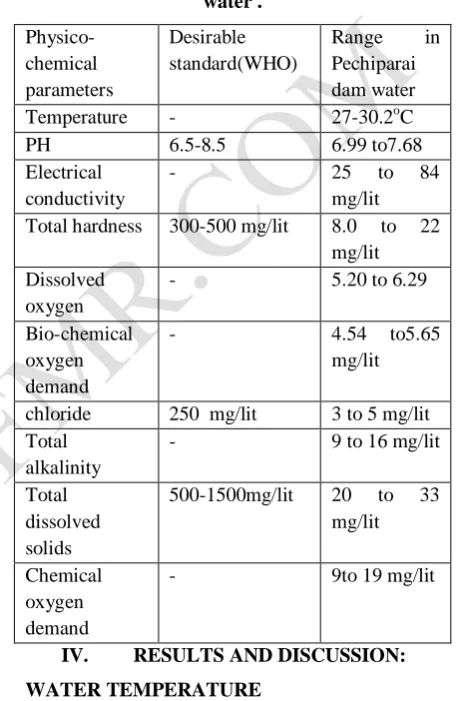
Table 1: Comparison of different physico-chemical parameters with suggested water standards suggested by WHO for drinking
water .
Physico-chemical parameters
Desirable standard(WHO)
Range in Pechiparai dam water Temperature - 27-30.2oC PH 6.5-8.5 6.99 to7.68 Electrical
conductivity
- 25 to 84 mg/lit Total hardness 300-500 mg/lit 8.0 to 22
mg/lit Dissolved
oxygen
- 5.20 to 6.29 Bio-chemical
oxygen demand
- 4.54 to5.65 mg/lit chloride 250 mg/lit 3 to 5 mg/lit Total
alkalinity
- 9 to 16 mg/lit Total
dissolved solids
500-1500mg/lit 20 to 33 mg/lit Chemical
oxygen demand
- 9to 19 mg/lit
IV. RESULTS AND DISCUSSION:
WATER TEMPERATURE
Emperor International Journal of Finance and Management Research [EIJFMR] Page 153
temperature showing a minimum of 250C to a maximum of
34.0 0C in a natural pond at Madurai.
WATER pH
The pH is affected not only by the reaction of carbon dioxide but also by organic and inorganic solutes present in water. Any alteration in water pH is accompanied by the change in other Physico-chemical parameters. The range of pH on the study sites in Pechiparai dam site ranges between 6.99 to7.68. The pH (6.99) was low during monsoon season and high (7.68) during pre monsoon season. According to Venkateswarlus’classification Pechiparai dam water has indifferent pH.
ELECTRICAL CONDUCTIVITY:
Electrical conductivity is a numerical expression ability of an aqueous solution to carry electric current. In the present study, the range of electrical conductivity on the study sites in Pechiparai dam water was from 25 to 84 µmho/cm. The maximum value was observed at pre monsoon season and minimum at monsoon season. The present findings in relation to Electrical conductivity are in conformity with the work of Kaushik and Saxena (1991) Chausaria and Pandey (2007) and Saxena (2012).
TOTAL HARDNESS
Total hardness of water is due to the concentration of salts. Temperory hardness of water is mainly governed by the cations of calcium and magnesium which largely combines with carbonates, bicarbonates and with sulphates. Permanent hardness occurs when cations combine with chlorides and other anions of minerals. In particular, hardness is due to the concentration of multivalent metallic ions of calcium and magnesium. The range of total hardness on the study sites in Pechiparai dam site was between 8.0 mg/lit to 22 mg/lit. The maximum value was
observed at pre monsoon season and minimum at monsoon season
DISSOLVED OXYGEN
The dissolved oxygen is one of the most important parameter indicating the health of water body. The dissolved oxygen play a role of regulator of metabolic activities of organisms and thus governs metabolism of the biological community as a whole and used as an indicator of trophic status of the water. Dissolved oxygen concentration more than 5.00 mg/lit favour growth of flora and fauna. Surve et al (2005) reported the dissolved oxygen ranges from 3.00 to 6.00 mg/lit in Kandhar Dam. As dissolved oxygen levels in water drop below 5.0 mg/lit, many life forms are put under pressure (Bowman et al., 2008).The range of dissolved oxygen on the study sites in Pechiparai dam water was between 5.20 mg/lit to 6.29 mg/lit. The maximum value was observed at pre monsoon season and minimum at monsoon season
BIO CHEMICAL OXYGEN DEMAND
Biochemical oxygen demand is the amount of oxygen required by the living organisms engaged in utilization and ultimate destruction and stabilization of organic water. It indicates the presence of microbial activities and dead organic matter on which microbes can feed. BOD increases with increased inflow of the domestic waste (Athalye and Patil, 2003).The BOD in Pechiparai dam water was ranging from 4.54 mg/lit to 5.64 mg/lit. The higher biochemical oxygen demand indicates maximum consumption of oxygen in justifying higher organic pollution load. In the present investigation, the BOD values were maximum during monsoon and minimum during summer.
WATER SALINITY
Emperor International Journal of Finance and Management Research [EIJFMR] Page 154
stress on biotic components of aquatic ecosystem. Chloride is a ubiquitous aqueous anion in all natural waters, the concentrations varying very widely and reaching a maximum in sea water. Chloride values varied from 19.6 mg/lit to 50.5mg/lit, in Angoori reservoir (Abay et al
2012).The range of chloride content on the study sites in Pechiparai dam site was between 3 mg/lit to 5 mg/lit. The maximum value was observed at premonsoon season and minimum at monsoon season.
TOTAL ALKALINITY
Total alkalinity is the sum of total of carbonate and bi-carbonate alkalinities. Bicarbonates are mainly responsible for the variation of total alkalinity.The range of total alkalinity on the study sites in Pechiparai dam water was between 9 mg/lit to 16.52 mg/lit. The maximum value was observed at pre monsoon season and minimum at monsoon season. The increased alkalinity during premonsoon was due to the concentration of nutrients in water. . These findings coincided with the findings of Garg et al (2006 and 2009) in Harsi and Ramsagar reservoir.
TOTAL DISSOLVED SOLIDS
Total dissolved solids are affected by the geographical location of the water body, drainage, and rainfall, deposit of organic material at the bottom level, incoming water and nature of biota. In various water bodies in India, total dissolved solids are variable. The range of total dissolved solids on the study sites in Pechiparai dam water was between 20 mg/lit to 33 mg/lit.The maximum value was observed at pre monsoon season and minimum at monsoon season. The high value in pre monsoon season is due to increased evaporation, high temperature and decrease in water volume. Similar results have also been observed by Kumbhar et al in Ujaini reservoir and Salwale et al
in Deoli Bhorus Dam water
CHEMICAL OXYGEN DEMAND
It is the oxygen consumed by the chemical break down of organic and inorganic substances in water. The values of COD varies from 9.5 mg/lit in June to 18 mg/lit April and May in Pechiparai dam water.The COD was higher in Premonsoon. High Oxygen demand in water in premonsoon is due to increase in temperature of water. Similar trends are reported by Tiwari et al in a polluted pond.
V. CONCLUSION
All physico-chemical parameters of Pechiparai dam water are within the limit suggested by WHO. The water is suitable for drinking and agriculture.
VI. REFERENCES
1. Athalye R.P., Patil N.N., Borkar U.,
Quadros G. and Somani V.U.,
(2003).Studies of flora,Intertidal Macrobenthic fauna and fishery of ulhas river and Thane creek to assess the pollution statusand decide mitigation strategy.B. N.Bandodkar college of science,Thane and MMRDA Mumbai project,pp211.
2. Abhay Kumar Rahul., Kushwaha M. K.
S., Mathur R., Shashi Rahuland Akash Yadav.,(2012). Assessment of freshwater quality of Angoori reservoir, District Datia, Madhya Pradesh. Nature
Environment and Pollution Technology;
11(4): pp 667-669
3. APHA. 1998. Standard Methods for the examination of water and waste water.(20thedn.),American Public Health Association, New York.
Emperor International Journal of Finance and Management Research [EIJFMR] Page 155