How Partner Characteristics Can Affect
Performance of Alliances with Different Time
Frames?
Seyed Hossein JALALI
*Received: April 12, 2017 Revised: November 27, 2017 Accepted: December 3, 2017
Abstract
Firms increasingly adopt cooperative strategies and form strategic alliances with foreign partners to be prosperous in entering to international market. Most of scholars have typically focused on generic, conceptual models for alliances partner selection, addressing only limited dimensions of the partner characteristics. This paper presents a new empirical framework that considering the effect of partner characteristics on export performance of alliances, in the case of short/medium-term alliances and long-short/medium-term ones. The study explores the effective partner characteristics for each type of alliances based on a sample of 540 alliances which rooted in East European region and also, have at least one Iranian partner. The findings stress the differences between varied partner characteristics in short/medium-term and long-term alliances. More specifically, results introduce a framework that addresses certain and specific partner characteristics to improve the export performance of alliances, due to the time frame of strategic alliances.
Keywords: Strategic Alliance, Alliance Partner, Alliance Time Frame, Partner Characteristics, Export Performance.
JEL Code Classification: M16, F23, L20
UDC: 658.114.5
DOI: https://doi.org/10.17015/ejbe.2017.020.06
*
1. Introduction
In the contemporary business world, forming strategic alliances is a reliable strategy for firms to expand the geographic scope from domestic to international markets. Strategic alliances provide firms with opportunities to gain more market power and achieve faster and more effective market entry in the international market (Xia, 2011). Strategic alliances create value through the combination of complementary resources and capabilities beyond firm boundaries (Mindruta, Moeen & Agarwal, 2016); and are particularly effective in helping a firm gain and maintain a competitive advantage in dynamic, volatile and uncertain international environments.
While research on strategic alliance has produced an impressive body of theoretical and empirical work, important limitations exist. In particular, the literature is rich on general studies on partner selection. Many scholars highlighted the importance of appropriate partner selection as a critical parameter in alliance success, since that superior value creation depends on whether partners represent synergies in the relevant characteristics (Shah & Swaminathan, 2008; Mitsuhashi & Greve, 2009; Ahuja, Polidoro, & Mitchell, 2009; Mindruta, Moeen & Agarwal, 2016). But on the other hand, frameworks that addresses when and why managers choose partners with certain, specific characteristics are understudied. In addition, much works on strategic alliances and partner characteristics have been based on developed economies. But, strategic alliances concept is growing in appeal to firms in developing economies and become a strategic choice that firms pursue to gain competitive advantage in international markets. Highly complex, volatile and largely unknown business environment of developing economies raises the risk of any business collaboration (Li & Ferreira, 2008). So, managers of developing economies-based firms should be able to choose a right partner to ally with, particularly in international markets where firms faced with intense competition from developed economies-based firms, MNCs and alliances.
frame of alliances. Previous literature mostly points out the strategic alliances as a short-term relationship. But, issues and attributes of long-term strategic alliances are not the same as short/medium-term ones (Swärd, 2016). Partners involved in short/medium-term alliances exchange resources for a definite time frame in order to achieve a specific objective and the separation phase is arranged at the end of that time period. On the other hand, resources exchange in long-term alliances is happened in indefinite time period and normally, the separation phase is not arranged and alliances are terminated due to problems associated with the alliance (Bignoux, 2006). The current work distinguishes between short/medium-term and long-term alliances, and applied the theory to the case of wholly export-oriented alliances from a developing economy context, and provides empirical evidences about the effects and priorities of partner characteristics on export performance of alliances. Second, it adds significant new empirical knowledge to the international strategic alliance from developing economies context literature and provides a more complete understanding of the impact of alliance partners' characteristics on alliance outcome.
The remainder of this paper is organized as follows: The next section contains a brief literature review about international strategic alliances and partner characteristics. Then the research methodology, including data collection and measures presents in the subsequent section. The paper continues with a presentation of empirical findings and sensitivity analysis, along with the discussion of the findings, limitations, and directions for future researches.
2. Literature review
As a body of research stated, inappropriate chosen partners is a key determinant variable of strategic alliances failure (Bierly & Gallagher, 2007), and is a predominant source of internal tension in strategic alliances (Krishnan, Martin & Noorderhaven, 2006). It is supposed that even outstanding strategic alliance management may not be sufficient to overcome poor partner selection (Cummings & Holmberg, 2012). According to Arranz, Arroyabe, and de Arroyabe (2016), the alliance cooperation itself is not a guarantee of successful entry in international markets and searching, choosing and coordinating of partners has a pivotal role in attainment of desired goals.
The partner selection consists of choosing to ally with someone among the various available options who has the resources you need and whom you can induce, via your own stock of resources, to collaborate with you. This choice relates to what capabilities are being combined in an alliance (Ahuja, Polidoro & Mitchell, 2009), and is a key decision alongside decisions about governance structure and alliance scope (Meuleman et al., 2010). The importance of partner selection can be discussed from different theoretical contexts. From the resources based-view, partner selection is a critical decision in pre-agreement phase of strategic alliances formation, because it influences the mix of resources and capabilities which will be available to the alliance (Dong & Glaister, 2006); and thus, arises complementarity (Shah & Swaminathan, 2008; Mindruta, Moeen & Agarwal, 2016).
Undoubtedly, the alliances' outcome is contingents on partner characteristics (Lu & Beamish, 2006). Also, specific characteristics could determine the dynamics of any cooperative activities. According to Shah and Swaminathan (2008) alliance type is a critical consideration in evaluating the importance of specific partner characteristics. There is needed to do studies which examine whether and how partner selection criteria might vary with different types of strategic alliances (Hitt et.al, 2000). So, in the case of developing economies-based international strategic alliances, we need to consider specific characteristics that are relevant and significant to the context.
Table 1 presents the list of partner characteristics for international strategic alliances, and also recent contributors for each item. This list is not limited to indicate ones, but the theoretical, contextual and time-based concerns would ensure that potentially all important partner characteristics for developing economies-based international strategic alliances are extracted from the literature.
Table 1. List of Partner Characteristics and Recent Contributors
Partner Characteristics ContributorsAccess to distribution channels
Dong and Glaister (2006); Chand and Katou (2012); Wu and Barnes (2014)
Financial assets Hitt et.al (2000); Hitt et.al (2004); Dong and Glaister (2006); Chen, Lee and Wu (2008); Gulati, Lavie and Singh (2009); Solesvik and Westhead (2010); Ahlstrom et.al (2014)
Institutional knowledge Dong and Glaister (2006); Solesvik and Westhead (2010); Chand and Katou (2012)
Intangible assets (non technological)
Hitt et.al (2000); Hitt et.al (2004); Wu, Shih and Chan (2009); Ahlstrom et.al (2014)
International market knowledge
Hitt et.al (2000); Luo (2002); Hitt et.al (2004); Dong and Glaister (2006); Wu, Shih and Chan (2009); Chand and Katou (2012); Ahlstrom et.al (2014)
Links with buyers and suppliers
Dong and Glaister (2006); Solesvik and Westhead (2010); Chand and Katou (2012)
Managerial capability Hitt et.al (2000); Luo (2002); Hitt et.al (2004); Wu, Shih and Chan (2009); Ahlstrom et.al (2014); Bakker (2016); Jalali (2017)
Previous alliance experiences
Hitt et.al (2000); Hitt et.al (2004); Hoang and Rothaermel (2005); Dong and Glaister (2006); Gulati, Lavie and Singh (2009); Ahlstrom et.al (2014)
Reputation of the partner
Luo (2002); Dong and Glaister (2006); Nielsen (2007); Solesvik and Westhead (2010); Ding, Dekker and Groot (2014); Gu and Lu (2014)
Technological capability
Hitt et.al (2000); Luo (2002); Chen, Lee and Wu (2008); Wu, Shih and Chan (2009); Gulati, Lavie and Singh (2009); Chand and Katou (2012); Ahlstrom et.al (2014); Badir and O'Connor (2015); Jalali (2017)
Trust representation Dong and Glaister (2006); Bierly and Gallagher (2007); Nielsen (2007); Shah and Swaminathan (2008); Solesvik and Westhead (2010); Ding, Dekker and Groot (2014)
outcome of international strategic alliance manifested in the performance of alliance, namely, export performance of alliance.
Export performance can be explained as the outcomes from an exporting and thus it is the extent to which the firm achieves its purposes when exporting products or services to international markets (Navarro et al., 2010). Wang and Leastari (2013) referred to financial indicators as the best proxy for export performance. While the export performance in many researches is supposed to be depend on firm competitive position. These different viewpoints made it challenging to reach a consensus over the concept of export performance (Sousa, Martínez-López & Coelho, 2008; Jalali, 2012; Malhotra & Kumari, 2016), and it is needed to consider both of the qualitative and quantitative dimensions of export performance concept (Navarro-García et al., 2016).Hence, a multidimensional approach based on market data is used in this study to provide a better understanding of export performance in international strategic alliances. While numerous researches devoted to the export performance in the firm-level, the export performance of alliances is an issue that has been underexplored, not only in strategic alliance research, but in strategic management research as a whole.
3. Methodology
3.1. Data Collection and Sample
This study aimed to assess the effective partner characteristics for international strategic alliances in both form of short/medium-term alliances and long-term ones. To reach to this aim, current research has focused on empirical findings from analysis of the relationship between partner characteristics and export performance of alliance, and categorizes these findings for short/medium-term alliances versus long-term ones. In order to test the intention of the study, the databases of Iran Ministry of Industry, Mine and Trade (MIMT), Iran Chamber of Commerce, Industries, Mines and Agriculture (ICCIMA) and the Islamic Republic of Iran Customs Administration (IRICA) were used as an initial sampling frame to find strategic alliances between Iranian and Eastern European firms (i.e. Including Belarus, Bulgaria, Czech Republic, Hungary, Moldova, Poland, Romania, Russia, Slovakia and Ukraine, according to the United Nation Statistics Division (UNSD) classification, and also Anderson, 2011). So, the initial sample consisted of international strategic alliances between partners from developing economies-based countries.
the difficulties, ambiguities, clarity and validity of measures. Then, a revised version of the questionnaire was used in the full-scale study. Data were collected over a period of five months during 2016. The data collection yielded 540 valid surveys (52% of short/medium-term alliances and 48% of long-term alliances), making an available return rate of 43.4%. Nearly half the alliances partners (49.8%) are large firms with more than 250 employees, while 19.4% of firms have fewer than 50 employees, and 30.8% are firms with employees between 50 and 250. Overall, the sample represented 13 different manufacturing industries. Petroleum products, textile product mills and food manufacturing were represented the most with 41.2%, 28.5% and 21.1%, respectively. These alliances are involved in different markets, but majority of them (60.7%) export their products to a target market which is not the origin of any partners, and 23.7% of them are doing business internationally, without focusing on a specific target market.
3.2. Measurement
3.2.1. Independents
The respondents were presented with the list containing of eleven international strategic alliances partner characteristics, as mentioned in the table 1. This list was compiled after thorough review on previous empirical studies about alliances partner characteristics with theoretical, contextual and time-based limitation. The resulting characteristics were then reviewed with academics and executives to ensure that the list was complete and that all partner characteristics were potentially relevant criteria for the content and context of current research. Respondents were first asked to identify their perception of the importance of partner characteristics on each item which was rated on a five-point scale, ranging from "not at all important" (1) to "very important" (5).
3.2.2. Dependents
(alliances with less than three years age) and the export performance of long-term alliances (alliances endured more than three years) are separated from each other.
3.2.2. Controls
Some variables were used as controls in the analyses because of their potential effect on partner selection. These variables can be categorized in three groups of industry, size and experience. Industry type (natural resources, manufacturing, and services) was controlled in the analyses. Each industry type was transformed into a dummy variable; while the petroleum products, textile product mills and food manufacturing were represented the 90.8% of the sample. Firm size is another control variable which was calculated as the natural logarithm of the total number of employees. International experiences is the third control variable. As firms gain more experiences in international markets, their performance will be improved and they will better respond to the international markets necessitates. Thus, the international experience of the firm, calculated as the total number of years in which the firm had engaged in international markets, was controlled.
4. Results
4.1. Descriptive Statistics
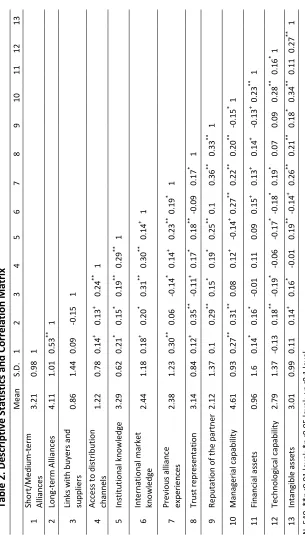
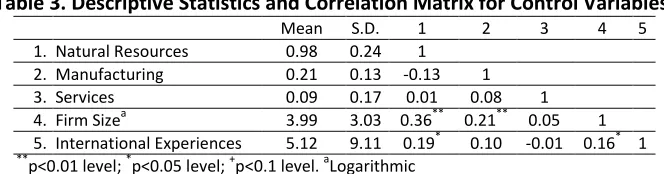
Table 2 and 3 show descriptive statistics and intercorrelations for all variables. Between different variables, the average links with buyers and suppliers measure is 0.86, but the standard deviation of 1.44 indicates that there is substantial variation across alliances. The financial assets have a similar situation with a average of 0.96 and standard deviation of 1.60. Table 3; also provide some valuable insights about the sample, as it shows that the size of partner plays a significant role in formed alliances in natural resources and manufacturing.
4.2. How Partner Characteristics Can Affect Export Performance?
To answer the question about how partner characteristics can affect export performance, the results are presented in models A to D of table 4. Each of the reported estimates is from panel-level regressions allowing for random effects, heteroskedasticity and clustering of the standard errors. Model A and B are relates to short/medium-term alliances, while the results of analyses for long-term alliances are presented in model C and D. Also, models A and C are including only fixed effects (controls), while model B and D including both of fixed effects and random effects.
Ta
b
le
2
. De
sc
ri
p
ti
ve
S
ta
ti
st
ic
s an
d
C
o
rr
el
ati
o
n
Ma
tr
ix
13 1
N =54 0. * * p <0.01 l eve l; * p <0.05 l eve l; + p <0.1 le ve l
12 1 0.27
**
11 1 0.16
*
0.11
10 1 0.23
**
0.28
**
0.34
**
9 1 -0.15
*
-0.13
+
0.09 0.18
*
8 1 0.33
** 0.20 ** 0.14 + 0.07 0.21 **
7 1 0.17
* 0.36 ** 0.22 ** 0.13 + 0.19 * 0.26 **
6 1 0.19
*
-0.09 0.1 0.27
** 0.15 + -0.18 * -0.14 +
5 1 0.14
+ 0.23 ** 0.18 ** 0.25 ** -0.14 + 0.09 -0.17 * 0.19 **
4 1 0.29
** 0.30 ** 0.14 + 0.17 * 0.19 * 0.12 +
0.11 -0.06 -0.01
3 1 0.24
** 0.19 ** 0.31 ** -0.14 * -0.11 + 0.15 *
0.08 -0.01 -0.19
*
0.16
*
2 1 -0.15 0.13
+ 0.15 * 0.20 * 0.06 0.35 ** 0.29 ** 0.31 ** 0.16 * 0.18 ** 0.14 +
1 1 0.53
** 0.09 0.14 + 0.21 * 0.18 + 0.30 ** 0.12 + 0.1 0.27 ** 0.14 * -0.13 0.11
S.D. 0.98 1.01 1.44 0.78 0.62 1.18 1.23 0.84 1.37 0.93 1.6 1.37 0.99
Me
an
3.21 4.11 0.86 1.22 3.29 2.44 2.38 3.14 2.12 4.61 0.96 2.79 3.01
Sho rt /Me d iu m -te rm A lli an ce s Lo n g-te rm A lli an ce s Li n ks w ith b u ye rs a n d su p p lie rs A cc es s to d is tri b u ti o n ch an n el s In sti tu ti o n al k n o w le d ge In te rn at io n al mark et kn o w le d ge Pre vio u s all ian ce ex p eri e n ce s Tru st r ep re se n tati o n R ep u tati o n o f th e p art n er Man ag eri al c ap ab ili ty Fi n an ci al a ss et s Te ch n o lo gi cal ca p ab ili ty In tan gi b le as se ts
Table 3. Descriptive Statistics and Correlation Matrix for Control Variables
Mean S.D. 1 2 3 4 5 1. Natural Resources 0.98 0.24 12. Manufacturing 0.21 0.13 -0.13 1 3. Services 0.09 0.17 0.01 0.08 1 4. Firm Sizea 3.99 3.03 0.36** 0.21** 0.05 1 5. International Experiences 5.12 9.11 0.19* 0.10 -0.01 0.16* 1
**
p<0.01 level; *p<0.05 level; +p<0.1 level. aLogarithmic
Furthermore, the relevant z statistic shown in table 4 is positive and statistically significant (z=3.118; p < 0.01), indicating that long-term alliances more heavily emphasize this criterion than do short/medium-term ones.
Table 4. Effective Partner Characteristics in Export Performance of
Strategic Alliances
Fixed Effects (controls)
Short/Medium-term Alliances Long-term Alliances Model A Model B Model C Model D β z-stat β z-stat β z-stat β z-stat Intercept 0.678 0.359 3.111* 2.177 1.522 0.999 4.257** 3.614
Industry 1 (Natural Resources) 0.188* 1.413 0.165+ 1.401 0.177* 1.513 0.173* 1.502 Industry 2 (Manufacturing) 0.144+ 1.212 0.121 1.030 0.152* 1.382 1.150+ 1.380
Industry 3 (Services) 0.013 0.700 0.011 0.661 0.010 0.510 0.002 0.392 Firm Size 0.170* 1.219 1.157+ 1.111 0.191** 1.600 1.163* 1.444
International Experiences -0.122+ 0.982 -0.099 0.740 0.130+ 1.096 0.113 0.878 Random Effects
Links with buyers and suppliers 0.241** 2.230 -0.222 -1.370 Access to distribution channels 0.228** 2.186 -0.190 -1.285 Institutional knowledge 0.204* 2.111 0.295** 2.871 International market knowledge 0.141+ 1.317 0.151* 1.459 Previous alliance experiences -0.056 0.082 0.130 0.988
Trust representation 0.113 1.104 0.198* 1.823
Reputation of the partner 0.100 1.012 0.202** 2.011
Managerial capability 0.355** 2.539 0.414** 3.118
Financial assets 0.299** 2.455 0.112 0.961
Technological capability -0.410 -1.119 0.311** 2.644
Intangible assets 0.199* 2.012 0.143+ 1.313
Observations 284 284 256 256
Chi-squared statistic 322.2* 471.3* 360.1* 577.9*
R-squared 0.217 0.238 0.222 0.284
Results are based on random-effects regressions with controls for heteroskedasticity, autocorrelation, and industry-level clustering. **p<0.01 level; *p<0.05 level; +p<0.1 level. All significance tests are two-tailed.
alliances place greater emphasize on intangible assets (β=0.199;z=2.012; p < 0.05) than do long-term ones.
Along with these common variables, analysis showed that there are some partner characteristics which are determinant in export performance of only short/medium-term alliances or long-term alliances. Table 3 shows that the coefficient and z statistic for links with buyers and suppliers (β=0.241;z=2.230; p < 0.01), access to distribution channels (β=0.228; z=2.186; p < 0.01), and financial assets (β=0.299;z=2.455; p < 0.01), are positive and statistically significant in the short/medium-term alliances, but the coefficients for these criteria are not statistically significant in the long-term alliances. Furthermore, the coefficient and z
statistic of trust representation (β=0.198; z=1.823; p < 0.05), reputation of the partner (β=0.202; z=2.011; p < 0.01), and technological capability (β=0.311; z=2.644; p < 0.01) presented in table 4 are positive and statistically significant for only long-term alliances, suggesting that export performance in long-term alliances affected by these characteristics more strongly than do short/medium-term ones. It is also notable that a previous alliance experience is not statistically significant in both forms of alliances.
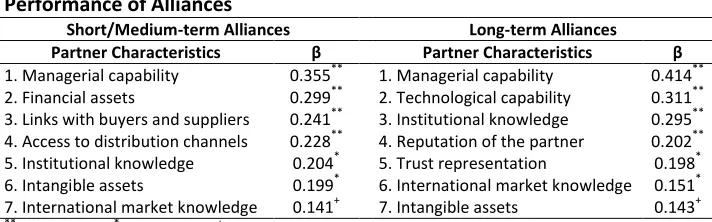
Due to the findings, the effective partner characteristics in export performance of short/medium-term alliances and long-term alliances could be summarized as presented in table 5. Partner characteristics are sorted by the β coefficient.
Table 5. Assortment of Effective Partner Characteristics in Export
Performance of Alliances
Short/Medium-term Alliances Long-term Alliances
Partner Characteristics β Partner Characteristics β
1. Managerial capability 2. Financial assets
3. Links with buyers and suppliers 4. Access to distribution channels 5. Institutional knowledge 6. Intangible assets
7. International market knowledge
0.355** 0.299** 0.241** 0.228** 0.204* 0.199* 0.141+
1. Managerial capability 2. Technological capability 3. Institutional knowledge 4. Reputation of the partner 5. Trust representation
6. International market knowledge 7. Intangible assets
0.414** 0.311** 0.295** 0.202** 0.198* 0.151* 0.143+
**
p<0.01 level; *p<0.05 level; +p<0.1
4.2. Sensitivity Analysis
strongly robust to this alternative estimation methodology. The second sensitivity tests was also carried out to ascertain whether findings are robust to a closer matching of the time periods for defining alliances (i.e. short/medium-term in less than three years and long-term for more than three years). The alliance time frame measured using data from shorter time spans (i.e. in one year, and for the second time, in two years), which are closer match to the financial outcome of export performance. This sensitivity analysis was find support for findings at the 1 percent significance level.
5. Discussion and Conclusion
Current research contributes to a greater understanding of the alliance performance, regarding of the partner characteristics and alliance's time frame. Indeed, findings of this study provide the following key insight: partner characteristics have different effects on alliances export performance, and the effective characteristics depend on the alliance's time frame, categorized in short/medium-term alliances and long-term alliances.
show the importance of studying the alliance time frame, and strongly support the idea that the critical criteria for assessing alliance partner characteristics vary depending on the differential inherent in a short/medium-term strategic alliance and long-term strategic alliances. The current research findings also help executives understand the basis on which partner characteristics affect their alliance outcome, and then, which partner characteristics should have priority on theirs' criteria for decision-making to form alliances due to the intended time frame.
Future researches could identify the way partner characteristics affect alliance outcome from different theoretical and contextual backgrounds, or various time frame. Such studies can extend the literature about partner characteristics in alliance, and more importantly, about differences between various partner characteristics. In addition, the effects examined in this study should be investigated in other countries or regions of the world to determine whether the highly significant results of this study are stable.
References
Ahlstrom, D., Levitas, E., Hitt, M.A., Dacin, M.T. & Zhu, H. (2014). The three faces of China: Strategic alliance partner selection in three ethnic Chinese economies. Journal of World Business, 49(4), 572-585. https://doi.org/10.1016/j.jwb.2013.12.010
Ahuja G. (2000). The duality of collaboration: inducements and opportunities in the formation of interfirm linkages. Strategic Management Journal, 21(3), 317-343.
https://doi.org/10.1002/(SICI)1097-0266(200003)21:3<317::AID-SMJ90>3.0.CO;2-B
Ahuja, G., Polidoro, F. & Mitchell, W. (2009). Structural homophily or social asymmetry? The formation of alliances by poorly embedded firms. Strategic Management Journal, 30(9), 941-958. https://doi.org/10.1002/smj.774
Anderson, E.E. (2011). Industrial Growth Rates and Instability: An Historical Analysis of the Former Centrally Planned Economies of Eastern Europe. Eurasian Journal of Business and Economics, 4(8), 51-70.
Arranz, N., Arroyabe, M.F. & Fdez. de Arroyabe, J.C. (2016). Alliance‐building process as inhibiting factor for SME international alliances. British Journal of Management, 27(3), 497-515. https://doi.org/10.1111/1467-8551.12159
Badir, Y.F. & O'Connor, G.C. (2015). The formation of tie strength in a strategic alliance's first new product development project: The influence of project and partners' characteristics. Journal of Product Innovation Management, 32(1), 154-169.
https://doi.org/10.1111/jpim.12222
Bakker, R.M. (2016). Stepping in and stepping out: Strategic alliance partner reconfiguration and the unplanned termination of complex projects. Strategic Management Journal, 37(9), 1919-1941. https://doi.org/10.1002/smj.2429
Bierly, P.E. & Gallagher, S. (2007). Explaining alliance partner selection: Fit, trust and strategic expediency. Long Range Planning, 40(2), 134-153.
https://doi.org/10.1016/j.lrp.2007.03.001
Bignoux, S. (2006). Short-term strategic alliances: A social exchange perspective. Management Decision, 44(5), 615-627.
Carneiro, J., Farias, I., da Rocha, A. & da Silva, J. F. (2016). How to measure export performance? Scholars’ vs. practitioners’ answers. Journal of Business Research,69(2), 410-417. https://doi.org/10.1016/j.jbusres.2015.06.046
Chand, M. & Katou, A.A. (2012). Strategic determinants for the selection of partner alliances in the Indian tour operator industry: A cross-national study. Journal of World Business, 47(2), 167-177. https://doi.org/10.1016/j.jwb.2011.04.003
Chen, H.L. & Huang, Y. (2004). The establishment of global marketing strategic alliances by
small and medium enterprises. Small Business Economics, 22(5), 365-377.
http://dx.doi.org/10.1023/B:SBEJ.0000022207.90510.46
Chen, S.H., Lee, H.T. & Wu, Y.F. (2008). Applying ANP approach to partner selection for strategic alliance. Management Decision, 46(3), 449-465.
https://doi.org/10.1108/00251740810863889
Cummings, J.L. & Holmberg, S.R. (2012). Best-fit alliance partners: The use of critical success factors in a comprehensive partner selection process. Long Range Planning, 45(2), 136-159.
http://dx.doi.org/10.1016/j.lrp.2012.01.001
Das, T. K. & Teng, B. S. (2002). The dynamics of alliance conditions in the alliance
development process. Journal of Management Studies, 39(5), 725-746.
http://dx.doi.org/10.1111/1467-6486.00006
Ding, R., Dekker, H.C. & Groot, T. (2013). Risk, partner selection and contractual control in interfirm relationships. Management Accounting Research, 24(2), 140-155.
https://doi.org/10.1108/13552550610667422
Dong, L. & Glaister, K.W. (2006). Motives and partner selection criteria in international strategic alliances: Perspectives of Chinese firms. International Business Review, 15(6), 577-600. http://dx.doi.org/10.1016/j.ibusrev.2006.09.003
Gomes, E., Barnes, B.R. & Mahmood, T. (2016). A 22 year review of strategic alliance research in the leading management journals. International Business Review, 25(1), 15-27.
https://doi.org/10.1016/j.ibusrev.2014.03.005
Gu, Q. & Lu, X. (2014). Unraveling the mechanisms of reputation and alliance formation: A study of venture capital syndication in China. Strategic Management Journal, 35(5), 739-750.
https://doi.org/10.1002/smj.2117
Gulati, R., Lavie, D. & Singh, H. (2009). The nature of partnering experience and the gains from alliances. Strategic Management Journal, 30(11), 1213-1233.
https://doi.org/10.1002/smj.786
Hitt, M.A., Ahlstrom, D., Dacin, M.T., Levitas, E. & Svobodina, L. (2004). The institutional effects on strategic alliance partner selection in transition economies: China vs. Russia. Organization Science, 15(2), 173-185. https://doi.org/10.1287/orsc.1030.0045
Hitt, M.A., Dacin, M.T., Levitas, E., Arregle, J.L. & Borza, A. (2000). Partner selection in emerging and developed market contexts: Resource-based and organizational learning perspectives. Academy of Management Journal, 43(3), 449-467.
https://doi.org/10.2307/1556404
Hoechle, D. (2007). Robust standard errors for panel regressions with cross-sectional
dependence. Stata Journal, 7(3), 281-312.
http://EconPapers.repec.org/RePEc:tsj:stataj:v:7:y:2007:i:3:p:281-312
Jalali S.H. (2017). Partner capabilities and alliance time frame: An analysis of international strategic alliances from the CEE. Journal of Entrepreneurship, Management and Innovation, 13(2), 59-75. https://doi.org/10.7341/20171323
Jalali, S.H. & Soleimani, M. (2014). An investigation about the impacts of e-commerce adoption on export performance. International Journal of Modern Management and Foresight, 1(3), 129-138.
Jalali, S.H. (2012). The effect of export promotion programmes on export performance: Evidence from Iranian food manufacturers. International Journal of Business and Globalisation, 9(2), 122-133. https://doi.org/10.1504/IJBG.2012.048955
Krishnan, R., Martin, X. & Noorderhaven, N. G. (2006). When does trust matter to alliance
performance?. Academy of Management Journal, 49(5), 894-917.
https://doi.org/10.5465/AMJ.2006.22798171
Lee, H. U. & Park, J. H. (2006). Top team diversity, internationalization and the mediating effect of international alliances. British Journal of Management, 17(3), 195-213.
https://doi.org/10.1111/j.1467-8551.2006.00501.x
Li, D. & Ferreira, M.P. (2008). Partner selection for international strategic alliances in emerging economies. Scandinavian Journal of Management, 24(4), 308-319.
https://doi.org/10.1016/j.scaman.2008.05.001
Lu, J.W. & Beamish, P.W. (2006). Partnering strategies and performance of SMEs' international joint ventures. Journal of Business Venturing, 21(4), 461-486.
https://doi.org/10.1016/j.jbusvent.2005.02.002
Luo, Y. (2002). Partnering with foreign businesses: Perspectives from Chinese firms. Journal of Business Research, 55(6), 481-493. https://doi.org/10.1016/S0148-2963(00)00178-8
Mac, L. & Evangelista, F. (2016). The relative impact of market orientation and entrepreneurship on export performance: Do we really know enough?. Journal of Global Marketing, 29(5), 266-281. https://doi.org/10.1080/08911762.2016.1196285
Malhotra, N. & Kumari, D. (2016). Export Performance and Economic Growth in East Asian Economies– Application of Cointegration and Vector Error Correction Model. Eurasian Journal of Business and Economics, 9(18), 135-152.
https://doi.org/10.17015/ejbe.2016.018.08
Meuleman, M., Lockett, A., Manigart, S. & Wright, M. (2010). Partner selection decisions in interfirm collaborations: The paradox of relational embeddedness. Journal of Management
Studies,47(6), 995-1019. https://doi.org/10.1111/j.1467-6486.2009.00897.x
Mindruta, D., Moeen, M. & Agarwal, R. (2016). A two‐sided matching approach for partner selection and assessing complementarities in partners' attributes in inter‐firm alliances. Strategic Management Journal, 37(1), 206-231. https://doi.org/10.1002/smj.2448
Mitsuhashi, H. & Greve, H.R. (2009). A matching theory of alliance formation and organizational success: Complementarity and compatibility. Academy of Management Journal, 52(5), 975-995. https://doi.org/10.5465/AMJ.2009.44634482
Navarro, A., Losada, F., Ruzo, E. & Díez, J.A. (2010). Implications of perceived competitive advantages, adaptation of marketing tactics and export commitment on export performance.
Journal of World Business, 45(1), 49-58. https://doi.org/10.1016/j.jwb.2009.04.004
Navarro-García, A., Arenas-Gaitán, J., Rondán-Cataluña, F. J. & Rey-Moreno, M. (2016). Global model of export performance: Moderator role of export department. Journal of
Business Research, 69(5), 1880-1886.https://doi.org/10.1016/j.jbusres.2015.10.073
Nielsen, B.B. (2003). An empirical investigation of the drivers of international strategic alliance formation. European Management Journal, 21(3), 301-322.
https://doi.org/10.1016/S0263-2373(03)00043-4
Nielsen, B.B. (2007). Determining international strategic alliance performance: A multidimensional approach. International Business Review, 16(3), 337-361.
https://doi.org/10.1016/j.ibusrev.2007.02.004
Shah, R.H. & Swaminathan, V. (2008). Factors influencing partner selection in strategic alliances: The moderating role of alliance context. Strategic Management Journal, 29(5), 471-494. https://doi.org/10.1002/smj.656
Solesvik, M.Z. & Westhead, P. (2010). Partner selection for strategic alliances: Case study insights from the maritime industry. Industrial Management and Data Systems, 110(6), 841-860. https://doi.org/10.1108/02635571011055081
Sousa, C.M.P., Martínez-López, F.J. & Coelho, F. (2008). The determinants of export performance: A review of the research in the literature between 1998 and 2005.
International Journal of Management Review, 10(4), 343-374.
https://doi.org/10.1111/j.1468-2370.2008.00232.x
Swärd, A. (2016). Trust, reciprocity, and actions: The development of trust in temporary inter-organizational relations. Organization Studies, 37(12), 1841-1860.
https://doi.org/10.1177/0170840616655488
Wu, C. & Barnes, D. (2014). Partner selection in agile supply chains: A fuzzy intelligent approach. Production Planning and Control, 25(10), 821-839.
https://doi.org/10.1080/09537287.2013.766037
Wu, W.Y., Shih, H.A. & Chan, H.C. (2009). The analytic network process for partner selection criteria in strategic alliances. Expert Systems with Applications, 36(3), 4646-4653.
https://doi.org/10.1016/j.eswa.2008.06.049
Wyatt, M.R., Pathak, S.B. & Zibarras, L.D. (2010). Advancing selection in an SME: Is best practice methodology applicable?. International Small Business Journal, 28(3), 258-273.
https://doi.org/10.1177/0266242609350815
Xia, J. (2011). Mutual dependence, partner substitutability, and repeated partnership: the survival of cross-border alliances. Strategic Management Journal, 32(3), 229-253.
https://doi.org/10.1002/smj.873
Yu, J., Gilbert, B.A. & Oviatt, B.M. (2011). Effects of alliances, time, and network cohesion on the initiation of foreign sales by new ventures.Strategic Management Journal,32(4), 424-446. https://doi.org/10.1002/smj.884
Zhang, Y., Duysters, G. & Filippov, S. (2012). Chinese firms entering Europe: Internationalization through acquisitions and strategic alliances. Journal of Science and
Technology Policy in China, 3(2), 102-123.