disease: a disease management
double-edged sword?
Bahare Fazeli
1,2*, Shayan Keramat
3, Ladan Assadi
4and Hossein Taheri
5Abstract
Due to unknown aetiology of Thromboangiitis obliterans (TAO), its effectively treating is challenging. However,
angiogenesis induction is one of the acceptable treatments for TAO patients. Recently, we have noticed that TAO
patients who were under long-term treatment with angiogenesis-inducing medication showed considerable
improvement in terms of healing chronic ulcers over the course of one to 2 years of treatment. However, some
of them developed dermal gangrene despite the warming of their feet, with or without palpable pulses in the
extremities, and with hair growth on the affected skin. Unfortunately, following the progression of dermal gangrene,
some of these patients had to undergo amputation and limb loss.
During histopathological evaluation, we detected some changes in the amputee TAO patients under
long-term angiogenic medical treatment that were not present in amputee TAO patients who had not received
any treatment for many years. The greatest pathological changes were observed in the microvascular of the
skin, appearing as a proliferation of endothelial cells, NETosis and thrombus formation inside the vessels with
proliferation of endothelial cells. The immunohistochemistry for CD31 and Ki67 as markers of vascular
endothelium differentiation and cell mitosis confirmed the proliferation of endothelial cells. However, in the
patients who had not received any treatment for years the typical pathology view of BD, including preserved
vascular architecture with infiltration of inflammatory cells and inflammatory cells inside the thrombus,
organised thrombus with recanalisation and intimal thickening was observed. Further longitudinal cohort
studies regarding long-term treatment with angiogenic medications for TAO in different geographic areas are
highly recommended.
Keywords:
Thromboangiitis obliterans, Buerger
’
s disease, Treatment, Angiogenesis
Dear Editor.
Until recently, Thromboangiitis obliterans (TAO) has
been regarded as a type of peripheral vascular disease
usually involving small and medium-sized arteries [
1
].
Due to its unknown aetiology, effectively treating TAO
is challenging. However, angiogenesis induction is one of
the suggestive treatments for TAO for patients with and
without critical limb ischemia (CLI). Notably, most of
the acceptable medical treatments for TAO that seek to
achieve vasodilation can also induce angiogenesis.
For instance, iloprost upregulates the influence of
vas-cular endothelium growth factor (VEGF) on endothelial
cell proliferation and angiogenesis [
2
]. Also,
prostaglan-din E1 analogues have been reported to induce
neovas-cularisation in ischemic areas mainly by upregulating
endothelial nitric oxide synthase (eNOS), hepatocyte
growth factor (HGF) and VEGF [
3
]. Notably, bosentan
also induces upregulation of VEGF and eNOS levels in
ischemic limbs and induces angiogenesis [
4
]. Similarly,
cilostazol induces angiogenesis and endothelial cell
pro-liferation in ischemic limbs by upregulating HGF and
VEGF [
5
].
© The Author(s). 2019Open AccessThis article is distributed under the terms of the Creative Commons Attribution 4.0 International License (http://creativecommons.org/licenses/by/4.0/), which permits unrestricted use, distribution, and reproduction in any medium, provided you give appropriate credit to the original author(s) and the source, provide a link to the Creative Commons license, and indicate if changes were made. The Creative Commons Public Domain Dedication waiver (http://creativecommons.org/publicdomain/zero/1.0/) applies to the data made available in this article, unless otherwise stated. * Correspondence:[email protected];[email protected]
1Immunology Research Center, Inflammation and Inflammatory Diseases
Division, School of Medicine, Mashhad University of Medical Sciences, Mashhad, Iran
2Vascular Independent Research and Education, European Foundation, Milan,
Italy
A
B
C
D
E
F
G
H
Recently, we noted that TAO patients undergoing
long-term treatment with angiogenesis-inducing
medica-tion, particularly cilostazol, showed considerable
im-provement in terms of reduced pain and claudication
and healing of chronic ulcers over the course of 1 year
of treatmesnt.
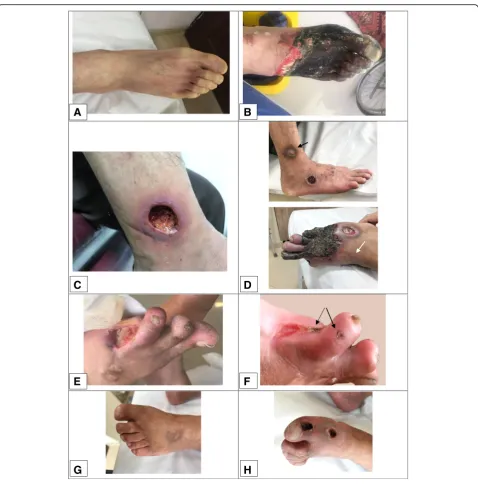
However, some of them developed dermal gangrene
despite the warming of their feet with hair growth on
the affected skin and improvement in pain and ulcer
healing (Fig.
1
). Unfortunately, following the progression
of dermal gangrene, some of these patients had to
undergo amputation and limb loss.
During histopathological evaluation, we detected some
changes in the amputee TAO patients under long-term
angiogenic medical treatment that were not present in
amputee TAO patients who had not received any
treat-ment for many years.
We studied 68 slides from 29 paraffin blocks of
biop-sies from two below-knee amputees and two toe
ampu-tee patients who were undergoing long-term treatment
with antigenic medication. In addition, we evaluated 41
slides from 20 paraffin blocks of biopsies from five
below-knee amputees with CLI who underwent
amputa-tion without receiving any medical treatment due to the
progression of gangrene.
Notably, the gangrene of the extremities was limited
to the derma in TAO patients with long-term angiogenic
medical treatment, and granulation tissue generation
and angiogenesis or a reduction of thrombus formation
were observed in the small or medium-sized vessels.
However, the greatest pathological changes were
ob-served in the microvascular of the skin, appearing as a
proliferation of endothelial cells. NETosis and thrombus
formation were also observed inside the vessels with
proliferation of endothelial cells (Fig.
2
).
Immunohisto-chemistry (IHC) was also performed for cluster of
differentiation 31 (CD31) as a marker of vascular
endo-thelium differentiation [
6
] and antigen Ki67 as a marker
of cell mitosis and apoptosis inhibition [
7
]. According to
the results of IHC, extensive proliferation of endothelial
cells in the soft tissue and proliferation of endothelial
cells in the intima layer of microvessels were observed
(Fig.
2
).
However, in the patients who had not received any
medical treatment before amputation the typical
path-ology view of TAO, including preserved vascular
archi-tecture with infiltration of inflammatory cells and
inflammatory cells inside the thrombus, organised
thrombus with recanalisation and intimal thickening was
observed. However, proliferation of endothelial cells was
not observed, as confirmed by IHC of CD31 and Ki67
(Fig.
3
).
It appears that angiogenesis induction in TAO patients
through long-term medical treatment, become dysregulated
and induced obstruction instead of neo-vascularisation. We
noted dermal gangrene primarily in the patients who had
been taking cilostazol continually for more than six months.
Dermal gangrene can be caused by the angiogenic
induc-tion that occurs in long-term use of cilostazol. Notably,
Isner et al. also observed that induction of angiogenesis by
phVEGF165 gene transfer in TAO patients led to forefoot
gangrene in 33% of patients; they ultimately required
below-knee amputation, despite evidence of improved
per-fusion [
8
].
Whilst the trigger for dysregulated angiogenesis is
un-known, long-term treatment with angiogenic medication
may be a risk factor for dermal gangrene in TAO
pa-tients and ultimately might be a disease management
double-edged sword.
All in all, we suggest that TAO patients who receive
long-term treatment with angiogenic medication be
monitored carefully. Indeed, it might be the better
A
B
C
D
E
F
G
H
course of action to pause the treatment to observe
whether there is any evidence of gangrene. Moreover, a
combination of angiogenic and anti-angiogenic
medica-tions that can also improve tissue oxygenises, such as
pentoxifylline or antioxidants [
9
], may regulate
angio-genesis in TAO and influence the disease outcomes of
patients.
The limitation of our study is its small sample size.
However, since our findings may influence the limb
sur-vival of TAO patients, further longitudinal cohort
stud-ies relative to long-term treatment with angiogenic
medications in different geographic areas are highly
recommended.
Abbreviations
eNOS:endothelial nitric oxide synthase; H & E: Haemotoxylin and eosin; HGF: Hepatocyte growth factor; IHC: Immunohistochemistry;
NETs: Neutrophil extracellular traps; PAS: Periodic acid–Schiff;
TAO: Thromboangiitis obliterans; VEGF: Vascular endothelium growth factors
Acknowledgements
The authors would like to appreciate Mr.Reza Feyzi for his helpful cooperation in preparing the pictures from pathology slides.
Declarations
All the authors declare that there is not any conflict of interest in preparing this letter.
Authors’contributions
Bahare Fazeli: Preparing the letter. Shayan Keramat: Correspondence of TAO patients data gathering, pathology slides preparation and staining. Ladan Assadi: Advisor pathologist Hossein Taheri: Correspondence of TAO diagnosis and management. All authors read and approved the final manuscript.
Funding
Authors have received no funds for preparing this letter.
A
B
C
D
E
F
Fig. 3Intimal fibrosis thickening instead of proliferation of endothelial cells, inflammatory thrombus and NETosis formation inside preserved vessels and organised thrombus in a TAO patient who received no treatment for many years.aPAS staining. X10 objective lense. Perivascular infiltration of inflammatory cells and the preserved vascular structure of a small artery with early-stage thrombus formation.bPAS staining. X40 objective lense Diffuse intimal thiceking with infiltration of inflamamtory cells in the intima layer.cH&E staining. X40 objective lense. Infiltration of inflammatory cells in all layers of the vessel.dPAS staining. X40 objective lense Organized thrombus with recanalization. The arrow shows basal membrane of intima.e
Availability of data and materials
All the pathology slides and blocks in addition to all the pictures from slides of TAO patients are available.
Ethics approval and consent to participate
This letter is not prepared from a research project. The data in this letter are gathered according to reporting and follow ups of TAO patients to our private office.
Consent for publication
The patients signed informed consent forms to permit inclusion of pictures of their feet in this letter (Ethical code: MUMS-941028).
Competing interests
There is no competing interests in preparing this letter.
Author details
1Immunology Research Center, Inflammation and Inflammatory Diseases
Division, School of Medicine, Mashhad University of Medical Sciences, Mashhad, Iran.2Vascular Independent Research and Education, European Foundation, Milan, Italy.3Hematology Department, Imam Reza Hospital,
Mashhad University of Medical Sciences, Mashhad, Iran.4Pathology
department, 17Shahrivar Hospital, Mashhad, Iran.5Surgery Department,
Farabi Hospital, Mashhad, Iran.
Received: 24 April 2019 Accepted: 26 July 2019
References
1. Fazeli B, Dadgar Moghadam M, Niroumand S. How to treat a patient with Thromboangiitis obliterans: a systematic review. Ann Vasc Surg. 2018;49: 219–28.
2. Jearanaiphaisarn T, Sanharati T, Pavasant P, et al. The effect of iloprost on cell proliferation and angiogenesis-related gene expression in human periodontal ligament cells. Odontology. 2018;106(1):11–8.
3. Haider DG, Bucek RA, Giurgea AG, et al. PGE1 analog alprostadil induces VEGF and eNOS expression in endothelial cells. Am J Physiol Heart Circ Physiol. 2005;289(5):H2066–72.
4. Iglarz M, Silvestre JS, Duriez M, et al. Chronic blockade of endothelin receptors improves ischemia-induced angiogenesis in rat hindlimbs through activation of vascular endothelial growth factor-no pathway. Arterioscler Thromb Vasc Biol. 2001 Oct;21(10):1598–603.
5. Chao TH, Tseng SY, Chen IC, et al. Cilostazol enhances mobilization and proliferation of endothelial progenitor cells and collateral formation by modifying vasculo-angiogenic biomarkers in peripheral arterial disease. Int J Cardiol. 2014 Mar 15;172(2):e371–4.
6. Vanchinathan V, Mirzamani N, Kantipudi R, Schwartz EJ, Sundram UN.The vascular marker CD31 also highlights histiocytes and histiocyte-like cells within cutaneous tumors.Am J Clin Pathol 2015;143(2):177–185; quiz 305. 7. Scholzen T, Gerdes J. The Ki-67 protein: from the known and the unknown.
J Cell Physiol. 2000;182(3):311–22.
8. Isner JM, Baumgartner I, Rauh G, Schainfeld R, Blair R, Manor O, Razvi S, Symes JF.Treatment of thromboangiitis obliterans (Buerger's disease) by intramuscular gene transfer of vascular endothelial growth factor: preliminary clinical results.J Vasc Surg 1998;28(6):964–973; discussion 73-5. 9. Radomska-Leśniewska DM, Bałan BJ, Skopiński P. Angiogenesis modulation
by exogenous antioxidants. Cent Eur J Immunol. 2017;42(4):370–6.
Publisher
’
s Note