DOI 10.1007/s12651-013-0145-y A RT I C L E
Why to employ both migrants and natives?
A study on task-specific substitutability
Anette Haas·Michael Lucht·Norbert Schanne
Published online: 1 October 2013
© Institut für Arbeitsmarkt- und Berufsforschung 2013
Abstract This paper analyses the performance of migrants on the German labour market and its dependence on the tasks performed on their jobs. Recent work suggests quanti-fying the imperfect substitutability relationship between mi-grants and natives as a measure for the hurdles mimi-grants have to face. Our theoretical framework adopts that migrant shares vary with qualification, task categories, and experi-ence.
Hence, substitution elasticities of an aggregate produc-tion funcproduc-tion can be quite different regarding different job cells. Finally, we estimate elasticities of substitution for dif-ferent aggregate CES-nested production functions for Ger-many between 1993 and 2008 using administrative data and taking into account the task approach. We find significant variation in the substitutability between migrants and natives across qualification levels and tasks. We show that especially
Thanks to Bastian Stockinger and Pirmin Schanne for valuable research assistance and to Marco Hafner for providing us the data on the task-occupation assignment. We gratefully acknowledge helpful comments by Uwe Blien, Stephan Brunow, Bernd Fitzenberger, seminar discussions at IAB and Kiel University, as well as participants at the T.A.S.K.S 2 workshop at Bonn, the NORFACE migration conference 2012 at Mannheim, the International Workshop on Economic Impacts of Immigration and Population Diversity 2012 at Hamilton. Financial support from NORFACE research programme on Migration in Europe—Social, Economic, Cultural and Policy Dynamics is acknowledged.
A. Haas (
B
)·M. Lucht·N. SchanneInstitut für Arbeitsmarkt- und Berufsforschung (IAB), Weddigenstr. 20-22, 90478 Nürnberg, Germany e-mail:[email protected]
M. Lucht
e-mail:[email protected]
N. Schanne
e-mail:[email protected]
interactive tasks seem to impose hurdles for migrants on the German labour market.
Keywords Heterogeneity·Migrants·Substitution elasticity·Tasks
JEL Classification J15·J24·J31
Warum gleichzeitig Migranten und Einheimische beschäftigen? Eine Untersuchung
der Aufgaben-spezifischen Substituierbarkeit
1 Introduction
The current labour market performance of migrants in Ger-many has stirred a lively public debate on how policy could foster and improve the integration of immigrants into the labour force. Until 1973, during the economic boom, Ger-man firms focused on the recruitment of foreign labour with-out demanding special (formal) skill or job prerequisites. Many of these “guest workers” did not remigrate as initially planned. They settled down, some family members followed from the country of origin for the purposes of family re-union. In general, equal job opportunities do not prevail any-where, workers with an immigration background face a risk of becoming unemployed nearly twice as high as Germans, work in different jobs than natives and mostly earn lower wages.
Many potential explanations for these wage differences exist, including discrimination and differing productivities in the same jobs caused by imperfect transferability of labour market skills required in a foreign country or lack of language skills. Various studies analyze the effects of im-migration for natives, how immigrants adapt to the labour market, and how they perform in terms of wages. The com-mon framework uses the variation to the marginal produc-tivity of native labour caused by immigration by changes in aggregate wages (Borjas1992,2003; Borjas and Katz2007; Bonin 2005; Card 2001, 2007; Bruecker and Jahn 2011; Suedekum et al.2012; D’Amuri et al.2010). Despite differ-ences in productivity and discrimination, imperfect substi-tutability between migrants and natives is a realistic scenario for persistently lower wages. Comparing the existing stud-ies, estimating wage effects of immigration relies strongly on the nested form of production function, which factors are used as inputs, the assumptions about separability between groups of inputs and a short- or long-run perspective. It is more realistic to assume that capital adjusts in the long run. Borjas (2003) assumes that capital is fixed, whereas in Ot-taviano and Peri (2012) capital is supplied perfectly elastic. Furthermore, the main conceptual innovation is the question of the level of substitutability concerning the effect of labour market outcomes for natives and different subgroups.
The idea by Borjas (2003) is that workers with equal qualification levels might be imperfect substitutes if they ex-hibit different work experience. With regard to the size of the elasticity of migrant-native substitution, evidence for the German labour market is however ambiguous. Bonin (2005) focuses on a long-run perspective by using the period 1975– 1997 and replicates the analysis of Borjas (2003) at the ag-gregate level dividing immigrants and natives in experience and education cells. In contrast to Borjas’ findings for the US, he finds for Germany that immigration does not have negative consequences on employment outcomes; at most, a 10 percent increase in immigration will decrease wages by
1 percent. However, discrepancies in estimates yielded with almost equal data and equal periods (e.g. Bruecker and Jahn 2011vs. D’Amuri et al.2010) call for further explanation.
What we want to contribute to this discussion is to distin-guish labour horizontally by different job requirements, in addition to the vertical distinctions by formal qualification level or by experience duration.
Peri and Sparber (2009) observe that a major difference between immigrants and natives is English language skill, and show that as more immigrants enter a local labour mar-ket, natives shift to occupations where communication skills are relatively more valuable and leave those where only pure manual skills are required. They observe that in the US migrants with graduate degrees specialise in occupations demanding cognitive and analytical skills, whereas their native-born counterparts specialise in occupations requir-ing interactive and communication skills. Such adaptive be-haviour generates imperfect substitution endogenously and mitigates an important fraction of negative wage competi-tion between natives and immigrants. The contribucompeti-tion by Peri and Sparber (2009) addresses comparative advantages as an explanation for occupational sorting by migrants even with the same formal qualification level.
Similarly, Borjas concludes for the US: “(. . . ) the grow-ing divergence between immigrants and natives does not lie in which sector of the economy they are employed. Rather, the divergence is occurring in the kinds of tasks that im-migrants and natives perform on the job” (Borjas 2003, pp. 1335–1374). Following the literature, our interest is to investigate the elasticity of substitution between migrants and natives considering various qualifications; however, we contribute to the literature with a special focus on the task dimension.
We extend the model by Borjas (2003) by considering a nested CES production technology containing qualification group, task dimension, and experience group. This modi-fied specification has particular importance in the German case because the labour market is organised by occupation-specific skills, so that a certain level of formal education is required for most occupations.
According to the nested theoretical framework, we aug-ment the empirical standard model for migrant-native sub-stitutability which distinguishes labour by qualification and experience (as used by D’Amuri et al.2010and Borjas et al. 2011) by the task dimension to account for the job selection. Our estimations indeed highlight the importance of differen-tiation by task and qualification and of properly accounting for their heterogeneity.
the occupational choice and the occupation-specific human capital are crucial for the labour market performance and the risk to become unemployed over the whole working life (Kambourov and Manovskii2009; Longhi and Brynin2010; Schmillen and Moeller2012).
The paper is structured as follows. Firstly, we present related literature and some empirical evidence to motivate our research question. Secondly, we sketch the theoretical framework using a nested CES production technology sim-ilar to the well-established approach by Borjas (2003) and thirdly, we estimate elasticities of substitution between mi-grants and natives for different task and qualification groups. To our knowledge, no prior study has addressed this ques-tion differentiated by skill groups using the task approach to distinguish different types of occupation.
2 Why consider tasks: Related literature and empirical evidence
Recent work (Ottaviano and Peri 2005,2007, 2012; Card 2007) points at a positive and significant effect of immigra-tion on the average wage of US natives across US states and metropolitan areas. Research on the links between migrants and economic outcomes has to date focused primarily on the aggregate level. Most studies do not consider that migrants concentrate in different occupations and firms with hetero-geneous requirements of skills. However, the occupational classification is a central dimension of the German labour market: on the one side the choice of occupation determines earnings and career opportunities to a large extent, on the other hand firms try to select the “best matching” worker by including vocation and job in the advertisement of the vacancy. Abraham et al. (2011) state that especially in Ger-many the vocational dimension is a key element for theo-retical explanations of the labour market. The authors in-terpret occupations as a kind of ideal typical indicator and description of tasks of vacant jobs. Every occupation para-phrases a spectrum of tasks that requires specific knowledge and skills. There are plausible arguments that recruiting be-haviour or matching processes might differ across occupa-tional groups (Stops and Mazzoni2010).
Descriptive evidence for Germany shows that foreigners and natives with comparable qualifications work in differ-ent occupational segmdiffer-ents (Steinhardt2011). Even after re-siding in the host country for a long time, immigrants are more likely than natives to work in jobs that require lower qualification, even if they possess higher skill levels. Ac-cording to empirical evidence, it seems more reasonable to consider different occupational groups as defined by char-acteristic tasks in addition to the skill dimension. Moreover, studies of recruitment behaviour find that one of the reasons why unemployed persons generally face more problems to
get a particular job is that they do not meet the job require-ments in terms of qualification and experience levels in the immigration country (e.g. Gorter et al.1993). There is addi-tional evidence that firm size plays a role for the amount of employed migrants (Holzer1998).
Although the human capital framework illuminates both the determination of skill prices and the incentives for skill investment, there is no further information on what kind of requirements workers have to satisfy and which task dimen-sion is crucial to hold a certain occupation. Going beyond the common approach by using qualification as a proxy for human capital, Lazear (1999) supports the view of a broader definition of human capital as a vector of different attributes, including physical skills, education or cognitive abilities, language and communication skills.
Recent literature follows the idea of linking tasks and ac-tivities workers perform on the job to the skills needed to carry out these activities (Autor et al. 2003; Spitz-Oener 2006; Acemoglu and Autor 2010; Autor 2013). This so-called “task-based approach” offers a framework to classify jobs according to their core task requirements and then con-sider the set of formal and informal skills required to carry out these tasks. One asset of this new approach is that it pro-vides a micro-foundation for linking the aggregate demand in the labour market to the specific skill demands of given job activities. One stylised fact observed by Autor et al. (2006) is that higher skilled workers perform different and more interactive (or communicative) tasks compared to less skilled workers. Further occupations are classified to the in-volved share of routine vs. non-routine tasks. We thus mea-sure workers’ non-routine skills by the extent of non-routine job tasks involved with the occupation of that worker.
Autor et al. (2003) define non-routine job tasks as tasks that cannot be performed by computers. More general, non-routine tasks are characterised by non-repetitive work meth-ods. Such non-routine job tasks typically involve problem-solving and a lack of deductive rules and codifiable infor-mation that might require certain knowledge in the German labour market. Contrary to non-routine jobs, routine jobs are defined to be easily replaceable by machines. As a conse-quence, routine labour shows a higher elasticity of substi-tution towards capital than non-routine labour. If migrants are assigned to different tasks than natives, omitting the task dimension could lead to biased estimates of this elasticity. Insofar, considering the task-based approach could add to the aforementioned discussion about capital adjustment and its relation with the short-run and long-run perspective on the substitution elasticity between migrants and natives.
into the data to confirm first evidence for comparative (dis)advantages for migrants relative to Germans in cer-tain occupations or tasks. For the US as well as for most European countries, there has been an increase in demand for jobs requiring more complex and abstract skills cou-pled with a decrease in the demand for unskilled jobs in the last decade. In particular, non-routine manual jobs can also be assigned to foreign workers who may have poor native language skills or who may not know the cultural specifics, social norms and institutions of the host coun-try. A central finding by Peri and Sparber (2009) demon-strates that immigrants who do not speak the language of the host country are concentrated in more manual and less interactive tasks (especially unskilled workers) and tend to receive lower wages than natives. Evidence for the UK shows the phenomenon that immigrants downgrade substantially upon arrival and work in jobs and profes-sions that are far beneath where they would be assigned based on their observable skills. For instance, 26 % of the highly educated recent immigrants in the UK were em-ployed in routine and semi-routine occupations, the two lowest paid occupation categories (Goos and Manning2007; Goos et al.2009; Dustmann et al.2008,2009). A special fea-ture of the German labour market is that occupational mo-bility is not very high compared to other countries. All in all theoretical and empirical results underline the importance to deal carefully with job selection to get a more detailed picture of substitutability between migrants and natives.
3 Theoretical framework
Relaxing the assumption of perfect substitutability between natives and migrants is a crucial factor in up-to-date mi-gration research assessing the impact of immimi-gration to labour market outcomes (Borjas2003; D’Amuri et al.2010; Bruecker and Jahn 2011). These studies measure the rela-tionship by estimation of the parameters of the aggregate production function of the economy, and the empirical re-sults indicate that indeed migrants and natives can be seen as imperfect substitutes. We follow this well-established ap-proach and extend it to account also for the different job se-lection of migrants and natives by including task categories. The economy uses a nested CES production technology similar to Borjas (2003), Borjas et al. (2011), D’Amuri et al. (2010) and Bruecker and Jahn (2011) all following Card and Lemieux (2001). At the top level the qualifications are dis-tinguished:
Q=A·
3
h=1
θh·L δ−1
δ h
δ
δ−1 ,
3
h=1
θh=1 (1)
where Qis output, A total factor productivityLh the in-elastic labour supply of low, medium and high skilled andδ
is the elasticity of substitution between these groups,θh is a share parameter. On the second stage, we introduce task cells to account for the job selection. We use 5 task cate-gories following Black and Spitz-Oener (2007) and Gath-mann and Schoenberg (2010) distinguishing non-routine an-alytical tasks, non-routine interactive tasks, routine cogni-tive/analytical tasks, routine manual tasks, and non-routine manual tasks:
Lh=
5
i=1
θhi·L η−1
η hi η η−1 , 5
i=1
θhi=1 (2)
HereLhiis the labour supply of workers with an experience leveliand qualificationh. On the third level the labour sup-ply in the different qualification and task groups is further distinguished by experience. We use 5 experience groups for eachh=1,2,3:
Lhi=
5
j=1
θhij ·L ζ−1
ζ hij ζ ζ−1 , 5
j=1
θhij=1 (3)
for everyh=1,2,3 and i=1, . . . ,5. On the fourth level, which is the most important for our analysis, we distinguish between migrants and natives:
Lhij=
θhij M·L γhi−1
γhi
hij M +(1−θhij M)·L γhi−1
γhi hij N
γhi
γhi−1 (4)
The γhi is the elasticity of substitution between migrants and natives, which is our main variable of interest in this study. Though we first estimate under the assumption that
γhi=γ for allh=1,2,3;i=1, . . . ,5 to check whether the introduction of the task level has an impact in comparison to other studies, we later leave the possibility open that this elasticity may vary across the task cells and/or the qualifica-tion groups.
Following Autor et al. (2003) we might also include a sub-step between the second (task) and the third (experi-ence) level and assume that routine jobs are also substi-tutable to computer capitalChi which is subject to techno-logical change. Then,LhibecomesL˜hiin (2) for all routine tasksiand
˜
Lhi=
θhic·C χ−1
χ
hi +(1−θhic)·L χ−1
χ hi
χ
χ−1
with an elasticityχ≥0 and a parameterθhic∈ [0,1). Such a technological change has no impact on our estimation of the elasticity of substitution between migrants and natives, but causes a bias on estimations that do not differentiate be-tween tasks as long as the distribution of migrants and na-tives is unequal between routine and non-routine tasks.
We assume that the firm faces a price-demand function of the following type:
Q=Λ·P−σ (5)
equilibrium model, where each firm faces the price-demand function
q=Λ·p−σ (6)
with firm individual pricepand quantityq, and
Λ= ˜Q· ˜Pσ (7)
whereQ˜ is the aggregated output of all firms andP˜ is the related price index. The aggregation of the individual firms then corresponds to the aggregate firm behaviour.
The first order condition on the lowest CES level for the optimising aggregated firm then is:
whij k=Λ
1
σ ·Q
1
δ−
1
σ ·θh·L
1
η−
1
δ
h ·θhi·L
1
ζ−
1
η hi ·θhij
·L 1
γhi−
1
ζ
hij ·θhij k·L
− 1
γhi
hij k (8)
for allh, i, j andk=N.M. The elasticity of substitution on the lowest level is a measure of the similarity between the jobs of migrants and natives. Therefore, we would expect that the difference between migrants and natives is smaller in jobs where language competence and culturally adequate behaviour play only a minor role. Language skills are obvi-ously linked to interactive tasks; thus we expect the elastic-ity to be lowest in jobs relying heavily on interactive tasks. Cultural knowledge, the knowledge about the norms, values and beliefs of the native population, is more diffusely related to the variables we use. It is also negatively related to inter-active tasks, but additionally it depends on the decisions a worker has to make for his job. Therefore it is linked to jobs with a low complexity, which means jobs where only a low qualification is necessary and in manual and routine jobs.
4 Empirical design
Our approach is to slice the labour market into cells along certain dimensions, such as skill groups, occupation/task groups and experience to use the variation induced by the differences in immigration intensity across these cells to es-timate the effect of immigration on wages.
Thus, when estimating γhi the substitution elasticities between different groups of labour at a certain CES sub-aggregate level—e.g., between migrants and natives in low-skilled employment with manual routine tasks—we employ a strategy similar to Card and Lemieux (2001) and D’Amuri et al. (2010). In the present paper, we modify the overall log-wage equation from D’Amuri et al. (2010) with regard to two aspects. Firstly, we add the task level as an additional intermediate level of disaggregation; here, we test various specifications where to put it in (whether as a substitute for formal qualification, at a level beyond formal qualification but above experience, or at a level below experience). Sec-ondly, we allow for heterogeneity of the migrant-native sub-stitution elasticity across the CES sub-aggregates.
The logarithm of average wages for workers with quali-ficationh, taski, experiencej and migration statusk(with
k∈ {m, n}) at timet follows from Eq. (8) after taking logs and some little rearrangements
lnwhij kt =Ψt+ 1
δ(lnLt−lnLht)+lnθh
+1
η(lnLht−lnLhit)+lnθi
+1
ζ(lnLhit−lnLhij t)+lnθj
+ 1
γhi
(lnLhij t−lnLhij kt)
+lnθhik+εhij kt (9) whereΨt denotes a general productivity parameter which may result from the (time varying) demand on the goods market, the varying number of firms in the market (a certain fraction closes every period, others enter the market) and the firm-specific total factor productivity aggregated over all firms; this is constant across labour aggregates within a year and thus can be estimated by time dummies. Likewise, the productivity parameters in the CES sub-aggregatesθare es-timated by group identifiers (qualification, task, experience dummies).1If at a certain level the respective sub-aggregate encloses more than two groups of labour, the respective pa-rameters(θ, δ, η, ζ )need to be estimated from Eq. (9). Elas-ticities of substitution between migrants and natives can be estimated from the log of the wage ratio ofwhijmtoverwhijnt
(that is, from the difference between lnwhijmt and lnwhijnt).
Most components of Eq. (9) are equal between both and thus are differenced away; the remainder is
ln whijmt whijnt =ln θhim θhin − 1 γhi ln Lhijmt Lhijnt
+(εhijmt−εhijnt) (10)
The two equations are estimated by OLS with heteroscedas-ticity-consistent standard errors. The empirical analogue to Eq. (6) includes, besides the log wage-ratio as dependent variable and the log employment ratio as regressor only a constant and the disturbance. As in Card and Lemieux (2001), the labour demand equations are identified from the data only if we abstract from demand-supply interactions by assuming inelastic labour supply.2
1If we would want to account for qualification-specific technological
change, we would have to use time-variant (trending) productivity pa-rametersθht rather than constantθh. With regard to the
qualification-task-specific technology parameters of the migrant-native CES nest (not eliminated in Eq. (6)) which reflect the nest-specific mean inte-grative ability of firms, it is reasonable to assume a constant parameter rather than a trending.
2In principle, labour quantities are determined simultaneously with the
5 Data
Our individual employment data are based on the Sample of Labor Market Biographies (SIAB), a two percent repre-sentative sample of administrative social security records in Germany covering 1975–2008. The sample, which includes more than 200,000 employment spells per year, provides precise information on daily wages, working days and fur-ther individual characteristics for all individuals who con-tribute to the social security system. This represents about 80 percent of the German workforce; among the excluded groups are the self-employed and civil servants (Dorner et al. 2010). We construct our sample of aggregate employment and wages (by formal qualification, tasks, experience and nationality) considering only persons in regular employment subject to social security from 1993 to 2008; employment before 1993 is used to calculate a person’s labour market experience. The presented results use volume data (working days per year and total annual salaries) for all employees to construct average monthly salaries and employment. As a robustness check we estimate the same equations with data only for full-time male workers, and for total employment with wages for full-time males. In addition, we split the data in two subsamples, the first covering the period from 1993 to 2000, the second the years from 2001 to 2008.
The information on task-specific labour is taken from the Qualification and Career Survey, an employee survey carried out by the German Federal Institute for Vocational Train-ing (“Bundesinstitut fur Berufsbildung, BIBB”) and the Re-search Institute of the Federal Employment Service (“Insti-tut fur Arbeitsmarkt- und Berufsforschung, IAB”). Its four cross-sections were launched in 1979, 1986, 1992 and 1999, each covering about 30,000 individuals. An alternative, the “BIBB-BAuA survey” launched in 2006, cannot be com-bined easily with the previous surveys because of a distinct methodology. We use the 1998/1999 wave for our analysis as we start our analysis in 1993 and this wave is collected approximately in the midst of our sampling period. A ma-jor advantage is that these data use a consistent set of occu-pational classifications; the constant occuoccu-pational titles thus provide the reference point for the analysis. Another major improvement over previous data is that survey respondents indicated themselves what kind of activities they perform on the job. It is very unlikely that this causes an underestima-tion of true changes in job content.
Occupational skill requirements are based on the activ-ities that employees have to perform at the workplace. We
In our regression (Eq. (10)), these strongly endogenous components are eliminated since we compare only the differential between mi-grants and natives of equal qualification and experience in the same task. Thus, endogeneity of the migrant-to-native labour ratio with re-gard to the migrant-to-native wage ratio seems negligible given equal qualification, task and experience.
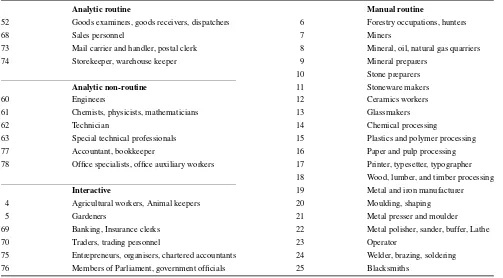
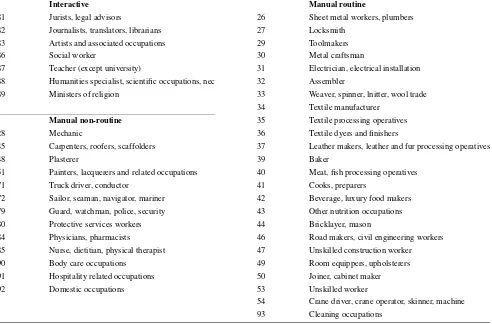
pool these activities into five task categories, and each oc-cupation has a value for each task category. The task cate-gories are: non-routine analytical tasks, non-routine interac-tive tasks, routine cogniinterac-tive/analytical tasks, routine manual tasks, and non-routine manual tasks (for detailed informa-tion, see Table3 in the Appendix). We calculate for each occupation (2-digits) the working time spent within a cer-tain task category and use this as an approximation for all workers in this occupation. Particularly, we use data infor-mation to calculate for each occupation (2-digits) a vector that describes how important each of the 5 task categories is for the job. We rate this procedure adequate to use full in-formation about task allocation compared to a simple one to one classification of each occupation to one dominant task (see Table4).
Experience (in the same occupation in the German labour market) is coded in 5-year groups, with all persons with more than 20 years working experience in one class. We use an approximation for persons firstly reported in the sam-ple in Eastern Germany in 1993 since we do not know their working experience before German re-unification: Medium-qualified persons are considered to have age minus 20 years working experience, high-qualified persons’ experience is set to age minus 28 if their experience would be lower oth-erwise.
We consider individuals as migrant (person with migra-tion history) if they are reported at least once with for-eign nationality, the standard (albeit problematic) proceed-ing to define migrants in the SIAB data. By this we count any person as a migrant who switched from a foreign to German nationality. We are aware that this might result in measurement error with regard to three points: Firstly, we count “Aussiedler” (non-native Germans with German an-cestors) as natives; secondly, we count many second- or third-generation migrants as migrants though they were born in Germany; thirdly, there might be coding errors which we are not able to differentiate from real acquiring another na-tionality.
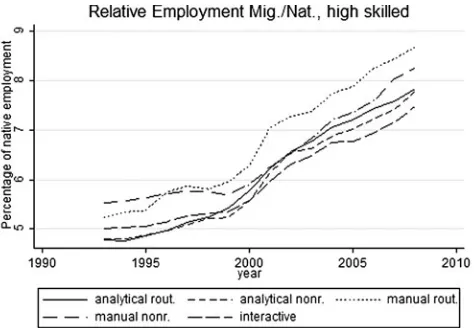
Descriptive evidence for the migrant-native wage differ-ential is provided in theAppendixin Table5. Information on the development of relative employment (as a ratio of migrant over native employment) by qualification and task group is shown in Figs.1,2and3.
6 Results
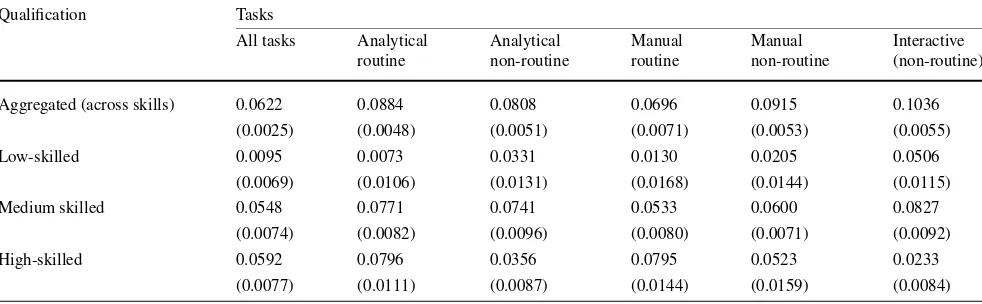
Table 1 Inverse substitution elasticities between migrants and natives, by qualification and task
Qualification Tasks
All tasks Analytical routine
Analytical non-routine
Manual routine
Manual non-routine
Interactive (non-routine)
Aggregated (across skills) 0.0622 0.0884 0.0808 0.0696 0.0915 0.1036
(0.0025) (0.0048) (0.0051) (0.0071) (0.0053) (0.0055)
Low-skilled 0.0095 0.0073 0.0331 0.0130 0.0205 0.0506
(0.0069) (0.0106) (0.0131) (0.0168) (0.0144) (0.0115)
Medium skilled 0.0548 0.0771 0.0741 0.0533 0.0600 0.0827
(0.0074) (0.0082) (0.0096) (0.0080) (0.0071) (0.0092)
High-skilled 0.0592 0.0796 0.0356 0.0795 0.0523 0.0233
(0.0077) (0.0111) (0.0087) (0.0144) (0.0159) (0.0084)
Standard errors in parenthesis
The estimations in the first column build on 400 (16 years×5 experience groups×5 tasks) observations, the estimations in the second to sixth column on 80 observations
levels, the second row estimates where we pool the observa-tions across the qualification levels. Likewise, the first col-umn shows inverse elasticities estimated in a pooled regres-sion across all task groups.
When we look at labour demand aggregated over all for-mal qualification groups (but disaggregated by year, task and experience), we estimate an overall inverse elasticity of substitution between migrants and natives of 0.0622, which corresponds to an elasticity of roughly 16. The task-specific elasticities of substitution are in the range between 9.6 and 14.4. These estimates are close to the threshold between per-fect and imperper-fect substitutes which frequently in the liter-ature is assumed to be at a value of 10 (though sometimes higher values are still considered as imperfect substitutes). We find that migrants and natives are better substitutable in manual routine tasks and somewhat worse substitutable when carrying out interactive tasks. However, when we con-sider only aggregates over all qualification levels, it is not clear whether the elasticities really reflect the substitutabil-ity between migrants and natives. These estimates may be affected to some extent by the different assignment of mi-grants and natives to qualification groups.
Hence, we disaggregate the labour-demand quantities by formal qualification in the next step. However, we still es-timate a homogeneous elasticity of substitution across the qualification-task-experience cells. These estimations are, with regard to the specification, closest to those used in D’Amuri et al. (2010) though we consider another period (till 2008 rather than 2001); they report estimates in the same value range as the elasticities found by us. The results indi-cate (almost) perfect substitutability between migrants and natives throughout all tasks. Actually, our estimate for sub-stitution in manual routine task is (insignificantly) negative, i.e. below the lower bound at zero (1 over infinity) as the value for which the inverse elasticity indicates absolutely
perfect substitutability. Inverse elasticities of employees in both non-routine manual and interactive tasks are higher than those in other tasks, even if they are far from imper-fect substitutability.
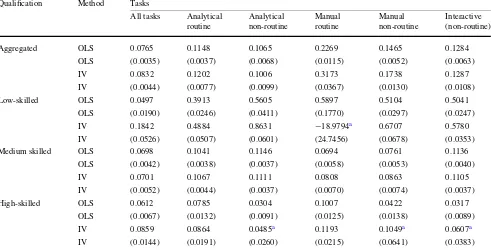
administra-Table 2 Comparison between OLS and IV estimates
Qualification Method Tasks
All tasks Analytical routine
Analytical non-routine
Manual routine
Manual non-routine
Interactive (non-routine)
Aggregated OLS 0.0765 0.1148 0.1065 0.2269 0.1465 0.1284
OLS (0.0035) (0.0037) (0.0068) (0.0115) (0.0052) (0.0063)
IV 0.0832 0.1202 0.1006 0.3173 0.1738 0.1287
IV (0.0044) (0.0077) (0.0099) (0.0367) (0.0130) (0.0108)
Low-skilled OLS 0.0497 0.3913 0.5605 0.5897 0.5104 0.5041
OLS (0.0190) (0.0246) (0.0411) (0.1770) (0.0297) (0.0247)
IV 0.1842 0.4884 0.8631 −18.9794a 0.6707 0.5780
IV (0.0526) (0.0507) (0.0601) (24.7456) (0.0678) (0.0353)
Medium skilled OLS 0.0698 0.1041 0.1146 0.0694 0.0761 0.1136
OLS (0.0042) (0.0038) (0.0037) (0.0058) (0.0053) (0.0040)
IV 0.0701 0.1067 0.1111 0.0808 0.0863 0.1105
IV (0.0052) (0.0044) (0.0037) (0.0070) (0.0074) (0.0037)
High-skilled OLS 0.0612 0.0785 0.0304 0.1007 0.0422 0.0317
OLS (0.0067) (0.0132) (0.0091) (0.0125) (0.0138) (0.0089)
IV 0.0859 0.0864 0.0485a 0.1193 0.1049a 0.0607a
IV (0.0144) (0.0191) (0.0260) (0.0215) (0.0641) (0.0383)
Standard errors in parentheses
The estimations in the first column build on 275 observations, those in column two to six on 55 observations
aWeak instrument—the F-statistic of the instrument in the first-stage regression is below 10
tions or related to the court). Overall, we provide evidence that migrants and natives are more or less perfect substitutes in most tasks if we account adequately for formal qualifica-tion. Further, they are not far from imperfect substitutabil-ity in interactive tasks requiring medium formal qualifica-tion, analytical tasks with medium qualificaqualifica-tion, as well as analytical-routine and manual-routine tasks carried out by employees with college/university degree.
7 Robustness checks and instrumental design
The identification of elasticities depends crucially on the as-sumption of inelastic labour supply. However, we cannot rule out completely that shocks on the ratio of migrants to natives differ across qualification-task-experience cells and that these labour ratios are unaffected by changes in the rel-ative wage structures. We expect reverse causality to induce a positive correlation between wage ratios and employment ratios (as relative wages of migrants go up, so does relative migrant labour supply). Hence, this endogeneity concern might bias OLS coefficients towards zero, with the conse-quence that the inverses of our OLS estimates are somewhat larger than the true elasticities of substitution.
External instruments are hardly available. Thus, we rely on internal instrumentation (for a more general discussion
on that issue see Card 2010), using the 5-year lag of the explanatory variable. This time lag exceeds both the dura-tion of vocadura-tional training (including average schooling in college) and the typical frequency in (collective) wage bar-gaining. I.e., the instrument eliminates short-term or con-temporaneous feedback effects from business cycle and an-ticipated effects due to the people currently upgrading their skills.
Every additional year used in the instrumentation comes at the cost of one year lost for the estimation. To provide a direct comparison, we report in Table2 even OLS esti-mates at the reduced time span. We reject equality of the two estimates for low-skilled labour throughout several tasks (analytical non-routine, manual non-routine, interactive and across all tasks). On the contrary, the IV estimates do not dif-fer significantly (at reasonable significance levels) from the OLS estimates over the same period for most qualification-task combinations; i.e. the OLS estimates cannot be consid-ered as inconsistent. Thus, endogeneity seems to be indeed only a minor issue in our analysis.
in-crease by roughly the same amount relative to the inverse elasticities reported in Table1. A notable exception are the estimates for substitution elasticities between low-skilled migrants and natives throughout all tasks; with data from 2001–2008, they are closer (albeit smaller) to those dis-played in Table2. I.e., the estimates for the second period increase sharply so that they indicate imperfect substitutabil-ity amongst the low-skilled. If we restrict both wages and employment only to full-time male workers, we find hardly any deviation from perfect substitutability. The estimated in-verse elasticities are much smaller than those reported in the table; the corresponding elasticities are between twice and ten times higher than those which can be derived from Ta-ble1. On the other hand, if we consider the wages for full-time male workers and contrast them with total employment, the estimated inverse elasticities of substitution are some-what higher than those shown above.
8 Conclusion
In this paper we have investigated to what extent migrants are substitutes to natives in the German labour market with a particular focus on the task dimensions. Our study has been motivated by the fact that migrants earn on average less than natives. Despite discrimination, imperfect substi-tutability is a possible reason for persistently lower wages. Recent research on the German labour market is ambigu-ous regarding the question whether migrants and natives are perfect (D’Amuri et al.2010, with elasticities between 16 and 35) or imperfect (Bruecker and Jahn2011, with an over-all elasticity of 7) substitutes in the labour market. Though the relations are conditional on comparable qualification and experience and almost equal data is employed in the analysis. However, migrants and natives—albeit possessing equal qualification level—frequently work in distinct occu-pational segments. They may have different language com-petence, and they will specialise in tasks in which they have comparative advantages. This suggests augmentation of the qualification-experience-nativity model employed in the previous literature by an additional dimension reflecting different tasks.
We sketch a theoretical framework by following the ap-proach by Borjas (2003) using a nested CES-production technology with inelastic labour supply of different skill lev-els. On the following stages we augment the basis model by introducing task cells for each qualification group. The em-pirical part adds the task level as an additional intermediate level of disaggregation with various specifications allowing for heterogeneity of substitution elasticity across the CES sub-aggregates.
In general, we find substitution elasticities between mi-grants and natives above ten, that is, in a range typically
con-sidered to indicate perfect substitution but not too far away from imperfect substitution. Our estimations highlight the importance of differentiation by task and qualification and of properly accounting for their heterogeneity. Qualification is crucial, indeed, if we consider different task groups: mi-grants and natives with low formal qualification show higher substitutability than migrants and natives with medium or high formal qualification. With regard to migrants and na-tives with medium qualification, we find that they are better substitutes in manual tasks and relatively worse substitutes in interactive tasks. Surprisingly, in interactive tasks highly qualified migrants and natives are good substitutes.
What are the economic implications of our results? If the wage gap between migrants and natives declines e.g. be-cause minimum wages are introduced (and thus the wage ratio becomes closer to one), we would expect an enormous effect amongst the low qualified (with a large number of mi-grant workers replaced by natives) and less strong effects amongst natives and migrants with medium and high for-mal qualifications. If, on the other hand, the wage ratio be-tween migrants and natives is not affected by an immigration shock, we would expect hardly any effect on native labour demand in the respective qualification level if the migrants have low formal qualification and a slightly positive effect if they have medium or high formal qualification.
All in all we find mainly perfectly substitutability within the task levels. Evidence of imperfect substitutability of im-migrant and native labour point at difficulties due to transfer-ability of labour market relevant skills and qualification ac-quired abroad. Moreover, we conclude that integration into the labour market is hampered especially in interactive in-tensive tasks.
Executive summary
explana-tion for occupaexplana-tional sorting by migrants even with the same formal qualification level. Descriptive figures confirm that migrants and natives—albeit possessing equal qualification level—frequently work in distinct occupational segments. They may have different language competence, and they will specialise in tasks in which they have comparative advan-tages.
This suggests augmentation of the qualification-experi-ence-nativity model employed in the previous literature by an additional dimension reflecting different tasks. By distin-guishing labour horizontally according to job requirements, we contribute to the existing literature which so far differen-tiates labour at most vertically by formal qualification or by experience.
In general, we find an elasticity of substitution between migrants and natives in a range typically considered to in-dicate perfect substitution but not too far away from imper-fect substitution. Our estimations highlight the importance of differentiation by task and qualification and of properly accounting for their heterogeneity. Qualification is crucial, indeed, if we consider different task groups: migrants and natives with low formal qualification show higher substi-tutability than migrants and natives with medium or high formal qualification. With regard to migrants and natives with medium qualification, we find that they are better sub-stitutes in manual tasks and relatively worse subsub-stitutes in interactive tasks. Surprisingly, in interactive tasks highly qualified migrants and natives are good substitutes. Evi-dence of imperfect substitutability of highly qualified immi-grant and native labour in routine tasks point at difficulties due to transferability of labour market relevant skills and qualification acquired abroad. Moreover, we conclude that, in particular for the medium qualified, integration into the labour market is hampered especially in interactive intensive tasks.
Building upon the estimates, further economic implica-tions can be derived with regard to the employment effects of wage and migration policy. If the wage gap between mi-grants and natives declines e.g. because minimum wages are introduced (and thus the wage ratio becomes closer to one), we would expect an enormous effect amongst the low quali-fied (with a large number of migrant workers replaced by na-tives) and less strong effects amongst natives and migrants with medium and high formal qualifications. If, on the other hand, the wage ratio between migrants and natives is not affected by an immigration shock, we would expect hardly any effect on native labour demand in the respective qualifi-cation level, for migrants with low formal qualifiqualifi-cation and a slightly positive effect for medium or high formal qualifi-cation.
Kurzfassung
Ausgehend vom TASK-Ansatz versucht dieser Beitrag zu erklären, warum Migranten im Schnitt weniger verdienen als Deutsche. Die schlechtere Performanz von Migranten auf dem Arbeitsmarkt hat eine lebhafte Debatte darüber an-gestoßen, wie die Position von Migranten auf dem Arbeits-markt verbessert und der Aufholprozess beschleunigt wer-den kann. Warum sind Migranten am Arbeitsmarkt benach-teiligt? Sieht man einmal von der Möglichkeit der Diskrimi-nierung ab, so deuten aktuelle Forschungsergebnisse darauf hin, dass Einheimische und Migranten im Produktionspro-zess nur bis zu einem gewissen Grade substituierbar sind. Dies könnte die niedrigeren Löhne von Migranten erklären. Die einschlägigen empirischen Befunde für den deutschen Arbeitsmarkt sind nicht eindeutig: Folgt man D’Amuri et al. (2010), so sind Migranten und Einheimischen vollkomme-ne Substitute – ein Befund, dem Bruecker and Jahn (2011) widersprechen. Das ist insofern überraschend, als die in bei-den Studien verwendeten Modellierungen auf sehr ähnli-chen Datensätzen basieren und bezüglich beruflicher Qua-lifikation und Berufserfahrung für vergleichbare Variablen kontrollieren.
Die Konzentration von Migranten in bestimmten Beru-fen – selbst bei gleicher Qualifikation – erklären Peri and Sparber (2009) damit, dass diese über relative Vorteile in be-stimmten Tätigkeitsfeldern verfügen. Deskriptive Evidenz bestätigt, dass Migranten und Einheimische – selbst bei ver-gleichbarer Ausbildung – häufig in unterschiedlichen Beru-fen arbeiten. Denn Migranten verfügen über unterschiedli-che sprachliunterschiedli-che Kompetenzen und spezialisieren sich meist auf diejenigen Tätigkeiten, in denen sie relative Vorteile ha-ben. Im Gegensatz zu bisherigen Studien zur Situation von Migranten am Arbeitsmarkt, die auf unterschiedliche Gra-de an formaler Qualifikation und Berufserfahrung abheben, wird in diesem Beitrag auch nach den horizontalen Arbeits-platzanforderungen (job tasks) unterschieden.
Generell bewegen sich die Substitutionselastizitäten zwi-schen Migranten und Einheimizwi-schen, nach unseren Schät-zungen in einem Bereich, der von perfekter bis zu relativ weitgehender Substituierbarkeit reicht.
Unsere Ergebnisse unterstreichen, dass die Unterschie-de in Unterschie-den Taskdimensionen und in Unterschie-der beruflichen Qualifi-kation gleichermaßen beachtet werden müssen. Die Ebene der beruflichen Qualifikation bleibt weiterhin zentral – auch wenn man nach Taskebenen differenziert: Migranten und Einheimische ohne abgeschlossene Berufsausbildung sind stärker substituierbar als Personen mit mittlerer und höherer Qualifikation. Auf der mittleren Qualifikationsebene ist die Substituierbarkeit zwischen Migranten und Einheimischen bei manuellen Tätigkeiten deutlich höher als bei Tätigkeiten mit interaktiven Anforderungen.
Routinetätigkeiten. Dies dürfte daran liegen, dass in diesem Bereich die relevanten Arbeitsmarktkenntnisse häufig fehlen und ausländische Berufsabschlüsse nur zum Teil übertragbar sind. Zudem zeigt sich, dass Migranten mit abgeschlossener Berufsausbildung Schwierigkeiten bei der Integration in den Arbeitsmarkt haben, wenn sie mit überwiegend interaktiven Tätigkeitsanforderungen konfrontiert sind.
Aus den Ergebnissen lassen sich zudem wichtige Er-kenntnisse für die Lohn- und Migrationspolitik ableiten. Falls der Lohnabstand zwischen Migranten und
Einhei-mischen schrumpft, etwa weil ein Mindestlohn eingeführt wird, hätte dies deutliche Auswirkungen für die geringer Qualifizierten. So dürfte insbesondere die Nachfrage nach geringqualifizierten Arbeitskräften mit Migrationshinter-grund abnehmen. Bei unverändertem Lohnabstand zwischen Migranten und Einheimischen hingegen hätte Zuwanderung leicht positive Beschäftigungseffekte für mittel- und hoch-qualifizierte Einwanderer, und keine nennenswerten Aus-wirkungen für geringqualifizierte Migranten oder Deutsche.
Appendix
Table 3 Assignment of activities to task classification scheme
Task classification Activities
Non-routine analytic Researching/analysing/evaluating and planning, making plans/constructions/designing and sketching, working out rules/prescriptions, using and interpreting rules
Non-routine interactive Negotiating/lobbying/coordinating/organising, teaching/training, selling/buying/advising customers/advertising, entertaining/presenting, employ/manage personnel
Routine cognitive Calculating/bookkeeping, correcting of texts/data, measuring of length/weight/temperature Routine manual Operating/controlling machines, equipping machines
Non-routine manual Repairing/renovation of houses/apartments/machines/vehicles, restoring art/monuments, serving or accommodating Note: Overview of how activities asked for in the Qualification and Career Survey are grouped into the task categories
Source: Black and Spitz-Oener (2007), p. 30
Table 4 Occupations by dominant task (Kl.d.B.88)
Analytic routine Manual routine
52 Goods examiners, goods receivers, dispatchers 6 Forestry occupations, hunters
68 Sales personnel 7 Miners
73 Mail carrier and handler, postal clerk 8 Mineral, oil, natural gas quarriers
74 Storekeeper, warehouse keeper 9 Mineral preparers
10 Stone preparers
Analytic non-routine 11 Stoneware makers
60 Engineers 12 Ceramics workers
61 Chemists, physicists, mathematicians 13 Glassmakers
62 Technician 14 Chemical processing
63 Special technical professionals 15 Plastics and polymer processing
77 Accountant, bookkeeper 16 Paper and pulp processing
78 Office specialists, office auxiliary workers 17 Printer, typesetter, typographer 18 Wood, lumber, and timber processing
Interactive 19 Metal and iron manufacturer
4 Agricultural workers, Animal keepers 20 Moulding, shaping
5 Gardeners 21 Metal presser and moulder
69 Banking, Insurance clerks 22 Metal polisher, sander, buffer, Lathe
70 Traders, trading personnel 23 Operator
75 Entrepreneurs, organisers, chartered accountants 24 Welder, brazing, soldering
Table 4 (Continued)
Interactive Manual routine
81 Jurists, legal advisors 26 Sheet metal workers, plumbers
82 Journalists, translators, librarians 27 Locksmith
83 Artists and associated occupations 29 Toolmakers
86 Social worker 30 Metal craftsman
87 Teacher (except university) 31 Electrician, electrical installation 88 Humanities specialist, scientific occupations, nec 32 Assembler
89 Ministers of religion 33 Weaver, spinner, lnitter, wool trade
34 Textile manufacturer
Manual non-routine 35 Textile processing operatives
28 Mechanic 36 Textile dyers and finishers
45 Carpenters, roofers, scaffolders 37 Leather makers, leather and fur processing operatives
48 Plasterer 39 Baker
51 Painters, lacquerers and related occupations 40 Meat, fish processing operatives
71 Truck driver, conductor 41 Cooks, preparers
72 Sailor, seaman, navigator, mariner 42 Beverage, luxury food makers 79 Guard, watchman, police, security 43 Other nutrition occupations
80 Protective services workers 44 Bricklayer, mason
84 Physicians, pharmacists 46 Road makers, civil engineering workers
85 Nurse, dietitian, physical therapist 47 Unskilled construction worker
90 Body care occupations 49 Room equippers, upholsterers
91 Hospitality related occupations 50 Joiner, cabinet maker
92 Domestic occupations 53 Unskilled worker
54 Crane driver, crane operator, skinner, machine 93 Cleaning occupations
Own calculation and presentation based on data source: Dustmann et al. (2010) and classification of occupations (2-digit)
Table 5 Descriptive statistics of the mean log wage difference between Germans and natives by qualification level (conditional on equal experi-ence, task qualification, and years)
Low skilled Medium skilled High skilled
Descriptive statistics across all tasks
mean −0.0131 −0.0051 −0.0013
s.d. 0.0178 0.0080 0.0075
min −0.0526 −0.0269 −0.0244
max 0.0206 0.0117 0.0194
Average log wage difference by task
Analytical routine −0.0157 −0.0097 0.0002
Analytical non-routine −0.0156 −0.0069 0.0006
Manual routine −0.0235 −0.0097 0.0001
Manual non-routine −0.0041 0.0015 −0.0046
Interactive −0.0066 −0.0008 −0.0030
The log wage difference between migrants and natives with qualificationhin taskIwith experiencejat timetis defined as ln(wwhijmt
Fig. 1 Relative Employment Mig./Nat., unskilled
Fig. 2 Relative Employment Mig./Nat., med. skilled
Fig. 3 Relative Employment Mig./Nat., high skilled
References
Abraham, M., Damelang, A., Schulz, F.: Wie strukturieren Berufe Arbeitsmarktprozesse? Eine institutionentheoretische Skizze, LASER Discussion Paper 55, University of Erlangen, Nuremberg (2011)
Acemoglu, A., Autor, D.: Skills, tasks and technologies: implications for employment and earnings. NBER working paper No. 16082 (2010)
Autor, D.H.: The “task approach” to labor markets. An overview. J. Labour Market Res., doi:10.1007/s12651-013-0128-zOnline first, 15 (2013)
Autor, D.H., Levy, F., Murnane, R.J.: The skill content of recent tech-nological change: an empirical exploration. Q. J. Econ. 118(4), 1279–1333 (2003)
Autor, D.H., Katz, L.F., Kearney, M.S.: The polarization of the US labor market. Am. Econ. Rev. 96(2), 189–194 (2006)
Black, S.E., Spitz-Oener, A.: Explaining women’s success: technologi-cal change and the skill content of women’s work. NBER working paper No. 13116 (2007)
Bonin, H.: Wage and employment effect of immigration to Germany: evidence from a skill group approach, IZA Discussion Paper (1875), Bonn (2005)
Borjas, G.J.: Ethnic capital and intergenerational mobility. Q. J. Econ. 107(1), 123–150 (1992)
Borjas, G.: The labor demand curve is downward sloping: reexamining the impact of immigration on the labor market. Q. J. Econ. 118(4), 1335–1374 (2003)
Borjas, G., Katz, L.F.: The evolution of the mexican-born workforce in the United States. In: Borjas, G. (ed.) Mexican Immigration to the United States, pp. 13–56. Univ. of Chicago Press, Chicago (2007) Borjas, G.J., Grogger, J., Hanson, G.H.: Substitution between
immi-grants, natives, and skill groups, NBER working papers 17461, National Bureau of Economic Research (2011)
Bruecker, H., Jahn, E.: Migration and wage-setting: reassessing the la-bor market effects of migration. Scand. J. Econ. 113(2), 286–317 (2011)
Card, D.: Immigrant inflows, native outflows, and the local labor mar-ket impacts of higher immigration. J. Labor Econ. 19(1), 22–64 (2001)
Card, D.: How immigration affects US cities. CREAM discussion pa-pers series 0711 (2007)
Card, D.: Immigration and Inequality. NBER discussion paper No. 14683 (2010)
Card, D., Lemieux, T.: Can falling supply explain the rising return to college for younger men? A cohort-based analysis. Q. J. Econ. 116(2), 705–746 (2001)
D’Amuri, F., Ottaviano, G.I.P., Peri, G.: The labor market impact of immigration in Western Germany in the 1990s. Eur. Econ. Rev. 54(4), 550–570 (2010)
Dorner, M., Heining, J., Jacobebbinghaus, P., Seth, S.: Sample of integrated labour market biographies (SIAB) 1975–2008. FDZ Datenreport No. 01/2010 (2010)
Dustmann, C., Frattini, T., Preston, I.: The effect of immigration along the distribution of wages. CReAM discussion paper Series 0803 (2008)
Dustmann, C., Ludsteck, H., Schoenberg, U.: Revisiting the German wage structure. Q. J. Econ. 124(2), 843–881 (2009)
Dustmann, C., Hafner, M., Schoenberg, U.: Organizational Change and Polarization (2010). Mimeo
Gathmann, C., Schoenberg, U.: How general is human capital? A task based approach. J. Labor Econ. 28(1), 1–49 (2010)
Goos, M., Manning, A.: Lousy and lovely jobs: the rising polarization of work in Britain. Rev. Econ. Stat. 89(1), 118–133 (2007) Goos, M., Manning, A., Salomons, A.: Job polarization in Europe.
Amer. Econ. Rev.: Papers Proc. 99(2), 58–63 (2009)
Gorter, C., Nijkamp, P., Rietveld, P.: The impact of employers’ recruit-ment behaviour on the allocation of vacant jobs to unemployed job seekers. Empir. Econ. 18(2), 251–269 (1993)
Holzer, H.J.: Why do small establishments hire fewer blacks than large ones? J. Hum. Resour. 33(4), 896–914 (1998)
Lazear, E.: Culture and language. J. Polit. Econ. 107(S6), S95–S126 (1999)
Longhi, S., Brynin, M.: Occupational change in Britain and Germany. Labour Econ. 17(4), 655–666 (2010)
Ottaviano, G.I.P., Peri, G.: Cities and cultures. J. Urban Econ. 58(2), 304–337 (2005)
Ottaviano, G.I.P., Peri, G.: Rethinking the effects of immigration on wages. J. Eur. Econ. Assoc. 10(1), 152–197 (2012)
Ottaviano, G.I.P., Peri, G.: The effects of immigration on US wages and rents: a general equilibrium approach. CReAM discussion paper series 0713 (2007)
Peri, G., Sparber, C.: Task specialization, immigration, and wages. Am. Econ. J. Appl. Econ. 1(3), 135–169 (2009)
Schmillen, A., Moeller, J.: Distribution and determinants of lifetime unemployment. Labour Econ. 19(1), 33–47 (2012)
Spitz-Oener, A.: Technical change, job tasks, and rising educational demands: looking outside the wage structure. J. Labor Econ. 24, 2:235–270 (2006)
Stops, M., Mazzoni, T.: Job matching on occupational labour markets. J. Econ. Stat. 230(3), 287–312 (2010)
Suedekum, J., Wolf, K., Blien, U.: Cultural diversity and local labour markets. Regional studies. J. Region. Stud. Assoc., doi:10.1080/ 00343404.2012.697142Online first, 19 (2012)
Steinhardt, M.F.: The wage impact of immigration in Germany—new evidence for skill groups and occupations. B.E. J. Econ. Anal. Policy 11(1), 31 (2011)
Anette Haas graduated in Economics at the University of Regensburg, specializing in regional and urban economics, econometrics and em-pirical macroeconomics. She has been working at the IAB since 1997. Currently, she is head of IAB’s “Working Group on Migration and In-tegration”. She is interested in regional and international migration and labor market integration.
Michael Lucht studied maths and economics at the Christian Albrecht University in Kiel completing his studies in 2010 (Diplom Volkswirt) and 2011 (Diplom Mathematiker). He has been a scholarship holder in IAB’s Graduate Programme (GradAB) since November 2010 and is working at IAB’s department “Regional Labour Markets” as a re-searcher.