R E S E A R C H
Open Access
Modeling causes of death: an integrated
approach using CODEm
Kyle J Foreman
1, Rafael Lozano
1, Alan D Lopez
2and Christopher JL Murray
1*Abstract
Background:Data on causes of death by age and sex are a critical input into health decision-making. Priority setting in public health should be informed not only by the current magnitude of health problems but by trends in them. However, cause of death data are often not available or are subject to substantial problems of
comparability. We propose five general principles for cause of death model development, validation, and reporting.
Methods:We detail a specific implementation of these principles that is embodied in an analytical tool - the Cause of Death Ensemble model (CODEm) - which explores a large variety of possible models to estimate trends in causes of death. Possible models are identified using a covariate selection algorithm that yields many plausible combinations of covariates, which are then run through four model classes. The model classes include mixed effects linear models and spatial-temporal Gaussian Process Regression models for cause fractions and death rates. All models for each cause of death are then assessed using out-of-sample predictive validity and combined into an ensemble with optimal out-of-sample predictive performance.
Results:Ensemble models for cause of death estimation outperform any single component model in tests of root mean square error, frequency of predicting correct temporal trends, and achieving 95% coverage of the prediction interval. We present detailed results for CODEm applied to maternal mortality and summary results for several other causes of death, including cardiovascular disease and several cancers.
Conclusions:CODEm produces better estimates of cause of death trends than previous methods and is less susceptible to bias in model specification. We demonstrate the utility of CODEm for the estimation of several major causes of death.
Keywords:cause of death, ensemble models, predictive validity, spatial-temporal models, maternal mortality, Glo-bal Burden of Disease
Background
Data on causes of death by age and sex are a critical input into health decision-making. Nations devote con-siderable resources to collecting, collating, and analyzing various types of cause of death data for this reason [1-3]. Priority setting in public health, however, should be informed not only by the current magnitude of health problems but by trends in them. Whether or not a cause of death is increasing or decreasing is important information as to whether current disease control efforts are working or inadequate. The rising burden of
diabetes and the policy debate it has triggered is a good example of the importance of monitoring national trends in causes of death [4,5].
The fundamental challenge for most countries, how-ever, is that cause of death data are often not available or subject to substantial problems of comparability. Even in the 89 countries with complete vital registration systems and medical certification of causes of death in 2009, many issues of comparability remain [6-8]. Dra-matic changes from year to year in death rates from a cause can be due to changes in International Classifica-tion of Diseases (ICD) revision [9,10] or naClassifica-tional modifi-cations of coding rules [11-14]. In some cases, causes such as HIV or diabetes may be systematically misclassi-fied [8,15-21]. The fraction of deaths assigned to causes * Correspondence: [email protected]
1
Institute for Health Metrics and Evaluation, University of Washington, 2301 5thAve, Seattle, WA 98121, USA
Full list of author information is available at the end of the article
that are not true underlying causes of death can vary widely and change over time [20,22-27]. In places with-out complete vital registration, a range of sources such as verbal autopsy studies (national or subnational), par-tial urban vital registration, or survey/census data may be available. Data may be available only for a limited number of years and these data are often subject to sub-stantial sampling and even larger nonsampling error. Generating national assessments of causes of death by age, sex, and year requires a strategy and methodology to deal with this diverse set of data issues.
Efforts to model causes of death using available data have a long history [28-34]. Initial attempts focused on estimating causes of death for a cross-section of coun-tries by modeling cause as a function of overall mortal-ity levels. For example, Preston’s 1976 Mortality Patterns in National Populations: With Special Reference to Recorded Causes of Death [28] was the initial effort to assess trends in causes of death taking into account misclassification of deaths. The demand for estimates of both levels and trends in key causes from diverse groups have led to multiple recent studies on diarrhea, maternal mortality, and other causes of death [29-31,35-37]. These studies have used a wide variety of analytical stra-tegies and specific model implementations. The recent debate on maternal mortality estimation [35,36,38-41] is an illustration of quite different choices of the depen-dent variable and model specifications. The use of Gaus-sian Process Regression (GPR) and other related techniques has been used for all-cause mortality in chil-dren and adults and in time series cross-sectional work on key risk factors [5,42-45]. Affordable computational power and innovations in Bayesian statistical modeling have fueled a steady growth in alternative estimation strategies. This innovation is likely to continue for the foreseeable future.
Comparing alternative modeling approaches applied to the same cause of death is complicated by a lack of accepted standards for good cause of death modeling practice. Preferences for the results of alternative strate-gies may be based not on documented performance but on impressionistic grounds. In this paper, we propose five general principles for cause of death model develop-ment, validation, and reporting. We then detail a speci-fic implementation of these principles that is embodied in an analytical tool, CODEm - the Cause of Death Ensemble model.
Principles for cause of death model development
1. Identify all the available data
Good cause of death modeling practice begins with a systematic attempt to identify all the available data. Most cause of death data is captured through a variety of national data collection systems such as partial or
complete vital registration or national or sample regis-tration systems with verbal autopsy. Most of these data are not published in the scientific literature but are available through national sources or the World Health Organization (in the case of vital registration with medi-cal certification of causes of death). These main sources can also be supplemented with subnational studies on select causes or age groups from the published literature through systematic reviews. For some diseases, there may be special sources of information, such as popula-tion-based cancer registry data for mortality from selected cancers in particular catchment areas.
2. Maximize the comparability and quality of the dataset
completeness of death registration. Various methods have been proposed to correct for completeness [34,53].
Even after various known biases due to ICD classifica-tion changes, garbage coding, and completeness have been taken into account, the results of some studies may be subject to large nonsampling error. Nonsam-pling error can come about from a wide range of factors that can affect vital registration, verbal autopsy, and other surveillance data sources. Explicit criteria should be used to detect extreme outliers in the rates or cause fractions derived from different sources. Based on expli-cit criteria, outlier data points should be excluded from the cause of death modeling analysis.
3. Develop a diverse set of plausible models
There are a myriad of choices to be made when model-ing cause of death trends. Cause of death data are often sparse for many low-income countries and may also be more available for certain time periods such as 1995 to 2005 than for earlier or later periods; predictions for data-sparse time periods and/or populations are often sensitive to subtle differences in model specification or the form of the dependent variable; modeling cause-spe-cific mortality rates or cause-fractions can yield very dif-ferent results; and choosing to use educational attainment rather than income per capita can lead to major differences in the predicted trend in causes of death in places with economic downturns. We believe that good modeling practice starts by casting a wide net in terms of proposed models.
Whatever models that are proposed, however, should meet basic plausibility criteria. Known strong biological or behavioral relationships should be respected. For example, models for the age-specific stroke death rate should have a positive coefficient on mean systolic blood pressure of the population, models for lung can-cer should have a positive coefficient on tobacco con-sumption, and so on. A set of models for which these known directions of relationships are respected provides a more robust platform for assessing models and creat-ing model ensembles.
The diverse set of models we test also includes various ways of combining the predictions of multiple individual models. Experience in many fields - ranging from meteorology, soil chemistry, and stocks to the Netflix Challenge and others - have demonstrated that ensem-ble models have smaller prediction error than the best single model [54-61]. Ensemble models that are weighted combinations of the posterior distributions of component models provide lower error for the point estimate and more accurate uncertainty intervals [62-66]. Additionally, ensemble models capture uncer-tainty not only due to the parameters in any one model but also the uncertainty of predictions due to differences in specification across models. Many methods have been
proposed and used for developing weights for compo-nent models in an ensemble, including Bayesian Model Averaging (BMA), averaging of all plausible models, and using fixed or arbitrary weights [67].
4. Assess the predictive validity of each plausible individual model and of ensemble models
In-sample fit is not a robust measure of prediction when data are sparse or missing. Instead, out-of-sample pre-dictive validity is the appropriate measure [66,68-72]. If one model generates better out-of-sample predictions than another, we should prefer this model for the task of prediction. Assessing predictive validity requires hold-ing out some fraction of the data from model buildhold-ing and then assessing the predictions from the model against the data that have been held out. The compel-ling logic that modecompel-ling strategies used for prediction should be assessed through out-of-sample predictive validity is unlikely to be controversial. There are, how-ever, many options for assessing predictive validity that deserve exploration, including which data to hold out, how many repeated samples to perform, and which metrics of validity to calculate.
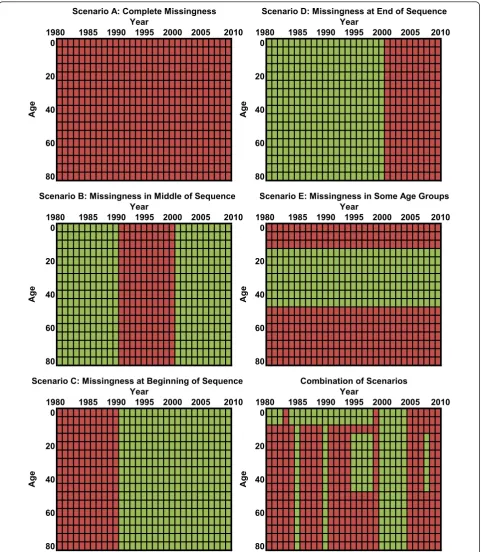
In bioinformatics and genomics, the standard predic-tive validity approach is to perform five- or 10-fold cross-validation, in which 10% or 20% of the data are held out and models are developed on the remaining data, a process which is then repeated multiple times to ensure stability. The statistical literature suggests that leave-one-out methods overestimate performance, instead recommending that larger hold-outs be used [73-75]. For cause of death estimation, we can identify five distinct scenarios for prediction: a) countries with no data; b) countries with missing data years but with data from years before and after the missing sequence; c) data missing at the beginning of the sequence; d) data missing at the end of the sequence; and e) data for some age groups such as children or reproductive-age females and not for other age groups. Countries may often be characterized by a combination of these scenarios. Dif-ferent models can and do in fact perform difDif-ferentially on these various tasks. We believe that the data hold-out strategy should mimic the task required of the model. In other words, we should hold out sequences of data in proportion to how often the model would need to fill in such a sequence (Figure 1 illustrates the con-struct). In this way, the hold-out will reflect the appro-priate mix of the five scenarios that have been described. Producing train-test datasets through a hold-out strategy should be repeated often enough to yield stable assessments of predictive validity that are not a function of the idiosyncratic nature of a particular ran-domly generated data hold-out.
predicting levels, errors in predicting trends, and the adequacy of uncertainty intervals. First, for assessing prediction error for the quantity of interest, one can imagine metrics that assess absolute error or relative
error and metrics that are based on variances or abso-lute deviations. Second, two models may yield similar metrics of prediction error on the levels of mortality but one model may more robustly predict the trend in a
0 0
20 20
40 40
60 60
80 80
0 0
20 20
40 40
60 60
80 80
0 0
20 20
40 40
60 60
80 80
1985 1990 1995 2000 2005 2010 1985 1990 1995 2000 2005 2010
2010 Scenario C: Missingness at Beginning of Sequence
Age
1985 1990 1995 2000 Year
1985 1990 1995 2000 2005
Scenario E: Missingness in Some Age Groups Scenario B: Missingness in Middle of Sequence
Scenario A: Complete Missingness
1985 1990 1995 2000 2005 2010
Age
Year Year 1980
1980
Year
1980 1985 1990 1995 2000 2005 2010 Scenario D: Missingness at End of Sequence
Age
1980
Year 1980
Age
Age
Combination of Scenarios Year
1980
Age
2005 2010
Figure 1Examples of missingness patterns observed in data for a single country and cause of death. Green represents available data
given cause of death. For many applications of cause of death modeling, estimating an accurate trend may be even more important than estimating an accurate level. Predictive validity for trends can be assessed by examin-ing the first differences over time for the prediction and the data and assessing error in this dimension. Third, it is particularly important to derive uncertainty intervals for cause of death estimation that are accurate. Cover-age of the uncertainty intervals of any proposed model should be reported taking into account the sampling and nonsampling error estimated for a model. The reported uncertainty interval for a model is the uncer-tainty in the expected value of the death rate. This should be much narrower than the interval for the pre-diction of data measurements of that expected quantity of interest. An ideal model should have data coverage close to or greater than 95%.
Some ensemble models use information on the perfor-mance of component models to generate the weights on the component models [65]. If weights are chosen from in-sample fit, these may not yield the best results. In cases where ensemble weights need to be selected on the basis of out-of-sample performance, a train-test 1-test 2 strategy needs to be used. In these cases, some percentage of the data, such as 70%, are set aside for the training set, and the remaining data are randomly split into two test datasets. The first test is used to develop ensemble weights, and the performance of all compo-nent models and the ensembles are compared using the second test dataset. In this way, the comparison in the second test between the component models and variants of ensemble models is equitable, using data that have not previously been used for any modeling strategy. Train-test 1-test 2 strategies will need to be repeated multiple times until stable performance metrics have been achieved.
5. Choose the model or ensemble model with the best performance in the out-of-sample predictive validity tests
In selecting a best single model or model ensemble, the three types of assessments may have to be balanced. The model with the lowest root mean squared error (RMSE) may do worse on trend or have coverage that is too high or too low. Balancing these attributes will depend on the specific cause of death application. An overall judgment to choose the final model or model ensemble should take into account preferences for these three domains. A set of preferences should in principle be translated into an objective function that captures the desired trade-offs between different dimensions of performance. Most users will, in fact, want to balance various attributes of predictions, and they will want to examine metrics of predictive validity that capture these various attributes. In all cases, model selection should be designed to be robust to outliers.
Methods
Cause of Death Ensemble model (CODEm) - an integrated cause of death modeling environment
We have developed a cause of death modeling environ-ment to facilitate work on modeling cause-specific mor-tality for a large number of countries, which can be applied to any cause of death for which data are avail-able. To design this modeling tool we have developed a specific implementation of the five principles that we have outlined above. Many specific choices were required to develop a computationally tractable but flex-ible strategy that is consistent with these principles. In this section, we describe in detail these design choices, including the development of a large set of plausible models, the development of ensemble models using adaptive weighting systems, the assessment of out-of-sample predictive validity, and final results using mater-nal mortality as a case study.
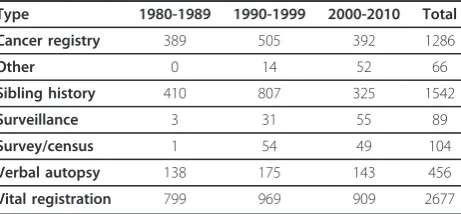
We illustrate the application of CODEm to modeling several major causes of death using the cause of death database that has been developed at the Institute for Health Metrics and Evaluation. This database has been developed following the first two principles outlined above. For reference, Table 1 summarizes the available cause of death data from vital registration systems, ver-bal autopsy studies, surveillance systems, and various surveys/censuses with some cause-specific data. In addi-tion, it includes data based on information collected at hospitals, mortuaries, burial sites, etc. Data inputs have been processed to deal with various issues to enhance comparability. For example, Naghavi et al. have devel-oped algorithms to systematically deal with problems of ICD revision comparability and the phenomenon of
“garbage coding”[49]. In other cases, datasets have been made comparable by mapping from aggregated age groups to five-year age groups. The end result of this work is a database of multiple sources of cause of death data that is continuously updated as new datasets are identified. While we use this database to illustrate the application of CODEm, in principle CODEm can be applied to any cause of death dataset.
Table 1 CODEm data sources by type and decade Type 1980-1989 1990-1999 2000-2010 Total
Cancer registry 389 505 392 1286
Other 0 14 52 66
Sibling history 410 807 325 1542
Surveillance 3 31 55 89
Survey/census 1 54 49 104
Verbal autopsy 138 175 143 456
Developing plausible models
Model families
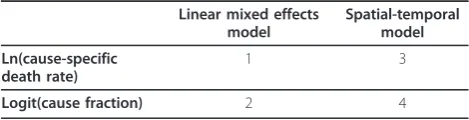
We have developed four families of models that reflect the choice of the dependent variable and the use of spa-tial-temporal patterns in the data. Table 2 shows the four families of models. One choice is whether to model cause fractions or death rates; the second choice is whether to use a simple linear hierarchical model or to also capture spatial-temporal patterns in the unex-plained component of the data. As highlighted in Table 2, taking both choices into account yields four modeling families. We model cause fractions using the logit of the cause fraction. Mortality has long been shown to have an exponential relationship to units of time [28,76], so we model death rates using the natural logarithm (ln) of rates. For each family of models, we include multiple possible covariate combinations, resulting in possibly hundreds of different models.
Choosing covariates
For each cause of death, one could postulate many feasi-ble models based on the published literature where cohort studies, cross-sectional time series studies, or intervention trials have suggested that there is a rela-tionship between a covariate and a specific cause of death. Because of multicollinearity, including all possible covariates in a model often yields implausible signs on covariates or unstable coefficients, as well as overfitting. There is an extensive literature on choosing covariates in these circumstances, including forward and backward stepwise regression [77,78], LASSO (L1-constrained regression) [79], elastic nets [80], Bayesian variable selection [81], and other covariate selection methods. Especially when predicting out of sample for countries with no data or very limited data, the specific choice of covariates can make a large difference on prediction [82,83]. Building on the various traditions for choosing covariates, we have developed an algorithm that cap-tures both strong views on the plausible relationships between covariates and the relevant cause of death as well as our desire to propose a diversity of plausible models. Ideally the uncertainty of the covariates would also be taken into account, but it is not computationally feasible at present to bootstrap each covariate.
Our solution to this problem is a covariate selection algorithm that takes into account prior information on which covariates are important and what sort of effect
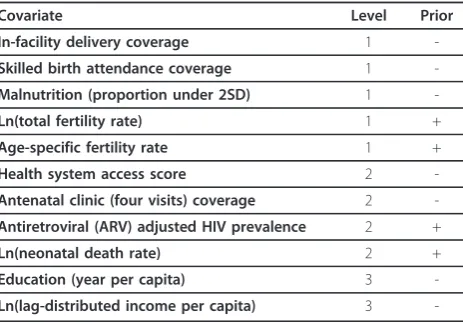
they should have on the dependent variable. We first select n covariates and categorize them into three groups based on how strong the evidence is of the cau-sal connection. For each disease, the literature was searched for previous studies showing correlations between available covariates and cause-specific mortality (particularly at the population level), and disease experts were consulted. Covariates with strong proximal rela-tionships, such as etiological or biological roles in the disease process, are ranked as level 1. Covariates for which there is strong evidence for a relationship, but not a direct biological link, are placed in level 2. Covari-ates with weak evidence for a relationship, or which would be distal in the causal chain and thus may be mediated by factors in levels 1 or 2, are categorized as level 3. Based on the literature, we assign a prior on the direction of each covariate. Covariates that should increase the dependent variable are classified as having a positive prior, while those that should be inversely related are given a negative prior. If there is conflicting or inconclusive evidence as to the expected direction, the user can also specify that either direction would be valid. By definition, we would not expect to assign an ambiguous direction for a level 1 covariate.
After priors have been set according to level of evi-dence and presumed direction, a list of all possible cov-ariate combinations for level 1 is created. We test all 2n -1 combinations of level -1 covariates. We retain all mod-els where the sign on all covariates in that model is in the expected direction and the coefficient is significant at the p < .05 level. In each case, the model is estimated with the mixed effects structure used in the spatial-tem-poral model described below (random effects on super-region, super-region, and age), with the covariates under exploration included as fixed effects. So as to not have to retest each of these covariate combinations with the linear model family described below, we make the sim-plifying assumption that the inclusion of an additional country random effect will not change the direction or significance of the fixed effects; this assumption has held true in our testing and greatly reduces computational burden.
Level 2 covariates are assessed using a more computa-tionally efficient approach. First, for each level 1 model that was retained, we create a list of 2m possible level 2 models (where mis the number of level 2 covariates). The first, which has no level 2 covariates included, has already been tested and is retained. Next, each of them
possible models in which one covariate is added to the level 1 model is tested. If adding the level 2 covariate does not affect either the significance or the sign on any level 1 coefficients, and the level 2 covariate itself fits the priors on direction and significance, then it is retained as another possible model. If, however, the Table 2 Families of CODEm component models
Linear mixed effects model
Spatial-temporal model
Ln(cause-specific death rate)
1 3
level 2 covariate does not fulfill the priors or forces any of the level 1 covariates to violate their priors, then it is dropped.
In addition, all other possible level 2 models that contain that covariate are also dropped. For example, if we have a level 1 model A, and three possible level 2 covariates, X, Y, and Z, we first test each of them individually against level 1 model A. Suppose × and Y fulfill the priors, but Z vio-lates them. Then, we can eliminate the level 2 models Z, X +Z, Y+Z, and X+Y+Z. Thus, we can test just one more level 2 model, X+Y. If that model fulfills the prior, then we are left with 4 different models from our original level 1 model: A (level 1 only), A+X, A+Y, and A+X+Y. This is a conservative approach because it reduces computational burden - both for the software which thus has fewer mod-els to evaluate, and for the analyst who typically lacks the sorts of information that would be necessary to formulate conditional priors for multiple covariates. However, if the analyst has sufficient time and computational power, all covariates can be designated as level 1 and thus all combi-nations of covariates will be tested.
Next, we take each of the models resulting from level 2 and use the same process as described for level 2 on the level 3 covariates. In this way, we can either test or preemptively eliminate all (2n-1)*2m*2lpossible covariate models (where n= the number of level 1 covariates, m
the number of level 2 covariates, and l the number of level 3 covariates) in an efficient manner. Ultimately we obtain a set of all possible covariate combinations that fulfill our priors on covariate direction. This ensures that we do not exclude any potentially valuable informa-tion in our modeling process. We run the covariate selection tool for both cause fractions and death rates and then create both mixed effects only and spatial-tem-poral models for each set of chosen covariates.
This covariate selection method, which produces a list of models for which prior covariate relationship beliefs are maintained, allows for great flexibility in model choice. If a user specifies all-cause mortality as a level 1 covariate, then a classical Preston-type cause of death model would be tested. Or if there is strong reason to believe that cohort effects are prominent for a cause of death, then cohort-lagged measures could be incorpo-rated. For instance, in the case of lung cancer an analyst could test five-year cohort lags of smoking prevalence (in which the value used to estimate lung cancer in 60 year olds in 2005 would be the smoking prevalence amongst 55 year olds in 2000), 10-year cohort lags (in which lung cancer deaths in 60 year olds in 2005 would be based on smoking prevalence amongst 50 year olds in 1995), and so forth. By using covariate selection to select a broad pool of logical models, different strategies such as these can be employed and compete on the same metrics of performance.
Linear mixed effects models
Model families 1 and 2 use a mixed effects model with fixed effects on covariates (selected via the mechanism explained below) and age dummies, plus hierarchical ran-dom effects by super-region, region, country, and age. The fixed effects allow us to capture broad trends in both age patterns and the impacts of key biological and envir-onmental covariates. The random effects allow for improved estimation by adding intercept shifts by GBD super-region, region, and country (the 187 countries are grouped into 21 regions based on both geographical proximity and epidemiologic similarity; the 21 regions are further grouped into seven more general super-regions), and changes in age patterns across regions and countries. The models of this family follow this form:
ln
rate
s,r,c,y,a=
β
iX
is,r,c,y,a+
β
ad
+
π
s+
π
s,r+
π
s,r,a+
π
s,r,a,c+
ε
s,r,c,y,alogit
cause fraction
s,r,c,y,a=
β
iX
is,r,c,y,a+
β
ad
+
π
s+
π
s,r+
π
s,r,a+
π
s,r,a,c+
ε
s,r,c,y,aWhere:
s = super-region index; r = region index; c = country index; y = year index; a = age index
[countries are nested within regions, which are nested within super-regions]
bi= coefficient on covariate i
Xis, r, c, y, a= covariate i for observation s, r, c, y, a
ba= coefficient on age offsets
d = age dummy variables
πs = random intercept on super-region
πs, r = random intercept on region (nested within
super-region)
πs, r, a = random intercept on age (nested within
region)
πs, r, a, c= random intercept on country (nested within
region-age)
ε
s,r,c,y,a∼
N(0,
σ
ε•
I)
data available for predicting all-cause mortality rates in the form of censuses, demographic and health surveys, vital registration systems that do not capture cause of death, etc. We have therefore placed a ceiling on log rate models such that they can never exceed the log all-cause mortality rate.
Spatial-temporal models
Model families 3 and 4 begin with nearly the same mixed effects model used for families 1 and 2, but with the removal of the random country effect. The spatial-temporal models then utilize additional regression analy-sis to take into account how the dependent variable further varies across time, space, and age. This type of spatial-temporal regression model has been used in many applications, including the estimation of maternal mortality [36]. We do this by calculating the residual (predicted - observed dependent variable) for each data point and then run local regression in three dimensions on the residual. The process assumes that residuals con-tain valuable information that cannot be directly observed but nonetheless vary systematically across geo-graphic region, time, and age group. This allows us to predict how much the observed dependent variable dif-fers from the mixed effects model’s prediction and to account for these differences.
In order to perform the local regressions we must cycle through each observation in the dataset, weight every other observation in the dataset relative to it, and then find the weighted mean of the residual term. The first dimension across which we calculate weights is age. We use a simple exponential decay function
w
ai,j=
1
e
×|agegroupi−agegroupj|such that if observationjhas the same age group as the observation we’re predicting for (i), then it receives an age weight of 1. Whenωis set to its default value of 1, ifjis in the adjacent age group, it receives a weight of .367, if it is two age groups away the weight is .135, etc. We chose this weighting scheme recognizing that mortality estimates typically change smoothly over age. For causes with sparse data,ωcan be decreased to induce greater smoothing over age; in causes of death that we expect to have very differ-ent levels by age,ωcan be increased to reduce smoothing over age groups.
Next, we weight all observationsjrelative to observation
iin time by using a weighting scheme similar to the tricu-bic weights used in traditional LOESS local regression:
w
ti,j=
⎛
⎝
1
−
|
year
i−
year
j|
argmax
|
year
i−
year
j|
+ 1
λ⎞
⎠
3The key difference between our time weights and tra-ditional LOESS weights is that we leave l as a para-meter that can be tuned to increase or decrease how much smoothing occurs across time. We usel= .5 for countries that have data. If we were predicting the year 1995 in a time series from 1980 to 2010, then this would correspond to a time weight of 1 for observations from 1995, a weight of .42 for observations from 1994 or 1996, a weight of .27 for 1993 or 1997, a weight of .09 for 1990 or 2000, and a weight of close to 0 for 1980 or 2010. For countries without data, we have much less certainty in their trends; thus, we use a higher lof 2, which smooths out predictions and avoids issues of compositional bias.
The age and time weights are multiplied together for each observation, producing a weight that reflects proxi-mity in both dimensions. Then, the weights are rescaled to reflect geographical proximity to the observation being predicted. We use the following formula to rescale the weights:
w
i,j=
ζ
×
w
ai,j×
w
ti,jw
ai,j×
w
ti,jFor data from country i
w
i,j=
ζ
×
(
1
−
ζ )
×
w
ai,j×
w
ti,jw
ai,j×
w
ti,jFor data from region i, but not country i
w
i,j=
(
1
−
ζ )
2×
w
ai,j×
w
ti,jw
ai,j×
w
ti,jFor data from super-region i, but not region i wi,j= 0 for data from outside of super-region i
We use a value ofζ= .9 for countries with data, such that 90% of the weight in the local regression is given to observations from the same country, 9% is given to data from the same region but outside the country, and just 1% is given to data in other parts of the super-region. When there are no data for a country, we use ζ = .7, which gives 70% of the weight to data from within the region and 30% to data from other parts of the super-region; this reflects the fact that we wish to borrow more strength in such data-sparse areas.
to the nationally representative data points and 10% is assigned to the subnational data. This reflects our desire to capture nationally representative trends.
Once these weights have been calculated, weighting every observation in the dataset relative to the one being predicted, it a simple matter of calculating a weighted average of the residuals from the mixed effects regression. This“predicted residual”is then added back onto the mixed effects prediction, creating an estimate that more closely takes into account aspects of the data that cannot be captured by a simple covariate model.
Gaussian Process Regression
Gaussian Process Regression (GPR) is a Bayesian estima-tion technique that is well-suited to estimating time ser-ies data because it maintains correlation in the uncertainty over time. The resulting estimates also track in-sample data very closely without significantly chan-ging the predictions out of sample. We utilize GPR as the final step in our spatial-temporal component mod-els. The inputs required are the mean function, ampli-tude, scale, degree of differentiability, and data variance.
Each of the models developed for the different combi-nations of covariates in the two spatial-temporal families provides the mean function (a prior estimate of the dependent variable). We run a separate instance of GPR for each country-age group, such that GPR will simply pick up temporal trends. Amplitude is meant to capture the uncertainty in the mean function; a higher ampli-tude means that the GPR will be more likely to move far away from the mean function, conditional on the data. We estimate the amplitude for each model using a robust estimate of the standard deviation of the resi-duals from each first stage model - specifically, we com-pute the standard deviation as 1.4826 times the median absolute deviation (MAD) estimate of the residuals.
The GPR parameters governing the covariance func-tion are scale and differentiability. We assume a scale of 10 years and a differentiability of 2. In principle, these can be varied and the performance of different models tested out of sample to choose the best parameters. We have not, however, varied these as the performance of GPR in these applications does not appear to be very sensitive to the choice of these parameters.
For data variance, we would ideally like to capture variance due to sample size and sample design, as well as the data variance due to the myriad sources of non-sampling variance. Sampling variance can usually be estimated from each source on the basis of sample size and sample design. The more challenging task is to esti-mate the data variance due to nonsampling error. Work on child mortality and maternal mortality suggests that nonsampling variance is often substantially larger than sampling variance. In settings where multiple measure-ments in the same place and time period are available, it
is possible to directly compute nonsampling variance. However, in most cases we have insufficient data in the same country-year to provide a direct measurement of nonsampling error.
To approximate the nonsampling error, we first com-pute a simple spatial-temporal weighted average of the natural log of the death rates. We then estimate for three cases the MAD estimator of the residual from this weighted average: for countries with more than 10-year sequences of vital registration data (representing systems with the highest data recording), for subnational data when national data are also present for the country, and all other cases. The MAD times 1.4826 is a robust esti-mate of the standard deviation [84]. The MAD estima-tor of the residuals includes both sampling and nonsampling error as well as the systematic variation in death rates not adequately captured by the spatial-tem-poral weighted average. As such it is an overestimate of nonsampling variance (NSV). We believe it is preferable to overestimate rather than underestimate data variance and have used the NSV for each data type from this procedure for all models.
Uncertainty estimation
In order to find uncertainty on model families 1 and 2, we first draw multiple times from the variance-covar-iance matrix of the fixed effects. We then simulate pre-dicted death rates using these draws of beta, giving us an estimate of the parameter uncertainty. In order to capture the systematic variance in the model, we also add to each draw a random value from Normal(0,s
syste-matic) where s2systematic is estimated as the square of
1.4826 times the MAD of the model residuals minus the estimated nonsampling variance.
In order to be able to capture uncertainty and the cor-relation structure over time in uncertainty and to be able to distinguish between uncertainty in the quantity of interest and sampling and nonsampling variance, we have used GPR [85] for both families of spatial-temporal models (3 and 4). We use the output of all covariate possibilities for the two spatial-temporal local regres-sions as the mean function ("prior”) in GPR. Our imple-mentation of GPR follows the approach of Rajaratnam et al. used for child and adult mortality estimation [42,86]. GPR input derivations are explained in the pre-vious section.
Creating ensemble models
prediction uncertainty [87]. One potential key criticism of cause of death predictions is that uncertainty due to model specification is not captured. Ensemble models provide a clear strategy to capture specification uncer-tainty in the prediction intervals.
There are multiple approaches to developing compo-nent models. Ensemble Bayesian Model Averaging (Ensemble BMA) models as proposed by Raftery, Gneit-ing, et al. [65] assess the probability of each model condi-tional on the training data. The ensemble model is then created based on weights that are equal to the probability of each model divided by the sum of the probabilities of all models. Ensemble BMA models have been found to outperform the best component model in weather fore-casting, hydrology, and other fields [59,65,87,88]. Ensem-ble BMA weights are generally based on the performance of the model in the training data (see below for the crea-tion of training and test datasets).
In the case of our cause of death applications, we have found that in-sample performance in the training data-set can be a poor predictor for performance out of sam-ple in the test data. Specifically, some models with good or even the best performance in sample may yield poor performance out of sample. In these cases, it is possible to develop ensemble weights based on the probability of the model conditional on the test data, not the training data. To demonstrate objectively the performance of an ensemble weighted by the out-of-sample performance of the component models requires a strategy of splitting the data into three groups: training, a test dataset 1 used for estimating the probability of the model conditional on the test data, and a test dataset 2 to assess perfor-mance of the component models and ensembles based on out-of-sample performance.
Based on the Netflix challenge [54] and other predic-tion efforts, other ensemble strategies may also perform well. Simple averaging of all plausible models is one pos-sibility. Simple averages of all models or of the top per-forming models can avoid adding to the variance in the model due to misestimation of the weights on each com-ponent model. A compromise approach is to average the topXmodels, which effectively puts 0 or 1/Xweights on each component model. Another option is to use a monotonically declining function for weights based on the ranked performance of each component. This approach provides some reward for better performance but does not try to directly estimate a weight from the data. One example of a monotonically declining weight on each component model is to use the function:
W
i=
ψ
(N−ranki)
Nj=1
ψ(
N−j)
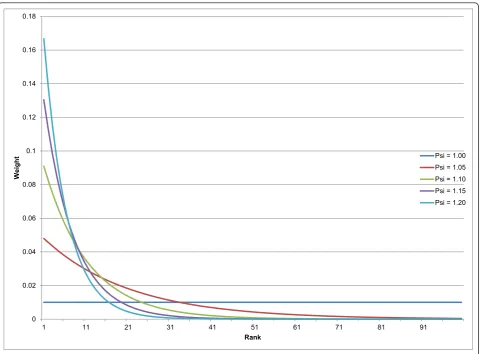
Where N is the number of models andψ is a para-meter influencing the relative weighting of models. In this case, if there were four total models to choose from andψ = 1.2, the top performing model would be given 32.2% weight, the second model 26.8%, the third 22.4%, and the last 18.6%. We use the weights to determine how many draws from each model to add to the final pool. We take 1,000 draws overall, so the top perform-ing model would have 533 draws included in the aver-age in this example, whereas the worst performer would have only 67 draws contributing to the final average. Figure 2 demonstrates how the weighting function works for different values ofψ in the case of 100 com-ponent models.
In an ensemble of 100 possible component models, a
ψof 1.2 would result in 167 draws from the top model, 80 for the fifth place model, 32 from the 10th place model, two from the 25th place model, etc., and no draws at all from models ranked below the top 32 (effectively placing a threshold such that the bottom 68% of models in this case have no bearing on the final predictions). In contrast, an ensemble withψ= 1 would take equal draws from all models.
We develop and test ensembles that includeψ values from 1.0 to 1.2 in intervals of .01. We can then compare these different ensemble models using predictive validity performance on the second set of test data. This enables us to choose an ensemble model that weights the com-ponent models adaptively. An ensemble with some good models and some very bad models would perform best with a higher ψ value; perhaps surprisingly, previous studies have shown that an ensemble with all models having similar performance often performs best when all models are included (i.e., in the case of CODEm, when a lower value ofψ[55] is chosen).
Because the component models and ensembles are developed without any access to the second test dataset, the evaluation of performance of each strategy is based on a fair out-of-sample test.
Assessing predictive validity
Our approach to predictive validity can be divided into two distinct parts: the strategy for developing train and test datasets, and the metrics used for assessing predic-tive validity.
Developing train-test 1-test 2 datasets
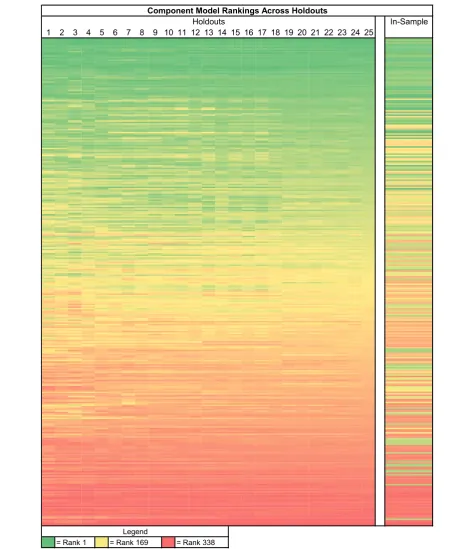
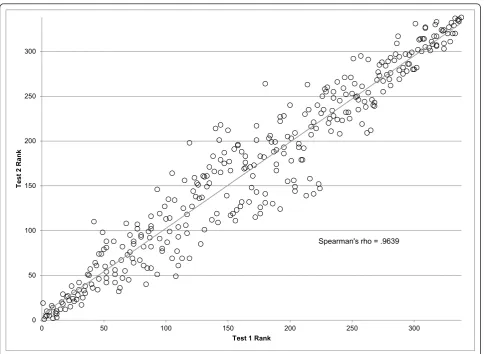
found that results from this type of“knockout” strategy provide stable model orderings when the process is repeated 10 to 30 times. Figure 3 demonstrates that component model rankings on the test 1 dataset are susceptible to noise when there are just a few hold-outs but begin to stabilize after approximately 10 hold-outs. Furthermore, it demonstrates that in-sample fit is a poor predictor of out-of-sample fit.
Our knockout pattern operates as follows: we create two randomly shuffled lists of all 187 countries, × and Y. We take the first country in list × and mark for which age-year pairs it is missing data for the selected cause and sex. We then knock out any data that are pre-sent in those age-years for the first country from list Y. For instance, if the country from list × had a missing-ness profile like that of Scenario D in Figure 1 (in which data after 2000 are not present) and the list Y country had all age-year pairs present, then we would knockout the data from 2001 to 2010 for the list Y country, leav-ing in the data from 1980 to 2000. We repeat this pro-cess for pairs of countries until 15% of the data in list Y
are knocked out, assigning those data points to the test 1 set. We then continue down the list of country pairs until an additional 15% of the data have been knocked out, which we assign to test 2. Note that this test is excessively stringent, because it does not take into account whether or not the country from list Y actually contains data in the same age-years as the list × country, making the task harder in most cases.
We create 25 sets of train-test-test datasets based on the knockout strategy just described, then run all the component models on the training data. We use the results of each component model to predict for the test 1 data. We then assess the performance of each compo-nent model in the test 1 dataset using the metrics described below. Ensemble model weights are estimated based on the performance of component models in test 1 data. Then the ensemble models are evaluated for 21 values of ψ(1.0 to 1.2 at intervals of .01) on the test 1 data. The ensemble weighting scheme that achieves the best predictive validity metrics on test 1 is then used to create the final predictions. Its predictive validity is
0 0.02 0.04 0.06 0.08 0.1 0.12 0.14 0.16 0.18
1 11 21 31 41 51 61 71 81 91
We
ig
ht
Rank
Psi = 1.00 Psi = 1.05 Psi = 1.10 Psi = 1.15 Psi = 1.20
In-Sample 1 2 3 4 5 6 7 8 9 10 11 12 13 14 15 16 17 18 19 20 21 22 23 24 25
Component Model Rankings Across Holdouts
Holdouts
Legend
= Rank 1 = Rank 169 = Rank 338
Figure 3Heatmap of stability in maternal mortality component model rankings. Each row represents a component model, and each
assessed along with the component models on the test 2 data.
Metrics of predictive validity
Predictive validity is evaluated using three metrics. First, we evaluate how well each model for a particular cause of death predicts age-specific death rates using the RMSE of the natural log of the death rate. Log death rates are generally comparable across age groups, so the choice of RMSE of the natural log of death rates means that we are equally concerned about a 10% error in one age group compared to another. Metrics that focus on the absolute error would tend to give highest weight to model fit in the age groups with higher rates, but most users of cause of death data actually attach greater importance to accuracy at younger ages where each death represents more years of life lost. We have thus chosen a method of assessing accuracy that we think balances the need to develop models that predict both an accurate overall level of mortality as well as an accu-rate age pattern. Second, we also desire models that pre-dict accurate trends. To do this, for the test data we compute where possible the log death rate in year t minus the log death rate in year t-1. We also compute the same metric for the prediction. We then count the percentage of cases for which the model predicts a trend in the same direction as the test data.
In order to compare the performance of multiple families of models that may use different measures and transformations of cause of death data (e.g., logit cause fractions versus log death rates in our case), we must choose a single space in which to assess all the models. We have chosen to assess performance in log rate space. We prefer to assess accuracy of rates instead of cause fractions because they are generally more useful from a public health perspective - for instance, a declining rate represents progress on combatting a cause of death, whereas a declining cause fraction could result from a stagnating death rate for one cause but an increase in another. Log rates are used because of the well-estab-lished log-linear relationship with death rate and time [28,76].
Ideally, we would like to use out-of-sample coverage as an additional metric in comparing component mod-els’ performance. Unfortunately, it is computationally intractable to compute full confidence intervals for every single component model once the model pool becomes large. As computational speed improves, cover-age can be added into the model ranking scheme. In the case of CODEm, we find the computationally expedient expectation of each component model for the ranking process.
We rank each component model on the median of these two metrics across hold-outs (lower being better for RMSE, higher being better for the trend test). We
then sum up the ranks across the two metrics for each component model, and assign overall rank 1 to the model with the smallest sum of ranks, rank N to the model with the highest sum of ranks, etc. These ranks are then used in the ensemble weighting equation described above.
We similarly rank the ensemble models for different values of ψon these two metrics and compute the sum of their ranks across hold-outs for test 2. We choose the value ofψthat minimizes the sum of ranks and use it to make our final set of predictions.
Finally, an important property of the models is that they generate plausible prediction intervals. We there-fore compute the percent of data in the test set that were included in the 95% prediction interval. The pre-diction interval is based both on the uncertainty in the predicted death rate and the data variance for each observation. We report the mean value of each of these metrics across the 25 test 2 datasets.
Results
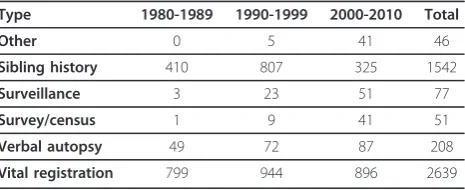
We demonstrate the logic of CODEm and the perfor-mance of various models for maternal mortality. Data availability for maternal mortality are summarized in Table 3. Overall, there are 4,563 site-years available for analysis. In addition, there are a number of applicable covariates available for analysis. Table 4 provides the class 1, 2, and 3 covariates for maternal mortality, along with the priors placed on the direction of their coefficients.
The process of running covariate selection for the four families of models yields a total of 338 models, as shown in Additional File 1 for maternal mortality. In order to find these models, the covariate selection tool began with 1,984 possible models each for rates and cause fractions. We ran 261 regressions on rates and 226 on cause fractions and found 98 rate models and 71 cause fraction models that fulfilled all of our priors, each of which was tested as both a simple mixed effects model and a spatial-temporal model. The difference between 1,984 possible combinations of covariates and the 261 for which regressions were run relates to the algorithm
Table 3 CODEm data sources for maternal mortality, by source type and decade
Type 1980-1989 1990-1999 2000-2010 Total
Other 0 5 41 46
Sibling history 410 807 325 1542
Surveillance 3 23 51 77
Survey/census 1 9 41 51
Verbal autopsy 49 72 87 208
for class 2 and class 3 covariates where models are not evaluated if the simpler model with a covariate does not have the sign and statistical significance expected.
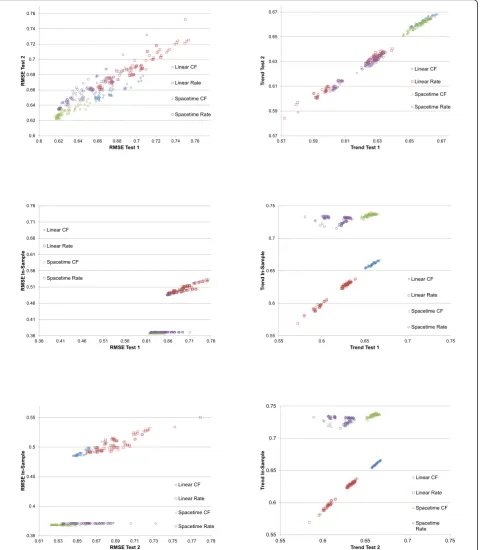
As seen in Figure 4, it is evident that performance var-ies widely across models; RMSE ranges from 0.616 to 0.774 across component models in test 1, while the trend test ranges from 0.572 to 0.667. In-sample fit ranges from 0.368 to 0.550 in RMSE and 0.569 to 0.740 on the trend test. The performance on test 2 is very similar to that of test 1, as also seen in Figure 5, sug-gesting that model performance is not a function of the particular hold-outs used for the assessment. Figure 4 shows several important patterns. First, for RMSE, in-sample fit for all the spatial-temporal GPR models, whether for cause fractions or for rates, are much better than for the mixed effects models. This is to be expected given that these models tend to capture some of the patterns in the residuals that are structured over space and time. However, in the case of maternal mor-tality, the figure also shows that in the out-of-sample RMSE tests, these models tend to also do better, although there is clear overlap between classes of mod-els. Of note, within a class of models, particularly the spatial-temporal GPR models, there is little relationship between in-sample fit and out-of-sample RMSE. This visual impression is confirmed by the rank order corre-lation coefficient within model class between in-sample RMSE and out-of-sample RMSE on test 2, which are -0.369, 0.463, 0.887, and 0.830 for spatial-temporal cause fractions, spatial-temporal rates, linear cause frac-tions, and linear rates, respectively. The strongest rela-tionship observed between in-sample performance and out-of-sample predictive validity is for linear cause frac-tion models. However, even a rank order correlafrac-tion coefficient of 0.887 within that class of models means that some poorly performing models might be selected if selection is based only on in-sample fit. For the better
performing classes of models, in this case the spatial-temporal cause fraction and rates models, in-sample fit is not a useful guide for model choice at all.
Figure 4 also shows a similar analysis of performance for the trend test, but the patterns are distinctly differ-ent. In the case of maternal mortality, in sample the spatial-temporal models do better than the linear mod-els. However, out of sample, the cause fraction models perform substantially better than the rates models. In fact, in both test 1 and test 2 cases, the linear cause fraction models have on average slightly better perfor-mance than the spatial-temporal models for cause frac-tions; there is however substantial overlap in these sets of models on this test. Within model class, the rank order correlation coefficient for the trend test is 0.675 for temporal cause fractions, -0.174 for spatial-temporal rates, 0.975 for linear cause fractions, and 0.984 for linear rates.
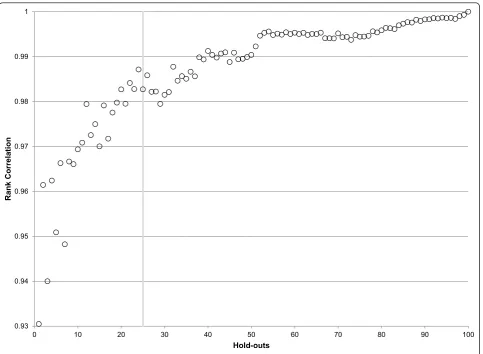
The high correlation of out-of-sample performance for RMSE between test 1 and test 2 provides reassurance that the ordering of models is not specific to the parti-cular set of hold-outs used. Nevertheless, it is important to ascertain how many hold-outs are required to get a stable assessment of the ordering of different models within and between classes. Figure 6 illustrates how the stability in component model rankings improves as more hold-outs are added. After 25 hold-outs, the rank correlation exceeds .98; 40 hold-outs yields rank order correlation coefficients in excess of 0.99 for maternal mortality. Figure 3 shows that for maternal mortality the top ranked models have all become rather stable after 25 hold-outs; it further demonstrates that in-sample fit is poorly correlated with out-of-sample predictive valid-ity. Extra hold-outs tend to further stabilize the ranking of the poorer performing models rather than change the order of the top models in this case.
Notice in Additional File 1 that spatial-temporal mod-els on the logit of the cause fraction occupy the top 88 slots out of 338 total component models. This indicates that spatial-temporal models do indeed do a better job of capturing levels and trends not present in covariates alone. The fact that cause fraction models perform bet-ter than rate models suggests that cause fractions, which are constrained to be less than the all-cause mortality rate, may benefit from the additional information pro-vided by being multiplied by the all-cause mortality rate when calculating final predictions. The covariates for the best ranked model included the natural log of the total fertility rate, skilled birth attendance coverage, and the natural log of lag-distributed income per capita. Similar models with additional covariates, such as the fourth-ranked model, which added age-specific fertility rates, performed worse in many cases, suggesting that while additional covariates may improve in-sample fit Table 4 Covariate priors for maternal mortality covariate
selection
Covariate Level Prior
In-facility delivery coverage 1
-Skilled birth attendance coverage 1 -Malnutrition (proportion under 2SD) 1
-Ln(total fertility rate) 1 +
Age-specific fertility rate 1 +
Health system access score 2
-Antenatal clinic (four visits) coverage 2 -Antiretroviral (ARV) adjusted HIV prevalence 2 +
Ln(neonatal death rate) 2 +
Education (year per capita) 3
-they often cause overfitting that harms out-of-sample predictions.
Table 5 shows how well ensemble models of varying levels ofψ perform on test 1 predictive validity. In the
case of maternal mortality aψof 1.17 has been chosen. This is a rather steep weighting scheme, giving over half the weight to just the top five component models - the top component model receives 139 draws, relative to
0.6 0.62 0.64 0.66 0.68 0.7 0.72 0.74 0.76
0.6 0.62 0.64 0.66 0.68 0.7 0.72 0.74 0.76
RM
SE T
est
2
RMSE Test 1
Linear CF
Linear Rate
Spacetime CF
Spacetime Rate
0.57 0.59 0.61 0.63 0.65 0.67
0.57 0.59 0.61 0.63 0.65 0.67
Tr
end T
est
2
Trend Test 1
Linear CF
Linear Rate
Spacetime CF
Spacetime Rate
0.36 0.41 0.46 0.51 0.56 0.61 0.66 0.71 0.76
0.36 0.41 0.46 0.51 0.56 0.61 0.66 0.71 0.76
RM
SE In-Sample
RMSE Test 1 Linear CF
Linear Rate
Spacetime CF
Spacetime Rate
0.55 0.6 0.65 0.7 0.75
0.55 0.6 0.65 0.7 0.75
Tr
end In-Sample
Trend Test 1
Linear CF
Linear Rate
Spacetime CF
Spacetime Rate
0.35 0.4 0.45 0.5 0.55
0.61 0.63 0.65 0.67 0.69 0.71 0.73 0.75 0.77 0.79
RM
SE In-Sample
RMSE Test 2
Linear CF
Linear Rate
Spacetime CF
Spacetime Rate
0.55 0.6 0.65 0.7 0.75
0.55 0.6 0.65 0.7 0.75
Tr
end In-Sample
Trend Test 2
Linear CF
Linear Rate
Spacetime CF
Spacetime Rate
102 draws for the third-place model, 46 for eighth place, 15 for 15thplace, etc (see the last column of Additional File 1). Interestingly, ψ of 1.0 - which gives equal weights to all models - performed the worst on both predictive validity tests, suggesting that there was at least one bad component model that would harm pre-dictions if included.
Table 6 provides the performance on test 2 of the best component model (the spatial-temporal model on logit (cause fraction) with covariates of age-specific fertility rate, the natural log of total fertility rate, and the natural log of lag-distributed income per capita) and of the best ensemble model. Results are consistent with previous findings that out-of-sample predictive validity metrics are improved by creating an ensemble of models instead of just using the top component model. RMSE decreases, trend test performance remains about the same, and the prediction interval coverage also increases.
Finally, we checked the test-retest stability of our method by running the same model with 25 hold-outs
twice on maternal mortality. The Pearson correlation coefficient for the log rates of the final mean estimate (by country, year, and age) was 0.9998 for the two runs, indicating that the method gives consistent results with 25 random outs. Nevertheless, given that the hold-out process and assessment of predictive validity is sto-chastic by nature, the exact set of top performing mod-els for a cause of death can vary between model runs even if the predictions are highly consistent.
Table 7 shows summary results comparing the ensem-ble model to the best component model for several causes of death, including cardiovascular disease, chronic respiratory disease, cervical cancer, breast can-cer, and lung cancer. The table highlights that in each case, to a varying degree, the ensemble model has as good as or slightly better predictive validity metrics than the component model. In most cases the out-of-sample performance for RMSE and trend test both improve or remain roughly equal when comparing the ensemble to the top component model. The one exception is lung cancer in males, in which the ensemble model has
0 50 100 150 200 250 300
0 50 100 150 200 250 300
T
est
2
Ran
k
Test 1 Rank
Spearman's rho = .9639
slightly worse RMSE and trend; however, the coverage of the ensemble models is much better than that of the component, so this is most likely a desirable trade-off. In no case do we observe that the ensemble model per-forms significantly worse than the top component model, and in many instances the ensemble is a sub-stantial improvement. In all cases, the uncertainty inter-val coverage is better for the ensemble model than the best component model.
Discussion
In this paper, we have proposed a framework for cause of death model development. We have illustrated this approach for several causes of death including maternal mortality, cardiovascular disease, chronic respiratory dis-eases, cervical cancer, breast cancer, and lung cancer mortality. Our strategy yields an ensemble model with smaller error in estimated rates than the single best model. It yields more accurate trends and often better uncertainty intervals with nearly 95% data coverage in out-of-sample prediction tests. We have used maternal mortality in this paper to illustrate the results of
CODEm, but we have applied this strategy to many causes with similar findings; in addition, separate papers utilizing this method include more detailed results for maternal mortality, breast cancer, and cervical cancer [89,90]. The model development strategy we have used has already been widely applied in other fields; what we have done is to develop a pragmatic implementation of these ideas to cause of death modeling.
Debate on cause of death estimation, such as for maternal mortality [36,38-41], can be traced to three components: the database used, including covariates; the processing of data to enhance comparability and quality; and model building. By encompassing a very wide range of models and model families combined with objective assessment of performance through out-of-sample pre-dictive validity tests, we expect that our approach will substantially decrease debate around model building. Debate in the future will more likely focus on the data processing step. With regards to the database, most ana-lysts will agree that a more systematic collation of all data sources is preferable to fewer data sources. The real issue is how one uses or modifies observations in
0.93 0.94 0.95 0.96 0.97 0.98 0.99 1
0 10 20 30 40 50 60 70 80 90 100
Rank Cor
rel
at
io
n
Hold-outs
the largest database. Controversy will remain on how to deal with misclassification in cause of death assignment, subnational and nonrepresentative samples, and the exclusion of data points due to extreme nonsampling variance. We hope that by proposing and implementing a structured approach to model building, the idiosyn-cratic aspect of final model choice will be minimized or even eliminated. Debate on data processing will con-tinue and hopefully be fertile ground for methods inno-vation in the future
In various conferences following the release of the maternal mortality studies in 2010 [36,38,39], some commentators argued that simple models should be pre-ferred to more complex models such as GPR. Underly-ing these comments are two possible perspectives. First, simple or parsimonious models may actually generate better predictions out of sample. Given that we test all models, whether simple, more complicated, or ensemble on a level playing field, if simple models are better they will be selected as the basis for making predictions in
our modeling framework. The second possible interpre-tation of this view is more philosophical, namely that simple models are intrinsically preferable regardless of predictive performance. In other fields, like weather forecasting, consumers do not demand simple models; they demand accurate models. Not surprisingly, weather forecasters - who have in some ways an easier task than cause of death estimation, as their forecasts are shorter and have much more data to rely on - use dynamic ensemble models where the weights on various models are selected each day for tomorrow’s forecast [87] in order to generate predictions with the smallest error and accurate uncertainty intervals. This is entirely inconsistent with a call from some in global health to sacrifice performance of cause of death models for the sake of simplicity. In this era, we all use complex devices such as computers, cell phones, or even watches. Most of us do not understand how the circuitry or machinery within the device works. We judge these devices by how well they perform, not how well we understand their Table 5 Ranking and predictive validity metrics for maternal mortality for different values ofψ
Rank ψ RMSE (in-sample) RMSE (test 1) Trend test (in-sample) Trend test (test 1)
1 1.17 0.368 0.617 0.737 0.737
2 1.16 0.368 0.617 0.737 0.737
3 1.15 0.368 0.617 0.737 0.737
3 1.11 0.369 0.617 0.737 0.737
5 1.08 0.369 0.616 0.737 0.737
6 1.12 0.368 0.617 0.737 0.737
7 1.18 0.368 0.617 0.737 0.737
8 1.06 0.370 0.616 0.736 0.736
9 1.03 0.376 0.615 0.734 0.734
10 1.04 0.373 0.615 0.735 0.735
11 1.09 0.369 0.616 0.737 0.737
12 1.05 0.371 0.616 0.736 0.736
13 1.1 0.369 0.617 0.737 0.737
14 1.14 0.368 0.617 0.737 0.737
14 1.13 0.368 0.617 0.737 0.737
16 1.19 0.368 0.617 0.737 0.737
17 1.02 0.381 0.614 0.732 0.732
18 1.2 0.368 0.617 0.737 0.737
19 1.07 0.369 0.616 0.737 0.737
20 1.01 0.390 0.614 0.726 0.726
21 1 0.412 0.624 0.709 0.709
Table 6 Predictive validity measures for final CODEm maternal mortality model
Model RMSE (in-sample) RMSE (test 2) Trend test (in-sample) Trend test (test 2) Coverage (in-sample) Coverage (test 2)
Top ensemble 0.368 0.626 0.739 0.665 99.2% 97.3%
Top component 0.369 0.636 0.737 0.663 99.2% 96.9%
inner workings. We believe that the same ethos ought to be applied for cause of death modeling. The predictive validity metrics we have described in this paper are use-ful not only for ranking researchers’own models and creating ensembles, but we believe they can also provide a framework within which modeling strategies from diverse research groups can be fairly compared. Since it is good out-of-sample predictive performance that should ultimately decide which models are most useful, then we think models should be evaluated and com-pared on those grounds.
The current implementation of our strategy has sev-eral limitations. The Netflix challenge experience sug-gests that pooling results from very different modeling strategies performs better [54]. We have used four mod-eling families that are the product of modmod-eling natural log rates and logit cause fractions, mixed effect linear models, and spatial-temporal GPR models. This creates a diverse pool of models that compete in predictive validity tests. For example, combined with the covariate selection approach, we had in the case of maternal mor-tality 7,936 possible component models. Nevertheless, many other modeling strategies are possible; given the experience in other areas, expanding the universe of modeling families that are included in the model pool will likely improve prediction performance. The funda-mental challenge to expanding beyond our four families
of models is computational power and time. In our implementation, we have already reached the limit of what is currently practical - each model run takes approximately 600 hours of processor time, which for our cluster is equal to about 5,000 GFlops. As computa-tional power and cloud computing get progressively cheaper and estimation algorithms more and more opti-mized, it may be possible in future iterations to increase the diversity of the model pool and therefore the predic-tion performance of the model ensemble. As with any modeling strategy, the approach outlined here depends critically on the database that is used for estimation, the quality of the covariates, and the assessment of the evi-dence on the expected relationships for covariates.
Although model building is becoming a computation-ally intensive but replicable and less subjective task, the challenge remains of capturing uncertainty due to cor-recting data for bias, excluding data points as outliers, and measuring and forecasting covariates. Garbage code redistribution algorithms are largely based on expert opi-nion, although some empirical approaches have been applied [51]. Methods to capture uncertainty in these approaches need to be developed. For verbal autopsy, the results of the Population Health Metrics Research Con-sortium verbal autopsy studies [91,92] provide a potential strategy for assessing misclassification uncertainty. For outliers or observations with high nonsampling variance, Table 7 Predictive validity measures for CODEm results for several selected causes of death
Cause Model RMSE
(in-sample)
RMSE (test 2)
Trend test (in-sample)
Trend test (test 2)
Coverage (in-sample)
Coverage (test 2)
Cardiovascular disease (male)
Ensemble 0.123 0.290 0.764 0.699 0.993 0.853
Best component model
0.122 0.292 0.764 0.693 0.992 0.822
Cardiovascular disease (female)
Ensemble 0.162 0.304 0.750 0.698 0.993 0.903
Best component model
0.162 0.305 0.751 0.707 0.993 0.877
Maternal mortality Ensemble 0.368 0.626 0.739 0.665 0.992 0.973
Best component model
0.369 0.636 0.737 0.663 0.992 0.969
Cervical cancer Ensemble 0.528 0.944 0.667 0.593 0.988 0.938
Best component model
0.489 0.951 0.678 0.587 0.982 0.912
Breast cancer (female) Ensemble 0.438 1.105 0.678 0.572 0.985 0.923
Best component model
0.428 1.129 0.675 0.570 0.981 0.875
Lung cancer (male) Ensemble 0.359 0.769 0.714 0.599 0.993 0.841
Best component model
0.330 0.759 0.738 0.617 0.993 0.800
Lung cancer (female) Ensemble 0.383 0.734 0.705 0.580 0.995 0.932
Best component model
one can imagine a number of strategies. Instead of assigning 0 or 1 weights to a data point, 0 if the point is an outlier and 1 if it is not, numbers from 0 to 1 could be assigned that represent the probability that a data point is an outlier. Repeated sampling of the dataset could be undertaken using this matrix, allowing for propagating uncertainty. Alternatively, outliers could be assigned higher nonsampling variance in techniques such as GPR that can take this into account. The covariates we use as inputs to our models also have measurement error, and because they are often themselves modeled they may also have prediction uncertainty. It is unclear if incorporating this uncertainty would be helpful in predicting causes of death since we test out-of-sample data coverage to check that it is close to 95%, but because of computational lim-itations we have been unable to test the usefulness of including such information. These approaches all repre-sent attractive avenues for further exploration. The main limitation is the computational time and cost that such schemes would imply.
In many cases, cause of death information is most valuable when placed into context with the entire cause of death composition of the population. The relative burdens of causes of death are often more influential in priority setting than are the individual causes’respective sizes. For this reason, it is often desirable to produce estimates of mutually exclusive and collectively exhaus-tive cause of death categories. Ideally, one would design a model that predicts for all causes of death simulta-neously, accounting for correlations and dependencies between them. There are, however, three major limita-tions on modeling all causes simultaneously: severe restrictions on model diversity, limitations on data usability, and infeasibility for analysis.
First, current computational restrictions make it intractable to fit multinomial or seemingl