R E S E A R C H
Open Access
Generalized probabilistic satisfiability
through integer programming
Glauber De Bona
1*, Fabio G. Cozman
2and Marcelo Finger
1Abstract
Background: This paper studies the generalized probabilistic satisfiability (GPSAT) problem, where the probabilistic satisfiability (PSAT) problem is extended by allowing Boolean combinations of probabilistic assertions and nested probabilistic formulas.
Methods: We introduce a normal form for this problem and show that both nesting of probabilities and multi-agent probabilities do not increase the expressivity of GPSAT. An algorithm to solve GPSAT instances in the normal form via mixed integer linear programming is proposed.
Results: The implementation of the algorithm is used to explore the complexity profile of GPSAT, and it shows evidence of phase-transition phenomena.
Conclusions: Even though GPSAT is considerably more expressive than PSAT, it can be handled using integer linear programming techniques.
Keywords: Probabilistic logic; Probabilistic satisfiability; Mixed integer linear programming
Background
Propositional logic and probability theory stand as major knowledge representation tools in many fields, and notably in artificial intelligence. Useful combinations of propositional logic and probability theory are already pur-sued by Boole [3, Chapter XVIII], who was concerned with problems where propositional formulas are asso-ciated with probability assertions. Loosely speaking, we have propositional sentences {φi}qi=1, each containing a subset of atomic propositions{Aj}nj=1. We may associate one or more of these sentences with probabilities, writ-ing for instanceP(φi) = αi. To establish semantics for these assessments, we consider a probability measure over the set of truth assignments. Theprobabilistic satisfiabil-ity(PSAT) problem is to determine whether it is possible to find a probability measure over truth assignments such that all assessments are satisfied [13]. PSAT problems have received attention in a variety of fields [4, 9, 14, 15, 17]; in artificial intelligence research, PSAT problems appear
*Correspondence: [email protected]
1Instituto de Matemática e Estatística, Universidade de São Paulo, Rua do Matão 1010, Sao Paulo, Brazil
Full list of author information is available at the end of the article
as a foundation for probabilistic rules [21] and first-order probabilistic logic [16, 20, 22].
In this paper, we consider an extended version of PSAT problems. To illustrate the PSAT problem, consider the following situation:
Problem 1.Three friends, Alice, Bob, and Charlie, go to the pub everyday and they have two options: “Bar Phi” and “Bar Not Phi”. Each friend goes exactly to one bar per night. Talking about tonight, a fourth friend, David, says that Alice goes to “Bar Phi” with probability 6/7, that Bob goes to “Bar Phi” with probability 5/7; and that the probability of Charlie drinking at “Bar Phi” is 4/7. Furthermore, David states that exactly two of them will be at “Bar Phi” tonight.
Question:Is David being consistent?
This problem can be captured by the PSAT formalism, as it will be shown later. The idea is to check the consis-tency of the probabilities assigned to each friend going to “Bar Phi” tonight together with the fact that exactly two of them being there with probability one. However flexi-ble it may be, PSAT proflexi-blem can only handle conjunction
of probability assessments. To understand our goal, note that the satisfiability of probabilistic formulasP(φi)=αi,
1 ≤ i ≤ q obtains when there is a probability measure
(over the truth assignments) that satisfies
P(φ1)=α1∧P(φ2)=α2∧ · · · ∧P
φq=αq.
One obvious generalization is to deal with disjunction and negation of probabilistic assertions to construct more complex formulas, such as
¬(P(φ1)=α1)∧(P(φ2)=α2)∨(P(φ3)=α3).
We will see that the same semantics used for PSAT can be adopted in such an extended probabilistic satisfiability problem. As an example of the higher expressivity introduced by this generalization, consider a modification of Problem 1:
Problem 2.Three friends, Alice, Bob, and Charlie, go to the pub everyday and they have two options: “Bar Phi” and “Bar Not Phi”. Each friend goes exactly to one bar per night. Talking about tonight, a fourth friend, David, says that Alice goes to her favorite bar with probability 6/7, that Bob goes to the bar he likes most with probability 5/7; and that the probability of Charlie drinking at his favorite place is 4/7. Furthermore, David states that exactly two of them will be at “Bar Phi” tonight.Question:Is David being consistent?
The key difference between Problems 1 and 2 is that in the former we have probabilities for each friend to go to “Bar Phi” and we are asked about the consistency of such assignments together with the constraint that exactly two of them are going there tonight; in the latter, the proba-bilities are assigned toeither“Bar Phi”or“Bar Not Phi”, and we want to check whether David is stating consistent probabilities with which Alice, Bob, and Charlie are going to their favorite bars. Such difference might be clearer in the next sections, where these problems are formalized.
We can move to an even more expressive language by allowing probabilistic formulas to be nested; that is, by allowing a subformula ofφ inP(φ) =αto beP(ϕ)= α. Nested probabilities may receive different interpretations, and ours can be exemplified with a problem:
Problem 3.Alice says that the probability of her going to “Bar Phi” tonight with probability 5/6 is 1/2; and, with probability 1/2, she is going to “Bar Phi” tonight with probability 1/6.Question:Can these probabilistic statements be consistent?
A possible scenario consistent with what Alice says could be the following: Alice initially wanted to go to the bar, but as she likes some randomness in her life, she decided to throw a fair die tonight. She will go drink unless she gets a 6. In the middle of the day, she is not in the mood. She makes her mind to go to the bar only if the die shows up a 6. But she suddenly realizes she was too conservative, and gives to a fair coin the responsibility of choosing her destiny: in case of heads, she is going out only with a 6 in the die; with the coin landing tails, she is going to the bar unless a 6 happens to be the case. Just for fun, she tossed the coin in the afternoon, but will only see the outcome in the evening—right before throwing the die. In the meantime, she is thinking about the probability of her going out tonight. With probability 1/2, she thinks she is in a world where the coin landed heads, and the probability of her getting a 6 to drink is 1/6. But with prob-ability 1/2, the actual case is with the coin showing tails, and she is going to the bar with probability 5/6—only a 6 can spoil her night.
In such a scenario, there is a probability measure over possible worlds (tails and heads) which have their own probability measure over other possible worlds (going to the bar or not). This is the case in the logic devised in ref. [10], which finds its application in stochastic systems, for instance. In this paper, however, we follow a different path, keeping only a single probability measure over all possible worlds. To give meaning to nested probabilities, we use the lifting assumption, that “one believes the probability ofφ isαif, and only if, one believes that the probability of the probability ofφ beingα is 1” [23]. In Problem 3, one can argue that, if the probability of Alice going out is 5/6 or 1/6, with probability 1/2 each, then the probabil-ity of her going out is actually 1/2×5/6+1/2×1/6 = 1/2—with probability one. As Alice states that a proba-bility of a probaproba-bility being 5/6 is not one or zero, but 1/2, she is being inconsistent under the lifting assumption. Clearly, this assumption is restrictive, in the sense that it claims an agent may not have uncertainty about his own probabilistic beliefs. However, maybe surprisingly, under this premise, we can prove that satisfiability of formulas with nested probabilities can be reduced to satisfiability without nesting.
The problem of deciding satisfiability of these formulas is what we define asgeneralized probabilistic satisfiabil-ity(GPSAT). The resulting language can be viewed as the closure of probabilistic formulas with respect to Boolean and probabilistic operators.
columns [19]. A recent alternative approach reduces PSAT into logical satisfiability [11]. Neither of these approaches is easily extended to deal with disjunction of constraints, that is essential to solve GPSAT.
In this paper, we present an approach to generalized probabilistic satisfiability, where the original problem is written as a mixed integer linear program of a size that is polynomial on the size of the original problem. This technique was firstly proposed to solve probabilistic satis-fiability in ref. [6], and this paper builds on that work to deal with GPSAT problems.
The remaining of this section summarizes necessary fundamentals on SAT and PSAT. The generalized abilistic satisfiability is defined in the section “The prob-lem”, where a normal form is introduced. In the same section, we show how a multi-agent scenario is reduced to the single-agent case. An algorithm for GPSAT is described in the section “Methods”, building on a reduc-tion from PSAT to mixed integer linear programming. Implementation and experiments, with a discussion of phase transitions, are presented in the section “Results”.
Consider the setLLPof well-formed formulas built with a setA = {A1,A2,A3. . .} of atomic propositions using the usual Boolean connectives ¬, ∧,∨ and→. A truth assignment (or valuation)ωis a functionω : A→ {0, 1} that takes atomic propositions to truth values, which we denote by 0 and 1. Through the classical semantics of propositional logic1 ω can have its domain extended to
LPL, assigning a truth value to any propositional formula. Ifφ is true, writeω |= φ; ifφ is false, we writeω |= φ. Given a finite a set of formulas{φ1,. . . φq} ⊂LPL, the sat-isfiability (SAT) problem is to determine whether or not there exists a truth assignment to all variables such that all sentences evaluate to true [5, 12]. We call such a set a SAT instance.
If every sentenceφiis a conjunction of clauses, then we
have a SAT instance inCNF. A SAT instance in CNF is
ak-SAT instance when each clause haskliterals. The
2-SAT problem has a polynomial solution, while k-SAT is
NP-complete fork>2.
Suppose now we haveqpropositional sentences overn atomic propositions, sayφ1,. . .,φq∈LLP, associated with
probabilities through assessmentsof the form P(φi)
αi, where is one of≥, = or≤. For computability, let the probabilitiesαi be rational numbers. The semantics of such an assessment is as follows. Take the set of 2n truth assignments that can be generated for then propo-sitions. A probability measurePover this set satisfies the assessments if, for each assessmentP(φi)αi,
ω|=φi
P(ω)αi. (1)
Theprobabilistic satisfiability(PSAT) problem is to deter-mine whether a given set of probabilistic assessments (a
PSAT instance) can be satisfied in the sense that there is a probability measure over truth assignments such that all assessments are satisfied. PSAT is know to be in NP, as it has a small model, and since SAT is a subproblem where all assigned probabilities are 1, PSAT is NP-complete [13]. A few polynomial special cases of PSAT are known [1].
Example 4(Friends’ Favorite Bar).Consider Problem 1, with friends {A,B,C}. Let φi represent that person i is at the “Bar Phi” tonight, i ∈ {A,B,C}. As exactly two friends are going to the “Bar Phi”, according to David, no two friends can be absent tonight, represented by ¬¬φi∧ ¬φjwith 100 % certainty, fori=j:
P(φA∨φB)=P(φA∨φC)=P(φB∨φC)=1.
Furthermore, at least one must be at “Bar Not Phi”:
P(¬φA∨ ¬φB∨ ¬φC)=1.
David assigns the probability for each friend being at “Bar Phi”:
P(φA)=6/7,P(φB)=5/7,P(φC)=4/7,
and the question is if there exists a probability mea-sure that simultaneously satisfies these seven probability assignments. It happens that there is no such a proba-bility assignment and this PSAT instance is unsatisfiable. We can conclude that David is being inconsistent in his probabilistic assertions.
There are many proposed algorithms for PSAT. The most obvious one is to write downq constraints of the form (1), one for each sentence, associated with
assign-ments P(φi) αi. Each constraint can be written as
2n
j=1
ωj(φi)P(ωj)αi, (2)
while truth assignmentsωjare ordered from 1 to 2n(say by then-bit binary number obtained by writing 0 for false and 1 for true as assigned toA1,. . .,An). Probabilistic sat-isfiability is then obtained when the resulting set of linear constraints has a solution. The challenge is that we have 2ntruth assignments, so the size of the linear constraints is exponential in the input.
is reached, a solution is found; otherwise, the linear pro-gram has no feasible solution and the PSAT instance is unsatisfiable. As the number of columns is exponential, column generation techniques are used. A good survey on this approach is [17]. Combining inference rules with lin-ear programming techniques leads to the currently most efficient algorithms, as showed in ref. [18].
The problem
The language we contemplate is syntactically easy to spec-ify: simply take Boolean operations over assessments, and allow a subformula in an assessment to be itself any well-formed formula of the language. That is, we allow sentences such as
(P(A1∨ ¬A2)≥1/2)∨¬(P(A3)≥1/4)∨(P(A1)=1/5), and even sentences where probabilities are nested as fol-lows:
¬(P(A1)≤1/3)∨P(A2∧(P(A3)≥3/4))≥1/2,
both of which contain a single “clause” of (possibly negated) assessments. Another example is the following, where we find two “clauses” of assessments:
((P(A1)=1/3)∨ ¬(P(A2)≤3/5)) ∧
((P(¬A1)≥2/3)∨ ¬(P(A1∨ ¬A3)=3/7)). To make sense of these sentences, we must establish an appropriate semantics. Note that in any PSAT instance, the truth value of an assessment such as P(φi) = αi is derived from a probability measure on the truth assign-mentsω1,. . .,ω2n (because the relationωj |= φi is well
defined). This is not the case when nested probabilities are allowed andφimay contain probabilistic subformulas. This next section shows how to define a semantics that characterizes when a probabilistic assessment is true in a possible worldωj.
Syntax and semantics
We start with an infinite set of atomic (or primitive) propositionsA= {A1,A2,A3,. . .}.
Our language is then defined recursively as the smallest setLsuch that:2
• Ifφ∈A, thenφ∈L;
• Ifφ∈L, then¬φ∈L;
• Ifφ∈Landθ ∈L, then(φ∨θ)∈L;
• Ifφ∈Landθ ∈L, then(φ∧θ)∈L;
• Ifφ∈L, then(P(φ)α)∈L, for∈ {≤,≥}and
α∈[ 0, 1]∩Q.
Parentheses are omitted whenever possible. As usual, P(φ) = α,P(φ) < αandP(φ) > αare abbreviations for (P(φ)≤α)∧(P(φ)≥α),¬(P(φ)≥α)and¬(P(φ)≤α), respectively.
To give truth values to formulas inL, we define a struc-tureM=(,P(.)), whereis a finite set of propositional truth assignmentsωi(valuations), andP : →[ 0, 1] is a probability measure over. With this machinery in hand, we now define when a pair (M,ω) satisfies a formula φ ∈L, or(M,ω)|=φ:
• (M,ω)|=Aiifω|=Ai; • (M,ω)|= ¬φif(M,ω)|=φ;
• (M,ω)|=φ1∧φ2if(M,ω)|=φ1and(M,ω)|=φ2; • (M,ω)|=φ1∨φ2if(M,ω)|=φ1or(M,ω)|=φ2; • (M,ω)|=P(φ)αif{P(ωi)|(M,ωi)|=φ} α,
for∈ {≤,≥}andα∈[ 0, 1]∩Q;
This semantics leads propositional formulas and proba-bilistic formulas to have their truth value associated to possible worlds(M,ω). This means one can talk about the truth value of formulas such as
φ1∧(P(φ2)≤0.5)∨(P(¬(P(φ3)≥0.7))≤0.2) in a given pair (M,ω). However, as the truth value of P(φ) α in(M,ω) does not depend onω, for a fixed
M, P(φ) α will be true either in all pairs(M,ω) or in none of them – this captures the intuition that nested probabilities collapse to either 1 or 0. We writeM|=φif (M,ω)|=φfor allω∈.
Given a formula φ ∈ L, we say that it is satisfiable if there is a pair (M,ω), where M = {,P(.)} and ω ∈ , such that(M,ω) |= φ; otherwise, we say φ is unsatisfiable.
The generalized probabilistic satisfiability (GPSAT) is then the problem of deciding whether or not a givenφ∈L is satisfiable. In this way, any formulaφ ∈ Lis aGPSAT instance.
Example 5(Friends Telling the Truth).Consider Prob-lem 2. Using the same formalization as in Example 4, at least two friends must be at “Bar Phi” tonight:
P(φA∨φB)=1 (3)
P(φA∨φC)=1 (4)
P(φB∨φC)=1. (5)
Furthermore, at least one must be at “Bar Not Phi”:
P(¬φA∨ ¬φB∨ ¬φC)=1. (6)
We want to check if David is being consistent, but we do not know if the probabilities he is claiming correspond to “Bar Phi” or “Bar Not Phi”:
assignments together with at least one probability assign-ment per each clause above. More precisely, our GPSAT instance is a formula θ, whose satisfiability we want to check, built as the conjunction of the formulas in Expres-sions (3) to (9).
Consider a structure M = (,P(.)), in which =
{ω1,ω2,ω3} is a set of possible worlds and P : → [ 0, 1] is a probability measure over it. Letbe such that ω1 |= φA∧φB∧ ¬φC,ω2 |= φA∧ ¬φB∧φC andω3 |= ¬φA∧φB∧φC. MakeP(ω1) = 4/7,P(ω2) = 2/7 and P(ω3)=1/7. Note that in each worldω∈, exactly two ofφA,φB, andφCare true, so
M|=P(φi∨φj)=1 ,
for all pairsi =j, satisfying the conjuncts of Expressions (3) to (5). Asω|=(¬φA∨ ¬φB∨ ¬φC)for allω∈,
M|=P(¬φA∨ ¬φB∨ ¬φC)=1 .
Finally, we have {P(ωi)|(M,ωi) |= φA} = 6/7,
{P(ωi)|(M,ωi)|= φB} =5/7 and{P(ωi)|(M,ωi) |= ¬φC} =4/7, yielding:
M|=P(φA)=6/7 ,
M|=P(φB)=5/7 ,
M|=P(¬φC)=4/7 ,
satisfying the clauses in Expressions (7), (8), and (9), respectively. Hence,M|=θ andθis satisfiable.
We conclude that David is being consistent, with a pos-sible scenario being with only Charlie preferring the “Bar Not Phi”. Indeed, every structure satisfyingθ leads to this scenario. Any other assignment of favorite bars for Alice, Bob, and Charlie different from this one (only Charlie preferring “Bar Not Phi”) makes the probabilities incon-sistent. Therefore, it can be inferred that this scenario is the case, given that David is consistent.
Note that this problem could be solved as a sequence of PSAT instances: we just guess the favorite bar of each friend and decide the corresponding PSAT instance. But to cover all possible assignments of favorite bars leads to an exponential quantity (on the number of friends) of PSAT instances, thus it is a less efficient solution. As we shall see, GPSAT is inNP, and there must exist a polyno-mial reduction from it to PSAT, but there seems to be no simple way of performing it.
The logic presented by Fagin, Halpern, and Megido in ref. [9] had already dealt with Boolean combinations of probabilistic assessments, but they kept the probabilities applied only to pure propositional formulas, hence avoid-ing nestavoid-ing. Their semantics assigns truth values only to
probability assessments through a whole structure M,
and not a pair (M,ω). So their semantics is closer to PSAT’s, even though they use probability “inside” the lan-guage. Another difference is that Fagin et al. allow more
general assessments of the forma1P(α1)+a1P(α1)+· · ·+
amP(αm) ≥ α (this enabled them to axiomatize their
logic). They show that the corresponding satisfiability problem is NP-complete, but do not propose algorithms to solve it. One of our goals here is to provide concrete algorithms.
In another work, Fagin and Halpern [10] investigated a more general logic to reason about knowledge and probabilities. Its probabilistic semantics is similar to ours because the probabilistic formulas have truth value in spe-cific states (worlds), but they introduce a probability dis-tribution for each set of indistinguishable possible worlds (states). Additionally, their logic has an epistemic modal relation, so that multi-agent and linear combinations of probabilities are also allowed. Again, they axiomatize their logic, show the complexity of the related decision proce-dure, but do not provide algorithms. Variations of logics adding probabilities to the propositional language can be found in ref. [7].
The logic we propose here can be seen as a particular case of the logic in ref. [10], where there is only one agent and all possible worlds are indistinguishable (all with identical probability distributions). It follows that GPSAT inherits an NP upper bound proved by Fagin and Halpern (Theorem 4.6 in ref. [10]); and as PSAT is a subproblem of GPSAT, the latter is also NP-complete.
GPSAT normal form
The algorithm for GPSAT to be proposed decides satisfi-ability only for formulas without nested probabilities and with all propositional formulas in a probability assessment (like in PSAT). That is, the algorithm cannot handle a for-mula such asP(P(φ) ≥ 0.2) ≤ 0.1 orφ1∧P(φ2) ≤ 0.5. As we now show, any GPSAT instance can be reduced in polynomial time to a normal form that complies with these constraints and preserves satisfiability.
We say a formulaφ ∈ Lis innormal formif it is the
conjunction of two formulas∧ , where
• is the conjunction of 3-clauses over probabilistic
assessments in the formP(Ai)≥α, in which each
assessment is over a different atomic propositionAi,
and
• is a probabilistic assignmentP(γ )≥1, in whichγ
is a conjunction of propositional 3-clauses.
Note that probability values that are smaller than one can be assigned only to atomic propositions, and additionally, every atomic proposition occurrence is a subformula of no more than one probabilistic assessment in.
An example of a formula in normal form is:
This normal form is based on the PSAT normal form introduced by Finger and De Bona [11], and, although it may seem quite restrictive, we can show that all
formu-las in L can be brought to the normal form. Before we
apply techniques from Finger and De Bona, a sequence of intermediate results is needed.
A formula in normal form has no nested probabilities nor propositions outside the scope of a probability assign-ment. A particular case of a result in ref. [7] (Theorem 1) can be used to eliminate these undesired subformulas. First, we introduce an auxiliary notation. We call a prob-abilistic atomany formulaP(φ) αinLsuch thatφ ∈
LPLis purely propositional. LetL ⊂ Lbe the language formed by the Boolean closure of probabilistic atoms:
• Ifφis a probabilistic atom, thenφ∈L;
• Ifφ∈L, then¬φ∈L;
• Ifφ∈Landθ ∈L, then(φ∨θ)∈L;
• Ifφ∈Landθ ∈L, then(φ∧θ)∈L.
Now we can state the result we need:
Lemma 6.For everyφ ∈ L, there existsθ ∈ L, such thatφ is satisfiable if, and only if,θ is; furthermore,θ is computed in polynomial time.
Proof Sketch.Let I be the set of indexes of all atomic propositionsAioccurring inφoutside the scope of a prob-ability assignment. To build φ0, for all i ∈ I, substitute P(Bi) ≥ 1, whereBi is a fresh atomic proposition, for all occurrences ofAi out of a probability assessment; this is done in linear time in the size ofφ.
Given φ0, construct φ0 by substituting a new atomic propositionCifor a expressionP(ψ) α (is≤or≥) inside the scope of probability assessment. Defineφ1 = φ
0∧((P(Ci)≥1)∨P(Ci)≤0))∧(¬(P(Ci)≥1)∨(P(ψ) α))∧((P(Ci) ≥1)∨ ¬(P(ψ)α)). Note thatφ1can be
computed in polynomial time. Constructφm+1fromφm
until there is no more nesting of probabilities, obtaining θ ∈L. As the number of nested probabilities has a linear
upper bound on the size ofφ, the whole process of build-ingθis polynomial in time. To verify thatθis satisfiable iff φis, see the complete proof (Theorem 1 in ref. [7]).
So, by using Lemma 6, we have a formula which is a Boolean combination of probability assignments over pure propositional formulas. If each probabilistic atom of a formulaφ is replaced by a new atomic proposition Bi, then we have a formulaθ from classical propositional logic. Using standard techniques, by adding new atoms, we can build a 3-SAT instanceθwhich is (Boolean) sat-isfiable iffθ is. Replace the atomic propositionsBiby the corresponding probabilistic atoms and the new atomic propositions by probabilistic atoms of the formP(Ci) ≥
1, where Ci a fresh atomic proposition. Now we have a GPSAT instanceφthat is satisfiable only ifφis. For our normal form transformation procedure, we start from a formula likeφ, which is the conjunction of 3-clauses, each formed from probabilistic atoms or their negation using only≥. Observe that a probability assessment in the form P(ψi) ≤ αi is equivalent to the assignmentP(¬ψi) ≥ 1−αi.
Theorem 7. For all formulasφ ∈ L, there is a formula θ ∈ Lin normal form that is satisfiable iffφ is;θ can be computed in polynomial time.
Proof. Given a formulaφwith 3-clauses of probabilistic
atoms, we construct fromφ, and from scratch. For
eachP(ψi)≥αiinφ, substitute a new atomic proposition Biforψito construct. Let be assignmentP(γ )≥ 1, whereγ is the conjunction of the clauses corresponding to(ψi)↔Bi,(¬ψi∨Bi)∧(ψi∨¬Bi), for allBiintroduced. Using propositional techniques again, one can transform γ into a 3-SAT in polynomial time, possibly adding fresh
atomic propositions. We have built θ = ∧ in
poly-nomial time, it remains to prove that θ is satisfiable iff φis.
(←) Suppose (M,ωj∗) |= φ, with M = (,P(.)).
We can extendM to satisfyθ. For eachωj ∈ , make
ωj |= Bi iff (M,ωj∗) |= ψi to form. Create a struc-tureM = (,P(.)). Observe that(M,ωj∗) |= P(Bi) ≥ αi iff (M,ωj |=)P(ψi) ≥ αi, for all i. It follows that (M,ωj
∗)|=. Asφi ↔Biholds in all worldsωjfor alli, (M,ωj
∗)|=P(γ )≥1. Thus(M,ωj∗)|=θ.
(→) Now suppose(M,ωj∗) |= θ, withM= (,P(.)). For allωj∈withP(ωj) >0, since(M,ωj∗)|=P((¬ψi∨ Bi)∧(ψi∨ ¬Bi))≥1,(M,ωj)|=Biiff(M,ωj)|=ψi, for alli. Hence(M,ωj∗)|=P(Bi)≥αiiff(M,ωj∗)|=P(ψi)≥ αi, for alli. Finally,(M,ωj∗)|=φ.
Note that a GPSAT instance in normal form has no proposition outside the scope of a probabilistic assign-ment. This means that if(M,ωj∗) |= φ, for someM = (,P(.))andφ =∧ in normal form, then(M,ωj∗)|=
φ for allωj ∈ . We may write simplyM |= φ in such
case.
The normal form allows us to see a GPSAT instance∧ P(γ )=1 as an interaction between a probability problem (represented by) and a SAT instanceγ. Solutions to the instance can be seen as solutions toconstrained by the SAT instanceγ. This is formalized as follows.
Proof.(←) Suppose first there is a structure M = (,P(.)), such that|| ≤q+1,M|=and, for allω∈, andω|=γ. Trivially,M|=P(γ )=1 andM|=φ.
(→) Now suppose thatφ =∧P(γ )=1 is satisfiable. Then there is a pairM =(,P(.))such that(,P(.)) |= ∧P(γ ) = 1. Without loss of generality, we can sup-pose thatP(ω) > 0 for allω ∈ —one could just rule out anyω∈ with zero probability. If there is aω ∈ such thatω|= ¬γ, then(,P(.))|=P(¬γ ) > 0 and thus (,P(.))|= P(γ ) = 1, a contradiction. So,ω |= γ for all ω ∈ . As(,P(.)) |= ,(,P(.))satisfies at least one probabilistic atom per clause in. LetP(Aij) ij αij be
a probabilistic assignment satisfied in thejth-clause, with ij∈ {≥,<}, so(,P(.))|=P(Aij)ij αij, for 1 ≤j ≤q.
SupposeM= (,P(.))is such that(,P(.))|=P(Aij)=
βij, for 1≤j≤q. Using Caratheodory’s Lemma [8], there
is aM = (,P(.))such that ⊆ , || ≤ q+1 and(,P(.)) |= P(Aij) = βij for all 1≤ j ≤ q. Hence,
M |=P(A
ij)ij αij for 1≤j≤qandM |=. Finally,
as⊆,ω|=γ for allω∈
A multi-agent setup
The language of our logic can be extended to deal with more than one probability measure. This may be useful in the case where different agents might assess differ-ent probability measures to the same set of evdiffer-ents. For instance, we can modify Problem 1 to consider three probability measures, one for each friend.
Problem 9.Three friends, Alice, Bob, and Charlie, go to the pub everyday and they have two options: “Bar Phi” and “Bar Not Phi”. Each friend goes exactly to one bar per night. Talking about tonight, each friend has its own probability assessments: Alice says that she goes to “Bar Phi” with probability 6/7, Bob tells he goes to “Bar Phi” with probability 5/7; and Charlie states that the probability of him drinking at “Bar Phi” is 4/7. Furthermore, the three friends agree that exactly two of them will be at “Bar Phi” tonight.
Question:Are Alice, Bob, and Charlie being consistent?
While in Problem 1, there is one probability measure (David’s), in Problem 9, Alice, Bob, and Charlie have different opinions about the probabilities, and each one states his own belief. To formalize this situation, we extend the language of GPSAT to consider the case withN proba-bility measures, so that probaproba-bility assignments may con-strain the values of one out of theNdifferent probability measures. We call this languageLN, and its syntax is iden-tical toL’s except from the construction of the probability assessment:
• Ifφ∈L, then(Pi(φ)α)∈L, for∈ {≤,≥},
α ∈[ 0, 1]∩Qandi∈ {1, 2,. . .N}.
To give truth values to formulas in LN, we define a structureM = (,), whereis a finite set of propo-sitional truth assignmentsωi (as before), and is a set ofN probability measures Pi : →[ 0, 1] for 1 ≤ i ≤ N. For a formulaφ ∈ LN, we change the definition of
(M,ω) |= φ by modifying only the semantics of the
probability assignment:
• (M,ω)|=Pi(φ)αif{Pi(ωj)|(M,ωj)|=φ} α, for∈ {≤,≥},α∈[ 0, 1]∩Qandi∈ {1, 2,. . .N}.
It is clear that, ifN=1, the former GPSAT logic is recov-ered. Using the languageL3, we can model Problem 9:
Example 10 (Friends’ Favorite Bar Revisited).Let φi, with i ∈ {A,B,C}, be the same as Example 4. Let P1, P2, andP3 be the probability measures that Alice, Bob, and Charlie, respectively, assign over the possible worlds. We then assign, for each friend, the probability of him being “Bar Phi” tonight, constraining his own probability measure:
P1(φA)=6/7,P2(φB)=5/7,P3(φC)=4/7,
As they agree that two friends are going to the “Bar Phi”, the formulas¬(¬φi∧ ¬φj), for i = j, must have 100 % probability in all three probability measures:
Pi(φA∨φB)=Pi(φA∨φC)=Pi(φB∨φC)=1,
fori ∈ {1, 2, 3}. Furthermore, since they agree that at least one must be at “Bar Not Phi”:
Pi(¬φA∨ ¬φB∨ ¬φC)=1,
for alli∈ {1, 2, 3}.
The question is if there are three probability measures (P1, P2, andP3) that satisfy these 15 probability
assign-ments. We show that it is the case. Let be such that
ω1 |= φA∧φB∧ ¬φC,ω2 |= φA∧ ¬φB∧φC andω3 |= ¬φA∧φB∧φC. Let = {P1,P2,P3}; andP1(ω1) = 6/7, P1(ω3) = 1/7,P2(ω2) = 2/7,P2(ω3) = 5/7,P3(ω1) = 3/7,P3(ω2) = 4/7, andP1(ω2) =P2(ω1)= P3(ω3) = 0. As in Example 4, within eachω ∈ , the formulas stat-ing that exactly two friends are gostat-ing to “Bar Phi” tonight are all satisfied, so they have probability one for the three friends:
(,)|=Pi(φj∨φk)=1,
(,)|=Pi(¬φA∨ ¬φB∨ ¬φC)=1,
for all pairsj = kandi ∈ {1, 2, 3}. Additionally, it is the case that
Differently from Example 4, the three friends are each one consistent. However, they do not agree with each other’s probabilities; for instance,P1(φA)=6/7=2/7= P2(φA).
In practice, Example 10 can be seen as three sepa-rated GPSAT instances. As the three probability measures are independent from each other, the consistency check can take place within the probability assignments of the same agent. Alice’s probability measure has to satisfy only P(φA)=6/7,P(¬φA∨¬φB∨¬φC)=1 andP(φi∨φj)=1 fori = j. Analogously, Bob’s probability measure must model P(φB) = 5/7, and Charlie’s,P(φC) = 4/7, each together with the constraint that exactly 2 of the friends are going to “Bar Phi” tonight. Indeed, this correspon-dence between satisfiability of formulas inLNand GPSAT can be formalized as a polynomial reduction. To prove that, we depart from formulasφ∈LNwithout nesting, as it can be eliminated with a slight modification of Lemma 6:
Lemma 11.For everyφ ∈LN, for a fixedN ∈N, there exists a θ ∈ LN in which all probabilistic formulas are not subformulas of another probabilistic formulas, such thatφ is satisfiable if, and only if,θ is. Furthermore,θ is computed in polynomial time and(M,w) |= θ implies (M,w)|=φ.
Proof. To prove by induction, we show how to decrease the number of nested probabilities, keeping the satisfi-ability and the connection between the models. Given a formula φ with nested probabilities, construct φ by substituting a new atomic propositionBfor a basic prob-abilistic formulaPi(ψ)α, that is subformula of another basic probabilistic formulaPj(ψ)α, with 1≤i,j≤N and,∈ {≤,≥}. Defineφ = φ ∧((Pj(B) ≥ 1) ∨ (Pj(B)≤0))∧(¬(Pj(B)≥1)∨(Pi(ψ)α))∧((Pj(B)≥ 1)∨ ¬(Pi(ψ)α)). Clearly, this can be done in polyno-mial time. Now we need to prove thatφis satisfiable iff φis.
(←) Suppose(M,ω∗)|=φ, withM= (,). We can
changeMto satisfyφ. For eachω ∈ , makeω |= B
iff (M,ω∗) |= Pi(ψ) α to form . Create a
struc-ture M = (,). If (M,ω∗) |= Pi(ψ) α, then
(M,ω) |= Bfor allω ∈ and(M,ω∗) |= Pj(B) ≥ 1.
Else, (M,ωj) |= ¬Bfor all ω ∈ , and(M,ω∗) |= Pj(B)≤ 1. Anyway,(M,w∗) |= ((Pj(B) ≥1)∨(Pj(B) ≤ 0))∧(¬(Pj(B) ≥ 1)∨(Pi(ψ) α))∧((Pj(B) ≥ 1)∨ ¬(Pi(ψ)α)). Furthermore, as(M,ω)|=Pi(ψ)αiff (M,ω)|=B, for allω∈, it is the case that(M,ω∗)|=
φ. Hence,(M,ω∗)|=φ.
(→) Suppose now(M,ω∗)|=φ. Note that the last two clauses inφstate thatPj(B) ≥1 ↔ Pi(ψ) α. There-fore, (M,ω∗) |= Pj(B) ≥ 1 iff(M,ω∗) |= Pi(ψ) α. But(M,ω∗) |= Pj(B) ≥ 1 iff(M,ω) |= Pj(B) ≥ 1 for
everyω ∈ ; and(M,ω∗) |= Pi(ψ) αiff(M,ω) |=
Pi(ψ) α for everyω ∈ . Hence, for everyω ∈ ,
(M,ω) |= Pj(B) ≥ 1 iff (M,ω) |= Pi(ψ) α. Then, due to the clause((Pj(B) ≥ 1)∨Pj(B) ≤ 0)), for every ω ∈ with πj(ω) > 0, we have that(M,ω) |= Biff (M,ω) |=Pi(ψ)α. Finally, as(M,ω∗) |=φ,(M,ω∗) |=φ.
We now prove the desired reduction.
Theorem 12.Given a formulaφ ∈LN, for a fixedN ∈ N, there is a formulaθ ∈ L such thatφ is satisfiable if, and only if,θis; furthermore,θis computed in polynomial time.
Proof. Using Lemma 11, we first eliminate nested prob-abilities from φ, keeping its (un)satisfiability, and this is done in polynomial time. Suppose, without lost of generality, that φ is built using n atomic propositions A1,A2. . .,An. To construct θ from φ, for each i ∈ {1, 2,. . .N}, transform any probabilistic atomPi(ϕ) α into P(ϕi) α, in which ϕi is constructed from ϕ by replacing eachAjbyA(i−1)∗n+j. Note thatθ ∈LhasN dis-junct sets ofnatomic propositions, and each set is used to build formulas whose probability was constrained inφ for a different probability measure. Clearly,θis computed in polynomial time on the length ofφ. It remains to prove thatθis satisfiable if, and only if,φis.
(→) Supposeθis satisfiable, so there is a structureM= (,P(.))such that(M,ω∗) |= θ for someω∗ ∈ . Let = {ω
1,ω2,. . .,ω2n}be a set with the all possible
valua-tions onA1,A2,. . .,An—the atomic propositions inφ. For eachi ∈ {1, 2,. . .,N}and all 1 ≤ j ≤2n, makePi(ωj) =
{P(ω)|ω∈ s.t.ω(A(i−1)N+k) = ωj(Ak)for all 1≤ k ≤
n}. Make = {P1,P2,. . .,PN} and M = (,). It follows that, for any probabilistic atomPi(ϕ) α in φ,
M |=Pi(ϕ)αiffM|=P(ϕi) α, whereP(ϕi) α is the corresponding probabilistic atom inθ. Letω∗∈ be such thatω∗(Ak) = ω∗(Ak)for all 1 ≤ k ≤ n. Note that every atomic proposition outside of the scope of a probability assignment inθ is satisfied in(M,ω∗)iff it is satisfied in(M,ω∗). We can conclude that(M,ω∗) |= φ.
(←) Now supposeφ is satisfiable, so there is a struc-ture M = (,), with = {P1,P2,. . .,PN}, such
that (M,ω∗) |= φ for some ω∗ ∈ . Without
lost of generality, we assume = {ω1,ω2,. . .,ω2n},
since if less valuations are needed to satisfy φ,
oth-ers can be inserted with zero probability. Make =
{ωj1,j2,...,jN|1 ≤ jk ≤ 2n, 1 ≤ k ≤ N} such that
ωj1,j2,...,jN(A(i−1)n+k) = ωji(Ak), for ωji ∈ . That is,
each valuationωj1,j2,...,jN ∈ can be seen as the
aggre-gation of partial valuationsωj1,. . .,ωjN over the disjunct
untilA(N−1)n+1,. . .,ANn. Each partial valuation ωjk is a
“translation” ofωjk ∈ to thekth set of atomic propo-sitionsA(k−1)n+1,. . .,A(k−1)n+n. LetP(ωj1,j2,...,jN)be equal
to the productP1(ωj1)×P2(ωj2)×,. . .,×PN(ωjN). Create
a structureM = (,P(.)). As2j=n1Pi(ωj) = 1 for all 1 ≤ i ≤ N, it follows that(,) |= Pk(φ) α iff (,P(.))|=P(φk) α, in whichϕkis constructed from ϕby replacingAjbyA(k−1)N+jfor all 1 ≤ j ≤ n. Finally, supposeω∗ = ωq ∈ . There is aω∗ = ωq,j2,...,jN ∈
such that every atomic proposition outside of the scope of a probability assignment inφis satisfied in(M,ω∗)iff it is satisfied in (M,ω∗); which yields (M,ω∗) |= θ, finishing the proof.
This result enables us to focus on how to solve GPSAT, as any formula ofLN, with probability assignments for different probability measures, can be transformed into a GPSAT instance in polynomial time.
Methods
Assume our GPSAT instance is in normal form withq
clauses, each with three (possibly negated) assessments {P(Aj)≥αj}and a sentenceγin CNF withmclauses, each clause with three literals. So our problem is parameterized by the number of atomic propositions,n, the number of clauses with probability assessments,q, and the number of 3-clauses inγ,m. Such a parameterized normal form neatly separates the probabilistic and the propositional aspects of general probabilistic satisfiability.
Suppose, without loss of generality, the kth clause
contains assignments over A3k−2, A3k−1, and A3k. By Lemma 8, if a normal form GPSAT instance is satisfiable, there is a structure with no more thanq+1 possible worlds that satisfy it. So we can search for onlyq+1 valuations, as long as they all satisfyγ. Our problem becomes: find the (q+1)truth assignmentsωjsatisfyingγ and the following disjunction of restrictions, for 1≤k≤q
i=3k
i=3k−2 q+1
j=1
ωj(Ai)P(ωj)iαi, (10)
where i∈ {<,≥}.
Hence, we have 3q(q+1)optimization variables (values ofωj(Ai), denoted byai,j); all of them are binary with val-ues 0 and 1. Furthermore, we have a probability measure over q +1 truth assignments, represented by the real-valued variablesp1,. . .,pq+1∈[ 0, 1], that must sum up to 1. Following the approach of [6], we find{ai,j}and{pj}by solving a mixed integer linear program.
Note that, for each k, (10) is a disjunction of con-straints and may contain strict inequalities—both char-acteristics not common to standard integer linear pro-gramming formulations. Since probabilities are bounded, one can eliminate disjunctions of inequalities by adding
fresh integer variables, for instance. Strict inequalities like
q+1
j=1ωj(Ai)P(ωj) < αi can be replaced by a non-strict one qj=+11ωj(Ai)P(ωj) ≤ αi − for a suitably chosen >0. We leave these tasks for the integer programming solver to handle. So, we do not formally reduce GPSAT to mixed integer linear programming, but use techniques of the latter (described for instance in ref. [24]) to solve the former.
The elements ai,j for a fixed jcorresponds to a truth assignment that satisfies γ. We explore the well-known connection between SAT and integer programming to find such a truth assignment [5]. Start by generating a vec-torajwithnbinary variables{ai,j}ni=1, all with values 0 and 1. Now take one clause ofγ; suppose it is written as
∨k l=1Ail
∨∨k l=1¬Ail
.
For this clause, generate the linear inequality:
⎛ ⎝ k
l=1 ak,il
⎞ ⎠+
⎛ ⎝ k
l=1
1−ak,il ⎞⎠
≥1. (11)
Consider theminequalities generated this way (one per clause inγ). A vectorajthat satisfies theseminequalities yields a truth assignmentωjforγ such thatωj(Ai) = aij, assigning true toAiwhenai,jis one, and assigning false to Aiwhenai,jis zero.
We generate the truth assignments by generating(q+ 1)sets of variablesajand their related inequalities. These valuations correspond to the possible worldsωj∈, with repetitions allowed3. Now we have to force the probability measure over these worlds to satisfy a probabilistic literal in each clause of. To do so, note that each probabilistic atom in that is not negated represents an inequality as follows:
q+1
j=1
ai,jpj≥αi, (12)
where pj denotesP(ωj). When the atom is negated, the constraint becomes:
q+1
j=1
ai,jpj< αi, (13)
The inequalities in (12) and (13) do not have to hold for all 3qprobabilistic atoms. Only one per clause inmust hold. So, we have the following disjunction of constraints for each clause 1≤k≤q:
3k
i=3k−2 q+1
j=1
ai,jpjiαi, (14)
0 20 40 60 80 100
1 2 3 4 5 6
0 100 200 300 400 500 600
%SAT
Time [ms]
m/n
%SAT time
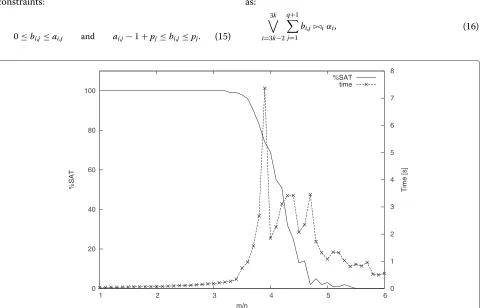
Fig. 1GPSAT phase transition. Ratio of satisfiable instance and average computation time for each numbermof clauses in , withn=50 andq=5
reduce the bilinear term ai,jpj to linear constraints. We do that by introducing a new fresh variable bi,j and the constraints:
0≤bi,j≤ai,j and ai,j−1+pj≤bi,j≤pj. (15)
Note that ifai,j=0, thenbi,j=0; and ifai,j=1, thenbi,j= pj. The constraints from Expression (14) can be rewritten as:
3k
i=3k−2 q+1
j=1
bi,jiαi, (16)
0 20 40 60 80 100
1 2 3 4 5 6 0
1 2 3 4 5 6 7 8
%SAT Time [s]
m/n
%SAT time
for each clause 1≤k≤qand withi∈ {<,≥}.
A last restriction ensuresP(.)is a probability measure:
q+1
j=1
pj=1. (17)
The whole procedure is presented in Algorithm 1; it basically collects constraints from Expressions (11), (15), (16), and (17). Note that variables ai,j ∈ {0, 1} are restricted to be integers, while bi,j andpj range within the real interval [ 0, 1], leading to an instance of mixed integer linear programming . The algorithm produces a MILP instance that has a solution if and only if the original GPSAT instance is satisfiable.
It remains to prove that the mixed integer program gen-erated has polynomial size on the length of the GPSAT instance and can be generated in polynomial time. Fist, we sum up the number of variables introduced at the line 1 of Algorithm 1:
• variablesai,j:q+1valuations timesn atomic
propositions;
Algorithm 1 GPSAT solution based on mixed integer linear programming.
Input:Propositions{Aj}nj=1,with 3-clauses of (possibly negated) assignments overA3i−2, A3i−1andA3i for 1 ≤ i ≤q, a sentenceγ, from = P(γ )≥ 1 in CNF withm 3-clauses.
Output:“Satisfiable” if∧ is satisfiable; “Unsatisfiable” otherwise.
1: Variablesai,jare binary; variablesbi,jandpjare real-valued in [ 0, 1].
2: forj∈ {1,. . .,q+1}and each clause (∨k
l=1Ail)∨(∨
k
l=1¬Ail)ofγ do
3: Generate linear constraint (k
l=1ail,j)+( k
l=1(1−ail,j))≥1.
4: end for
5: foreach clausekl=1P(Al)≥αl∨
k
l=1¬P(Al)≥ αldo
6: Generate disjunction of linear constraints
(k l=1
q+1
j=1bl,j≥αl)∨(k l=1
q+1
j=1 bl,j< αl). 7: end for
8: fori∈ {1,. . ., 3q}do 9: forj∈ {1,. . .,q+1}do
10: Generate linear constraints 0 ≤ bi,j ≤ ai,j and ai,j−1+pj≤bi,j≤pj.
11: end for 12: end for
13: Generate linear constraintqj=+11pj=1.
14: Submit constraints to an integer programming solver. 15: returnSatisfiableif linear constraints have a solution,
Unsatisfiableotherwise.
• variablesbi,j:q+1valuations times3qatomic
propositions in;
• variablespj: one per valuation,q+1.
Now we count the constraints created together with the time consumption of the loops in Algorithm 1 that gener-ate them:
• loop at lines 2–4:(q+1)minequalities with three
variables each;
• loop at lines 5–7:q disjunctions of three inequalities
withq+1variables each;
• loop at lines 8–12:(q+1)3qpairs of inequalities on
three variables each;
• command at line 13: 1 equality withq+1variables.
Summing up, Algorithm 1 generates(m+6q+ 1)(q+
1) + 2q = O((m + q)q) inequalities on (n + 3q + 1)(q + 1) = O(nq) variables. Therefore, the resulting mixed integer linear program has polynomial size and is built in polynomial time on the length of the correspond-ing GPSAT instance. Note that the total runncorrespond-ing time of Algorithm 1 depends largely on the command at line 14, that calls a solver for the MILP instance; as the decision version of mixed integer linear programming is itself an NP-complete problem, it might take exponential time.
Results and discussion
We have coded our GPSAT method using the Java lan-guage with calls to CPLEX version 12, extending the implementation from [6] to solve PSAT, and run experi-ments in a iMac computer with 4 GBytes of memory.
We were particularly interested in investigating whether phase transition phenomena can be identified in our solu-tions to GPSAT. Until the recent work of Finger and De Bona [11], there was little evidence of phase transition for PSAT in the literature. Baiotelli et al. [2] have shown empirical results for the 2CPA problem—that is equiva-lent to the PSAT in normal form with only two literals per clause—in which a typical phase transition shape is seen. However, 2CPA is not exactly a normal form of PSAT, even though it is NP-complete. As our normal form extends Finger and De Bona’s, and GPSAT is also NP-complete, we expect to find evidence of phase transition also for GPSAT. Consequently, we examine the behavior of
GPSAT using instances∧ in normal form for various
values ofm/nfor fixedqandn, looking for hard instances instead of randomly trying out large instances that in the end may be easy.
Following the approach from Finger and De Bona [11], we fix the number of clauses in,q, and the total number of probabilistic literals in, 3q. Each probability
assess-ment P(Ai) i αi in was generated in such a way
0 20 40 60 80 100
1 2 3 4 5 6
0 5 10 15 20 25
%SAT Time [s]
m/n
%SAT time
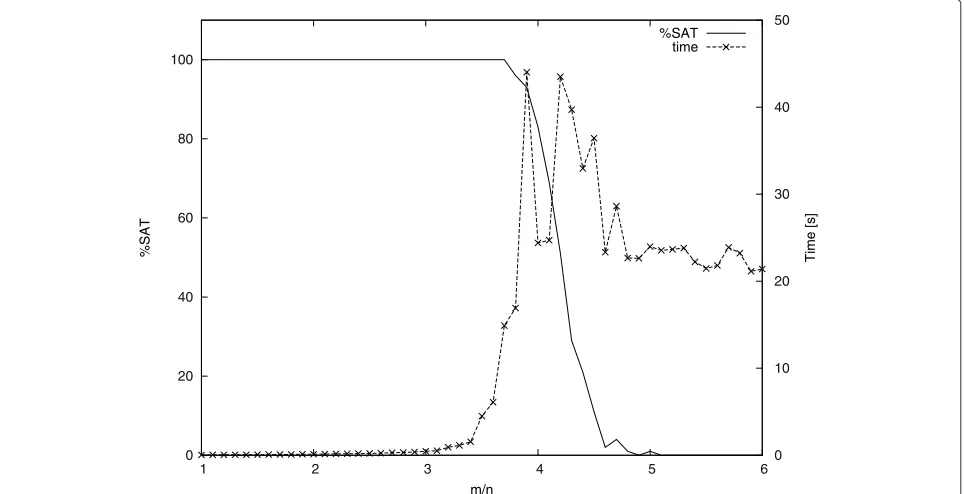
Fig. 3GPSAT phase transition. Ratio of satisfiable instance and average computation time for each numbermof clauses in , withn=50 andq=15
uniform distribution, discretizing [ 0, 1] using two dec-imal digits. Clauses with three literals each in γ were randomly generated by selecting atomic propositions ran-domly out of thenpropositions; each literal was negated or not with probability 1/2. We varied the numbermof
clauses inγ in order to explore the complexity profile of GPSAT form/n. For each pointm/n, 100 random GPSAT instances in normal form were generated, submitted to the implementation of Algorithm 1, and the average compu-tation time was registered together with the percentage
0 20 40 60 80 100
1 2 3 4 5 60
10 20 30 40 50
%SAT Time [s]
m/n
%SAT time
Fig. 4GPSAT phase transition. Ratio of satisfiable instance and average computation time for each numbermof clauses in , withn=100 and
0 20 40 60 80 100
1 2 3 4 5 6
0 10 20 30 40 50 60 70 80
%SAT Time [s]
m/n
%SAT time
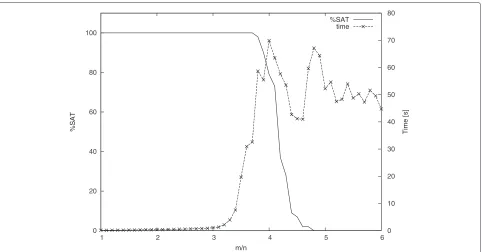
Fig. 5GPSAT phase transition. Ratio of satisfiable instance and average computation time for each numbermof clauses in , withn=100 and
q=15
of satisfiable formulas. Figures 1, 2, 3, 4, and 5 shows the results of such experiments, for different values ofq andn.
An easy-hard-easy pattern, typical from phase transi-tion phenomena, is seen in Figs. 1, 2, 3, 4, and 5. The hard-est instances were found close to the transition between regions of satisfiable and unsatisfiable instances; further-more, unsatisfiable instances were found harder to solve than satisfiable ones. Ifq = 0, the problem is Boolean satisfiability, and the point of approximately 50 % of sat-isfiable instances is around m/n = 4.3 [12]. Here we add some probabilistic constraints, so the phase transition point has moved leftwards, as expected.
Comparing to the results in ref. [6] solving GPSAT seems harder than PSAT. This is not surprising, since it is known that disjunctive linear programming is consider-ably harder than linear programming.
Conclusions
In this paper, we have introduced the generalized prob-abilistic satisfiability problem, a normal form for it, and an algorithm to solve it. GPSAT is considerably more expressive than PSAT, allowing negation and disjunction of probabilistic assessments and probabilistic nesting as well, but it is still NP-complete. Based on an integer lin-ear programming solution to PSAT, we introduced an integer linear programming solution for GPSAT. Evidence for phase transition was found in our initial experiments,
but an exhaustive investigation is needed to confirm and understand this phenomenon in GPSAT and PSAT.
As future work, it would be interesting to enlarge our language to embed linear combinations of probabilistic assignments and conditional probabilities. Another path would be to generalize the coherence checking prob-lem, as we did for PSAT, for de Finetti’s framework for probability.
Endnotes
1ω(¬φ)=1 iffω(φ)=0;ω(φ
1∧φ2)=1 iffω(φ1)=1 andω(φ2)=1;ω(φ1∨φ2)=1 iffω(phi1)=1 or ω(φ2)=1;ω(φ1→φ2)=1 iffω(φ1)=0 orω(φ2)=1.
2For simplicity, we left the connective→outside the
language, without loss of generality.
3If a solution can be reached with less thanq+1
valuations with positive probability, then someajcan be repeated with zero probability.
Competing interests
The authors declare that they have no competing interests.
Authors’ contributions
FGC suggested the idea, provided the basis for the implementation of the algorithm, and contributed to the text. GDB completed the implementation, ran the experiments, and contributed to the text; he is a PhD candidate under supervision of MF. All authors read and approved the final manuscript.
Acknowledgements
Author details
1Instituto de Matemática e Estatística, Universidade de São Paulo, Rua do Matão 1010, Sao Paulo, Brazil.2Escola Politécnica, Universidade de São Paulo, Avenida Professor Luciano Gualberto 380, Sao Paulo, Brazil.
Received: 2 May 2014 Accepted: 10 June 2015
References
1. Andersen KA, Pretolani D (2001) Easy cases of probabilistic satisfiability. Ann Math Artif Intell 33(1):69–91
2. Baioletti M, Capotorti A, Tiberi P, Tulipani S (2004) An empirical complexity for a 2CPA solver. 10th International Conference IPMU:1857–1864 3. Boole G (1958) An Investigation on the Laws of Thought, Dover, New York 4. Bruno G, Gilio A (1980) Applicazione del metodo del simplesso al teorema
fondamentale per le probabilità nella concezione soggettivistica. Statistica 40:337–344
5. Chandru V, Hooker J (1999) Optimization Methods for Logical Inference, John Wiley & Sons Inc. ISBN: 978-0-471-57035-6
6. Cozman FG, di Ianni LF (2013) Probabilistic satisfiability and coherence checking through integer programming. In: Symbolic and Quantitative Approaches to Reasoning with Uncertainty, The Netherlands. pp 145–156 7. De Bona G, Cozman FG, Finger M (2014) Towards classifying propositional
probabilistic logics. J Appl Logic 12(3):349–362
8. Eckhoff J (1993) Helly, Radon, and Carathéodory type theorems. In: Grüber P, Wills J (eds). Handbook of convex geometry, North-Holland,
Amsterdam, 1993. pp 389–448
9. Fagin R, Halpern JY, Megiddo N (1990) A logic for reasoning about probabilities. Inform Comput 87:78–128
10. Fagin R, Halpern JY (1994) Reasoning about knowledge and probability. J ACM 41(2):340–367
11. Finger M, De Bona G (2011) Probabilistic satisfiability: Logic-based algorithms and phase transition. In: IJCAI. pp 528–533.
doi:10.5591/978-1-57735-516-8/IJCAI11-096
12. Gent IP, Walsh T (1994) The SAT phase transition. In: 11th European Conference on Artificial Intelligence. pp 105–109
13. Georgakopoulos G, Kavvadias D, Papadimitriou CH (1988) Probabilistic satisfiability. J Complexity 4:1–11
14. Hailperin T (1965) Best possible inequalities for the probability of a logical function of events. 72:343–359
15. Hailperin T (1976) Boole’s Logic and Probability: a Critical Exposition from the Standpoint of Contemporary Algebra, Logic, and Probability Theory, North-Holland, Amsterdam
16. Halpern JY (2003) Reasoning about Uncertainty. MIT Press, Cambridge, Massachusetts
17. Hansen P, Jaumard B (1996) Probabilistic Satisfiability. Technical Report G-96-31, Les Cahiers du GERAD, École Polytechique de Montréal 18. Hansen P, Perron S (2008) Merging the local and global approaches to
probabilistic satisfiability. Int J Approximate Reasoning 47(2):125–140 19. Jaumard B, Hansen P, de Aragão MP (1991) Column generation methods
for probabilistic logic. ORSA J Comput 3(2):135–148
20. Lukasiewicz T (2008) Expressive probabilistic description logics. Artif Intell 172(6–7):852–883
21. Ng R, Subrahmanian VS (1992) Probabilistic logic programming. Inform Comput 101(2):150–201
22. Nilsson NJ (1986) Probabilistic logic. Artif Intell 28:71–87 23. Uchii S (1973) Higher order probabilities and coherence. Philos Sci
40(3):373–381
24. Williams HP (2009) Logic and integer programming. Springer. ISBN 978-0-387-92280-5
Submit your manuscript to a
journal and benefi t from:
7Convenient online submission
7Rigorous peer review
7Immediate publication on acceptance
7Open access: articles freely available online
7High visibility within the fi eld
7Retaining the copyright to your article