Submitted in: July 2011 Accepted in: November 2011 Published in: January 2012
Recommended citation
ALBANO, Giovannina (2012). “A Knowledge-Skill-Competencies e-Learning Model in Mathematics”. In: “Mathematical e-learning” [online dossier]. Universities and Knowledge Society Journal (RUSC). Vol. 9, No 1. pp. 306-319UOC. [Accessed: dd/mm/yy].
<http://rusc.uoc.edu/ojs/index.php/rusc/article/view/v9n1-albano/v9n1-albano-eng> ISSN 1698-580X
A Knowledge-Skill-Competencies
e-Learning Model in Mathematics
article
Dr Giovannina Albano
Faculty of Engineering, University of Salerno
Dossier “Mathematical e-learning”
Abstract
This paper concerns modelling competence in mathematics in an e-learning environment. Competence is something complex, which goes beyond the cognitive level, and involves meta-cognitive and non-meta-cognitive factors. It requires students to master knowledge and skills and at least some measurable abilities, which Niss calls ‘competencies’. We present a model that exploits the innovative technological features of the IWT platform to defi ne a personalised learning experience allowing students to increase their competence in mathematics. It is based on knowledge and skills representations by means of a graph metaphor, and on a theoretical framework for modelling competence.
Keywords
1. Introduction
Competence in mathematics is something complex, hard to defi ne, which requires students to master not only knowledge and skills, but at least some measurable abilities, which Niss calls ‘competencies’ (detailed in section 2). In this paper we face the problem of mathematics teaching-learning in an e-teaching-learning environment, with particular respect to competencies. The author has extensive experience in undergraduate blended courses supported by the e-learning platform IWT (Intelligent Web Teacher), which allows personalised Units of Learning (UoLs) for each learner to be created and delivered by means of an explicit knowledge representation (see section 3). The latter has been improved in order to make a clear distinction between knowledge and skills (Albano, 2011a). Competency modelling requires a diff erent approach and further work, since it is based on knowledge and skills and goes beyond the cognitive and meta-cognitive levels of both. In this paper, starting from the assumption that the learning of competencies comes from the engagement of learners in suitable Learning Activities (LAs), we propose a model that is able to generate and update suitable templates
associated with the learning of a certain competency. Moreover, we give a complete framework of how the knowledge-skill-competency model should work in the IWT context. In particular, the IWT learning personalisation features can be exploited to personalise the delivery of LAs, so as to engage learners in those activities that best match their individual cognitive states and learning preferences.
The paper is organised as follows: sections 2 and 3 give an overview of the theoretical and technological frameworks, respectively; section 4 describes a model for knowledge and skills in mathematics learning, based on a multi-level graph representation of the domain; section 5 describes a model for competencies, framed in Dubinsky research on undergraduate mathematics education (RUME); section 6 shows how the three models work and integrate; section 7 analyses
Conocimientos, destrezas y competencias:
un modelo para aprender matemáticas en un entorno virtual
Resumen
Este trabajo se centra en la competencia matemática en un entorno de aprendizaje virtual. La competen-cia es algo complejo, que trasciende el nivel cognitivo, e implica factores metacognitivos y no cognitivos. Exige de los estudiantes su dominio sobre conocimientos y destrezas y, por lo menos, sobre algunas capaci-dades medibles, a las que Niss llama «competencias específi cas» [competencies]. El modelo que presenta-mos utiliza las innovadoras características tecnológicas de la plataforma IWT para defi nir una experiencia de aprendizaje personalizado que permite a los estudiantes aumentar su competencia en matemáticas. Se basa en la representación de conocimientos y destrezas mediante metáforas gráfi cas y en un marco teórico para modelar la competencia.
Palabras clave
costs and benefits; section 8 explores the opportunities for future research; and section 9 draws some conclusions.
2. Theoretical framework
Many authors (Weinert, 2001; D’Amore, 2000; Godino, J.; Niss, 2003) have tried to explain competence in mathematics. According to Niss (2003), “possessing mathematical competence means having knowledge of, understanding, doing and using mathematics”. All these authors agree that it is not something to be taught; rather, it is a long-term goal for the teaching-learning process. It is something complex and dynamic, which requires mathematics domain knowledge of a declarative-propositional type and of a procedural type, that is, knowledge (to know) and skill (to know how), but at the same time goes beyond cognitive factors. Table 1 shows a list of some basic requirements for the distinction between knowledge and skills:
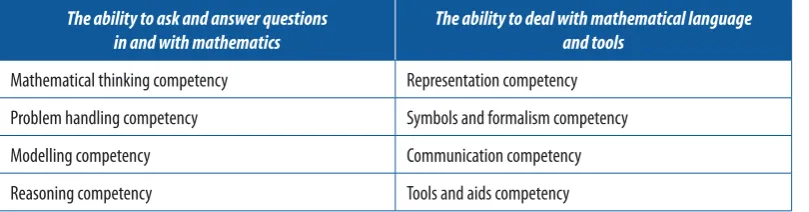
In order to make the notion of mathematical competence more factual, we can consider a mathematical competency as a clearly recognizable distinct major constituent in mathematical competence (Niss, 2003). Niss has distinguished eight characteristic cognitive mathematical competencies, adopted by PISA 2009 (OECD, 2009). They correspond to relational mathematics (Skemp, 1976), which consists of reasoning, thinking, problems, and processes. This is reflected by ‘relational comprehension’, which means to know why. The following table lists them in two clusters (Niss, 2003):
Table 1.
Classification of the main types of mathematical content.
Content type Knowledge Skill
Definition Statement Procedure/computation
Theorem Theorem Statement Proof Procedure/computation Procedure/computation Algorithm
Example (counter) Description
Performance of the algorithm
Exercise Problems
Computational skills Solving standard problems
Table 2. Clusters related to cognitive mathematical competencies.
The ability to ask and answer questions in and with mathematics
The ability to deal with mathematical language and tools
Mathematical thinking competency Representation competency
Problem handling competency Symbols and formalism competency
Modelling competency Communication competency
3. Technological framework
From a technological viewpoint, we refer to the IWT platform that we used in our practices. It is a software platform for distance learning, equipped with Learning Content Management System (LCMS) and adaptive learning system features. It allows teaching-learning experiences to be both personalized and collaborative by means of the explicit representation of knowledge and the use of Web 2.0 techniques and tools. Realized at the Italian Pole of Excellence on Learning & Knowledge and marketed by MOMA1, this platform, which is not open source, has been adopted by various Italian
universities and high schools.
3.1 Th
e main features of IWT
Personalisation of the learning process is made possible in IWT by means of three models: Knowledge, Learner, Didactic.
The Knowledge Model (KM) is able to intelligibly represent the computer and the information associated with the available didactic material. It makes use of:
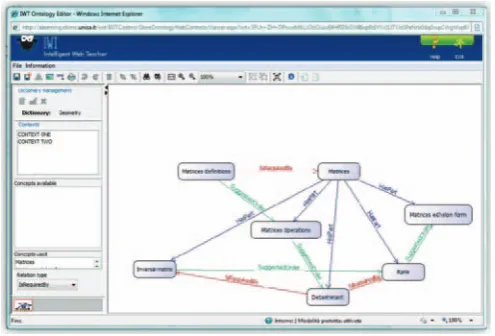
1) Ontologies, which allow the formalization of cognitive domains through the defi nition of concepts and relations between the concepts. They consist of graphs, whose nodes are the concepts of the cognitive domain and whose edges represent the relations HasPart, IsRequiredBy and SuggestedOrder, designed by domain experts using a specifi c editor available in IWT (Figure 1).
2) Learning Objects (LOs), consisting of “any digital resource that can be reused to support learning” (Wiley, 2000).
3) Metadata, which are descriptive information tagged to each LO in order to associate it with one or more concepts in an ontology (Figure 2, red box). Further information refers to educational
1. http://www.momanet.it/index.php?lang=en
parameters such as LO typology (video, text, slide, etc.), context (high school, college, training, etc.), type of interaction (expositive, active, mixed) and its level, diffi culty and semantic density.
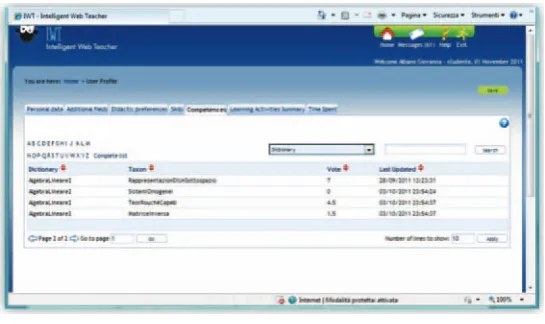
The Learner Model (LM) allows a user profi le to be managed (Figure 3). The user profi le automatically captures, stores and updates information on individual learners’ preferences and needs (e.g., media, level of interactivity, level of diffi culty, etc.) and their cognitive states (that is, concepts of a knowledge domain that have already been learnt).
The Didactic Model (DM) refers to a pedagogical approach to learning (e.g., inductive, deductive, learning by doing, etc.). Currently, it is associated with specifi c LO typologies (for instance, a simulation refers to inductive didactic learning) and it is stored both in the LO metadata and in user profi les (as preferred LO typologies).
3.2. How IWT works
IWT allows both guided and self-regulated learning. The former consists of standard courses (e.g., Geometry, Calculus) and the latter allows learners to express their learning needs in natural language (e.g., learning to solve linear systems). In both cases, IWT gives rise to tailored UoLs, taking advantage
Figure 2. An example of metadata (zoom on Ontology/Concept association).
of the previous models (Albano, 2011b; Albano et al., 2007; Gaeta et al., 2009). Domain experts (i.e., teachers) fi rst defi ne a number of suitable specifi cations for courses or learning needs, choosing or editing a suitable ontology for the course topics. They then set suitable learning goals (e.g., one or more target concepts on the chosen ontology) and fi nally choose certain parameters for the teaching fl ow (e.g., pre-test, how many intermediate tests, educational context). The UoL is generated at run-time from IWT, when a student accesses it for the fi rst run-time, through the following steps: the ontology is used to create the list of concepts needed to reach the target concepts of the course, then user profi le information allows this list to be updated according to the cognitive state, and the LOs to be chosen. These LOs are those whose metadata best match the learner preferences. Further, the UoL is dynamically updated according to the outcomes of intermediate tests.
4. Multi-level graphs to model knowledge
and skills learning
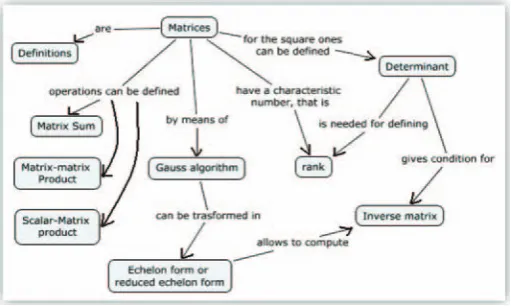
The current use of ontology in IWT corresponds to a rough version of teaching according to ‘fundamental nodes’. With this term we refer to “those fundamental concepts which occur in various places of a discipline and then have structural and knowledge procreative value” (Arzarello et al., 2002). In mathematics education, teaching by fundamental nodes means “to weave a conceptual map, strategic and logic, fi ne and smart” (e.g., Figure 4), where each concept is the goal of a complex meshed system, where no concept stands completely alone and each of them is part of a relational web rather than a single “conceptual object” (D’Amore, 2000).
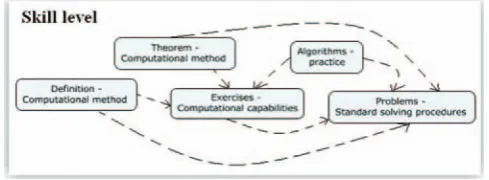
As we can see, the distinction between the knowledge and the skill levels is made clear by the relations between the nodes (i.e., the edges). Edges in IWT ontologies cannot do the same. So the two levels are fl attened onto the nodes, thus associating LOs for both of them.
In order to overcome this restraint, we propose the use of a multi-level graph representation (Albano, 2011a). At the fi rst level, the fundamental nodes are seen as ‘roots’ of a further two graphs (ontologies), where the levels of knowledge and skill are made explicit.
t Knowledge level (Figure 5), where the nodes correspond to definitions, theorems, examples, etc. (Table 1), and the possible relations, mandatory (continuous lines) or not (discontinuous lines).
t Skill level (Figure 6): where the nodes correspond basically to computational methods and standard problem-solving capabilities (Table 1).
Moreover, a third level related to competencies can be devised:
t Competency level: where the nodes correspond to those competencies for the fundamental node ‘root’ (Table 2).
In the following section, we shall take the competency level and its modelling into consideration.
5. Dubinsky’s cycle to model competency learning
According to the theoretical framework, we assume that competencies develop from students’ engagement in LAs. This is why, in order to model competencies, we refer to Dubinsky’s RUME framework (Asiala et al., 1996). It consists of a cycle of three interrelated elements, which are theoretical analysis, instructional treatment and data collection/analysis.
Let us see what they mean in our context. Starting from a concept, we can single out one or more associated competencies. Then, we can implement a LA aimed at getting students to practice them. Thus, we can start the cycle described below:
Figure 5. Generic ontology at the knowledge level.
Th
eoretical analysis
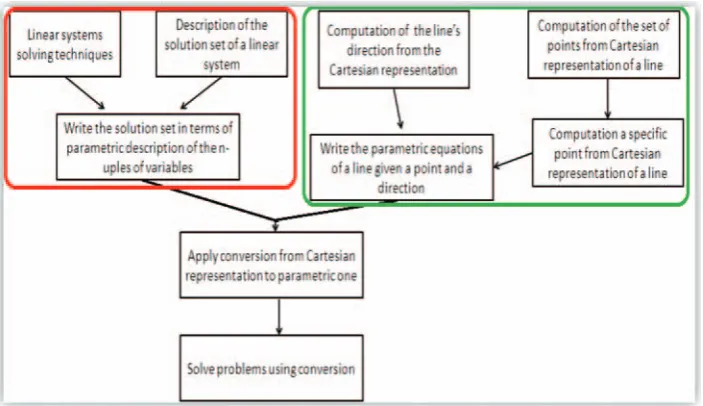
The theoretical analysis aims to propose a competency learning model, that is, a description of mental construction processes used by learners in their understanding of the competency, called Genetic Decomposition (GD). Such GD is strictly dependent on the content to which the competency is applied (e.g., representation competency has a diff erent meaning if it concerns a set of real numbers or the lines in a 2D space) and it is not necessarily unique with respect to fi xed content (Figure 7).
Moving along a GD, the mechanism for practicing and constructing mathematical competency is described in terms of the following four elements (APOS):
t Action: a transformation generated as a reaction to external stimuli (physical or mental).
t Process: the interiorisation of the object, so that transformations can be mentally imagined.
t Object: the encapsulation of the process, due to reflections on operations applied to a particular process, making the individual aware of the process in its totality.
t Schema: objects and processes can be organized in a coherent collection, explicating the interconnections between them and giving rise to what is called a‘schema’. A schema represents an individual’s knowledge of a competency and it is invoked in order to understand, deal with and face a perceived situation involving that competency.
Given a competency, its GD together with the related APOS give rise to a Learning Scenario (LS) suitable for a learner to practice and master such a competency.
Instructional treatment
Theoretical analysis indicates a specifi c LS to be fostered by instruction. This means designing instruction for a LA associated with a LS, which enables students to construct the appropriate actions, processes, objects and schemata. Such instruction can be described using a specifi c language for learning design (for instance, IMS-LD 2003) allowing the description of an activity workfl ow associated with the LS. These workfl ows include the defi nition of actions, processes, pedagogical strategies and specifi c environments comprising sets of LOs and services (forum, chat, calendar, virtual classroom, access to maths engines, etc.). The outcome of this phase will be one or more templates for a LA associated with a fi xed LS. The templates also contain descriptive information in order to associate a LA with both a competency and to one or more concepts in an ontology (at knowledge and/or skill level).
Data collection/analysis
Once the instruction is implemented and experienced by students, observations and analysis of learning results in terms of theoretical expectations are needed. This means examining whether students have made the mental constructions predicted by the theoretical analysis or whether they have used alternative constructions. The data are used to validate the theoretical analysis and the consequent instruction treatment. Appropriate adjustments or a complete revision can be made.
6. How the new models work
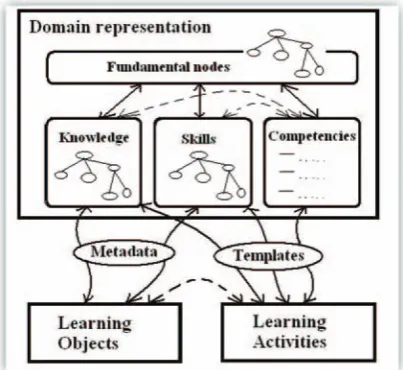
From the above sections, we can sketch out the following Figure 8.
Domain representation in the platform will consist first of all of an ontology on fundamental nodes, and then further levels of ontologies (knowledge and skills) and a database of competencies are devised.
Taking into consideration both guided and self-regulated learning, let us see how the new domain representation impacts on them. Concerning the former, the UoL corresponding to the standard course differs from the ones described in section 3.2 with respect to two aspects:
t The selection of target concepts can be specified at one or more ontology levels and the learning path will develop from the merging of the lists generated at each level; then the process continues as previously shown.
t The UoL will be enriched by engaging learners in LAs corresponding to selected competencies in the third level of domain representation (sections 4 and 5). The choice of LAs will be guided by the best match between a template’s descriptive information and a user profile.
Concerning self-regulated learning, the models are also able to meet learners’ needs with respect to competencies (e.g., to learn proving statements). In this case, from among the available LAs, the platform selects the ones that best match the needs expressed by learners and, at the same time, that refer to concepts (in an ontology) already present in their cognitive states. In any event, a pre-test on such concepts can be done and a tailored UoL can be offered to each learner in order to bridge the gap if necessary.
7. Costs, benefits and feedback
In traditional teaching, teachers are, at one and the same time, the authors, tutors and evaluators of their courses. In an e-learning environment, we can explicitly distinguish the roles of author and tutor. Authors are collective subjects possessing all the skills required for the preparation of teaching materials in a digital context; they are not only experts with competencies in general and discipline-specific education, but also professionals with technical capabilities in ICTs, management and pedagogy. Tutors can be human or artificial agents to give students the right scaffolding needed to reach the desired educational goals. Teachers can assume one or more roles, including that of author, according to their expertise. For instance, in the case of our courses at the University of Salerno, teachers act as domain experts in Geometry or Calculus and have designed the related ontologies (by means of a user-friendly graphical tool, shown in Figure 2). They have also designed various LOs (from hypermedia to structured video and dynamic exercises with Mathematica2) and supervised
their implementation by suitable technical staff.
While the work of an author in an e-learning context may seem tougher (since it also requires technical capabilities) than that of a teacher in traditional lectures, there are some considerable advantages, including:
t Reusability: ontologies, LOs and templates constitute a repository available to all authors using the platform (not only to the owner).
t Continuous enrichment of the learning pool: this is a direct consequence of the previous item, as every teacher can take advantage of the others’ work, thus benefitting from the chance to use much more material than they are individually capable of producing.
t Support for diversity in students’ learning methods: the personalisation of teaching is not possible at undergraduate level, especially with large classes of freshers, but blended courses that combine face-to-face classes and distance mathematics instruction/learning can bridge the gap.
t Automatic learning tracking data: for both individuals and groups. Their analysis provides a great deal of information at the domain level (e.g., topics with intrinsic difficulty) and at learning level (e.g., basic shortcomings) so that adjustments can be made in the design/implementation of LOs and LAs.
Regarding students, we can make some considerations on the basis of our experience at the University of Salerno. Over the last few years, some mathematics courses at the University of Salerno have been IWT supported. Traditional classes have been supported by distance instruction, consisting of tailored UoLs (section 3.2) and teacher-driven cooperative or individual learning activities (whose formalisation, and the generalisation of the latter, has given rise to the model in section 5). Apart from the grades obtained in exams, we submitted questionnaires to students engaged in blended classes in order to investigate outcomes concerning meta-cognitive and non-cognitive levels. We essentially found that LAs have fostered a change in their working methods: going into depth as a standard practice, broadening perspectives, changing attitudes towards learning, focusing on relevant activities, organizing homework timetables and giving continuity to their work. Besides changing their working methods, they begin to grasp mathematical meanings and improve their ways to tackle problems, which were our main goals. Then their attitudes towards mathematics change (even those of individuals who are not usually successful at mathematics), thus initiating a productive learning process.
8. Future trends
We plan to continue our research on the knowledge-skill-competency model. Implementation on a platform requires details to be investigated, and integration with IWT algorithms for the automatic generation of personalised UoLs poses new open problems, such as:
t Investigation into tools useful for instructional treatment: it would be very interesting to have the chance to choose, at run-time, LOs involved in LAs, taking account of the assigned metadata.
t Definition of competency assessment procedures according to the requirements of PISA (OECD, 2009), both in closed and open form (Albano, 2011b; Albano et al., 2008).
t Integration of the outcomes of competency open assessment to automatically update the UoLs and choose subsequent LAs.
9. Conclusions
In the context of mathematics e-learning, in this paper we have focused on competency learning. Assuming that competencies develop from learners’ engagement in LAs, we have proposed a model apt to generate learning experiences, which can be further tailored to individual learners according to their user profiles. This model supplements the knowledge and skill models based on multi-graphs. All three models interact in order to generate a knowledge-skill-competencies model capable of creating and delivering personalised UoLs consisting of collections of LOs or LAs. The IWT platform has been used to validate the models in undergraduate courses. The outcomes show that students improve their ways of tackling mathematics problems or studying, while changing their attitudes towards mathematics.
References
ALBANO, G. (2011a). “Knowledge, Skills, Competencies: a Model for Mathematics E-Learning”. In: R. Kwan; C. McNaught; P. Tsang; F. L. Wang; K. C. Li (eds). Enhancing Learning Through Technology: International Conference, ICT 2011, Hong Kong, July 11-13. Proceedings (Communications in Computer
and Information Science). CCIS 177. ISBN: 978-3-642-22382-2. Springer Heidelberg. Pages 214-225. ALBANO, G. (2011b). “Mathematics education: teaching and learning opportunities in blended
learning”. In: A. Juan; A. Huertas; S. Trenholm; C. Steegmann (eds). Teaching Mathematics Online: Emergent Technologies and Methodologies [in press].
ALBANO, G.; FERRARI, P. L. (2008). “Integrating technology and research in mathematics education: the case of e-learning”. In: F. J. García-Peñalvo (ed.): Advances in E-Learning: Experiences and Methodologies. IGI Global. Pages 132-148.
ALBANO, G.; GAETA, M.; RITROVATO, P. (2007). “IWT: an innovative solution for AGS e-Learning model”.
International Journal of Knowledge and Learning. Vol. 3, No 2/3, pages 209-224. ARZARELLO, F.; ROBUTTI, O. (2002). Matematica. Brescia: La Scuola.
ASIALA, M.; BROWN, A.; DEVRIES, D. [et al.] (1996). “A Framework for Research and Curriculum Development in Undergraduate Mathematics Education”. CBMS Issues in Mathematics Education. Vol. 6.
D’AMORE, B. (2000) “La complessità dell’educazione e della costruzione dei saperi”. Riforma e didattica. No 4, pages 35-40.
GODINO, J. ( 2002). “Competencia y comprensión matemática: ¿Qué son y cómo se consiguen?”. Uno. Vol. 8, No 29, pages 9-19.
NISS, M. (2003). “ Mathematical competencies and the learning of mathematics: The Danish KOM project”. In: A. Gagatsis; S. Papastavridis (eds). Proceedings of the 3rd Mediterranean Conference on
Mathematical Education. Athens: Hellenic Mathematical Society. Pages 115-124.
OECD (2009). PISA 2009 Assessment Framework - Key Competencies in Reading, Mathematics and Science. [Accessed: 28 January 2011].
<http://www.oecd.org/dataoecd/11/40/44455820.pdf>
SKEMP, R. (1976). “Relational understanding and instrumental understanding”. Mathematics Teaching. No 77, pages 20-26.
WEINERT, F. (2001) . “Concept of competence: a conceptual clarifi cation”. In: D. Rychen; L. Salgenik (eds). Defi ning and electing key competencies. Seattle, Toronto, Bern, Göttingen: Hogrefe & Huber Publishers.
WILEY, D. A. (2000) . “Connecting learning objects to instructional design theory: A defi nition, a metaphor, and a taxonomy”. In: D.A. Wiley (ed.). The Instructional Use of Learning Objects. [Accessed: 18 February 2010].
<http://reusability.org/read/chapters/wiley>
About the Author
Giovannina Albano
Faculty of Engineering, University of Salerno
Assistant professor of Geometry in the Faculty of Engineering at the University of Salerno, Italy. She holds a doctorate in Applied Mathematics and Computer Science awarded by the University of Naples Federico II, and a bachelor of science in Mathematics, also awarded by the University of Naples Federico II. Her research interests include e-learning models as well as mathematics education in e-learning environments. She is the author of around 80 scientifi c papers published in international journals, books and proceedings in these fi elds. She was the Italian representative on the Working Party for Learning Policies within the IST Programme, V Framework Programme. She was the vice-project coordinator of the Centre of Excellence for Methods and Systems for Learning and Knowledge funded by the Italian Ministry of Universities and Research, and the scientifi c leader of the Virtual Scientifi c Experiments line of research. She participates in many Italian and European projects on education programmes.
Università degli Studi di Salerno Via Ponte don Melillo