Recent advances of the signal
processing techniques in future smart grids
Zahoor Uddin
†, Ayaz Ahmad
*†, Aamir Qamar
†and Muhammad Altaf
†Introduction
Smart grid is a network of electric supply that manages power demand in reliable and economic manner by detecting and reacting to local changes in usage. The infrastruc-ture comprises of smart meters, appliances, and resources with a combination of mod-ern technologies like, control, power, instrumentation, and communication. In such a complex scenario, signal processing techniques are essential to understand, plan, design and operate the complex future smart electronic grids [1]. In addition to this, signal pro-cessing has wide variety of applications and is becoming an important tool for electric power system analysis. This is due to the fact that measurements retrieved from numer-ous locations of the grid can be used for data analysis. These measurements can also be used for a variety of issues such as voltage control, power quality and reliability, power system and equipment diagnostics, power system control and protection, etc [2–6].
Power quality is one of the main issue of the smart grid research where voltage, current and frequency deviations in the power system are the main concerns of the system oper-ator [7]. The characterization of the incompatibilities caused by these deviations requires an understanding of their principal cause. Other possible aspects that need inspection are the efficient representation of the voltage and current variations in various electrical
Abstract
Smart grid is an emerging research field of the current decade. The distinguished features of the smart grid are monitoring capability with data integration, advanced analysis to support system control, enhanced power security and effective communi-cation to meet the power demand. Efficient energy consumption and minimum costs are also included in the prodigious features of smart grid. The smart grid implementa-tion requires intelligent interacimplementa-tion between the power generating and consuming devices that can be achieved by installing devices capable of processing data and communicating it to various parts of the grid. The efficiency of these devices is greatly dependent on the selection and implementation of the advance digital signal process-ing techniques. This paper provides a comprehensive survey on the applications of signal processing techniques in smart grids, plus the challenges and shortcomings of these techniques. Furthermore, this paper also outlines some future research directions related to applications of signal processing in smart grids.
Keywords: Smart grid, Signal processing techniques, Wireless communication, Control, Security
Open Access
© The Author(s) 2018. This article is distributed under the terms of the Creative Commons Attribution 4.0 International License (http://creativecommons.org/licenses/by/4.0/), which permits unrestricted use, distribution, and reproduction in any medium, provided you give appropriate credit to the original author(s) and the source, provide a link to the Creative Commons license, and indicate if changes were made.
REVIEW
*Correspondence: [email protected]
†Zahoor Uddin, Ayaz
Ahmad, Aamir Qamar and Muhammad Altaf contributed equally to this work
equipment. Moreover, the signal processing of the power patterns leads to better under-standing the behavior of these equipment. Continuous monitoring is also required to capture various events and variations. To meet future demands, methods and techniques must be developed to explore the full range of signals derived from the complex interac-tion between suppliers, consumers and network operators [8].
A smart grid performs measurement, monitoring and processing of waveforms based on acquisition, analysis, detection and classification techniques [9]. Furthermore, these techniques can be utilized for the identification of the system events, phenomena and load characteristics [10]. A key aspect of signal processing in power systems is signal processing methods which provide the best characterization and analysis of the signals to be investigated. For instance, many methods only demand the voltage measured for an acceptable evaluation, but in some cases current, frequency or active and reactive power of the system is required. Furthermore, an understanding of electrical system behavior is needed to study digital signal processing techniques for control, protection and monitoring of the smart grids [11].
Related work
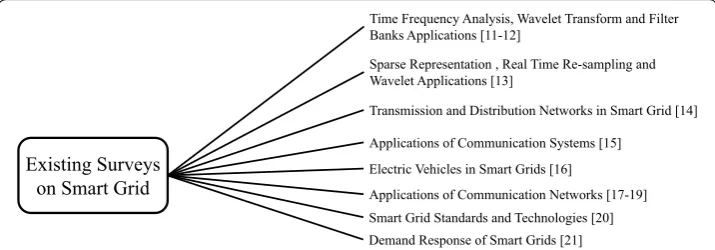
In the literature, different surveys are performed. In [12, 13], the authors discussed the applications of time frequency analysis, wavelet packet transform and the filter banks in the future smart grids. In [14], a short survey of some advance signal processing tech-niques used in smart grids are presented. These techtech-niques include sparse representa-tion, real time re-sampling, and the wavelet applications. Technological advancements of the transmission and distribution networks in smart grid are discussed in [15]. The survey presented in [16] gives an analysis of the applications of communication tech-nologies and their requirement in smart grids. In [17], the authors reviewed the issues of electric vehicle while implementing the smart grids. The applications and characteristics of the communication networks [18] and the communication infrastructures are sur-veyed for smart grids in [19]. Review on the security threats in communication networks is presented in [20]. The smart grid technologies and standards are reviewed in [21]. The demand response of the smart grids is reviewed in [22]. These surveys are summarized in Fig. 1.
Existing Surveys on Smart Grid
Time Frequency Analysis, Wavelet Transform and Filter Banks Applications [11-12]
Sparse Representation , Real Time Re-sampling and Wavelet Applications [13]
Transmission and Distribution Networks in Smart Grid [14]
Applications of Communication Systems [15] Electric Vehicles in Smart Grids [16]
Case studies and service scenario
The smart grid has numerous advantages as well as technological challenges concerning its practical implementation. Throughout the world researchers contributed to the smart grid challenges. Due to the availability of modern technological tools and contributions of researchers toward smart grid, practical implementation of this grid becomes pos-sible. The signal processing techniques contributed much more toward implementation of this grid. Challenges like security, communication, and control are outstripped with various signal processing techniques. Furthermore, smart grid is a complex system that incorporates a variety of other systems like communication system, power system, sta-bility analysis, load management system, and the interconnected systems. The analysis of these systems and detection of certain conditions is a burdensome task in such a chal-lenging scenario. Advance signal processing techniques are required to perform this job. Some advance signal processing techniques reported in the literature and used to over-whelm the smart grid challenges are time frequency analysis, wavelet transforms, filter banks, sparse signal processing, and real time re-sampling. The time frequency analy-sis and the wavelet transforms are used to overcome the limitation of the Fast Fourier transform (FFT) i.e., the time frequency analysis and the wavelet transform are more efficient than the FFT. They are also applicable in case of non-stationary scenario where within the window the data are assumed stationary. Moreover, the filter banks are used to improve the efficiency of the DSP system. Sparse signal processing and real time re-sampling are also used to process the data for various tasks in the smart grid scenario. All these signal processing techniques are surveyed in [12–14]. In addition to this, vari-ous advancements of the transmission and distribution networks are surveyed in [15]. The applications of communication technologies and their requirements in the smart grid scenario are discussed in [16]. Furthermore, communication networks also play a vital role in the implementation of the smart grid. Various communication networks and their infrastructures are surveyed in [19] in the smart grid scenario. Security of the com-munication networks is also a challenging issue in the smart grid scenario. Numerous techniques are presented in the literature regarding the security of the smart grid which are summarized in [20]. Due to the complex nature of the smart grid various technolo-gies are used in the development of the smart grid and various standards are defined which are discussed in detail in [22].
Motivation and contribution
transient conditions associated with the presence of high frequency harmonics and other disturbances. Finally, the complexity of the future smart grid will require not only advanced signal processing that can identify specific parameters, but also intelligent methods for identifying particular patterns of behavior.
Several reviews published in recent years addressed limited signal processing algo-rithms [12–14]. Therefore a thorough and detailed review of the applications of signal processing techniques in smart grids will be beneficial for the research community. In this paper, we concentrated on different areas of the smart grid where various signal pro-cessing techniques are used. These areas mainly include the smart metering, vehicular transportation, power quality, fault diagnosis, and modern instrumentation and control. Main contributions of this paper are listed below:
• This paper highlights the importance of signal processing techniques in smart grids due to their large number of applications.
• The smart grid technologies and implementation issues are discussed while imple-menting signal processing techniques.
• The applications and limitations of the important signal processing tools in power system analysis are reviewed.
• Future research directions regarding the signal processing applications in smart grid are proposed.
Remaining paper is organized into five sections. "The smart grids" section gives an over-view of the smart grid concepts. Reover-view of the signal processing applications in smart grid is given in "Signal processing applications in smart grids" section. The challenges and limitations of the signal processing techniques in smart grid are analyzed in "Role of signal processing in overcoming the challenges andlimitations of smart grids" section. Future research directions are discussed in "Discussion" section and, finally a conclusion is given in "Conclusion" section. Moreover, the list of abbreviations used in this article is illustrated in the end of the article.
The smart grids
The main characteristics of the existing electric grid are one way energy flow to con-sumers, mostly centralized energy production, few communication nodes, limited automation and utilities usually, only have monthly contact with customers. The smart grid is quite a new concept introduced in the late 1990 with the first basic practical sys-tem introduced in the early 2000. The smart grid is an electric power grid that employs information technology and signal processing techniques to constantly optimize elec-trical power generation, delivery and consumption [23]. The smart grid is a power grid equipped with numerous sensors that are connected through advance communication and data acquisition systems. The functionalities of theses sensors become possible with the latest information technologies and signal processing techniques [24] as shown in Fig. 2.
has enabled operators of industrial, commercial, municipal buildings as well as home-owners to take part in greening the grid. All these factors together positively affects the economy [25]. Although in the existing grid, power is generated and distributed by the utility companies with very less interaction with the consumers. However, the modern grid is still largely based on the existing grid [26, 27]. Some of the other benefits of the smart grid are summarized in Fig. 3.
A smart grid is not a single upgrade to the electric transmission and distribution but a complete overhaul with twenty-first century infrastructure, metering and communica-tion technologies. Each part of the smart grid brings its own system and societal benefits with the goal of improving electricity delivery and utility [28].
Fig. 2 Smart grid architecture highlighting communication, control and signal processing
Smart Grid
Energy Efficiency
Electricity Consumption
Consumer Friendly Bi-directionalNature
Reducing Losses
Integrating Renewable Generation
Smart Metering
Smart Appliances
Controlling Usage Showing Cost/Day Connection of Private
Generation to the Grid
Signal processing applications in smart grids
In power systems signal processing provides the best characterization and analysis of the signals to be investigated. Secondly, it determines which parameters should be measured and to what level of accuracy. In addition to this, the time invariant analysis of the smart grid requires signal processing techniques comprises of digital filters, moving average, trapezoidal integration and special digital systems such as the estimation of the differen-tiator, time-domain harmonic distortions and the notch filters. Although the smart grid context will introduce many time varying variables in the behavior of the electric power network, the utilization of classical linear and time invariant systems will continue to be the main tool to analyze and design signal processing algorithms for the future smart grid. Current smart grids demand more signal processing techniques for electri-cal parameters to keep the network under control and operating at the desired quality. Furthermore, analytical tools are required for the state estimation of system parameters due to the uncertainty and non-feasibility of monitoring system parameters at various locations. This makes the estimation and further processing of electrical power system parameters an essential feature of the power system analysis [29].
Power frequency is an important parameter in a power system that is determined using spectrum estimation or spectral analysis. The applications of spectral analysis in power systems can be found in power quality analysis, protection and control. Previ-ously, spectral analysis was used to estimate the harmonic component of a stationary signal. However, spectrum analysis of non-stationary signals with a time-varying fre-quency and inter-harmonics is the current focus of researchers [12].
Signals in electrical power system are time and frequency dependent. Frequency domain analysis is used to extract features and information for possible transient con-ditions. These transient conditions are associated with the presence of high frequency harmonics and other disturbances. As the electric smart grid of the future becomes more complex in terms of the variability of loads and generation, growth in response to market incentives and utilization of power electronics for energy processing is required. Therefore, electrical signals will require a broader set of tools and methods for signal processing. The basic bridge between time and frequency domains is the Fourier trans-form (FT). The FT is not the best tool to analyze power system signals because power system signals are non-stationary signals but FT assumes that the signals under analysis are stationary. In order to overcome this limitation, alternative methods have been pro-posed such as the short-time Fourier transform (STFT), wavelets and filter banks. These techniques are commonly known as joint time-frequency analysis [13].
All of these are creating the complex smart grid of the future where pattern recognition is an important enabling tool for operation and control [14].
Recent advances of the signal processing techniques in smart grids
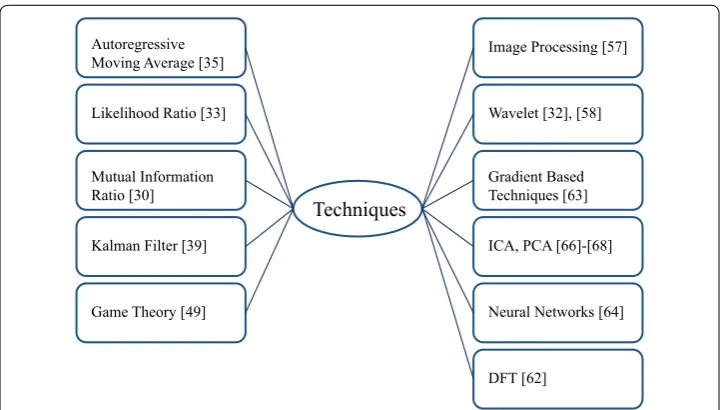
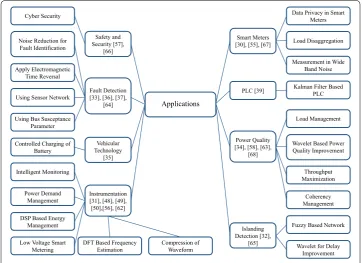
A smart grid is the combination of various advanced sensing nodes, control devices and modern communication systems that make the smart grid a very complex system. Due to the increased complexity fault localization is necessary. In [30], a fault detection tech-nique is developed utilizing the change in bus susceptance parameters of the smart grids. This technique is based on least square and generalized likelihood ratio. In [31], the fault localization problem is analyzed in the power networks by using the electromagnetic time reversal technique. In addition to this, a sensor network based algorithm is pro-posed for fault localization in smart grids [32]. This technique is based on the minimum measurement error criteria. Moreover, ensemble empirical mode decomposition (EMD) and Hilbert Huang transform are used for noise reduction and fault identification in the smart grid scenario [33]. Applications of the signal processing techniques in smart grids are illustrated in Fig. 4.
Smart metering is one of the important component of the future smart grid. In [34], the authors discussed the smart meter privacy issues by suing mutual information rate and the Bahl Cocke Jelinek Raviv algorithm. In [35], the independent component analy-sis technique in combination with principle component analyanaly-sis technique is used for data recovery from various smart meters in the presence of wide band noise. Using the concept of enhanced event driven metering, the collection of information in low voltage systems for the smart metering is addressed in [36]. In addition, the smart grid safety and security issues are discussed in [37] and [38] by using various signal processing tech-niques. In [37], image processing techniques are introduced for the safety of dams and smart grids. The cyber security issues of the bad data injection are discussed in [38], where the authors proposed the independent component analysis technique to handle
Techniques
Image Processing [57]
Wavelet [32], [58]
Gradient Based Techniques [63]
ICA, PCA [66]-[68]
Neural Networks [64]
DFT [62] Autoregressive
Moving Average [35]
Likelihood Ratio [33]
Mutual Information Ratio [30]
Kalman Filter [39]
Game Theory [49]
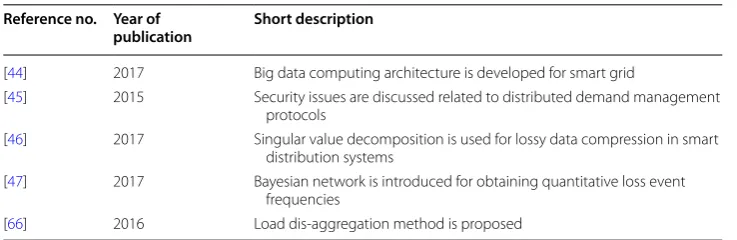
the situation. Furthermore, the state estimation of smart grid is discussed in [39]. The authors used Kalman filter based approach to resolve the synchronization problem in phase measurement units while using large scale deployment. The authors of [40] pro-posed a system that can generate any arbitrary pricing signal. The propro-posed system is able to detect the correct pricing signal and protect any attack against pricing. In [41], a method based on short term state forecasting is proposed that is able to detect false data injection in smart grids. A new routing protocol is presented in [42] for smart grid applications. In [43], instruction detection system is developed for smart grids. The pro-posed system fulfills real time communication requirements with the available limited resources in the smart grid scenario. Moreover, the authors in [44] suggested big data computing architecture for the smart grid. The proposed technique consists of com-munication architecture for enabling big data aware comcom-munication for smart grid. Furthermore, in [45] some security issues are discussed related to distributed demand management protocols and proposed a protocol that is able to share information among users providing privacy and confidentiality. In [45], the authors also proposed a protocol that can identify untruthful users in the network. Singular value decomposition (SVD) based method is developed in [46] for lossy data compression in smart distribution sys-tems. The developed method reduces computational burden over communication net-works. In [47], a Bayesian network is introduced for obtaining quantitative loss event frequency results of high granularity using traceable and repeatable process. This pro-posed technique differentiates the most effective part of a certain threat that is useful for plan countermeasures in a better way. Moreover, the false data injection issues are discussed in [41]. Short term state forecasting in combination with temporal correlation is used to detect such attacks.
The authors introduced auto regressive moving average technique for controlled charging of electrical vehicles [48]. Moreover, [49] utilizes wavelet transform for island-ing detection and improvisland-ing islandisland-ing delay. The islandisland-ing detection problem is also addressed in [50], where authors used fuzzy neural networks for islanding detection. Optimization of mobile networks in smart grids is discussed in [51]. The proposed sys-tem generate green energy in individual base stations and the base stations can share these energies to reduce the power consumption from the grid. A technique is devel-oped in [52] for efficient energy storage systems in the smart grid scenario. The devel-oped technique is probabilistic that is able to determine the optimal operation at each load state. A load side frequency control mechanism is developed in [53] which is able to keep the grid within operational limits. The proposed technique re-adjust the supply and demand after disturbances and also restore the frequency to its desired value. In [54], the developed technique can self repair the smart grid. This technique builds coor-dination for smart transformer that runs in three healing modes and performs collective decision making of the phase angles in the lines of a transmission system to improve reli-ability under disruptive events.
signal processing for power quality improvements in smart grids. This article addressed the demand response management and load forecasting for better power quality of smart grid. Moreover, the downlink throughput maximization of the smart meters in smart grid is discussed in [57] by using the stochastic sub-gradient approach for qual-ity improvement of the smart grid. In [58], the independent component analysis (ICA) technique is utilized to overcome the coherency problem in different power systems connected together to improve the power quality of the smart grid. Figure 5 contains information regarding the signal processing in smart grid technologies. A transformer-less active filter based technique is developed in [59] to improve the power quality of a single phase household. In [60], the effects of some advance technologies on power qual-ity are discussed in the smart grid scenario. The technologies considered are microgrids, voltage controllers, feeder configurations, and demand side management. Study regard-ing investment in renewable energy by a household is performed in [61]. The possibility of providing electric power to grid is analyzed that can be performed by net metering. Secondly, the authors discussed the issues regarding the smart meters installation.
Modern smart grid requires intelligent instrumentation techniques to overcome its various challenges. Smart grid also need efficient and smart algorithms for communi-cation and information sharing. In [62], a new signal processing technique is proposed for intelligent monitoring of smart grid. A compression technique which is an essen-tial part of all types of data storage and communications is developed for the smart grid waveforms [63]. Furthermore, game theory based approach is presented for home power demand management in [64]. In [65], a signal processing based energy management in coordinated multipoint system is proposed for the smart grids. A newly developed signal processing based method of load disaggregation is proposed in [66]. Moreover, a
Applications
Smart Meters [30], [55], [67]
Data Privacy in Smart Meters
Load Disaggregation
Measurement in Wide Band Noise
Kalman Filter Based PLC PLC [39]
Power Quality [34], [58], [63],
[68]
Wavelet Based Power Quality Improvement Load Management Throughput Maximization Coherency Management Islanding Detection [32], [65]
Fuzzy Based Network
Wavelet for Delay Improvement Safety and Security [57], [66] Cyber Security Fault Detection [33], [36], [37],
[64] Noise Reduction for
Fault Identification
Apply Electromagnetic Time Reversal
Using Sensor Network
Using Bus Susceptance Parameter
Vehicular Technology
[35] Controlled Charging of
Battery
Instrumentation [31], [48], [49], [50],[56], [62] Intelligent Monitoring
Power Demand Management
DSP Based Energy Management
Low Voltage Smart
Metering DFT Based Frequency Estimation Compression of Waveform
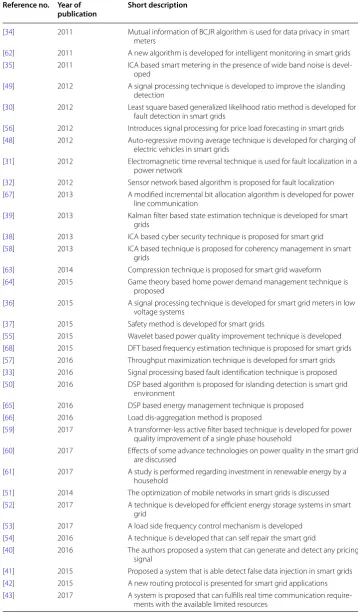
recursive discrete Fourier transform (RDFT) algorithm is developed to estimate instan-taneous frequencies in smart grids. In references [69, 70], the authors presented the con-cept of a modern smart home and the inclusion of renewable energy with the smart grid scenario to reduce the electric bills accordingly. A global overview of the applications of signal processing techniques in smart grids is given in Table 1.
Role of signal processing in overcoming the challenges and limitations of smart grids
A smart grid is not a single technology but an integration of important technologies like instrumentation, control, signal processing, and wireless communication, etc. Advance signal processing techniques are required for secure and efficient communication in future smart grid. In this regard, the challenges and limitations of the signal processing techniques are summarized as follows:
• Efficient processing: Efficient signal processing is a major issue in the development of the future grid due to the interconnection of various technologies and diverse nature of the smart grid.
• Secure communication: Security is a major challenge in the next generation power grid. Advance signal processing techniques should be developed to ensure security of information.
• Large number of sensor nodes: Sensor networks are suggested to be used in future smart grids. Due to the presence of large number of sensor nodes in smart grid, the existing signal processing techniques are unable to produce quality results.
• Fast and accurate processing: Diverse nature of the future power grid limits the speed and accuracy of the existing signal processing techniques that is why more accurate and fast signal processing techniques should be developed.
• Time varying scenario: One of the most challenging aspects of the future grid is its varying nature due to varying loads and the wireless channel condition.
• In case of fault alternative techniques: In case of failure some alternate signal pro-cessing techniques should be developed to overcome the situation in case of occur-rence of failure of the existing algorithm.
• Signal processing in noisy area: Due to the presence of large amplitude noise, it is difficult for existing signal processing techniques to process the noisy data in smart power grid with acceptable signal quality.
Discussion
Table 1 A global overview of the signal processing techniques in smart grids
Reference no. Year of
publication Short description
[34] 2011 Mutual information of BCJR algorithm is used for data privacy in smart meters
[62] 2011 A new algorithm is developed for intelligent monitoring in smart grids [35] 2011 ICA based smart metering in the presence of wide band noise is
devel-oped
[49] 2012 A signal processing technique is developed to improve the islanding detection
[30] 2012 Least square based generalized likelihood ratio method is developed for fault detection in smart grids
[56] 2012 Introduces signal processing for price load forecasting in smart grids [48] 2012 Auto-regressive moving average technique is developed for charging of
electric vehicles in smart grids
[31] 2012 Electromagnetic time reversal technique is used for fault localization in a power network
[32] 2012 Sensor network based algorithm is proposed for fault localization [67] 2013 A modified incremental bit allocation algorithm is developed for power
line communication
[39] 2013 Kalman filter based state estimation technique is developed for smart grids
[38] 2013 ICA based cyber security technique is proposed for smart grid [58] 2013 ICA based technique is proposed for coherency management in smart
grids
[63] 2014 Compression technique is proposed for smart grid waveform [64] 2015 Game theory based home power demand management technique is
proposed
[36] 2015 A signal processing technique is developed for smart grid meters in low voltage systems
[37] 2015 Safety method is developed for smart grids
[55] 2015 Wavelet based power quality improvement technique is developed [68] 2015 DFT based frequency estimation technique is proposed for smart grids [57] 2016 Throughput maximization technique is developed for smart grids [33] 2016 Signal processing based fault identification technique is proposed [50] 2016 DSP based algorithm is proposed for islanding detection is smart grid
environment
[65] 2016 DSP based energy management technique is proposed [66] 2016 Load dis-aggregation method is proposed
[59] 2017 A transformer-less active filter based technique is developed for power quality improvement of a single phase household
[60] 2017 Effects of some advance technologies on power quality in the smart grid are discussed
[61] 2017 A study is performed regarding investment in renewable energy by a household
[51] 2014 The optimization of mobile networks in smart grids is discussed [52] 2017 A technique is developed for efficient energy storage systems in smart
grid
[53] 2017 A load side frequency control mechanism is developed [54] 2016 A technique is developed that can self repair the smart grid
[40] 2016 The authors proposed a system that can generate and detect any pricing signal
[41] 2015 Proposed a system that is able detect false data injection in smart grids [42] 2015 A new routing protocol is presented for smart grid applications [43] 2017 A system is proposed that can fulfills real time communication
implementing signal processing techniques. Thirdly, the applications and limitations of the important signal processing tools in power system analysis are reviewed. Finally, future research directions regarding the signal processing applications in smart grid are proposed which are given below:
• Independent component analysis (ICA) is used in smart grid [48, 55] but, the per-formance of the existing ICA algorithms is not reliable in case of highly time varying scenarios. One can develop algorithms to efficiently handle large variations in the wireless channel. Secondly, most of the current employed ICA algorithms assumed a noise free environment while processing the mixed signals for un-mixing. Due to the presence of large amplitude noise in smart grid, the existing ICA algorithms should be modified to perform well in noisy scenarios.
• For efficient communication in smart grid, [55] proposed wireless sensor networks and cognitive radio networks. One can combine the two techniques in a single framework called the cognitive radio sensor networks (CRSN) to improve the per-formance of smart grid.
• Large amount of sensor nodes are required in smart grid while utilizing the wire-less sensor networks. New algorithms are demanded to handle the resultant large amount of information in smart grid.
• Due to the existence of large amplitude noise in the power grid, the existing rithms are unable to produce better results. Sophisticated signal processing algo-rithms must be developed to handle the noise intense environment of smart grid.
Conclusion
Smart grid is one of the important technological advancement for the efficient utiliza-tion of electrical energy. This efficient utilizautiliza-tion not only conserves electrical energy but also reduces the tariff enabling smart grid friendly towards the utility companies as well as consumers. In this research work a thorough review of signal processing techniques in smart grids is presented. Recent advances of the smart grids are also reviewed fol-lowed by suggestions for further improvement and future research direction. It is hoped that this paper would provide a solid base for research in the field of applications of sig-nal processing techniques in smart grids.
Table 1 continued
Reference no. Year of
publication Short description
[44] 2017 Big data computing architecture is developed for smart grid
[45] 2015 Security issues are discussed related to distributed demand management protocols
[46] 2017 Singular value decomposition is used for lossy data compression in smart distribution systems
[47] 2017 Bayesian network is introduced for obtaining quantitative loss event frequencies
Abbreviations
FFT: fast Fourier transform; EMD: empirical mode decomposition; SNR: signal-to-noise ratios; FT: Fourier transform; STFT: short-time Fourier transform; CRN: cognitive radio network; ICA: independent component analysis; GERI: Gachon Energy Research Institute; DR: demand response; OFDM: orthogonal frequency division multiplexing; TQOS: trustworthiness-based quality of service; CPT: conservative power theory; PEVs: plug-in electric vehicles; SFCL: super-conducting fault current limiters; TCI: thyristor controlled impedance; CNSPG: cooperative network of smart power grids; PQ: power quality; CPES: cyber physical energy systems; SCADA: supervisory control and data acquisition; WSN: wireless sensor network; RTDS: real time digital simulator; AGC: automatic generation control; DMS: distribution management system; OPF: optimal power flow; IEDs: intelligent electronic devices; ICT: information and telecommunication technologies; DSM: demand side management; PEA: provincial electricity authority; FCC: fault current controller; DOE: Department of Energy; US: United States; CRSN: cognitive radio sensor networks.
Authors’ contributions
ZU collected, reviewed and classified main literature for the paper. AA identified the challenges of signal processing techniques in smart grid. AQ drafted the smart grid related part of the manuscript. MA identified future research direc-tions. All authors read and approved the final manuscript.
Competing interests
The authors declare that they have no competing interests.
Ethics approval and consent to participate Not applicable.
Publisher’s Note
Springer Nature remains neutral with regard to jurisdictional claims in published maps and institutional affiliations.
Received: 7 September 2017 Accepted: 2 January 2018
References
1. Jiang Z, Li F, Qiao W, Sun H, Wan H, Wang J, Zhang P (2009) A vision of smart transmission grids. In: IEEE power & energy society general meeting, 2009, PES’09. IEEE, New Jersey pp 1–10
2. Masoum MA, Moses PS, Deilami S (2010) Load management in smart grids considering harmonic distortion and transformer derating. In: IEEE innovative smart grid technologies (ISGT), 2010, pp 1–7
3. Dong X, Lin H, Tan R, Iyer RK, Kalbarczyk Z (2015) Software-defined networking for smart grid resilience: opportuni-ties and challenges. In: Proceedings of the 1st ACM workshop on cyber-physical system security. ACM, New York, pp 61–68
4. Lugmaier A, Fechner H, Pruggler W (2008) National technology platform-smart grids austria
5. Lu W, Zhang D (2009) Research of enterprise application integration base on service oriented architecture. In: Inter-national conference on Computational intelligence and software engineering. CiSE 2009. IEEE, New Jersey, pp 1–9 6. Johnson AP (2010) The history of the smart grid evolution at southern california edison. In: Innovative smart grid
technologies (ISGT), 2010. IEEE, New Jersey, pp 1–3
7. Lee J, Jung D-K, Kim Y, Lee Y-W, Kim Y-M (2010) Smart grid solutions, services, and business models focused on telco. In: Network operations and management symposium workshops (NOMS Wksps), 2010 IEEE/IFIP. IEEE, New Jersey, pp 323–326
8. Li F, Qiao W, Sun H, Wan H, Wang J, Xia Y, Xu Z, Zhang P (2010) Smart transmission grid: vision and framework. IEEE Tans Smart Grid 1(2):168–177
9. Ahmad A, Hassan NU (2016) Smart grid as a solution for renewable and efficient energy. Advances in environmental engineering and green technologies (AEEGT) book series. IGI Global, Hershey. https://doi.org/10.4018/978-1-5225-0072-8. https://www.igi-global.com/book/smart-grid-solution-renewable-efficient/142123
10. Rietveld G, Braun J, Wright P, Grottker U (2010) Metrology for smart electrical grids. In: Conference on precision electromagnetic measurements (CPEM), 2010. IEEE, New Jersey, pp 529–530
11. Hauttekeete L, Stragier J, Haerick W, De Marez L (2010) Smart, smarter, smartest the consumer meets the smart electrical grid. In: 9th conference on telecommunications internet and media techno economics (CTTE), 2010. IEEE, New Jersey, pp 1–6
12. Carvalho T, Duque C, Silveira P, Mendes M, Ribeiro P (2012) Review of signal processing techniques for time-varying harmonic decomposition. In: Power and energy society general meeting, 2012. IEEE, New Jersey, pp 1–6 13. Carvalho T, Duque C, Silveira P, Ribeiro P (2013) Considerations on signal processing for power systems in the
con-text of smart grids. In: Power and energy society general meeting (PES), 2013. IEEE, New Jersey, pp 1–5 14. Silva LRM, Duque CA, Ribeiro PF (2015) Recent developments on signal processing for smart grids. In: Power &
energy society general meeting, 2015. IEEE, nwe Jersey, pp 1–5
15. Hamidi V, Smith KS, Wilson RC (2010) Smart grid technology review within the transmission and distribution sector. In: Innovative smart grid technologies conference Europe (ISGT Europe), 2010, IEEE PES. IEEE, New Jersey, pp 1–8 16. Gungor VC, Sahin D, Kocak T, Ergut S, Buccella C, Cecati C, Hancke GP (2013) A survey on smart grid potential
17. Richardson DB (2013) Electric vehicles and the electric grid: a review of modeling approaches, impacts, and renew-able energy integration. Renew Sustain Energy Rev 19:247–254
18. Khan RH, Khan JY (2013) A comprehensive review of the application characteristics and traffic requirements of a smart grid communications network. Compu Netw 57(3):825–845
19. Yan Y, Qian Y, Sharif H, Tipper D (2013) A survey on smart grid communication infrastructures: motivations, require-ments and challenges. IEEE Commun Surv Tutor 15(1):5–20
20. Lu Z, Lu X, Wang W, Wang C (2010) Review and evaluation of security threats on the communication networks in the smart grid. In: Military communications conference, 2010-MILCOM. IEEE, New Jersey, pp 1830–1835 21. Gungor VC, Sahin D, Kocak T, Ergut S, Buccella C, Cecati C, Hancke GP (2011) Smart grid technologies:
communica-tion technologies and standards. IEEE Trans Ind inform 7(4):529–539
22. Balijepalli VM, Pradhan V, Khaparde S, Shereef R (2011) Review of demand response under smart grid paradigm. In: Innovative smart grid technologies-India (ISGT India), 2011 IEEE PES. IEEE, New Jersey, pp 236–243
23. Bouffard F (2010) The challenge with building a business case for smart grids. In: Power and energy society general meeting, 2010. IEEE, New Jersey, pp 1–3
24. Meenual T (2010) Roadmapping the pea smart grids. In: Proceedings of the international conference on Energy and sustainable development: issues and strategies (ESD), 2010. IEEE, New Jersey, pp 1–6
25. Tenti P, Paredes HKM, Marafão FP, Mattavelli P (2010) Accountability and revenue metering in smart micro-grids. In: IEEE International workshop on applied measurements for power systems (AMPS), 2010. IEEE, New Jersey, pp 74–79 26. Deconinck G, Labeeuw W, Vandael S, Beitollahi H, De Craemer K, Duan R, Qui Z, Ramaswamy PC, Meerssche BV,
Vervenne I, et al (2010) Communication overlays and agents for dependable smart power grids. In: 5th international conference on critical infrastructure (CRIS), 2010. IEEE, New Jersey, pp 1–7
27. Stragier J, Hauttekeete L, De Marez L (2010) Introducing smart grids in residential contexts: Consumers’ perception of smart household appliances. In: IEEE conference on innovative technologies for an efficient and reliable electric-ity supply (CITRES), 2010. IEEE, New Jersey, pp 135–142
28. Budka K, Deshpande J, Hobby J, Kim Y-J, Kolesnikov V, Lee W, Reddington T, Thottan M, White CA, Choi J-I, et al (2010) Geri-bell labs smart grid research focus: economic modeling, networking, and security & privacy. In: 1st IEEE international conference on smart grid communications (SmartGridComm), 2010. IEEE, New Jersey, pp 208–213 29. Ribeiro PF, Ribeiro PM, Cerqueira AS, Ribeiro PF, Duque CA, Ribeiro PM, Cerqueira AS (2013) Power systems signal
processing for smart grids. Wiley, New York
30. Wei C, Wiesel A, Blum RS (2012) Change detection in smart grids using errors in variables models. In: 7th sensor array and multichannel signal processing workshop (SAM), 2012. IEEE, New Jersey, pp 17–20
31. Manesh H, Lugrin G, Razzaghi R, Romero C, Paolone M, Rachidi F (2012) A new method to locate faults in power networks based on electromagnetic time reversal. In: 13th international workshop on signal processing advances in wireless communications (SPAWC), 2012. IEEE, New Jersey, pp 469–474
32. Korkali M, Abur A (2012) Optimal sensor deployment for fault-tolerant smart grids. In: 13th international workshop on signal processing advances in wireless communications (SPAWC), 2012. IEEE, New Jersey, pp 520–524
33. Yalcin T, Ozdemir M (2016) Noise cancellation and feature generation of voltage disturbance for identification smart grid faults. In: 16th international conference on environment and electrical engineering (EEEIC), 2016. IEEE, New Jersey, pp 1–6
34. Varodayan D, Khisti A (2011) Smart meter privacy using a rechargeable battery: minimizing the rate of information leakage. In: International conference on acoustics, speech and signal processing (ICASSP), 2011. IEEE, New Jersey, pp 1932–1935
35. Qiu RC, Hu Z, Chen Z, Guo N, Ranganathan R, Hou S, Zheng G (2011) Cognitive radio network for the smart grid: experimental system architecture, control algorithms, security, and microgrid testbed. IEEE Trans Smart Grid 2(4):724–740
36. Simonov M, Li H, Chicco G (2015) Gathering process data in low-voltage systems by enhanced event-driven meter-ing. IEEE Syst J 11:1755–1766
37. de Oliveira AL, Magrini LC, Kim HY, Carneiro E, Pínfari J (2015) Image processing as an integration tool between a dam safety system and smart grids. In: Innovative smart grid technologies Latin America (ISGT LATAM), 2015 IEEE PES. IEEE, New jersey, pp 650–654
38. Huang Y, Esmalifalak M, Nguyen H, Zheng R, Han Z, Li H, Song L (2013) Bad data injection in smart grid: attack and defense mechanisms. IEEE Commun Mag 51(1):27–33
39. Yang P, Tan Z, Wiesel A, Nehorai A (2013) State estimation with consideration of PMU phase mismatch for smart grids. In: Innovative smart grid technologies (ISGT), 2013 IEEE PES. IEEE, New Jersey, pp 1–6
40. Giraldo J, Cárdenas A, Quijano N (2017) Integrity attacks on real-time pricing in smart grids: impact and counter-measures. IEEE Trans Smart Grid 8(5):2249–2257. https://doi.org/10.1109/TSG.2017.2665654
41. Zhao J, Zhang G, La Scala M, Dong ZY, Chen C, Wang J (2017) Short-term state forecasting-aided method for detec-tion of smart grid general false data injecdetec-tion attacks. IEEE Trans Smart Grid 8(4):1580–1590
42. Yang Z, Ping S, Sun H, Aghvami A-H (2017) CRB-RPL: a receiver-based routing protocol for communications in cogni-tive radio enabled smart grid. IEEE Trans Veh Technol 66(7):5985–5994
43. Genge B, Haller P, Dumitru C-D, Enachescu C (2017) Designing optimal and resilient intrusion detection architec-tures for smart grids. IEEE Trans Smart Grid 8(5):2440–2451. https://doi.org/10.1109/TSG.2017.2665654
44. Wang K, Wang Y, Hu X, Sun Y, Deng D-J, Vinel A, Zhang Y (2017) Wireless big data computing in smart grid. IEEE Wirel Commun 24(2):58–64
45. Rahman MA, Manshaei MH, Al-Shaer E, Shehab M (2017) Secure and private data aggregation for energy consump-tion scheduling in smart grids. IEEE Trans Dependable SecureComput 14(2):221–234
46. de Souza JCS, Assis TML, Pal BC (2017) Data compression in smart distribution systems via singular value decompo-sition. IEEE Trans Smart Grid 8(1):275–284
international conference, SmartGIFT 2016, Liverpool, UK, May 19–20, 2016, Revised Selected Papers. Springer, Berlin, pp 43–51
48. Kwasinski A, Kwasinski A (2012) Signal processing in the electrification of vehicular transportation: techniques for electric and plug-in hybrid electric vehicles on the smart grid. IEEE Signal Process Mag 29(5):14–23
49. Vatani M, Sanjari M, Gharehpetian G, Noroozian M (2012) A new fast and reliable method for islanding detection based on transient signal. In: 2nd Iranian conference on smart grids (ICSG), 2012. IEEE, New Jersey, pp 1–4 50. Kermany SD, Joorabian M, Deilami S, Masoum MA (2016) Hybrid islanding detection in microgrid with multiple
con-nection points to smart grids using fuzzy-neural network. IEEE Trans Power Syst 32:2640–2651
51. Huang X, Han T, Ansari N (2017) Smart grid enabled mobile networks: Jointly optimizing BS operation and power distribution. In: IEEE/ACM transactions on networking. IEEE, New Jersey
52. Awad AS, El-Fouly TH, Salama MM (2017) Optimal ESS allocation for benefit maximization in distribution networks. IEEE Trans Smart Grid 8(4):1668–1678
53. Mallada E, Zhao C, Low S (2017) Optimal load-side control for frequency regulation in smart grids. IEEE Trans Autom Control 62:6294–6309
54. Pournaras E, Espejo-Uribe J (2017) Self-repairable smart grids via online coordination of smart transformers. IEEE Trans Ind Inform 13(4):1783–1793
55. Alshahrani S, Abbod M, Alamri B (2015) Detection and classification of power quality events based on wavelet trans-form and artificial neural networks for smart grids. In: Smart grid (SASG), 2015 Saudi Arabia. IEEE, New Jersey, pp 1–6 56. Chan S-C, Tsui KM, Wu H, Hou Y, Wu Y-C, Wu FF (2012) Load/price forecasting and managing demand response for
smart grids: methodologies and challenges. IEEE Signal Process Mag 29(5):68–85
57. Chen X, Chen T, Wang X, Giannakis GB (2016) Stochastic online control for smart-grid powered MIMO downlink transmissions. In: International conference on acoustics, speech and signal processing (ICASSP), 2016. IEEE, New Jersey, pp 3451–3455
58. Ariff M, Pal BC (2013) Coherency identification in interconnected power systeman independent component analysis approach. IEEE Trans Power Syst 28(2):1747–1755
59. Javadi A, Hamadi A, Ndtoungou A, Al-Haddad K (2017) Power quality enhancement of smart households using a multilevel-thseaf with a PR controller. IEEE Trans Smart Grid 8(1):465–474
60. Bollen MH, Das R, Djokic S, Ciufo P, Meyer J, Rönnberg SK, Zavodam F (2017) Power quality concerns in implement-ing smart distribution-grid applications. IEEE Trans Smart Grid 8(1):391–399
61. Dato P, Durmaz T, Pommeret A (2017) Smart grids and renewable electricity generation by households. Technical report, FAERE Working Paper
62. Gu IY, Bollen MH, Le CD (2011) Signal processing and classification tools for intelligent distributed monitoring and analysis of the smart grid. In: 2nd IEEE PES international conference and exhibition on innovative smart grid tech-nologies (ISGT Europe), 2011. IEEE, New Jersey, pp 1–7
63. Tcheou MP, Lovisolo L, Ribeiro MV, da Silva EA, Rodrigues MA, Romano JM, Diniz PS (2014) The compression of electric signal waveforms for smart grids: state of the art and future trends. IEEE Trans Smart Grid 5(1):291–302 64. Zhu Z, Lambotharan S, Chin WH, Fan Z (2015) A game theoretic optimization framework for home demand
man-agement incorporating local energy resources. IEEE Trans Ind Inform 11(2):353–362
65. Xu J, Zhang R (2016) Cooperative energy trading in comp systems powered by smart grids. IEEE Trans Veh Technol 65(4):2142–2153
66. Koutitas GC, Tassiulas L (2016) Low cost disaggregation of smart meter sensor data. IEEE Sens J 16(6):1665–1673 67. Noreen U, Baig S (2013) Modified incremental bit allocation algorithm for powerline communication in smart grids.
In: 1st international conference on communications, signal processing, and their applications (ICCSPA), 2013. IEEE, New Jersey, pp 1–6
68. Ykhlef F, Ykhlef H, Ykhlef F (2015) Frequency estimation of power systems in context of smart grids. In: 3rd interna-tional renewable and sustainable energy conference (IRSEC), 2015. IEEE, New Jersey, pp 1–5
69. Vanus J, Belesova J, Martinek R, Nedoma J, Fajkus M, Bilik P, Zidek J (2017) Monitoring of the daily living activities in smart home care. Human-centric computing and information sciences, vol 7. Springer, Berlin, p 30