Translated and revised from Zhongguo gongye jingji中国工业经济(China Industrial Economy), 2007, (4): 13–20
LIU Zhiyuan ()
School of Business, Nankai University, Tianjin 300071, China E-mail: [email protected]
LIU Qing
Department of Accounting, School of Business, Nankai University, Tianjin 300071, China E-mail: [email protected]
RESEARCH ARTICLE
LIU Zhiyuan, LIU Qing
Can group decision-making mitigate propensity of
escalating commitment
?
―
An experimental research based on the prospect theory
© Higher Education Press and Springer-Verlag 2008
Abstract Escalation of commitment is a well-known investment trap, which is irrational from an economic point of view but inevitable due to psychological factors. Based on a role-playing experiment, this paper intends to analyze the impact of different effects of the prospect theory on the tendency of escalating commitment in different decision-making processes, and discusses whether certain decision-making processes can mitigate the tendency of escalating commitment. Our empirical results indicate that groups with prior individual consideration can make better decisions involving effects of the prospect theory than individuals and groups.
Keywords escalation of commitment, group decision-making, prospect theory
关键词 恶性增资,集体决策,前景理论
1
Introduction
Previous research(Staw, 1976, 1981; Bazerman et al., 1984) has found that individuals who are responsible for a previous decision tend to make increasing commitment to the previously chosen course of action even when the outcome of the previous decision turned out to be negative. This tendency (or phenomenon) is referred to as escalation of commitment, a common entrapment of investment. In practice, managers frequently meet this kind of decision-making dilemma. A survey by Keil et al. (2000) showed that there exists escalation of commitment in 38% of foreign IT projects. And in China, 93% surveyed managers admit their companies escalate commitment to a certain extent, and 56% managers among them acknowledge this phenomenon exists widely(Chow et al., 2000). Escalation of commitment wastes numerous resources, and makes enterprises lose opportunity to develop.
help explain the different findings, generally within the group decision making literature, and specifically within our focal area of escalation (Moon et al., 2003). In some previous literatures, group members privately considered information about a problem and formed individual judgments before meeting as a group (e.g., Smith et al., 1998; Stasser, 1992; Whyte, 1993). In other studies, groups are exposed to problems for the first time as a group (Bazerman et al., 1984). Members in a no-prior-consideration-decision process enter a group discussion without any previous commitments or positions. Consequently, the dynamics of the group decision may be markedly different. Decisions on whether to abandon or continue a project are made solely within the group setting. Moon et al. (2003) were cognizant of this problem, and their study found that group decisions are affected in systematic ways depending on whether or not there was individual consideration of the problem before meeting as a group, but their topic focused on the incrementalism and adoption. Undistinguishing between with or without individual consideration makes these studies conclude differently to some extent to group decision-making in escalating commitment field. Further more, these findings were made in the western context, and most respondents attending experiments hold western culture. Numerous evidences indicate that different folks prefer different value and risk opinion about their jobs. Cultural factors may influence the applicability of the above findings of escalating commitment in China.
The remainder of the paper is organized as follows: In Section 2, we introduce a theoretical framework and propose hypotheses. We then present our experimental design and method in Section 3. The analysis of data and experimental results are reported in Section 4. Lastly, Section 5 provides concluding remarks.
2
Theory and hypotheses
group level of analysis. Whyte(1993) extended the theory to the group level in order to address the absence of a broadly applicable explanation for escalation at the group level of analysis. Main concepts used in prospect theory include sunk cost effect, framing effect, mental accounting, loss aversion, etc.
2.1 Sunk cost effect
Sunk cost is the cost that has been initially invested and cannot be redeemed from the loss. Studies have consistently demonstrated that decision makers often consider past expenditures when making current-utility-based decisions(Staw, 1997). In prospect theory, sunk cost is relevant only insofar as it influences the framing of decisions, and not enters into the computation to determine whether the benefits of a particular course of action exceed the costs. But the existence of a negative balance will result in the subsequent decision being framed as a choice between losses, just as the existence of a positive balance will tend to result in the subsequent decision being framed as a choice between gains(Whyte, 1986). Prospect theory implies that sunk costs are incurred in a losing course of action, and these costs still possess economic value in their original use or have yet to be fully depreciated, and subsequent decisions concerning whether to continue the initially chosen course of action are likely to be framed as a choice between losses(Whyte, 1993). If gives up, the manager will suffer certain losses, and if escalate, the manager may lose more but may retrieve prior cost. So when the prior investment fails, the impact of the sunk cost is such that decision-maker has propensity to behave, whether he is responsible for the initial investment’s failure or not, in a risk-seeking way to escalate the commitment, to avoid wasting invested resources(Arkes and Blumer, 1985). Therefore, we hypothesize that:
Hypothesis 1a Because of the impact of sunk cost, decision-makers will escalate their commitment to a failing projects.
Hypothesis 1b Because of the impact of sunk cost, escalating commitment will occur less often in group decisions with prior individual consideration than in individual decisions and group decisions without prior individual consideration.
2.2 Framing effect
Prospect theory suggests that escalation of commitment might occur due to framing of choices as gains or losses (Bazerman, 1984; Arkes and Blumer, 1985; Whyte, 1986). A decision frame is the decision-maker’s conception of the acts, outcomes, and contingencies associated with a particular decision (Tversky and Kahneman, 1981). The decision frame adopted is partially controlled by the positive and negative framing of the information used by the decision maker. Positive framing means the information is formulated in terms of its influence on the ability to achieve an event. Negative framing implies the information is described in terms of its influence on the ability not to achieve an event (Rutledge, 1995). It makes difference whether a decision is framed in terms of gains or losses, because people usually prefer risky options when choosing between losses but avoid risky options otherwise. A choice between losses refers to a choice between a certain loss on one hand, and potentially even greater losses combined with the chance of avoiding those losses on the other. Escalating commitment is the natural consequence of negatively framing a decision about the fate of an entire course of action, and will occur regardless of whether decision-maker is responsible for previous failing choices (Whyte, 1993).
Hypothesis 2a Under negative framing, decision-makers escalate commitment more often than under positive framing.
A single decision-maker will be constrained by his thinking frame when he makes decision by himself. A single decision frame will rarely be entirely adequate. Decision makers should be encouraged to frame decisions in many ways by using multiple points of reference(Whyte, 1997). Group has the capacity to view events using multiple frames, whether with or without prior individual decisions(Neale et al., 1986). Given the group’s awareness that individuals have (potentially) different positions, it is plausible that consensus might more frequently form around compromises, involving partial allocation of resources, to gain the support of members with different viewpoints. Compromise allows individuals with different frames or opinions of the problem to view the investment decision as supportive of their positions. Therefore, in addition to having difficulty abandoning losing propositions, we hypothesize that the nature of the decision-making process of group will lead to a low level of escalating commitment.
likely to escalate commitment to a failing project than group decision-makers, whether or not with prior individual consideration.
2.3 Mental accounting
Mental accounting is an economic concept established by Thaler in 1985, which contends that individual divides his current and future assets into separate, non-transferable portions. The concept has been used to describe how outcomes may be evaluated jointly (i.e., in the same mental account) or separately. For instance, Tversky and Kahneman(1981) explained their finding in this way that a large majority of experiment respondents chose not to replace a lost theater ticket while they chose to buy a ticket after just having lost the equivalent sum of money. It was suggested that they estimated the loss of a ticket and the price of a new ticket in the same mental account while the loss of money and the price of a ticket were evaluated separately.
The concept expands prospect theory and represents individuals assign different levels of utility to each asset group, which affects their consumption decisions and other behaviors. Rather than rationally viewing every dollar as identical, mental accounting helps explain why many investors treat some of their dollars as “safety” capital which they invest in low-risk investments, while at the same time designating their “risk capital” quite differently. Therefore, we hypothesize that:
Hypothesis 3a Because of the impact of mental-accounting, a decision-maker tends to continue a failing project rather than begin a new project under the same risk condition of gains and losses.
Individual decision-maker is easier to be potentially impacted by mental-accounting. But the members of group can communicate and comprehend sufficiently to deciding events, whether with or without prior individual decisions. Therefore, group decision-maker have more chances to avoid some decision entraps. Hypothesis 3b Because of the impact of mental-accounting, an individual decision-maker is more likely to escalate a failing project than group decision-makers, whether or not with prior individual consideration.
2.4 Loss aversion
losses are as much as twice as psychologically powerful as gains. Given loss aversion, decision-makers will be risk seeking, and will prefer to allocate additional resources in the hope of turning the situation around, rather than accept the sure loss if they were to stop allocating resources at that point. Investors are risk-eluding when they get the gain and are risk-pursuing when they face a loss.
Hypothesis 4a Under loss-aversion, decision-makers are more likely to escalate commitment.
The popularity of loss aversion is due to the fact that it can explain many phenomena which remain paradoxes in traditional choice theory. People typically exhibit greater sensitivity to losses than to equivalent gains when making decisions. Groups with prior individual consideration are more rational to analyze all aspects of being decided issue, which can mitigate the influence of temporary impulse to certain extent. A single decision-maker might be influenced by his emotion and make risky decision by impulsion. Under decision-making process by groups without prior consideration, group decision is easily influenced by emotional members’ feeling and inclined to their opinions due to lack of prior cognizance of members before gathering. Therefore, we hypothesize that:
Hypothesis 4b Under loss-aversion, escalating commitment may has less occurrence in group decisions with prior individual consideration than in individual decisions and decisions of group without prior individual consideration.
3
Research design
A majority of prior research about escalating commitment got the outcomes by experiments. Experiment study’s strongpoint is its repeatability, indicating that it can get required data for many times. Researchers can repeat some situation time after time through controlling main factors to get comparable data. They can give prominence to factors they want to study while simultaneously controlling other factors.
To test the above hypotheses, a laboratory experiment was conducted. The experiment used a 2×2×3 factorial design and varied sunk costs (low versus high), framing (negative versus positive), and decision-making process (individual only, group without prior individual decisions , or group with prior decisions).
3.1 Respondents
were students from the Business School of Nankai University, including juniors, undergraduate students of accounting and MPAcc. Respondents had an average of approximately 1.06 years full-time work experience1. Given the relevant work and educational experience of the respondents in the study, they were considered highly appropriate for the managerial/ investing task that was required of them. The average age of respondents was 23 years old.
Performing unit refers to the entity faced with the decision making task, and includes individuals and groups consisting of three members. And the order of presentation of the performing unit manipulation is the same for each group prior consideration: individual and then group. Consequently, performing unit is a two-level within-respondents factor. It is appropriate in laboratory studies comparing individual and group decision making to first request individuals to make a decision, and then assemble them into groups to make the identical decision(Myers and Lamm, 1976, 1977; Myers, 1982; Whyte, 1993). All groups are assigned freely based on positions where they sat in classroom.
3.2 Procedures
The experiments were conducted during class time in four different classes at Nankai University. A brief standardized introduction to the study was given. The experiments required individual respondents(or three-person groups) to assume the role of the “Financial Vice Presidents(or financial planning committee) of Ace R&D Company.” They should make an initial decision about whether to invest ¥10 million to No.1 R&D project(Condition A in our study), while a competitor has recently exhibited a similar (and in many respects, superior) product to the one being developed. The decision-makers considered: Option A, not invest the project; or Option B, invest an initial 10 million. If the company does not invest in the project, it certainly will not suffer any losses or achieve any gains. In contrast, if the invest is made, there is a 75% chance that a total loss of 10 million will be realized on the project and a 25% chance that a net gain(i.e., after deducting the ¥10 million investment) of ¥30 million will be realized on the project. Condition B: respondents should complete a case where ¥30 million had previously been invested in No. 2 project that(to date) produces no benefits, while a competitor has recently exhibited a similar(and in many respects, superior) product to the one being developed. Respondents have the option of withdrawing from or increasing ¥10 million the commitment of funds to the
original course of action. If the company does not invest further in the project, a ¥30 million loss on the project will be realized with certainty. In contrast, if the additional ¥10 million investment is made, there is 3/4 probability that a total loss of ¥40 million will be realized on the project and 1/4 probability that no net loss(i.e. , after deducting the ¥40 million total investment) will be realized on the project. Furthermore, our study described the condition B positively and asked the respondents to make the decision again. If not invest further, a ¥10 million loss on the project can be avoided. If invest additional ¥10 million, 1/4 probability that ¥40 million investment can be returned, and 3/4 probability cannot be returned. This is condition C. Under the above three conditions, the amounts and probabilities allow both choices (Option A and Option B) to have the same expected values.
Ace R&D Company will not be threatened by bankruptcy in the event that the fund is invested and no return is realized.
3.3 Data
The primary dependent variable is the choice whether to make the investment described. The choices are “Yes” and “No”. Under the experimental conditions B and C, a “Yes” response is tantamount to a decision to escalate commitment to a losing course of action. This variable measures the frequency with which the escalation option is preferred over the project abandonment option. We dichotomized the commitment measure into dummy variables, representing two opposite categories, with 0 indicating disinvestment or termination of the project and 1 indicating investment or continuation of the project. Under Condition C, some units chosen “Can not Decide”, we excluded these samples from analyses. Eliminating these respondents doesn’t influence the results. Most variables are dummy variables, which are not a normal distribution. We test these hypotheses with Nonparametric Test. The univariate tests for each dependent variable are to determine whether sunk cost, decision frame or decision-making process has significant effects, separately. In our study, we used SPSS 13.0 as the analysis tool.
4
Results
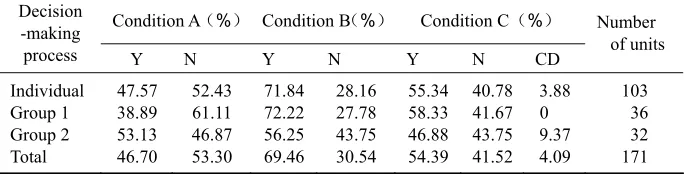
Table 1 Summary of results for investment decision under the three decision-making processes Condition A(%) Condition B(%) Condition C(%)
Decision -making
process Y N Y N Y N CD
Number of units Individual Group 1 Group 2 Total 47.57 38.89 53.13 46.70 52.43 61.11 46.87 53.30 71.84 72.22 56.25 69.46 28.16 27.78 43.75 30.54 55.34 58.33 46.88 54.39 40.78 41.67 43.75 41.52 3.88 0 9.37 4.09 103 36 32 171 Notes: Y indicates Yes, N means No, and CD means “Can’t Decide”. Group 1 means groups without prior individual consideration; Group 2 indicates groups with prior individual consideration.
Under Condition A(no sunk-cost, neutral framing), decision-maker should decide whether invest initially No. 1 R&D project. We found there was no evident risk-seeking trend among three decision-making processes, and group without prior individual consideration appeared strong risk aversion(only 38.89% of team made decision to invest). Under Condition B(sunk cost, negative framing),decision-maker should decide whether to increase ¥10 million investment to No. 2 project, which will make the invested ¥30 million sunk cost if choose to terminate the project. Under the condition, risk preference diverted evidently in individuals and groups without prior individual decision. 72.22% of “no prior individual decision” groups and 71.84% of individuals chose to escalate the commitment. The risk preference of groups with prior individual decision was consistent with the result under Condition A. 56.25% of “prior individual decision” groups chose to escalate the commitment, not significantly different from the 53.13% under condition A. Under Condition C (positive description of Condition B), which just changes the pattern of declaration, the frequency of escalations had a distinct shift. No matter with different decision-making processes or total samples, evident escalation of commitment appears under condition B, but positive description can moderate to certain extent. Generally speaking, the performance of “prior individual decision” groups is superior to the other two processes’ in this domain.
4.1 Sunk-cost effect
was significant, indicating that with sunk-cost decision-makers are more likely to fund the project than without sunk-cost. Hypothesis 1a was supported, and the result was consistent with Whyte(1993). Then we separately analyzed the decision-making of three decision-making processes under Condition A and B. And we found that sunk-cost effect was significant at 1% confidence level on individual decision-making and at 5% confidence level on “no prior individual decision” groups, but it had no significant impact on “prior individual decision” groups. So Hypothesis 1b was supported. The conclusion about the degree to which different decision-making processes escalate the commitment was basically consistent with the above results. Average amount of resources committed to a failing venture was ¥14.94 million to individual decision-maker, and the amount was ¥15 million to groups without prior individual decision. The amount was obviously smaller than the other two decision-making processes decided by groups with prior individual decision, which was only ¥13.13 million.
Table 2 Nonparametric tests of independent samples-sunk cost effect
Decision-making process Z Sig. Number of units Individual
Group 1 Group 2 Total
–2.897***
–2.595 ***
–0.144 17.113***
0.004 0.009 0.886 0.001
309 108 96 513
Notes:*** means significant at the two-tailed 1% confidence level,** means significant at the
two-tailed 5% confidence level,* means significant at the two-tailed 10% confidence level,
sic passim.
by others. And because every one knows the project well, they can communicate with each other very sufficiently and consider more comprehensively so that the final decision tends to be more conservative. Diversity of individual opinions(Jehn et al., 1999) has been advanced as benefiting the ultimate group decision.
4.2 Framing effect
The framing variable was manipulated to test the effect on three decision-making processes in escalation situations(Condition B and C). We performed nonparametric tests(McNemar) of two paired samples: the different investment decisions under Condition B(negative framing) and Condition C(positive framing). The statistical results are summarized in Table 3. The analysis indicates that decision frame had significant effect on frequency of escalation(χ2=10.473,
sig. =0.001). Actually, Condition B and C are the same project situation under different angles of description, which means the propensities and patterns of expression are very important for problems to be solved. Thus, Hypothesis 2a was supported. We next tested Hypothesis 2b, the difference was significant (χ2=5.939, sig. =0.015), indicating that individuals under Condition B are more likely to fund the project than individuals under Condition C, but decision frame had on significant effect on group decision-making whether with prior individual decision or not. This result supports our Hypothesis 2b. The conclusion we made is consistent with what was studied by Neale et al. (1986). They highlighted that group have the capacity to view events using multiple frames, thereby diluting the impact of one specific frame, then escalating commitment should occur less frequently in group than in individual decision making.
Table 3 Nonparametric tests of independent samples-Framing effect
Decision-making process χ2 Sig. Number of units
Individual Group 1 Group 2 Total
5.939**
— — 10.473***
0.015 0.267 0.453 0.001
103 36 32 171
4.3 Mental accounting
two choices to invest into project No.1 or No.2, and results shown that decision to invest No.2 project was significantly higher than to No.1.34% samples chosen to invest in No.1(sig. =0.000), demonstrating the proportion of selecting to continue No.2 is significantly higher than that of selecting to begin No.1. A majority of samples preferred to continue an ongoing project than restart a new project, which means mental accounting had a significant effect and thus supported hypothesis 3a. Specifically, significant difference appeared in individual decision-making(30.56% chosen to invest in No.1 project, sig.=0.005) and group without prior individual decision(34.95% of this type samples decided to invest in No.1 project). Mental accounting apparently had impact under two decision-making processes. But the choice difference under decision-making by groups with pre-consideration was insignificant(34.38% for No.1 project,
sig. =0.110). Hypothesis 3b was partly supported.
4.4 Loss aversion
We then proceeded to inquire the respondents who selected to invest in No. 2 project, how the degree of reluctance about the loss of previous ¥30 million influenced the decision to invest in No.2 project. Answers indicated that decision-makers made increasing investment to No.2 because of the average 69.8% degree for reluctance to avoid the prior loss. We performed a Chi square Test and found loss aversion had significant effect, hypothesis 4a was supported. To further illustrate the influence from loss-aversion under three different decision-making processes, we examined the aforementioned decision-making results under different processes. The results showed the degree is 66.28% under individual decision-making process, 84.81% under group decision-making without prior decision, and 61.44% under group decision-making with prior consideration. Paired-sample test was unavailable due to different sample size under three processes, so we chosen Median test in Nonparametric Test for independent samples. Results showed that decision answers were significantly different among three decision-making processes(median=75%, χ2=10.353, sig.=0.006). We further tested the results under different decision-making processes by Chi-square Test, and found loss-aversion is evident under decision-making process by individuals and process by groups without consideration, but this effect is insignificant under groups with pre-consideration decision-making process. Hypothesis 4b is accepted.
4.5 Sensitivity analysis—Certainty effect
psychological principle which holds that a given decrease in the probability of an event will have the greatest impact when the event is initially considered inevitable, rather than merely possible(Kahneman and Tversky, 1979). When choices are made between gains, the certainty effect leads to risk aversion, since the attractiveness of positive gambles is diminished relative to sure things. The certainty effect promotes risk seeking in choices between losses by exaggerating the distastefulness of losses that are certain relative to those that are less sure(Whyte, 1986). Facing losses with certainty, accordingly, decision-makers have more propensities to escalate commitment than under uncertain situation. We designed relative problems in our questionnaire to examine the influence from certainty effect to examine the robustness of our results. We changed some details about condition B. If the company does not invest further in the project, a ¥30 million loss on the project will be realized in 3/4 probability, but there is 1/4 probability to break even. In contrast, if the additional ¥10 million investment was made, there is 9/16 probability that a total loss of ¥40 million will be realized on the project and 7/16 probability that no net loss will be realized on the project. Compared the answers with prior answers for Condition B by Paired-sample Test, we presented the results in Table 4 and 5. we found there is no evidence to certify that certainty effect significantly influence escalating decision-making, even though there is some impact (χ2=1.306, sig.=0.253). And certainty effect had no significant impact when testing the answers under Condition C(χ2=2.215, sig.=0.137).
Table 4 Summary results for decision to invest under three decision-making processes-
Certainty effect
Decision-making Condition B(%) Condition C(%) process Certainty Uncertainty Certainty Uncertainty
Number of units Individual Group 1 Group 2 Total 71.84 72.22 56.25 69.01 60.19 63.89 59.38 60.82 55.34 58.33 46.88 54.39 47.57 47.22 34.38 45.03 103 36 32 171
Table 5 Nonparametric tests of independent samples-Certainty effect under condition B Decision-making process χ2 Sig. Number of units
5
Conclusions and discussions
Based on a role-play experiment, this study documents the following results. First, sunk cost, framing, mental accounting, and loss aversion have significant effects on escalation of commitment decision, but certainty effect does not significantly increase the propensity to escalation. Second, group decision-making with prior individual consideration is superior to other two processes in escalation commitment field, under which decision-maker has less tendency to escalate. All effects we study in this paper except certainty effect significantly influence individual decision-making process. Under group decision-making without prior individual decision appears more escalating propensity impacted by sunk cost effect, mental accounting and loss aversion. But all these effects are insignificant under group decision-making process with prior individual consideration. Third, cultural difference between Western countries and China has marked influence on escalating tendency under group decision-making with pre-consideration. The Chinese are inclined to rely on majority rule in the absence of unanimity situation when every member is equal, and they do not show their individual opinion adequately in final group decision outcome. But Western decision-makers persevere in their original opinions more often than Chinese.
Some limitations of this paper are also discussed. Although respondents with working experiences are preferred choice, the experiment is a laboratory case. Real decision-makers have sufficient decision making experiences so their behavior may be inconsonant with our respondents when making decision. Furthermore, we focused on psychological impact based on prospect theory framework, whereas responsibility is a crucial factor in escalation situations. Since the manipulations had a significant effect in the experimental context in the absence of true personal responsibility, they might have dramatic effects in the context of personal responsibility in real-world organizational settings. Future research can extend to these and other areas.
Acknowledgements We would like to express our gratitude to Dr. Qingchuan Hou of the Hong Kong University of Science & Technology for his help in translating this paper. Kind supports from Prof. Baoyuan Zhou, Jianhua Zhang, Yujian Lu, and Dr. Yi Yao of Nankai University are also deeply appreciated. The second author is grateful to Dr. Mingzeng Yang, Jixiu Zhang and Yang Tang for their helpful suggestions. An earlier version of this paper had been discussed at the 2nd China Research Incubator Conference and the 5th International
Symposium on Empirical Accounting Research, separately sponsored by The Chinese University of Hong Kong and Peking University.
References
Arkes H,Blumer C(1985). The psychology of sunk costs. Organizational Behavior and Human Decision Processes, (35): 124–140
Bazerman M, et al.(1984). Escalation of commitment in individual and group decision making. Organizational Behavior and Human Performance, 33: 141–152
Chow C,Vidya N, Fleenor C(2000). Exploring the extensives, effects, and causes of remedies for escalation in Chinese business enterprises. China Accounting and Finance Review, 2(1): 21–33
Kahneman D, Tversky A(1979). Prospect theory: An analysis of decisions under risk. Econometrica, 47: 263–291
Kahneman D, Knetsch J, Thaler R(1991). The endowment effect, loss aversion, and status quo bias. Journal of Economic Perspectives, (5): 193–206
Liu Chao(2004). Theoretical framework and predict model of project escalation in capital budgeting. Dissertation of Nankai University (in Chinese): 1–148
Liu Zhiyuan, Liu Chao(2004). Interpretation of escalation of commitment based on an experiment research: Self-justification theory or prospect theory. China Accounting Review (in Chinese), 2(2): 249–258
Moon H, et al.(2003). Group decision process and incrementalism in organizational decision making. Organizational Behavior and Human Decision Processes, 92: 67–79
Neale M, Bazerman M, Northcraft, G, Alperson C( 1986). “Choice shift” effects in group decisions: A decision bias perspective. International Journal of Small Group Research, (3): 33–41
Schmidta U, Zankb H(2002). What is Loss Aversion? Working paper, 1–9
Staw B(1976). Knee-deep in the big muddy: A study of escalating commitment to a chosen course of action. Organizational Behavior and Human Performance, (16): 27–44
Tversky A, Kahneman D(1991). Loss aversion in riskless choice: A reference-dependent model. The Quarterly Journal of Economics, 106: 1039–1061
Tversky A, Kahneman D(1992). Advances in prospect theory: Cumulative representation under certainty. Journal of Risk and Uncertainty, (5): 297–323;
Whyte G(1986). Escalating commitment to a course of action: A reinterpretation. Academy of Management Review, 11(2): 311–321
Whyte G(1991). Decision failures: Why they occur and how to prevent them. Academy of Management Executive, 5(3): 23–31