RUSC VOL. 12 No 3 | Universitat Oberta de Catalunya and University of New England | Barcelona, July 2015
CC Renata Marciniak | CC by FUOC, 2015| Methodological proposal for the application of international benchmarking…
Recommended citation:
Marciniak, R. (2015). Methodological proposal for the application of international benchmarking in order to assess the quality of virtual higher education. RUSC. Universities and Knowledge Society Journal, 12(3). pp. 46-60. http://dx.doi.org/10.7238/rusc.v12i3.2163
Abstract
This research focuses on providing a benchmarking methodology that allows any university offering virtual education (e-learning or b-learning) to compare itself to the best international universities in order to improve the quality of the virtual education offered. In order to verify the adequacy of the proposed methodology, it has been applied to the Polish Virtual University (PUW). On the other hand, the Open University of Catalonia (UOC) was chosen as the leading partner university. The benchmarking performed has allowed the author to obtain solid results in order to draw up and implement a complete action plan for improvement, which will make it possible to increase, in the short and medium terms, the quality of the virtual education offered by PUW. It is therefore concluded that the proposed benchmarking methodology is adequate in order to assess and improve the quality of virtual higher education.
Keywords
benchmarking, virtual higher education, education assessment, quality of education
Propuesta metodológica para la aplicación del benchmarking internacional en la evaluación de la calidad de la educación superior virtual
Resumen
El objetivo de este trabajo consiste en proporcionar una metodología de benchmarking que permita a las universidades que ofrezcan educación virtual compararse con las mejores universidades a nivel internacional al objeto de mejorar la calidad de su educación virtual. Para comprobar la idoneidad de la metodología propuesta, esta se aplica a la Universidad Virtual de Polonia (PUW). Como universidad socia (líder) se elige la Universitat Oberta de Catalunya (UOC). El benchmar-king realizado ha permitido obtener unos resultados sólidos para la elaboración y posterior implantación de un completo plan de acción de mejora que permitirá mejorar a corto y medio plazo la calidad de la educación virtual de la Universidad Virtual de Polonia. Por ello, se concluye que la metodología de benchmarking propuesta es adecuada para evaluar y mejorar la calidad de la educación superior virtual.
Palabras clave
benchmarking, educación superior virtual, evaluación, calidad
Methodological proposal for the application
of international benchmarking in order to assess
the quality of virtual higher education
Renata Marciniak
Autonomous University of Barcelona (UAB), Spain | [email protected]
RUSC VOL. 12 No 3 | Universitat Oberta de Catalunya and University of New England | Barcelona, July 2015
CC Renata Marciniak | CC by FUOC, 2015| Methodological proposal for the application of international benchmarking…
1. Introduction
The development of virtual learning environments, the emergence of competiveness in those environments and
the students’ expectations and conditions require universities to focus on a high quality virtual education and to
apply methods in order to improve its quality.
One of the methods is benchmarking, that is, a systematic process carried out by a specific organization in order
to learn from the best ones on the local (national benchmarking) or global (international benchmarking) market
through a comparative assessment of products, services, processes, methods, procedures and strategies (Fazlagić,
2006). Based on that comparison, the university obtains knowledge regarding the quality of the education offered
by other universities and identifies the reasons due to which they obtain better results in order to learn from them
and improve the quality of a specific action (Cobo, 2009).
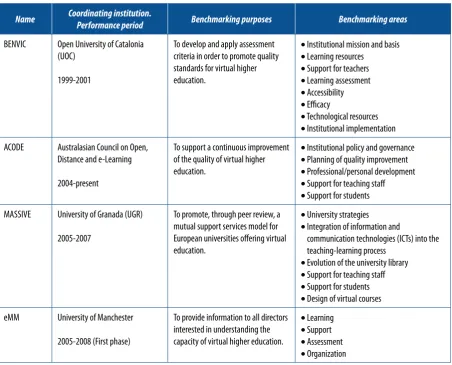
Nowadays, benchmarking is being increasingly applied to the quality management of virtual higher education,
as confirmed by different projects regarding the application of it to that area. Table 1 shows the projects considered
of interest to this research.
Table 1. Examples of benchmarking projects performed in the virtual education sector
Name Coordinating institution.
Performance period Benchmarking purposes Benchmarking areas
BENVIC Open University of Catalonia
(UOC)
1999-2001
To develop and apply assessment criteria in order to promote quality standards for virtual higher education.
• Institutional mission and basis
• Learning resources
• Support for teachers
• Learning assessment
• Accessibility
• Efficacy
• Technological resources
• Institutional implementation
ACODE Australasian Council on Open,
Distance and e-Learning
2004-present
To support a continuous improvement of the quality of virtual higher education.
• Institutional policy and governance
• Planning of quality improvement
• Professional/personal development
• Support for teaching staff
• Support for students MASSIVE University of Granada (UGR)
2005-2007
To promote, through peer review, a mutual support services model for European universities offering virtual education.
• University strategies
• Integration of information and
communication technologies (ICTs) into the teaching-learning process
• Evolution of the university library
• Support for teaching staff
• Support for students
• Design of virtual courses
eMM University of Manchester
2005-2008 (First phase)
To provide information to all directors interested in understanding the capacity of virtual higher education.
• Learning
• Support
• Assessment
RUSC VOL. 12 No 3 | Universitat Oberta de Catalunya and University of New England | Barcelona, July 2015
CC Renata Marciniak | CC by FUOC, 2015| Methodological proposal for the application of international benchmarking…
Name Coordinating institution.
Performance period Benchmarking purposes Benchmarking areas
E-xcellence European Association of Distance Teaching Universities (EADTU)
2008-2012
To help universities improve the quality, the attractiveness and the accessibility of their virtual education by creating standards of excellence.
• Strategic management
• Curricular design
• Course design
• Course delivery
• Support to teaching staff
• Support to students
Source: Prepared by the author based on Cano et al. (2012), Cobo (2009), Devedžić et al. (2011), European Association of Distance Teaching Universities (2011), Op de Beeck et al. (2012), Keppell et al. (2011) and Marshall (2009)
These and other projects of unquestionable utility have made it possible to carry out comparative analysis of
various universities based in different countries using a set of specific criteria. However, no methodologies have yet
been designed, based on the results from those projects, that could be used as practical support by universities
in order to introduce the method in a correct and satisfactory manner. Given the lack of a proper methodology,
the purpose of this research is to draw up a benchmarking methodology, with all the necessary phases, in order to
apply it to universities offering virtual education based in different countries so as to improve its quality.
2. Assessment of the quality of virtual higher education
The quality of virtual education is a complex matter, especially, given its multifactorial nature. Some authors link
its quality to learning processes, products and services based on the use of information and communication
technologies (ICTs) (Marúm-Espinosa, 2011). Others (Ardila-Rodríguez, 2011) refer to the quality of virtual education
as user satisfaction, system excellence, positive academic results and good social impact. According to Silvio (2006),
such quality should be understood as the union between academic excellence, equity and social relevance. In
his opinion, bringing quality to virtual education means studying it from its singular and specific aspects, taking
into consideration all variables, criteria and specific indicators arising from the characteristics of virtual education.
According to that author, the quality of virtual education cannot be compared or reduced to the criteria applied
to traditional education, as it requires specific assessment models and methodologies adapted to the different
contexts of virtual education.
Rubio (2003) highlights two types of models that can be used to assess the quality of virtual education:
1) Partial focus based mainly on one of the following:
t Assessment of the educational activity
t Assessment of the educational material t Assessment of the technological platforms t Financial assessment
2) Global focus. It is the assessment based on a series of elements included in an e-learning solution in order to
RUSC VOL. 12 No 3 | Universitat Oberta de Catalunya and University of New England | Barcelona, July 2015
CC Renata Marciniak | CC by FUOC, 2015| Methodological proposal for the application of international benchmarking… a) Assessment systems focused on Total Quality Management (TQM) models and/or standards
b) Systems based on benchmarking
As can be observed, a university can assess the quality of its virtual education using different methods in order
to reach the highest quality and the best results possible based on its competitiveness’ conditions. One of the
methods is benchmarking, the purpose of which is to discover the very best practices.
3. The proposed methodology for performing international benchmarking
of the quality of virtual higher education
Nowadays, there are several methodologies describing how benchmarking should be carried out. However, most
of them have been designed for application to the industrial sector and, thus, it is difficult to apply them in order
to assess the quality of virtual education, as they do not take into consideration its specific context. For this reason,
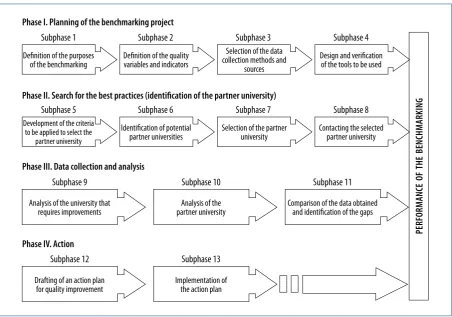
the author proposes her own methodology to carry out such benchmarking, setting out all the necessary phases
and subphases (see Figure 1).
Phase I. Planning of the benchmarking project
Definition of the purposes of the benchmarking
Definition of the quality variables and indicators
Selection of the data collection methods and
sources
Design and verification of the tools to be used
Development of the criteria to be applied to select the
partner university
Identification of potential partner universities
Selection of the partner university
Contacting the selected partner university
Analysis of the university that requires improvements
Analysis of the partner university
Comparison of the data obtained and identification of the gaps
Drafting of an action plan for quality improvement
Implementation of the action plan
Phase II. Search for the best practices (identification of the partner university)
Phase III. Data collection and analysis
Phase IV. Action
Subphase 1 Subphase 2 Subphase 3 Subphase 4
Subphase 5 Subphase 6 Subphase 7 Subphase 8
Subphase 9 Subphase 10 Subphase 11
Subphase 12 Subphase 13
PERFORMANCE
OF
THE
BENCHMARKING
Figure 1. The proposed benchmarking methodology for the assessment of the quality of virtual higher education
According to Figure 1, the benchmarking process is divided into four phases and thirteen subphases, as described
RUSC VOL. 12 No 3 | Universitat Oberta de Catalunya and University of New England | Barcelona, July 2015
CC Renata Marciniak | CC by FUOC, 2015| Methodological proposal for the application of international benchmarking…
Phase I. Planning of the benchmarking project
Subphase 1: Definition of the purposes of the benchmarking
The start point of each benchmarking process is to define its purposes and main tasks to be fulfilled.
Subphase 2: Definition of the quality variables and indicators
In this subphase, all the variables and indicators to be used to measure quality will be defined.
Subphase 3: Selection of the data collection methods and sources
In this subphase, the type of data necessary to carry out the research will be defined. Given the relevance of data
collection, various data sources will be defined.
Subphase 4: Design and verification of the tools to be used
The last step of phase I consists in designing data collection tools to be used during the benchmarking process.
Phase II. Search for the best practices (identification of the partner university)
Subphase 5: Development of the criteria to be applied to select the partner university
The first subphase of phase II, consists in developing the criteria to be applied to select the universities to be
considered for the final selection of the partner university (the university with the best practices).
Subphase 6: Identification of potential partner universities
This subphase requires exhaustive research using secondary data in order to identify the best university according
to certain variables. Based on the results from that research, the universities with the best possible practices will be
identified in order to select potential partner universities.
Subphase 7: Selection of the partner university
In this subphase, the university that best fulfills all the criteria set out in subphase 5 will be identified.
Subphase 8: Contacting the selected partner university
At this point, the first formal contact with the selected partner university will be made. For this purpose, it is
necessary to contact the persons in charge of the that university, informing them of the purposes of the research,
as well as of the reasons why the selected university is considered one of the best of its kind, asking them whether
they are interested in participating in the research.
Phase III. Data collection and analysis
Subphase 9: Analysis of the university that requires improvements
Based on the indicators drawn up in subphase 3, all the internal data necessary to assess the performance of the
university will be collected, using the collection sources and tools created in that subphase.
Subphase 10: Analysis of the partner university
Based on the indicators drawn up in subphase 3, all the internal data necessary to assess the performance of the
RUSC VOL. 12 No 3 | Universitat Oberta de Catalunya and University of New England | Barcelona, July 2015
CC Renata Marciniak | CC by FUOC, 2015| Methodological proposal for the application of international benchmarking…
Subphase 11: Comparison of the data obtained and identification of the gaps
In this subphase, the results from the application of the criteria to the analyzed university will be compared to
those obtained from their application to the partner university. The differences between the results will be defined
in order to identify the gaps between the two universities.
Phase IV. Action
Subphase 12: Drafting of an action plan for quality improvement
In this phase, an improvement plan containing specific actions to be taken will be designed in order for the
analyzed university to achieve the very best practices.
Subphase 13: Implementation of the action plan
This subphase consists in implementing the previously drawn up plan, and in following up and monitoring its
implementation.
4. Empirical application of the proposed methodology. Research results
In order to verify the efficiency of the proposed methodology, the author applied it from April to August 2013 to the
Polish Virtual University (PUW).1 The benchmarking was performed according to the methodology described in Figure 1.
Phase I. Planning of the benchmarking project
Subphase 1: Defining of the purposes of the benchmarking
The main purpose of the benchmarking was to assess the quality of the education offered by PUW in order to
compare it to a leading university and define the gaps between them so as to identify the steps that should be
taken in order to improve the quality of the education offered by PUW.
Subphase 2: Definition of the quality variables and indicators
Based on the analysis described in Table 1, it can be concluded that the most common benchmarking variables
applicable to virtual education can be divided into five main groups:
t Strategic plan t Institutional context t Educational agents
t Teaching-learning processes t Virtual platforms
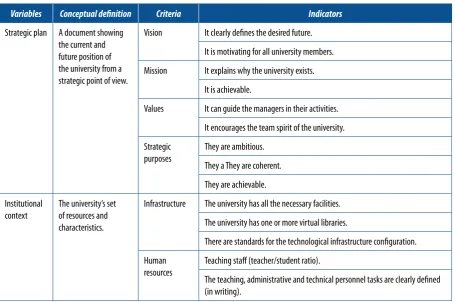
The aforementioned variables were applied to this research. Table 2 below defines each of the aforementioned
variables, as well as the criteria and indicators to be used for each of them.
RUSC VOL. 12 No 3 | Universitat Oberta de Catalunya and University of New England | Barcelona, July 2015
CC Renata Marciniak | CC by FUOC, 2015| Methodological proposal for the application of international benchmarking…
Subphase 3: Selection of the data collection methods and sources
The author applied documentary analysis methods and social research techniques in order to collect all the
necessary data. For this purpose, semi structured face-to-face interviews and non-participant observation of
the virtual classroom were carried out. Both primary and secondary sources were used for documentary analysis.
Regarding primary sources, the author used, among others, the documentation provided by the researched
university for the variables described above, that is, strategic plans, curricula, course documents, student statistics,
teaching guides and materials. Regarding secondary sources, the author used, among others, information materials
provided by the Education Ministries of Poland and Spain, reports drafted by the Polish E-learning Association, the
Polish Accrediting Commission, the Spanish National Agency for Quality Assessment and Accreditation (ANECA)
and the Catalan University Quality Assurance Agency (AQU)
A total of eight semi-structured interviews were carried out in order to understand, as much as possible, the
issues related to the scope of this research. The interviews were carried out with directors of virtual programs (2),
human resources managers (2), managers of virtual classrooms (2) and teachers-tutors (2).
The non-participative observation of virtual classrooms allowed the quality of the virtual environment to
be assessed. Furthermore, the author applied her knowledge of virtual education acquired through years of
professional experience as a teacher-tutor at PUW and through her studies at various virtual universities, among
others, the Open University of Catalonia (UOC), the National Distance Education University (UNED) of Spain and the
Virtual Educa Teacher Training Institute of Argentina.
Table 2. Definition of the variables
Variables Conceptual definition Criteria Indicators
Strategic plan A document showing the current and future position of the university from a strategic point of view.
Vision It clearly defines the desired future.
It is motivating for all university members.
Mission It explains why the university exists.
It is achievable.
Values It can guide the managers in their activities.
It encourages the team spirit of the university.
Strategic purposes
They are ambitious.
They a They are coherent.
They are achievable.
Institutional context
The university’s set of resources and characteristics.
Infrastructure The university has all the necessary facilities.
The university has one or more virtual libraries.
There are standards for the technological infrastructure configuration.
Human resources
Teaching staff (teacher/student ratio).
RUSC VOL. 12 No 3 | Universitat Oberta de Catalunya and University of New England | Barcelona, July 2015
CC Renata Marciniak | CC by FUOC, 2015| Methodological proposal for the application of international benchmarking…
Variables Conceptual definition Critera Indicators
Educational agents
The persons involved in the teaching-learning process
Students The students are informed of the admittance and graduation profile.
The students are offered additional services.
There are rules regarding the students’ rights and duties.
Teachers-tutors There are teacher/tutor selection procedures.
There are teacher/tutor assessment procedures.
Teaching-learning process
The cognitive activity carried out by students guided by teachers-tutors in order to gain knowledge and skills.
Studies program The program recipients are well defined.
The program is up to date.
Teaching materials and resources
They are varied.
There are resources for students with special needs.
There are procedures for the validation of teaching materials.
Methodology The teaching strategies applied by teachers-tutors are varied.
The learning process is sufficiently encouraged.
Feedback is given to each student.
Tutoring There are instructions regarding communication paths with tutors.
The tutors’ tasks and functions are well defined.
The tutoring is monitored.
Learning activities
The activities are varied.
A schedule has been defined for each activity.
The way each activity should be delivered is well defined.
Learning assessment
An assessment methodology has been well defined.
The students are involved in the assessment process.
Virtual platform
The tool used to support the virtual education process
Course management by users
There are activity management tools.
There are tools to encourage team work.
There are tools to create a personal learning environment (PLE).
Communication management Asynchronous communication. Synchronous communication. Assessment and follow-up
There are assessment exercises.
There are self-assessment exercises.
Standardization The platform meets the SCORM standard requirements.
The platform meets the A/AA accessibility requirements.
RUSC VOL. 12 No 3 | Universitat Oberta de Catalunya and University of New England | Barcelona, July 2015
CC Renata Marciniak | CC by FUOC, 2015| Methodological proposal for the application of international benchmarking…
Subphase 4: Design and verification of the tools to be used
In order to collect all the necessary data to carry out the benchmarking, the author drew up five assessment
protocols to be used for the comparative assessment.
These were:
t A comparative assessment protocol of the strategic plans t A comparative assessment protocol of the institutional context t A comparative assessment protocol of the teaching-learning process t A comparative assessment protocol of the educational agents t A comparative assessment protocol of the virtual platform
The results from the application of the aforementioned protocols have been arranged according to the
Likert scale, ranging from 1 (non-fulfillment of the indicator) to 4 (high fulfillment of the indicator). Furthermore,
comments were made regarding each of the applied indicators (qualitative assessment), as the author considered
that subjective values should be included in the assessment. For this reason, the objective data obtained from the
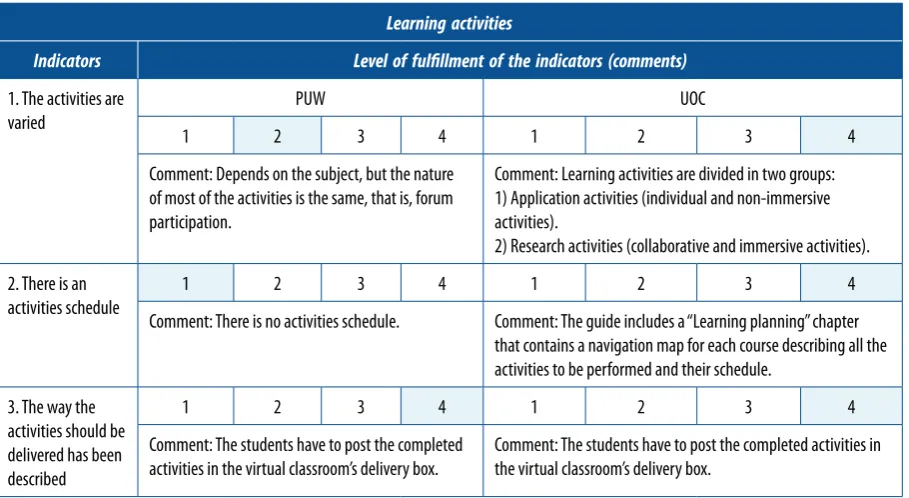
application of the protocols was completed with the author’s comments on the results obtained (see Table 3).
The drafted protocols were assessed by four experts in virtual higher education.
Phase II. Search for the best practices (identification of the partner university)
The author chose a Spanish university as partner university, given that Spanish universities offer highly
developed virtual education, as shown by numerous international rankings, such as the Online MBA Listing 2013
by the Financial Times (Financial Times, 2013) or RankingMundial de Universidades en la Web (Consejo Superior de Investigaciones Científicas, 2013).
A description of the selection process for the partner university is given below:
– During subphase 5, the author created six selection criteria: online mode, access to ICTs, course variety, other
services offered, quality and prestige.
– During subphase 6, a total of 41 Spanish universities offering virtual education were analyzed. As a result, four
preselected universities were thoroughly assessed, applying the above-mentioned criteria.
– During subphase 7, UOC was selected as the partner university, as it satisfactorily fulfilled all the applied
criteria.
– Subphase 8 consisted of sending a letter to the partner university, requesting its authorization to carry out the
benchmarking and explaining the functioning of the entire process.
Phase III. Data collection and analysis
Subphases 9 and 10: Internal analysis of PUW and UOC
The purpose of these subphases is to collect data about the partner university and the quality of its virtual
education. For this reason, prior to collecting that data, the quality of the virtual education offered by PUW was
assessed in order to increase the possibility of detecting all areas to be improved. The assessment was carried out
using comparative assessment protocols (see Table 3 for an example of those protocols) and the data collection
RUSC VOL. 12 No 3 | Universitat Oberta de Catalunya and University of New England | Barcelona, July 2015
CC Renata Marciniak | CC by FUOC, 2015| Methodological proposal for the application of international benchmarking…
Table 3. Example of a completed comparative assessment protocol
Learning activities
Indicators Level of fulfillment of the indicators (comments)
1. The activities are varied
PUW UOC
1 2 3 4 1 2 3 4
Comment: Depends on the subject, but the nature of most of the activities is the same, that is, forum participation.
Comment: Learning activities are divided in two groups: 1) Application activities (individual and non-immersive activities).
2) Research activities (collaborative and immersive activities).
2. There is an activities schedule
1 2 3 4 1 2 3 4
Comment: There is no activities schedule. Comment: The guide includes a “Learning planning” chapter that contains a navigation map for each course describing all the activities to be performed and their schedule.
3. The way the activities should be delivered has been described
1 2 3 4 1 2 3 4
Comment: The students have to post the completed activities in the virtual classroom’s delivery box.
Comment: The students have to post the completed activities in the virtual classroom’s delivery box.
Subphase 11: Comparison of the data obtained and identification of the gaps
Once the quality of the virtual education offered by PUW had been assessed, its situation as compared to the
partner university was defined in order to identify possible gaps (see Table 4) between the two universities in five
main areas, as well as to determine their causes.
A brief summary of those gaps is given below.
The first variable used by the author was the strategic plan of each university. One of the biggest weaknesses
of PUW in this area is that its vision and the values that it should abide by for its future development have not been
developed. Furthermore, the strategic mission and objectives of PUW are significantly less well defined than those
of UOC.
Another relevant variable that creates a positive and a negative gap in comparison to the partner university is
the institutional context. The positive gap is that the teaching load of PUW (student/teacher ratio) is lower than
that of the partner university. The negative gap is that PUW lacks not only a virtual library but also strategies for the
availability of technological services and human resources management.
Regarding educational agents, there is a clear negative gap between the two universities, as PUW does not
provide its students with any additional services, that is, it does not assist them with their access to the job market
and it does not encourage them to participate in educational events or scientific research/programs. What is more,
not even PUW’s teachers participate in such events. Moreover, PUW has not defined any teacher/tutor selection
procedure.
Regarding the teaching-learning process variable, there is a very significant negative gap between the two
universities. In this case, PUW has not set out any procedures for the updating or drafting of studies programs.
Furthermore, it lacks educational material, learning strategies and technologies, and the activities it offers are not
varied. Finally, it should be noted that the qualification criteria and assessment systems applied by PUW teachers
RUSC VOL. 12 No 3 | Universitat Oberta de Catalunya and University of New England | Barcelona, July 2015
CC Renata Marciniak | CC by FUOC, 2015| Methodological proposal for the application of international benchmarking…
Table 4. Quality gaps detected in the virtual education offered by PUW and UOC
Average score*
Variables Criteria 1 2 3 4
Strategic plan Vision
♦
•
Mission
♦
•
Values
♦
•
Strategic purposes
♦
•
Institutional context Infrastructure
♦
•
Human resources
♦
•
Educational agents Students
♦
•
Teachers
♦
•
Teaching-learning process Studies program
♦
•
Teaching materials
♦
•
Methodology
♦
•
Tutoring
♦
•
Learning activities
♦
•
Assessment of the learning process
♦
•
Virtual platform Course management by its users
♦
•
Communication resources management
♦
•
Assessment, follow-up and self-assessment
♦
♦
•
Standardization support
♦
•
Explicaciones: PUW ♦ ♦ ; UOC
• •
* The average score is the sum of scores obtained for each indicator divided by the total number of indicators making up each criterion
Regarding the last variable, that is, the virtual platform, the negative gap of PUW in comparison to the partner
university is due to the fact that the virtual platform used by PUW offers very few tools for team projects and it does
not offer any tool for students to create their own personal learning environment (PLE). Moreover, the platform offered
by PUW has not had accessibility standards applied to it, so it does not offer students with special needs the possibility
RUSC VOL. 12 No 3 | Universitat Oberta de Catalunya and University of New England | Barcelona, July 2015
CC Renata Marciniak | CC by FUOC, 2015| Methodological proposal for the application of international benchmarking… Phase IV. Action
Subphase 12: Drafting of an action plan for quality improvement
In order to remove or reduce the gaps identified in phase III, an improvement action plan was designed,
consisting of specific actions to be taken so that PUW could not only remove the said gaps, but also achieve the
very best practices.
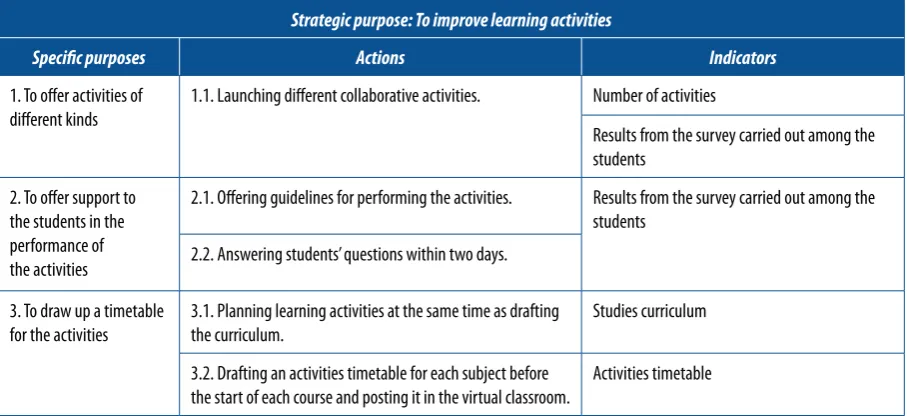
Table 5 shows an example of the plan drafted for PUW.
Table 5. Example of an action plan to improve learning activities
Strategic purpose: To improve learning activities
Specific purposes Actions Indicators
1. To offer activities of different kinds
1.1. Launching different collaborative activities. Number of activities
Results from the survey carried out among the students
2. To offer support to the students in the performance of the activities
2.1. Offering guidelines for performing the activities. Results from the survey carried out among the students
2.2. Answering students’ questions within two days.
3. To draw up a timetable for the activities
3.1. Planning learning activities at the same time as drafting the curriculum.
Studies curriculum
3.2. Drafting an activities timetable for each subject before the start of each course and posting it in the virtual classroom.
Activities timetable
Subphase 13: Implementation of the action plan
In this subphase, the drawn-up action plan had to be implemented and monitored. This subphase is extremely
important, as any failure could lead to the strategic objectives not being reached and, thus, the quality of the virtual
education offered by PUW not being improved. In order to avoid that risk, a set of the most relevant indicators was
drawn up in order to ensure that each step of this subphase would be carried out.
Conclusions
The results obtained from the application of the proposed benchmarking methodology enable the following
conclusions to be drawn:
Regarding the methodology
The drawn-up methodology sets out all the relevant phases in order to carry out international benchmarking of
the quality of virtual higher education. It is not a static methodology, as it allows a dynamic application based
on modifications and the evolution of quality assessment models through the adaptation, elimination and
RUSC VOL. 12 No 3 | Universitat Oberta de Catalunya and University of New England | Barcelona, July 2015
CC Renata Marciniak | CC by FUOC, 2015| Methodological proposal for the application of international benchmarking…
Regarding the application of the methodology
By applying the methodology, the author has been able to verify its complete usefulness and great potential when it
comes to improving the quality of virtual education by discovering the very best practices and collecting all the
necessary data in order to assess, in a comparative manner, the quality of the virtual education offered by different
universities and, as a result, to draw up an improvement action plan for such education.
Regarding the utility of the methodology
The methodology was created to perform international benchmarking of the quality of the virtual education offered
by Polish universities. The application of a comparative analysis (with a leading international university) made it
possible to establish a thorough diagnosis of the actual quality of the virtual education offered by the selected
Polish university, as well as to discover the very best practices in order to increase the quality of it and to initiate a
learning process based on the best virtual education universities at an international level. The creation of a clear and
objective methodology allowed the author to use the results obtained to draft an action plan for the continuous
improvement of the quality of the virtual education offered by the chosen Polish university. It is believed that the
use of the methodology described above could extend beyond the purposes initially set and become a tool that
brings added value and knowledge to all institutions offering virtual education (both in Poland and abroad).
References
Ardila-Rodríguez, M. (2011). Indicadores de calidad de las plataformas educativas digitales. Educación y Educadores 14(1), 189-206. doi: http://dx.doi.org/10.5294/edu.2011.14.1.10
BENVIC. (2002). Benchmarking of virtual campuses. Retrieved from http://www.benvic.odl.org/
Cano, C., Fernández Sanz, L., Pages, L., Villalba, M. T., Temesio, S., & Motz, R. (2012). Modelos de madurez de la
ense-ñanza virtual ¿Consideran la accesibilidad? In L. Bengochea & N. Piedra (Ed.), ATICA 2012. IV Congreso Internacional sobre Aplicación de Tecnologías de la Información y Comunicaciones Avanzadas (pp. 100-108). Loja: Universidad Técnica Particular de Loja. Retrieved from http://www.esvial.org/wp-content/files/Atica2012_pp101-109.pdf
Cobo Romaní, J. C. (2009). El concepto de tecnologías de la información. Benchmarking sobre las definiciones de las
TIC en la sociedad del conocimiento. Zer - Revista de Estudios de Comunicación, 14(27), 295-318.
Consejo Superior de Investigaciones Científicas. (2013). Ranking Mundial de Universidades en la Web. Retrieved from
http://www.webometrics.info/es/About_Us
Devedžić, V., Šćepanović, S., & Kraljevski, I. (2011). E-Learning benchmarking. Methodology and tools review. Retrieved from http://www.dlweb.kg.ac.rs/files/DEV1.3%20EN.pdf
Duart, J. M., & Martínez, M. J. (2001). Evaluación de la calidad docente en entornos virtuales de aprendizaje. UOC.
Retrieved from http://www.uoc.edu/web/esp/art/uoc/0109041/duartmartin.html
Espinoza, O., & González, L. E. (2006). Procesos universitarios dinámicos. El Modelo de Gestión de la Calidad Total.
Calidad de la Educación, 1(24), 15-34.
European Association of Distance Teaching Universities (2011). E-xcellence in E- learning associates in quality. Retrieved from
RUSC VOL. 12 No 3 | Universitat Oberta de Catalunya and University of New England | Barcelona, July 2015
CC Renata Marciniak | CC by FUOC, 2015| Methodological proposal for the application of international benchmarking… Fazlagić, A. J. (2006). Intellectual Capital and Benchmarking. Poznań, Poland: Rys STUDIO.
Financial Times (2013). Online MBA Listing 2013. Retrieved from http://rankings.ft.com/exportranking/online-mba-listing-2013/pdf
García Aretio, L. (1998). Indicadores para la evaluación de la enseñanza en una universidad a distancia. RIED. Revista Iberoamericana de Educación a Distancia, 1(1), 63-85.
García Aretio, L. (2003). La educación a distancia. Una visión global. Boletín Ilustre Colegio de Doctores y Licenciados de España, 146, 13-27.
Giogetti, C. G., Romero, L., & Vera, M. (2013). Diseño de un modelo de evaluación de la calidad específico para EaD.
RUSC. Universities and Knowledge Society Journal, 10(2), 54-68. Retrieved from http://rusc.uoc.edu/ojs/index.php/
rusc/article/view/v10n2-giorgetti-romero-vera/v10n2-Gros, B. (Ed.). (2011). Evolución y retos de la evaluación virtual: construyendo el e-learning del siglo XXI. Barcelona, Spain: Editorial UOC.
HEQC (Higher Education Quality Committee). (1997). Directrices para la Educación a Distancia. Gran Bretaña: HEQC. Levy, G. D., & Valcik, N. A. (2012). Benchmarking in Institutional Research: New Directions for Institutional Research.
Tallahassee, FL: John Wiley & Sons.
Marshall, S. (2009). ACODE Benchmarks - eMM version 2.3 Concordance. Report to the Australasian Council of Open and Distance Education. Wellington, New Zealand: Victoria University of Wellington.
Marúm-Espinosa, E. (2011). Calidad en el servicio en la Educación a Distancia. Una perspectiva desde México. RIED. Revista Iberoamericana de Educación a Distancia, 14(2), 49-62.
Op de Beeck, I., Camilleri, A., & Bijnens, M. (2012). Research results on European and international e-learning quality, certification and benchmarking schemes and methodologies. Belgium: VISCED Consortium.
Ornellas, A., & Muñoz P. C. (2012). Aprendizaje basado en proyectos audiovisuales colaborativos en un entorno
e-learning. Análisis de una experiencia desarrollada en la Universitat Oberta de Catalunya. Innovación Educativa,
22, 143-156.
Rubio, M. J. (2003).Enfoques y modelos de evaluación del e-learning. Revista Electrónica de Investigación y Evaluación Educativa, 9(2). Retrieved from http://www.uv.es/RELIEVE/v9n2/RELIEVEv9n2_1.htm
Sánchez Rodríguez, J. (2009). Plataformas de enseñanza virtual para entornos educativos. Pixel-Bit. Revista de Medios y Educación, 34, 217-233.
Sangrà, A., & Duart, J. (1999). Formació universitaria per mitjà del web: un model integrador per a l’aprenentatge
superior. In A. Sangrá and J. Duart (Eds.), Aprenentatge i virtualitat (pp. 57-78). Barcelona, Spain: UOC.
Sarramona, J. (2001). Evaluación de programas de educación a distancia. RIED. Revista Iberoamericana de Educación a Distancia, 1(1), 1-24.
Silva Quiroz, J. (2011). Diseño y moderación de entornos virtuales de aprendizaje. Barcelona, Spain: UOC.
Silvio, J. (2006). Hacia una educación virtual de calidad, pero con equidad y pertinencia. RUSC. Universities and Knowledge Society Journal, 3(1). Retrieved from http://www.uoc.edu/rusc/3/1/dt/esp/silvio.pdf
RUSC VOL. 12 No 3 | Universitat Oberta de Catalunya and University of New England | Barcelona, July 2015
CC Renata Marciniak | CC by FUOC, 2015| Methodological proposal for the application of international benchmarking…
About the author
Renata Marciniak
PhD candidate in Education, Department of Applied Pedagogy, Autonomous University of Barcelona (UAB), Spain
Renata Marciniak holds a doctorate in Business Administration from the University of Economics in Kraków, Poland, and a bachelor’s degree and a master’s degree in Company Organization and Management from the College of Management and Foreign Languages in Katowice, Poland. She also holds a master’s degree in Research in Education and a postgraduate degree in Virtual Learning Environments from the Virtual Educa Teacher Training Institute. She has been a lecturer at various Polish universities. She also has experience in e-learning as she was a lecturer at the Polish Virtual University. Currently, she is writing her PhD in Education at the Autonomous University of Barcelona. She is the author of two books and has published a number of journal articles and authored chapters in books and proceedings about Business Management. She has participated as a speaker in several international congresses and conferences. Her research interests include management in education, learning technologies, quality of education and evaluation models for e-learning quality in higher education.
Facultad de Pedagogía Aplicada Universidad Autónoma de Barcelona Edificio G
Campus de la UAB
08193 Bellaterra (Cerdanyola del Vallès) Spain
Original title: Propuesta metodológica para la aplicación del benchmarking internacional en la evaluación de la calidad de la educación superior virtual