Intelligent phishing url detection using
association rule mining
S. Carolin Jeeva
1*and Elijah Blessing Rajsingh
2Background
Phishing is a malicious website that impersonates as a legitimate one to get sensitive data like credit card number or bank account password. A phisher uses social engineering and technical deception to fetch private information from the web user. The phishing web pages generally have alike page layouts, blocks and fonts to mimic legitimate web pages in an endeavor to influence web users to obtain personal details such as username and password. Over the last few years, online banking has become very popular as more financial institutions have begun to offer free online services. With the increase in online theft, financial crimes have changed from direct attacks to indirect attack. Phishing [1] is a quickly growing type of fraud and is taken into account as one of the foremost danger-ous threats within the web which cause folks to mislay guarantee [2] in on-line transac-tions. It is relatively a current web crime as compared with virus, hacking and remains an ominous threat to client and business round the world.
According to the RSA’s online fraud report [3], the year 2013 has been confirmed to be a record year where many phishing attacks have been launched globally. Additional1y, RSA estimates that over USD $5.9 billion was lost by global organizations due to phish-ing attacks at the same period. The Internet Security Threat Report 2014 [4] reports that cybercrimes are prevailing and damaging threats from cybercriminals still emerge over
Abstract
Phishing is an online criminal act that occurs when a malicious webpage impersonates as legitimate webpage so as to acquire sensitive information from the user. Phishing attack continues to pose a serious risk for web users and annoying threat within the field of electronic commerce. This paper focuses on discerning the significant features that discriminate between legitimate and phishing URLs. These features are then sub-jected to associative rule mining—apriori and predictive apriori. The rules obtained are interpreted to emphasize the features that are more prevalent in phishing URLs. Ana-lyzing the knowledge accessible on phishing URL and considering confidence as an indicator, the features like transport layer security, unavailability of the top level domain in the URL and keyword within the path portion of the URL were found to be sensible indicators for phishing URL. In addition to this number of slashes in the URL, dot in the host portion of the URL and length of the URL are also the key factors for phishing URL. Keywords: Phishing, Web security, Association rule mining
Open Access
© 2016 The Author(s). This article is distributed under the terms of the Creative Commons Attribution 4.0 International License (http://creativecommons.org/licenses/by/4.0/), which permits unrestricted use, distribution, and reproduction in any medium, provided you give appropriate credit to the original author(s) and the source, provide a link to the Creative Commons license, and indicate if changes were made.
RESEARCH
businesses and customers. According to RSA monthly fraud report January 2014, the [5] big data analytics and broader intelligence will lead to faster detection resulting in lower financial losses. Data mining techniques are used to extract helpful information by ana-lyzing the past information then predicting the future incidents.
In this paper, the rules are generated using association rule mining to detect phish-ing URL. The remainphish-ing section in the papers is organised as follows: The outline of lit-erature survey is shown in second section. The system architecture is illustrated in third section. The features that are generated from the URL are discussed in fourth section. Fifth section explains the methodology used in detecting phishing URL. Sixth section presents an association rule mining technique to discover the rules concerning phishing URL and in the last section conclusions are presented.
Related work
Phishing is a major danger to web users. The fast growth and progress of phishing tech-niques create an enormous challenge in web security. Zhang et al. [6] proposed CAN-TINA, a completely unique HTML content method for identifying phishing websites. It inspects the source code of a webpage and makes use of TF-IDF to find the utmost ranking keywords. The keywords obtained are given as input to google search engine and examined whether the domain name of the URL matches with N top search result and is considered as legitimate. This approach fully relies on google search engine. CAN-TINA+ proposed by Xiang et al. [7] is an upgraded version of CANTINA, in which new features are included to achieve better results. In particular, the authors include the HTML Document Object Model, third party and google search engines with machine learning technique to identify phishing web pages.
Huang et al. [8] proposed SVM based technique to detect phishing URL. The features used are structural, lexical and brand names that exist in the URL. Liebana-Cabanillas et al. [9] proposed completely different technique to search out the variables that are most often utilized in financial institutions so as to predict the trust among electronic banking. Yuancheng et al. [10] proposed semi supervised based method for detection of phishing web page. The features of the web image and DOM properties are consid-ered. Transductive Support Vector Machine is applied to detect and classify phishing web pages. Islam et al. [11] proposed filtering phishing email with the message content and header using multi-tier classification model.
Chen et al. [12] have proposed a hybrid approach that mixes extraction of key phrase, textual, financial data to ascertain the vicious of phishing attack using supervised clas-sification strategies. Nishanth et al. [13] have proposed a method in which the struc-tured style of the financial data are mined using machine learning algorithms. Liu et al. [14] have proposed the visual approach to identify phishing web pages. The similarity between the pages is assessed by block, layout and overall style. Medvet et al. [15] also adopted the visual similarity between webpages to calculate the similarity among a legit-imate site and the suspected phishing website. The features used to verify page similarity are text piece, their style, images and the overall appearance of the webpage.
the webpage image signature is computed using EMD. The authors use a trained EMD threshold value to differentiate the legitimate and phishing webpages. Lam et al. [17] have proposed an image based approach for detecting phishing webpages. The authentic and the suspected pages are transformed into black and white image. The size and loca-tion of each blob are recorded and compared. The matched pair is selected by comparing the block pair with maximum similarity degree. The classifier categorizes the page based on the similarity score. Chen et al. [18] have proposed an approach that uses CCH to fig-ure out the resemblance degree between fake and legitimate page.
Pshark is an approach proposed by Shah et al. [19] to detect and eliminate the identi-fied phishing web page from host server. The WHOIS database is used to retrieve the information about the page. A notification is sent to the host server intimating that a phishing page resides in that server. He et al. [20] adopted heuristic method to cat-egorize the legitimacy of the web page. The heuristic used in this system are based on the term identity set of a webpage. Aburrous et al. [21] have proposed fuzzy data min-ing technique to identify the phishmin-ing website. Zhang et al. [22] adopted domain fea-ture enhanced classification model for the detection of Chinese phishing e- business websites.
Zhang et al. [10] proposed CANTINA, a completely unique HTML content method for identifying phishing websites. It inspects the source code of a webpage and makes use of TF-IDF to find the utmost ranking keywords. The keywords obtained are given as input to google search engine and examined whether the domain name of the URL matches with N top search result and is considered as legitimate. This approach fully relies on google search engine. CANTINA+ proposed by Xiang et al. [7] is an upgraded version of CANTINA, in which new features are included to achieve better results. In particular, the authors include the HTML Document Object Model, third party and google search engines with machine learning technique to identify phishing web pages. However, both the approaches rely on google search engine and the contents are down-loaded from the webpages. But in our work the features related to URL is considered and thus downloading the content of the webpage is avoided. Moreover the system predic-tion is not exclusively based on querying search engine result.
Huang et al. [8] proposed SVM based technique to detect phishing URL. The features used are structural, lexical and brand names that exist in the URL. However, more fea-tures related to URL are considered in the proposed work. Neda et al. [23] proposed rule based classification algorithm to detect phishing URL. However the rule used in this is based on human experience rather than intelligent data mining technique. In the approach proposed by Han et al. [24] the system warns the user, when the user submits the username and password for the first time, although the current website is a legiti-mate website. This is because the information about the legitilegiti-mate website is not main-tained. This login problem is eliminated in our system as a repository of white list is effectively maintained.
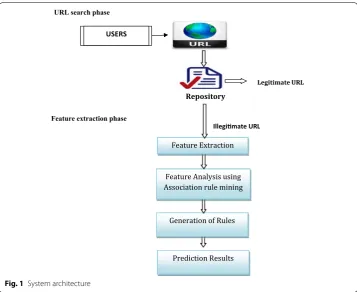
System architecture for prediction of phishing URL
extraction phase. In the URL search phase, once the user accesses/requests an URL, a search is carried out to check whether the given URL is in the repository of legitimate URLs. If a match is found in the repository, then the URL is considered to be a legitimate URL. Otherwise the URL is not a legitimate URL and it undergoes the next phase. The main reason for carrying out the search phase before the feature extraction phase is it reduces the unnecessary computation during the feature extraction phase and improves the overall response time of the system. In the Feature extraction phase, we have defined heuristics to extract 14 features from the URL and are subjected to association rule min-ing to determine the legitimate and phished URL.
Feature extraction
The proposed work focuses on identifying the relevant features that differentiate phish-ing websites from legitimate websites and then subjectphish-ing them to association rule mining. In order to identify the relevant features, certain statistical investigations and analysis were carried out on the phish tank (http://www.phishtank.com) and legitimate dataset. Based on the heuristics, fourteen features were defined and are subjected to association rule mining to effectively determine the legitimate and phished URL.
Heuristic 1: length of the host URL
URL is a formatted text string utilized by internet users to recognize a network resource on the Internet. URL string consists of three elements such as network protocol, host name and path. For a given URL, the host name is extracted and host name length is examined. For the input data set (1200 phishing URLs and 200 legitimate URLs), domain
USERS
Repository
Illegimate URL
Legitimate URL URL search phase
Feature extraction phase
name length is analyzed for phishing and legitimate URLs. The distribution of the domain name length for phished URL is plotted in Fig. 2 and the average length of the domain name (ɭ) in phishing URL is found to be greater than 25 characters. The distri-bution of the domain name length for legitimate URL is plotted in Fig. 3 and the average length of the domain name (ɭ) in legitimate URL is found to be 20 characters.
Therefore, the heuristic is defined as
Heuristics 2: number of slashes in URL
The phishers try to trick web users by mimicking the doubtful URL look legitimate. One such technique used in scamming is the addition of slashes in URL. The present study, therefore, considers the number of slashes in URLs as a feature of identification of phish-ing and examines the number of slashes (μ) in legitimate and phishphish-ing URLs. For the input data set (1200 phishing URLs and 200 legitimate URLs), the number of slash is
0 50 100 150 200 250 300
1 201 401 601 801 1001
Length of the Host URL
URL (#) Fig. 2 URL domain length of phishing URL
0 5 10 15 20 25 30 35
1 51 101 151
Length of host URL
analyzed for phishing and legitimate URLs. The distribution of number of slashes in the phishing URLs and legitimate URLs are analyzed and are plotted in Figs. 4 and 5. The result shows that the average number of slashes (μ) in phishing URL is found to be greater than or equal to five and the average slash (μ) in legitimate URL is found to be three.
Therefore, the heuristic is defined as
Heuristics 3: dots in host name of the URL
This heuristics verifies the presence of dots in the host name of the URL. However phishing URL usually have many dots to make users believe that they are genuine page. For the input data set (1200 phishing URLs and 200 legitimate URLs), the number of dot in hostname is analyzed for phishing and legitimate URLs. The presence of dots (α) in both phishing and legitimate URLs are analyzed and are plotted in Figs. 6 and 7. The
H2=
if (Slash in URL)≥µ→Phishing URL else, Legitimate URL
0 2 4 6 8 10 12
1 51 101 151
Slash in the URL
URL (#) Fig. 5 Number of slashes in legitimate URL
0 2 4 6 8 10 12 14 16 18 20
1 201 401 601 801 1001
Slash in URL
URL (#)
result shows that the suspicious URL has more than four dots and the number of dots (α) in legitimate URL is almost three.
Therefore, the heuristic is defined as
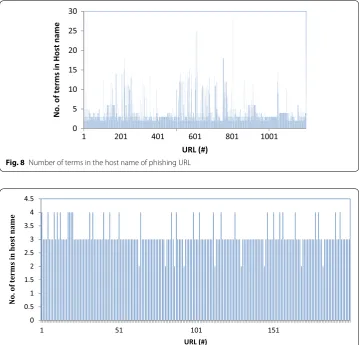
Heuristics 4: number of terms in the host name of the URL
Domain names are used to ascertain a unique identity. The host name component is extracted from the URL. The terms in the host name component are tokenized. If the number of terms in the host name portion of the URL is (∂) then the URL is legitimate otherwise phishing. For the input data set (1200 phishing URLs and 200 legitimate URLs), the number of terms in the host name of the URL is analyzed for phishing and legitimate URLs. The distribution of number of terms in the host name for phishing URL is plotted in Fig. 8. The number of terms in the host name (∂) in the phishing URL is found to be greater than four. The distribution of number of terms in the host name for legitimate URL is plotted in Fig. 9. The average number of terms in the host name (∂) in the legitimate URL is found to be four.
Therefore, the heuristic is defined as
H3=
if
Dots in host name of URL
> α → Phishing URL else, Legitimate URL
0 5 10 15 20 25 30
1 201 401 601 801 1001
Dot in URL
URL(#)
Fig. 6 Number of dots in phishing URL
0 1 2 3 4 5 6
1 51 101 151
No. of Dot in the URL
Heuristics 5: special characters
The URL is unique in the cyberspace. The identity of the legitimate website is obtained from the host name of the URL. The hostname in the URL of the legitimate and phished dataset is investigated for understanding the presence of special characters in both the data sets. While examining, it was found that 77.75 % of phished URLs are with special characters.
Therefore, the heuristic is defined as
Heuristic 6: IP address
In general, the legitimate websites are addressed by their domain name. In the dataset, the hostname in the URL is examined for the presence of IP address. It was found that 9.4 % of phished URLs contained IP address.
Therefore, the heuristic is defined as H4=
if Host(terms) > ∂→Phishing URL else, Legitimate URL
H5=
if (Special characters in Host)→Phishing URL else, Legitimate URL
0 0.5 1 1.5 2 2.5 3 3.5 4 4.5
1 51 101 151
No. of terms in host name
URL (#)
Fig. 9 Number of terms in the host name of legitimate URL
0 5 10 15 20 25 30
1 201 401 601 801 1001
No. of terms in Host name
URL (#)
Heuristics 7: unicode in URL
Unicode provides a unique number for every character. On analyzing the input data set (1200 phishing URLs and 200 legitimate URLs), it is scrutinized that most of the phish-ing URLs are coded with unicode characters. The presence of Unicode in the host name of the URL indicates that the URL is a phished URL. It was found that 65.16 % of phished URLs contained unicode characters
Therefore, the heuristic is defined as
Heuristics 8: transport layer security
The URL is broken down into host component and a path component. The URL uses Transport Layer Security to determine whether the URL is protected. The presence of HTTPs protocol is required when delicate information is transferred across network. Therefore the existence of Transport Layer Security is examined for the input URL. On analyzing the phishtank dataset, 99.16 % URLs were found without transport layer security.
Therefore, the heuristic is defined as
Heuristics 9: Subdomain
The securityweek network, [25] reports that subdomain leads to increase uptime for phishing attack. Fraudsters, scam users by adding sub domains to make the link look legitimate. Adding subdomain to the URL makes the cyber space user believe that the URL belongs to the authentic website. Hence, the number of subdomain present in the phishing URLs is analyzed and 64 % of phished URLs are found to be with subdomain.
Therefore, the heuristic is defined as
Heuristics 10: certain keyword in the URL
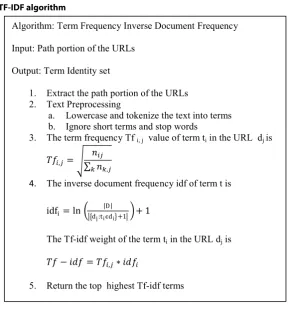
While investigating the URLs of the phished and legitimate dataset, it was found that certain keywords occur frequently in the phished URL. Therefore (TF-IDF) method is used to obtain the term frequency identity set from the path portion of the URLs and repeated keywords were examined. It was found that the Phishing URL contains many frequently repeated keywords such as suspend, confirm, PayPal etc. The frequency of the keyword is calculated for the entire URLs. If the most commonly used keywords are pre-sent in the path portion of the URL, then the URL is a phished URL. On analyzing the phishtank dataset, 91.08 % of URL has certain keywords in the path portion of the URL. Table 1 shows the algorithm of TF-IDF.
Therefore, the heuristic is defined as H6=
if (IP address in URL)→Phishing URL else, Legitimate URL
H7=
if (Unicode in URL)→Phishing URL
else, Legitimate URL
H8=
if (URL is http)→Phishing URL else, Legitimate URL
H9=
Heuristics 11: top level domain
The host name of the URL includes the top level domain, secondary level domain and the domain. The top level domain part of the URL is checked for existence. If the top level domain is not available in the host name of the URL then it is a phished URL otherwise the URL is a legitimate URL. Hence, the existence of the top level domain in the phish-ing URLs is analyzed and 66.5 % of phished URLs are found without top level domain.
Therefore, the heuristic is defined as
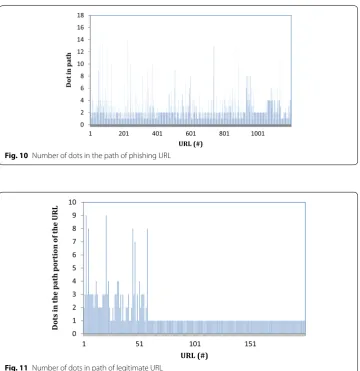
Heuristics 12: number of dots in the path of the URL
The path portion is retrieved from the URL. The path portion of the URL is examined for the occurrence of dots. The number of dots in the path portion of the URL is ana-lyzed for both URLs. The distribution of the dots in the path of the URL for phishing URL is plotted in Fig. 10. The number of dots (Ω) in the path of the URL is found to be greater than two. The distribution of dots in the path portion of the URL for legitimate URL is plotted in Fig. 11. The number of dots (Ω) in the path of the URL is found to be less than two.
Therefore, the heuristic is defined as H10=
if (Keyword in the path portion of URL)→Phishing URL else, Legitimate URL
H11=
if (Top Level Domain does not exists)→Phishing URL else, Legitimate URL
Table 1 TF-IDF algorithm
, = ∑
,
− = , ∗
Algorithm: Term Frequency Inverse Document Frequency
Input: Path portion of the URLs
Output: Term Identity set
1. Extract the path portion of the URLs 2. Text Preprocessing
a. Lowercase and tokenize the text into terms b. Ignore short terms and stop words
3. The term frequency Tf i, j value of term tiin the URL dj is
4. The inverse document frequency idf of term t is
idfi= ln |D|
dj:tiϵdi+1 + 1
The Tf-idf weight of the term tiin the URL djis
Heuristics 13: hyphen in the host name of the URL
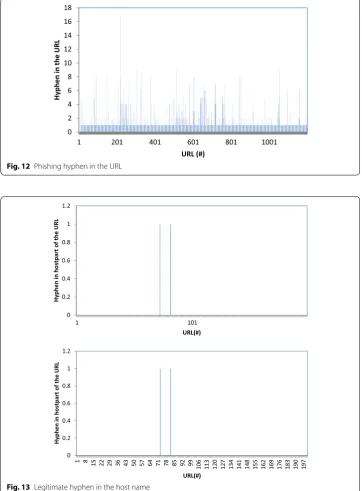
The results confirm that the presence of more than one hyphen in the host name of the URL may indicate that it is a phishing URL. Legitimate URLs are found to have at the most one hyphen in majority of cases. Figures 12 and 13 show the distribution of num-ber of hyphen in the host part of phishing and legitimate URLs. The numnum-ber of hyphen () in the host part of the URL is found to be greater than 1 for phishing URLs. The
num-ber of hyphen () in the host part of the URL is found to be 1 for legitimate URLs. http://
www.merchant-credit-card-account.net/PeyPol/profile.php is a phishing URL in which the hyphen available in the host portion of the URL is found to be three.
Therefore, the heuristic is defined as
H12=
if path(dot) > Ω →Phishing URL else, Legitimate URL
H13=
if hyphen(hostname) >→Phishing URL else, Legitimate URL
0 2 4 6 8 10 12 14 16 18
1 201 401 601 801 1001
Dot in path
URL (#) Fig. 10 Number of dots in the path of phishing URL
0 1 2 3 4 5 6 7 8 9 10
1 51 101 151
Dots in the path portion of the URL
Heuristics 14: URL length
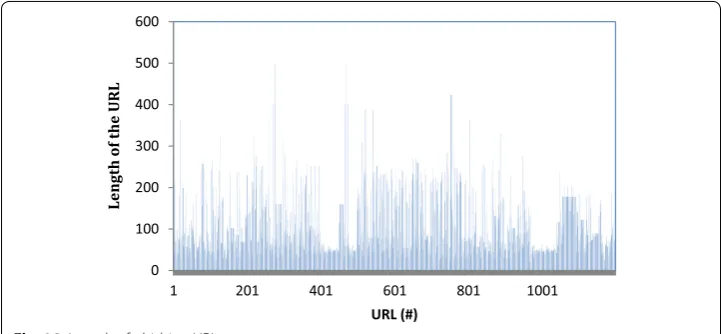
The URL is checked for the occurrence of phishing attack. Long URLs are used by the phisher to hide the doubtful part of the URL. If the length of the URL is greater than β then the URL is identified as phished URL otherwise legitimate URL. Figures 14 and 15 show the distribution of the length of the URL for both phished and legitimate URLs. The average length of the legitimate URL (β) is found to be 40. The average length of the phishing URL (β) is found to be greater than 75.
Therefore, the heuristic is defined as 0 2 4 6 8 10 12 14 16 18
1 201 401 601 801 1001
Hyphen
in the URL
URL (#) Fig. 12 Phishing hyphen in the URL
0 0.2 0.4 0.6 0.8 1 1.2 1 0 1 1
Hyphen in hostpart of the URL
URL(#) 0 0.2 0.4 0.6 0.8 1 1.2
1 8 15 22 29 36 43 50 57 64 71 78 85 92 99 106
11 3 12 0 12 7 13 4 14 1 14 8 15 5 16 2 16 9 17 6 18 3 19 0 19 7
Hyphen in hostpart of the URL
Association rule mining
Data mining is the method that tries to get patterns in massive information sets. The overall objective of data mining method is to extract information from data set and remodel it into comprehensible structure. The objective of the association rule mining is used to discover associations among items in a set, by mining essential knowledge from the database. The algorithm was proposed by Agrawal et al. [26]. Support and con-fidence techniques are used to assess the association rules. Support is the proportion of transactions wherever the rule holds. Confidence is the conditional probability of C with reference to A or, in different words, the relative cardinality of C with reference to A.
Apriori is an important algorithm for mining frequent itemsets. This algorithm uses past information of frequent itemset properties. To select fascinating rules from the set of possible rules, constraints on numerous measures of significance and interest are used. Support and confidence are the measures of rule that replicate the quality and cer-tainty of a rule. Predictive apriori is an algorithm proposed by [27], which exploits the accuracy of association rules, on hidden data. Apriori grades the rules with respect to
H14=
if
length of URL
> β→Phishing URL else, Legitimate URL
0 50 100 150 200 250 300 350 400 450
1 51 101 151
Length of the URL
URL (#)
Fig. 15 Length of legitimate URL
0 100 200 300 400 500 600
1 201 401 601 801 1001
Length of the URL
URL (#)
confidence alone but predictive apriori deliberates the confidence and support together in ranking the rules. The support and confidence is joined in a single measure called accuracy.
Association rule mining to detect phishing URL
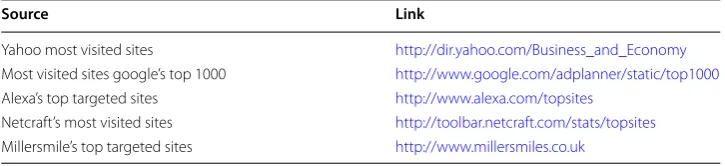
The process of identifying the type of a URL is generated using association rules in which the different heuristics are utilized to acquire unknown knowledge. This rule is used to ascertain the URL type when a user accesses it. We have recognized different heuristics extracted from the URLs and collected over 1400 URLs from several sources. Legitimate URLs is acquired from five sources and is shown in Table 2 and we collected 1200 phish-ing URLs from phishtank database (http://www.phishtank.com). The feature extraction is implemented in PHP. The experiments were performed using WEKA. WEKA a data mining tool incorporates collection of machine learning algorithms. The experiments have been performed with apriori and predictive apriori rule generation algorithms. The experiment is done to discover the rules based on phishing URLs. Detail of this experi-ment is provided in the following subsections.
Rule extracted from apriori
Association rules play a major role in finding interesting patterns. Association rules deliver information within the kind of “if–then” statements. The rules are computed from the information and are probabilistic in nature. Association rule mining is used to explore the hidden relationship between the attributes. In the proposed work, associa-tion rule mining has been used for detecting the frequently occurring features in phish-ing URLs. All the attributes selected in the data set are binary attributes and only the phishing URLs are mined using the apriori algorithm for identifying the recurring pat-terns. The strong rule generated by the apriori with 100 % confidence alone has been considered for further analysis and the other rules are discarded.
(1)
Supp(X)= Number of times X appears
N =P(X)
(2)
Supp(XY)= Number of times X and Y appears together
N =P(X∩Y)
(3)
Conf(X→Y)= Supp(XY)
Supp(X) =
P(X∩Y)
P(X)
(4)
Support, Confidence
=Accuracy
Table 2 Legitimate data source
Source Link
Yahoo most visited sites http://dir.yahoo.com/Business_and_Economy
Most visited sites google’s top 1000 http://www.google.com/adplanner/static/top1000
Alexa’s top targeted sites http://www.alexa.com/topsites
Netcraft’s most visited sites http://toolbar.netcraft.com/stats/topsites
The result of the analysis is shown in Table 3. The results show that most of phish-ing URL are without transport layer security. Other features indicatphish-ing a phishphish-ing URL include subdomain in the URL and certain keyword in the path portion of the URL. Sim-ilarly the special characters in the host name of the URL, top level domain does not exist in the URL and Unicode in the URL were all possible features that are available in the phishing URL. To conclude the investigation features such as transport layer security, unavailability of the top level domain and keyword in the path portion of the URL fre-quently occur together in phishing URL.
Rule extracted from predictive apriori
The detailed study and analysis of phishing URL were carried out and the results indicate that in predictive apriori algorithm few different rules are generated apart from apriori. The rules generated by predictive apriori are based on accuracy. The result obtained from predictive apriori is shown in Table 4. The strong rule generated by the predictive apriori with accuracy level above 99 % has been considered for further analysis and the other rules are discarded. An investigation on the itemsets reveals that the features like transport layer security, unavailability of the top level domain in the URL and keyword within the path portion of the URL were found to be sensible indicators for phishing URL. In addition to this number of slashes in the URL, dot in the host portion of the URL and length of the URL are also the key factors for phishing URL. Other features such as special characters in the URL, Unicode in the URL, length of the URL is greater than 75 and more than four dots in the host name of the URL were also found to be sig-nificant features of phishing URL.
Table 3 Rules extracted for phishing URL through apriori algorithm Algorithm: Apriori
Rules:
Overall the two algorithms generated different rules. Apriori algorithm is faster com-paring to predictive apriori. Comcom-paring the experimental results, it is seen that the fea-tures such as subdomain, URL without transport layer security and keyword in the path portion of the URL are found in most of the phishing URL and these are obtained by using apriori algorithm. However, the number of slashes in the URL is greater than or equal to five, top level domain does not exists in the URL, keyword in the path portion of the URL and special characters in the URL are found in most of the phishing URL and are obtained using predictive apriori algorithm. The algorithms are compared with the execution time for different number of instances. The execution time for both the algorithms is shown in Table 5. The graphical representation of the computational time for apriori and predictive apriori is shown in Fig. 16. It has been observed that the pre-dictive apriori requires more time than the apriori to generate rules. Finally, it is inferred that when the number of instances is increased the time taken for both the algorithm is increased.
The best unique rules generated from apriori and predictive apriori for various size of the phishing input dataset is considered. The graphical representation of the number of rules mined for apriori and predictive apriori is shown in Fig. 17. Thirty-one unique rules are mined by predictive apriori when 100 % of the input dataset is used. When Table 4 Rules extracted for phishing URL through predictive apriori algorithm
Algorithm:Predictive Apriori
10 % of the input data set is mined using apriori algorithm 27 best unique rules are gen-erated The time taken to generate the rules by predictive apriori is much higher than apriori. Apriori is able to mine the rules must faster. Although, predictive apriori mines unique rules the rules mined by apriori is considered for further process. The rule gen-erated by the training dataset is checked for a sample input data set. 93 % of the test dataset contain URL without transport layer security, keyword in the path portion of the
0 5 10 15 20 25 30 35
10% 50% 100%
Number of Rules
Phishing Input Dataset
Apriori
Predicve Apriori
Fig. 17 Number of effective rules of algorithms in various instances
0 50000 100000 150000 200000 250000
500 1000 1500 2000 2500 3000
Time Taken (ms)
No. of Instances
Apriori Predicve Apriori
Fig. 16 Comparision of computational time of algorithms
Table 5 Execution time of algorithms
No. of instances Apriori (ms) Predictive apriori (ms)
500 0 10,958
1000 1 23,996
1500 1 39,002
2000 2 48,000
2500 2 109,982
URL and without top level domain. 90 % of the test data set contain number of slashes in URL is greater than or equal to five, without transport layer security and keyword in the path portion of the URL. 88 % of the test data set contains more than four dots in the host portion of the URL, without transport layer security and number of terms in the host portion of the URL is greater than four. About 79 % of the test data set contains number of slashes in the URL is greater than or equal to five, dots in the host URL is greater than four and length of the URL is greater than 75. Ninety percentage of the test data set contains dots in the host name of the URL, without transport layer security and keyword in the path portion of the URL. About 88 % of the test data set dots in the host URL is greater than four, keyword in the path portion of the URL and does not contain top level domain in the host portion of the URL. Overall 93 % of the phishing URL are detected using the rules obtained by apriori algorithm.
Conclusion
In this paper, the features of the URL are analyzed and are subjected to associative rule mining—apriori and predictive apriori. The rules obtained are interpreted to emphasize the features that are more prevalent in phishing URLs. The results obtained from rule mining have highlighted the useful features available in the phished URL. Analyzing the information available on phishing URL and considering confidence as indicator, the fea-tures such as transport layer security, unavailability of the top level domain in the URL and keyword within the path portion of the URL were found to be sensible indicators for phishing URL. In addition to this number of slashes in the URL, dot in the host portion of the URL and length of the URL are also the key factors for phishing URL.
Authors’ contributions
SCJ carried out the studies, and drafted the manuscript. EBR provided full guidance and revised the manuscript to high standards. Both authors read and approved the final manuscript.
Author details
1 Department of Computer Applications, Karunya University, Coimbatore, India. 2 Director (Collaborations), Karunya University, Coimbatore, India.
Competing interests
The authors declare that they have no competing interests.
Received: 1 September 2015 Accepted: 2 May 2016
References
1. https://ers.trendmicro.com/guide/en_us/AG/AppA/Phish_Attack.htm. Accessed May 2015 2. http://www.consumeraffairs.com/news04/2005/gartner.html. Accessed June 2015
3. http://www.emc.com/collateral/fraud-report/rsa-online-fraud-report-012014.pdf. Accessed June 2015
4. http://www.symantec.com/content/en/us/enterprise/other_resources/bistr_main_report_v19_21291018.en-us.pdf. Accessed June 2015
5. RSA Anti-Fraud Command Center. RSA monthly online fraud report. (2014). http://www.emc.com/collateral/fraud-report/rsa-online-fraud-report-012014.pdf. Accessed July 2015
6. Zhang Y, Hong JI, Cranor LF (2007) CANTINA: a content based approach to detecting phishing web sites. In: Pro-ceedings of the 16th international conference on world wide web, Banff, p 639–648
7. Xiang G, Hong J, Rose CP, Cranor L (2011) CANTINA+: a feature-rich machine learning framework for detecting phishing web sites. ACM Trans Inf Syst Secur 14:21
8. Huang H, Qian L, Wang Y (2012) A SVM based technique to detect phishing URLs. Int Technol J 11(7):921–925 9. Liébana-Cabanillas F, Nogueras R, Herrera LJ, Guillén A (2013) Analysing user trust in electronic banking using data
mining methods. Expert Syst Appl 40:5439–5447
10. Li Y, Xiao R, Feng J, Zhao L (2013) A semi-supervised learning approach for detection of phishing webpages. Optik 124:6027–6033
12. Chen X, Bose I, Leung ACM, Guo C (2011) Assessing the severity of phishing attacks: a hybrid data mining approach. Expert Syst Appl 50:662–672
13. Nishanth KJ, Ravi V, Ankaiah N, Bose I (2012) Soft computing based imputation and hybrid data and text mining: the case of predicting the severity of phishing alerts. Expert Syst Appl 39:10583–10589
14. Liu W, Deng X, Huang G, Fu AY (2006) An antiphishing strategy based on visual similarity assessment. IEEE Computer Society 1089-7801/06 IEEE, IEEE Internet Computing
15. Medvet E, Kirda E, Kruegel C (2008) Visual-similarity-based phishing detection. SecureComm. In: Proceedings of the 4th international conference on Security and privacy in communication netowrks. pp 22–25
16. Fu AY, Wenyin L, Deng X (2006) Detecting phishing web pages with visual similarity assessment based on earth mover’s distance. IEEE Trans Dependable Secure Comput 3(4):301–321
17. Lam IF, Xiao WC, Wang SC, Chen KT (2009) Counteracting phishing page polymorphism: an image layout analysis approach. Springer-Verlag, Berlin
18. Chen KT, Chen JY, Huang CR, Chen JY (2009) Fighting phishing with discriminative keypoint features of webpages. IEEE Internet Comput 13:56–63
19. Shah R, Trevathan J, Read W, Ghodosi H (2009) A proactive approach to preventing phishing attacks using Pshark. In: Sixth international conference on information technology: new generations. IEEE, Las Vegas, pp 915–921
20. He M, Horng SJ, Fan P, Khan MK, Run RS, Lai JL et al (2011) An efficient phishing webpage detector. Expert Syst Appl 38(10):18–27
21. Aburrous M, Hossain MA, Dahal K, Thabtah F (2010) Intelligent phishing detection system for e-banking using fuzzy data mining. Expert Syst Appl 37(12):7913–7921
22. Zhang D, Yan Z, Jiang H, Kim T (2014) A domain-feature enhanced classification model for the detection of Chinese phishing e- business websites. Inf Manag 51:845–853
23. Abdelhamid N, Ayesh A, Thabtah F (2014) Phishing detection based associative classification data mining. Science-Direct 41:5948–5959
24. Han W, Cao Y, Bertino E, Yong J (2012) Using automated individual whitelist to protect web digital identities. Expert Syst Appl 39:11861–11869
25. http://www.securityweek.com/use-subdomains-leads-increased-uptime-phishing-attacks. Accessed June 2015 26. Agrawal R, Imielinski T, Swami A (1993) Mining association rules between sets of items in large databases.
ACM-SIGMOD 22:207–216