Recommendedcitation
Jareño, F., Jiménez, J.J. & Lagos, M.G. (2014). Cooperativelearninginhighereducation:differencesinperceptionsofcontributiontothegroup. RUSC. Universities and Knowledge Society Journal, 11(2). pp. 66-80. doihttp://dx.doi.org/10.7238/rusc.v11i2.1936
Abstract
Thisdocumentanalysescooperativelearninginaworkinggroupusingaproblem-basedlearningmethodology.
Wealsoevaluateiftheperceptionthateachmemberofthe grouphas ofhis/hercontributiontocooperative
learningisgreaterorlesserthanthatobservedbyhis/herteam-mates. Differentelementsoftheworkcarriedout
inthegroupareanalysed, suchas theeffectiveeffort made, theirparticipation, the organisationofthegroup,
cohesion, communication, andtheoverallperceptionoftheirinvolvementinthecooperativelearningandwork.
Itisobservedthatthestudentsperceivetheircontributionasgreaterthanthatperceivedbytheirteam-mates,
althoughwe findslightdifferencesdependingontheelementsanalysed.
Keywords
cooperativelearning, interdisciplinaryapproach, problem-basedlearning(PBL), highereducation
Aprendizaje cooperativo en educación superior: diferencias en la percepción de la contribución al grupo
Resumen
Este documento analiza el aprendizaje cooperativo en un grupo de trabajo en el que se utiliza metodología del
aprendi-zaje basado en problemas. Además, se evalúa si la percepción que cada componente del grupo tiene de su aportación
al aprendizaje cooperativo es mayor o menor que la percibida por sus compañeros. Se analizan diferentes aspectos del
trabajo desarrollado dentro del grupo, como son el esfuerzo efectivo realizado, su participación, la organización del grupo,
la cohesión, la comunicación y la percepción global de su implicación en el trabajo y el aprendizaje cooperativo. Se
obser-va que los estudiantes perciben que su aportación es mayor que la percibida por sus compañeros, aunque encontramos
ligeras diferencias en función de los aspectos analizados.
Palabras clave
aprendizaje cooperativo, interdisciplinariedad, aprendizaje basado en problemas (ABP), educación superior
C
ooperati
v
e
learning
in
higher
education:
di
ff
erences
in
perceptions
of
contri
b
ution
to
the
group
F
rancisco
Jare
ñ
o
1,
Juan
Jos
é
Jim
é
ne
z
2and
M.
G
a
b
riela
L
agos
31. UniversityofCastilla-LaMancha(UCLM), Spain|[email protected] 2. UniversityofCastilla-LaMancha(UCLM), Spain| [email protected] 3. UniversityofCastilla-LaMancha(UCLM), Spain|[email protected]
Submittedin:September2013
1
.
I
ntroduction
Ourobjectiveistostudythecooperativelearningdevelopedinanactivitythatappliesproblem-basedlearning
(PBL)withstudents of theBusiness Administration and Management degree at the Faculty ofEconomic and
BusinessSciencesof Albacete, UniversityofCastilla-LaMancha(UCLM), Spain.
PBL, appliedtomultidisciplinaryactivities, isanappropriatetechniqueforreachingtheobjectivesofcompetency
development, suchasindividualresponsibility, autonomouswork, leadership, commitmenttothegroup, etc.
Moreover, weanalysetheperceptionthatstudentshaveoftheworkcarriedoutinthegroupincomparison
totheperceptionthattheirteam-mateshaveoftheircontributiontothegroup. Theresultsobtainedshowthat
theperceptionofthestudentsinrelationtothecontributiontheymaketothegroupisgreaterthanthatactually
observedbytherestofthemembersofthegroup.
Inourview, itisimportanttocontrasttheself-evaluationofthestudentwiththatreceivedfromthegroupinorder
tovalidatethisteachingmethodinuniversitypractices. Oneoftheconstantcomplaintsofthestudentsinrelation
togroupworkisitsimpactonthe finalgradeofthesubject, sincetheyconsiderthistobenegative; thatis, they
tendtoperceivetheircontribution, andthus, theirgrade, ashigherthantheactualone, intermsofpeerevaluation.
Therestofthisworkisstructuredinthefollowingway:inthesecondsection, welookatthebackgroundof
cooperativelearning, thethirdsectiondescribesthecaseinhand, andinthefourthsectionthemethodologyused
isexplained. Finally, theresultsobtainedareanalysedinthe fifthsectionand, inthesixth, themainconclusionsare
highlighted.
2. Cooperative learning and problem-based learning methodology
ThisarticlestudiescooperativelearningframedinanactivitydevelopedusingaPBLmethodology. Thistypeof
learningactivelyinvolvesthestudentintheprocess, whichallowsforanincreaseintheirmotivation. Itstimulates
thestudenttoarguehis/hercontributionsindebateswiththerestofthegroupmembers. PBLisbasedonthe
considerationofaproblempreparedor selectedbytheteacher, theresolutionofwhichwilldemandthatthe
studentsacquireanddevelopcertainpreviouslydefinedcompetencies. Inthismethodology, theteacheradopts
theroleoffacilitatorandnottransmitterofknowledge(Jiménez etal., 2013), whichmeansachangeintheclassic
paradigmoftheteaching-learningprocess.
Arias-Gundín (2008) and Domingo (2008) highlight the importance of the renovation of certain teaching
methodologiesinthe new contextofhigher education, althoughthey alsopointtothe difficulties thattheir
applicationinvolves. Oneofthesedifficultiesisfoundintheprecisedefinitionofcooperativeworkandcollaborative
work; thus, whiletheformerinvolvesstricterandmoreformaldirectionbytheteacher, collaborativeworkallowsfor
agreaterdegreeofstudentautonomy. However, theadvantageofcooperativelearningwarrantsitsapplicationin
thiscase, sincesomecontrolofthestudents’activitiesisanobjectivewedeemexpedient. Inanycase, theseactive
methodologiesimprovetheachievementofcompetencies(PujolàsiMaset, 2009), astheycombinetheacquisition
ofknowledgewiththedevelopmentofcapabilities, attitudes, skills, etc.; thesearenecessarycompetencies for
professionalperformance. Buttheseauthorswarnofthelimitationsanddifficultiesofapplyingactivemethodologies,
andtheyhighlighttheconsiderableeffort demandedoftheteachers, thenecessarychangeofattitude inthe
SantillánandSiordía(2011)arguethatthistypeoflearninghighlightstheworkcarriedoutinthegroup, aswell
asthejointeffortsbetweenteachersandstudents, andtheygivespecialimportancetotheactiveandinteractive
participationofthestudents. Alongsimilarlines, Jiménez etal. (2013)highlighttheimportanceofthistypeofactive
workmethodologiesorlearningstrategiesinordertodevelopprofessionalcompetencies, like, forexample, the
capacityforeffectivecommunicationandlifelongself-learning.
Muchoftheliteratureconfirmsthefactthatstudentswhoworkincooperativegroupshaveagreatersenseof
belongingtothegroupandbecomeactivelyinvolvedinthelearningprocess, incontrasttowhathappenswith
othertechniquesor methodologies. Incooperativelearning, thestudentsmust completeataskinwhicheach
individualshouldnotonlybeconcernedwithhis/herownlearning, butalsowiththatoftherestofhis/herteam
-mates.
AccordingtoJohnsonandJohnson(1987), Lobato(1997), andDomingo(2008), fortheworkinacooperative
grouptobeeffective, fivebasiccomponentsmustbepresent:positiveinterdependence(“theyaresavedtogether
ortheydrowntogether”), positiveinteraction(themembersofthegroupencourageandsupportoneanother),
individualdemandsorpersonalresponsibility(withindividualquestionsortests), cooperativeabilities(leadership,
communication, conflictmanagement, etc.)and, finally, self-analysisofthegroup’sfunctioning(tocorrectpossible
malfunctions).
ForEcheita(1995), JohnsonandJohnson(1989), Slavin(1990), andLeóndelBarcoandLatas(2007), threebasic
requirementsmustbemetinordertobeabletospeakofcooperativelearning:
r UIFFYJTUFODFPGBUBTLUIBUNVTUCFDBSSJFEPVUJOBHSPVQ r UIFSFTPMVUJPOPGUIBUUBTLPSQSPCMFN
r UIBUUIFHSPVQTSFTPVSDFTCFTVîDJFOUUPNBJOUBJOBOEUBLFGPSXBSEJUTBDUJWJUZ
Thisargumentjustifiestheanalysisdevelopedinthisresearch, giventhatastrategyoflearningwithcooperative
groups fitsperfectlywiththeadoptionofaPBLmethodology, accordingtotherequirementsdescribedinthe
literature.
Indeed, Fernández etal. (2006)cometotheconclusionthatoneoftheelementsmosthighlyvaluedbythe
studentsthathavefollowedaPBLapproachisthecooperativework. Besidesthis, theyalsovaluetheuseofreal
problemsandthecreationofknowledgeor, thatis, ofself-learning.
3. Description of the problem-based learning activity
Theprojectpresentedinthisarticleconsistsofaninterdisciplinaryactivityacrosstheareasofstrategy, taxation, and
finances, framedinaspecialisationseminarforthebachelor’sdegreesinBusiness AdministrationandManagement
andinEconomicsattheFacultyofEconomicandBusinessSciencesof Albacete, UCLM.
ThemainobjectiveoftheactivityistoemployaPBLmethodologyincorporatingthreesubjectsofthedegree
inBusiness AdministrationandManagement:strategicmanagement, taxationsystems, and financialmanagement,
suchthatthecomplementarityofthecontentandcompetencies allowsbusiness problemstobetackled ina
comprehensiveway. Furthermore, inthisarticlewespecificallyanalysetheperceptionthatthestudentshavein
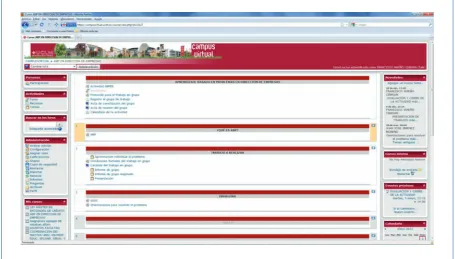
Figure 1. View of the open virtual space on Moodle
The activityisorganisedintotwoface-to-facesessionsoftwohours(onewithpresentationsandanotherwith
projectexposition andclosing)andautonomouswork(firstindividuallyand theninthegroup) lastingtwenty
hours, guidedthroughface-to-faceand/orvirtualtutorials, withsupportfromtheseminar’svirtualspacelocated
onMoodle(seeFigure1).
Inthe firstface-to-facemeeting, theteacherinformsthestudentsaboutPBL, presentsthewayofworkingina
PBLactivity, andhighlightsthemainrolesthatthemembersofthecooperativeworkinggroupsmustfulfil. Finally,
theformalaspectsarecommunicatedtothestudents(protocols, make-upofthegroup, meetingminutes, etc.), as
istheactivity’stimetable, inwhichthetimingoftheworktobecarriedoutisexplained. Furthermore, therearetwo
phasestotheproject:
r "first phase of individual work, fromwhichanapproachfortacklingorsolvingtheproblememerges. Escribano
andJareño(2013)identifythetasksthatthestudentshouldcarryoutinthis firstphase, whichinvolvesidentifying
theproblemsthatappearinthesituationconsidered, dealingwiththelearninginvolved, andtheabilities, skills,
andcompetenciesnecessaryforreachingalternativeresolutionsthateachstudent, individually, shouldpropose.
r "second phase of group work, throughcooperativelearning. Fromthisphaseasecondreportemerges, which
showstheproposedsolutiontotheproblemthattheworkinggroupconsiders. EscribanoandJareño(2013)
showthatthemembersofeachgroupwilldebatetheproblemstoberesolved, withcooperativework, sinceallof
themembersofthegroupshouldparticipateandcontributevalue. Thus, allofthemembersofthegroupshould
becapableofdefendinganypartoftheprojectandareresponsibleforthesolutioncontributedinitsentirety.
… theworkmethodologydeveloped […] highlightstheimportanceofthestudentscarryingouta firstindividualstudy
andanalysisoftheproblem, detectingandidentifyingwhatdifficultiesthey findinthesituationconsidered. Onthe
individuallevel, eachstudentshouldpresentawrittenreportwithaninitialapproachtotheproblem. Inthisway, the
studentswillbeabletotakemorefromthesecondphase, whichconsistsofgroupwork(collaborativeorcooperative). If
thestudentshavestudiedandevaluatedpreviouslyandindividuallytheproblemsofthesituationconsidered, thegroup
workwillconsistofsharingtheindividualanalysisdeveloped, aswellastryingto findbettersolutionsinacooperativeway.
Consideringtheworkin twophases(one individual and another in-group) allows ustoanalyse what impact
thegroupworkhas onthequalityoftheresolutionoftheproblem. Itisexpectedthatsuchresolutionwillbe
considerablyricherifthestudentstakeadvantage ofthegroup-workphasetocooperativelyanalyse allofthe
possiblesolutionsandincorporatethemintothe finalreport.
Withtheconclusionofeachphase, anevaluationoftheworkcarriedoutiscollected. Thisresearchfocuses
exclusivelyonanalysing and evaluatingtheperception thateachmember has oftheworkcarried outin the
cooperativegroup, thatis, thecontributionofeachstudenttothegroupwork.
4
.
Methodolog
y
used
to
anal
y
se
the
di
ff
erences
in
perceptions
of
w
or
k
contri
b
uted
to
the
group
Inordertoanalysetheperceptionthatthestudentshaveoftheworkcarriedoutinthegroupincomparisonto
theperceptionthattherestofthemembershaveoftheircontributiontothegroup, differentaspectsofthegroup
workareexamined, suchaseffectivework, participation, organisationofthegroup, cohesion, communication, and
overallperceptionoftheirinvolvementinthecooperativeworkandlearning.
Tothatend, weproposetheuseofaquestionnaireevaluatingtheperceptionoftheworkofeachmemberof
thegroup(forthepersoninquestionaswellasfortherestofthemembers). Inaccordancewiththecategoriesof
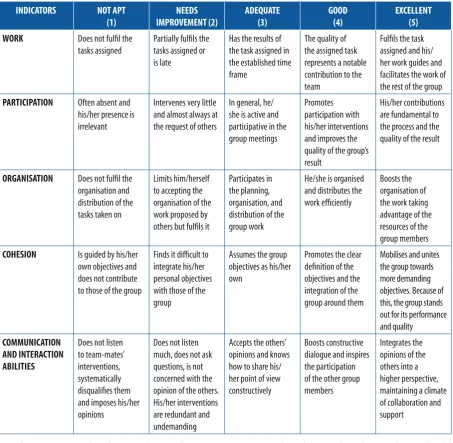
evaluationproposedbyMartín(2010), wethereforeanalysequalitativevariables(see Table1).
Thisquestionnaireshowstheopinionsofthestudentsinrelationtothe indicators thatgatherinformationon
theseelements:
r Work:assessmentofwhether(ornot)thestudentcarriesouttheassignedtaskswithintheagreedtimeframe.
r Participation:analysisoftheactiveparticipationofeachstudentinthemeetingsandhis/hersharingofinformation,
knowledge, andexperiences.
r Organisation:assessmentofwhetherthestudentcollaboratesinthedefinition, organisation, anddistributionof
thegroup’stasks.
r Cohesion:assessmentofwhetherthestudentgetsinvolvedintheachievementofthecommonagreementsand
objectives.
r Communication and interaction abilities:assessmentofwhethereachstudentconsidersthepointsofviewofthe
othersandprovidesconstructivefeedback.
Eachstudentevaluatestheseelementsoftheworkcarriedoutbyeachmemberofthegroupintheprocessof
3 = adequate, 4 = good, and5 = excellent. Inthequestionnaire, itisexplainedthateachstudent“evaluator”should
fillinthe firstcolumnwithhis/herself-evaluationforthedifferentindicators, andinthefollowingcolumnshe/she
shouldevaluatetheothermembersofthegroupandproposeimprovements.
In accordance with Amo and Jareño (2011), the data obtained from the aforementioned questionnaire
isprocessed bycreatingameasure thatallows ustoanalyse theperceptionthatthe team-mateshaveofthe
contributionofastudenttothegroup, andifthisdiffersfromtheperceptionorassessmentthattheevaluated
studenthasofhis/herowncontribution.
Weconsideravariablecalled dif, whichisdefinedas:
difj = Ev.teammatesj – Selfevaluationj (1)
wheredif
jisthevariablethatshowsthedifferencebetweentheevaluationgivenbytheteam-matesonthe
workcontributedtothegroupforeachperson j andhis/herself-evaluation.
Table 1. Extract of the evaluation questionnaire used to analyse perceptions of the work contributed in the process of cooperative learning
INDICATORS NOT APT (1) NEEDS IMPROVEMENT (2) ADEQUATE (3) GOOD (4) EXCELLENT (5)
WORK Does not fulfil the
tasks assigned
Partially fulfils the tasks assigned or is late
Has the results of the task assigned in the established time frame
The quality of the assigned task represents a notable contribution to the team
Fulfils the task assigned and his/ her work guides and facilitates the work of the rest of the group
PARTICIPATION Often absent and
his/her presence is irrelevant
Intervenes very little and almost always at the request of others
In general, he/ she is active and participative in the group meetings
Promotes participation with his/her interventions and improves the quality of the group’s result
His/her contributions are fundamental to the process and the quality of the result
ORGANISATION Does not fulfil the
organisation and distribution of the tasks taken on
Limits him/herself to accepting the organisation of the work proposed by others but fulfils it
Participates in the planning, organisation, and distribution of the group work
He/she is organised and distributes the work efficiently
Boosts the organisation of the work taking advantage of the resources of the group members
COHESION Is guided by his/her
own objectives and does not contribute to those of the group
Finds it difficult to integrate his/her personal objectives with those of the group
Assumes the group objectives as his/her own
Promotes the clear definition of the objectives and the integration of the group around them
Mobilises and unites the group towards more demanding objectives. Because of this, the group stands out for its performance and quality
COMMUNICATION AND INTERACTION ABILITIES
Does not listen to team-mates’ interventions, systematically disqualifies them and imposes his/her opinions
Does not listen much, does not ask questions, is not concerned with the opinion of the others. His/her interventions are redundant and undemanding
Accepts the others’ opinions and knows how to share his/ her point of view constructively
Boosts constructive dialogue and inspires the participation of the other group members
Toobtainameasureoftheteam-mates’evaluation, anequally weightedmeanoftheassessmentsthatthe
team-matesawardtotheevaluatedstudentiscalculated:
Ev.teammatesj = ∑
k
i=1 Ev.teammates
i j (2)
Here, thevariable Ev.teammatesi
j referstotheevaluationthatthestudent i ofthegroupassignstothestudent j
analysed.
Thus, if(2)isincorporatedinto(1), intheendwehavethefollowingdefinitionofthevariable dif
j:
dif
j =
∑k
i=1 Ev.teammatesij – Selfevaluation
j (3)
Theinterpretationofthevaluethatthisvariablemaytakeis:
r *Gdifj > 0¤DIFPOSIT ¤ Theteam-mateshaveaperceptionoftheworkcontributedtothegroupbythestudent
analysedthatisgreaterthanthatperceivedbythestudenthim/herself.
r *Gdifj = 0¤DIF ZERO¤ Themembersoftheworkinggroupperceivethatthecontributionofthestudentanalysed tothegroupisexactlythesameaswhathe/sheassignstohim/herself.
r *Gdifj < 0¤DIFNEGAT ¤ Theteam-matesevaluatetheworkcontributedbythestudentanalysedwithalower
scorethanthatassignedbythestudenttohim/herself.
Thedistributionofthevariableallowsustodiscoverifthestudentsfeelvaluedornotinthegroup.
5
.
A
nal
y
sis
of
the
results
of
di
ff
erences
in
perceptions
of
w
or
k
in
cooperati
v
e
groups
Wetakeasampleof48students, dividedintoworkinggroupsofbetween3and5people, whoparticipatedin
thesamespecialisationseminarheldintheacademicyears2010/11(39students)and2011/12(9students). We
proposetoundertakeananalysisofthetotalsampleandofthesub-samplesforthetwoacademicyears, justincase
therearedifferentpatternsofbehaviour.
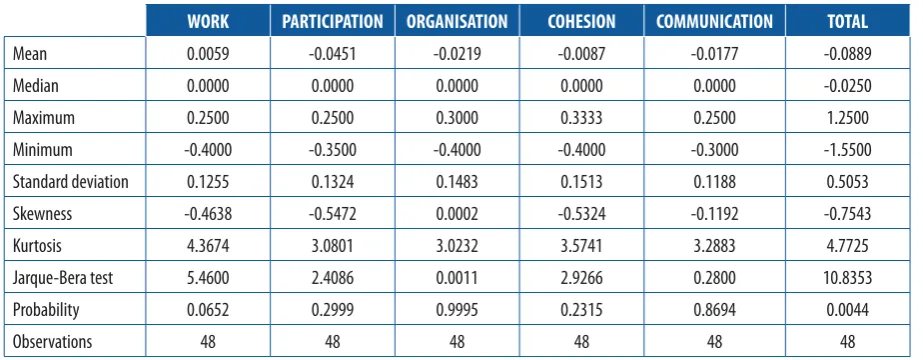
Firstly, thestatisticalprinciplesofthevariableproposedinthestudy(difj)areshown, bothforthetotalsample (Table2, Panel A)andforthetwosub-samples(Table2, PanelsBandC).
In Table2, we find apattern ofbehaviourthatisrepeatedinthetotalsample andinthetwosub-samples
analysed, whichcanbesummarisedinthefollowingresults:
t Work indicator:themeanoftheproposedvariable(difj)ispositive, whichmeansthattheassessmentthatthe
studentsawardthepersonanalysedisgreaterthanthatperceivedbythestudenthim/herself.
t Participation, organisation, and overall assessment (total):theresultsobtainedofferameanofthevariable difj that
showsnegativevaluesinthethreecases. Therefore, thestudentsperceivethattheircontributiontothegroupis
greaterthanthatwhichtheotherteam-matesawardtotheirworkintheprocessofcooperativelearning.
r Cohesion indicator:showsaresultthatisverysimilartotheprevious indicators, thevaluesofthevariabledifj
arenegativeforthetotalsampleandforthe firstsub-sample(academicyear2010/11). However, thesecond
sub-sample(academicyear2011-12)doesnotshowanydifferencesbetweenindividualself-evaluationandthe
evaluationmadebythegroup.
k
Table 2. Statistical principles of the variable difj, which represents the difference between the perception of the team-mates and that of
the individual student of the work contributed by each student.
Panel A: Total sample (academic years 2010/11 and 2011/12)
WORK PARTICIPATION ORGANISATION COHESION COMMUNICATION TOTAL
Mean 0.0059 -0.0451 -0.0219 -0.0087 -0.0177 -0.0889
Median 0.0000 0.0000 0.0000 0.0000 0.0000 -0.0250
Maximum 0.2500 0.2500 0.3000 0.3333 0.2500 1.2500
Minimum -0.4000 -0.3500 -0.4000 -0.4000 -0.3000 -1.5500
Standard deviation 0.1255 0.1324 0.1483 0.1513 0.1188 0.5053
Skewness -0.4638 -0.5472 0.0002 -0.5324 -0.1192 -0.7543
Kurtosis 4.3674 3.0801 3.0232 3.5741 3.2883 4.7725
Jarque-Bera test 5.4600 2.4086 0.0011 2.9266 0.2800 10.8353
Probability 0.0652 0.2999 0.9995 0.2315 0.8694 0.0044
Observations 48 48 48 48 48 48
Panel B: Academic year 2010/11
WORK PARTICIPATION ORGANISATION COHESION COMMUNICATION TOTAL
Mean 0.0051 -0.0427 -0.0162 -0.0107 -0.0231 -0.0850
Median 0.0000 0.0000 0.0000 0.0000 0.0000 0.0000
Maximum 0.2000 0.1333 0.3000 0.2000 0.2500 0.6000
Minimum -0.4000 -0.3500 -0.4000 -0.4000 -0.3000 -1.5500
Standard deviation 0.1095 0.1119 0.1376 0.1330 0.0986 0.4272
Skewness -0.9642 -1.1233 -0.2375 -1.1631 -0.2826 -1.5652
Kurtosis 6.7078 4.0234 3.7854 4.8299 4.4623 6.2811
Jarque-Bera test 28.3835 9.9030 1.3691 14.2352 3.9940 33.4195
Probability 0.0000 0.0071 0.5043 0.0008 0.1357 0.0000
Observations 39 39 39 39 39 39
Panel C: Academic year 2011/12
WORK PARTICIPATION ORGANISATION COHESION COMMUNICATION TOTAL
Mean 0.0093 -0.0556 -0.0463 0.0000 0.0056 -0.1056
Median 0.0000 -0.0833 -0.0833 0.0000 0.0000 -0.0833
Maximum 0.2500 0.2500 0.2500 0.3333 0.2500 1.2500
Minimum -0.2500 -0.3333 -0.2500 -0.2500 -0.2500 -1.2500
Standard deviation 0.1884 0.2083 0.1959 0.2244 0.1898 0.7953
Skewness 0.0615 0.1075 0.5942 0.1223 -0.2603 0.0596
Kurtosis 1.5481 1.5576 1.8670 1.5999 1.5800 2.3354
Jarque-Bera test 0.7962 0.7975 1.0110 0.7575 0.8578 0.1710
Probability 0.6716 0.6712 0.6032 0.6847 0.6512 0.9181
r Communication indicator:offersresultsthatalsovarybetweenthetotalsampleandthe firstsub-sampleandthe
secondsub-sample. Thedifj meanisnegativeinthe firstcase(thestudentsvaluethemselvesabovethegrade assignedbytherestofthegroupmembers), whereasthevaluebecomesslightlypositiveinthesecondcase
(eachstudentevaluateshim/herselfexactlythesameashis/herteam-matesdo)1.
Inordertoconfirmtheseresultswecancompareifthemeanvaluesstudiedaresignificantlydifferentfrom zero
ornot, tobeabletoconcludeif, indeed, theassessmentsawardedbytheteam-matestothestudentanalysedare
differenttothosethatthestudentassignstohim/herself.
Theresultsareshownin Table3:
Table 3. Comparison confirming if the mean of the variable difj is significantly different from zero
WORK PARTICIPATION ORGANISATION COHESION COMMUNICATION TOTAL
TOTAL 0.0059 -0.0451 a -0.0219 -0.0087 -0.0177 -0.0889
SUB-1 0.0051 -0.0427 a -0.0162 -0.0107 -0.0231 -0.0850
SUB-2 0.0093 -0.0556 -0.0463 0.0000 0.0056 -0.1056
a p < 0.05
The comparisonscarriedoutconfirmthatthemostimportantdifferences areinthe participation indicator. The
studentsperceivetheirinvolvementintheworkcarriedoutduringtheprocessofcooperativelearningasmuch
greaterthanthatcontributedbytherestoftheteam-mates. Thisconfirms thegeneralbeliefthatmost ofthe
studentshave, whichisthat, ingroupwork, itisperceivedthattheworkcarriedoutindividuallymaybebeingtaken
advantageofbythegroup’sso-called“parasites”. Thesestudentscontribute“little”tothegroup, buttheyobtainthe
samerewardastherestoftheteam-mates(unlessthesemalfunctionsareinterceptedbytheteam-matesand/or
bytheteacher).
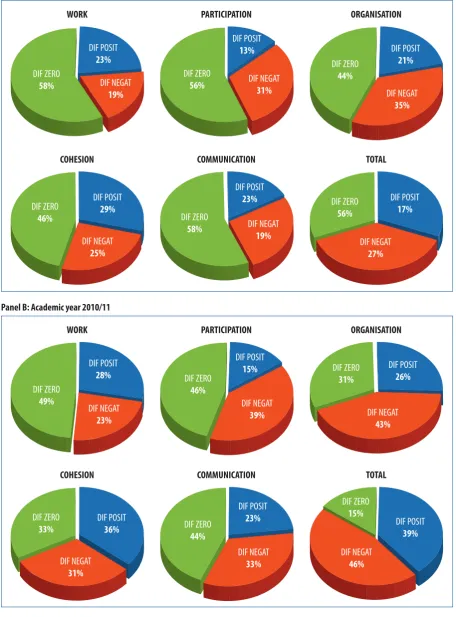
TheresultsobtainedareshowngraphicallyinFigure2, distinguishingbetweenthetotalsample(Panel A)and
thetwosub-samples(PanelsBandC).
WORK WORK DIF ZERO 58% DIF ZERO 49% DIF ZERO 46% DIF ZERO 33% DIF ZERO 58% DIF ZERO 44% DIF ZERO 56% DIF ZERO 15% DIF ZERO 44% DIF ZERO 31% DIF ZERO 56% DIF ZERO 46% DIF POSIT 23% DIF POSIT 28% DIF POSIT 13% DIF POSIT 15% DIF POSIT 21% DIF POSIT 26% DIF POSIT 17% DIF POSIT 39% DIF POSIT 23% DIF POSIT 23% DIF POSIT 29% DIF POSIT 36% DIF NEGAT 19% DIF NEGAT 23% DIF NEGAT 31% DIF NEGAT 39% DIF NEGAT 35% DIF NEGAT 43% DIF NEGAT 27% DIF NEGAT 46% DIF NEGAT 19% DIF NEGAT 33% DIF NEGAT 25% DIF NEGAT 31% COHESION COHESION PARTICIPATION PARTICIPATION COMMUNICATION COMMUNICATION ORGANISATION ORGANISATION TOTAL TOTAL
Figure 2. Percentage distribution of the differences between the perception of the group members and that of the student in relation to his/her contribution to the group
Panel A: Total sample (academic years 2010/11 and 2011/12)
WORK
DIF ZERO
11%
DIF ZERO
11% DIF ZERO
22%
DIF NULA 0% DIF NULA 0%
DIF NULA 0% DIF NULA 0%
DIF POSIT
45%
DIF POSIT
44%
DIF POSIT
33%
DIF POSIT
33%
DIF POSIT
45%
DIF POSIT
45%
DIF NEGAT
44%
DIF NEGAT
56% DIF NEGAT67%
DIF NEGAT
67%
DIF NEGAT
33%
DIF NEGAT
44%
COHESION
PARTICIPATION
COMMUNICATION
ORGANISATION
TOTAL Panel C: Academic year 2011/12
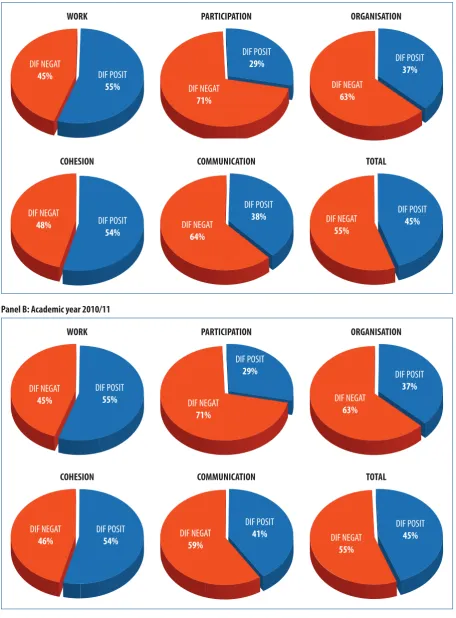
Sincethefundamentalobjectiveofthisworkconsistsin analysingif(significant)differencesexistbetweenthe
student’s perception of workcontributed tothe group and the perception his/her team-mateshave of said
contribution, weexcludethose zerodifferencesfound, whenbothevaluationscoincide. Thus, Figure3reproduces
theinformationshowninFigure2, buteliminatingDIF ZERO(dif
j = 0).
Regardingthedifferences, bothofthetotalsampleandofthesub-samples:
t Inrelationto participation, organisation, and total (overall assessment), similarresultsarefoundinthetotalsample andinthetwosub-samples, whichcanbesummarisedinhigherpercentagesofDIFNEGAT thanthosefoundfor
DIFPOSIT. Accordingtothis, thestudentsperceivethattheirinvolvementintheparticipation, organisationand,
ingeneral, intheworkundertakenintheprocessofcooperativelearninginthegrouphasbeenhigherthanthat
assessedbytherestofthestudentsinthegroup.
t Onanalysingthe communication indicator, weobserveadifferentpatternofbehaviourbetween, ontheonehand,
thetotalsampleandthe firstsub-sample(Panels A andB), andontheotherhand, thesub-samplecorresponding
toacademicyear2011/12(PanelC). Inthe firstcase, themeasureidentifiedasDIFNEGAT offershigherpercentages
thanthatofDIFPOSIT, whichmeansthatthestudentsperceiveagreaterindividualcontributiontothegroup
thanthatperceivedbythegroupitself. However, thesecondsub-sampleshowstheoppositeresult; here, itisthe
variableDIFPOSIT whichoffersahigherpercentage(57%).
t Finally, inrelationto work andcohesion, thetotalsampleandthe2010/2011sampleshowsomedifferencesbetween the percentagesfound inthe measure DIFPOSIT (approximately45%) andDIFNEGAT (approximately 55%).
WORK
WORK
DIF POSIT
55%
DIF POSIT
55%
DIF POSIT
29%
DIF POSIT
29%
DIF POSIT
37%
DIF POSIT
37%
DIF POSIT
45%
DIF POSIT
45%
DIF POSIT
38%
DIF POSIT
41%
DIF POSIT
54%
DIF POSIT
54%
DIF NEGAT
45%
DIF NEGAT
45%
DIF NEGAT
71%
DIF NEGAT
71%
DIF NEGAT
63%
DIF NEGAT
63%
DIF NEGAT
55%
DIF NEGAT
55%
DIF NEGAT
64%
DIF NEGAT
59%
DIF NEGAT
48%
DIF NEGAT
46%
COHESION
COHESION
PARTICIPATION
PARTICIPATION COMMUNICATION
COMMUNICATION
ORGANISATION
ORGANISATION TOTAL
TOTAL
Figure 3. Percentage distribution of the differences between the perception of the group members and that of the student in relation to his/her contribution to the group
Panel A: Total sample (academic years 2010/11 and 2011/12)
WORK
DIF NULA 0% DIF NULA 0%
DIF NULA 0% DIF NULA 0%
DIF POSIT
50%
DIF POSIT
44%
DIF POSIT
33%
DIF POSIT
33%
DIF POSIT
57%
DIF POSIT
50%
DIF NEGAT
50% DIF NEGAT
56% DIF NEGAT67%
DIF NEGAT
67%
DIF NEGAT
43%
DIF NEGAT
50%
COHESION
PARTICIPATION
COMMUNICATION
ORGANISATION
TOTAL Panel C: Academic year 2011/12
6
.
C
onclusions
Thenewbachelor’sdegreeshaveentailedachangeofmodelthatinvolvestheintroductionofnewinstrumentsfor
theevaluationofcompetencyacquisition. Oneofthemostcommonlyfosteredcross-disciplinarycompetenciesis
groupwork(capacityforteamwork, leading, directing, planning, andsupervisingmultidisciplinaryandmulticultural
teams). Itisthereforerelevantto findouttheopinionofthestudentsonthesuitabilityoftheevaluationinstrument
andthefairnessoftheresult.
Inthispaper, wehaveappliedameasureofevaluationthatallowsustoanalysethemembers’perceptionof
theirowncontributiontocooperativelearninginrelationtothatperceivedbytheirteam-mates, analysingdifferent
elements:theeffectivework carriedout, theirparticipation, theorganisation withinthegroup, cohesion, communication,
andoverall perception oftheirinvolvement in the cooperativework andlearning (total or overall assessment).
Theresultsobtainedallowustoassertthatthestudentsperceivethattheircontributiontothegroupworkis
greaterthanthatobservedbytheirteam-mates, althoughslightdifferencesarefounddependingontheelements
analysed. Thisperceptionismuchmorestrikingwhenweanalysethetotalsampleand, fundamentally, whenwe
studytheindicatorsof participation, organisation, communication, and overall assessment (total).
Consequently, theseresultswouldleadustorevisetheweightofgroupworkinthe finalgradeofthestudent.
Nevertheless, thereductionofitsweightdoesnotresolvetheproblemoftheacceptanceofthemethodbythe
students; hence, weconsiderthattheessentialissueistoconsiderimprovingtheprocessofcooperativework,
mechanismsthatgivemorevisibilitytotheindividual contribution, withimprovementsinthefollow-upofthe
meetingminutes, forexample.
References
Amo, E., & Jareño, F. (2011). Self, peer andteacher assessmentas active learning methods. Research Journal of
International Studies, 18, 41-47. Retrievedfrom http://www.eurojournals.com/RJIS_18_05.pdf
Arias-Gundín, O., Fidalgo, R., & García, J. N. (2008). Eldesarrollode lascompetenciastransversalesenMagisterio
medianteelaprendizajebasadoenproblemasyelmétododelcaso. Revista de Investigación Educativa, 26(2),
431-444. Retrievedfrom http://revistas.um.es/rie/article/view/94011/90631
Domingo, J. (2008). El aprendizaje cooperativo. Cuadernos de Trabajo Social, 21, 231-246. Retrievedfrom http://
revistas.ucm.es/index.php/CUTS/article/view/CUTS0808110231A/7531
Echeita, G. (1995). Elaprendizajecooperativo. Unanálisispsicosocialdesusventajasrespectoaotrasestructurasde
aprendizaje. InP. Fernández & A. Melero(Eds.). La interacción social en contextos educativos (pp. 175-190). Madrid:
SigloXXI.
Escribano, F., & Jareño, F. (2013). Aplicación dela metodología ABP enel MásterUniversitarioen Consultoríay
AsesoríaFinancierayFiscal. InE. Farinós & A. Escribano(Eds.). Experiencias de innovación educativa en finanzas
(pp. 73-87). Valencia: TirantLoBlanch.
Fernández, M., García, J. N., DeCaso, A., Fidalgo, R., & Arias, O. (2006). Elaprendizajebasadoenproblemas. Revisión
de estudios empíricos internacionales. Revista de Educación, 341, 397-418. Retrieved from http://www.
revistaeducacion.mec.es/re341/re341_17.pdf
Jiménez, J. J., Lagos, M. G., & Jareño, F. (2013). El AprendizajeBasadoenProblemascomoinstrumentopotenciadorde
lascompetenciastransversales. E-pública. Revista electrónica sobre la enseñanza de la Economía Pública, 13, 44-68.
Johnson, D. W., & Johnson, R. (1987). Learning together and alone. EnglewoodCliffs, NJ:PrenticeHall.
Johnson, D. W., & Johnson, R. (1989). Cooperation and competition. Edina, MN:InteractionBookCompany.
León delBarco, B., & LatasPérez, C. (2007). La formaciónen técnicas de aprendizaje cooperativodelprofesor
universitarioenelcontextodelaconvergenciaeuropea. Revista de Psicodidáctica, 12(2), 269-278. Retrievedfrom
http://www.ehu.es/ojs/index.php/psicodidactica/article/view/224/220
Lobato, C. (1997). Haciaunacomprensióndelaprendizajecooperativo. Revista de Psicodidáctica, 4, 59-76. Retrieved
from http://www.ehu.es/ojs/index.php/psicodidactica/article/view/58/58
Martín, T. (2010). Autoevaluación grupal del proceso de aprendizaje e informe de los resultados. Plan de Acogida
y Formación de los Estudiantes de 1.º de Grado. Retrieved from http://www.uclm.es/organos/vic_
ordenacionacademica/uie/plan_acogida_formacion.htm
PujolàsiMaset, P. (2009). Lacalidad enlosequipos de aprendizaje cooperativo. Algunasconsideracionespara
el cálculo del grado de cooperatividad. Revista de Educación, 349, 225-239. Retrieved from http://www.
revistaeducacion.mec.es/re349/re349.pdf
Santillán, F., & Siordía, S. (2011). Elaprendizajebasadoenproblemascomopropuestaeducativaparalasdisciplinas
económicas ysocialesapoyadas en el B-learning. Revista Iberoamericana para la Investigación y el Desarrollo
Educativo, 7, 1-28. Retrievedfrom http://www.ride.org.mx/docs/publicaciones/07/07-072011.pdf
Ab
out
the
authors
Francisco Jareño
DepartmentofEconomic AnalysisandFinance, FacultyofEconomicandBusiness
Sciences, UniversityofCastilla-LaMancha(UCLM), Spain
FranciscoJareñoisauniversitylecturerandcarriesouthisresearchintheareaofFinance, specificallyinthestudyofthe termstructureofinterestratesandvolatilities. Moreover, heparticipatesinseveralteachingandeducationalresearch innovationprojectsonevaluationtechniquesandteachingmethodologies.
Juan José Jiménez
DepartmentofBusinessManagement, UniversityofCastilla-LaMancha(UCLM), Spain
JuanJ. Jiménez isaseniorlecturerintheareaofBusinessOrganisation, andhislineofresearchfocusesonentrepreneurs
-hip, businessresults, andentrepreneurialtraining, aswellasthetransferofnewteachingmethodology.
M. Gabriela Lagos
DepartmentofPoliticalEconomyandPublicFinance, EconomicandBusiness StatisticsandEconomicPolicy, UniversityofCastilla-LaMancha(UCLM), Spain
M. GabrielaLagosisauniversitylecturerandspecialistinbusinesstaxation. Sheparticipatesinseveralprojectsontheim
-pactoftaxationonthecreationofcompanies, aswellasothersdealingwithproblem-basedlearning(PBL)asateaching method.
UniversityofCastilla-LaMancha PlazadelaUniversidad, 1
02071 Albacete
Spain
Thetextspublishedinthisjournalare–unlessindicatedotherwise–coveredbytheCreativeCommons Spain Attribution 3.0 licence. Youmaycopy, distribute, transmitandadaptthework, providedyouattributeit (authorship, journalname, publisher)inthemannerspecifiedbytheauthor(s)orlicensor(s). Thefulltextofthe licencecanbeconsultedhere:<http://creativecommons.org/licenses/by/3.0/es/deed.en>