49
STRATEGIC IMPLICATION OF LEVEL OF EMOTIONAL INTELLIGENCE
AMONG THE FACULTY MEMBERS
Deepali Bhatnagar
Sr. Lecturer, Amity Business School, Amity University Rajasthan Email: [email protected]
ABSTRACT
Recent past has witnessed great turbulence in the business environment which led to a lot of uncertainties. This uncertainty has not left the education Industry unaffected too. Especially if we talk about the higher education and university level education, we can observe that it has gone a sea change due to the amendments in educational policy marked by the government. Liberalization of education has led to mushrooming of many private universities along the country. These private universities, in order to remain competent require quality faculties. Shortage of quality faculty members is strategic in nature has proved to be related with adverse incidents and aspects of university inefficiency. This shortage of faculty members results due to the tendency of job switching and turnover of faculty members. Therefore, in order to retain and leverage upon the faculties it is highly important to study turnover intention and its antecedents in the Private University system. Thus this study tries to establish a relationship between the turnover intentions of the faculty members and their organizational commitment with the level of emotional intelligence that they possess with mediating role of perceived stress. The study was conducted through a cross sectional survey of 80 faculty members working in various private universities of North India. The study contends that encouraging more emotionally intelligent responses in faculties may enhance the number of retentions and improve their attitude towards the management.
Keywords: Turnover intention, Emotional Intelligence, Perceived stress, strategic significance, organizational commitment.
1. INTRODUCTION
50
There are many potential personal, social, and societal benefits of incorporating a focus on emotional intelligence, which includes an individual’s performance on the job, his adjustments with the surroundings, productivity and above all his desire to stay with the present organization.
According to Mayer et.al, (2000) emotional intelligence is defined as an ability to perceive and express emotion, assimilate emotion in thought, understand and reason with emotion in self and others. Many researchers have been exploring the area of emotional intelligence of people and what makes a person more emotionally intelligent. The researches have indicated that the key to success of an individual lies in his ability to understand, diagnose and manage emotions. These ablates further forms the basis of his social an emotional competency and is needed for success in the job.
There are many studies that indicate that only intelligence cannot explain an individual’s achievements at work or in life rather emotions also play a key role in organizational success (Gloeman et al., 2002). Thus emotional intelligence is required in all types of organizations and educational settings are no where different from them.
Hence Emotional Intelligence also plays a very significant role in the success of the faculty members and their style to handle organizational pressure in universities. This study deals with the assessment of the level of emotional intelligence among the university faculty members and the outcomes of these varied levels of emotional intelligence in terms of their turnover intentions and organizational commitment. 2. LITERATURE REVIEW
2.1 Emotional intelligence
Emotional intelligence is not a very new concept, though it have gained popularity in the past few decades but its roots lies deep back in the history when the era of intelligence testing era existed. The dawn of this era was marked by the work of Professor E.L Thorndike laid the foundations of the theory of "social intelligence" in 1920 as "the ability to understand and manage men and women, boys and girls, to act wisely in human relations".
51
kinesthetic, interpersonal and intrapersonal intelligences. He later added naturalistic as well as spiritual/existential intelligences in multiple intelligences.
In the year 1983 Gardner proposed the theory of interpersonal intelligence, which talked about individual’s ability to understand others. The interpersonal intelligence was termed as skill s to contemplate and understand others emotions as well; it deals with better communication and mutual understanding in daily life in work place.
The recognition of social intelligence received a major boost after the publication of Gardner’s interpersonal theory. Researchers believe that emotional intelligence has its roots in social intelligence (Bar-On, 2006; Young, 1943, 1967) and both interpersonal and intrapersonal intelligences are closely related with the phenomenon of emotional intelligence (Bradberry & Su, 2006).
In the year 1990 a new term called ‘Emotional Intelligence’ was coined by Mayer and Salovey. They defined emotional intelligence as an ability to solve problem on the grounds of recognizing the meaning of emotions and relationships.
The concept of emotional intelligence gained even more momentum after the publication of Daniel Goleman’s (1995) book, Emotional intelligence: Why it can matter more than IQ where he introduced an emotional competencies model that focuses on emotional intelligence as a wide array of competencies and skills that drive leadership performance. The model outlines four main emotional intelligence constructs, namely, self awareness, self-management, social awareness and relationship management. Within each of these four emotional intelligence constructs, the model includes a set of emotional competencies.
Martinez in 1997 described Emotional Intelligence as “An array of non- cognitive skills, capabilities and competencies that influence a person’s ability to cope with environmental demands and pressures.” Against the above stated definition of EI, Goleman (1997) said that the traditional definitions of EI are also equally relevant to a person’s day to day life. Thus both the types of definitions must be considered.
Daniel Goleman (1998) defined emotional competency as ‘a learned capability based on emotional intelligence that results in outstanding performance at work’ (Goleman, 1998, p. 23). In that book he widened the definition of emotional intelligence even further, saying that it consists of 25 ‘skills, abilities and competencies’
2.2 Emotional Intelligence and turnover intention
52
to identify the association between the level of emotional intelligence and the intention to withdraw from workplace among the sample of senior managers of public sector organization. He diagnosed that the managers who scored high of the level of emotional intelligence, were also able to deal with workplace stress and issues quite comfortably and depicted lesser intent to quit. In the year 2002 Jordan et al found that one of the important causes of job turnover among the employees was the feeling of job insecurity. The study came to the conclusion that employees with higher level of emotional intelligence are able to handle the emotions that emerge from perceptions of job insecurity quite well. Besides this another study was conducted by Lopes et. al. 2003 concluded that the employees with higher level of emotional intelligence are able to maintain quality relationship at their workplace and good relationship in turn affects their intention to remain associated with the existing organization. (Saks, 2006) also indicated the similar kind of results from his study and proposed that higher emotional intelligence results in lower turnover intention. This study also attempted to explore the similar kind of relationship between emotional intelligence and turnover intention, among the faculty members of private universities. On the ground of above stated studies this research proposes the following hypothesis.
H1 - There is a significant relation between emotional intelligence level and turnover
intention of faculty members.
2.3 Emotional Intelligence (EI) and Organizational Commitment (OC)
Organizational Commitment is a psychological state that characterizes an employee’s relationship with his or her organization and has implications for that employee continuing membership in the organization (Meyer & Allen, 1997).
Meyer and Allen (1991) developed a three-component model of organizational commitment. The first component is affective commitment, which refers to an employee’s ‘‘emotional attachment to, identification with, and involvement in an organization’’ (Meyer & Allen, 1991, p. 67).The next component is continuance commitment, which refers to an employee’s perceptions of the costs associated with leaving an organization. The last component is normative commitment, which refers to an employee’s feelings of obligation to remain in his or her organization
The other definition of the organizational commitment is: the relative strength of an individual’s identification with and involvement in a particular organization (Gunlu et al., 2010)
53
change orientation or propensity and stronger organizational commitment (Carmeli, 2003; Vakola et al., 2004).
The study conducted by Zeidner et al. (2004) indicated that those individuals who are high on emotional intelligence level are presumably successful in their conversation, expressing themselves, conveying their thoughts and ideas. The findings of this study suggest that emotional intelligence is linked to social skills. The same thought was carried by Mayer and Salovey (1997). Cherniss (2001) proposed through his study that organizational leaders who are emotionally intelligent may influence the relationship in work setting, which on the other hand impacts the other employees and their organizational commitment.
This study tries to explore the relationship between the level of emotional intelligence of faculty members in private universities and their organizational commitment. Based on the findings from above literature, the study proposes its second hypothesis.
H2 - There is a significant relation between emotional intelligence level and
organizational commitment of faculty members.
2.4 Turnover intention and organizational commitment
One of the most well-established and researched prediction of turnover has been organization commitment (Tett & Meyer, 1993; Meyer et al., 2002). Further to this, a number of studies have found that turnover intention is one of the most important contributions to actual turnover (Lee & Mowday, 1987). Both Meyer et al. (2002) and Bentein et al. (2005) look on OC as an attitude and have evaluated it through the effective, cognitive and convictive components. Van Der Berghe and Trembley (2008) found that affective commitment of an employee towards his parent organization work with his pay satisfaction and by reducing TI. Thus for this study also the predictive effect of OC on TI, would be considerable. Based on this consideration the following hypothesis is formulated.
H3 - There is a significant relation between the level of organizational commitment of
faculty members and their turnover intention.
3. RESEARCH METHODOLOGY
54
3.2 Population for the Study: The target population for the study consists of all faculties’ workers that fall within lecturer, senior lecturer assistant professor, associate professor and professor cadres in selected private universities in Northern India.
3.3 Sample and Sampling Technique: A total of 80 respondents were selected for the study using a purposive stratified sampling technique. The respondents consisted of 53 male and 52 female faculty members. The stratified sampling technique was utilized to select respondents on the bases of the strata of Gender (male and female), working experience (experienced and less experienced), cadre (lecturer, senior lecturer, assistant professor, associate professor and professor)
The purposive sampling technique was used to select the respondents who spent at least three years in their respective organizations.
3.4 RESEARCH MODEL AND MEASURES
Figure 1: Research Model used for the study STRATEGIC IMPLICATIONS
Independent Variable
Emotional Intelligence was measured using Emotional and Social Competence Inventory (ESCI), a tool developed by Boyatzis and Goleman (2007) and acquired legally from Hay Group organization. This is a standard measuring tool developed to measure EI component. A five point likert scaling technique is used to measure all the components. The ESCI measures 20 competencies organized into four clusters which were taken as independent variables of the study: Self-Awareness, Self- Management, Social Awareness, and Relationship Management. Self-Awareness includes Emotional Awareness. Self-Management includes Emotional Self-Control, Adaptability, Achievement Orientation and Positive Outlook. Social Awareness cluster is composed of two competencies: Empathy, Organizational Awareness. Finally the Relationship
Emotional
Intelligence
Turnover
Intention
Organizational
Commitment
H
55
Management cluster includes these clusters i.e. Coach and Mentor, Inspirational Leadership, Influence, Conflict Management and Teamwork.
Competency Framework by Goleman 2007 Self Awareness
Emotional Self Awareness
Accurate Self Assessment
Self Confidence
Social Awareness
Empathy
Organizational Awareness
Service Orientation
Self Management
Self Control
Trustworthiness
Initiatives
Achievement Orientation
Adaptability
Conscientiousness
Relationship Management
Developing Others
Communication
Influence
Change Catalyst
Leadership
Conflict Management
Building Bonds
Teamwork and Collaboration
Figure 2: Boyatzis and Goleman (2007) competency framework Dependent variables
The first dependent variable of the study ‘Turnover Intention’ was measured with the help of three item scale developed by Colarelli (1984). This measure has been validated by the previous researches (Colarelli, 1984; Oldham and Cummings, 1996). The measure uses a five point Likert type scale ranging from strongly disagrees to strongly agree. Second dependent variable of the study was Organizational Commitment. This variable was measured with the help of a scale developed by Meyer and Allen (1991). The instrument measures three dimensions of affective, continuance and normative commitment. These constructs contains 24 items and were ranked on five points Likert type scale ranging from the scale of ‘1’ for strongly disagree to ‘5’ for strongly agree. 4. DATA ANALYSIS AND RESULTS DISCUSSION
To assess the relationship between EI, turnover intention and organization commitment performance, we performed regression analysis.
4.1 Demographic Profile of the respondents of the study
56
Table 1: Age Group of respondentsAge Group Number of Employees Percentage
18-25 years 20 25
26-40 years 36 45
41-50 years 16 20
51-60 years 08 10
Table 2: Number of years of association with the present institution
Number of Years of Association Number of Employees Percentage
3 years 25 31.25
4-6 years 50 62.5
7-10 years 05 6.25
More than 10 years - 0
Table 3: Education level of Respondents
Education Level Number of Employees Percentage
Post Graduate 55 68.75
Doctorate 25 31.25
Table 4: Gender of Respondents
Gender Number of Employees Percentage
Male 53 66.25
Female 52 65
4.2 Descriptive Statistics of study variables
The table below describes the basic descriptive statistics of the variables used in the study. Emotional Intelligence has a mean score of 3.94 and standard deviation of 0.537. The results show the variance statistic 0.289. Moreover, Turnover intention shows the highest average value with a mean score of 4.09 and standard deviation of 0.507. The results also depict a variance of 0.257.Organizational Commitment has a mean score of 3.85 and standard deviation of 0.577.
Table 5: Descriptive Statistics
Measures N Minimum Maximum mean
Statistics Statistics Statistics Stats
Emotional Intelligence 80 1 5 3.94
Turnover Intention 80 1 5 4.09
Organizational Commitment 80 1 5 3.85
57
results also depict a variance of 0.257.Organizational Commitment has a mean score of 3.85 and standard deviation of 0.577.
4.3 Factor Analysis and Reliability
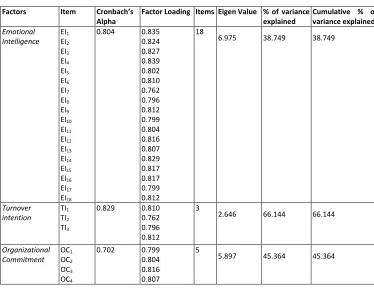
The Principle Component Analysis (PCA) and varimax rotation were conducted with Exploratory Factor Analysis (EFA). Kaiser-Meyer-Olkin (KMO) and Bartlett’s test as in Table 6 indicates good sampling adequacy of 0.842 and a significant Bartlett’s sphericity (χ2 = 1885.557, p<0.001) hence permitting further factor analysis to be carried on (Andy field, 2005). The Cronbach’s alpha coefficient ranges from 0.702 to 0.829, in which all these values are greater than 0.70 and thus the data are considered good reliability and good internal consistency (Andy field, 2005). The factor loadings of less than 0.5 were suppressed while the Kaiser’s criterion of using Eigenvalues > 1.0 is utilized. As a result of the data purification process, 2 items were deleted from the survey in view of the poor factor loadings (<0.5). Three factors with a 47.28% total variance explained have been successfully extracted using EFA. Table 6 shows the factor loadings of these factors.
Table 6: Reliability and validity of instrument used*
Factors Item Cronbach’s
Alpha
Factor Loading Items Eigen Value % of variance explained
Cumulative % of variance explained Emotional Intelligence EI1 EI2 EI3 EI4 EI5 EI6 EI7 EI8 EI9 EI10 EI11 EI12 EI13 EI14 EI15 EI16 EI17 EI18
0.804 0.835 0.824 0.827 0.839 0.802 0.810 0.762 0.796 0.812 0.799 0.804 0.816 0.807 0.829 0.817 0.817 0.799 0.812 18
6.975 38.749 38.749
Turnover intention
TI1 TI2 TI3
0.829 0.810 0.762 0.796 0.812
3
2.646 66.144 66.144
Organizational Commitment OC1 OC2 OC3 OC4
0.702 0.799 0.804 0.816 0.807
5
58
OC5 0.829
0.817
*Note extraction method: Principal Component Analysis; Rotation Method: Varimax with Kaiser’s Normalization; n = 80
4.4 Hypothesis Testing
The research model as shown in Figure 1 was tested using the Regression Analysis. The study had two hypotheses H1, H2 and H3 which were:
H1: The level of emotional intelligence impacts turnover intention of faculty members.
Independent Variable: Emotional Intelligence (EI) Dependent Variable: Turnover Intention (TI)
H2: The level of emotional intelligence impacts organizational commitment of faculty members.
Independent Variable: Emotional Intelligence (EI) Dependent Variable: Organizational Commitment (OC)
H3 - There is a significant relation between the level of organizational commitment of faculty members and their turnover intention.
Independent Variable: Organizational Commitment (OC) Dependent Variable: Turnover Intention (TI)
The regression models of the study can be written as: Model1
y1 = a + b1 (x1)
y1= Predicted Value of the dependent variable (Turnover Intention)
a = Constant
b1 = Slope of Variable 1 x1 = Variable 1(Emotional Intelligence)
Model 2 y2 = a + b2 (x2)
y2 = Predicted Value of the dependent variable (Organizational Commitment)
59
b2 = Slope of Variable 2 x2 = Variable 2 (Emotional Intelligence) Model 3
y3 = a + b3 (x3)
y3= Predicted Value of the dependent variable (Turnover intention)
a = Constant
b3 = Slope of Variable 3 x3 = Variable 3 (Organizational Commitment) Table 7: Regression Results for research model
Model 1(Emotional Intelligence Turnover Intention)
Variable Standardized Beta t-value* Significance Remarks
Turnover Intention -0.064 -1.698 0.090 Not Supported
*t –Value: A t statistic can be used to test the null hypothesis that no linear relationship exists between X and Y, or H0: β = 0, where t=b /SEb . From the results of Table above, it
is clear that Turnover Intention is not significant at 5 percent level of significance. The t-value= -1.698; null hypothesis is accepted which shows there is no linear relationship between Emotional Intelligence and Turnover Intention.
Implications of the result: the regression model 1 depicts that the hypothesis H1is disapproved according to this: The level of emotional intelligence does not impacts turnover intention of faculty members. Therefore, findings have demonstrated that the faculty members seem to have several other reasons that more strongly influence their intention to quit as compared to their level of emotional intelligence. Such factors have been indicated by many researchers.
The findings imply that a faculty who are high on emotional intelligence tends to experience reduction on turnover intentions from the organization and that a faculty who is low on an emotional intelligence scale tends to experience turnover intentions in a high magnitude. The findings tally with Action Society Trust (1996) that reported that no significant correlation was found between withdrawal intentions from the organization and emotional intelligence.
Akinboye (2003) and Omole (2005) have studied the relationship between emotional intelligence and withdrawal intentions of employees from the organization their study reported that the relationship tends to positively moderate the two variables. The results were contrary to the present study that has not resulted in such a relationship.
Model 2 (Emotional Intelligence Organizational Commitment)
60
Organizational Commitment 0.294 7.836 0.000 Supported
*t –Value: A t statistic can be used to test the null hypothesis that no linear relationship exists between X and Y, or H0: β = 0, where t=b /SEb. From the results of
Table above, it is clear that Organizational Commitment is significant at 5 percent level of significance. The t-value= 7.836; null hypothesis is rejected which shows there is a linear relationship between Emotional Intelligence and Organizational Commitment. The value shows that EI of a faculty member has an impact on the level of organizational commitment. This result strengthen the findings of Carmeli (2003)
Model 3 (Organizational Commitment Turnover Intention)
Variable Standardized Beta t-value* Significance Remarks
Turnover Intention -0.666 -2.261 0.000 Supported
*t –Value: A t statistic can be used to test the null hypothesis that no linear relationship exists between X and Y, or H0: β = 0, where t = b/SEb. From the results of Table above, it
is clear that Turnover Intention is significant at 1 percent level of significance. The t-value= -2.261; null hypothesis is rejected which shows there is a negative linear relationship between Organizational Commitment and Turnover Intention. This means that faculties with a higher degree of organizational commitment seem to present a lower intention to leave their organization. These findings are in support of the study conducted by Van Der Berghe and Trembley (2008) In which they tried to establish the relationship between OC and TI and found that affective commitment of an employee towards his organization helps in reducing TI and both the variables are inversely related.
CONCLUSION
The importance of EI in increasing the level of organizational commitment of employees has been demonstrated by this study. It is also apparent that those who are high on EI tend to become more committed towards their work. This commitment is experienced in the form of achieving targets, having a good rapport with their colleagues in the work set-up, regular attendance, and active participation in day-to-day life activities, leading to less withdrawal intentions.
Study conducted by Jaeger (2003) reported that Emotional Intelligence is positively correlated with the academic performance.
61
as the human resource of any organization is the only asset which cannot be imitated easily.
The other hypothesis of the study was rejected suggesting that emotional intelligence do not have a liner relationship with turnover intention the reason can be predicted as the desire to quit an organization is dependent on several factors like organizational related factors and individual based factors, since the level of emotional intelligence simply deals with individual factors and the organization factors are ignored hence it cannot be a true indicator of turnover intention.
Although the findings of this study are encouraging, still there were some limitations that should be considered for future studies for example the sample size was not too wide that the study could be generalized, more over effects of few extraneous variables like individual’s age group, years of experience etc could be nullified by making this variable constant in future research. This could lead to more specific result. Future study and research considering the comparisons of emotional intelligence domains, with different method of data gathering from individuals or groups of employees such self report, self score, direct report, etc could result more detail in understanding of important role of each EI domain to each different segment of employees and group. REFERENCES
Action Society Trust (1996), Emotional intelligence and individual difference at workplace, Monograph, New York: Prentice Hall.
Akinboye J. A. (2003), Emotional intelligence and personality factors: Effect on job performance of managers at workplace, Journal of Educational Psychology, Vol. 21 (2), pp. 76- 83.
Bentein, K., Vandenberg, R. J., Vandenberghe, C., & Stinglhamber, F. (2005), The role of change in the relationship between commitment and turnover: A latent growth modeling approach. Journal of Applied Psychology, Vol. 90, pp. 468–482.
Bradberry, T., & Su, L. D. (2006), Ability-versus skill based assessment of emotional intelligence, Psicothema, Vol. 18, pp. 59-66.
Carmeli, A. (2003), The relationship between emotional intelligence and work attitudes, behavior and outcomes: An examination among senior managers, Journal of Managerial Psychology, Vol. 18 (8), pp. 788-813.
Colarelli, J. (1984), Methods of communication and mediating processes in realistic job previews, Journal of Applied Psychology, Vol. 69, pp. 633-42.
Freshman, B and Rubino, L. (2002), Emotional intelligence: A core competency for health care administrators, The health care manager. Vol. 20 (4), pp.1-9
Gardner, H. (1993), Multiple intelligences: The theory in practice. New York, NY: Basic Books.
Goleman D (1998), Working with Emotional Intelligence, Bantam Books, New York.
Goleman D, (2001), An EI-Based Theory of Performance. Available from http://www.eiconsortium.org
Goleman D., (1997), Beyond IQ: developing the leadership competencies of emotional intelligence. Paper presented at the 2nd international competency conference, London, October.
Goleman D., (1999), Working with Emotional Intelligence. New York: Bantan Books.
Goleman, D. (1995), Emotional Intelligence: Why It Can Matter More than IQ, Bantam Book New York, NY.
62
Goleman, D. (2000), Emotional Intelligence, In Sadock, B and Sadock, V. (ed), Comprehensive textbook of psychiatry, Seventh edition, Philadelphia.
Lee TW, Mowday RT. (1987), Voluntarily leaving an organization: An empirical investigation of Steers and Mowday’s model of turnover. Academy of Management Journal, Vol. 30, pp. 721-743.
Lopes, P. N., Brackett, M. A., Nezlek, J. B., Schutz, A., European Journal of Personality, Vol. 17 , pp. 39
Mayer, J.D, Salovey, P. and Caruso, D. (2000), Competing models of emotional intelligence, in R.J. Sternberg (ed), Handbook of human intelligence, Cambridge University Press, second edition, New York, pp. 396- 420.
Meyer, J. P., Stanley, D. J., Herscovitch, L., & Topolnytsky, L. (2002), Affective, continuance and normative commitment to the organization: A meta-analysis of antecedents, correlates, and consequences. Journal of Vocational Behavior, Vol. 61, pp. 20–52.
Oldham, G.R. and Cummings, A. (1996), Employee creativity: personal and contextual factors at work, Academy of Management Journal, Vol. 39, pp. 607-34.
Omole, M.A.L (2005), Emotional intelligence in organizations: A conceptualization, genetic, social and general psychology. Monographs, Vol. 2, pp. 209-294.
Tett, R.P. and Meyer, J.P. (1993), Job satisfaction, organizational commitment, turnover intentions and turnover: Path analysis based on meta-analytic findings, Personnel Psychology, Vol. 46, pp.259-293.
Thomdike, R. L., and Stein, S. (1937), An evaluation of the attempts to measure social intelligence, Psychological Bulletin, Vol. 34, pp. 275-284