Corresponding Author: Ho Yew Joe, School of Economics and Management, Xiamen University Malaysia, 43900, Selangor, Malaysia, +60 12 5388199
12
Journal of Social Science and Humanities, 2 (5): 12-18, 2019 e-ISSN: 2600-9056
© RMP Publications, 2019 DOI: 10.26666/rmp.jssh.2019.5.3
Exploring and overcoming obstacles to academic-industry knowledge diffusion: A framework
Yew Joe, Ho
1and Nurhamiza Mumin
21School of Economics and Management, Xiamen University Malaysia, 43900, Selangor, Malaysia
Labuan Faculty of International Finance,
2Universiti Malaysia Sabah, 87000, Federal Territory of Labuan, Malaysia.
Abstract: This paper explores the plausible challenges of knowledge diffusion, particularly the transmission of novel academic findings to their ultimate utilization or adoption in the industry. The paper focuses on the more restrained but not less important issues that impede such development and proposes that solution to the lack of reliability in measuring knowledge diffusion hinges on methodological improvement; the disinclination of human factor in technology acceptance could be understood and potentially rectified with the Technology Acceptance Model (TAM) instrument; and the hindrance of less-accessible medium for knowledge diffusion could be resolved with a more simplified medium, specifically the Online-Video-Platform (OVP) journal.
Key words: Knowledge diffusion; Innovation; Industry evolution; Technology acceptance; Online video platform.
INTRODUCTION
Disseminating new knowledge for the creation of technology or system improvement in the industry is challenging as the trajectories of knowledge transmission from researchers to practitioners are fuzzy and non-linear [1][2]. Such research-practice problem which necessitate further understanding was highlighted in the past studies, e.g. [3][4][5][6]
However, understanding knowledge spill-overs is not an easy task neither. Firstly, an investigation on the effectiveness of academic knowledge transfer is difficult because knowledge is multifaceted and practitioners demand very specific solutions. Case specific problems encountered by practitioners are more complex in reality as they are not bounded by solutions offered by academicians which in many instances are conceived based on assumptions. These assumptions renders most solutions impractical [1].
Secondly, the undertaking of transforming knowledge to workable technology is itself a huge challenge. Depending on sector, in most cases it requires the synchronization of a functioning platform or
machinery, a compatible controlling system and adequately skilled human capital.
Notwithstanding the first and second impediments aforementioned, challenges to knowledge diffusion also include various less obtrusive issues, namely the reliability of instruments in measuring knowledge diffusion, the level of technology acceptance among practitioners and the effectiveness of medium for knowledge diffusions. This paper attempts to examine these issues.
LITERATURE REVIEW
Academic has been a pivotal and conceivably the main source in generating cutting edge scientific discoveries and refining procedural best practices across all disciplines. The conversion from sciences to technologies and adapting behavioral insights to policy makings have enabled mankind to simplify complex tasks and solved intricate problems efficiently.
13 mutually sustaining ecosystem between researchers and innovators [8][9][10].
Firms compete in the market for highly skilled employees to tap on their knowledge for their production. The cultivation of such employee entrepreneurship enables firms to innovates and stay abreast with constantly evolving demand in the market which moves in tandem with technological advancement [8][11].
User entrepreneurship on the other hand is a type of innovation-based commercialization that benefits from a paradigm shift in management, decision science or economic insight via academic endeavors. New technology is not capitalized for production but instead, this type of downstream entrepreneurship strive to enhance the knowledge context on the application and utilization of the existing products and services [12][13][14].
The academic-industry symbiosis thus is a critical impetus for industrial revolution. An in-depth understanding on the synergy between the two domains as well as the stimulants and hindrances to knowledge diffusion could potentially increase the industrial science-technology conversion and expedite technological advancement and new best practices in general.
Shin and Kook [15] stressed on the importance of virtual knowledge organizations (VKOs) in disseminating knowledge efficiently for business development. The dependence of business on knowledge has been ever increasing as it has a direct relationship to a firm’s productivity. Knowledge enhances business processes, spurs new technologies and facilitate the transfer of new information, all which are the key factors to productivity improvement.
One main hindrance for the acquirement of knowledge is the off limit accessibility of firms beyond their organizational perimeter. Such constraint has encourage firms to seek out to obtain and share new scientific advancements via knowledge networks [16]. VKOs are proven viable and efficient platforms for the transmission of innovations across the industries [17][18]
A VKO is defined as a “virtual organization” where innovators and users alike create and share their innovations [19][20]. VKO platforms commonly feature databases of knowledge and congregates these knowledge creators and knowledge seekers for shared benefits [15]. The greatest advantage of a VKO is in its wide accessibility that transcends organizational
hierarchy and boundary. The more hands-on knowledge-centric networks befittingly complements the more scholastic academic-industry engagement in bringing innovations to the industry.
Academic-industry undertakings in knowledge-based cooperation could arise in many forms such as coactive research, consultation, “academic entrepreneurship” and various other collaborative intellectual engagements [21]. Past studies have proposed numerous frameworks in attempts to explain and examine the significance of academic engagement to the industry. This in turn has also entails studies on such impacts from the policy perspectives [22].
Benefits reaped by the industry from academic engagement include the access to scientific innovations and new knowledge, technological enhancement of scientific tools, scholastic network and commercialization potential, exposure to alternative angles to problems and their solutions, and to some extent guiding the direction of innovations and determining research and development programs [23].
OBSTACLES TO KNOWLEDGE DIFFUSSION
The origin of most models in the literature on knowledge diffusion could be traced back to the Rogers’ diffusion of innovation theory [24]. In a summary, Roger [25] articulated that the espousal and partaking of new knowledge among individuals or organizations depend on five factors at the fundamental level, i.e. “awareness, interest, evaluation, trial, and adoption”.
Building from that foundation is a five-level innovation diffusion model i.e. 1) Knowledge – getting to know about the fact and basis of the innovation; 2) Persuasion – developing the conviction on the benefits of the innovation; 3) Decision – dedicating voluntarily to embrace the innovation; 4) Implementation – manifestation of actual utilization; 5) Confirmation – a conclusive acceptance or rejection.
Measuring Knowledge Diffusion
14 electronic semiconductors, shipbuilding, chemical and agriculture.
Nonetheless, it was underscored that findings of knowledge diffusion studies are arguable as they are contingent to the reliability of measurement used at the company level. It was furthered that mis-measurement is highly plausible at company level due to the aggregation of output which contained error or that the measurement is merely a proxy which inaccurately reflect a latent experience which is unobserved.
Technology Acceptance
Technology acceptance or lack of at firm level or in the industry could be attributed to many factors. It is generally defined as the endorsement, voluntary embracement and continuous utilization of new technologies and systems [27].
The central barrier could be due to the reality that academic-generated knowledge is commonly too esoteric for industrial consumption. Moreover, the research-generated decision support model and tools are more complex in comparison to practical models and tools [1]. Therefore, it is difficult for the industry players to understand the technicalities of academic-generated knowledge.
Medium for Knowledge Diffusion
The more common medium of knowledge diffusion is academic journals. Understanding the content of new knowledge documented in medium such as journals has been a huge challenge to technology acceptance among industrial practitioner.
According to Plavén-Sigray, Matheson, Schiffler & Thompson [28], the content of academic journals is becoming less reader-friendly as there has been a growing trend of excessive use of esoteric jargons which hinders readers’ comprehension. The finding is a cause for concern for both academia and practitioners because such development has an adverse impact on the replicability and accessibility of new knowledge.
OVERCOMING THE KNOWLEDGE DIFFUSION OBSTACLES
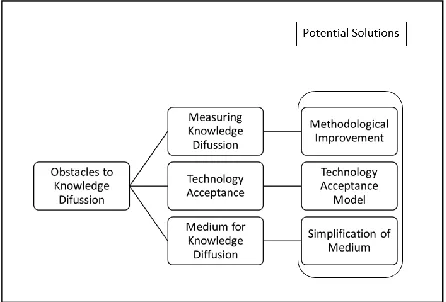
Figure 1 in the following encapsulates the discussion in section III and summarize the potential solutions to the
issues on measuring knowledge diffusion, technology acceptance and medium for knowledge diffusion. The suggested solutions include methodological improvement, utilization of Technology Acceptance Model (TAM) and simplification of medium for the dissemination of knowledge.
Fig.1 Obstacles to Knowledge Difussion and Potential Solutions
Methodological Improvement
The availability of reliable instruments for measuring knowledge diffusion is crucial to gauge the economic of knowledge creation and the rate of knowledge-technology conversion. Advancement in research method would push the boundary of academic efficacy and improve the overall accuracy of findings in the downstream researches.
There is a growing fraternity of scientific scholars who dedicate their endeavours especially in methodological innovation. According to Jewitt, Xambo &. Price [29], methodological innovation has been advancing leap and bound particularly in the social science discipline.
Methodological innovation comes in various forms. Firstly, it may be an extension to an existing theoretical method, modified by the means of permutation or by blending and applying with other models [30]. Secondly, it could be an entirely new creation [31].
However, one concern on the recent development in methodological innovation in the academic has been the divergence from the genuine intention to inform, to the fervor of exaggeration and the chase of novelty [32][33]. Methodological innovation drifting towards the overreaching path could be counterproductive to the accuracy of research findings.
15 The disinclination to technology acceptance in the industry has been a subject of interest for the past decades. Past studies had among others focused on the aspect of social psychology, information theory and diffusion of information. The central models for technology acceptance gyrates around the context of information and communication technologies (ICT) embracement among employees of firms. The Technology Acceptance Model (TAM) is widely accepted as the most reliable instrument to examine the readiness of human factor in utilizing new technology [27].
TAM connects the dots between the willingness to embrace new technology and the actual practice of using it. The model is based on the Theory of Reasoned Action which stipulates that the behavior of a person is driven by the intention of exhibiting specific behaviors. According the classic literature by Davis [34], intention reacts to an individual’s personal attitude towards his own norms and behavior.
Corresponding to the TAM, an individual’s choice of utilizing a newly introduced technology is dependent on the intention shaped by the individual’s inherent behavior to actually adopt the new system. The behavioral intention is driven by the individual’s perception on the convenience and ease of use of the new system.
Studies by Schwarz & Chin, [35] and Arning & Zeifle [36] showed evidence that the perception on the ease of use and the convenience brought about from using a new system are the best predictors of technology acceptance and the actual utilization of the system.
Simplification of Medium
Ahmet, Gamze, Mustafaoglu & Karaborklu Argut [37] suggested that a person usually retains only 10% to 15% of what is read, 10% to 20% of what is heard, and 20% to 30% of what is seen. However, when audio and video materials are presented side by side, it is found that the retention of knowledge increases to 40% to 50%.
At present, the teaching and learning innovation of video usage is still at its inductive level in most universities globally. The video-assisted training in the medical sector is fast gaining acceptance [38][39][40].
Notwithstanding, it is noteworthy that the knowledge recipients in the abovementioned instances were principally medical students. Lessons delivered in these videos were standard syllabus of the respective area. The entire process of knowledge transfer therefore is still confined within the academic sphere.
Given the proven efficacy of video in delivering intellectual content, the paper thus proposes a framework for an online-video-platform based journal that enables a seamless transmission of new scholastic findings for industrial consumption. The proposed framework will integrate various ICT tools (i.e. electronic manuscript submission system, text-to-speech converter (TTS), screencasting application etc.) that could facilitate the production of short DIY video clip by researchers.
The ultimate goal of the research is to initiate a paradigm shift that will expedite the dissemination of abridged and moderated findings/results of researches originally documented in esoteric academic journals. This in turn will accelerate the conversion of intellectual novelties to tangible innovation and management best practices in the industry.
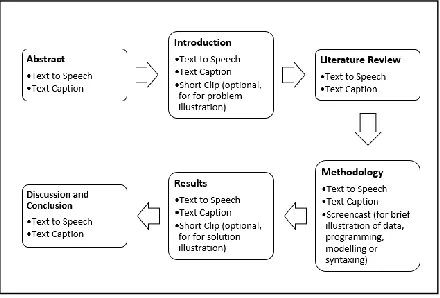
Fig. 2 Framework of OVP Journal
Fig. 2 shows the proposed framework for the OVP journal that is envisaged to function as what a movie trailer would be to a journal. The core idea is to enable the delivery of new knowledge in the most efficient means and in the simplest form. The content of the platform features all the standard sections in sequence commonly used for journal which begins with Abstract, Introduction, Literature Review, Methodology, Results and lastly Discussion and Conclusions.
16 The prototype of the proposed OVP journal system is not complicated as it merely integrates a number of other existing ICT systems, namely the electronic manuscript submission system widely used by online journal publishers, text-to-speech system (TTS) and screen casting system as shown in the flow in Fig. 2. The basic recommended framework (subjected to enhancement) begins with the use of TTS along with the appearance of text caption of the Abstract. TTS and text caption are also used for the rest of all other sections. However, short clip or diagrams could be optional especially at the Introduction section to enhance better understanding on the problem statements or research gaps.
Visual illustration with short clips recommended for both sections of Introduction and Results could be particularly useful for some disciplines that involve heavy usage of diagram layouts, tools or machineries such as architecture, engineering and agricultural sciences, respectively. Another example, the illustration of video-captured magnified molecules or cell in medical science studies could also vastly improve the efficiency in delivering a journal’s content compared to the traditional journal in text and diagram format.
Screencast is recommended for the Methodology section and it is applicable for all disciplines for a brief demonstration of data, programming, modelling or syntaxing that are rarely shown in traditional-format journals. This to some extend could add reliability to a study by verifying that the new finding or innovation is replicable.
Nonetheless, the extent of which a study intents to disclose to the readers its data analysis or other possible “trade secret” is entirely the prerogative of the author(s). Disclosure could also be based on the requirements determined by journal publishers. Furthermore, it is imperative to underscore that the proposed OVP journal is intended to provide only cursory information on a study. A link to the respective online journal publishers should appear at the end of the few minutes video clip for potential purchase. The OVP system for the generation of summarized journal clips can be integrated into the common electronic manuscript submission system.
Alternatively, full version OVP journals can be generated, albeit requiring a longer duration. Decision in this context is purely commercial, depending on the type of business model of the journal publishers i.e. for profit or open access. The full fledge development of the idea could viably allow journal publishers to upload the summarized or full-content journal clips onto major video-sharing platform and the creation of academic themed channel such as YouTube Scholar.
CONCLUSION
This paper proposes that solution to the lack of reliability in measuring knowledge diffusion hinges on methodological improvement; the disinclination of human factor in technology acceptance could be understood and potentially rectified with the Technology Acceptance Model (TAM) instrument; and the hindrance of less-accessible medium for knowledge diffusion could be resolved with a more simplified medium specifically, the Online-Video-Platform (OVP) journal.
The novel concept of OVP journal demands special attention as it is a potential game-changer. A perfunctory observation on the industry may yield a general inference that the usage of video are mainly to facilitate employees in their routine operation i.e. in the form of instructional manual or standard operating procedures. Given the efficacy of knowledge transmission and retention via video-based learning platform, there is a huge potential that the latest innovation published in academic journals can be disseminated more expansively with the use of video as the medium of knowledge diffusion.
REFERENCES
[1] Rajaeian, M.M., Carte-Steel, A. and Lane, M. 2018. Determinants of effective knowledge transfer from academic researchers to industry practitioners. Journal of Engineering and Technology Management 47, 37-52.
[2] Easterby-Smith, M., Lyles, M.A. and Tsang, E.W.K. 2008. Inter-organizational knowledge transfer: Current themes and future prospects. J. Manage. Stud. 45(4), 677-690.
[3] Bansal, P. Bertels, S. Ewart, T. MacConnachie, P. and O’Brien, J. 2012. Bridging the research-practice gap. Acad. Manage. Perspect. 26(1), 73-92. [4] Kieser, A., Nicolai A., and Seidl, D. 2015. The
practical relevance of management research: Turning the debate on relevance into a rigorous scientific research program. Acad. Manage. Ann. 9(1), 143-233.
[5] O’Brien, J.P., Drnevich, P.L., Crook T.R. and Armstrong, C.E. 2010. Does business school research add economic value for students? Acad. Manage. Learn. Educ. 9(4), 638-651.
[6] Becker, J., vom Brocke, J., Heddier, M. and Seidel, S. 2015. In search of information systems (grand) challenges, Bus. Inf. Syst. Eng 57(6), 377-390. [7] Kirzner, I.M. 1997. Entrepreneurial discovery and
17 [8] Agarwal R. and Shah, S. 2014. Knowledge sources
of entrepreneurship: Firm formation by academic, user and employee innovators. Research Policy 43, 1109-1133.
[9] Lockett, A., Siegel, D., Wright M. and Ensley, M.D. 2005. The creation of spin-off firms at public research institutions: managerial and policy implications. Research Policy 34, 981-993.
[10] Mowery, D.C. 2005. The Bayh–Dole Act and high-technology entrepreneurship in US universities: chicken, egg, or something else? advances in the study of entrepreneurship. Innovation & Economic Growth 16, 39-68.
[11] Klepper, S. 2001. Employee startups in high-tech industries. Industrial & Corporate Change 10. 639-674.
[12] Baldwin, C., Hienerth, C. and von Hippel, E. 2006. How user innovations become commercial products: a theoretical investigation and case study. Research Policy 35, 1291-1313.
[13] Shah, S.K. 2005. Open beyond software, in Open Sources 2: The Continuing Evolution. Dibona, C., Cooper, D. and Stone M. Eds. O’Reilly Media, Sebastopol CA, 339-360.
[14] Shah, S.K. and Tripsas, M. 2007. The accidental entrepreneur: The emergent and collective process of user entrepreneurship. Strategic Entrepreneurship Journal 1, 123-140.
[15] Shin S.K. and Kook, W. 2014. Can knowledge be more accessible in a virtual network?: Collective dynamics of knowledge transfer in a virtual knowledge organization network. Decision Support Systems 59, 180-189.
[16] Mesquita, L.F., Anand J. and Brush, T.H. 2008. Comparing the resource-based and relational views: knowledge transfer and spillover in vertical alliances. Strategic Management Journal 29(9), 913-941.
[17] Hoegl, M., Parboteeah K.P. and Munson, C.L. 2003. Team-level antecedents of individuals' knowledge network. Decision Sciences 34(4), 741-770.
[18] Lin, L., Geng X. and Whinston, A.B. 2005. A sender–receiver framework for knowledge transfer. MIS Quarterly 29(2), 197-219.
[19] Kuk, G. 2006. Strategic interaction and knowledge sharing in the KDE developer mailing list. Management Science 52(7), 1031-1042.
[20] Lee G.K. and Cole R.E. 2003. From a firm-based to a community-based model of knowledge creation: the case of the Linux kernel development. Organization Science 14(6), 633-649.
[21] Perkmann, M., Tartari, V., McKelvey, M. Autio, E., Broström, A., D'Este, P., ... and Sobrero, M. 2013. Academic engagement and commercialisation: A
review of the literature on university-industry relations. Research Policy 42(2), 423-442.
[22] Perkmann, M., Neely A. and Walsh, K. 2011. How should firms evaluate success in university–industry alliances? A performance measurement syste., R and D Management 41(2), 202-216.
[23] Rossi, F., Rosli A. and Yip, N. 2017. Academic engagement as knowledge co-production and implications for impact: Evidence from Knowledge Transfer Partnerships. Journal of Business Research 80, 1-9.
[24] Ward, R. 2013. The application of technology acceptance and diffusion of innovation models in healthcare informatics. Health Policy and Technology 2, 222-228.
[25] Rogers, E.M. 1995. Diffusion of innovations, 4th edn, The Free Press/Simon & Schuster Inc., New York.
[26] Thompson, P. 2010. Chapter 10 - Learning by Doing, in Handbook of the Economics of Innovation. B.H. Hall and N. Rosenberg Eds. North-Holland, Amsterdam, vol. 1, 429-476.
[27] Arning K. and Ziefle, M. 2009. Different perspectives on technology acceptance: The role of technology type and age, HCI and Usability for e-Inclusion: 5th Symposium of the Workgroup Human-Computer Interaction and Usability Engineering of the Austrian Computer Society, USAB, Linz, Austria, Proceedings, 20-41, November 9-10, 2009.
[28] Plavén-Sigray, P., Matheson, G.J., Schiffler B.C. and Thompson, W.H. 2017. The readability of scientific texts is decreasing over time. eLife, 27725 (featured article), 1-14.
[29] Jewitt, C., Xambo A. and Price, S. 2017. Exploring methodological innovation in the social sciences: The body in digital environments and the arts. International Journal of Social Research Methodology 20(1), 105-120.
[30] Xenitidou M. and Gilbert, N. 2009. Innovations in social science research methods, National centre for research methods report. Retrieved from http://eprints.ncrm.ac.uk/
[31] Taylor C. and Coffey, A. 2008. Innovation in qualitative research methods: Possibilities and challenges, (Working paper. 121), 121-130. Cardiff University. Retrieved from http://www.cardiff.ac. uk/socsi/research/publications/workingpapers/ papers-121-130.html
[32] Eisner, E. 2001. Concerns and aspirations for qualitative research in the new millennium. Qualitative Research 1, 135-145.
18 [34] Davis, F.D. 1989. Perceived usefulness, perceived
ease of use, and user acceptance of information technology, MIS Quarterly 13, 319-337.
[35] Schwarz A. and Chin, W. 2007. Looking forward: Toward an understanding of the nature and definition of IT acceptance. Journal of the Association for Information Systems 8, 232-243. [36] Arning K. and Ziefle, M. 2007. Understanding age
differences in PDA acceptance and performance. Computers in Human Behavior 23, 2904-2927. [37] Ahmet, A. Gamze, K. Mustafaoglu R. and Sezen,
K.A. 2018. Is video-based education an effective method in surgical education? A systematic review. Journal of Surgical Education 75(5), 150-158. [38] Broekema, T.H., Talsma, A.K., Wevers K.P. Pierie,
and J-P E.N. 2017. Laparoscopy instructional videos: The effect of preoperative compared with intraoperative use on learning curves. Journal of Surgical Education 74(1), 91-99.
[39] Mącznik, A.K., Schneiders, A.G., Athens J. and Sullivan, S.J. 2018. The development of an instructional video for the teaching of acupressure for pain management in acute musculoskeletal injuries: A knowledge translation study. Physical Therapy in Sport 29, 34-42.