Construction of a Gyrokinetic Plasma Simulation Model for
Electromagnetic Phenomena
Yasushi TODO and Atsushi ITO
National Institute for Fusion Science, Toki 509–5292, Japan (Received 16 March 2007/Accepted 10 April 2007)
A new gyrokinetic plasma simulation model for electromagnetic phenomena is presented. In this model, the total characteristic method, where theδf particle-in-cell simulation model is complemented with the fluid model to satisfy the conservation properties, is applied to electrons. The electric field component parallel to the magnetic field is calculated from the time derivative of Amp`ere’s law. It is demonstrated that both the real frequency and damping rate of kinetic Alfv´en wave are computed correctly for various electron beta values. It is also shown that with respect to the number of marker particles, the numerical convergence of real frequency and damping rate is faster with the total characteristic method than with the conventionalδf method. Specifically, it is demonstrated that the total characteristic method enables a simulation of a kinetic Alfv´en wave with a grid size ten times larger than the electron skin depth, while the wave damps spuriously for the same physical condition in a conventional
δf simulation. c
2007 The Japan Society of Plasma Science and Nuclear Fusion Research
Keywords: gyrokinetic simulation, electromagnetic plasma phenomenon, total characteristic method,
δf particle-in-cell method DOI: 10.1585/pfr.2.020
1. Introduction
The gyrokinetic particle-in-cell (PIC) simulation model is a powerful tool for investigating low frequency microinstabilities in magnetized plasmas [1]. When the fu-sion core plasmas are simulated with the gyrokinetic PIC method, theδf method [2–5] is often employed to reduce the numerical noise. Electromagnetic phenomena can be simulated with the gyrokinetic model coupled with the Poisson and Amp`ere equations. The internal kink mode was investigated with the gyrokineticδf PIC method [6]. A difficulty was suggested in accurately solving Amp`ere’s law with a term in proportion to the inverse square of the electron skin depth, when the gyrokinetic PIC method is applied to electromagnetic phenomena [7, 8]. In order to overcome this difficulty and relax the restriction of the Courant condition for electrons, split-weight schemes of the δf PIC method have been devised [8, 9]. It was also reported that this difficulty could be resolved with a con-ventionalδf scheme with careful normalization applied to the skin terms [10]. In another trend for electromagnetic gyrokinetic simulation, electrons are simulated with a fluid model [11] or with fluid-kinetic hybrid models [12, 13].
The total characteristic method [14] was presented to improve the conservation properties, i.e., the conservation of particles, momentum, and energy, in the δf PIC sim-ulation. In the δf PIC simulation, the distribution func-tion is expressed as the sum of the reference distribufunc-tion and variation distribution. The PIC model is not applied to the reference distribution, often represented by f0, which
author’s e-mail: [email protected]
is defined in advance of the simulation. Only the variation distributionδf is approximated by the Klimontovich dis-tribution functionδfK using Lagrangian markers (marker
particles). The time evolution ofδfK is described by an
advection term and a source term associated with f0. It
was shown that the source term, which is a Monte Carlo estimate in theδf method, violates the conservation prop-erties [14]. In theδf simulation, each Lagrangian marker represents a characteristic of the Vlasov equation. How-ever, the characteristics which the Lagrangian markers do not represent are not considered in theδf simulation. In the total characteristic method, a fluid system provides characteristics complementary to those represented by the Lagrangian markers. The corrections to the Monte Carlo estimate of the source term propagate along the comple-mentary characteristics provided by the fluid system.
In this paper, an electromagnetic gyrokinetic simu-lation model is presented using the total characteristic method. The new model is described in Sec. 2. In Sec. 3, both the real frequency and damping rate of the kinetic Alfv´en wave are demonstrated to compute correctly for various electron beta values. It is shown that with respect to the number of marker particles, the numerical conver-gence of real frequency and damping rate is faster with the total characteristic method than with the conventionalδf method. Specifically, it is demonstrated that the total char-acteristic method enables a simulation of a kinetic Alfv´en wave with a grid size ten times larger than the electron skin depth, while the wave damps spuriously for the same phys-ical condition in the conventionalδf simulation. A
sum-c
mary is given in Sec. 4.
2. Construction of an
Electromagnet-ic Plasma Model with the Total
Characteristic Method
2.1
Vlasov-Poisson-Amp`ere system
We consider phenomena with frequency lower than the ion cyclotron frequency in the uniform magnetic field
B0. We express the electromagnetic field using the scalar
potentialφand the vector potential parallel to the magnetic fieldA
E = −∇φ−b∂∂
tA, (1)
B = B0+∇ ×(Ab), (2)
where b = B/B. The perpendicular components of the vector potential are neglected because we focus on incom-pressible perturbations of the magnetic field. For the low frequency phenomena, the gyrokinetic model provides a useful physical framework.
When the equilibrium number density and the elec-tron temperature are given byn0andTe0, the Debye length
isλD =
0Te0/n0e2. The gyrokinetic Poisson equation
in the long wavelength approximation for the electrostatic potential is ρ s λD 2 ∇2
⊥φ=−qini+(−e)ne
0
, (3)
whereniandne are the ion and electron number density,
andqi is the ion charge. In the definition of ni and ne,
the polarization drift effects are not included. The ion po-larization charge density is given by the left-hand side of Eq. (3). Thus, Eq. (3) represents the quasi-neutrality con-dition without the electron polarization charge density. We defineρs=cs/Ωi, wherecs=
√
Te0/mi,Ωi=qiB0/mi, and
miis the ion mass. The operator∇2⊥ is∇ ·[∇ −b(b· ∇)].
The Amp`ere’s law for the vector potential is
∇2
⊥A=−µ0(ji+je), (4)
where ji and je are the ion and electron current density
parallel to the magnetic field.
The equations of motion for electrons and ions are ˙
x = vb+E×B
B2 , (5)
˙
v = qσ
mσE (σ=i,e), (6)
wherevis the velocity parallel to the magnetic field. The parallel electric fieldEis needed for the time integration of the equations of motion. The parallel electric fieldEis given from Eq. (1)
E=−b· ∇φ−∂∂
tA. (7)
Operating ∇2
⊥ to Eq. (7) and coupling the resultant equation with the time derivative of Eq. (4), we find that
the parallel electric field is given by the following equa-tion,
∇2
⊥E=−∇2⊥(b· ∇φ)+µ0
∂
∂t(ji+je). (8) The distribution function of the guiding-center evolves following the drift kinetic equation (σ=i,e):
∂ ∂tfσ+
vb+E×B
B2
· ∇fσ+qσE
mσ
∂
∂vfσ=0. (9)
Finite Larmor radius effects are omitted for simplicity. Equation (9) is multiplied byqσv and integrated in the velocity space. This procedure gives the time evolution of the current density on the right-hand-side of Eq. (8)
∂ ∂tjσ=−
qσ
mσb· ∇Pσ−
E×B
B2 · ∇jσ+
nσq2σ
mσ E,
(10) Pσ=
mσv2fσd3v . (11)
Finally, we obtain the equation for the parallel electric field
∇2
⊥−
σ=i,e
ω2 pσ
c2
E=−∇2⊥(b· ∇φ)
−
σ=i,e
µ0
qσ
mσb· ∇Pσ+
E×B
B2 · ∇jσ
, (12)
whereωpσ =
nσq2σ/0mσ. Equations (1)-(6) and (12)
constitute a closed set of the electromagnetic plasma model.
2.2
1-dimensional simulation model with the
total characteristic method
In this subsection, we construct a 1-dimensional sim-ulation model. The 1-dimensional phase space (x, v) is considered. We assume cold ions with constant number densityn0and focus on electron dynamics. For cold ions,
nidoes not change in time, because theE×Bdrift in the
xdirection vanishes in the 1-dimensional model. Note that the ion polarization charge density is considered in the left-hand side of Eq. (3). The equilibrium distribution of elec-trons is assumed to be a Maxwellian distribution:
fe0(x, v)=
n0
√
2πTe0/me
e−mev2/2Te0 . (13) We simulated the evolution of the distribution func-tion using the total characteristic method where theδf PIC model is complemented with the fluid model [14]. The position and velocity of Lagrangian markers evolve ac-cording to the equation of motion (Eqs. (5) and (6)). The Lagrangian markers were loaded uniformly in the phase space, 0≤ x ≤ L,−5vt ≤v ≤5vt, wherevt =
√
Te0/me
Lagrangian markers is uniformp(x, v)=1/V, whereVis the phase space volume andV=10vtL.
The following equation gives the weight evolution of marker particles:
dwj dt =−
V N
(−e) me
E(xj,t) n0
√
2πvt
(−vj
v2 t
)e−v2j/2v2t , (14)
wj(t=0)=0. (15) In the conventionalδf simulation, the electron num-ber density, current density, and parallel pressure are esti-mated using theδf Klimontovich distribution function:
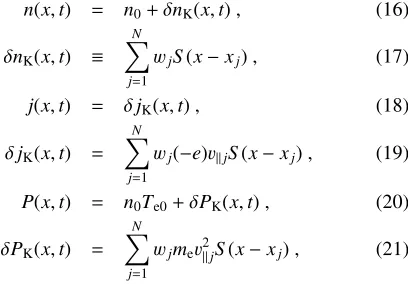
n(x,t) = n0+δnK(x,t), (16)
δnK(x,t) ≡
N
j=1
wjS(x−xj), (17) j(x,t) = δjK(x,t), (18)
δjK(x,t) =
N
j=1
wj(−e)vjS(x−xj), (19) P(x,t) = n0Te0+δPK(x,t), (20)
δPK(x,t) =
N
j=1
wjmev2jS(x−xj), (21)
whereS(x−xj) is a shape factor. We should notice thatn0,
j0, andTe0 are constant in space and time. With the total
characteristic simulation model, the equations for the num-ber density and current density are derived from Eq. (15) of Ref. [14], while the isothermal model is assumed for the pressure evolution. The following fluid equations are em-ployed in the total characteristic simulation:
∂
∂tδng(x,t)=− bx (−e)
∂
∂xδjg(x,t)
−
N
j=1
dwj
dt S(x−xj), (22)
∂
∂tδjg(x,t)=− (−e)bx
me
∂
∂xδPg(x,t)
+ e2
me
E(x,t)n0+δng(x,t)
−
N
j=1
dwj
dt (−e)vjS(x−xj), (23)
∂
∂tδPg(x,t)=− mevt2bx
(−e)
∂
∂xδjg(x,t)
+2E(x,t)j0+δjg(x,t)
−
N
j=1
dwj dt mev
2
jS(x−xj), (24)
δng(x,t=0)=0, (25)
δjg(x,t=0)=0, (26)
δPg(x,t=0)=0. (27)
The E × B drift in the x direction vanishes in the 1-dimensional model. The spatial derivatives are calculated
with the spectrum method. In the total characteristic sim-ulation, the number density, current density, and pressure are given by
n(x,t) = n0+δnK(x,t)+δng(x,t), (28)
j(x,t) = δjK(x,t)+δjg(x,t), (29)
P(x,t) = n0Te0+δPK(x,t)+δPg(x,t). (30)
3. Benchmarks on Kinetic Alfv´en
Wave
The real frequency and damping rate of the kinetic Alfv´en wave for various electron beta values have been in-vestigated with the simulation model described in the pre-vious subsection. The physical parameters are the same as those used in Ref. [12],mi/me = 1837,k⊥ρs = 0.4, and
k/k⊥ = b0x/b0y = 10−2 with b0z = 0. The number of grid points is 64, the time step width∆t = 0.5∆x/b0xvt,
and the number of Lagrangian markersN = 32768. The 4th-order Runge-Kutta method is employed for the time integration. The time step with the total characteristic method is restricted by the Courant condition for electrons. With regards to computational time, the total characteris-tic method requires additional computational time for the fluid equations, Eqs. (22)-(24). In the fluid equation calcu-lation, the calculation of the terms withNj=1dwj
dt S(x−xj) in Eqs. (22)-(24) demands the most computational time that is comparable to the calculation ofδnK,δjK, andδPK. The
calculation ofδnK, δjK, andδPKoften takes the longest
time in the conventionalδf simulations. Thus, the compu-tational time with the total characteristic method is at most roughly twice that with the conventionalδf method.
The real frequency and damping rate of the simulation results are compared with the theoretical values in Fig. 1. There is good agreement between the simulation results and theoretical values both for real frequency and damping
Fig. 1 Real frequency (= ωr) and damping rate (= −γ) of the
Fig. 2 Real frequency and damping rate versus number of marker particles. Solid line and dashed line represent an-alytical values of the real frequency and damping rate,
respectively. Closed (open) circles and closed (open)
squares represent the real frequency and damping rate in the simulation with the total characteristic method (with
the conventionalδfmethod).
rate. There is also good agreement for the low electron beta values (βe<10−3) for which the frequencies were not well
reproduced with the hybrid method devised in Ref. [12] (see Fig. 1 of Ref. [12]). The theoretical frequencies of the kinetic Alfv´en wave were calculated from Eq. (16) of Ref. [12] using a plasma dispersion function library DSPFNV [16]. In Fig. 1, the real frequency is roughly in propor-tion to the inverse of the square root of the electron beta. This can be explained as follows. The real frequency of the Alfv´en wave in the fluid limit is given bykB0/√µ0min0.
With the conditionk=10−2k
⊥andk⊥ρs=0.4,kis in
pro-portion to the inverse ofρs. The ratio of the real frequency
to the ion cyclotron frequency (= ωr/Ωi) is in proportion
toB0/√µ0min0ρsΩi=B0/
õ
0n0Te0=
2/βe. Then, we
haveωr/Ωi∝β−e1/2.
In Fig. 1, we see a discrepancy in the damping rate be-tween the simulation and theory forβe=0.2. For this case,
the numerical convergence of real frequency and damping rate were investigated with respect to the number of marker particles using the total characteristic method and the con-ventionalδf method. The results are compared in Fig. 2. It can be seen that the convergence with the total char-acteristic method is faster than with the conventionalδf method. ForN=32768 with the conventionalδf method, the damping rate is−γ/Ωi=1.6×10−3and is not shown
in Fig. 2.
For the application to fusion plasmas, it is important to simulate with a grid size larger than the electron skin depth. For example, when the electron number density is 1020m−3, the electron skin depth isc/ω
pe = 0.53 mm. If
two-hundred grid points are assigned for a 1m minor ra-dius, the grid size is 5 mm, which is larger than the electron skin depth by one order of magnitude. Thus, it is impor-tant to simulate with a grid size larger than the electron
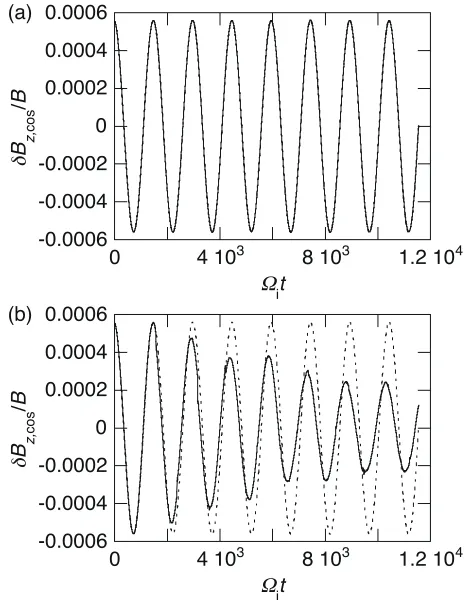
Fig. 3 Time evolution of the cosine part of Bz in simulations
(a) with the total characteristic method and (b) with the
conventional δf method are compared to the
theoreti-cal evolution plotted in dashed curves. The grid size is
∆x=10c/ωpe.
skin depth. We carried out a run with∆x=10c/ωpewhich
is larger than the grid sizes for the runs shown in Fig. 1, for example, ∆x = 0.15c/ωpe forβe = 3.9×10⁻⁴ and
∆x=3.3c/ωpe forβe =2.0×10⁻¹. The physical
param-eters for the present run aremi/me = 1837, βe = 10−2,
k⊥ρs = 3.0×10⁻², andk/k⊥ = b0x/b0y = 10−2. The
number of grid points is 64. The results are compared to those with the conventional δf method in Fig. 3. It can be seen that the results with the total characteristic method are close to the theoretical curve, while the kinetic Alfv´en wave damps spuriously with the conventionalδf method.
4. Summary
kinetic Alfv´en wave with a grid size ten times larger than the electron skin depth, while the wave spuriously damps in the conventionalδf simulation. The gyrokinetic simu-lation model with the total characteristic method presented in this paper is useful for magnetically confined plasmas such as tokamak plasmas and helical plasmas.
Acknowledgments
The authors would like to thank Prof. T. Watanabe for the plasma dispersion function library DSPFNV. This work was supported by a Grant-in-Aid for Scientific Research from the Japan Society for the Promotion of Science (No. 16560728).
[1] W.W. Lee, J. Comput. Phys.72, 243 (1987).
[2] M. Kotschenreuther, Bull. Am. Phys. Soc.33, 2107 (1988).
[3] A.M. Dimits and W.W. Lee, J. Comput. Phys.107, 309
(1993).
[4] S.E. Parker and W.W. Lee, Phys. Fluids B5, 77 (1993).
[5] A.Y. Aydemir, Phys. Plasmas1, 822 (1994).
[6] H. Naitou, K. Tsuda, W.W. Lee and R.D. Sydora, Phys.
Plasmas2, 4257 (1995).
[7] Y. Chen and S.E. Parker, Phys. Plasmas8, 2095 (2001).
[8] Y. Chen and S.E. Parker, J. Comput. Phys.189, 463 (2003).
[9] W.W. Lee, J.L.V. Lewandowski, T.S. Hahm and Z. Lin,
Phys. Plasmas8, 4435 (2001).
[10] A. Mishchenko, R. Hatzky and A. Konies, Phys. Plasmas
11, 5480 (2004).
[11] Y. Chen and S.E. Parker, Phys. Plasmas8, 441 (2001).
[12] Z. Lin and L. Chen, Phys. Plasmas8, 1447 (2001).
[13] B.I. Cohen, A.M. Dimits, W.M. Nevins, Y. Chen and S.E.
Parker, Phys. Plasmas9, 251 (2002).
[14] Y. Todo, J. Plasma Fusion Res. 81, 944 (2005),
http://www.jspf.or.jp/Journal/2005.html
[15] C.K. Birdsall and A.B. Langdon,Plasma Physics via
Com-puter Simulation(Adam Hilger, Bristol, 1991) p. 393.
[16] T. Watanabe, KAKUYUGO KENKYU65, 556 (1991) [in