Numerical Simulation of Atomic Layer Oxidation of Silicon
by Oxygen Gas Cluster Beams
Kohei MIZOTANI, Michiro ISOBE, Kazuhiro KARAHASHI and Satoshi HAMAGUCHI
Center of Atomic and Molecular Technologies, Osaka University, 2-1 Yamadaoka, Suita, Osaka 564-0871, Japan
(Received 15 February 2015/Accepted 8 March 2015)
A gas cluster is a collection of atoms or molecules weakly bound by van der Waals forces. Gas clusters may form by the adiabatic expansion of gases. In this study, it is demonstrated by molecular dynamics simulations that a low-energy beam of oxygen gas clusters may be used to oxidize the top surface layer of silicon (Si) substrates without affecting its deeper layers. An incident oxygen gas cluster with sufficiently low incident energy may stick to the Si surface and expose a large number of oxygen molecules to the surface Si atoms for extended periods until the cluster sublimates. This may cause the formation of Si–O bonds only on the top Si surface. This is in contrast to the oxidation of Si by oxygen ion beams or plasmas, where deeper layers of the Si surface are typically oxidized by the energetic incident oxygen ions. An oxidized single Si layer may be chemically removed; therefore, this nearly single-layer oxidation process by oxygen gas cluster beams may lead to the development of a new atomic layer etching technology for Si.
c
2015 The Japan Society of Plasma Science and Nuclear Fusion Research
Keywords: gas cluster, gas cluster ion beam, molecular dynamics simulation, beam–surface interaction, atomic layer etching
DOI: 10.1585/pfr.10.1406079
1. Introduction
As the sizes of transistors on computer chips continue to decrease, etching and deposition processes to form de-vice structures on a chip are now required to have atomic level accuracy. Atomic layer etching (ALE) [1–16] refers to an etching process where each atomic layer of the sur-face of a substrate, such as crystalline Si, is etched in a single cycle. In such a process, one could specify the exact number of atomic layers to be removed from the substrate, thereby ensuring atomic level accuracy of the etched depth. Similar to atomic layer deposition [17–23], ALE pro-cesses typically use chemical propro-cesses to modify the top single layer or a few monolayers of the substrate surface. Once the top surface is chemically modified, the subse-quent step is to remove the modified monolayer(s) by a chemical or reactive ion etching process by employing the specific chemical nature of the modified layer(s).
In this study, we employ an oxygen gas cluster beam to oxidize the topmost single layer of a crystalline Si sub-strate. A gas cluster is an aggregation of several to tens of thousands of atoms or molecules bound by van der Waals forces [24, 25]. A beam of gas clusters is typically formed by the adiabatic expansion of a gas at room temperature in a high-vacuum chamber. When a gas is adiabatically ex-panded, it cools to an extremely low temperature and atoms and/or molecules of the gas may aggregate and form clus-ters.
Such a cluster beam may be ionized via interaction with an electron beam and accelerated by an externally ap-author’s e-mail: [email protected]
plied electric field to the target substrate surface. A beam of ionized gas clusters is called a gas cluster ion beam (GCIB) [24–41]. In typical GCIB experiments, gas clus-ter beams are accelerated up to about 20 keV.
In such a cluster, several thousands of atoms or molecules share kinetic energy; thus, the average kinetic energy per atom or molecule of a gas cluster is typically in the range of a few eV, causing little damage to the sub-strate surface at impact [34, 38]. Furthermore, a number of atoms or molecules interact with the surface nearly si-multaneously at impact; therefore, the atomic or molecular flux of a gas cluster beam is typically comparable with or may be even higher than that of an ordinary molecular or ion beam.
However, a possible drawback of a GCIB is that the cluster size typically has wide distribution. Every cluster of the same charge, regardless of its size, gains the same kinetic energy from the externally applied electric field for ion acceleration. Therefore, the average energy per atom or molecule may vary significantly, depending on the size of the cluster. Energetic atoms or molecules of a smaller cluster ion may cause more surface damages than less ener-getic atoms or molecules of a larger cluster ion when they hit the surface. Therefore, the energy control of individual atoms or molecules is important to precisely control the surface damage during the GCIB process.
As aforementioned, in most GCIB processes, the beam energy is in the range of a few eV per atom or molecule [32]. In this study, however, we focus on even lower energy ranges, which may be achieved by
c
unionized gas cluster beams or gas cluster neutral beams (GCNB). Experimentally, the kinetic energy of each atom or molecule of a charge-neutral cluster generated by adi-abatic expansion is in the range of the thermal energy of the original gas, regardless of the cluster size. Therefore, unlike a GCIB, the average energy per atom or molecule of a GCNB is nearly the same for all clusters of various sizes. Furthermore, the kinetic energy of a GCNB can be some-what increased by adding lighter gas components, such as He, to the original gas (O2 in our study) [42]. Therefore,
in this study, the energy range per molecule for O2GCNB
is from 0.025 eV to a few eV. Furthermore, we only per-formed numerical simulations. Experimental verification of the simulation results is the subject of a future study.
2. Numerical Method
To examine the interaction of O2gas clusters with the
crystalline Si surface, we used molecular dynamics (MD) simulations. In earlier MD simulation studies of GCIB processes [30, 31, 36, 37, 39], a cluster of molecules with a given total kinetic energy was injected into a model sub-strate surface. In this study, a cluster consists of a few hun-dred to several thousand O2 molecules and the substrate
is the Si (100) surface. Unlike earlier studies, however, we focus on the incident energy range that is close to the thermal energy and evaluate the surface oxidation rate as a function of the cluster beam energy and cluster size. We define the surface oxidation rate as the number of O–Si bonds formed at each impact of a cluster on the Si surface. The classical MD simulations used in this study are based on interatomic potential functions of the Stillinger– Weber-type [43–48], representing covalent bonds for the Si and O system. In addition, all atoms are assumed to in-teract via van der Waals forces, which are modeled by a two-body force of the Lennard–Jones-type [49, 50].
The model substrate is a rectangular box of crystalline Si whose horizontal top surface represents a Si (100) sur-face with a cross-section of 21.7×21.7 nm2. The depth of the substrate is 1.63 nm. To avoid unnecessary down-ward shift of the substrate by momentum transfer from in-cident clusters to the substrate, the bottom layer of the sub-strate is fixed in position as an anchor layer. With periodic boundary conditions imposed in the horizontal directions, the model substrate represents an infinitely wide horizon-tal surface. The initial temperature of the substrate is set to 300 K.
To form an O2gas cluster model in the MD
simula-tions, we first form an oxygen molecule O2from two
oxy-gen (O) atoms. Two O atoms in a single oxyoxy-gen molecule are bound by a covalent bond modeled by the interatomic force function aforementioned. Then, we place a few hun-dred to several thousand O2molecules at regular intervals
in a sphere of an appropriate size. In the proposed model, all atoms, including oxygen atoms, are weakly bound to each other by van der Waals forces with assumed
bind-Fig. 1 Examples of the O2gas clusters used in the MD
simula-tions. The clusters (a), (b), and (c) consist of 2,888, 891, and 359 O2molecules, respectively. Blue spheres denote
O atoms. Each cluster shown here is in thermal equilib-rium at 50 K.
ing energy and interaction length of 0.01 eV and about 8 Å, respectively. Therefore, neighboring O2 molecules
are weakly bound and form clusters if their thermal en-ergies are sufficiently low. In this study, a cluster of O2
molecules is formed at about 10 K. Examples of such gas clusters used in our MD simulations are shown in Fig. 1.
In each MD simulation run, an O2gas clusters, such as
those shown in Fig. 1, is launched to the Si substrate sur-face with a given kinetic energy. The angle of incidence is normal to the substrate surface. Each MD simulation is performed under constant total-energy (i.e., microcanoni-cal) conditions. To obtain statistically averaged data, we repeat the simulation of the O2 gas cluster incidence
sev-eral times with a new clean Si (100) surface and the same physical parameters except for a different random number sequence to determine the impact position of the gas clus-ter on the substrate surface.
3. Simulation Results: Morphologies
of Clusters after Impact
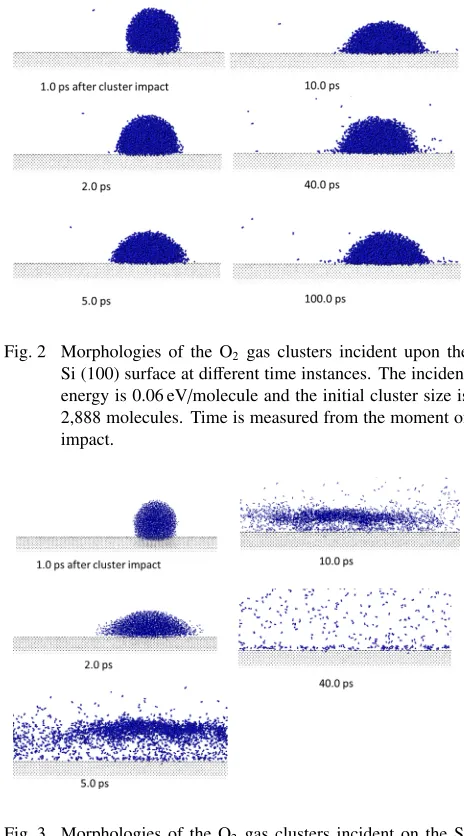
Figure 2 shows the morphologies obtained from the MD simulation of an O2 gas cluster incident upon the Si
(100) surface at different time instances. The cluster ini-tially consists of 2,888 O2molecules, and the incident
ki-netic energy is 0.06 eV/molecule. The time is measured from the moment of impact, and it is seen in Fig. 2 that, at this relatively low incident energy, a gas cluster is attached to the substrate surface. The shape of the attached O2 gas
cluster barely changes after 5 ps, indicating that the initial collision process has been completed by this time. The simulation is performed up to 100 ps after impact; how-ever, the cluster attached to the surface is expected to sub-limate eventually because of the heat conduction from the substrate. At the interface between the cluster and sub-strate, O2molecules are close to the surface Si atoms for
extended periods.
Similarly, Fig. 3 shows morphologies obtained from the MD simulation of an O2 gas cluster incident upon
Fig. 2 Morphologies of the O2 gas clusters incident upon the
Si (100) surface at different time instances. The incident energy is 0.06 eV/molecule and the initial cluster size is 2,888 molecules. Time is measured from the moment of impact.
Fig. 3 Morphologies of the O2 gas clusters incident on the Si
(100) surface at different time instances. The incident energy is 0.6 eV/molecule and the initial cluster size is 2,888 molecules. Time is measured from the moment of impact.
0.6 eV/molecule. The time is measured from the moment of impact. It is seen that the cluster splits after incidence. Furthermore, the interaction time of the O2molecules with
surface Si atoms is much shorter than that in the case of Fig. 2, because most O2molecules in Fig. 3 are seen to
de-part from the surface immediately after impact. It has been observed that, for a gas cluster of a given size, the higher the incident energy per molecule is, the more likely the splitting of the cluster occurs after impact. However, for a given incident energy per molecule, the smaller the cluster size is, the more likely the splitting of the cluster occurs after impact.
4. Simulation Results: Surface
Oxida-tion
With cluster impact simulations, such as those de-scribed above, we evaluated the surface oxidation rate, i.e.,
Fig. 4 (a) A side view of an O2gas cluster at 100 ps after its
im-pact on the Si (100) surface. The initial cluster consists of 15,440 O2molecules, and the incident cluster energy is
0.06 eV/molecule. (b) A top view of the same Si surface near the center of the attached O2gas cluster [around the
region encircled by the red ellipse in (a)], where only O atoms that are covalently bonded with Si atoms are plot-ted (other O atoms or O2molecules are not plotted for the
sake of clarity).
the number of O atoms that are covalently bonded with Si atoms after cluster incidence. Figure 4 (a) shows a side view of an O2 gas cluster at 100 ps after its impact on
the Si (100) surface. Here the initial cluster consists of 15,440 O2 molecules, and the incident cluster energy is
0.06 eV/molecule. Figure 4 (b) shows a top view of the same Si surface near the center of the attached O2gas
clus-ter [around the region encircled by the red ellipse in (a)], where only O atoms that are covalently bonded with Si atoms are plotted (other O atoms or O2 molecules are not
plotted for the sake of clarity). The gray sphere represents a Si atom and the blue sphere represents an O atom.
Note that the average kinetic energy of the O2
molecule before impact (0.06 eV) is far lower than the dis-sociation energy of the O2 molecule (5.1 eV).
Neverthe-less, as shown in Fig. 4 (b), the impact of the O2gas cluster
upon the Si surface caused the formation of Si–O bonds, which suggests that dissociation of some O2molecules
oc-curred during the process. In the collision process, where the incident O2 gas cluster is brought to the Si surface,
several O2 molecules of the cluster are forced to closely
approach the Si dangling bonds on the surface, forming unstable partial bonds with Si, such as Si–O–O with weak-ened O–O bonds. Such O2 molecules may form Si–O
bonds on the surface and release O atoms, which are again likely to form other Si–O bonds on the surface. During the collision process, part of the total kinetic energy of the in-cident O2 cluster, which is more than 900 eV in the case
of Fig. 4, is used to place some O2 molecules sufficiently
close to the Si atoms on the surface against the activation energy for the formation of unstable Si–O–O bonds.
Our simulations suggest that the final temperature of the O atoms in the cluster at 100 ps of Fig. 4 is approxi-mately 630 K, including the thermal energy of the vibra-tions and rotavibra-tions of O2molecules, the source of which is
the conversion of the incident translational kinetic energy of the cluster to thermal energy. However, at this temper-ature, O2 atoms are very unlikely to dissociate by thermal
Fig. 5 The number of Si–O bonds formed per cluster incidence as functions of the incident kinetic energy per molecule for O2gas clusters of various sizes incident upon the Si
(100) surface.
We have also confirmed by MD simulations that the incidence of a single O2 molecule with incident
ki-netic energy of 0.06 eV does not cause dissociation of the molecule, thus does not oxidize the Si surface. This means that the 0.06 eV kinetic energy is not sufficient to overcome the activation energy and form unstable Si–O–O that may lead to the formation of a Si–O bond on the surface. Con-versely, an O2 molecule surrounded by a large number of
O2 molecules in the cluster may stochastically gain suffi
-ciently large amount of kinetic energy from the momen-tum transfer by colliding with other O2 molecules inside
the cluster if the cluster collides with the surface at large total energy, even if the energy per molecule is small.
Figure 5 shows the number of Si–O bonds formed per cluster incidence as functions of the incident kinetic en-ergy per O2 molecule for O2 gas clusters of various sizes
incident upon the Si (100) surface in the normal direction, obtained from the MD simulation. The number of Si–O bonds was counted 100 ps after the cluster impact in each case. To obtain statistically averaged data, we have re-peated the simulation of O2gas cluster incidence five times
for each data with a different random number sequence. The number of Si–O bonds formed in a single cluster incidence is lower at higher incident energy in general be-cause the cluster tends to break apart, thus has little time to interact with the Si surface. However, in the case of relatively large clusters, if the incident energy is too low, then the number of Si–O bonds formed by a single cluster impact is also low. This is because, at such low incident energy, the cluster sticks to the surface with a relatively small interfacial area and with less momentum, which pro-vides only a small number of O2molecules with sufficient
energy to interact with the surface Si atoms.
It is also seen in Fig. 5 that, for a given incident energy per molecule, the rate of Si–O bond formation per single cluster impact is higher for larger clusters in general. This is mainly because a larger cluster provides more oxygen
Fig. 6 The number of Si–O bonds formed per cluster incidence normalized by the number of O2molecules of the incident
cluster. The values are plotted as functions of the incident kinetic energy per oxygen molecule for O2gas clusters of
various sizes incident upon the Si (100) surface.
molecules to the surface at single impact. Therefore, we replotted the same data in Fig. 6 from a different perspec-tive. Figure 6 shows the number of Si–O bonds formed by a single cluster impact, normalized by the number of O2
molecules contained in the incident cluster. As shown in Figs. 2 and 4, if a large cluster with low incident energy sticks to the surface and forms a dorm-like structure, then many O2 molecules in the cluster do not have the chance
to interact with the surface Si atoms before they sublime. Therefore, a large cluster is in general not efficient in oxi-dizing the Si surface for a given number of O2 molecules
arriving at the surface. Indeed, it is clearly seen in Fig. 6 that, at a given incident energy per molecule, a smaller cluster is more efficient in using the O2 molecules that it
carries for the formation of Si–O bonds on the substrate surface.
Note that in all simulation cases discussed so far, most oxygen atoms bond with the Si atoms of the first top layer of the substrate after the cluster impact, and only a very small number of O atoms are seen to enter the second or deeper layers of the substrate. Therefore, our simulations clearly suggest that the low-energy cluster-beam incidence may be used as a process for a nearly single-layer oxidation of a crystalline Si surface.
5. Summary and Conclusions
To examine the possibility of controlling surface reac-tions with atomic layer level accuracy, we performed MD simulations of the dynamics of O2 gas cluster impact on
a Si (100) surface with relatively low incidence energy. Nearly all previous studies on O2gas cluster processes are
layer of a Si substrate with little damage to its deeper lay-ers. Thus, single-layer oxidation process by a low-energy O2gas cluster beam may be used for the ALE of Si if it is
combined with a technique to remove the SiO2layer
chem-ically in each etch cycle. Although the development of such an ALE technology is a subject of a future study, the present study has clearly shown that single-layer oxidation of Si by an O2gas cluster beam at extremely low incident
energy is a feasible technology for the ALE of Si surfaces.
Acknowledgments
This work was supported by the Semiconductor Tech-nology Academic Research Center (STARC) and a Grant-in-Aid for Scientific Research from Ministry of Education, Culture, Sports, Science, and Technology of Japan.
[1] Y. Horiike, T. Tanaka, M. Nakano, S. Iseda, H. Sakaue, A. Nagata, H. Shindo, S. Miyazaki and M. Hirose, J. Vac. Sci. Technol. A8, 1844 (1990).
[2] H. Sakaue, S. Iseda, K. Asami, H. Yamamoto, M. Hirose and Y. Horiike, Jpn. J. Appl. Phys.29, 2648 (1990). [3] T. Meguro, M. Hamagaki, S. Modaressi, T. Hara, Y.
Aoyagi, M. Ishii and Y. Yamamoto, Appl. Phys. Lett.56, 1552 (1990).
[4] T. Meguro, M. Ishii, H. Kodama, M. Hamagaki, T. Hara, Y. Yamamoto and Y. Aoyagi, Jpn. J. Appl. Phys.29, 2216 (1990).
[5] S.D. Athavale and D.J. Economou, J. Vac. Sci. Technol. A
13, 966 (1995).
[6] S.D. Athavale and D.J. Economou, J. Vac. Sci. Technol. B
14, 3702 (1996).
[7] T. Sugiyama, T. Matsuura and J. Murota, Appl. Surf. Sci.
112, 187 (1997).
[8] B.-J. Kim, S. Chung and S.M. Cho, Appl. Surf. Sci.187, 124 (2002).
[9] S.-D. Park, K.-S. Min, B.-Y. Yoon, D.-H. Lee and G.-Y. Yeom, Jpn. J. Appl. Phys.44, 389 (2005).
[10] J.B. Park, W.S. Lim, B.J. Park, I.H. Park, Y.W. Kim and G.Y. Yeom, J. Phys. D: Appl. Phys.42, 055202 (2009). [11] A. Agarwal and M.J. Kushner, J. Vac. Sci. Technol. A27,
37 (2009).
[12] N. Marchack and J.P. Chang, J. Phys. D: Appl. Phys.44, 174011 (2011).
[13] E. Vogli, D. Metzler and G.S. Oehrlein, Appl. Phys. Lett.
102, 253105 (2013).
[14] C.G.N. Lee, K.J. Kanarik and R.A. Gottscho, J. Phys. D: Appl. Phys.47, 273001 (2014).
[15] D. Metzler, R.L. Bruce, S. Engelmann, E.A. Joseph and G.S. Oehrlein, J. Vac. Sci. Technol. A32, 020603 (2014). [16] K. Nojiri, Dry Etching Technology for Semiconductors
(Springer International Publishing, 2015).
[17] M. Leskela and M. Ritala, Thin Solid Films 409, 138 (2002).
[18] M. Leskela and M. Ritala, Angew. Chem., Int. Ed.42, 5548 (2003).
[19] M.D. Groner, F.H. Fabreguette, J.W. Elam and S.M. George, Chem. Mater.16, 639 (2004).
[20] R.L. Puurunen, J. Appl. Phys.97, 121301 (2005). [21] E. Langereis, M. Creatore, S.B.S. Heil, M.C.M. van de
Sanden and W.M.M. Kessels, Appl. Phys. Lett.89, 081915
(2006).
[22] H.B. Profijt, S.E. Potts, M.C.M. van de Sanden and
W.M.M. Kessels, J. Vac. Sci. Technol. A 29, 050801
(2011).
[23] H. Kim and I.-K. Oh, Jpn. J. Appl. Phys. 53, 03DA01 (2014).
[24] A. Kantrowitz and J. Grey, Rev. Sci. Instrum. 22, 328 (1951).
[25] E.W. Becker, K. Bier and W. Henkes, Z. Phys.146, 333 (1956).
[26] O.F. Hagena and W.J. Obert, J. Chem. Phys. 56, 1793 (1972).
[27] T. Takagi, I. Yamada and A. Sasaki, J. Vac. Sci. Technol.
12, 1128 (1975).
[28] I. Yamada, K. Matsubara, M. Kodama, M. Ozawa and T. Takagi, J. Cryst. Growth45, 326 (1978).
[29] F. Frank, W. Schulze, B. Tesche, J. Urban and B. Winter, Surf. Sci.156, 90 (1985).
[30] P.M.S. John, R.D. Beck and R.L. Whetten, Phys. Rev. Lett.
69, 1467 (1992).
[31] Z. Insepov and I. Yamada, Nucl. Instrum. Methods B99, 248 (1995).
[32] M. Akizuki, J. Matsuoet al., Jpn. J. Appl. Phys.35, 1450 (1996).
[33] I. Yamada, J. Matsuo, N. Toyoda and A. Kirkpatrick, Mater. Sci. Eng. R34, 231 (2001).
[34] X. Li, W.D. Goodhue, C. Santeufeimio, T.G. Tetreault, R. MacCrimmon, L.P. Allen, C. Bliss, K. Krishnaswami and C. Sung, Appl. Surf. Sci.218, 251 (2003).
[35] N. Toyoda, J. Matsuo and I. Yamada, Nucl. Instrum. Meth-ods B216, 379 (2004).
[36] C. Anders and H. Urbassek, Nucl. Instrum. Methods B228, 57 (2005).
[37] Y. Yamaguchi and J. Gspann, Eur. Phys. J. D 34, 247 (2005).
[38] S. Kakuta, S. Sasaki, T. Hirano, K. Ueda, T. Seki, S. Ninomiya, M. Hada and J. Matsuo, Nucl. Instrum. Meth-ods B257, 677 (2007).
[39] T. Aoki, T. Seki and J. Matsuo, Nucl. Instrum. Methods B
267, 2999 (2009).
[40] R.J. Paruch, B.J. Garrison, M. Mlynek and Z. Postawa, J. Phys. Chem. Lett.5, 3227 (2014).
[41] I. Yamada, J. Matsuo, N. Toyoda, T. Aoki and T. Seki, Curr. Opin. Solid State Mater. Sci.19, 12 (2015).
[42] Atomic and Molecular Beam Methods, ed. by G. Scoles, D. Bassi, U. Buck and D.C. Laine (Vol.1, Oxford University Press, 1988).
[43] F.H. Stillinger and T.A. Weber, Phys. Rev. B 31, 5262 (1985).
[44] F.H. Stillinger and T.A. Weber, J. Chem. Phys.88, 5123 (1988).
[45] F.H. Stillinger and T.A. Weber, Phys. Rev. Lett.62, 2144 (1989).
[46] T.A. Weber and F.H. Stillinger, J. Chem. Phys.92, 6239 (1990).
[47] H. Ohta and S. Hamaguchi, J. Chem. Phys. 115, 6679 (2001).
[48] H. Ohta and S. Hamaguchi, J. Vac. Sci. Technol. A19, 2373 (2001).
[49] J.E. Jones, Proc. R. Soc. Lond. A106, 463 (1924). [50] J.O. Hirschfelder and W.E. Roseveare, J. Phys. Chem.43,