1923
Deconstruction Mathematics Anxiety Into
Motivation To Develop Mathematical Disposition
Imam Kusmaryono, Hardi Suyitno, Dwijanto, Nurkaromah Dwidayati
Abstract: Problem of mathematical anxiety has raised concerns for educators because of its negative impact on mathematical knowledge, mathematics achievement, self-confidence and disposition towards mathematics and future students' careers. This research was a survey reasearch, aimed to describe about (1) Level of mathematical anxiety in grade IX in Islamic Junior High School 4 Sultan Agung Semarang; (2) Factors that caused students‘ anxiety on mathematics; (3) Whether the level of mathematical anxiety caused the lower performance of mathematics; and (4) Teachers‘ strategy in deconstructing students‘ mathematical anxiety into positive disposition toward mathematics. Data was collected through questionnaire and interview. Result of the research concluded that (1) Level of mathematical anxiety by 9th graders in Islamic Junior High School 4 Sultan Agung Semarangindicated the high level of anxiety. (2) There were four factors that caused students‘ mathematical anxiety, namely: (a) assessment on periodic test, (b) mathematics teachers, (c) student personality, and (d) mathematics nature and perception; (3) it was not the level of students‘ mathematical anxiety that caused a decrease on mathematical performance, but the students‘ ability to organize their anxiety on the stage of anticipation and paying attention on a task. (4) Strategy from teachers was to create conducive learning environment, provide scaffolding, and help students to deconstruct mathematical anxiety into positive mathematical disposition behaviour, so the students would be more successful in mathematics.
Keyword: Deconstruction, mathematics anxiety, mathematical disposition
————————————————————
1. INTRODUCTION
Mastery of ability in mathematics was often considered as a special ability higher than any other abilities. The higher ability on mathematicswas often believed to go hand in hand with a greater level of general intelligence. There was an assumption that a student had not been considered clever if his mathematics score was not special. Thus, many parents were worried if their children were not good at mathematics because it would affect on the national exam. At the same time, many students had anxiety and negative attitudes towards mathematics. Mathematics anxiety was defined in research literatures as a feeling of anxiety, tension, apprehension or fear experienced by a person in a situation that interfered mathematical problem solving in daily life or academic situation (Ganley & Mcgraw, 2016; Wang, Lukowski, Hart, & Lyons, 2016; Zakariya, 2018). Some people said that a high level of mathematics anxiety interfered with the amount of resources a person could use to complete a mathematics task. In particular, high levels of anxiety could affect an individual's ability to run working memory; a type of memory that allows storing information in the head when completing tasks such as calculations and problem solving (Chai, Abd Hamid, & Abdullah, 2018). Many studies suggested that mathematics anxiety was a fundamental part of the learning process because they could influence student behavior (Passolunghi, Caviola, De Agostini, Perin, & Mammarella, 2016; Ramirez, Gunderson, Levine, & Beilock, 2013; Zhang, Zhao, & Kong, 2019). Excessive anxiety and fear would disrupt our performance.
———————————————— Imam Kusmaryono, Department of Mathematisc Education,
Universitas Negeri Semarang and Universitas Islam Sultan Agung, Indonesia. PH-081575626844. E-mail:
Hardi Suyitno, Department of Mathematisc Education, Universitas Negeri Semarang, Indonesia. E-mail:[email protected] Dwijanto, Department of Mathematisc Education, Universitas
Negeri Semarang, Indonesia.E-mail:[email protected] Nurkaromah Dwidayati, Department of Mathematisc Education,
Universitas Negeri Semarang, Indonesia.E-mail: [email protected]
1924 mathematics anxiety experienced by students of grade IX in
Islamic Junior High School 4 Sultan Agung Semarang? (2) What factors did cause mathematics anxiety on students of grade IX in Islamic Junior High School 4 Sultan Agung Semarang? (3) How is the correlation between the level of mathematics anxiety and mathematics performance?;and (4) Teachers‘ strategy to deconstruct mathematics anxiety into positive disposition toward mathematics.Through very careful consideration, one-usesurvey design was chosen as the research design. The one-use survey only involved one empirical cycle (research questions - data collection - analysis - reports) in parallel with typical cases of statistical surveys (Keiding & Louis, 2016). Instrument of mathematics anxiety (IMA) was a questionnaire referred to a measurement of students‘ mathematics anxiety developed by Zakariya (2019) with high psichometric nature, especially correlation of item total, internal consistency, reliability, and validity. The IMA was a questionnaire contained questions designed to measure mathematics anxiety. The IMA contained 20 question items with Likert Scale 5-point format. The questions focused on reactions or thought about mathematics and task relating to mathematics in which students measured their level of anxiety. The students provide response by choosing answers from scale (1) Strongly Agree, (2) Agree, (3) Neutral (No. comment), and (4) Disagree, and (5) Strongly Disagree. The interview instrument contained a list of random questions to collect information about the causes of anxiety from the respondents. This study was conducted in Islamic Junior High School 4 Sultan Agung Semarang.Sample of the study
involved 124 students of grade IX in four classrooms participating in survei by filling in the questionnaire to measure their level of mathematics anxiety. Eight students (student A toH) were selected based on their scores and represented male and female to have face-to-face interview.The IMA was given to124 students of grade IX with help of 4 assistants.On the first session, the subjects filled in the questionnaire for 20 minutes in average. Result of the questionnaire was chosen 80 students (40 male students and 40 female students) to provide complete quetionnaire response. Then, the result was tabulated and analyzed carefully. On the second session, the eight selected students (students A to H) were interviewed to collect information about the cause of their anxiety. On the third session, the author described the result of the stufy. On the fourth session, the author conducted a discussion with fellows about the result of the study to collect advice and suggestion. On the fifth session, the author compiled a report of research result. Factors of students‘ anxiety on mathematics were studied in their natural performance without manipulating one of variables. The authors collected data through questionnaire and interview, then analyzed to provide objective description about the phenomena.
RESULTS AND DISCUSSIONS
Result of questionnaire data processing to determine the level of mathematics anxiety in grade IX in Islamic Junior High School 4 Sultan Agung Semarang was presented on Table 1.
Table 1. Distribution of Students‘ Mathematics Anxiety Statistics
Matematics Anxiety (MA)
Male Sudents Female Students Total Percentage (%)
Category of Anxiety Level Numbers Mean
Score
Numbers Mean Score
0 < MA
25 2 22,50 1 25,00 3 3,75 Low25< MA
50 15 46,53 8 47,50 23 28,75 Moderate50< MA
75 7 74,71 11 72,88 18 22,50 High75< MA
100 16 87,62 20 92,70 36 45,00 Very HighTotal 40 --- 40 --- 80 ---
Final Average --- 66,69 --- 76,58 --- 71,63
This survey indicated a high average level of anxiety as 71,36. Average score of anxiety on male students was 66,69 (high) and on female students was 76,58 (very high).Table 1 indicated that almost half of samples were on very high level of anxiety (75<MA
100).Result of the survey indicated that mathematics anxiety seemed to cause obstacles for some students, so this kind of research was very important to bringawareness for teachers to deconstruct (transform) mathematics anxiety into motivation to improve students‘ positive disposition toward mathematics. There was a difference at score of anxiety based on gender, in which female students had higher mathematics anxiety that male students.
Table 2.Five Questions With Highest Score of Mathematics Anxiety
Rank Description of Question Items Score Number of Std.
Percentage (%)
1 I was afraid if the teacher asks me to solve the question in front of class. 365 73 91,25 2 I was nervous when working on assignments or school exam. 350 70 87,50
3 I was not ready to have incidental mathematics test. 300 60 75,00
4 I was anxious to think about National Exam of Mathematics at the end of academic period.
275 55 68,75
5 I considered mathematics as a difficult subject and influential to my achievement.
1925 Table 2 indicated top 5 situation that caused stress or
nerve for students, relating to mathematics. The highest percentage, 91.25% of students indicated that they were so nervous when the teacher asked them to solve mathematics questions in front of class. It also confirmed the student anxiety while facing National Exam and unexpected tension on themselves to do well in mathematics.
Factors to cause mathematics anxiety on students
Based on data obtained from the questionnaire about the cause of mathematics anxiety had been categorized from highest to lowest intensity as follows: (1) assessment on tests, (2) mathematics teacher, (3) personality factors, and(4) mathematics nature and perception. Below is reasons from respondents obtained from interview.
Question:
Why did you feel anxious while woking on test or school exam?
Student A
Student D
Student F
Figure 1. Mathematics anxiety caused by test or exam. Assessment on test or school exam is the most commonly
used reason by students and becomes a thrilling situation for them (87.50%)as shown on Table 2. Many students felt nervous duing test and feared of bad performance (Figure1). The others felt anxious with their academic result that
seemed to interfere their future. Student (A) anxiety could be seen when he sweated because he was nervous, while the students (D and F) frequently looked at the clock to check how much time they had.
Question:
Why did you feel anxious while learning mathematics with the teacher in class?
Student F
Student D
Student E
Figure 2.Mathematics anxiety caused by the teacher At least 42 students related their fear toward mathematics
caused by the teacher. The students (D, E, F) wrote about about teacher performance such as teaching too fast, explaining badly and not clearly, or got angry on them for doing mistakes in solving problems. The student(F)explained
that he did not prefer explaining solution in class, because he was afraid of being blamed by the teacher. Although only 42 students that explicitly mentioned teacher as the cause of their inconvenience. It could not be negected that teacher‘s treatment and decision related to other causes.
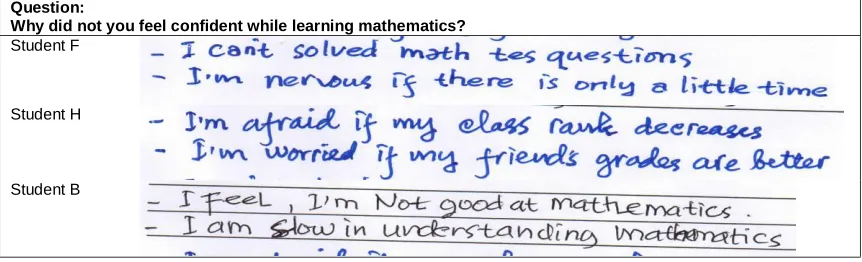
Question:
Why did not you feel confident while learning mathematics?
Student F
Student H
Student B
1926 Mathematics anxiety also comes from students‘ individual
self factors (48 students) (Figure 3). For example, some students wrote that their inability to solve mathematics problems made them angry and felt stupid during the mathematics learning. Low self efficacy also became a factor for them being nervous and pessimistic. Even student (H), who was on 3rd rank in the class, conducted evaluation of mathematics performance with fellows, and continuously worried about his rank in the class. On the other side, anxiety came when a student really appreciated tasks but
felt that he did not have control, and it was disharmony of two things causing the inconvenience (Wang et al., 2016). Although the correlation between mathematics skill and general intelligence was widely supported, admitting self difficulty on mathematics, lack of interest on mathematics or mathematics anxiety could be accepted socially and considered as a norm. On the other hand, if a student admitted that he liked mathematics and the score was always good, the student would be labelled as ―clever‖.
Question:
Why did you considered mathematics as a difficult one?
Student B
Student F
Student H
Figure 4. Mathematics anxiety relating to mathematics nature There were 51 studetns saying that mathematics was
difficult, dizzy, and complicated with many calculations(Figure 4). Some students believed that Algebra was the main reason of their panic, and they counfused with so many symbols and formulas. Mathematics got respects as it was considered as an indicator of intelligence, and good mathematics ability indicated an implication for being considered as ‗clever‘. The feeling of less control could come from the idea that mathematics is difficult or the idea that you should have ‗mathematics brain‘ to succeed on the subject. Both myth triggered an experience of mathematics anxiety for students and society (Luttenberger, Wimmer, & Paechter, 2018).
Teacher strategy to deconstruct students’ mathematics anxiety into positive disposition toward mathematics
Basically, all students wanted to succeed in life and
mathematics. All of them wanted to pass the national exam with satisfying score of mathematics, and to become mathematician that supported career in the future. However, while still being students, they did not have any choice beside following orders and examples given by the teacher. Monotonous learning process with explanation on the beginning, giving examples and doing many mathematics tasks and homeworks was so boring. If students did not follow the guide from the teacher, the teacher would get angry on them and their mathematics score would be not good. In fact, what teacher did to students would bring negative effect to their disposition on mathematics. The students were always shadowed by anxiety in each mathematics learning. Learning motivation on mathematics could decrease. The scariest thing was that students could become ignorant toward mathematics.
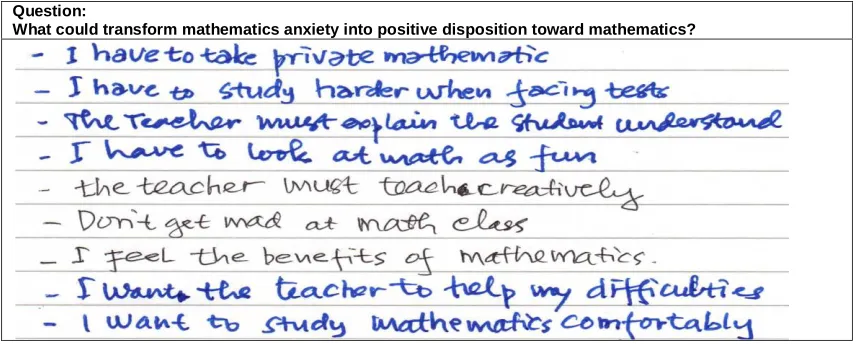
Question:
What could transform mathematics anxiety into positive disposition toward mathematics?
Figure 5. Students‘ need to deconstruct mathematics anxiety
Figure 5 indicated students‘ need that could be important recommendation for teachers. The teacher had an opportunity to get rid of negativestereotype and myth about
1927 stereotype and mathematics nature could not restrict their
choice to learn mathematics. Some effective strategy to get rid of anxious situation in mathematics learning were: (1) Understanding emotional stress phenomena, especially the anxiety in mathematics activities and trying to overcome these modes with the help of scaffolding strategy; (2) teaching strategy included some methods, that were effective in the improvement of students‘ mathematics performance. Cognitive tasks were conducted by making steps leading to problem solving skill; and (3)
Curriculum should be designed well so it contained tasks similar to what they faced in daily life. Mathematics content should be close to materials used in their daily life and should be correlated each other. The teacher should try to reduce student anxiety by using active and dynamic learning method. It meant that peaceful environment without tension in mathematics class was effective to reduce mathematics anxiety. The students‘ awareness on many aplication of mathematics in many careers and ways of life should be awakened. Bringing this view, they could fulfill their mathematics potentialand choose based on factors out of anxiety. To complete this, students should feel that mathematics was similar to other subjects and work hard to come up with improvement.
How to manage mathematics anxiety into motivation? Some students (clever ones) still succeeded with the way teacher tought. However, it did not mean that clever students did not have mathematics anxiety. There was a finding that anxiety did not always have negative implication toward mathematics performance. Some researchers said that not all students that were mathematically anxious had a bad performance in mathematics (Luttenberger et al., 2018; Wang et al., 2016). For example, if a student enjoyed the learning, anxiety could come, and they would be motivated to invest more efforts in the class to gain better outcome. Maybe in the future classess, they would learn more effectively (Wang et al., 2016).Below is an excerpt of interview with a student (G) who was a clever student on 2nd rank.
Researcher : Do you feel anxious to have mathematics test?
Student G : I feel anxious, nerveous and worried for sure.
Researcher : It seemed that the anxiety did not negatively influence on your mathematics achievement. How did you manage the anxiety?
Student G : Always before a mathematics test, I felt so worried, and afraid of bad score. But it encouraged me to study hard and wished for the best result.
Researcher : What efforts did you do?
Student G : I studied hard for sure, i had a lot of practice of solving questions and prayed for the best outcome.
Researcher : Is mathematics a difficult subject?
Student G : Mathematics is difficult, but it is a challenge for me. If i get a good score, i become confident, satisfied and happy.
Based on the excerpt, the student (G) also had a fairly high mathematics anxiety like others. However, the student (G) could manage the anxiety happened to him well. Being afraid of getting bad score was considered as a challenge
to overcome with the best result by giving harder efforts. As in latest research on neuroscience said that it was not the level of mathematics anxiety that caused a degradation of mathematics performance, but their ability to manage their anxiety dido n this anticipation stage and paying attention on a task (Kucian, McCaskey, O‘Gorman Tuura, & von Aster, 2018; Lai, Zhu, Chen, & Li, 2015). The skill of managing anxiety here meant as deconstructing anxiety into motivation to develop positive disposition toward mathematics.
CONCLUSION
This study concluded: (1) Level of mathematics anxiety on IX grade students in Islamic Junior High School Sultan Agung 4 Semarang was on high level of anxiety in mathematics learning. (2) There were four intensity that caused mathematics anxiety: (a) assessment on test, (b) mathematics teacher, (c) personal factors, and (d) mathematics nature and perception; (3) It was not the level of mathematics anxiety that caused decrease in students‘ mathematics performance, but their ability to manage their anxiety on this anticiation stage and pay atention on a task. (4) What could be done was that teacher should create conducive learning environment, provide scaffolding, and help students to deconstruct mathematics anxiety into positive mathematical disposition, so the students could be more successful in mathematics.
Acknowledgment
Thank you to the Sultan Agung Islamic University who funded the research in 2019. Thanks also to the dissertation promoters who have guided the realization of this article.
REFERENCES
[1] Chai, W. J., Abd Hamid, A. I., & Abdullah, J. M. (2018). Working memory from the psychological and neurosciences perspectives: A review. Frontiers in
Psychology, 9(MAR), 1–16.
https://doi.org/10.3389/fpsyg.2018.00401
[2] Cheng, Y. S. (2012). A measure of second language writing anxiety: Scale development and preliminary validation. Journal of Second Language Writing, 13(4), 313–335. https://doi.org/10.1016/j.jslw.2004.07.001 [3] Ganley, C. M., & Mcgraw, A. L. (2016). The Development
and Validation of a Revised Version of the Math Anxiety Scale for Young Children. Frontiers in Psychology,
7(1181), 1–18. https://doi.org/10.3389/fpsyg.2016.01181 [4] Hill, F., Mammarella, I. C., Devine, A., Caviola, S.,
Passolunghi, M. C., & Szucs, D. (2016). Maths anxiety in primary and secondary school students: Gender differences, developmental changes and anxiety specificity. Learning and Individual Differences, 48(1), 45–53. https://doi.org/10.1016/j.lindif.2016.02.006 [5] Keiding, N., & Louis, T. A. (2016). Perils and potentials of
self-selected entry toepidemiological studies and surveys. Journal of The Royal Statistical Society, 179(2),
319–376. Retrieved from
https://rss.onlinelibrary.wiley.com/doi/epdf/10.1111/rssa.1 2136
[6] Kucian, K., McCaskey, U., O‘Gorman Tuura, R., & von Aster, M. (2018). Neurostructural correlate of math anxiety in the brain of children. Translational Psychiatry,
8(1). https://doi.org/10.1038/s41398-018-0320-6
1928 Mathematics Anxiety and Mathematical Metacognition
on Word Problem Solving in Children with and without Mathematical Learning Difficulties. PLOS ONE Journal,
6(6), 1–19.
https://doi.org/10.1371/journal.pone.0130570
[8] Luttenberger, S., Wimmer, S., & Paechter, M. (2018). Spotlight on math anxiety. Psychology Research and
Behavior Management, 11(1), 311–322.
https://doi.org/10.2147/PRBM.S141421
[9] Passolunghi, M. C., Caviola, S., De Agostini, R., Perin, C., & Mammarella, I. C. (2016). Mathematics anxiety, working memory, and mathematics performance in secondary-school children. Frontiers in Psychology,
7(2), 1–8. https://doi.org/10.3389/fpsyg.2016.00042
[10] Ramirez, G., Gunderson, E. A., Levine, S. C., & Beilock, S. L. (2013). Math Anxiety, Working Memory, and Math Achievement in Early Elementary School.
Journal of Cognition and Development, 14(2), 187–
202. https://doi.org/10.1080/15248372.2012.664593 [11] Wang, Z., Lukowski, S. L., Hart, S. A., & Lyons, I. M.
(2016). Is Mathematical Anxiety Always Bad for Math Learning: The Role of Math Motivation. Psychological
Science, 26(12), 1863–1876.
https://doi.org/10.1177/0956797615602471.Is
[12] Zakariya, Y. F. (2018). Development of Mathematics Anxiety Scale : Factor Analysis as a Determinant of Subcategories. Journal of Pedagogical Research, 2(2), 135–144.