36
Implementation Of The Precision Agriculture
Using LEACH Protocol Of Wireless Sensor
Network
Than Htike Aung, Su Su Yi Mon, Chaw Myat Nwe, Zaw Min Naing, HLa Myo Tun
Abstract: The evolution of wireless sensor network technology leads to develop advanced systems for real-time monitoring. Wireless sensor network (WSN) is a major technology that drives the development of precision agriculture.By forming wireless sensor network,agricultural practicescan be made good monitoring systems.Various agricultural parameters like soil moisture, temperature, and humidity are monitored by monitoring units.The paper explains about how to utilize thesensors in agricultural practices and explains about routing protocols of wireless sensor network. In this paper, agricultural parameter of temperature will monitor with the use of LEACH protocol.
Index terms: Agriculture parameters, Crop monitoring,LEACH protocol, Precision agriculture, Wireless sensor network.
————————————————————
I.
INTRODUCTION
Precision Agriculture is a farming management concept basedon observing, measuring and responding to inter-fieldvariability of crops [1 and 5].Precision agriculture refers to the use of information andcontrol technologies in agriculture [2]. Effective soil data collectionand processing is a key requirement in this applicationto use the resources effectively for maximizing the crop yieldand minimizing the impact on the environment. In this paper a sensor network for such a precisionagriculture application is described. Myanmar being an agricultural country needs some innovation in the field of agriculture. This can be achieved through modern technologies which assist communication and control within devices. WSN technologies have become a backbone for modern precision agriculture monitoring [3]. A wireless sensor network typically consists of a large number of low-cost sensor devices with limited battery energy deployed in an unattended manner. Routing and data dissemination are an important issue in wireless sensor networks (WSNs). The essential function of a WSN is to monitor a phenomenon in a physical environment and report sensed data to a base station, where additional operations can be applied to the gathered data. In[4],The system developed by Aji Hanggoro and Rizki Reynaldo based on greenhouse monitoring and controlling using android mobile application was designed to monitor and control the humidity inside a green house. Here software was used as an android mobile phone and used Wi-Fi connection via serial communication to a microcontroller and to a humidity sensor. In [6], multi parameter monitoring system by using wireless sensor network was designed based on low-power Zigbee wireless communication technology for system automation and monitoring. Real time data was collected by wireless sensor nodes and transmitted to the base station using Zigbee. Data was received, saved and displayed at base station to achieve soil temperature, soil moisture and humidity monitoring. The data was continuously monitored at base station and if it exceeds the desired limit, a message was sent to farmer mobile through GSM network for controlling actions. In [7], the system for the automatic irrigation by remotelywhich was founded on embedded system to gather farmersenergy, money and time also use only when there will be needof water.In this approach, the soil test for water content,salinity and chemical constituents and fertilizer requirement ofdata, collected by wireless and processed for better dripirrigation plan. This was reconsider
II. ROUTING PROTOCOLS OF WIRELESS
SENSOR NETWORK
A wireless sensor network typically consists of a large number of low-cost sensor devices with limited battery energy deployed in an unattended manner. Routing and data dissemination are an important issue in wireless sensor networks (WSNs). Routing in a wireless sensor network is the process of forwarding a message from sensor nodesto source nodes [11]. In general, routing in WSNscan be divided into flat-based routing and hierarchical-based routing, depending on the network structure [12]. In flat-based routing, all nodes are typically assigned equal roles or functionality.In hierarchical-based routing, however, nodes will play different roles in the network. A routing protocol is consideredadaptive if certain system parameters can be controlled in order to adapt to the current network conditionsand available energy levels. Furthermore, these protocols can be classified into multipath-based, query-based,negotiation-based, QoS-based, or coherent-based routing techniques depending on the protocol operation. Inaddition to the above, routing protocols can be classified into three categories, namely, proactive, reactive,and hybrid protocols depending on how the source finds a route to the destination. In proactive protocols,all routes are computed before they are really needed, while in reactive protocols, routes are computedon demand.Hybrid protocols use a combination of these two ideas. The main aim for precision agriculture is to monitor the real time data of crop situations and collect the data and then send back to the base station. As sensor nodes are unrechargeable, choosing the suitable network topology is important for prolonging network lifetime [13].In network topology based routing protocol, hierarchical routing protocol is better than flat routing protocol on organizational management of nodes and expansibility of networks, especially suitable for large-scale distributed WSN [13].
III. LEACH PTOTOCOL
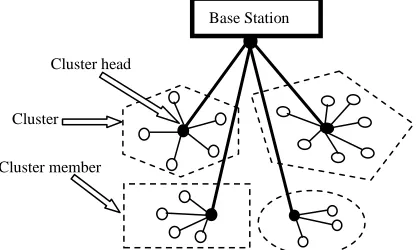
Low Energy Adaptive Clustering Hierarchy (LEACH) is thefirst hierarchical cluster-based routing protocol for wireless sensor network.In LEACH the nodes are partitions intoclusters and in each cluster there is a dedicated node withextra privileges called Cluster Head (CH). This CH createsand manipulates a TDMA (Time division multiple access) schedule for the other nodes (cluster member) of thatcluster. Those CHs aggregate and compress the sensing dataand send to base Station (BS) [14]. Thus it extends thelifetime of major nodes as shown in Fig. 1.
Fig. 1 LEACH Protocol [14]
This protocol is divided into rounds [15]; each round consists of two phases as shown in Fig. 2.
Figure 2: Time line showing LEACH operation
A. Set-up Phase
CH selection is done by considering two factors. First, the desired percentage of nodes in the network and second the history of node that has served as CH. This decision is made by each node n based on the random number (between 0 and 1) generated. If the generated random number is less than a threshold value T (n), then the corresponding nodes becomes CH for that round. The threshold value T (n) is calculated as following (1):
T(n) = {
P
P (r mod P) n∈G
0 otherwise (1)
Where P is the desired percentage of cluster-head, r is the number of round and G is the set of nodes that have not been cluster-heads in the last 1/P rounds. Nodes that have been cluster heads cannot become cluster heads again for P rounds. Thereafter, each node has a 1/P probability of becoming a cluster head in each round. In the following advertisement phase, the CHs inform their neighborhood with an advertisement packet that they become CHs. Non- CH nodes pick the advertisement packet with the strongest received signal strength. Every node that has opted to become a CH broadcasts its new role to the network using a non-persistent CSMA MAC protocol. On receiving the CH broadcasts, each non cluster head node (NCH) decides a cluster to join. The decision may be based on received signal strength of CH broadcast message, among other factors. The NCH, then inform selected CH their wish to become member of cluster. Once the cluster is formed, CH creates and distributes a TDMA based schedule to assign a time slot to each of its CM. To reduce inter cluster interference each CH selects a CDMA code, which is then distributed to all CMs. The completion of setup phase triggers beginning of the steady-state phase.
B. Steady-state Phase
Nodes send their data during their allocated TDMA slot to the CH. This transmission uses a minimal amount of energy (chosen based on the received strength of the CH advertisement). The radio of each non-CH node can be turned off until the nodes allocated TDMA slot, thus minimizing energy dissipation in these nodes. When all the data has been received, the CH aggregate these data and send it to the Base Station (BS).LEACH is able to perform local aggregation data in each cluster to reduce the amount of Base Station
Cluster head
Cluster
38 data that transmitted to the BS. In the precision agriculture,
wireless sensor network routing technique is used for the purpose of crop monitoring. LEACH protocol is used for routing protocol of the network. In LEACH protocol, the cluster head selection as shown in flow chart of Fig. 3 the work process of LEACH protocol have been simulated. In the implementation of LEACH protocol, 5% of sensor nodes are better for clusters heads selection [16]. In this paper, temperature data of agriculture will collect with the use of LEACH protocol.
Figure 3: The work process of LEACH protocol
IV. SIMULATION RESULTS AND DISCUSSIONS
A. Simulation Environment
NS2 is written in the C++ programming language with the Object Tool Common Language (OTCL) as the front-end interpreter. A class of hierarchy supported in C++ is the compiled hierarchy and the interpreter hierarchy for OTCL. The complete simulations are carried out using Network Simulation NS2 [17]. The Table 1 shows the simulation parameters used in the simulation.
Table 1 Simulation Parameters
Parameter Descriptions
Sensor nodes 20,40,60,80,100
Network Size 100m x 100m
Routing protocols LEACH
Radio Speed 1Mbps
Initial Energy 10J
Sensing Power 15mW
Processing Power 24mW
Antenna Gain Factor 1
Antenna High above the Ground 1.5m
B. Simulation Result and Discussion
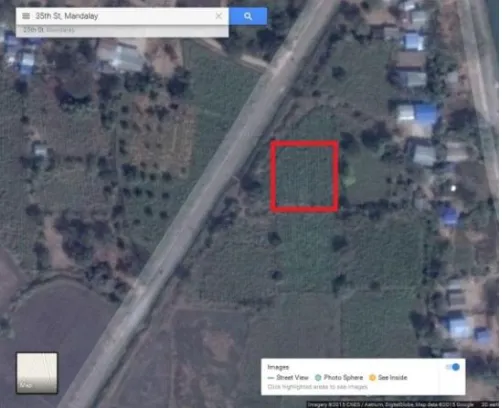
The Table 1 shows that the parameters used in this research. The sensing areas set to 100mx100m and number of sensor nodes will be 20,40,60,80 and 100 nodes. The radio speed of the network is 1 Mbps and initial energy is 10J.Sensing power and processing power of the nodes will be 15mW and 24mW. The sensor nodes will be place 1.5m above the ground and antenna gain factor of the sensor node is 1. The simulation took place with throughput (the total amount of data received), end to end delay and total energy consumption of sensor nodes. The research area is shown in Fig 4.
Figure 4: The research area
1. Throughput versus sensor nodes
In order to monitor the crop situation, the amount of data received at the base station must be as much as possible. The result of figure 5 shows that the temperature date received at the 100 sensor nodes is much higher than any other numbers of sensor nodes.
2. End to end delay versus sensor nodes
Figure 5: Throughput of sensor nodes
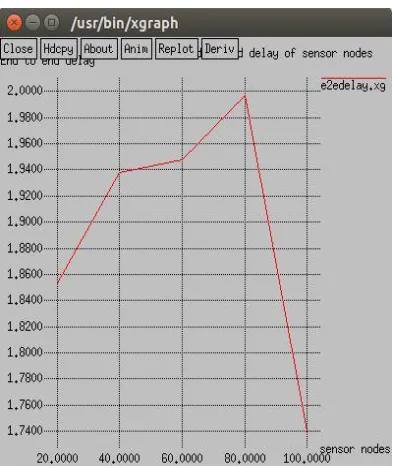
Figure 6: End to end delay of sensor nodes
3. Total energy consumption versus sensor nodes Energy consumption of the sensor nodes is the considerable fact because sensor nodes are unrechargeable. So how many sensor nodes must be deployed in the research area become one of the research goal. The result of figure 7 proves that 100 sensor node is the most suitable for research area.
Figure 7: Total energy consumption of sensor nodes
CONCLUSION
The vital role for precision agriculture is to improve the agriculture with the use of technology.Routing protocols of wireless sensor network can be made crop monitoring with the low cost sensor nodes. Myanmar being an agriculture country, the research is discussed that precision agriculture can be implemented with LEACH protocol of wireless sensor network. By the use of LEACH protocol, temperature data of research areacan collect effectivelywhich will improve the irrigation system of agriculture. Inthis paper LEACH protocol is simulated with three parameters (throughput, end to end delay and total energy consumption of sensor nodes). According to the results, deploying 100 sensor nodes are better for this research area to collect the temperature data. In the future, combination of two routing protocols can be made for more effective crop monitoring.
REFERENCES
[1] T. Kalaivani, A. Allirani and P. Priya, ―A survey on zigbeebased wireless sensor networks in agriculture‖, IEEEInternational Conference on Trendz in Information Sciences andComputing (TISC), 2011, pp. 85-89.
[2] J. Burrell, T. Brooke, and R. Beckwith. Vineyard computing: Sensornetworks in agricultural production. IEEE PervasiveComputing, 3(1),2004.
[3] Miskam, MuhamadAzman, Azwan bin Nasirudin and Inzarulfaisham:‖ Rahim Preliminary Design on the Development of Wireless Sensor Network for Paddy Rice Cropping Monitoring Application in Malaysia‖, 2009.
40 [5] M. Mafuta, M. Zennaro, A. Bagula, G. Ault, H.
Gombachikaand T. Chadza, ― Successful Deployment of a Wireless ensorNetwork for precision agriculture in Malawi‖, IEEEInternational Conference on Networked Embedded Systems forevery Application (NESEA-12), 2012, pp. 1-7.
[6] AnjumAwasthi& S.R.N Reddy, ―Monitoring For Precision Agriculture Using Wireless Sensor Network-A Review‖, Global Journal of Computer Science and Technology Network, Web & Security Volume 13 Issue 7 Versions 1.0 Year 2013.
[7] Aniket H. Hade, Dr. M.K. Sengupta, ―‖Automatic Control Of DripIrrigation System &Monitoring Of Soil By Wireless‖, (IOSR-JAVS) E-ISSN:2319-2380, P-ISSN: 2319-2372. Volume 7, Issue 4 Ver. Iii,pp. 57-61 (Apr.2014).
[8] Y. Kim, R. Evans and W. Iversen, ―‖Remote Sensing and Control of anIrrigation System Using a Distributed Wireless Sensor Network‖, IEEETransactions on Instrumentation and Measurement, pp. 1379–1387, July 2008.
[9] Siuli Roy, SomprakashBandyopadhyay, ―A Test-Bed on Real-Time Monitoring Of ―Agricultural Parameters Using Wireless Sensor Networks For Precision Agriculture‖.
[10]LIU Yumei, ZHANG Changli, and ZHU Ping, ―‖The temperaturehumidity monitoring system of soil based on wireless sensor networks‖.
[11]Sunita Gupta and K.C.Roy,‖Comparison of different Energy Minimization Techniques in Wireless Sensor Network‖,International Journal of Computer Applications (0975 – 8887)Volume 75– No.18, August 2013.
[12]Jamal N. Al-Karaki and Ahmed E. Kamal,‖Routing Techniques in Wireless Sensor Networks: A Survey‖. December, 2004.
[13]Than HtikeAung, Su Su Yi Mon and Chaw MyatNwe,‖Comparative Study on Routing Protocols of Wireless Sensor Network for Precision Agriculuture‖, 13th Research World International Conference,ISBN: 978-93-85973-55-0,pp. 37– 41,Singapore, March 2016.
[14]Mark A. Perillo and Wendi B. Heinzelman: ‖Wireless Sensor Network Protocols‖, 2005.
[15]Wendi Beth Heinzelman: ―Application-specific protocol architechtures for wireless networks Massachusetts Institute of Tchnology‖, June, 2000.
[16]Than HtikeAung, Su Su Yi Mon, Chaw MyatNwe and Zaw Min Naing:‖NS2-Based Simulation of LEACH Protocol Analysis on Different Parameters for
Precision Agriculture‖, The Sixth ICSE Yangon, Myanmar, December 2015.