Cattle Identification Using LBP Descriptor And
SVM Classifier
Supriya Rajankar, Rahul Mankar, Omprakash Rajankar
Abstract— In order to implement positive cattle identification delectability, the paper proposes a new model dependent on the histogram of Gradients (HOG) and Convolutional Neural Networks (CNN). Training algorithm was applied separately on a number of normalized gray faces of cattle images. Due to lighting variation sparse and low-rank disintegration was explained for alignment as well as misalignment, occlusion of the test image. The proposed work is an invariant biometric based cattle recognition based on cattle muzzle photo. It exploits texture feature extraction considering minimum distance and Support Vector Machine (SVM). The proposed work aims to achieve best accuracy.
Index Terms— Histogram of Gradients, CNN, Muzzle, Local binary pattern descriptor (LBP).
—————————— ——————————
1 I
NTRODUCTIONDRIVEN by government interest to enhance the livestock count, a robust and proficient cattle recognition system has become a necessity to know disease trajectory, herd management, cattle traceability, vaccination and ownership. Cattle recognition and tracking is a process of correctly knowing individual cattle using a unique identifier. To monitor cattle movement, the existing systems are based on numbered ear tags, tattooing, and branding, notching and electrical methods. In some of these methods tracking of attached device to animals is done instead of tracking the animal itself. In such situations loss or fake substituting of the tag becomes problematic for security challenges. Due to methods like notching, tattooing and branding cattle suffer from significant pain. Biometric recognition is a non-invasive method that provides unique identifiers using permanent biological properties. Due to the competency in universality, uniqueness, performance, circumvention, biometric is dominating the existing techniques. Cattle biometric consists of following three methods,
1. Iris Pattern
2. Retinal vascular pattern 3. Muzzle Print
The muzzle pattern or nose print that is associated with the unique human mark has been considered as a biometric marker for cattle. Related with the computerized organizationof the muzzle design, it contains dots and edges, the muzzle is an unpredictable area resembled an island, and the edge is a prolonged district resembled a waterway with asymmetric width. The muzzle example can be caught into computerized position in two different ways. The first is lifted on paper information, and the second is the muzzle photograph. In this research, for automatic cattle
identification, the muzzle photograph will be utilized as input data
2
L
ITERATURES
URVEYThe LBP descriptor was considered for surface representation. In Cheng Cai1 et al. [1], the executive doles out a mark to every pixel of a picture by the 3×3 thresholding of neighbourhood of each pixel with the inside pixel esteem to get the result a twofold number. If the intensity of focus pixel is greater than its adjacent, a 1 bit is set at the comparing area. Something else, a bit 0 is set. At that point, the eight bits created from power correlations are placed in a circuitous solicitation (gathered bits in a clockwise way) and twofold number considered, it can be changed over to a base-10 number in [0 255]. This is LBP esteem for middle pixel, as a file which goes to the LBP histogram. At that point the histogram of names can be utilized as a surface descriptor. The facial picture is isolated into a few locales and surface descriptors are removed from every area freely.
Habte Tadesse Likassa et. al proposed in [2] a compelling and strong calculation for picture arrangement on an arrangement of sprightly corresponded information. The new calculation changes the Robust Algorithm for Sparse and Low-rank deterioration (RASL) by using the earlier data of halfway segment rank. To accomplish this, an additional term is fused in the deterioration of information lattice, which empowers the new way to deal with be stronger to blunders, anomalies and impediments. The issue is given a role as a compelled enhancement issue, or, in other words by curved program. Another arrangement of conditions are likewise inferred to refresh the factors engaged with a round-robin way. Directed re-enactments on the recuperation of adjusted face pictures and manually written digits uncover the viability of the new calculation contrasted and the fundamental best in class works In [3] a novel and effective facial picture portrayal dependent on neighbourhood twofold example (LBP) surface highlights is displayed. The face picture is isolated into a few areas from which the LBP highlight appropriations are removed and linked into an improved element vector to be used as a face descriptor. The execution of the proposed strategy is evaluated in the face acknowledgment issue under various
_________________________________________
Supriya Rajankar Professor in Electronics and Telecommunication department, Sinhgad College of Engineering Vadgaon(bk), Pune, India Email: [email protected]
Rahul Mankar ME(ENTC), Sinhgad College of Engineering Vadgaon(bk), Pune, India Email: [email protected]
difficulties. Different applications and a few augmentations are same way talked about.
Paper [4] addresses the testing issue of acknowledgment and characterization of finished surfaces under light variety, geometric changes and loud sensor estimations. They propose another surface administrator, Adaptive Median Binary Patterns (AMBP) that broadens our past Median Binary Patterns (MBP) surface element. The main thought of AMBP is to hash little neighbourhood picture patches into a parallel example text on by intertwining MBP and Local Binary Patterns (LBP) administrators joined with utilizing self-versatile examination window sizes to all the more likely catch invariant microstructure data while giving strength to clamour. The AMBP conspire is appeared to be a successful system for non-parametric learning of spatially changing picture surface insights. The neighbourhood circulation of pivot invariant and uniform twofold example subsets stretched out with more worldwide joint data are utilized as the descriptors for vigorous surface grouping. The AMBP is appeared to beat ongoing paired example and sifting constructed surface examination techniques in light of two huge surface corpora (CUReT and KTH TIPS2-b) with and without added substance commotion. The AMBP strategy is marginally better than the best procedures in the silent case yet essentially beats different strategies within the sight of drive commotion.
It is notable that the relevance of independent segment
examination (ICA) to high-dimensional example
acknowledgment undertakings, for example, confront acknowledgment regularly experiences two issues. One is the little example measure issue. The other is the decision of premise capacities (or autonomous parts). The two issues make ICA classifier insecure and one-sided. In [5], we propose an improved ICA calculation by troupe learning approach, named as arbitrary autonomous subspace (RIS), to manage the two issues. Initially, we utilize the irregular resampling procedure to produce some low dimensional component subspaces, and one classifier is developed in each element subspace. At that point these classifiers are joined into an outfit classifier utilizing a ultimate choice run the show. Broad experimentations carried out on the FERET database recommend that the proposed strategy can enhance the execution of ICA classifier.
3 P
ROPOSEDS
YSTEMFacial images are the mostly used biometric characteristic by humans to gain personal recognition.
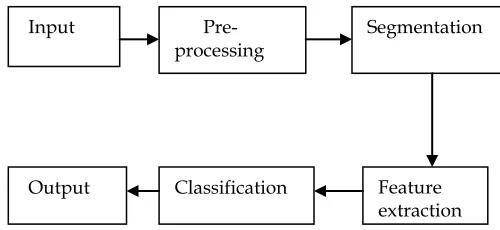
Fig.1 Block diagram of proposed system
Hence we are taking an interest in using this biometric feature. Fig. 1 shows a block diagram of the proposed system.
3.1 Input
Input to the system is image of face of a cow.
3.2 Pre-processing
Pre-processing includes removal of low-frequency
background noise from the images, evacuating reflections, normalizing the power of the independent particles of images, and masking portions of an image. Image pre-preparing is the technique for improving information pictures before computational handling.
3.3 Segmentation
In computer vision image segmentation is the process of
partitioning a digital image into multiple segments
(sets of pixels). The objective of segmentation is to simplify and change the representation of an image into something i.e. is more meaningful and easier to analyze. Image division is ordinarily used to discover limits and find objects (lines, bends, and so on.) in pictures. Thus, image segmentation allows a label to each pixel in an image so that pixels with a similar label can share certain feature.
3.4 Feature extraction
Feature extraction includes decreasing the number of resources required to depict a huge set of data. When examining complex data, one of the serious problems stems from the number of variables included. Analysis with a huge number of variables which requires a lot of memory and
calculation of power also it may cause
a characterization algorithm to over-fit to preparing samples and collect ineffectively to new samples. Feature extraction is a basic term for strategies for constructing combinations of the variables to get around these issues while still depicting the data with enough accuracy. Many machine learning specialists trust that appropriately optimized feature extraction is the way to powerful to effective model development.
3.5 HOG
The histogram of oriented gradients (HOG) is a feature descriptor used for the purpose of object detection in an image processing . The strategy calculates occurrences of gradient orientation in a localized area of an image. This strategy is similar to edge orientation histograms and shape contexts, scale-invariant feature transform descriptors. It also utilizes overlapping local contrast normalization to raised accuracy. To figure a HOG descriptor, we have to firstly compute the horizontal and vertical gradients, here we compute the histogram of gradients. We can also compute the same results, by utilizing Sobel operator in OpenCV with kernel size 1.
Input Pre-
processing
Segmentation
Output Classification Feature
3.6 CNN
A convolutional neural network (CNN) is a class of deep neural networks. CNN can reduce over fitting. CNN are used for image classification and recognition because of its high accuracy. The CNN works on building a network, like a funnel, and gives a fully-connected layer where all the neurons are connected to each other for processing output.
3.7 Classification
Classification is carried out using SVM algorithm.
4 R
ESULT ANDA
NALYSISPre-processing is performed on image using filter to reduce noise. Morphological operations like erosion and dilation are performed on dataset of image. Coefficients and gradients of histogram of image are calculated using HOG algorithm. Step 1 Take input image i.e. original image and resize it after that convert this image into gray image.
Step 2 Apply HOG transform on image. Extract required features from image using HOG transform. On the other side for training SVM algorithm, extracts features from image from dataset and feed them to SVM (linear Kernel) for training. SVM is used for classification of image. If ERR is less than threshold then image does not exist in dataset hence output will be unknown if it is greater or equals then output will be classified image which predicts animal.
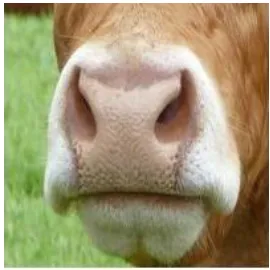
Fig. 2 Input Image
Fig 2 shows one of the images from dataset as input to the system
Fig. 3 Resize image
Resized image is shown in fig 3 An RGB Image consists of 3 layers R, G, B , that correspond to the intensity of red, green, blue light. It is a 3D matrix; therefore we are converting to gray image as shown in fig 4.
Fig. 4 Gray image
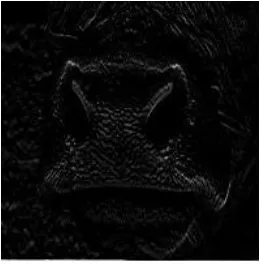
HOG transform is applied on gray image to extracts features from image as shown in fig 5.
Fig. 5 HOG features
Fig.7 Y gradient
X and Y gradients are shown in fig 6 and fig 7 respectively and fig 8 shows magnitude.
Fig. 8 Magnitude
Fig. 9 Result of feature calculation of one cattle
Fig. 10 Result of feature calculation of second cattle The graphs in above fig 9 and fig 10 show the plot of the texture features of cattle and predicted values evaluated by the SVM algorithm respectively. Simultaneously here we plot a texture feature of the entire database.
Fig.11 Result of feature comparison of different animals
After analysing the data manually we observes the above graph that is fig. 11. This shows the different cattle texture features are different for different database.
For analysis and calculating the accuracy of given algorithm we are using the confusion matrix. We achieved the final accuracy of 90.75% as shown in table 1.
Precision: proportion of instances that are truly of a class divided by the total instances classified as that class
No of images :- 400
Positive (P):-350
Negative (N):- 50
TABLE 1 ACCURACY CALCULATION
Detected Non Detected
Detected 330 [TP] 20[TN]
The manual calculations are given below:-
3 3 0 3 3
9 0 .7 5 % 3 5 0 5 0
3 3 0
_ _ 9 4 .2 8 %
3 5 0
3 3 0
P r 9 5 .1 0 %
3 5 0 1 7
T P F N
A c c u r a c y
P N
T P
T r u e p o s i t i v e r a t e
T P T N
T P e c i s i o n
T P F P
TABLE 2 CLASSIFICATION PERFORMANCE TABLE COMPARING WITH DIFFERENT CLASSIFIER.
Classifier Accuracy%
Nearest Neighbour 87.64
KNN, K=3 88.97
Proposed method
(SVM) 90.75
Table 2 shows classification performance comparing with different classifier. The results of the current study manifest the efficiency of the convolutional neural networks in classifying the cattle muzzle images that saved in database system and also for identifying cattle animals using muzzle print images. Also it has been achieved an excellent accuracy (more than 90% for) against well-captured images.
5
C
ONCLUSIONThe CNN has been widely used in many applications. LBP is simple operator which labels the pixels of an image by thresholding the neighbourhood of each pixel, the type of visual descriptor used for classification in computer vision. The detection performance of the database is improved by HOG. In this system, LBP has been used to extract robust texture features which are invariant to rotation and quality of the images. Also reduce the number of features extracted by LBP, i.e. reducing LBP dimensionality problem, and discriminate between different classes and thus improve the accuracy of the proposed system.
References
[1] Cheng Cai and Jianqiao Li, “Cattle Face Recognition Using Local Binary Pattern Descriptor”, Signal and Information Processing Association Annual Summit and Conference(APSIPA), Oct 2018
[2] Habte Tadesse Likassa, Wen-Hsien Fang and Yung-An Chuang, “Modified Robust Image Alignment By Sparse and Low Rank Decomposition for Highly Linearly Correlated Data”, 3rd International Conference on Intelligent Green Building and Smart Grid (IGBSG) 2018. [3] Timo and M. Pietikäinen, “Face description with local
binary patterns: application to face recognition,” IEEE Trans. Pattern Analysis and Machine Intelligence, vol. 28, issue. 12, pp. 2037- 2041, Dec 2006.
[4] Adel Hafiane, Boulvard Lahitolle, Kannappan Palaniappan “Adaptive Median Binary Patterns for Texture Classification” 22nd International Conference on Pattern Recognition, 2014
[5] J. Cheng, Q. Liu, H. Lu and Y. W. Chen, “Ensemble learning for independent component analysis,” Pattern Recognition, vol. 39, issue. 1, pp. 81-88, 2006.
[6] Santosh Kumara, Amit Pandeyb, K. Sai Ram Satwikb, Sunil Kumarc, Sanjay Kumar Singhd, Amit Kumar Singhe, Anand Mohan, “Deep learning framework for recognition of cattle using muzzle point image pattern”, Measurement,
vol 116 , pp 1–17, 2018,DOI:
10.1016/j.measurement.2017.10.064
[7] G. C. Smith, J. D. Tatum, K. E. Belk, J. A. Scanga, T. Grandin, and J. N. Sofos, “Traceability from a US perspective,” Meat Science ,vol. 71, issue 1, pp. 174-193, 2005.
[8] W. Zhao, R. Chellappa, P. J. Phillips and A. Rosenfeld, “Face recognition: a literature survey,” ACM Computing Surveys, vol. 35, issue 4, pp. 399-458, Dec 2003.
[9] Maria valid, Roxana andreea parvulet, madalin Stefan valid, “A Survey of Livestock Identification Systems” Latest Advances in Information Science, Circuits and Systems ISBN: 978-1-61804-099-2