192
An Extraction Of Ancient Tamil Scripts From
Epigraphy Images Using Gabor Filter, Active Contour
And Lomo
S.Sundareswari, Dr.I.Kaspar Raj
Abstract :The extraction of Ancient script from epigraphy images is a tough task. Many techniques are available to extract the characters from the document image. Most of the authors have given their ideas to extract the characters from the document image. The extraction of ancient Tamil script from epigraphy images is a challenging problem in pattern recognition area still. In this paper, we present an efficient approach to extract the ancient Tamil script from epigraphy images. Recognizing the ancient Tamil script from epigraphy images is a very tough task. The proposed methodology consists of three stages: preprocessing, segmentation and feature extraction and classification. Experimental results show that the proposed methodology is more effective and efficient and also it extracts the ancient Tamil script from epigraphy images accurately.
Keywords:Tamil Ancient Characters , Gabor Filter and Active Contour, Feature Extraction(Zernike and Lomo), Classification(KNN and RF)
————————————————————
1 INTRODUCTION
Epigraphy is the study of the science of epigraphs or inscriptions, especially of ancient inscriptions. An epigraph is any kind of text from a single character to a lengthy document. Texts in epigraphy images are different from written texts of each culture [1]. In this work, we have used Ancient Tamil Script epigraphy images as input images. Segmentation of text or character from document image is an easy process. In epigraphy images, the engraved characters are different in size, color, and writing style. Mostly the epigraphy images have broken characters, uneven character intensity, touching characters each other and direction variations within symbols [2In preprocessing Gabor filter and active contour are used to enhance the image clearly without any noise. Then the combinational approach of two different feature extractions like Zernike moment and Lomo are used. Finally, in classification, two classifiers such as KNN(K-Nearest Neighbor) and
RF(Random Forest) are used and tested. This paper is made as follows: Section 1 contains the initiation of
epigraphy images, Section 2 explains the details of proposed methodology through various steps involved, Section 3 presents the details of combinational approach of feature extraction techniques, Section 4 discuss the various types of classifiers, Section 5 discussion on results, Section 6 concludes research performance.
2. PROPOSED METHODOLOGY
This proposed methodology involves the following steps: i) Image Acquisition: Read an input image and convert into suitable format. ii) Preprocessing: Gabor filter and Active contour used to remove the noise. iii) Feature Extraction:
The combinational approach of Zernike moment and Lomo are used to extract the ancient Tamil scripts from epigraphy images. iv) Classification: In this proposed methodology two classifiers like K-Nearest Neighbor, Random Forest are used and tested. In this proposed methodology, Gabor filter and Active contour are used for preprocessing and for feature extraction techniques combinational approach of Zernike Moment and Lomo features are used. Hence the combinational of these two feature extraction techniques may improve the overall detection rate of the characters in epigraphy images. Next, we have used two different classifiers like RF (Random Forest) and KNN (K Nearest Neighbor) is used and tested to select the best classification algorithm for this research work
2.1 Proposed Algorithm :
Step 1: Read the following inputs like Image,ѳ (theta), f (frequency),threshold value(gmthr) Step 2: Read the testing
image as Img. Step 3: Initial parameter for Gabor filter GF as ѳ ← 90 and frequency value is 0.2 and threshold value is 50. Step 4: Apply Gabor filter using the equation 4.1. 4.1) [ ImggFC ,ImggFI) ← GF (Img) where ѳ =90, f = 0.2. Step 5:
for each pixel in image ← Img ImggF mag = SQRT (ImggFR 2
+ ImggFI
2
) End Step 6: Find Gabor filter magnitude binary mask as GFBW ← ImggFmag > gmthr . Step 7: Extract the Contour of the
image Img using GFBW as intial mask in Active Contour mode.
ImgACBW ← ACmode (Img,GFBW). Step 8: for each connected
label ← ImgACBW Extract the characters by using the following
feature extraction techniques. Zfeat ← Zernike(BWc) Lfeat ← Lomo(Img(BWC) end Step 9: Feature vector =
[Zernike(BWC),Lomo(Img(BWC) Step 10: Predict Charaters ←
Classifiers(Training feature, feature extraction). In this proposed methodology, first character samples are trained and tested. In preprocessing Gabor filter and Active contour are used. In Gabor filter, first read the input image,theta (ⱷ),frequency(f) and threshold value (gmthr).Next, read the testing image as Img. Then
set the initial parameters for Gabor filter is ѳ is 90 and the frequency value is 0.2 and the threshold value is 50. Applying Gabor filter using the equation [ImggFC ,ImggFI) ← GF (Img) ] and
get real and imaginary part of each pixel value using the above parameters. Then find out the Gabor filter magnitude binary mask of images as GFBW ← ImggF mag > gmthr This value should be
greater than the threshold value. Next, extract the contour of the image Img using GFBW as initial mask in Active Contour mode
as ImgACBW ← ACmode (Img,GFBW). Finally, for each connected
_____________________
S.Sundareswari, Research Scholar, Research and Development Centre,
BharathiarUniversity,Coimbatore,TamilNadu, [email protected]
Dr.I.Kaspar Raj,Director, Computer Centre, The Gandhigram Rural InstituteDeemed University,Gandhigram, Dindigul, Tamil Nadu, India
label in Active contour image, extract the characters one by one by using the combinational approach of Zernike and Lomo feature extraction techniques. Zfeat Zernike(BWc). Lfeat ← Lomo(Img(BWC). The process of extracting ancient scripts involves different stages. The stages of the proposed methodology are shown in Figure 1.
Fig .1. Flowchart for Proposed Methodology
2.2 Gabor Filter
Most of the researchers have used a Gabor filter for texture analysis. These Gabor filters are known as orientation and sensitive filters. Gabor filter points out the particular location in any image by using its direction. Gabor filter is an advanced level of Gaussian filter. In Gaussian filter variances Sx along x-axes and Sy along y axes respectively. The Gabor filter is modulated by a complex sinusoid with center frequencies. The formula of 2-D Gabor filter is [3] g(x,y: λ,ѳ,ψ,σ,ϒ) = exp ( ) exp
( ( )) where x’ = x cos ѳ + y sin ѳ y’ = -x sin + y cos ѳ (1) The Gabor transform is used to cut the
Fourier transform and isolate only specific information. Each Fourier ―pixel‖ is a complex value (real part and imaginary part). The tuning frequency f0,λ is used to select the best sinus wave filter. The following formula E= √ is used to find out the real and imaginary part for each pixel.
2.3 Active Contour
Active contour or snake method is an effective edge-based method in segmentation. It has strong mathematical properties and efficient numerical schemes based on the level set method [4].In our work, the active contour method is used to complete the boundary of the object of broken and unseen characters of the epigraphy image. In the Chan-Vese model [5] segmentation is
done by curve evolution to minimize the following term :
F(C) = μ.Length(C) + λ1 ∫ dxdy +
Inside(C) λ2 ∫ dxdy2)
Outside(C) In the above formula, μ,λ1 and λ2 are fixed
parameters.C is the contour and c1 and c2 are the average pixel values of inside and outside of C[6].
2.4 Dice Coefficient
Dice coefficient is the techniques to find similarity of an
object.The formula of dice coefficient is [ ]
(3) Stands for the cardinality of the set X.This incident measures the similarity between sets X and Y. If two sets are identical, the coefficient is equal to 1.0, while if X and Y have no elements in common, it is equal to 0.0. In our work, we have used the dice coefficient to identify character similarity between training characters and ground truth image[7].
Preprocessing (Binarization)
Preprocessing (Gabor Filter and Active Contour)
3. FEATURE EXTRACTION METHODS
The approach of representing or modifying the original data is known as feature extraction. In this section, we have discussed the feature extraction methods and choosing the input vector from every method.
3.1 Zernike Moment Descriptor
Zernike moments are a class of orthogonal moments. Therefore, we have used Zernike moments as our shape descriptor in recognition of ancient Tamil scripts from epigraphy images [8] In( ) polar coordinates, the zernike radial polynomials {
(ρ)} are defined as [4]
∑
( ) ( )
(4)
Where n is a non-negative integer and m is a non-zero integer subject to the following constraints: n-|m| is even |m| n. The set of orthogonal polynomials defined on the unit disk. It is defined as where, x, y and ρ, θ correspond to Cartesian and polar coordinates respectively, the moment simply the projection of the image function on to these orthogonal basis functions. It is defined
(5)
where, x, y and correspond to Cartesian and polar
coordinates respectively, moment simply the projection of the image function on to these orthogonal basis functions. It is
defined as
∫ ∫ [ ]
(6) (6)
Epigraphy Image
Gray scale Conversion
Gabor Filter and Active
Contour
Classification (KNN &
RF)
Feature Extraction (Zernike & Lomo)
194 where * is the complex conjugate operator and x^2+y^2≤1. In
Zernike moment, Scale invariance is calculated by multiply the scale factor raised to a certain power and translational invariance is used to shift images origin centric. The magnitude of each Zernike moment is invariant under rotation. Finally, we have used the Zernike moment to reconstruct the image by adding all the
individual contributions. It is given by
̂ ∑ ∑ (7)
3.2 LOMO (Local Maximal Occurrence) Lomo is based on the concepts of HSV (Hue,Saturation,Value) and SILTP (Scale Invariant Local Ternary Pattern).The three advantages of SILTP is given below (i) Computationally Efficient (ii) Robust to local image noises (iii) Robust to illumination changes. The formula of SILTP with the pixel location (xc,yc) is given below: N=1 SILTP
ϒ
N,R (xc,yc) = nnn
Sϒ (Ic,Ik) (8) k=0 denotes concatenation
operator of binary strings, ϒ is a scale factor indicating the comparing range, and Sϒ is a piecewise function defined as
Sϒ (Ic,Ik) ={
(9) Since
each comparison can result in one of the three values SILTP encodes it with two bits. The scale invariance of SILTP can be easily verified. Ik is that of its N neighborhood pixels equally
spaced on a circle of radius R [9].
4.CLASSIFICATION METHODS
The use of classification method if to classify Segmented image by making use of extracted features. In this research work, We have used two types of classification methods and tested to select the best classification method.
4.1 Random Forest
The random forest is a classification and regression algorithm originally designed for the machine learning community. A collection of tree-structured classifiers {h(x,ѳk)} exist in a random forest classifier. The {ѳk} are the identical distributed random vectors that are independent. Each tree casts a vote for the most popular class of input x. In a random forest, several decision trees are created and the response is calculated based on the outcome of all of the decision trees[ 10].
4.2 K-Nearest Neighbor
K-Nearest Neighbor is an omnipresent classification and regression tool with great adaptability for all type of applications. A K-Nearest Neighbour based classifier characterizes a query instance based on the class names of its neighbor events.NN classifier where each pixel is classified in the same class as the training data with the closest intensity [11]. In KNN, training data set which contains both the input and the target variables and then it is comparing the test data which contain only input variables. It sets the distance of the unknown to K nearest neighbors determines its class assignment by averaging class numbers or by obtaining a voting method [12].
5. RESULTS AND DISCUSSION
The following Figure 2 shows the result of the image with Gabor filter and active contour. Then it extracts the characters from the original image one by one. In this research paper, we have used and tested two classification techniques like RF, and KNN. This experiment was developed using Matlab. In this experiment, few
sample images have been tested using two different classification techniques and also used 2562 training samples and 648 test samples. In Table 1, the dice coefficient and the detection rate of the proposed algorithm is calculated by using three sample epigraphy images. In this proposed algorithm, the number of character identification is high than previous work (Table 2) and also it extracts the characters from epigraphy images accurately and clearly. Then, Table 3 shows the result of classification techniques. This Table 3 compares the precision, Recall, F-score obtained from the classification techniques like RF, and KNN. The detection rate of RF and KNN is also calculated.The detection rate is used to identify how many number of characters are extracted from epigraphy image accurately.From this analysis, we observed that the average Fscore value of RF gives 89.55 and overall recognition rate of average Fscore of KNN is 92.13. From this experiment, we observed the evaluation measurements have shown that KNN classifier shows excellent Fscore value than RF and also KNN gives the good detection rate value than RF..
Fig.2. Image with Gabor filter and Active Contour
Fig.3 Fig.4
Fig.5 Fig.6 Extraction of Characters one by one
TABLE 1
Dice Coefficient and Detection Rate Algorithm
Sample Epigraphy Image
Proposed Algorithm
Dice Coefficient
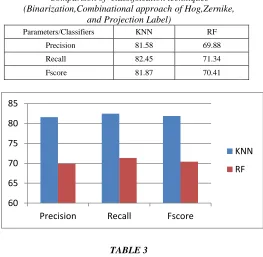
Detection Rate KNN RF Sample1 (sample5.png) 0.76 0.8 0.4 Sample2(stone13.jpg) 0.79 0.75 0.55 Sample3(sample1.png) 0.87 0.8 0.6 The following TABLE 2 and Chart shows that the result of Previous work done by using (Binarization with HOG,Zernike, & Projection Label) [13]
TABLE 2 ([13])
Comparison of classifsication techniques (Binarization,Combinational approach of Hog,Zernike,
and Projection Label)
Parameters/Classifiers KNN RF
Precision 81.58 69.88
Recall 82.45 71.34
Fscore 81.87 70.41
TABLE 3
Comparison of classification techniques
for Proposed Algorithm (Gabor Filter &Active Contour and Combinational approach of Zernike and Lomo)
Parameters/Classifiers KNN RF
Precision 93.52 91.23
Recall 93.22 91.82
Fscore 92.13 89.55
The following flowchart shows performance of two classification techniques with parameters
Fig.8.The comparative analysis of two classification techniques
Precision - Precision is the ratio of correctly predicted positive
observations to the total predicted positive observations.
Precision = TP/(TP+FP) (10) Recall (Sensitivity) - Recall is the ratio of correctly predicted
positive observations to the all observations in actual class
Recall = TP/(TP+FN) (11) FScore =2*(Recall *Precision)/(Recall + Precision) (12)
6. CONCLUSION
The detection rate of RF and KNN is also calculated. The detection rate is used to identify how many numbers of characters are extracted from epigraphy image accurately. From this analysis, we observed that the average F-score value of RF gives 89.55 and overall recognition rate of average F-score of KNN is 92.13. From this experiment, we observed the evaluation measurements have shown that KNN classifier shows excellent F-score value than RF and also KNN gives the good detection rate value than RF.
REFERENCES
[1] ―Epigraph – Online Etymology Dictionary‖
[2] Bharath A. and Sriganesh Madhavanath ,‖OCR for Indic Scripts Document Recognition and Retrieval‖ in Guide to OCR for Indic Scripts Advanced in Pattern Recognition
2010,Hewlett Packard Laboratories
,Bangalore,India,Springer ,2010,p.p.209-234.
[3] V.Kyrki,J-K.Kamarainen,H.Kalviainen ,‖Simple Gabor feature space for invariant object recognition‖ Pattern Recognition Letters,Vol.25,No.3,PP.311-318,2004.
[4] Xavier Bresson,Selin Esedoglu,Pierre Venderghevpst,Jean-Philippe,Thiran Stanley,‖Fast Global Minimization of the Active Contour /Snake Model‖,Journal of Mathematical Imaging and Vision 28(2),151-167,2007.
[5] T.Chan and L.Vese,An active contour model without edges in Proceeding of the Second International Conference on Scale-Space Theories in Computer Vision (Scale-Space ’99) ,Corfu ,Greece,September 26-27,1999.
[6] Yaakov Navon,Vladimir Kluzner,Boaz Ophir ,‖Enhanced Active Contour Method for Locating Text‖,Conference Paper,IEEE XPlore ,October 2011.
[7] Vikas Thada,Vivek Jaglari,‖Comparison of Jaccard,Dice,Cosine similarity Coefficient To find Best Fitness values for Web Retrieved Documents Using Genetic Algorithm:,International Journal of Innovations in Engineering and Technology(IJIET) ,Vol.2 ,Issue 4,August 2013.
[8] N.Sridevi,P.Subashini,‖Optimized Framework for Classification of 11th Century Handwritten Ancient Tamil
86 88 90 92 94
Precision Recall Fscore
KNN
RF
60 65 70 75 80 85
Precision Recall Fscore
KNN
196 Scripts Using Computational Intelligence Technique‖,The
International Journal of Computer Science &Applications(TIJCSA},Vol 2,No.02,April 2013,ISSN-2278-1080.
[9] Shengcai Liao,Guoying Zhao,Vili Kellokumpu,Matti Pietikainen,and Stan Z.,Li,‖Modeling Pixel Process with Scale Invariant Local Patterns for Background Subtraction in Complex Scenes‖,Center for Biometrics and Security Research & National Laboratory of Pattern Recognition,Institute of Automation ,Chinese Academy of Sciences,Machine Vision Group,University of Oulu,Finland.
[10] Leo Breiman,‖Random Forest‖,Statistics Department University of California Berkelay.2001.
[11] H.Selvaraj,S.Thamarai Selvi,D.Selvathi,L.Gewali,‖Brain MRI Slices Classification Using Least Squares Support Vector Machnine‖,IC-MED,Vol.1,No.1,Issue 1,pp 21-33,2007.
[12] Hiremath P.S,Parashuram Bannigidad,Manjunath Hiremath,‖Digital Microscopic Image Analysis of Virus Particles‖,International Journal of Machine Intelligence ,Issue 4,pp 180-184,2011.
[13] S.Sundareswari, I.Kaspar Raj ,‖An Efficient Feature Extraction Approach for Extracting the Ancient Tamil Scripts from Stone Inscription Images‖,Journal of Applied Science and Computations,Vol VI, Issue V,May/2019,ISSN NO :1076-5131.
[14] Vikas K.Yeotikar,Manish T,Wanjari,Dr.Mahendra P.Dhore,‖Text Extraction from Document Images Using Gabor,Wavelet and Hough Technique : A Novel Approach‖,International Journal of Innovative Research in Computer Science & Technology (IJIRCST),ISSN :2347-5552,Volume-3,Issue-4,July-2015.
[15] Papakostas G.A, Karras D.A., Mertzios B.G, Butalis Y.S ,‖An Efficient Feature Extraction Methodology for Computer Vision Applications using Wavelet Compressed Zernike Moments‖ ,ICGST.Com.
[16] Mai Showman,Tim Turner, Rob Stocker,‖Applying K-Nearest Neighbour in Diagnosing Heart Disease Patients‖,2012 International Conference on knowledge Discovery (ICKD 2012),ipcsit Vol.xx(2012),IACSIT Press,Singapore.
[17] Hasan Abdel Qadar,Abdul Rahman Ramli and Syed AL-Haddad,‖Fingerprint Recognition Using Zernike Moments‖,The International Arab Journal of Information Technology,Vol.4,No.4,Oct 2007.
[18] Mohammaed M. ,AL Samarraie,MDjan Nordin,Ghassan Jasim AL-Anizy,‖TEXTURE CLASSIFICATION USING
RANDOM FORESTS AND SUPPORT VECTOR
MACHINES‖,Journal of Theoretical and Applied Information Technology,20th March 2015,Vol 73 No 2,ISSN :1992-8645,E-ISSN : 1817-3195.
[19] Fayadh Alenezi,Ezzatollah Salari ,‖A Novel Pulse-Coupled Neural Network using Gabor Filters for Medical Image Fusion‖,International Journal of Computer Science and Technology ,Vol.,9,Issue 2,April-June 2018.
[20] Grigorescu,Simona E,Petkov,Nicolai,Krutizinga,Peter ,‖Comparison of texture features based on Gabor
filters‖,IEEE transactions on image
processing,11(10),1160-1167.https//doi.org/10.1109/TIP.2002.804262.
[21] Rajat Ketan Sahu, Anita Minz,Sagarika Mishra,Chandrasekar Panda,‖Analysis of Different
Technique Classification and therir Accuracy Measure over Odia Script-A Review‖,IJSRST,Vol 3,Issue 8,Print ISSN : 2395-6011,Online ISSN :2395-602X
[22] Hiafa Mao,Danhong Zhong,Yahong Hu,Weriguo Sheng,Gang Xiao and Zjiguo Qu,‖An image authentication technology based on depth residual network‖,Taylor & Francis,Systems Science & Contraol Engineering,An Open Access Journal ,2018.,Vol. 6,No.1,57-70.
[23] R.Adams, and L.Bischof, ―Seeded region growing,‖IEEE Transactions on Pattern Analysis Machine Intelligence, Vol.16, no.6, pp.641-647,June,1994.