The Study Of The Elements Of Fractal Geometry
As A Means Of Integrating Knowledge In
Mathematics And Computer Science In The
Educational Process Of A Secondary School
Students
Zakhiya Akhmedovna Narimbetova
Abstract : This article was written with the aim of developing methodological foundations for building an integrated course "Fractal Geometry at School", which helps to increase interest in the study of mathematics and computer science, as well as to improve the quality of assimilation of knowledge, training in mathematics and the level of development of students' mental activity. The following tasks are posed in the article, and their solutions are given: to study and analyze scientific and methodological literature, Internet sources, software on the research topic, to identify the degree of development of the problem from a theoretical and practical point of view; to analyze existing scientific approaches and practical experience in studying the elements of fractal geometry by students of secondary schools; to reveal the aesthetic potential of fractal geometry, its role in the formation of a holistic natural-science picture of the world and to outline ways of implementation in an integrated course; to develop the content of the integrated course and the system of tasks for studying the elements of fractal geometry by schoolchildren of a comprehensive school; to develop a met hodology for studying the elements of fractal geometry for secondary school students on the basis of creating a model for the implementation of integrative interaction between mathematics and computer science; experimentally verify the validity of the hypothesis of research by conducting a pedagogical experiment, processing and analyzing its results. The article defines the methods, tools and forms of training, developed conclusions.
Keywords: fractal geometry, geometric creativity, creative thinking, animation, fractals.
————————————————————
1.
INTRODUCTION
In today's fast-paced world, education is also subject to significant modernization. It becomes aimed at the formation of an intellectually developed personality with a holistic view of the world picture, at the formation of a person who is able to establish himself in the future as a competitive specialist in the labor market. However, if one of the main civilizational trends at present is the desire for economic, political, cultural, informational and scientific integration, then in the education system there is still a substantive disunity, which is the main reason for the fragmented worldview among students and school graduates. The disunity of the majority of disciplines studied in schools, general educational institutions and universities creates serious difficulties in the formation of a holistic picture of the world among schoolchildren and students, and hinders their organic perception of culture. The development of one of the fundamental sciences of our time, mathematics, is facilitated by the emergence of new directions in it, which allow mathematical methods to become more general and diverse, and mathematical models of natural phenomena, technical processes, and social situations more accurately reflect their essence. Modern knowledge is obliged to global changes by informatization and humanization of exact sciences. The close connection of mathematics with computer science, natural sciences and the humanities, the capabilities of computer technology, on the one hand, made it possible to take shape in fundamentally new mathematical directions: computer mathematical modeling, discrete mathematics, fractal geometry, and on the other hand, this integration process creates favorable conditions for familiarization schoolboy and schoolboy
to creative activity. That is why new interdisciplinary areas and courses should make certain adjustments to the entire training system. However, they are still not fully represented in school curricula.
2. MATHERIALS
AND
METHODS
Many researchers have noted that computer support is needed to teach modern integrated special courses in mathematics. However, most scientists are limited in developing such courses only to the theoretical justification for using a computer and conducting computerized mathematics lessons, which is undoubtedly important, but overall not innovative in teaching related disciplines.
Much more significant at the present stage of development of pedagogy and private methods seems to be the focus on such teaching methods and techniques that allow us to achieve a harmonious personal development. When studying the material of individual disciplines, quite often only one hemisphere of the brain is involved and subject to the development process, and their general interaction rarely occurs. The familiarity of schoolchildren with the elements of fractal geometry should help correct this situation, because when programming and constructing fractal sets, along with the development of the verbal-logical type of thinking, the creative abilities of a person, the so-called artistic (aesthetic) component of his personality, are formed and developed. This dignity of fractal geometry makes it relevant to create a course "Fractal Geometry at School" in a comprehensive school, which is based on the integration of mathematics, computer science and art. Thus, the analysis of research results devoted to these problems, the analysis of teaching experience in reveal the following contradictions:
between the tendency towards cultural, informational and scientific integration, the need for schoolchildren to form a holistic scientific picture of the world, and the subject ————————————————
678 disunity in learning, which makes schoolchildren have a
fragmented worldview;
between the need to familiarize schoolchildren with the elements of fractal geometry, as objects and concepts of modern mathematics, and not given the opportunity for this with curricula and programs of a comprehensive school;
between the possibilities for the integration of knowledge in the construction of integrated courses in mathematics and computer science in a comprehensive school, and the insufficient level of development of methods for conducting such courses using information technologies.
These contradictions determine the research problem: what are the methodological features of studying the elements of fractal geometry based on the integration of knowledge in mathematics and computer science in the educational process of schools? The need for its resolution determines the research topic: "The study of fractal geometry elements as a means of integrating knowledge in mathematics and computer science in the educational process of schools."
The object of the study is the process of teaching mathematics to students of secondary schools. The subject of the study is the methodology for studying the elements of fractal geometry through the integration of knowledge in mathematics and computer science by schoolchildren. The purpose of the study: to develop methodological foundations for building an integrated course "Fractal Geometry at School", which will increase interest in the study of mathematics and computer science, as well as improve the quality of assimilation of knowledge, training in mathematics and the level of development of students' mental activity. Research hypothesis: the study of fractal geometry elements can have a positive effect on increasing interest in the study of mathematics and computer science, as well as on improving the quality of mastering mathematical knowledge and the level of development of mental activity of students, if it is based on:
- actualization of integrative relations of mathematics VI computer science;
- integrated use in training information and communication technologies;
- the aesthetic component of learning mathematics.
In accordance with the goal, subject and hypothesis, the following research objectives were set:
1. To study and analyze scientific and methodological literature, Internet sources, software on the topic of research, to identify the degree of development of the problem from a theoretical and practical point of view. 2. To analyze the existing scientific approaches and practical
experience in studying the elements of fractal geometry by students of secondary schools.
3. To reveal the aesthetic potential of fractal geometry, its role in the formation of a holistic natural-science picture of the world and to outline the ways of implementation in an integrated course.
4. To develop the content of the integrated course and the system of tasks for studying the elements of fractal geometry by students of a comprehensive school.
5. To develop a methodology for studying the elements of fractal geometry for schoolchildren of a comprehensive school on the basis of creating a model for implementing the integrative interaction of mathematics and computer
science.
6. Experimentally verify the validity of the hypothesis of research by conducting a pedagogical experiment, processing and analysis of its results.
To solve the tasks in the work, the following research methods were used:
1. Theoretical (analysis of foreign and domestic philosophical, mathematical, scientific, methodological and psychological-pedagogical literature on the problem of research, the study of pedagogical experience).
2. Empirical (observation of the activities of schoolchildren in the educational process, questionnaires, testing, analysis of creative and control work of schoolchildren, pedagogical experiment).
3. Statistical (processing and analysis of the results of a pedagogical experiment).
shape in a separate area of human knowledge in the 17th century. The interest of mathematics in aesthetics from a methodological point of view has a peculiar "pulsating" character. There have been periods of complete oblivion (1985-1995) and periods of particular popularity, for example, in recent years, due to the tendency to humanize and humanize the educational process. In our opinion, the aesthetic potential of a new mathematical direction - fractal geometry consists in its openness and comprehensibility to any person. For example, in order to feel the aesthetic appeal of Euclidean geometry or algebra, certain mathematical skills and knowledge are needed (building drawings, knowledge of symmetry and the golden ratio in mathematics, problem solving skills, etc.). On the contrary, practically no additional knowledge and skills in the field of mathematics are required to experience the natural aesthetic attractiveness of fractals (the coastline of lakes and seas, the shape of clouds, trees, fern leaves) and get aesthetic pleasure from it. One of the main functions of science is worldview, which consists in the formation of a holistic scientific picture of the world in humans in the learning process. The scientific picture of the world is a kind of abstraction, a model that is formed on the basis of a generalization of data obtained in various fields of science, both empirically and theoretically. However, fractal geometry, as the geometry of nature, primarily contributes to the formation of the concept of "natural science picture of the world." It makes no sense to talk about the modern natural science picture of the world without taking into account the active role of mathematics in its creation. In our opinion, fractal geometry, fractality of natural objects (mountains, clouds, trees, rivers, the coastline of the sea, etc.) opens up fundamentally new opportunities for modern natural sciences, and allows a new look to evaluate the natural science picture of the world. Computer technology today has been widely developed throughout the world. The need for the introduction of new information technologies in the educational process is not in doubt. Our study is based on the works of well-known teachers and psychologists in the field of theory and practice of applying information technologies in the learning process and, in particular, in the process of teaching mathematics. In the educational process, information technology can be implemented in the following three options [17]:
1. As a "penetrating" technology (the use of computer training on specific topics, sections for individual didactic tasks). 2. As the main, determining, the most significant of the parts
used in this technology.
3. Like monotechnology (when all training, all management of the educational process, including all types of diagnostics, monitoring, rely on the use of a computer).
We consider penetrating technology to be the main thing in studying the elements of fractal geometry, since it combines various functions of a computer as a learning tool:
1. Computer training in the given processes (programming process when creating fractal sets).
2. Creation of new software products (when familiarizing students with fractals).
3. The use of various information media (the need for their use arises when creating compositions from elements of fractal sets).
From a psychological and pedagogical point of view [21, 22], the main prospects for using a computer as a learning tool are: - a significant expansion of the possibilities for presenting
educational information;
- strengthening both the general motivation of learning and motivation in the study of individual disciplines;
- Active involvement of students and schoolchildren in the educational process;
- expansion of the sets of applied educational tasks (tasks on modeling, planning, etc.);
- a qualitative change in the control over the activities of students and schoolchildren, providing flexibility in the management of the educational process.
Upon further analysis of studies in the field of education informatization, the methodology of applying IT in the learning process, as well as when considering software tools presented on the Internet for creating and studying fractal sets, we came to the following conclusions:
- the methods of applying IT in the learning process are not well developed, which causes certain difficulties in their practical use;
- almost all software developments in fractal geometry, with rare exceptions (Algebraic Fractal Generator, MCOCB), are not perfect and present certain inconveniences in the work;
- in the considered software environments, no attention is paid to the class of stochastic fractals (plasma, movement of a Brownian particle). The highlighted shortcomings required the solution of a number of problems:
1. To develop training software to familiarize students with the elements of fractal geometry, including information on the class of stochastic fractals.
2. To develop methods for the application of information and communication technologies in the study of fractals. Next, we examine the problem of integrating knowledge in mathematics and computer science. Computerization of a lesson, a training lesson is closely connected with the informatization and integration of education, since at a computerized lesson (not a computer science lesson), knowledge of at least two disciplines is included in the learning process. It is known that the processes of integration in education began to interest teachers and researchers for a long time. This problem has been repeatedly addressed by many representatives of foreign, as well as Russian and Uzbek pedagogy. In modern pedagogical science, integration is one of the priority areas. In the extensive literature on pedagogical labor technologies, as a rule, three main levels of integration are noted:
- the first is associated with the definition of general requirements for the educational process;
- the second is based on the combination of the conceptual and informational sphere of educational subjects;
- the third is related to the solution of general educational problems. It seems to be the most profound and is expressed in the ability of students and schoolchildren to compare facts, judgments about the same phenomena, events, to establish connections and patterns between them, to apply jointly the skills developed in different educational disciplines.
680 computer science, as well as developments in the field of
integrated courses has been the subject of a number of studies. Integration in education can take many forms. One of these forms is the creation of interdisciplinary methods, theories and research directions aimed at creating a holistic scientific picture of the world among schoolchildren [22]. This direction allows us to develop a new worldview, create a nonlinear methodology, and leads to the emergence of a new nonlinear type of thinking. The mathematical apparatus of nonlinear methodology includes bifurcation theory, catastrophe theory, as well as new areas of mathematics (fractal geometry, the theory of fuzzy sets, etc.). The considered approach can be used in the construction of new integrated courses in mathematics based on the use of information and communication technologies to familiarize students with the elements of fractal geometry. As the studies (analysis of slice control tests, final exam results, etc.) show, the quality of knowledge and the level of training in mathematics of most graduates remains low, many students do not show interest in studying mathematical disciplines throughout the entire period of study. High school students and graduates are also poorly trained, both in the field of self-mastery of personal computer skills and in the implementation of information technologies. We believe that familiarizing students with the elements of fractal geometry based on information and communication technologies can have a positive effect on increasing interest in the study of mathematics, as well as on increasing the general level of training of a graduate of a secondary school in mathematics and computer science. A number of sections and topics studied by schoolchildren in the course of mathematics (―Elements of Set Theory‖, ―Elements of Geometry‖), as well as the developed practical tasks that we included in teaching the integrated course ―Fractal Geometry at School‖, help to systematize the mathematical knowledge of students, improve the quality of knowledge and the math level of the graduate school. A number of practical tasks of the course are focused on the professional and pedagogical orientation of school graduates - future students.
The main goals and objectives of the integrated course "Fractal Geometry at School" are:
- ensuring the continuity and consistency of mathematical and computer training;
- the establishment of intersubject communications of mathematics and computer science;
- improving the quality of knowledge and the level of training in mathematics of schoolchildren;
- familiarization of students with the concepts and objects of modern mathematics (fractal, fractal geometry, self-similarity, etc.);
- the formation of the aesthetic component of modern mathematics among students by the example of studying the elements of fractal geometry;
- the development of verbal-logical and visual-figurative types of thinking in schoolchildren;
- development of computer skills acquired in the course of computer science.
3.
EXPERIMENTAL
RESULTS
The final paragraph describes the pedagogical experiment, which consisted of three stages: ascertaining, search, formative. The experimental work was carried out on the basis of secondary schools in the city of Chirchik, Tashkent region. The main goal of the ascertaining stage of the experiment
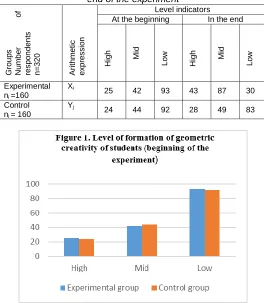
(2018) was to study the features of teaching informatics and mathematics courses in a comprehensive school, as well as issues related to the integration of knowledge during the teaching of these disciplines. As a result of teaching the studied disciplines, conducting a series of integrated training sessions in mathematics and computer science, questionnaires for schoolchildren, it was found that schoolchildren have an insufficient level of knowledge in the taught disciplines. In the course of the search experiment (2018-2019), the content of the educational material was selected, its own software was developed, the methodology of teaching the course in computer science classes was tested, the methods and forms of teaching material were refined and specified. The purpose of the formative experiment (2019-2020) was an experimental verification of the hypothesis. The experiment was held on the basis of secondary schools in the Tashkent region during the first quarter of 2020. Pupils participated in it, from which a control group (160 people) and an experimental group (160 people) were formed. In total, 320 people took part in the experiment. During the experiment, mathematics was taught in both groups of schoolchildren - subjects of mathematics and geometry were taught. In addition, an integrated course ―Fractal Geometry at School‖ was optionally taught for students of the experimental group. To conduct a component-wise analysis of the level of creativity of students using fractal geometry of students, experimental data were presented in table form.
Table 1. Dynamics of the level of formation of students' creativity using fractal geometry at the beginning and at the
end of the experiment
G
ro
u
p
s
N
u
m
b
e
r
o
f
re
sp
o
n
d
e
n
ts
n
=
3
2
0
A
rith
m
e
tic
e
xp
re
ssi
o
n
Level indicators At the beginning In the end
H
ig
h
M
id
Low Hig
h
M
id
Low
Experimental ni =160
Xi 25 42 93 43 87 30
Control ni = 160
The quality of mathematical knowledge and the level of training in mathematics of schoolchildren were checked at the beginning and end of the quarter through comprehensive tests in the disciplines being studied. Assignments for control works in both groups were identical. Statistical processing of the test results showed that after the formative experiment, the level of development of mental activity in schoolchildren of the experimental group is higher than that of schoolchildren in the control group. In addition, after schoolchildren completed creative projects to create compositions from fractal sets using IT, a questionnaire was conducted in the experimental group. The questionnaire revealed the development of interest among students in the study of mathematical disciplines in the course of familiarizing them with the elements of fractal geometry, as well as the implementation of an aesthetic orientation in the project. To evaluate the work, an expert group (6 people) was formed of teachers who teach computer science, mathematics and fine art at school. They also participated in the survey. Based on the results of the questionnaire, the exhibition ―Miracles of Fractal Geometry‖ was made out of the best works of schoolchildren. Thus, an analysis of the results of the forming experiment showed that familiarity with the elements of fractal geometry has a positive effect on increasing interest in the study of mathematics and computer science, as well as on increasing the levels of mathematical preparation and the development of the mental activity of schoolchildren.
4. CONCLUSION
In conclusion, the study formulated the main conclusions: 1. In the scientific, methodological and educational literature,
the degree of development of the research problem is insufficient.
2. Taking into account the analysis of scientific, methodological and psychological-pedagogical sources, a methodological approach to the study of fractals based on the use of information and communication technologies in teaching has been determined, which allows the inclusion of knowledge about the elements of fractal geometry in the system of mathematical knowledge already known by schoolchildren.
3. Fractal geometry has great aesthetic potential and plays a significant role in shaping the natural science picture of the world of schoolchildren.
4. The developed methodology for studying the elements of fractal geometry with the use of information and communication technologies, the course program, and a set of practical classes contribute to the formation of new mathematical concepts in schoolchildren, systematize the
previously studied, develop a steady interest in the study of mathematics and computer science, as well as increase the level of mathematical training and level of mental activity.
5. The created model for implementing the integrative interaction of mathematics and computer science reflects the structure and content of the process of familiarizing students with the elements of fractal geometry based on new information and communication technologies.
6. The validity and correctness of the proposed research hypothesis by conducting a pedagogical experiment, processing and analyzing its results has been experimentally and theoretically verified.
5. REFERENCES
[1] Azevich A. I. Fraktaly: geometrija i iskusstvo / A. I. Azevich // Matematika v shkole. 2005, #4. - pp.76 - 78.
[2] Afaunov, V. V. Fraktal'nyj analiz kak sposob opisanija strukturnoj stabilizacii modificirovannogo polijetilena: Dis. kand. him. nauk: Nal'chik, 2003.- p.144.
[3] Bozhokin, S. V. Fraktaly i mul'tifraktaly / S. V. Bozhokin, D. A. Parshin. M; Izhevsk: NIC «Reguljarnaja i haoticheskaja dinamika», 2001.- p.128.
[4] Budjanskij, M. V. Haoticheskaja advencija i fraktaly v nestandartnom ploskom potoke: Dis. . kand. fiziko-mat. nauk. Vladivostok, 2005, - p. 113.
[5] Gilford Dj. Tri storoni intellekta//Psixologiya mishleniya: sb. perevodov/pod red. A.M.Matyushkina.-Mocow, Progress, 1965, pp. 433-456.
[6] Dikov, A. V. Komandy na Logo konstruirujut fraktaly. / A. V. Dikov // Matematika v shkole. 2005. - #4. - pp. 78-80. [7] Kronin, G. V. Postroenie fraktalov / G. V. Kronin //
Komp'juternye instrumenty v obrazovanii. #5. - 2001. [8] Kronover, R. M. Fraktaly i haos v dinamicheskih sistemah
/ R. M. Kronover / Per. s angl. pod red. T. Je. Krjenkelja. M.: Postmarket, 2000.- p. 352.
[9] Mandel'brot, B. Fraktal'naja geometrija prirody / B. Mandel'brot. M.: Institut komp'juternyh issledovanij, 2002. – p. 656.
[10]Morozov, A. D. Vvedenie v teoriju fraktalov / A. D. Morozov. Moskva; Izhevsk: Institut komp'juternyh issledovanij, 2002. – p. 159.
[11]Pajtgen, X. O. Krasota fraktalov. Obrazy kompleksnyh dinamicheskih sistem / X. O. Pajtgen, P. X. Rihter. Per. s ang.pod red. A.N. Sharkovskogo. M.: Mir, 1993, - p. 176. [12]Petrov, M. N. Komp'juternaja grafika. Uchebnik / M. N.
Petrov, V. P. Molochkov. SPb.: Piter, 2002. – p. 736. [13]Rozov, N. X. Problema razmeshhenija novyh ponjatij i
ob"ektov v shkol'nom kurse matematiki. // Materialy vserossijskoj nauchno-prakticheskoj konferencii «Sovremennyj urok matematiki: teorija i praktika». Nizhnij Novgorod, 2005. – p. 56-64.
[14]Sekovanov, V. S. Formirovanie kreativnoj lichnosti studenta vuza pri obuchenii matematike na osnove novyh informacionnyh tehnologij / V. S. Sekovanov. Kostroma: 2004. – p. 231.
[15]Selevko, G. K. Sovremennye obrazovatel'nye tehnologii: Uchebnoe posobie / G. K. Selevko M.: Narodnoe obrazovanie, 1998. – p. 256.
682 Monografija. Feder, Ens Fraktaly / Ens Feder. M.: Mir,
1991. – p. 254.
[18]Shabarshin, A. A. Vvedenie vo fraktaly / A. A. Shabarshin. -Ekaterinburg, 1998. – p. 150.
[19]Shiljaev, P. A. Fraktal'nyj analiz poverhnosti sloev kremnija, vyrashhennyh metodom molekuljarno-luchevogo osazhdenija: Dis. kand. fiz.-mat. nauk. -N. Novgorod, 2005. – p.133.
[20]Shreder, M. Fraktaly, haos, stepennye zakony: (miniatjury iz beskonechnogo raja) / M. Shreder. Nauchno-izdatel'skij centr «Reguljarnaja i haotichnaja dinamika», 2001. – p. 528.
[21]Makhmudova D.M. Use of problem tasks in development of independent creative activity of students. International Journal of Innovative Technology and Exploring Engineering (IJITEE), ISSN: 2278-3075, Volume-IX, Issue-II, December 2019. Aviable to: http://www.ijitee.org/download/volume-9-issue-2.
[22]Kuralov Y. Development of Geometric Creativity of Secondary School Students by Computer. IJSTR International Journal Of Scientific & Technology Research Volume 9, Issue 02, February 2020. pp. 4572-4576. Aviable to: http://www.ijstr.org/final-