www.orientjchem.org
An International Open Free Access, Peer Reviewed Research Journal
2016, Vol. 32, No. (1): Pg. 609-615
Potentiometric Studies on the Binary and Mixed Ligand
Complexes in Solution: Zn(II) - Amlodipine - Amino Acids
Systems
LAMIA A. AL-BEdAIR
1,21Department of Chemistry, College of Science, Princess NourahBint Abdul Rahman University, 2Deanship of Scientific Research, Princess NourahBint Abdul Rahman University,
*Corresponding author E-mail: [email protected] http://dx.doi.org/10.13005/ojc/320169
(Received: December 07, 2015; Accepted: March 03, 2016)
ABSTRACT
Binary and mixed ligand complexes of Zn(II) involvingamlodipine drug (A) as a primary ligandand some amino acids (L)as a secondary ligands are investigated.The acidity constants of the ligands were determined and used for determining the stability constants of the complexes formed in 80% (v/v) ethanol-water media under the experimental conditions at 25°C , I = 0.10 M (NaNO3)by using potentiometric technique.The potentiometric data were analysed using the computer program HYPERQUAD. The concentration distribution of the complexes in solution was evaluated.
Key words:Amlodipine; Amino acids; Stability constant; potentiometric.
INTROdUCTION
Recently there has been considerable interest in the study of binary, ternary and quaternary complexes by pH-metric method1-3. The metal ions
in presence of organic and inorganic ligands, amino acids, peptides, proteins, vitamins and enzymes are playing a major role in the field of analytical chemistry4,5. The mixed ligand complexes have been
studied extensively because of their potential role in biological processes and can manifest themselves as enzyme-metal ion substrate complexes6-8. The amino
acids and drugs have a significant biological and
medicinal importance. In view of the growing interest in the ternary complexes, it is thought worth while to study the ternary complexes of number of amino acids and amlodipine with zinc (II). Amlodipine, 2-[(2-aminoethoxy)methyl]4-(2-chlorophenyl)-1,4-dihydro-6-methyl-3,5- pyridinedicarboxylic acid 3-ethyl 5-methyl ester, is a second generation 1,4-dihydropyridine derivative of the prototypical molecule nifedipine9. The importance of pyridinecarboxylic
properties displayed by the natural and synthetic acids. It is well known that complexes of metal ions are among the prominent interactions in nature10,11,
and versatile binding site of protein, amlodipine seems to have the best chelating properties. In the present investigation, the stability constants of Zn(II) complexes with amlodipine and some amino acids were studied in detail by potentiometric titration method in 80% (v/v) ethanol-water at 25 0C and I = 0.10 MNaNO3. The simultaneous reactions of the complexes has been established in the pH region studied. The concentration distribution of the complexes in solution was evaluated.
ExPERIMENTAL
MATERIALS ANd SOLUTIONS
Amlodipine, amino acids and related compounds, glycine, b-phenylalanine, alanine, valine, methionine,proline,threonine, histidine .HCl, histamine .2HCl,imidazol, ornithine .HCl, lysine, penicillamine,cysteine and mercaptoethylamine were obtained from Sigma Chemical U.S.A. All these chemical are used as received without any further purification, their purities ranged from 99-100%. Zinc(II) nitrate was provided by BDH-Biochemicals Ltd Poole, England. Their solutions were prepared and their concentrations were determined by conventional chemical methods[12]. Sodium hydroxide
was prepared by dissolving an Analar product in deionzed water to obtain a saturated solution. The required solutions were prepared by careful dilution in deionized water (CO2 –free) and then standardized with potassium hydrogen. All solutions were prepared with deionized water.
Apparatus
Potentiometric titrations were performed at (25°C±0.1°C) in a double-walled glass vessel using a Griffin pH J-300-010 GDigital pH meter. The temperature was controlled by circulating water through the jacket, from aconstant temperature bath. The electrode system was calibrated in terms of hydrogen-ion concentrations instead of activities. Procedure and Measuring Techniques
The following mixtures [A-D] were prepared and titrated potentiometrically with (0.05M) NaOH
solution to investigate the equilibria involved in proton-and/or metal ion-ligand complexes.
A. 40 ml of a solution containing 0.005M amlodipine drug (A)asprimary ligand and 0.1M NaNO3.
B. 40 ml of a solution containing 0.005M of L (L = amino acid) as secondary ligand and 0.1M NaNO3.
C. 40 ml of a solution containing 0.005M Zn(II) solution, 0.01M A or L and 0.1M NaNO3.
D. 40 ml of a solution containing 0.005M Zn(II) solution, 0.005M A, 0.005M L and 0.1M NaNO3.
The protonation constants of A (or L) were determined by titration of mixture (A) and (B). The formation constants of Zn(II)-A and Zn(II)-L complexes were determined by titration of mixture (C). The respective stability constants of Zn(II)-A-L for the ternary complexes were determined by titration of mixture (D). All titrations were performedin 80% (v/v) ethanol-water media and in a purified N2 atmosphere using aqueous 0.05M NaOH as titrant. For all the titrations, HNO3solution was added, so that they were fully protonated at the beginning of the titrations.
Computer Analysis of Titration data HYPERQUAd 2008 Program
Hyperquad 2008 is a Windows™ application that can that can be used to derive equilibrium constants from experimental data. The calculations were obtained from ca.100 data points in each titration Hyperquad 2008 is the latest in a long series of developments. The basis for the stability constant refinement of an earlier version has been published 13.
Species program
Speciation (based on concentration of metal ions and complexing species) is a program which calculates and plots the species distribution of a series of complexes over a specified pH range
14.The input data of total concentration of metal
are used to compute equilibrium concentration of all can be calculated, including mixed complexes, protonated, hydroxyl and polynuclear species. The graphical output can thus provide a visual record of the most predominant complex species within the physiological pH range.
RESULTS ANd dISCUSSION
The acid dissociation constants of the ligands were determined at 25.0 0C, I = 0.10 M
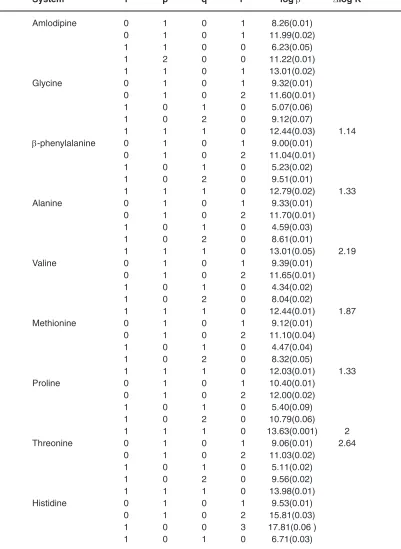
(NaNO3),and in 80% (v/v) ethanol-water media under the same experimental conditions used to study the Zn-A and the corresponding ternary complexes. The values were given in Table1. A pKa value of amlodipine 8.7 means that is predominantly present in the ionized form at a physiologic pH.
Formation equilibria of binary Zn(II)-A complexes
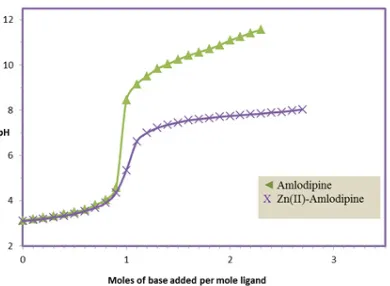
Potentiometric titration curves of A in presence and absence of Zn(II) ion are shown in Fig. 1. In the metal complex curve, there is a significant lowering from that of the free amlodipine, indicating formation of metal complexes by release of protons. Equilibrium models have been tried to fit the experimental potentiometric data for the Zn-(amlodipine). The selected model with the best statistical fit was found to consist of Zn(A) (110) and Zn(A)H (111) complexes. The concentration distribution diagram of various species as a function of pH is depicted in Fig. 2.The concentration of the 1100 and 1200 species increase with increase of pH, attaining a maximum of 80% and 95% at pH ca 7.40 and 10.20 , respectively. The main species present under physiological condition is calculated to be 1100 and 11200 which may be able to pass through cellular membranes.
Ternary complex formation equilibrium
Ternary complex formation may proceed either through a stepwise or a simultaneous mechanism depending on the chelating potential of amlodipineand other ligands. The formation constants of the 1:1 Zn(II) complexes with A and those of amino acids (Table1),are of the same order. Consequently, the ligation of amlodipineand amino acids will proceed simultaneously. The validity of this model was veried by comparing the experimental potentiometric data with the theoretically calculated (simulated) curve. Figure 3 presents such a comparison for the Zn-A-glycine system, taken as a representative one.
Fig. 1: Potentiometric titration curves of free Amlodipine and Zn(II)-Amlodipine obtained
from 80% (v/v) ethanol–water mixture.
The general four component equilibrium can be written as follows (charges are omitted For simplicity):
l(Zn) + p(A) + q(L) + r (H) (Zn) l (A)p (L)q (H)r
...(1)
...(2) The formation constants of amino acid complexes are higher than those of the corresponding monodentate imidazole complex. This indicates that amino acids bind through their amino and carboxylate groups. Phenylalanine forms a less stable complex than alanine. This may be due to the lower basicity of the amino group of phenylalanine compared to that of alanine. This will contribute to the decreased stability of the complex formed. The stability constant values of histidine and histamine are of the same magnitude and are considerably higher than those of the amino acids, indicating that both histidine and histamine would coordinate preferably through the amino and imidazole groups.
Concerning the secondary ligands (L): lysine, ornithine and histidine which can form protonated and deprotonated complexes, the acid dissociation constants of the protonated complexes are given by the following relation:
...(3)
The acid dissociation constants determined for the protonated ternary complex species amounted to 7.79 for ornithine and 7.73 for lysine, which compare favourably with the acid dissociation constant of the b-amino group. This indicates that
b-amino group is bound to Zn(II) ion in the ternary complexes while the b-amino group remains free. The acid dissociation constant obtained for the protonated ternary complex with histidine is 5.78, being lower than that of the protonated amino group NH3+(pK
a= 9.53), but closer to that of the protonated
imidazole group (pKa= 6.12), suggesting the proton in the protonated complex would be located mainly on the imidazole group.
The acid dissociation constants of ternary complexes with the sulphur ligands, penicillamine, cysteine and mercaptoethylamine are 6.13, 6.92 and 5.69 respectively. These values obtained in the present study are less than the previously reported microscopic acid dissociation constants15, revealing
that the [–NH3]+ and –SH groups most likely take part
in complex formation.
Evaluation of the concentration distribution of the various species as a function of pH provides a useful description of metal ion binding in biological system. In all species distribution curves the concentration of the formed complex increases with increasing pH , thus making the complex formation more favoured in the physiological pH rang. Protonated ternary complex species have been found to be most favoured at lower pH values.
Table 1: Acidity constant of ligands andformation constant of the binary and ternary complexes of Zn(II) involving amlodipine and amino acids at 25°C and
0.1 M ionic strength
System l p q ra log bb Dlog K
Amlodipine 0 1 0 1 8.26(0.01)
0 1 0 1 11.99(0.02)
1 1 0 0 6.23(0.05)
1 2 0 0 11.22(0.01)
1 1 0 1 13.01(0.02)
Glycine 0 1 0 1 9.32(0.01)
0 1 0 2 11.60(0.01)
1 0 1 0 5.07(0.06)
1 0 2 0 9.12(0.07)
1 1 1 0 12.44(0.03) 1.14
b-phenylalanine 0 1 0 1 9.00(0.01)
0 1 0 2 11.04(0.01)
1 0 1 0 5.23(0.02)
1 0 2 0 9.51(0.01)
1 1 1 0 12.79(0.02) 1.33
Alanine 0 1 0 1 9.33(0.01)
0 1 0 2 11.70(0.01)
1 0 1 0 4.59(0.03)
1 0 2 0 8.61(0.01)
1 1 1 0 13.01(0.05) 2.19
Valine 0 1 0 1 9.39(0.01)
0 1 0 2 11.65(0.01)
1 0 1 0 4.34(0.02)
1 0 2 0 8.04(0.02)
1 1 1 0 12.44(0.01) 1.87
Methionine 0 1 0 1 9.12(0.01)
0 1 0 2 11.10(0.04)
1 0 1 0 4.47(0.04)
1 0 2 0 8.32(0.05)
1 1 1 0 12.03(0.01) 1.33
Proline 0 1 0 1 10.40(0.01)
0 1 0 2 12.00(0.02)
1 0 1 0 5.40(0.09)
1 0 2 0 10.79(0.06)
1 1 1 0 13.63(0.001) 2
Threonine 0 1 0 1 9.06(0.01) 2.64
0 1 0 2 11.03(0.02)
1 0 1 0 5.11(0.02)
1 0 2 0 9.56(0.02)
1 1 1 0 13.98(0.01)
Histidine 0 1 0 1 9.53(0.01)
0 1 0 2 15.81(0.03)
1 0 0 3 17.81(0.06 )
1 0 2 1 12.14(0.02)
1 1 1 0 15.67(0.01) 8.51
1 1 1 1 21.45(0.03) 5.78
Histamine 0 1 0 1 9.85(0.01)
0 1 0 2 16.05(0.05)
1 0 1 0 5.26(0.06 )
1 0 2 0 10.63(0.04)
1 0 1 1 13.23(0.01)
1 1 1 0 16.01(0.01) 4.52
Imidazol 0 1 0 1 6.12(0.01)
1 0 1 0 3.98(0.02)
1 0 2 0 6.38(0.08)
1 1 1 0 10.32(0.01)
1 1 2 0 17.09(0.06) 0.11
Ornithine 0 1 0 1 10.79(0.03)
0 1 0 2 10.49(0.01)
1 0 1 0 6. 39 (0.05)
1 0 2 0 11. 34 (0.06)
1 1 1 0 15.89(0.01) 3.27
1 1 1 1 23.68(0.02) 7.79
Lysine 0 1 0 1 10.44(0.01)
0 1 0 2 19.66(0.01)
1 0 1 0 6.93(0.03)
1 0 2 0 12.08(0.05)
1 1 1 0 16.78(0.03) 3.62
1 1 1 1 24.51 (0.02) 7.73
Pencillamine 0 1 0 1 10.10(0.01)
0 1 0 2 17.97(0.01)
1 0 1 0 9.80(0.01)
1 0 2 0 19.32(0.01)
1 1 1 0 16.89(0.01) 0.86
1 1 1 1 23.02(0.01) 6.13
Cysteine 0 1 0 1 9.77(0.03)
0 1 0 2 17.67(0.02)
1 0 1 0 8.45(0.07) 7.2
1 0 2 0 16.37(0.06) 6.92
1 1 1 0 14.96(0.04)
1 1 1 1 21.88(0.01)
0 1 0 1 10.03(0.04)
Mercaptoethylamine 0 1 0 2 18.64(0.02)
1 0 1 0 9.61(0.04)
1 0 2 0 17.69(0.03) 5.6
1 1 1 0 21.44(0.02) 5.69
1 1 1 1 27.13(0.01)
al, p and q are the stoichiometric coefficient corresponding to Zn(II), A, L and H+
respectively.
The log K values are used to indicate the relative stability of the ternary formed through simultaneous mechanism, as compared to those of the corresponding binary complexes can be calculated using Eq. (4)
...(4)
The log K values given in Table 1 are invariably positive, showing that that ternary complexes are more stable than binarycomplexes.
ACKNOwLEdgMENTS
This research project was supported by a grant from the Deanship Of Scientific Research, Princess Nora Bint Abdul Rahman University.
1. Marcus,Y. and Elizer, I., Coor. Chem. Review
1969, 4, 273.
2. M.T. Beck, The determination of complex equilibria, 1969, 172.
3. Sigel, H., Metal ions in biological systems. Marcel Dekker Inc., New York, 2, 1 (1973); 5, 250 (1976), 6, 1(1976).
4. Flaschka, H.A. and Bernard, A.J., Chelates in analytical Chemistry, 1967,.I, Marcel Dekker Inc., NewYork.
5. Burger, K., Millor, I.T. and Allen, D.W.,
Coordination chemistry : Experimental methods. Butterworths Co.(Publishers) Ltd., London 1973.
6. Vallee, B.L. and Coleman, J.E., Compr. Biochem.1964, 12, 165.
7. Malmstrom, B.G. and Rosenberg, A., Advan. Enzymol.1959,21, 131.
8. Mildvan, A.S. and Cohn, M., J. Biol. Chem.
1966,241, 1178.
9. Beale Jr, J.M. and Block, J.H., Wilson and Gisvold’s Textbook of Organic Medicinal and Pharmaceutical Chemistry, 12th ed., Lippincott Williams and Wilkins, Philadelphia 2011., 625, 626
10. Sigel (Ed.), H., Metal Ions in Biological Systems 1973,.2. Dekker, New York.
11. Wood,J.M.,Naturwissenschaften1975, 62, 357.
12. Flaschka, H.A., EDTA Titrations, Pergamon, Oxford, 2nd Edit., 1964.
13. Gans, P., Sabatini, A and Vacca, A.,
Talanta1996 ,43,1739.
14. Gans, P., Ienco, A., Peters, D., Sabatini, A . a n d Va c c a , A . , C o o r d i n a t i o n
ChemistryReviews1999,184,311.
15. Kadima,W. and ragenstein,D.L., J. Inorg. Biochem.1990, 38, 227.