Dovid Katz PhD Thesis UnIversity College London Submitted October 1982
Explorations in the History of the Semitic Component in Yiddish
Vol. II
SUPPLEMENTARY MATERIAL
comDrising papers completed during residence at University College London
CONTENTS
1. The Wavering Yiddish Segolate: A Problem of Sociolinguistic Reconstruction
1
Intrtiona1 Journal th Soctology
.Q. I..!1g-uaze , 214. 5- 27 ] . . . • . • • . • • • • • • • • • • • 3 59
2. Der semitisher kheylek in yldish: A yerushe fun kadmoynim. Meto&n un
meglekhkaytn [= paper placed before the First International Conference on.
Research in Yiddish Language and
Literature at Oxford, August
1979]... . ... . . .
14.13 3. Reconstruction of the Stress System inthe Semitic Component of Yiddish
1
= paper submitted to the John MarshallCompetition, University College London]... . .506
14. . Yiddish Dialectology Iforthooming in
Iia1eic.o.1 gi .
in
d.biai zu
dtoh.ezi ufl. al1meine flalekors.thg ( IIanbJ zir ch- &
.mliatioa-iaaenehat, I), Walter de Gruyter:
359
The Wavering Yiddish Seolate: A Problem of Sociolthuistic Reconstruction
I. HISTORICAL RECONSTRUCTION AND SOCIOLINGUISTIC VARIATION
New theories of language of recent decades cast a shadow upon some of the principles of traditional historical linguistics. The challenge scarcely emerges from the generative model. On the contrary, the generative
framework adds to its rigorous formulation a highly standardized notation. It is amicably suited to the precise isolation and systematization of language
change (e.g. 1Cin
1969).
The shook to historical linguistics emanates from the rise of studies of language structure in the context of society. By demonstrating the orderly heterogeneity of language, Weinreich, Labov and. Herzog(1968)
discredit the homogeneous image ofspeech communities implicit in much comparative historical study. The empirical counterpart of the theory of
inherent linguistic heterogeneity is provided by the
pioneering field studies of ongoing language change in its social context (e.g. Bright and. Ramanujan
196
14.;
Labov1963; l966).1
Labov's
(1971:
L.22_14.23) uniformitarian principle claims that change in progress functions in a way that360
change can be a priori projected as a progression in the direction of prestige forms. It is precisely the
sociolinguistic school which rebuffs Tard.e's Law - °The notion that all movement of linguistic forms is from the higher prestige group to the lower" is shown to be "simply a remark" (Labov 1973: 216). As Uriel Weinreich (1956: 614.3) puts it, "innovations in language do not always slide down prestige slopes".
It is this discovery which ironically reverts a great onus upon the sociologist of language. Deprived of the
principle of' necessary spread of prestige forms,
the historical linguist may find, little use for sociology. He may be intent, say, on discovering which of two variant
forms is a relative innovation over the other, where the two are geographically complementary and. the day when both may have been variants of a sociolinguistic variable is long gone. A worker in language history is often separated by centuries or more from the point in time at which the change he is studying was ongoing and. observable
361
genetic relations between language states at different points of time and, space, unravelling transpired changes by the isolation of the conditioning environments. The comparative method undoubtedly continues to provide the histories of languages with permanent contributions. It is plausibly argued that its asocial application
represents a different but equally valid plane of reality. It remains for sociolinguistics to develop methodology capable of meaningfully taking into account social
correlates of the linguistic change that has completed its course before being encountered by the investigator. While sociologically conscious use of written monuments may
provide evidence regarding the social stratification of the language of bygone times (e.g. Wyld 1936), such documentary clues "can never replace the present as a
laboratory for the linguist" (Weinrelch, La'bov and Herzog 1968: 16l ). Noreover, there is often no documentary
-362
The soclolinguistic framework succeeds in convincingly
challenging asocial theories of language change because it
makes use of empirical evidence, that is to say, proof using
knowledge derived from the language experience of the
investigator. Even after a change has been completed,
a sociolinguistic trace of that change, and, its social
correlates, may yet linger on in the modern speech community.
The isolation of such a sociolinguistic trace in two or more
varieties of the modern language may facilitate reconstruction
of the change. In II, an anomalous correspondence in
Yiddish phonology is presented and. its background outlined.
In III, an attempt is made to reconstruct the change leading
to the modern anomaly by comparative study of speakers in
two modern varieties of Yiddish. This is followed by
documentation in IV of soololinguistic variation in
four varieties of Yid,d.ish for a set of items related
paradigmatically to the initial anomaly. An attempt
is made to reconstruct variation at an earlier more
uniform stage of Yiddish. The principles of
sociolinguistic reconstruction are briefly sketched
363
II. AN ANOMALOUS CORRESPONDENCE
A Yiddish protovowel called (corresponding with Proto-Yiddish *) appears as Central Yiddish 22
Northeastern Yiddish 22 . 2 Hence, Central Yiddish ávbik 'forever', bfávr 'explicitly', maxtá y s 'all right, with pleasure', nav 'snow' are cognate in a regular way with Northeastern Yiddish ybIk, bfévr, maxté, nev. Another Yiddish protovowel called
L
(corresponding with Proto-Yidd.ish stressed open syllabic *) appears asCentral Yiddish
25 and Northeastern Yiddish &25. Hence, Central Yiddish béyt 'to request', maxtê ynsta '(fern.) relative by marriage', nfa 'soul; (contemptible) person', zeyn 'to are cognate in a regular way with Northeastern Yiddish bti, max3tnesta, nfe, zii. Vowels 22 and 25 represent masses of lexical items. Their geographic delimitation on pre-World War II East European Yiddish
speech territory has moreover been carefully mapped (Herzog 19611. : 95). The internal Yiddish phonological history of vowels 22 and 25 has largely been determined by chain
shifts set in motion by the Great Yiddish Vowel Shift. The Great Shift occurred In the Old Yiddish period (defined
phonologically as the stage of Yiddish preceding the rise of Western Yiddish and Eastern Yiddish). A detailed
3611.
reflexes in Central Yiddish and. Northeastern Yiddish are schematically illustrated in Table 1. The mid back
protovowels, 11
.
2 (corresponding with Proto-Yid.d.ish *) and. 12 (corresponding with Proto-Yiddish *3 ) were analogously processed by the Great Vowel Shift, and are therefore included in Table 1.Our problem is this. Central Yiddish rivvx
'profit' (for some speakers also 'use, advantage, benefit') is intriguingly cognate with Northeastern Yiddish rvx. In terms of the protosystem, Central Yiddish 22
(normally corresponding with Northeastern Yiddish 22 appears in a lexical item displaying Northeastern Yiddish
-25 (itself normally orresponding with Central Yiddish
In the third major dialect of modern spoken Yiddish, Southeastern Yiddish, vowels 22 and 25 are merged as
unitary
22/25' hence Southeastern Yiddish réivvx The merger precludes the productive inclusion of Southeastern Yiddish evidence in the work at hand.
In the Germanic Component of Yiddish (constituting Yiddish forms descended etymologically from Germanic etymons), vowel 22 is most often cognate with standard Middle High German . (of. ic, and vowel 25 with standard Middle High German (cf. en, shen). While standard Mid.dle High German forms may often be cited as a convenient frame of reference, it must be stressed that such comparison violates historical reality. N.
C"
C"
U, H
H
-C"
4.
C.,
C"
O.rl O-4
4'd
-c',l c'J
-H
H C"
U,
C" C"
0
'1) z
z
'-I
k
'-I H
I.-'
0
* *
366
Yiddish are in effect the sociological correlate of Prjlut g kj's
(1917: 289-290)
linguistic proof that the key features of the Germanic Component in Yiddish (or any Yiddish dialect) are not congruent with any German dialect.In the Semitic Component of Yiddish (constituting Yiddish forms descended etymologically from Northwest Semitic etymons), vowel 22 is most often cognate with
standard Tiberian , marked by the Tiberian vowel rapherne sere (cf. bDfrii, mhx te), and vowel
25
withstandard Tiberian stressed open syllabic .., marked by the Tiberian vowel grapheme segol (cf. rnThuttnL nf)• Unfortunately, historical social realism has yet to be applied to the history of the Semitic Component in Yiddish. Having swallowed lock, stock and, barrel the haclmeyed
comparisons with Latin borrowings into European languages, standard theory (the t_thecr) maintains that Yiddish acquired the Semitic Component from sacred Hebrew and
Aramaic texts (of. M. Weinreich 1973: I, 222-230;
IV:
232-23
k).
We contend that sociohistorical realism compels the realization that a group with the degree of social identity and cultural autonomy exhibited by the millennium367
usual fashion of generation to generation language
transmission ( One
phonological correlate of this claim is the nonconformity, in a regular and. systematic way, of the Semitic Component of each Yiddish dialect with the same speakers'
pronunciation of sacred Hebrew and Aramalc. In point of phonology (but not by any means lexicon or grammar), the traditional pronunciation of Biblical, rabbinlo and.
liturgical Hebrew and Aramaic on the historical speech territory of Yiddish may be collectively called
One such systematic disparity is evident in the highly pervasive rule of Closed Syllable Shortening in the Semitic Component of each Yiddish dialect,
contrasting sharply with the absence of the rule In the Ashkenazio of the same speakers. 7 Another is the
seolate nonconformity, and it is here that the
difficulty raised in the present inquiry, Central Yiddish rvx vs. Northeastern Yiddish rvx fits in.
There is a set of Proto-Semitic stems which were 8
368
standard Tiberian Bible exhibits ccnsid.erable Q.Q3
CCVC vacillation (of. Kimchi 152i.5: 52b). The classical
masoretic work ascribed to the Tiberian master Aaron Ben-Asher points to cases where the çjQ.jQ CCVC alternation may reflect a synchronic syntactic functional distinction, the forms denoting the construct and the forms the absolute state of the noun (35 In Baer and Strack 1879). Yet many exceptions remain. Gesenius-Kautzsch-Cowley
(1910: §93k) posit coexisting *j and * stem protoforms to account for resulting • Eauer and Leander
(1922: §72y
take note of the parallel variation in stem vowels not processed. by Segolation which surviveIn certain suffixed forms and conclude that the vacillation indicates a partial merger of the two series. Compounding the linguistic Indeterminancies of Tiberian segolates are the manifold discrepancies between manuscriots (cf
Sperber 196: 1l46_L49),9 It is obvious that simplistic comoarisons of Yiddish forms with standard. stock language cognates, while often valuable for the sake of convenience, are linguistically fallacious.
The line must be carefully drawn between investigation into the prehistory of the Semitic Component in Torthwest
369
Component forms with cognate forms in the Ashkenazio
of each dialectal reg ion (and in vocalized Tiberian texts current among Ashkenazim) on the other. This latter comparison
concerns us here. In the entirety of its millennial history, spoken Yiddish coexisted with nonspoken
Ashkenazic, which was in extensive use for written
communication and prayer. Linguistically, the Semitic Component in Yiddish relates to Ashkenazic not as a daughter to a parent language, but the two are cognate
structures. The social setting of the Yiddish-Ashkenazic coexistence is characterized by Fishman
(1967: 31)
as entailing both bilingualism and diglossia (cf. also Pishman l95: 1-6; M. Weinreich 1973: I, 251-320; III,253-331).
Yiddish forms cognate with standard Tiberian CCVC segolate shapes may appear with a unitary vowel 25
realization (CY li NEY .) in both the Semitic Component of Yiddish and the homod.lalectal Ashkenazic. In as much as the stressed vowel of such forms conforms with the Ashkenazic realizations of the same speakers, these may be regarded as the
ie1
uromit IjLZb eiaea
(see Table 2). Analogously, Yiddish forms cognate with standard Tiberlan CCVC se go].ate shapes may appear with a unitary vowel
22
realizatIon (CY II NEY j) In theSemitic Component as well as in Ashkenazic. These are the cwe]. 22 cuomtst Itddth 1at (see Table 3). A third group, co gnate with Tiberian shapes,
370
while the corresponding Ashkenazic forms are in concord with standard Tiberian. These vowel 22 Yiddish forms digress, then, from the vowel 25 Ashkenazic forms used. by the same speakers. 1 ° They are the zel nctconQm
Ii.Zb te (see Table 11.).h1 The troublesome anomalous Central Yiddish rávvx LI Northeastern Yiddish rvx
correspondence is a ILab The
standard Tibertan form is rwah and. Ashkenazic has vowel 25. Central Yiddish rávvx is therefore a vowel 22 nonconformist Yiddish segolate (ef. Central Ashkenazio
371
a a
.1. a
-a C —
a a c- I..
E V.) c) a —
O E . r.
- O E..i 0 4)
-- b .a Z - E ac
- -E - - - -I.
-I
aN
. .
Li.Z w%bO a -i D E
o - 4.) 4 )
z< )$ . X . . S. 4 N I.
a a
d S.
D
- S. E
o - CJ á 'ê) ' '.3
$ S. 4' N
a N
c • . S.
', I..,
a - S. . a
c•4 .. •)
a a 4 'a 'a • 'a 'a 'a 'a
C) a .Q s . S. 4.' w
d 5.1
5.1.4 ID ID ID ID ID ID
4 r.4 S.i b
v .I
a .i W 'a 'a 'a 'a 'o 'a 'a
. 54 4' N
(d. C S.
4.' N N I.'
N- a ,- S. - . a
5..
372
C —o —
C r-4
--.4 C
- 0
08 00 C 0 0
I. - C -4 8
.1.3 0 0 .4.3 0
.40 0 - ..4 •..-4 -.4.0
C C - C 8.-I
8-4 • 43 8 8 8 .0 8- C
-0 .s0 ...I .:o
0 . 8 8 8 .4.3 0 8 . 43 0 04
... O' 0. —p4 8 43 CO
C) -czi - -• - - - -_
C
0 0
. ;0
—o 43.-(
63
>. . 8 . 43 ..
-.0 8 '8 63 63 43 6) 6) 6)
N I - •4
.43
8 OW 'C 'C '8 'C '8 '0
. M IC C C
43 C 0 - 0 - I.
4-I C — 43 C
0 8.0
43 CC 'C . 8 . 43
8 .O.-4 0 —
- 43 d - - .. IC 6-. 44 0 6-W N8 >5 >5 >5 >5 >5
0 ..-1 44. 0 'C 'C '8 '0 '0 C 44 44 44 IC C C
— = C -4 0 .
-- N 63
>4
,- . . 8 .4.3
'8 63 6) 6) 43 63 6)
C 43 N I .-4 6- IC 6-. 44
.4 O.ZcO >5 >5 >5 >5 >5 >5
C 4) C 8 '8 '8 '8 '8 '8 '8
44 44 44 IC 6) C
4-0 0 0
0.4 0-N
r4.O >5
80 '4 . C . 4) 1.
C (6 (6 (0
* N '4 6- > 6-. 44 >5 >5 >5 >1 >5
0 0. , >s
'8 '8 '8 '8
8
0>-I #4 #4 44 16) 6) 6) C
0
6) —
-4
'IC 63
( I 6) 0' 8 43 0' 63 .4k. 4) 6-43
0 i-I L. 10 > 6-,
6- 8 '4) 'IC 'IC 'IC '44) '44)
.0- .0- .0- 10 6) '(0
8 .43..-I
-373
--o-0 0
4)
as
0- 54
-.41 •--4 a 0
a- a -
-a s. as 0 a .-i 0
a - as as . . 0 0 . 4) .4 0
540 04) Ii 0 as 0
4).4 0- as as s o I.
-- _V
.? 0
- -o. a -
-a 0 -A 5.. o 4)-a ON ass - .
.00 54 - 54 54 0 0
4). II 41 4) 4) 41 4)
5. 5...0 t' V 4.. a . ,-1
.1.) 0 0 ('.1 '41 '4) '4) '4) '41 '41 • '4)
a 41f 4 . . A )a C,
0
'-4 - 54
a
0 4)
4) 0 as as.o
00 54 5. 4 0 0
o .o.-, a — a a a a a
4)V N V 4-. 0 . '-4
a s.. ci . .. . >..
0-i 4 'a •a 'a 'a 'a 'a 'a Cl ) . 0. 0. . )0 0 .0
a -V
•0
- U
>.4 -N
1-45
a 0 5. - 5. M 54 a 0
5.0 4) 4) 4) 5 4) 4) 4, a .e V 4-. bO 0 . .
-o aa a
5.. .0
'a 'a • 'a 'a 'a 0. . )O C 0 a 0 0 2 N N .-4.0
so s s. s. a a
- 54.-i a — a a a a a
• .41V N V 5.. 0 . b
X N > •. >.
o a-i
> 'as 'as ' ' 'as 'as O 'as0 a
54 - 5., .0- 54 a• 0 5 4) 41 4) 5 4) 4) 6)
as- .. ,- a
a V 5. '4) '4 '4) '4 '43 '4) '4)
.0- . 0. 0. a' a.
37Ll
III. SOCI0LI!GUISTIC RECONSTRUCTION
The prospect of constructing a thought experiment is tempting. The pronunciation of Ashkenazic in prayer has been largely limited to males. Its active use in written communication has been limited to
males educated in traditional Hebrew and. Aramaic sacred works (Bible, Talmud, Commentaries). Now in
Ashkenazlc society, the class of Talmudic scholars (lamd.ónim, :Ljrner, talmldev-khakhórnirn) has constituted a social elite (cf. Mark 19A1.l; N. Weinreich 1973: I, 219-222; III: 230). Given, firstly that nonconformist Yiddish segolates violate Ashkenazic, and, secondly that Ashkenazjc is the province of a prestigious social group,
it follows then, firstly that a nonconformist Yiddish segolate might be subject to ridicule as indicative of ignorance in traditional Hebrew and. Aramaic, and, secondly
that such forms might be subject to socially motivated. replacement by conformist forms. 13 We might surmise
that older Northeastern Yiddish *ryyax (with Northeastern Yiddish !22) underwent replacement by the socially
prestigious conformist révx (with Northeastern Yiddish while Central Yiddish rávvx (with Central Yiddish 22 preserves an older nonconformist form in the
375
Not only does this thou ght experiment base itself upon the Invalidated principle of necessary spread of prestI g e forms. It is, moreover, capable neither of demonstration nor dlsconfirmation as lon g as no empirical
evidence Is gleaned from the modern language. Native speakers who have grown up In traditional Ashkenazic society have no sociolinguistic variation. Thirty-six Informants were interviewed., eighteen of whom are Central Yiddish speakers and eighteen of whom are Northeastern Yiddish speakers.14 All Central Yiddish speakers who
have the word have rávvx, while all Northeastern Yiddish speakers who have the word. have rrn (see Table 5). It
would appear that the social history of our problem lies buried with bygone generations. R4vvx, which would reflect Central !Iddish and Northeastern Yiddish
22 occurs in neither dialect. Central Yiddish speakers confronted with réyvx consider It the 'Lithuanian'
(Northeastern Yiddish) form while Northeasterners consider it the 'Polish' (Central Yiddish) form. These judgments are objectively incorrect because of the anomaly of the
rávz Ii rvx correspondence and speakers of both dialects are making use of their knowledge of the usual correspondences. Central Yid.dish speakers considering
rérvx
"Lithuanian" are making use of their (objectively correct) knowledge of vowel 22Central Yiddish II Northeastern Yiddish .
Northeasterners considering révy "Polish" are analogously making use of their (objectively correct) knowledge of vowel 25
376
0
C.. C4
•1(
4)
--O4 o
zc,, 0 0
aIo
Jr-1 0 0 0
'C
0 0 0
4)
o m
I.
'cj %(i) —
377
words the shift that resulted in the rávvx U rvx
anomalous correspondence, whether 25 > 22 In Central Yid.d.Ish or 22 > 25 in Northeastern Yiddish is no longer In progress arid. Is therefore no longer observable. Any
erstwhile variation for one and the same speaker or between speakers of one dialect has vanished. It is characteristic that "the shift of the variable to the
status of a constant Is accompanied by the loss of whatever social significance the feature possessed"
(Weinreich, Labov and. Herzog 1968: 187). Can a
soclolinguistic variable that is no more be recovered? The clue Is provided. by the qualification 'speakers who have the word.' While all eighteen Central Yiddish
speakers have ráyvx, only thirteen of the eighteen
Northeastern Yiddish speakers interviewed have rvx. A number of social parameters Including age group, the
informant's characterIzation of his or her family's economic status In the village of city of origin and the involvement of an immediate family member in the merchant trades (potentially relating to 'profit' as a trade word) were unsuccessfully paired with responses. Factors which do show a high degree of correlation with Northeastern Yiddish speakers' responses are sex and, whether or not the speaker attended kheyder (traditional Jewish primary school).. Of the five Northeasterners who do not have
four are women and, none attended khevder. Of the
thirteen who do have rvx, eleven are men and ten
378
traditional Hebrew and. Aramaic by learned parents or private teachers, and, this brings us to the parameter which shows a perfect correlation with each Northeastern Yiddish response group (within our corpus of interviews)
4na;ic
ed.ng (see Table 6). The thirteen Northeasterners who have rvx are Ashkenazio readers while the five who do not are non-Ashkenazic reading. Although the majority (eleven) of the Central Yiddish speakers interviewed, do not read Ashkenazic, all none the less have rávvax because rvvx is unambiguously a Yiddish word in Central Yiddish. In NortheasternYiddish on the other hand, rvx lies on the hazy border
of learned Yiddish and Ashkei,azic. 5 While the target item was elicited initially without prompting during the interviews,
informants were subsequently asked their feelings on the word 1. 6 Central Yiddish speakers invariably consider rávv a 'plain Yiddish word.! Of the thirteen Northeasterners who do have rvx, nine consider the word to be "Hebrew' and, report that it was not used in the everyday speech of their native village or city.17 Northeasterners have Germanic Component fardlnst for both earnings' and
'profit'. Central Yiddish speakers who have fard1nt have a semantic differentiation between fard1nst 'earnings, wages' vs. 4vv3x 'profit'. Still, most Central Yiddish
379
Table 6: Social Central Northeastern Northeastern
Correlates of Yiddish Yiddish Yiddish
Informant Responses - rá'rnx _____
1. S( 18
women 8 1414 2 15 14 80
men 10 56 1]. 85 1 20
2. !HEDER EDUCATION BY SC
women/yes 1 6- 0 0 0 0
women/no 7 39 2 15 80
men/yes 7 39 10 77 0 0
men/no 3 17 1 8 1 20
3. OVERALL I2YDER EDUCATION
yes 8 1414 10 77 0 0
—no 1O_ 56 3 23 5 100
4. . ASHNAZIC BRADING PROFICIENCY BY SC
women/yes 0 0 2 15 0 0
women/no 8 44 0 0 4. 80
men/yes 7 39 11 85 0 0
men/no 3 17 0 0 1 20
5. OVERALL ASHNAZIC - -
-READING PROFICIENCY
yes 7 39 13 100 0 0
380
a profit', e.g.
ht far1nt drbáy 'He made a profit
(on it)'. There is a marked d.iøparity in the modern language
between the socially undifferentiated. knowledge and, usage
of nonconformist rvx in Central Yiddish and the
differentiated knowledge and, usage of conformist rvx
in Northeastern Yiddish. This is an empirical trace
of erstwhile variation and, subsequent completed shift
in Northeastern Yiddish. In Northeastern Yiddish,
*
4yy
,
with nonconformist 22 passed socially from
Yiddish generally to learned Yiddish and. Ashkenazic 9 The
phonological correlate of the, social shift is the
381
If our conclusion is viable, the historical
implication is that at an earlier stage in the history
of Yid.d.ish, the cognate of stazidaH Tiberian rwaIi in
Yiddish had a vowel 22 realization and belonged to the
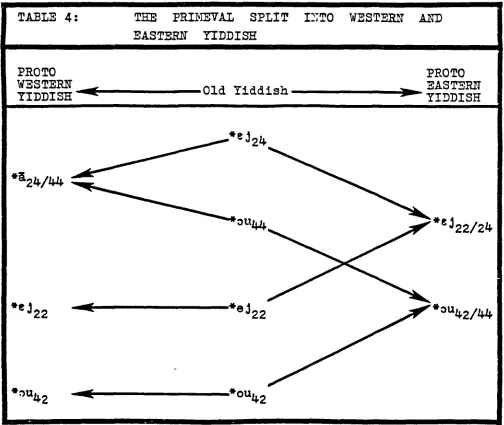
class of vowel 22 nonconformist Yiddish segolates (of.
Table k).
Older Yiddish documents usually divulge
nothing of the phonology of the Semitic Component due
to the historical orthography used for Semitic Component
forms in the Jewish alphabet.
We are fortunate
to be able to turn to Latin letter transcriptions of
Christian scholars. While non-Jewish letter transcriptions
are exceedingly rare for older periods of Eastern Yid.d.ish
(of. Joffe l9$L$.: 120-121), such transcriptions are
abundant t or pre-twentieth century varieties of Western
Yiddish.
The Christian descriptions of Yiddish
of the sixteenth and seventeenth centuries have made
permanent contributions to Yiddish historical linguistics.
It was not until the eIghteenth century, however, that the
school of
flourished. The eighteenth century
compilers published large scale dictionaries, often for
382
compilations provide the richest and. most linguistically
reliable corpus for modern research purposes. Phonemic
structures hidden by the historical Semitic orthography
are uncloaked. by the Christian transcriptions in the
Latin alphabet.
Many of the Christian compilers use transcriptions
reflecting Western Yiddish dialectal areas where vowels
22 arid 25 were merged, usually using unitary <e> (rarely
<ee>) to transcribe both. Like modern Southeastern
Yiddish, such varieties tell us nothing of the status
of our target lexical item because the merger precludes
the establishment of either conformity or nonconformity.
The neutralization of the vowel 22—vowel 25 opposition
(whatever Its exact phonetic status) Is reflected in
the transcriptions of (among others) Wagenseil (1699), 20
Christian
(1735),
Bibliophilus (l7k2), Selig (1767),
Relzenstein (176k)
andTend.lau (1860). The lack of
contrast between the two vowels is moreover explicitly
commented upon by Chrysander (1750a:
k; l7SOb: 2k) and.21
Se].ig (1792: 20).
There are, however, two compilers
known to us whose transcriptions reflect varieties of
eighteenth century Western Yiddish where the realizations
of historical vowels 22 and 25 (whatever their exact
383
Of even greater import, given the primacy of empirical
evidence, are the documentations of twentieth century
rennints of spoken Western Yiddish by modern linguistic
scholars. In many parts of modern Western Yiddish, as
indeed. in much of eighteenth century transcriptional
Western Yiddish, vowels 22 and 25 are merged.. 23 We turn
to empirical studies of modern remnants of Western Yiddish
which maintain oppositional reflexes of the two vowels.
In Netherland.ic Yiddish, vowel 22 is realized. as
and.
vowel 25 as .
Indeed it
is rvvox inNetherlandic
Yiddish, contrasting with Netherland.io Ashkeriazio rhax
(Voorzanger and. Polak
1915:262, 263;2 eem
1970:nos.
315,596, 861, 862; 1975: 12, 14.0, 101;
1979).The same
opposition
22
vs.occurs in the Yiddish of the
Surb River Valley in Switzerland.. There it is rvfx, again
with unambiguous
22 (Guggenheim-Grnberg
19511.:62;
3814.
IV. SEGOLATE CONFO}INIZATION IN YIDDISH
The conformization to modern Northeastern Yiddish rvx
is but a vestige of a wider process of segolate
contorinization in historical Yiddish soclophonology. Like
the forms cited. in Table 14, Tibertan mlx 'king' is 1own
to have a nonconformist vowel 22 realization in Yiddish.
Our Northeastern Yiddish informant from Riga (born
1903)
uses méylx (with nonconformist Northeastern Yiddish
three times in conversation. When his attention is
subsequently drawn to pronunciation of the word, he hastily
corrects to m€lex (with conformist Northeastern Yiddish
A number of other Northeasterners, while showing
no variation themselves during our interviews, none the
less recall variation in their place of origin. Invariably
they tell of lesser educated people having mévl3x. Some
Northeasterners do not nave the word on its own (using
Germanic Component kévnig only).
Unlike rvx the word.
always appears in a number of popular compounds, such as
dvidainvlx d.vidam1x 'King David' and. levTnamévlax
levmanilx 'King Solomon'. While all our Central Yiddish
informants have má ylax (with nonconformist Central Yiddish
a number recall hearing méviax (with conformist
Central Yiddish 25 and regarding it as an elitist,
Hebraicizing pronunciation. Unlike Central Yiddish rávvx
which is
a nonconformist constant and. Northeastern Yiddish
385
remain in sociolinguistic variation for some speakers of the modern language.
There is evidence of analogous variation and of ongoing segolate conformizatlon in modern remnants of spoken Western Yiddish. Guggenheim-Grtnberg's
(1961: 26-28) recording of the Yiddish of Gallingen, a village on the Swiss-German border, includes this
recollection of the informant (born 1896): "A [with nonconformist Gailingen Yiddish .y22] is a king. We
said inlax [with conformist Gailingen Yiddish A 25 ]. Our informant from Den Bosch, In the southern NetherlanIs
(born 1905) tells us 'With us it ['Passover', of. Table was pronounced. psax [with conformist Netherlandie Yiddish In Amsterdam the proletarians called It
DYS
[with nonconformist Netherlandlc YiddishWe said
m13x
but the common people said mvlax'. The usual Netherland.ic Yiddish forms are of cou.rse pvsax and mvla. Hartog Beem, the master of NetherlandleYiddish remarks that while the cognates of Tiberian klev aM ger are nonconformist kvla 'dog; vicious
fellow' and gr 'lie, falsehood', one could also hear
conformizing këlev and. kar under the "impact of the official Ashkenazic synagogue pronunciation" and. the norms of the
Nethex'land.jo khevd.er. Beem's judgment on klv and.
N
sekr: decidedly "nicht Volksspraohe (Beem 1977; 1979). The Latin letter transcriptions of Philoglottus (1733: 22, 23,
31, 35, 61) Kei1ef> arid. <Scheik'r>, like those of
386
have unambiguous nonconformist Transcriptional Western
Yiddish <el>22 . There can be little doubt that both
words are historically nonconformist in Yiddish. The
usual realizations in present day spoken Eastern Yiddish
Central Yiddish k4vlv,
IINortheastern Yiddish
klv, jjç are conforrnlzatlons, probably not unassociated.
with the competition from Germanic Component alternants
resulting in more socially restricted usage. 25 Yet
Bjrnbaujn
(1918: 136; 1932: 32)documents Central Yiddish
kávle y .
Mieses (192k: 2k) and. Bin-Nun
(1973:273;
1979)
26
document Central Yiddish sakar.
There is a marked
similarity in the modern language between ongoing
conforinizatlon in Netherland.lo Yiddish, Gailingen Yiddish,
Central Yiddish and. Northeastern Yiddish.
In the
four varieties, there is vowel 22 vowel 25
387
V. THE NATURE OF SOCIOLINGUISTIC RECONSTRUCTION
Let us imagine, for the sake or exposition, that part of a hypothetical dialect area with the phonemic system of Northeastern Yiddish has in conformity with the prestigious Ashkenazic pronunciation of the same speakers. Another part of the area has nonconformist r. Let us suppose, moreover, that we find that speakers of the révvx area all have the word. Only speakers proficient in Ashkenazic have the word in the ____ area.
Now let us imagine that all of Yiddish realized historical vowel 22 as and vowel 25 as (as in real life the Yiddish of Gailingen does). Let us suppose, moreover, that we find that speakers in such distant corners of the speech territory of Yiddish as the Netherlands, Gailingen, Poland and. Lithuania all show mvl3x variation. In each of the areas, mthl3x is the more frequent Yiddish realization while ntlx is a prestigious conformizing form.
Each of these imaginary experiments bears a
superficial resemblance to the methods described above in III and IV. Yet the difference is vital. Both these imaginary experiments are statements of synchronic
388
Genuine sociolinguistic reconstruction begins with
the Isolation of two or more genetically cognate entities.
It proceeds to discover the social correlates of the
cognate entities in two or more language varieties
available for empirical study. Recovery of erstwhile
sociolinguistic variation, whether leading to shift (as
in Northeastern Yiddish
or to no shift (as in
Central Yiddish rávv) or to continuous variation
(as in Netherlandic Yiddish n&1x nielx) can be
achieved if and. only if the genetically cognate entities
appear as divergent concrete entities in the several
varieties. The divergence of concrete realization on
the level of the oppositional phoneme is the historical
proof of descen from an earlier stage of the language
rather than horizontal diffusion through space. The
reliability of sociolinguistic reconstruction, as of any
other, depends upon the strength of the evidence.
Reliability
is proportionate with the number and
noncontiguous geographic spread of the several varieties,
the extent of the empirical evidence from the modern
language and the degree of disparity between the
concrete realizations in each variety.
In the first actual experiment, III above, we
find a
rii between two varieties
89
is indeed restricted to speakers proficient in
Ashkenazio.
The complernentation reflects the native
Yiddish status of the defiant form and the
innovative character of the conformist form. 28 The
reconstruction hinges on the vastly divergent phonemic
history of the two dialects (see Table 1).
In fact,
the two dialects demonstrate a theoretically optimum
disparity of concrete realization. Phoneme X
is the modern reflex of Proto
A inone variety and
happens to be the reflex of Proto B in the other, given
that A anti B are the genetically cognate entities
compared.
Central Yiddish /ey/ Is the realization
of historical vowel 25, which is a prestigious conformist
vowel in a certain group of items.
Northeastern
YidtIish /ey/ is the realization of historical vowel 22,
which is the nonconformist vowel in the same group of
items.
In the second actual experiment, IV above,
wefind.
a consta
orej
between four varieties of
Yiddish. Variation documented includes Netherlandic Yiddish390
vowel
25form conforming with Ashkenazic. The constancy
reflects a state of vowel 22 vowel 25 sociolinguistic
variation at an earlier stage of Yiddish predating the
riseof the four varieties.
Moreover, the direction
of shift is determined by conscious adoption of the
Ashkenazl.c norm at this earlier stage of Yiddish. Again,
the defiant forms are native Yiddish reflexes while
the conformizations are innovative.
The reconstruction
hinges on the disparity of the
concrete realizationsin the
four varieties (see Table 7).
To sum up, the
Proto-Yid.dishcognates of standard
Tiberian
mlx, rwa}i and. iQer were vowel
29
22 nonconformist Yiddish segolates. For centuries
they have been in variation with conformizing
variants. The variation has followed the phonemic
history of each variety of Yiddish where 22 and.
25have not merged.. In the modern language, they are
the handful of wavering Yiddish segolates, appearing
here as vowel 22 survivals, there as vowel
25 innovatIons. 30Un&
j.t(. C1le Lord.on. and Oxford. Ctre
LQPostzyute
391
N C 0
N N C
t
C,ow - .
- 43
0
In
-.0
-
.-C.)
43
--I. 0%.. 00
ii
C.-43
U
V
- U
-4 C
- -- 43
V C
43 CC
CV.- .4.- ....4 .4
392
NOTES
1. I have been privileged, while preparing this work, to benefit from the discussion and advice of Raphael Loewe
(University College London), Richard A. Hudson (TJCL),
and. Daniel Frank (Harvard University); from correspondence with Harto g Beem (The Hague) and. Jechiel Bin-Nun (Jerusalem). Full resoonsibility for the proposals herein and for
errors of fact or interpretation rests squarely with the author.
2. The double di g it desi gnation of Yiddish protovowels represents Herzog's
(1965:
228, note 1) symbological modification of the (now standard) protosystem of Max Weinretch (1960), revised. in M. Weinreich(1973: II,
321-382; IV, 36L_ 38k ).
Note that use of the protosystern does not hinge on acceptance of the phonetic reconstruction posited in Table 1 or any other reconstruction. The numbered vowel represents an emzirically real synchronic diaphoneme denoting spatially differentiated realizations of cownate entities. weL.22, as used herein corresponds to M. Weinreich's E 2 and. E 3 (I.e. vowels 22 and. 23). Katz39 3
3.
The evolution of Central Yiddish and Northeastern Yiddish from Proto Eastern Yiddish is discussed by U. Weinreich(1958:
237-2)49, 252-257),
Herzog(l9S5:
159-233, 27
)4-290; 1969)
and Katz(1978: §3.6-3.8).
l.• The terni enr1. Iiddih is used, herein in the stricter sense of the Yiddish of the area roughly
congruent with Congress Poland. In the Yiddish of Eastern Galicia, an area delimited geo2raphically in the map
appended to Bin-Nun (1973), it is rêvv. Bin-Nun
(1973: 101-102; 1979)
aptly characterizes this variety as Transitional Central Yiddish (in his terminology Transitional West Central Yiddish; his East CentralYiddish corresponds with. Southeastern. Yiddish). In light of the many features which Transitional Central Yiddish shares with Southeastern Yiddish t its immediate east, Bin-Nun
(1979)
notes that révvsx may have entered under Southeastern Yiddish impact. The problem deserves a special study.5.
Historically, part of Southeastern Yiddish distinguishes22 from 25
(or
25' but in modern Southeastern Yiddish the two are generally merged as unitary Southeastern Yiddish22/25
Prilutskl1920: 17-28;
Veynger 1929:6k;
U. Weinreich 1958:3911.
documentations of unitary 22/25 for Vlshkeve in Poland (Prilutskl 1921:
272;
Herzog1965: 178) and
Shafov (Schaffa) in Noravia (Beranek 1936:72).
6. We consider the notion of a fused "HebrewArarnaic"
to be linguistically and historically fallacious. The neutral eitc monent is used with the understood limitation that no Semitic other than Hebrew or Aramaic
may be involed.
Ti.brjan
denotes the classical phonological system of Biblical Hebrew and. Aramaiccodified in the late first millennium A.D. As a
phonological system, its application Is. not restricted necessarily to forms attested in the
Old Testament.
7. Closed Syllable Shortening results in automatic alternation (in the sense of Jakobson) in the Semitic Component of every Yiddish dialect where morphological paradigms give open vs. closed syllabic allomor phs. The patterning contrasts sharply with the lack of alternation
(rarely, dirferent alternation) in AshkenazIc. Cf. e.g. Central Yiddish kk 'screams' vs. 'voice',
'details' vs. sg. prat, mávsrn 'corpses' vs. sg. and. Central Ashkenazic cognates (where stress is variable)
395
Northeastern Yiddish kéiv1, ki].,; prtirn, orat; ntésim ws oontrastin with Northeastern Ashkenazic
keyl; pr-t2.rn, -t; me y sliii, meys.
8. The most s y stematic account of Northwest Semitic Segolation within a modern linguistic framework is provided by Malone (1971). The Pan Yiddish nominal shape C)Cé reflects a. classical Aramaic
segolate and, those at issue in the present paper reflect classical Hebrew segolates. The differentiation between the two 'doos not constitute an absolute isogloss"
(Malone 1971: 4) as there are substantial attestations of Hebrew and, Aramaic CVCVC.
9. In a well known instance of textual vacillation, Isokhor Ber
(1808: 9b)
reports that Elijah of Vilna(z vllner g
en)
had Tiberian zxr Iremembrancesin a text while Chaim of Valozhin believed he had seen
10. Diverginz Yiddish segolates are listed and. discussed by (among others) Lebenzohn
(1866: 2k),
Tshemerinski
(1913: 63-6k),
Reyzen(1920: 81),
Birnbaum (1922:27),
Mieses(192k:
2k), Veynger (1929: 98),396
11. Attempts to derive both the vowel 25 conformist Yiddish segolates (cf. Table 2) and, the vowel 22 nonccnformist Yiddish seolates (of. Table 1.) from common protoforms are unsuccessful because both occur in the same environment (stressed open syllabic
osition). M. Weinreich (1960: 68) posited lengthening to account for the latter series but saw the error and. reverseS himself
(1973:
II, .7, 291-292,33$.-335).
12. In our honemic transcription, Dosttonl.c reduced vowels are unitarily marked by . Note that in many varieties of Yiddish, posttonic , is realized as [a) preceding /r,x/, hence the frequent realizations Central Yiddish [ráyvax) and Northeastern Yiddish
[révax]. The coincidin g of the [a) allohphone of .. with historical g of Tiberian renders the Yiddish realizations minimally contrastive with Ashkenazic. But note that while the most ex1ioit Ashkenazic style is transcribed in Tables 2_LI. (i.e. with oositiona1
397
13. Instances of conformization to Ashkenazio in other areas of phonolo gy are documented in our own time. Cf. e.g. H-S (1957).
1L.. These interviews were taped in London between November 1978 and April 1979. I am indebted, to my friends A. N. Stenci (ed., Loshn lebn) and I. A. Lisky (ed., vid.ishe U) for their very kind help in the location of informants and arrangement of
interviews.
15. While the Semitic Com ponent Is characterized on the whole by a marked de gree of Pan-Yiddish uniformity, there are documentations of other items whose everyday usa'e is eorathicallv differentiated (cf. Mark 1941: 69).
16. 'Prompting' is here intended to include both direct prornptin ("Do you know what - meansV') and
indirect prompting ('How do you say - in Yiddish?'). Elicitations were achieved by relating a brief story and asking -the informant to comment and predict at various points.
17. It is probably not a coincidence that the reat
Yiddish lexicowra pher, Alexander Harkavv (1898: k86). Minseif a Northeasterner, adds the usage label "Hebrew" to his
398
18. Bin-Nun (1979) believes that fard.int is a recent borrowing into Yiddish from New High German.
19. Richard A. Hudson points out ar guments in favor of an alterrmte formulation: Older Northeastern
Yiddish nonconformist rv was re p laced by La.d1nstJ fardIn3n. Subsequently, rv was to some extent
reintroduced from Ashkenazic and. from literary
Yiddish. Nany speakers will have had. it all along in Ashkenazic (it occurs, e. g . in the frequently recited grace after meals). Its renewed use Is socially
restricted and. phonologically conformist — both symDtoms of reintroduction.
20. Historically, Waenseil is a notable exception within the cited. group. His main work was a literary Yiddish chrestomathy (provided with Latin letter
transcriptions of entire literary texts) and. his motivations were larg ely founded on intellectual appreciation for Yiddish literature (of. Borokhov
1913 : no. 26;
M. Weinreich 1928: 715-732).21. It Is likely that the phonetic realization
399
22. The works of Philolottus (1733) and Friedrich
(1781i.)
are deservedly praised by M. Weinreich(19L1.0: 103;
1957:
note7).
Accordi.n to Avé-Lallernant(1858-1862: III, 233)
PhiloElottus is the pseudonym of J. P. LUtke.23. The relevant Isoglosses and the phonetic status
of the merged
22/25
are not yet clear for much of Western Yiddish. On the merger of the two vowels in Western Yiddish, see Beranek(1957: 1975; 1961: 296-297; 1965:
114.6-114.9),
Hutterer(1965: 126-127)
and Bin-Nun(1973:
201).
214.
In Voorzanger and Polak(1915)
nonconformistseolates are cross referenced to corresponding Ashkenazio forms.
25.
Bin-Nun(1979)
points out that both these words are more figurative and, metaphorical semantic alternantsto Central Yiddish }iint
II
Northeastern Yiddish hunt 'dow' and. 1jg 'lie'. Unlike fardinst (after Bin-Nun), these Germanic Component items are undoubtedly of old YiddishkQQ
26. Bin-Nun
(1979)
believes recalling the older
generation in his native Rohatyn (East Galicia) using
ayk3r In the phrase ávkr-b. £ false plot; total
lie; blood libel'.
He and, his generation have
There are etymological dtfftculties with the phrase
kk3ft1 it
'two inept/helpless people!',
popular throughout Central Yiddish.
27.
This jibes with well known findings that conscious
Innovation (e. g . borrowing of prestige forms) is often
characteristic of prestigious social groups (Bright and,
Ramanujan 196k: 1112; Labov 1973:
217).
28.
Conformization in Yiddish apparently followed
the standardization of the classical form in Ashkenazic
itself. Older Ashkenazic texts often have <rwah>
(with çere), e.g. p. 9k of an Ashkenazic prayerbook
manuscript (British Library Oriental Add.
27,556)
dated paleographically by Nargoliouth (1905:
II, no. 653)
as "thirteenth to fourteenth century." So also
401
29. Unfortunately, comparative historical treatments
tend to treat the conformized Northeastern Yiadisn model
as a norm for classifying the protovowel In these Items.
E.g. Zuckerman (1969: Lt.
9) lists Alsatian Yid.d.ish kêylv wider vowel25;
N. WeinreIch (1973: II, 361) lists
the cognate of Tiberian qr under vowel
25.
jO. The list of wavering and conformizin,g Yiddish
segolates could be expanded by Including items which
have fallen out of use in modern Eastern Yiddish. For
example, nonconformist <Seiwel>
was in variation with
oonforinizIng <Sewel> in the eighteenth century Yiddish
LO2
REFERENCES
Av-La11emarit, Friedrteh Christian Benedict
1858-1862
dutsQh. Qnthum. Leipzig,
F. A. Brockhaus.
Baer, S. and. Strack, H. L.
1879
Di Digduo Ha-Tearnim d.e. Ahon ken
Moscheh b.
Leipzig, L.
Fernau.
Bauer, Hans and. Leand.er, Pontus
1922
Historisch Grammati1 der hebrtschei
rache es aten estarnentes. Halle,
Max Niemeyer.
Beem, Hartog
1970
rshe.
Jtd&tjc'ie pr.Qekwoorden n
Zeswijzen.
Assen, Van Gorcurn.
1975
sten
T&al...
ordenboe3c.j. van
h
isder1andse J1&discji.
Assen & Amsterdam,
Van Gorcum.
14.03
Beranek, F. 1936
1957
1961
1965
Bibliophilus 1714.2
NYldish in tshekhoslovakay" in Yivo-bleter,
9.63-75.
1Jidd.isch' in eataJi Phi1o1oge liii Aufrt, Vol.1, Berlin, Erich Schinid.t, pp . 1955-1998.
N IDIe frnkische Lanischaft des Jiddisohen" in Jahrbuch ii Landesfors.chun,
21. 267-303.
Wtj[d1scher Stractl. Marburg: N. G. Elwert
ischer Zacfl-M1ter Hebrgisch-Teutsches W$rtex-t. Frankfurt am Main & Leipzig.
Bin-Nun, Jechiel 1952
1973
1979
'Haivrjt shebeyidish' in Haju ha1aij
lemadaei liavahadut, Jerusalem, Hebrew University,
pp. 1514-161.
Jidflsc}i j . jj d.eutschen jyiarten. Tibingen, Max Niemeyer.
L.OLI.
Birnbaum, Salotno A.
1918
Grarnmati1 &e.iddischen Straphe.
Vienna
&Leipzig,
A. Hartleben.1922
s helbx4ische imd. araische Element in &z
idd.ische Srache. Leipzig, Gustav Enge]..
1932
fld.ish verterbilthl. Lod.z: Beys Yankev.
Borokhov, Ber
1913
'Di biblyotek funem ytdishri filolog' in Sh.
Niger
1913: 1-67
[separate pagination at
end, of volume].
Bright,
Williamand. Rarnanujan, A K.
196l
.
'
Soololinguistic Variation and. Language
Change' in H. (3. Lunt (ed..),
ocee1ng
1
.th. Ninth International Congress
Linguists,
The Hague, Mouton, pp. 1107-1113.
C[hristian], C[hristoph] G[ustav]
1735
JMischer Dolmetscher od.er Hebrisch- j
Teutsohe Vocabula. Nilrnberg.
Chrysand.er,
N. Wilhelm Christian Just],750a Jidisoh-Teutsche Gramrn&tick. Leipzig & Wolf enbUttel.
li.05
Fishrnan, Joshua A.
1965
YId.d.ish
America.
Socio-lingustic
DescrilDtion
Analysis. Bloomington,
Indiana University & The Hague, Mouton.
1967
'Bilingualism
With and.
Without Diglossia;
Diglossia With and. Without Bilingualism" in
Jlournal
S,ia1
Issue, 23,2.29-38.Fried.rich, Carl Wilhelm
1781
1.
Unterrioht j der Jud.ensDrache
Schrift.
Prenzlau.
Gesenius- Kautzsch-Cowley
1910
GeseniuQ' Hebreiw Grammar,
.
L
jitzsch,
re!.
&. .Cowlev.
Oxford, Clarend.on.
Guggenheim-Grinberg, Florence
19511.
'The Horse Dealers' Language of the
Swiss
Jews in
Endingen and Lengriau' In U. Weinreich
19511.: 1l.8-.62.
1958
'Zur Phonologie des Surbtaler Jid.d.ischen"
in Phonetic, 2.86-108.
1961
Gailinger J1id.disch.
G6ttingen, Vand.enhoeok &
Ruprecht
1 =Lutbib1iothek der d.eutschen
Alexander
English-Yid.dJ.sh Dictionary . New York,
Hebrew PLiblishing Company.
Marvin I.
406
Harkavy,
1898
Herzog,
196k
1965
1969
"channels of Systematic Exinction in Yid.d.ish
Dialects" in For M Weinreich .,
biSeventieth Bflthdav. Stud.ies jj
wish tanuages,
Literature,
Society, The Hague, Mouton,
pp .
93-107.
Yiddish
Lgag ii Northern Poland.. Its
Georahv
. History . Bloomington, Indiana &
The Hague, Mouton.
"Yiddish in the Ukraine: Isoglosses and. Historical
Inferences" in Herzog, Ravid. and.
Weinreich1969:
58-81.
Herzog, M.
I., Ravid.,W. and. Weinreich U.
1969
(eds.) Th Field.
Yiddish. Third. Collection.
The Hague, Mouton.
Hutterer, C. J.
1965
"The Phonology of Budapest Yiddish" in U.
Weinreich (ed.), The Field QI Yiddish. Second
Collection, The Hague, Mouton, pp. 116-146.
Isokhor Ber [ben] Tankhum
1808
Maase
,
Zolkiew, Jud.a Meyerhoffer.
Joffe, Jud.ah A.
Li.07
Katz, Dovid.
1978
Genetic Notes on Netherlandi.o Yiddish
Vocalism. Unpublished paper, Dept. of
Linguistics, Columbia University.
Kiinchi, David
l5L5
Sefer Mikhlol. [with commentary by Ella
Levita]. Venice, Daniel Bomberg.
King, Robert D.
1969
Historlca Liguitics
Geerativ
Grammar. Englewood. Cliffs (new Jersey),
Prentice-Hall.
Labov, William
1963
"The Social Motivation of a Sound Change"
in Word,
19.273-309.
1966
Social Stratification
En1ish
in
ew York C&y. Washington, D.C., Center for
Applied Linguistics.
1971
Methodology" in W. 0. Dingwall (ed..), , Survey
Linguistic Scienc, Univ. of Maryland., pp.
kl2-1.91.
4.08
Lebenzohn, Od.om hakoyheyn ben Khaylm [ Dov Ber
Mikhalishker = Adam Hakohen]
1866
[Commentary to] Sevfer talmud 1eshovn lvr1.
Vi].na, Horn.
Levita, Ella
1511.]. Sefer hatishbi. Isny.
Malone, Joseph L.
1971
"WaveTheory, Rule Ordering, and
Hebrew-Aramaio Segolation N
inJournal
1the American
Oriental Societ y ,
9l.Ll466.
Margoliouth, G.
1905
Catalogue
Hebrew
Samaritan
?lanuaori;ta
j the British ?useum. London,
British Museum.
Mark, Yude].
1914.1
"Lomir ufhltn dl. ashires fun dem
talmid-khokhems shprakh!" in Yldishe shDrakh,
1.65-77.
Mieses,
Matthias
19214.
Jidd.ische SDrache. Eine historisehe
Grammatlk des Idioms
integralen Juden
L'.09
Niger, Sh.
1913
(ed.) De. pinkes.
Yorbukh
fargeshiIhte
yldisher literatur i shDrakh,far
folklor, kritik bib1vorafe. Vilna, B.
Kletskin.
Philoglottus
1733
Kurtze
grfind1ihe Anweisung z
Teutsc-Jdischen SDraohe. Freiberg, Christoph
Matthi.
Prilutski, Noyakh
1917
Barg aruf. Warsaw.
1920
Tsum vid.ishn vokalizm. Warsaw.
1921
Dialektologishe Daraleln in1 bamerkunen. Warsaw.
R-S, T.
1957
'Vegn rikhtilm aroysreyd. fun a tsol
hebreizmen" in Yid.ishe
shDrakh, 17.25-26.
Reizenstein, Wolf Ehrenfrled von
176L$. Der vollkommene Pferd.e-Kenner.
Uffextheim,
Joh. Simon Meyer.
Heyzen, Zalmen
410
Selig, Gottfried.
1767
Xurze
.und.rihid1iche Anleitun2
Znelner'
].eichten Erlernung idischd.eutschenSDrache. Leipzig, Christian Fried.rich Hu!npf.
1792
Lehrbuch z grindiichen Erlernung der id.ischd.eutschen SDrache. Leipzig.Sperber, Alexander
1966
*, Historical Grammar
Biblical Herew.
Leiden, E. J.
Bri].l.Tendlau, Abraham
1860
Sprihwrter j.Reden.sarte deutsch-jidiseher
Vorzeit. Frankfurt am Main, Heim'lch Keller.
Tshemerinski, Kh.
1913
"DI yld.Ishefonetik" In Sh. Niger
1913
: 47-71.
Veynger, N.
1929
Yidishe dialektologve. Minsk, Vaysrusishez'
melukhe- far lag,
Voorzanger, 3. L. and. Polak, J. E.
1915
Het Jood.sch j Nederland. An
Wagenseil, Johan.n Christof
1699
Bl&rung d. Jidi h-Peiitshen R1- ]md.
ireibart. K6nigsberg, Paul Friederich
Rhode.
Weinreich, Max
1928
'Di. yidishe shprakhforshung in l7tn
yorhundert' in Tsavtshrift (Minsk), 2-3.
689-732.
1914.0
"Yidishe filologye' in A1grnevr1e ent&k1ot'ede.
Ytdn bevz, Paris, Dubnov-fox2d, pp. 101-108
195Z
'Prehistory and Early History of Yiddish:
Facts and Conceptual Framework' in U. Weinreich
195: 73-101.
1957
'A shprakh-dokument fun arum 1800' in Yid.tshe
shorakh, 17.146-52.
1960
'Di sistem yidishe kad.men-vokaln' in Yidihe
shDrakh, 20.65-71.
1967
'The Reality of Jewishness Versus the Ghetto
Myth:
The Sociolinguistic Roots of Yiddish' in
Honor Roman Jakobson. Esas , JJ Occasion
hJ.. Seventieth Birthday, The Hague, Mouton,
pp. 2199-2211.
412
Weiltreich, Uriel
195
4
(ed..) The.Fi1d.
YicMish.
ucIis jr],
Yiddish Language, Fok1ore,
Literature.
New York, Linguistic Circle of New York.
1956
"Notes on the Yid.d.ish Rise-Fall Intonation
Contour" in For Roman Jakobson.
avs
the O pcasion
Sixtieth Birthda,
The Hague, Mouton, pp. 633-643.
1958
"A Retrograde Sound Shift in the Guise of a
Survival: An Aspect of Yiddish Vowel
Development" in iisce1ea hornenaje André
Martinet. EstructuralisinQ
istorta,
Universidad. d.e La Laguzia, pp. 221-267.
Weirireich, Uriel and Labov, William and. Herzog,
Marvin I.
1968