O R I G I N A L A R T I C L E
Spatial variability in structural and functional aspects
of macrofauna communities and their environmental parameters
in the Jade Bay (Wadden Sea Lower Saxony, southern North Sea)
Ulrike Schu¨ckel•Melanie Beck• Ingrid Kro¨ncke
Received: 20 September 2011 / Revised: 15 April 2012 / Accepted: 18 April 2012 / Published online: 5 May 2012
ÓSpringer-Verlag and AWI 2012
Abstract Spatial distribution and functional structure of intertidal benthic macrofauna in relation to environmental variables in the Jade Bay (southern North Sea) were studied and compared with other intertidal areas of the Wadden Sea. A total of 128 stations covering the whole Jade Bay were sampled in summer 2009. A total of 114 taxa were found. Highest species numbers occurred in the subtidal areas, whereas highest mean abundances were found in the upper intertidal areas. Based on species abundance data, six sig-nificantly distinct macrofauna communities in the Jade Bay were identified and evaluated with multivariate statistics, univariate correlations and canonical correspondence analysis. Differences in these community patterns were caused by the response of the dominant species (Hydrobia ulvae, Tubificoides benedii, Pygospio elegans, Caulleriella
killariensis, Scoloplos armiger, Urothoe poseidonis,
Microprotopus maculatus) to prevailing environmental
conditions along the gradient from the lower and exposed sandy intertidal areas via intermediate mixed sediments to the upper mudflat areas. Distribution patterns in relation to tidal zonation were best explained by variability in submergence time, Chlorophylla (chla) content and sed-iment composition (mud content), which are proxies for
hydrodynamic conditions and food availability. Species inventory and species richness were comparable with other intertidal areas of the Wadden Sea, but the Jade Bay differs from these areas regarding dominant species. Differences in sediment composition and morphological characteristics (macrotidal versus mesotidal Wadden Sea areas) are dis-cussed for comparison of regional differences.
Keywords Tidal flat systemsSubmergence time
Food availabilityEnvironmental gradients
Functional diversitySpatial distributionWadden Sea
Introduction
Tidal flat ecosystems are dynamic and complex habitats. They represent highly productive areas for macrobenthic organisms (Heip et al.1995), thus being used as important feeding and nursery grounds by fishes and shore birds (Kuipers1977; Widdows et al.2004). Macrofauna species inhabiting tidal flats are highly adapted to this dynamic environment characterized by tidal fluctuations, changing water currents, wave action, altering periods of submersion and exposure to air from low to high intertidal levels (Newell 1970; Hummel et al. 1994). The hydrodynamic force itself influences sediment characteristics (grain size, organic carbon and chla contents), topography (intertidal height) and salinity (Snelgrove and Butman1994; Ysebaert et al.2003; Widdows et al.2004; Gray and Elliott2009). It is well known that the prevailing environmental conditions affect the distribution of tidal flat macrofauna species, resulting in a specific zonation pattern of the living com-munities (Linke 1939; Michaelis 1987; Beukema 1988; Hertweck1994; Reise et al.1994; Ysebaert et al.2003; van Colen et al. 2009; Puls et al. 2011). In addition, several Communicated by Karsten Reise.
U. Schu¨ckel (&)I. Kro¨ncke
Senckenberg am Meer, Marine Research Department, Su¨dstrand 40, 26382 Wilhelmshaven, Germany e-mail: [email protected]
M. Beck
macrofauna species themselves, such asArenicola marina
orHydrobia ulvae (e. g. Flach 1992; Orvain et al.2006),
act as bioturbators, which increase sediment erosion, tur-bidity, nutrient and carbon processing (Herman et al. 1999). In contrast, bio-stabilisers such as seagrass beds, mussel beds and microphytobenthos mats can modify the habitat by reducing turbidity, increasing light penetration and enhancing sedimentation processes (Kro¨ncke 1996; Bergfeld 1999; Widdows and Brinsley 2002; Bos et al. 2007; van Katwijk et al.2010).
The tidal flat systems in the European Wadden Sea along the coastal region of the North Sea between Den Helder (Netherlands) and Skallingen (Denmark) are classified according to their tidal range to define the geo-morphological, hydrological and sedimentological envi-ronment (Diekmann et al.1987). Depending on the tidal range, tidal flats are distinguished as macrotidal ([3.5 m), mesotidal (1–3.50 m) and microtidal (\1 m) (Hayes1979; Flemming 2011). Mesotidal flats are bordered by barrier islands, whereas macrotidal flats are open to sea where barrier islands are no longer present (Diekmann et al. 1987). With a mean tidal range of 3.8 m (Go¨tschenberg and Kahlfeld2008), the Jade Bay belongs to a macrotidal flat system, but differs from other macrotidal areas due to its land-locked bay character. In contrast to other sandier mesotidal flats (e.g. Balgzand and Ko¨nigshafen), the Jade Bay is characterized by a large mudflat belt with a unique, muddier sediment composition.
The spatial, temporal and seasonal variability of mac-rofauna species of European intertidal flat systems have been intensively studied (e.g. Beukema1974,1988; Jensen 1992; Essink et al. 1998; van der Graaf et al. 2009). Especially in the German intertidal Wadden Sea the clas-sification in mud, mixed sediments or sandflats/Arenicola -sandflats, and mussel or seagrass beds for macrofauna studies is still common (e.g. Linke1939; Michaelis1987; Hertweck 1994; Reise et al.1994; Steuwer 2002). In the present study, we have used a quantitative statistical approach to identify macrofauna community patterns, which was also applied for different subtidal areas in the East Frisian Wadden Sea (Reiss and Kro¨ncke2001; Neh-mer and Kro¨ncke2003) and the Pomeranian Bay (southern Baltic Sea) (Glockzin and Zettler 2008) as well as for intertidal areas of the Belgian and Dutch Wadden Sea (van Colen et al.2009)
The objectives in the present study were (1) to describe the present spatial distribution and functional structure of the macrofauna communities in the Jade Bay by applying a statistical approach, (2) to investigate their relations to environmental factors by using univariate and multivariate statistical approaches in order to explain the spatial dis-tribution patterns of species and structuring forces for
zonation and (3) to compare the Jade Bay with intertidal macrofauna communities of other Wadden Sea areas.
Materials and methods
Study area
The Jade Bay (53°2804200N, 8°120500) is a shallow semi-diurnal tidal bay located in the central part of the German North Sea coast (Fig.1). The shape of the Jade Bay is a result of several storm floods in the Middle Ages (Behre 2004). The Jade Bay is connected with the North Sea through the outer Jade, which enters the Jade Bay through a narrow bottle-neck east of Wilhelmshaven and branches into several channels (Ahne, Vareler Fahrwasser and Stenkentief), draining into a system of tidal inlets and gullies far into the backswamp area to the south. Each tide, a total volume of around 400 million cubic meter flows in and out of the Jade Bay. Freshwater discharge has only little influence on the salinity in the Jade, which varies between 2.9 and 3.2 % (Go¨tschenberg and Kahlfeld2008). Mean ebb and flood current velocities were 46 and 53 cm/s (Go¨tschenberg and Kahlfeld 2008).
During high tide, the water surface area is 158 km2, whereas at low tide it decreases to 44 km2(H. Westphal unpublished data). Furthermore, the study area contains intertidal Mytilus edulis mussel beds, which covered an area of 2.07 km2in 2009 (G. Millat unpublished data), as well as Zostera noltii seagrass beds, which were mostly found in the eastern and south-western areas and contained 10.9 km2in 2008 (Adolph2010).
Sampling and laboratory analysis Macrofauna sampling design
and all macrofauna was sorted and identified to the lowest possible taxonomic level and then counted.
Environmental variables
One surface sediment sample (\2 cm depth) was taken in parallel for analysing sediment characteristics (mud content \63lm, median grain size), total organic carbon and chlorophyllacontents. Grain size distribution was analysed on fresh, ultrasonically suspended samples by means of Fritsch Analysette 22 laser granulometer. Sediment types were classified according to Kramer et al. (1994) based on differences in median grain size. The total organic carbon content (TOC) was determined according to Babu et al. (1999). The difference between total carbon and inorganic carbon was measured with a CS 500 IR analyser (Eltra, Neuss, Germany) and a CO2coulometer (UIC, Joliet, USA),
respectively. Chlawas analysed by high-performance liquid chromatography (HPLC) by the extraction from 5 g of
homogenized sediment with 3 ml Dichlormethan-methanol (9 ?1). Chlacontents were calculated in mg/m2according to Brotas et al. (2007). Mean submergence time (given in hours per day) for each station was estimated using the finite-volume model FV COM (Lettmann et al.2010).
Statistical analyses
Prior to data analysis, species abundance data were stan-dardized to individuals per m2; species number is given per sample (79 cm2). Species such as Balanidae, which are typical for hard substrate, were excluded from the analysis. Each species was classified into functional feeding groups (surface deposit feeders, subsurface deposit feeders, sus-pension feeders, omnivores, predators, interface feeders and sand lickers based on available literature (Fauchald and Jumars1979; Ysebaert et al.2003; van Colen et al.2009). Data were first tested for normal distribution (D´ Agos-tino and Pearson omnibus normality test). Multivariate
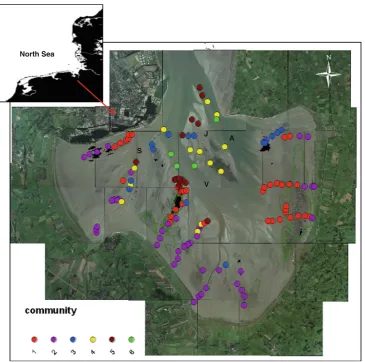
North Sea
A J
V S
Fig. 1 Location of the Jade Bay. Sampling stations are marked
according to their community (cluster): (1) red=Hydrobia ulvae
partially covered with seagrass beds, (2) purple=mudflats, (3)
blue=mixed sediments 1, (4) yellow=mixed sediments 2, (5)
brown=sandflats,(6)green=subtidal.A =Ahne,S =Stenkentief,
V =Vareler Fahrwasser, J =Jappensand, Mytilus edulis
bed-s=black, areas covered with Zostera noltiiseagrass beds=green
techniques on fourth root transformed abundance data were used to analyse the community structure. Group average cluster analysis based on Bray-Curtis similarity followed by a similarity profile test (SIMPROF; Clarke and Gorley 2006) and multidimensional scaling (MDS) were calcu-lated. ANOSIM randomization test (Clarke and Green 1988) was used to test significant spatial differences in community structure.
Discriminating species, which significantly (p\0.05) separated the different communities, were identified using the similarity percentage routine (SIMPER). Grouped clusters were characterized by their mean abundance, species richness, Shannon-Wiener diversity index, eveness index, characteristic species, feeding type composition in terms of abundance and environmental characteristics. Statistical analysis were performed by using GraphPad Prism 5, the multivariate analysis were performed using The Plymouth Routines in multivariate ecological research (PRIMER) package, version 6 (Clarke and Gorley2006).
Multivariate canonical correspondence analysis (CCA) by using CANOCO 4 software (Microcomputer Power) was performed to detect the variation in the species data set and the relationship between species composition and measured environmental variables. Forward selection was used to determine and rank the importance of environ-mental variables, which in turn would be used for deter-mining the species composition (Ter Braak and Verdonshot 1995). Monte Carlo permutation test was performed for statistical validity.
Relationships between species abundance and the environmental variables were also examined by using univariate (Spearman rank) correlations.
Results
General characterization of the macrofauna in the Jade Bay
A total of 114 taxa (45 polychaetes, 34 crustaceans, 20 molluscs, 6 oligochaetes and 9 others) were found during the study period. Number of taxa in a single sample (79 cm2) varied between 0 and 32 taxa, with a mean of 12 taxa. Total abundance varied between 0 and 480,380 ind./ m2, with a mean of 56,203±3,291 ind./m2. Gastropods (87 %) were the most abundant taxonomic group, followed by oligochaetes (6 %), polychaetes (6 %) and crustaceans (2 %).
The Jade Bay was generally dominated by Hydrobia
ulvae (69 %), Tubificoides benedii (12 %), Caulleriella
killariensis(5 %), Pygospio elegans (3 %) and Scoloplos
armiger(3 %), contributing 92 % of the total macrofauna
abundance. ExcludingH. ulvae, species such asT. benedii
(29 %), P. elegans (15 %), Retusa obtusa (13 %), C.
kil-lariensis (11 %), Cerastoderma edule (6 %), S. armiger
(5 %) andMacoma balthica(4 %) were most abundant and made up 83 % of the total macrofauna abundance. Trophic structure in terms of mean abundance was dominated by surface deposit feeders (89 %) followed by subsurface deposit feeders (7 %).
Community structure of the macrofauna
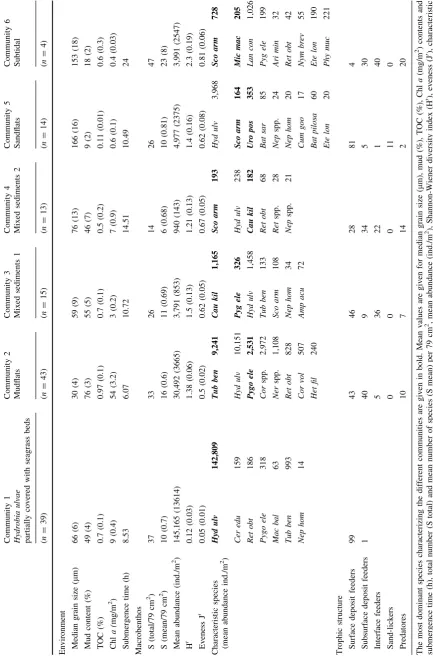
Six communities (Fig.1) were significantly separated based on SIMPROF (p\0.05) and multivariate data analysis (cluster analysis and MDS ordination) with fourth root transformed abundance data. The global R of ANO-SIM analysis was 0.84 (p\0.001) and supported the sig-nificant separation between the clusters. The biotic and abiotic characteristics of the six communities are summa-rized in Table1, allocated in the different areas and habi-tats of the Jade Bay.
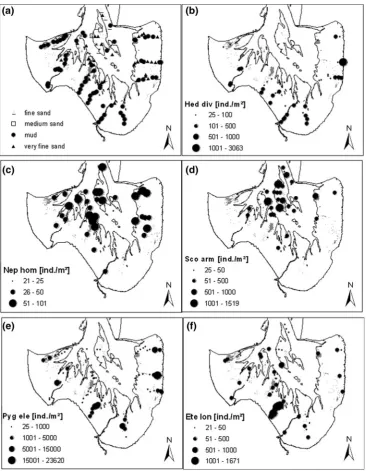
Figures2,3and4 show the grain size distribution and the spatial variability among the most dominant species (ind./m2) in the Jade Bay. The sediment composition (Fig.2a) was predominated by muddy and very fine sand sediments arranged belt-shaped in the Jade Bay. Fine sands and medium sands found in the lower intertidal area mostly in the central part of the study area were of minor importance.
The Hydrobia ulvae community (Community 1)
inclu-ded 39 stations (mean similarity of 66 %) located in the eastern and western intertidal flats. The mostly very fine sand environment was characterized by moderate submer-gence time (8.5 h) and mud, chlaand TOC contents. This community was characterized by a species-rich benthic fauna, highest mean abundance but lowest Shannon-Wiener diversity and eveness. The dominant species wasH. ulvae (99 %), which was widespread in high densities in the Jade Bay (Fig.4f). A clustered pattern with maximum abun-dance of more than 370,000 ind./m2 was found in close proximity toZostera noltiiseagrass beds in the eastern and south-western parts. Due to its dominance, the community structure was characterized by surface deposit feeders. By exclusion ofH. ulvae, species such asC. edule (Fig.3a),
M. balthica (Fig.3b),Retusa obtusa (Fig.4e), P. elegans
(Fig.2e), Nephtys hombergii (Fig.2c) and T. benedii dominated the community structure. This was the only community with high abundances of bivalves.
Scrobicu-laria plana (Fig.3c), commonly known for muddy
sedi-ments, occurred only at 29 stations, which were restricted to the southern and south-western upper intertidal areas.
a contents. The community revealed the second highest mean abundance and moderate values of Shannon-Wiener diversity and eveness, respectively. The community was numerically dominated by the subsurface deposit feeding
T. benedii (Fig.3f), which reached abundances of more
than 40,000 ind./m2, and again H. ulvae. Higher abun-dances were also found for P. elegans, Corophium
volu-tator(Fig.4b),R. obtusa, Heteromastus filiformis(Fig.3d)
and Juveniles of Nereis spp.. In general, the omnivorous feeding ragworm Hediste diversicolor (Fig.2b) occurred widespread in this muddier upper intertidal area. The dis-similarity between Community 2 and Communities 1, 3-6 was mainly caused by the two dominant speciesT. benedii
andP. elegans. Classified as subsurface and surface deposit
feeders, both species presented also the dominant feeding modes of this community.
Communities 3 and 4 both were referred to as mixed sediments. Community 3 included 15 stations (mean sim-ilarity of 33 %), which were widely distributed over the lower intertidal flats of the Jade Bay area predominantly found along the margins of the tidal gullies and tidal channels. Six stations in the eastern Jade Bay were located
near Mytilus beds. Community 4 was summarized by 13
stations (mean similarity of 23 %) located in the southern part of the Jappensand (central Jade Bay) and along the tidal inlets in the western part of the Jade Bay. The envi-ronmental characteristics of both communities were rather similar according to moderate mud, chl a and TOC Fig. 2 Distribution patterns of
grain size composition and dominant polychaete species
(mean ind./m2) in the Jade Bay.
asediment composition,
bHediste diversicolor, cNephtys hombergii,
contents, but differed in median grain size. Submergence time varied between 10.7 and 14.5 h, respectively. In Community 3, species richness and mean abundance were low, but Shannon-Wiener diversity and eveness high. The community structure was numerically dominated by inter-face feeding polychaetes, such asC. killariensis (Fig.3e)
andP. elegans, as well asH. ulvae. These three dominant
species, which contributed with 85 % to the total macro-fauna abundance, were also responsible for the distinction with the five other communities. Surface deposit and interface feeders dominated the community structure in terms of feeding modes. Community 4 was characterized by the lowest species richness and the lowest mean abun-dance in contrast to the five others. Trophic structure in
terms of abundance was dominated by subsurface deposit-, surface deposit- and interface feeders, and predators caused by the characteristic species S. armiger,H. ulvae, C.
kil-lariensis and R. obtusa. S. armiger (Fig.2d) represented
the most and widespread polychaete of the lower intertidal area, reaching a maximum abundance of 1,519 ind./m2.
The sandflat community (Community 5) included 14 stations (mean similarity of 15 %) characterized by the lowest mud, chla and TOC contents in the Jade Bay, but highest median grain size. Submergence time was 10.4 h, respectively. Stations were found in the lower intertidal central part of the Jade Bay (Jappensand) and on sandflats along the adjacent channels Stenkentief and Vareler Fahrwasser, which consisted of very fine to medium sands. Fig. 3 Distribution patterns of
dominant bivalve, polychaete and oligochaete species (mean
ind./m2) in the Jade Bay.
A total of 26 species were found. Mean abundance, Shannon-Wiener diversity and eveness revealed moderate values. Characteristic species wereH. ulvaeandS. armiger, several sand-licking amphipods (U. poseidonis, Bathyporeia
sarsi; Fig.4a, c) and Juveniles of the polychaete Nephtys
spp.. The two amphipod species occurred exclusively in Community 5, and were attributed to the differences between Community 5 and Communities 1–4 and 6. Additionally, these species contributed to the high percentage of sand-lickers in this community. Surface deposit feeders were again the dominant feeding mode.
The subtidal community (Community 6) (mean similarity of 17 %) was located within the adjacent channels (Ahne, Vareler Fahrwasser) characterized by 24 h of submergence
time, sediments with high median grain size, low mud, chl aand TOC contents. This community was characterized by the highest species richness, Shannon-Wiener diversity and eveness. The mean abundance was relatively low with 3,991±2,547 ind./m2similar to Community 3.S. armiger, the amphipod M. maculatus(Fig.4d) and the polychaete
Lanice conchilegawere the dominant species. Other species
numerically dominating in this community were polychae-tes, such as P. elegans, Aricidea minuta, Eteone longa (Fig.2f) andPhyllodoce mucosa, accompanied byR. obtusa and the pantopodNymphon brevirostre. Dominant feeding modes were subsurface deposit- and interface feeders, fol-lowed by predators. Surface deposit feeders were of minor importance in contrast to the five other communities. Fig. 4 Distribution patterns
of dominant amphipod and gastropod species (mean
ind./m2) in the Jade Bay.
Relationship between spatial distribution and environmental variables
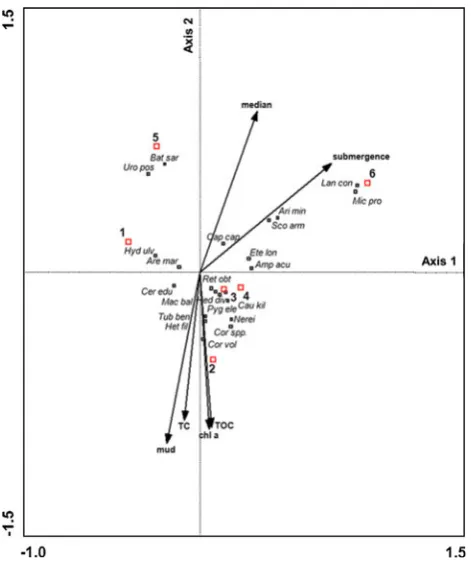
The CCA ordination diagram with stepwise forward selection revealed that submergence time, mud and chl acontents were significantly correlated to the variance in species abundance data. The first and second CCA axes together accounted for approximately 81 % of the relations between species and environmental variables. The first axis was most strongly correlated with submergence time fol-lowed by median grain size, chlaand TOC contents. The second axis was correlated with median grain size and submergence time. The different communities were clearly separated (Fig.5). Community 6 was characterized by 24 h of submergence time. Community 5, and Community 1 to a lesser degree, were associated with higher median grain size. Community 2 was associated with highest chla, mud and TOC contents, as were Community 3 and 4, but to a lesser degree.
Species (e.g.L. conchilega, M. maculatus, S. armiger, A.
minuta) related to a longer submergence time were
posi-tively correlated to the first axis. Species such asB. sarsi
andU. poseidonis,which were positively correlated to the
second axis, related to a higher median grain size. In contrast, species such as C. volutator, T. benedii and
H. filiformis related to more muddy sediment, were
nega-tively correlated.
Spearman rank correlations between species abundance and environmental variables revealed significant species-specific relationships similar to the CCA presented in Table2. Macrofauna abundance and species richness were positively correlated to mud, TOC, and chlacontents, but negatively to median grain size and submergence time. Especially, the abundance of macrofauna species such asT.
benedii, H. filiformis,juvenileNereisspp., H. diversicolor
andR. obtusawere significantly positively correlated with
the mud content, total organic carbon (TOC) and total carbon (TC) contents, but negatively correlated with median grain size and submergence time. In contrast, the abundance ofS. armiger,B. sarsi,U. poseidonis,Arenicola
marina and Capitella capitata showed a significantly
positive correlation with median grain size, but a signifi-cantly negative or no correlation with chlacontent. Similar results were found forE. longaandAmpharete acutifrons. Autocorrelations between the environmental variables confirmed negative correlations between submergence time and TOC, chl aand mud contents (-0.34;-0.60; -0.36, p\0.001), but a positive correlation between submer-gence time and median grain size (0.37, p\0.001). Median grain size correlated significantly negative with TOC (-0.79, p\0.001), chl a (-0.78, p\0.001) and mud contents (-0.80, p\0.001), but mud content corre-lated positively with TOC (0.86, p\0.001) and chl a (0.76,p\0.001) contents.
Discussion
Relationships between spatial distribution of macrofauna communities and environmental variables
The spatial distribution of macrofauna communities in the Jade Bay was best explained by the variability in submer-gence time, sediment composition (mud content, grain size) and chlacontent, all following an intertidal gradient. Our results agree with several studies in other areas of the Wadden Sea that sediment characteristics, food availability (expressed as TOC and/or chl a contents) and intertidal height (submergence time) are the primary causal factors for the distinct distribution patterns of intertidal macrofauna species resulting in characteristic zonation patterns (Beuk-ema 1988; Junoy and Vie´itez1990; Ysebaert et al.2003; van Colen et al.2009). Salinity, which is also a major factor affecting the macrofauna community structure in estuaries (Ysebaert et al.1998, 2003; Ysebaert and Herman 2002), was of rather minor importance in the whole polyhaline Jade Bay with no major freshwater influence.
Fig. 5 Species-environmental variables triplot of CCA with different communities, environmental variables selected by the forward
selection procedure (indicated byarrows) and selected species. For
Although the Spearman rank correlation coefficients were weakly correlated, results agree well with the species positions in the CCA biplot, which confirms the relation-ships between the macrofauna communities and the pre-dominant gradients. Similarly, weak relationships were found by van Colen et al. (2009), who explained this with the high small-scale patchiness of benthic organisms. According to their sensitivity to withstand desiccation during increasing times of emersion towards the upper muddy intertidal areas and to cope with increasing hydro-dynamics towards the more exposed, lower sandy intertidal areas, species are correlated to the two main gradients in the CCA plot. The general decrease from subsurface deposit and deposit feeders towards interface feeders in terms of abundance with increasing submergence time (decreasing tidal height), reflects also the close relationship between food availability and/or food quality for the macrofauna. Our results (Table1) confirm that higher sedimentation rates result in nutrient and TOC-rich sedi-ments in the upper intertidal areas, in contrast to the sandflats and subtidal areas, where higher hydrodynamics prevent organic enrichment. These relationships were
previously described by Pearson and Rosenberg (1978) and Hertweck (1994).
The different statistical methods used revealed similar results and divided the Jade Bay into almost the same zones with characteristic macrofauna community compositions corresponding with different habitat types (subtidal vs. intertidal, sandflat, mixed sediments, mudflat, seagrass beds). These results are in accordance with the still com-mon sediment related classification of intertidal flats in the Wadden Sea (see ‘‘Introduction’’).
In addition to the above discussed role of environmental parameters on macrofauna community structure, biological interactions (predation, competition), as well as bio-sta-bilization, bio-irrigation and bioturbation of species can modify the habitat (Schubert and Reise 1986; Rosenberg 1997; van der Meer et al.2000; Reise2002; Orvain et al. 2004, 2006) and, thus, have probably an influence on the distribution patterns of species and the structure of the benthic communities in the Jade Bay. Furthermore, no significant differences in community structure caused by seasonal fluctuations primarily triggered by species-spe-cific differences in the timing of recruitment (ANOSIM Table 2 Spearman rank correlations between species densities and environmental variables (sediment fractions:[63lm,\63lm (mud)
expressed as percentage, median grain size (lm), total carbon (%), TOC (%), Chla(mg/m2) and submergence time (h)
Species [63lm
(%)
\63lm% (mud)
Median grain
size (lm)
Total carbon (%)
TOC (%)
Chla
(mg/m2)
Submergence (h)
Hydrobia ulvae -0.12** 0.06 -0.14*** 0.25*** 0.21*** 0.32*** -0.38***
Cerstoderma edule -0.08* 0.13*** -0.13** 0.10* 0.06 ns 0.21*** -0.28***
Pygospio elegans -0.19*** 0.18*** -0.14*** 0.14*** 0.13*** 0.19*** -0.24***
Tubificoides benedii -0.59*** 0.53*** -0.52*** 0.49*** 0.45*** 0.64*** -0.62***
Scoloplos armiger 0.34*** -0.26*** 0.38*** -0.31*** -0.28*** -0.44*** 0.44***
Corophium volutator -0.11** 0.14*** -0.16*** 0.07 0.08 0.09 -0.17***
Corophiumspp. -0.21*** 0.26*** -0.23*** 0.15*** 0.15*** 0.20 *** -0.20***
Eteone longa -0.07 0.09* -0.02 0.01 -0.02 0.09 -0.15***
Hediste diversicolor -0.43*** 0.34*** -0.35*** 0.36*** 0.32*** 0.52*** -0.44***
Bathyporeia sarsi 0.24*** -0.24*** 0.23*** -0.23*** -0.22*** -0.20*** 0.08
Caulleriella killariensis -0.26*** 0.19*** -0.25*** 0.14*** 0.14*** 0.18** 0.06
Retusa obtusa -0.34*** 0.31*** -0.24*** 0.28*** 0.23*** 0.38*** -0.28***
Urothoe poseidonis 0.24*** -0.15*** 0.13** -0.26*** -0.25*** -0.15** -0.03
Ampharete acutifrons -0.09* 0.12** -0.05 0.08* 0.03 0.02 0.08*
Arenicola marina 0.11** -0.09* 0.06 -0.15*** -0.15*** 0.001 -0.23***
Heteromastus filiformis -0.46*** 0.44*** -0.42*** 0.35*** 0.33*** 0.42*** -0.30***
Nereisspp. -0.55*** 0.48*** -0.39*** 0.43*** 0.39*** 0.57*** -0.55***
Capitella capitata 0.20*** -0.07 0.11** -0.21*** -0.21*** -0.01 -0.06
Macoma balthica -0.37*** 0.30*** -0.25*** 0.32*** 0.29*** 0.38*** -0.44***
Scrobicularia plana -0.35*** 0.29*** -0.28*** 0.25*** 0.22*** 0.36*** -0.28***
Species richness -0.44*** 0.37*** -0.33*** 0.35*** 0.31*** 0.46*** -0.53***
Total abundance -0.24*** 0.22*** -0.24*** 0.36*** 0.32*** 0.41*** -0.46***
test, unpublished data) were found between spring and early summer.
Comparison of Jade Bay communities with other Wadden Sea areas
In general, the intertidal Jade Bay was characterized by species such as H. ulvae, T. benedii, C. killariensis,
P. elegans, S. armiger,U. poseidonis,R. obtusa, C. edule,
M. balthica, C. volutator and H. diversicolor. Although,
differences exist in sampling design (area, mesh size), the observed species composition is very similar compared with other areas of the Wadden Sea (e.g. Do¨rjes 1978; Beukema1988; Jensen 1992; Hertweck1994; Reise et al. 1994; van Colen et al. 2009). Reise et al. (1994) found 14 species per sample in Ko¨nigshafen, while Beukema (1988) for Balgzand and van Colen et al. (2009) for the Zwin nature reserve observed both an average of 11 species per sample. In accordance with these studies, species richness in the Jade Bay revealed an average of 12 species per sample.
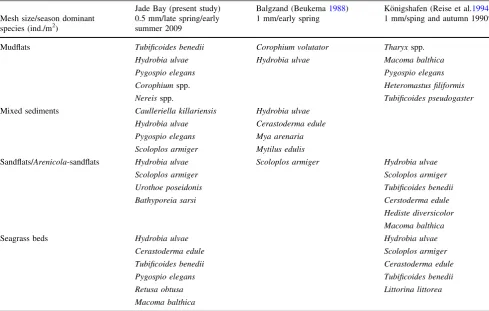
The comparison of our six distinct macrofauna com-munities in the Jade Bay with studies from other areas of the Wadden Sea revealed similar species distribution pat-terns with respect to their preferred habitat types, but dif-ferences in respect to the dominant species were found. The abundances ofH. ulvaewere in an order of magnitude higher than in the western (Beukema1988) and northern Wadden Sea (Jensen1992; Reise et al.1994). This might be caused by the presence of extensiveZ. noltii seagrass beds in the eastern and south-western Jade Bay at stations of Community 1 (Figs.1, 4f). In this sandy, generally nutrient-poorer area in the eastern Jade Bay, the occurrence of seagrass beds may increase the rate of sedimentation (Herku¨l and Kotta 2009) and the presence of macroalgae and microalgae growing on the units, used byH. ulvaeas food source. Also, seagrass beds decrease the risk of dis-lodgement by water currents and enable the protection for predation by epibenthic predators, such as crabs, shrimps, fishes and shorebirds (Cardoso et al.2007). These condi-tions might have caused the highest abundances ([370,000 ind./m2) ofH. ulvaein this area. In comparison with other Wadden Sea areas a significant contribution of
H. ulvaeto the total macrofauna abundance (and biomass)
is also related to the high proportion of seagrass beds, such as in Ko¨nigshafen (Tables3,4) and the Mondego estuary (Cardoso et al.2002). The high abundances also observed at stations without seagrass beds probably reflect the high spatial variability ofH. ulvae, which is quite common due to its active grazing on microphytobenthos (Fenchel et al. 1975; Herman et al. 2000), and migrating and floating behavior (Haubois et al.2002).
The upper intertidal mudflats (Community 2) were dominated by the pelophilous subsurface-deposit feeding oligochaete T. benedii,common for muddy intertidal flats (Do¨rjes et al. 1969; Vo¨ge et al. 2008). Supported by the significant correlation between abundance and mud con-tent, this opportunistic species with a short life span, high productivity, small body size and an invasive ability (Pearson and Rosenberg 1978) is adapted to these sedi-ments rich in organic carbon and able to tolerate anoxic conditions (Giere et al. 1999). A similar autecological potential has been recorded for the opportunistic P. ele-gans, which is well adapted to survive in moderate hypoxic conditions (Kube and Powilleit 1997). Mud offers a favourable substratum for diatoms (de Jonge 1985), expressed by the highest chl acontent in this community. This might have explained the high abundance of species such as H. ulvae, P. elegans and Juveniles ofCorophium spp., which feed on benthic diatoms (Fenchel et al.1975; Hertweck 1994).
A comparison between different mudflat areas in the Wadden Sea shows that the numerical dominance of vari-ous small, r-selected and opportunistic species is common (Table3). On Balgzand, the upper muddy coastal areas were characterized by a Corophium volutator-zone domi-nated by C. volutator and H. ulvae (Beukema 1988, Beukema and Cade´e 1997). In contrast, M. balthica,
Tubificoides pseudogaster, P. elegans, Tharyx spp. and
H. filiformiswere dominant species in Ko¨nigshafen (Reise
Jade Bay (German Wadden Sea) mudflat areas reveal that size and mud content varied largely. On Balgzand, only 20 % (Table4) of the intertidal area contained sediments with a mean percentage of only 10–24 % mud content (Beukema 1974, 1988). This is probably caused by a northward transport of sand brought into the back-barrier basin derived from the fronting barrier (Beets and van der Spek2000), resulting in the dominance of sandy sediments (Beukema1988). Higher percentages of mud content in the sediments affect the spatial distribution of macrofauna
species (Sakamaki and Nishimura 2009). An increase in mud content causes an increase in sediment cohesiveness resulting in an impermeable and high organically concen-trated sediment layer, which is harmful for sensitive spe-cies suffer from anoxic and sulfidic conditions (Sakamaki and Nishimura 2009), but seems to be advantageous for
T. benediiin the Jade Bay.
Two communities typical for mixed sediments were found in the Jade Bay. According to Beukema (1988) and supported by our results, these areas were defined as intermediate tidal flats characterized by mixed sediments and moderate submergence times, where most species of the mudflat and sandflat areas co-occurred. However, the cluster analysis revealed two significant distinct commu-nities different in terms of species richness, mean abun-dance and species dominance. Differences were mainly attributed to the presence or absence of C. killariensis,
P. elegans, H. ulvae andS. armiger. In Community 3 the
high abundances of P. elegans’ biogenic structures may have additionally affected the macrofauna. The increase of the psammophilous orbiinid polychaete S. armiger in Community 4 indicated an increase in hydrodynamical Table 3 Comparison of the dominant species ranked according to highest species abundance found per m2 on intertidal mudflats, mixed sediments, sandflats and seagrass beds in different areas of the Wadden Sea
Jade Bay (present study) Balgzand (Beukema1988) Ko¨nigshafen (Reise et al.1994)
Mesh size/season dominant
species (ind./m2)
0.5 mm/late spring/early summer 2009
1 mm/early spring 1 mm/sping and autumn 1990*
Mudflats Tubificoides benedii Corophium volutator Tharyxspp.
Hydrobia ulvae Hydrobia ulvae Macoma balthica
Pygospio elegans Pygospio elegans
Corophiumspp. Heteromastus filiformis
Nereisspp. Tubificoides pseudogaster
Mixed sediments Caulleriella killariensis Hydrobia ulvae
Hydrobia ulvae Cerastoderma edule
Pygospio elegans Mya arenaria
Scoloplos armiger Mytilus edulis
Sandflats/Arenicola-sandflats Hydrobia ulvae Scoloplos armiger Hydrobia ulvae
Scoloplos armiger Scoloplos armiger
Urothoe poseidonis Tubificoides benedii
Bathyporeia sarsi Cerstoderma edule
Hediste diversicolor
Macoma balthica
Seagrass beds Hydrobia ulvae Hydrobia ulvae
Cerastoderma edule Scoloplos armiger
Tubificoides benedii Cerastoderma edule
Pygospio elegans Tubificoides benedii
Retusa obtusa Littorina littorea
Macoma balthica
* Data are combined
Table 4 Comparison of the coverage of intertidal mudflats, mixed sediments, sandflats and seagrass beds of the entire intertidal (area in %) between different areas of the Wadden Sea
Area (in %) Jade Bay (Meyer
and Ragutzki1999;
Adolph2010)
Balgzand (Beukema 1974)
Ko¨nigshafen (Reise et al.1994)
Mudflats 43.4 20 9.0
Mixed sediments 16.6 50
Sandflats 30.9 30 75.9
stress, expressed by the somewhat higher median grain size and longer submersion times. Stronger tidal currents at stations of this community are also confirmed by the lower TOC content resulting in the lowest macrofauna densities and species richness.
The intermediate tidal flats on Balgzand were, in a similar manner, numerically dominated by H. ulvae (Table3), but also by suspension-feeding bivalves (C.
ed-ule, M. edulis and Mya arenaria) (Beukema1988), which
declined since the 1990s (Beukema and Dekker2005). As mentioned above for the mudflats, there is evidence that these differences in species composition and abundance between our present and earlier studies (in the Jade Bay and other parts of the Wadden Sea) were related to long-term changes. For instance, several studies discussed the absence of severe winters in the last two decades to be responsible for the lower recruitment success of bivalve species in different areas of the Wadden Sea (e.g. Strasser et al.2003; Beukema and Dekker2005; van der Graaf et al. 2009), as well as observed in the Jade Bay (Schu¨ckel and Kro¨ncke submitted).
The sandflats (Community 5) located in the central part (Jappensand) and at the margins of the northern entrance of the Jade Bay were dominated by the opportunistic
S. armigerand mobile amphipods such as U. poseidonis,
B. sarsiandB. pilosa.As commonly known from exposed
beaches, S. armiger and the fast swimming and digging amphipods are typical well-adapted inhabitants of unstable, well oxygenated coarser sandy sediments (pers. observa-tion; Degraer et al.2003), which is supported by the CCA plot. This explains why corresponding community struc-tures were found at the lower and exposed marginal areas of Balgzand (Beukema 1988) and the Lu¨tetsburger Plate (Steuwer2002), on the sandflats in Spiekeroog (Grotjahn 1990) and Ko¨nigshafen (Reise et al. 1994), as well as on the emerging flood delta shoals between the islands of Rømø and Sylt (Lackschewitz and Reise1998). Especially in Ko¨nigshafen, the large contribution of sandflats (76 %, Table4) and the predominance of medium sands might be a structuring factor resulting in higher abundances of
S. armigerin this part of the Wadden Sea than in the Jade
Bay. Higher densities ofBathyporeia were also found in the transition area between intertidal and subtidal, as also reported for the Knechtsand by Michaelis (1969).
The subtidal community (Community 6) was dominated by the cosmopolitan S. armiger in terms of abundance. Adapted to mobile sediments, this species indicated a higher hydrodynamic stress and tidal currents. Population studies on genetic divergence, reproductive strategies and tolerance to hypoxia ofS. armigerin subtidal and intertidal areas indicated a sibling species: the intertidal ‘‘Type I’’
and the subtidal ‘‘Type S’’ (Kruse et al.2003,2004). Thus, it might be the case that Community 6 was dominated by the subtidal ‘‘Type S’’, but Communities 4 and 5 by the intertidal ‘‘Type I’’. Further genetic studies are necessary to clear this assumption. In addition, the tube-building poly-chaetesL. conchilegaandP. elegans, as well the amphipod
M. maculatus,which is common for subtidal flats, occurred
in high abundances. Comparing this community structure with other shallow subtidal areas, an almost similar species composition was found in the exposed sandy inlets of the Wichter Ee (Nehmer and Kro¨ncke2003) and the Otzumer Balje (Reiss and Kro¨ncke2001) in the East Frisian Wadden Sea.
Of course, our communities revealed a large overlap of dominant species in the different communities (Table1), which is commonly known from other studies (Reise et al. 1994; Ysebaert and Herman2002; van Colen et al.2009; Puls et al. 2011), indicating the wide range of ecological tolerance of these species along the intertidal gradient. However, our results revealed significant differences between the macrofauna communities in the Jade Bay compared with other, more homogenous Wadden Sea areas. The main reason for these differences is the large variation in the proportion of mudflats between areas and the higher sediment mud contents in most of the Jade Bay mudflats resulting, for instance, in the dominance of
T. benedii. The macrotidal and special bay shaped
char-acter of the Jade Bay area seems to cause the regional-specific sedimentation processes that in turn influence the sediment composition, submergence time and food avail-ability for the macrofauna communities, in comparison with other Wadden Sea areas.
Acknowledgments We thank Helmo Nicolai and his team of the Institute for Chemistry and Biology of the Marine Environment (ICBM) for their help with fieldwork and providing ship time throughout the year. A special thank goes to Malte Groh and Jonas Arlt for their untiring help in the field. We thank several students and Christian Ma¨rz, Jo¨rn Logemann and Kerstin Wintermann for help with sampling and sorting samples. We are grateful to Gerald Millat for providing aerial images, Karsten Lettmann and Oliver Bleich for pro-viding submergence time data and Martina Schulz for technical assistance. We are also grateful to Karsten Reise and two anonymous reviewers for very helpful comments on the manuscript. Our results are part of the ‘‘Jade Bay project’’, an interdisciplinary background study addressing to collect historically and new basic data of natural sciences and cultural studies for a coastal database of Lower Saxony. This research was funded by the Ministry for Science and Culture of Lower Saxony (‘‘Niedersa¨chsisches Vorab der Volkswagen Stiftung’’).
Appendix
References
Adolph W (2010) Praxistest Monitoring Ku¨ste 2008. Seegraskartie-rung - Gesamtbestandserfassung der eulitoralen Seegrasbesta¨nde im Niedersa¨chsichen Wattenmeer und Bewertung nach
EG-Wasserrahmenrichtlinie. NLWKN Ku¨stengewa¨sser und A¨ stuare
2/2010, p 52
Babu CP, Brumsack H-J, Schnetger B (1999) Distribution of organic carbon in surface sediments along the eastern Arabian sea: a revisit. Mar Geol 162:91–103
Beets DJ, van der Spek AJF (2000) The Holocene evolution of the barrier and back-bariier basins of Belgium and the Netherlands as a function of late Weichselian morphology, relative sea-level rise and sediment supply. Geologie en Mijnbouw/Neth J Geosci 79:3–16 Behre K-H (2004) Coastal development sea-level change and
settlement history during the later Holocene in the Clay District of Lower Saxony (Niedersachsen) northern Germany. Quatern Int 112:37–53
Bergfeld C (1999) Macrofaunal community pattern in an intertidal sandflat: effects of organic enrichment via biodeposition by mussel beds. First Results. Senck Marit 29:23–27
Beukema JJ (1974) Seasonalchanges in the biomass of the macro-benthos of a tidal flat area I the Dutch Wadden Sea. Neth J Sea Res 8(1):94–107
Beukema JJ (1988) An evaluation of the ABC-method (abundance/ biomass comparison) as applied to macrozoobenthic communi-ties living on tidal flats in the Dutch Wadden Sea. Mar Biol 99:425–433
Beukema JJ, Cade´e GC (1997) Local differences in macrozoobenthic response to enhanced food supply caused by mild eutrophication in a Wadden Sea area: food is only locally a limiting factor. Limnol Oceanogr 42(6):1424–1435
Beukema JJ, Dekker R (2005) Decline of recruitment success in cockles and other bivalves in the Wadden Sea: possible role of climate change, predation on postlarvae and fisheries. Mar Ecol Prog Ser 287:149–167
Bos AR, Bouma TJ, de Kort GLJ, van Katwijk MM (2007) Ecosystem engineering by annual intertidal seagrass beds: sediment accre-tion and modificaaccre-tion. Estuar Coast Shelf Sci 74:344–348 Brotas V, Mendes CR, Cartaxana P (2007) Microphytobenthic
biomass assessment by pigment analysis: comparison of spec-trophotometry and High Performance Liquid Chromatography methods. Hydrobiologia 587:19–24
Bungenstock F, Weerts HJT (2010) The high-resolution Holocene sea-level curve for Northwest Germany: global signals, local effects or data-artefacts? Int J Earth Sci (Geol Rundsch) 99:1687–1706 Cardoso PG, LillebØ AI, Pardal MA, Ferreira SM, Marques JC
(2002) The effect of different primary producers onHydrobia
ulvaepopulations: a case study in a temperate intertidal estuary. J Exp Mar Biol Ecol 277:173–195
Cardoso PG, Raffaelli D, Pardal MA (2007) Seagrass beds and intertidal invertebrates: an experimental test of the role of habitat structure. Hydrobiologia 575:221–230
Clarke KR, Gorley RN (2006) Primer v6: user manual/tutorial Plymouth UK: Primer-E Plymouth Marine Laboratory Clarke KR, Green RH (1988) Statistical design and analysis for a
‘‘biological effects’’ study. Mar Ecol Prog Ser 173:121–127 De Jonge VN (1985) The occurrence of ‘‘epipsammic’’ diatom
populations: a result of interaction between physical sorting of sediment and certain properties of diatom species. Estuar Coast Shelf Sci 21:607–622
Degraer S, Volckaert A, Vincx M (2003) Macrobenthic zonation patterns along a morphodynamical continuum of macrotidal low tide bar/rip and ultra-dissipative sandy beaches. Estuar Coast Shelf Sci 56:459–468
Diekmann R, Osterthun M, Partenscky H-W (1987) Influence of water-level elevation and tidal range on the sedimentation in a German tidal flat area. Prog Oceanogr 15:151–166
Do¨rjes J (1978) Das Watt als Lebensraum. In: Reineck H-E (ed) Das Watt—Ablagerungs- und Lebensraum, Senckenberg Buch 50, W Kramer Frankfurt am Main, pp 107–143
Do¨rjes J, Gadow S, Reineck H-E, Singh IB (1969) Die Rinnen der Jade (su¨dliche Nordsee) Sediment und Makrobenthos. Senck Marit 50:5–62
Essink K, Beukema JJ, Madsen, PB, Michaelis H, Vedel GR (1998) Long-term development of biomass of intertidal macrozooben-thos in different parts of the Wadden Sea. Governed by nutrient loads? Senckenb Marit 29(1/6):25–35
Fauchald K, Jumars PA (1979) The diet of worms: a study of polychaete feeding guilds. Oceanogr Mar Biol Ann Rev 17:193–284
Fenchel T, Kofoed LH, Lappalainen A (1975) Particle size-selection
of two deposit feeders: the amphipodCorophium volutatorand
the ProsobranchHydrobia ulvae. Mar Biol 30:19–128
Flach EC (1992) The influence of four macrozoobenthic species on
the abundance of the amphipod Corophium volutatoron tidal
flats of the Wadden Sea. Neth J Sea Res 29:379–394 Table 5 List of macrofauna species together with its abbreviations
used in the text, tables and figures
Abbreviation Species name
Amp acu Ampharete acutifrons
Are mar Arenicola marina
Ari min Aricidea minuta
Bat pil Bathyporeia pilosa
Bat sar Bathyporeia sarsi
Cap cap Capitella capitata
Cau kil Caulleriella killariensis
Cer edu Cerastoderma edule
Corspp. Corophiumspp.
Cor vol Corophium volutator
Cum goo Cumopsis goodsir
Ete lon Eteone longa
Hed div Hediste diversicolor
Het fil Heteromastus filiformis
Hyd ulv Hydrobia ulvae
Lan con Lanice conchilega
Mac bal Macoma balthica
Mic mac Microprotopus maculatus
Nep hom Nephtys hombergii
Nepspp. Nephtysspp.
Nerei Nereisspp.
Nym bre Nymphon brevirostre
Phy muc Phyllodoce mucosa
Pyg ele Pygospio elegans
Ret obt Retusa obtusa
Retspp. Retusaspp.
Sco arm Scoloplos armiger
Scr pla Scrobicularia plana
Tub ben Tubificoides benedii
Flemming BW (2011) Siliciclastic back-barrier tidal flats. In: Davis RA Jr, Dalrymple RW (eds) Tidal depositional systems. Springer, Berlin, pp 1–48
Giere O, Preusse JH, Dubilier N (1999) Tubificoides benedii
(Tubificidae Oligochaeta)—a pioneer in hypoxic and sulfidic environments. An overview of adaptive pathways. Hydrobiolo-gia 406:235–241
Glockzin M, Zettler ML (2008) Spatial macrozoobenthic patterns in relation to major environmental factors—a case study from the Pomeranian Bay (southern Baltic Sea)
Go¨tschenberg A, Kahlfeld A (2008) The Jade. Die Ku¨ste 74:263–274 Gray JS, Elliott M (2009) Ecology of marine sediments—from science
to management. 2nd Edition. Oxford University Press, p 225 Grotjahn M (1990) Sedimente und Makrofauna der Watten bei der
Insel Spiekeroog -Untersuchungen im Rahmen des ‘‘Sensitivi-ta¨tsrasters Deutsche Nordseeku¨ste’’. -Jber. 1987, Jber. Forsch.— Stelle Ku¨ste 39:97–119
Haubois A-G, Guarini J-M, Richard P, Blanchard GF, Sauriau P-G (2002) Spatio-temporal differentiation in the population structure ofHydrobia ulvae on an intertidal mudflat (Marennes-Ole´ron Bay France). J Exp Mar Biol Ecol 371:1–12
Hayes MO (1979) Barrier island morphology as a function of tidal and wave regime. In: Leatherman SP (ed) Barrier islands, Academic Press, New York, pp 1–27
Heip CHR, Goosen NK, Herman PMJ, Kromkamp J, Middelburg JJ, Soetaert K (1995) Production and consumption of biological particles in temperate tidal estuaries. Oceanogr Mar Biol Ann Rev 33:1–149
Herku¨l K, Kotta J (2009) Effects of eelgrass (Zostera marina) canopy
removal and sediment addition on sediment characteristics and benthic communities in the Northern Baltic Sea. Mar Biol 30:74–82
Herman PMJ, Middelburg JJ, van de Koppel J, Heip CHR (1999) Ecology of estuarine macrobenthos. Adv Ecol Res 29:195–240 Herman PMJ, Middelburg JJ, Widdows J, Lucas CH, Heip CHR
(2000) Stable isotop labeling experiments confirm the impor-tance of mirophytobenthos as food for macrofauna. Mar Ecol Prog Ser 204:79–92
Hertweck G (1994) Zonation of benthos and Lebensspuren in the tidal flats of the Jade Bay, southern North Sea. Senckenb Marit 24(1/ 6):157–170
Hoselmann C, Streif H (2004) Holocene sea-level rise and its effect on the mass balance of coastal deposits. Quat Int 112:89–103 Hummel H, Fortuin AW, Bogaards RH, Meijboom A, de Wolf L
(1994) The effects of prolonged emersion and submersion by tidal manipulation on marine macrobenthos. Hydrobiologia 282(283):219–234
Jensen KT (1992) Macrozoobenthos on an intertidal mudflat in the Danish Wadden Sea: comparison of surveys made in the 1930 s, 1940 s and 1980 s. Helgol Meeresunters 46:363–376
Junoy J, Vie´itez JM (1990) Macrobenthic community structure in the Rı´a de Foz an intertidal estuary (Galicia North West Spain). Mar Biol 107:329–339
Kramer KMJ, Brockmann UH, Warwick RM (1994) Tidal estuaries: manual of sampling and analytical procedures. AABalkema, Rotterdam, p 303
Kro¨ncke I (1996) Impact of biodeposition on macrofaunal commu-nities in intertidal sandflats. Mar Ecol 17:159–174
Kruse I, Reusch TBH, Schneider MV (2003) Sibling species or poecilogony in the polychaete Scolopos armiger? Mar Biol 142:937–947
Kruse I, Strasser M, Thiermann F (2004) The role of ecological
divergence in speciation between intertidal and subtidal
Scolop-los armiger(Polychaeta: Orbiniidae) J Sea 51:53–62
Kube J, Powilleit M (1997) Factors controlling the distribution of
Marenzellaria cf viridis Pygospio elegans and Streblospio
shrubsoli(Polychaeta: Spionida) in the southern Baltic Sea with special attention for the response to an event of hypoxia. Aquat Ecol 31:187–198
Kuipers BR (1977) On the ecology of juvenile plaice on a tidal flat in the Wadden Sea Neth. J Sea Res 11(1):56–91
Lackschewitz D, Reise K (1998) Macrofauna on flood delta shoals in the Wadden Sea with an underground association between the
lugwormArenicola marinaand the ampipodUrothoe
poseido-nis. Helgol Meeresunters 52:147–158
Lettmann K, Wolff J-O, Liebezeit G, Meier G (2010) Investigation of the spreading and dilution of domestic waste water inputs into a tidal bay using the finite-volume model FVCOM. Abstract for EGU Conference 2010, Vienna
Linke O (1939) Die Biota des Jadebusenwattes. Helgol Meeresunters 1:201–348
Meyer C, Ragutzki G (1999) KFKI Forschungsvorhaben Sediment-verteilung als Indikator fu¨r morphodynamische Prozesse. Dien-stbericht der Forschst Ku¨ste Norderney 21:1–43
Michaelis H (1969) Makrofauna und Vegetation der Knechtsandw-atten. -Jber.1967, Forsch.-Stelle f. Insel- u. Ku¨stenschutz 19, Norderney, pp 147–175
Michaelis H (1987) Bestandsaufnahme des eulitoralen Makrobenthos im Jadebusen in Verbindung mit einer Luftbild-Analyse. Jber 1986 Forschst Ku¨ste Norderney 38:13–97
Nehmer P, Kro¨ncke I (2003) Macrofaunal communities in the Wichter Ee a Channel System in the East Frisian Wadden Sea. Senckenb Marit 32(1/2):1–10
Newell RC (1970) Biology of intertidal animals. Logos Press London, p 555
Orvain F, Sauriau P-G, Sygut A, Joassard L, Hir LP (2004)
Interacting effects ofHydrobia ulvae bioturbation and
micro-phytobenhos on the erodibility of mudflat sediments. Mar Ecol Prog Ser 278:205–223
Orvain F, Sauriau P-G, Bacher C, Prineau M (2006) The influence of
sediment cohesiveness on bioturbation effects due toHydrobia
ulvae on the initial erosion of intertidal sediments: a study combining flume and model approaches. J Sea Res 55:54–73 Pearson TH, Rosenberg R (1978) Macrobenthic succession in relation
to organic enrichment and pollution of the marine environment. Oceanogr Mar Biol Ann Rev 16:229–311
Puls W, van Bernem K-H, Eppel D, Kapitza H, Pleskachevsky A, Riethmu¨ller R, Vaessen B (2011) Prediction of benthic community structure from environmental variables in a soft-sediment tidal basin (North Sea). Helgol Mar Res. doi:10.1007/s10152-011-0275-y Reise K (2002) Sediment mediated species interactions in coastal
waters. J Sea Res 48:127–141
Reise K, Herre E, Sturm M (1994) Biomass and abundance inintertidal sediments of Ko¨nigshafen in the northern Wadden Sea. Helgol Meeresunters 48:201–215
Reise K, Herre E, Sturm M (2008) Mudflat biota since the 1930 s: change beyond return? Helgol Mar Res 62:13–22
Reiss H, Kro¨ncke I (2001) Spatial and temporal distribution of macrofauna in the Otzumer Balje (East Frisian Wadden Sea). Senckenb Marit 31(2):283–298
Rosenberg GG (1997) Bioresuspension and biodeposition: a review. J Mar Syst 11:269–278
Sakamaki T, Nishimura O (2009) Is sediment mud content a significant predictor of macrobenthos abundance in low-mud-content tidal flats? Mar Freshw Res 60:160–167
Schubert A, Reise K (1986) Predatory effects ofNephtys hombergii
on other polychaetes in tidal flats sediments. Mar Ecol Prog Ser 34:117–124
Snelgrove PVR, Butman CA (1994) Animal-sediment relationships revisited: cause versus effect. Oceanogr Mar Biol Ann Rev 32:111–177
Steuwer J (2002) Die Makrofauna der Lu¨tetsburger Plate. TMAP-Monitoring 2001. Forschst Ku¨ste Norderney 7:1–11
Strasser M, Dekker R, Essink K, Gu¨nther C-P, Jaklin S, Kro¨ncke I, Madsen PB, Michaelis H, Vedel G (2003) How predictable is high bivalve recruitment in the Wadden Sea after a severe winter. J Sea Res 49:47–57
Ter Braak CFJ, Verdonshot PFM (1995) Canonical correspondence analysis and related multivariate methods in aquatic ecology. Aquat Sci 57(3):255–289
van Colen C, Snoeck F, Struyf K, Vincx M, Degraer S (2009) Macrobenthic community structure and distribution in the Zwin nature reserve (Belgium and the Netherlands). J Mar Biol Ass UK 89(3):431–438
Van der Graaf S, de Vlas J, Herlyn M, Voss J, Heyer K, Drent J (2009) Macrozoobenthos. Thematic Report No 10. In: Marencic H, de Vlas J (eds) Quality Status Report 2009. Wadden Sea Ecosystem No 25. Common Wadden Sea Secretariat, Trilateral Monitoring and Assessment Group, Wilhelmshaven, Germany, p 27
Van der Meer J, Beukema JJ, Dekker R (2000) Population dynamics of two marine polchaetes: the relative role of density dependence predation and winter conditions. ICES J Mar Sci 57:1488–1494
Van Katwijk MM, Bos AR, Hermus DCR, Suykerbuyk W (2010) Sediment modification by seagrass beds: muddification and sandification induced by plant cover and environemental condi-tions. Estuar Coast Shelf Sci 89:175–181
Vo¨ge S, Reiss H, Kro¨ncke I (2008) Macrofauna succession in an infilling salt marsh clay pit. Senckenb Marit 38:93–106 Widdows J, Brinsley M (2002) Impact of biotic and abiotic processes
on sediment dynamics and the consequences to the structure and functioning of the intertidal zone. J Sea Res 48:143–156 Widdows J, Blauw A, Heip CHR, Herman PMJ, Lucas CH,
Middelburg JJ, Schmidt S, Brinsley MD, Twisk F, Verbeek H (2004) Role of physical and biological processes in sediment dynamics of a tidal flat in Westerschelde Estuary SW Nether-lands. Mar Ecol Prog Ser 274:41–56
Ysebaert T, Herman PMJ (2002) Spatial and temporal variation in benthic macrofauna and relationships with environmental vari-ables in an estuarine intertidal soft-sediment environment. Mar Ecol Prog Ser 244:105–124
Ysebaert T, Meire P, Coosen J, Essink K (1998) Zonation of intertidal macrobenthos in the estuaries of Schelde and Ems. Aquat Ecol 32:53–71