T E C H N I C A L A D V A N C E
Open Access
Using an analogical reasoning framework
to infer language patterns for negative life
events
Jheng-Long Wu
1, Xiang Xiao
2,3,4, Liang-Chih Yu
3,5*, Shao-Zhen Ye
4and K. Robert Lai
2,5Abstract
Background:Feelings of depression can be caused by negative life events (NLE) such as the death of a family member, a quarrel with one’s spouse, job loss, or strong criticism from an authority figure. The automatic and accurate identification of negative life event language patterns (NLE-LP) can help identify individuals potentially in need of psychiatric services. An NLE-LP combines a person (subject) and a reasonable negative life event (action), e.g. <parent:divorce> or < boyfriend:break_up>.
Methods:This paper proposes an analogical reasoning framework which combines a word representation
approach and a pattern inference method to mine/extract NLE-LPs from psychiatric consultation documents. Word representation approaches such as skip-gram (SG) and continuous bag-of-words (CBOW) are used to generate word embeddings. Pattern inference methods such as cosine similarity (COSINE) and cosine multiplication similarity (COSMUL) are used to infer patterns.
Results:Experimental results show our proposed analogical reasoning framework outperforms the traditional methods such as positive pairwise mutual information (PPMI) and hyperspace analog to language (HAL), and can effectively mine highly precise NLE-LPs based on word embeddings. CBOW with COSINE of analogical reasoning is the best word representation and inference engine. In addition, both word embeddings and the inference engine provided by the analogical reasoning framework can further be used to improve the HAL model.
Conclusions:Our proposed framework is a very simple matching function based on these word representation approaches and is applied to significantly improve HAL model mining performance.
Keywords:Negative life event, Language pattern mining, Analogical reasoning
Background
The prevalence of clinical depression has increased rap-idly in recent years, and the onset of depression can be triggered or exacerbated by negative or stressful life events, such as the death of a family member, a quarrel with one’s spouse, job loss, or conflict with an authority figure. Such negative life events (NLE) are associated with the onset of depressive episodes, such as anxiety [1], suicide attempts [2] and bulimic symptoms [3]. Many online services have been developed to assess
mental health and provide treatment. Users interact with these websites by writing about their feelings and recent negative life experiences, and these utterances are re-ferred to as negative life event language patterns (NLE-LPs). These text-based messages are then manually reviewed by professional psychologists who provide diag-nosis and recommendations, but this is a labor-intensive process and responses may take several days, and this lengthy delay may have dire consequences, especially for those with suicidal tendencies. Therefore, many re-searches are used the online text-based messages to mining its affective meaning [4,5].
Automating the identification of NLE-LPs in social media texts could reduce the delay in diagnosis and inter-vention response. However, NLE-LPs are unstructured
© The Author(s). 2019Open AccessThis article is distributed under the terms of the Creative Commons Attribution 4.0 International License (http://creativecommons.org/licenses/by/4.0/), which permits unrestricted use, distribution, and reproduction in any medium, provided you give appropriate credit to the original author(s) and the source, provide a link to the Creative Commons license, and indicate if changes were made. The Creative Commons Public Domain Dedication waiver (http://creativecommons.org/publicdomain/zero/1.0/) applies to the data made available in this article, unless otherwise stated. * Correspondence:[email protected]
3
Innovation Center for Big Data and Digital Convergence, Yuan Ze University, Taoyuan City, Taiwan
5Department of Information Management, Yuan Ze University, Taoyuan City, Taiwan
expressions made up of non-continuous word combina-tions. For example, there are two NLE-LPs such as < brother:lovelorn> and <brother:resigned> in a consult-ation sentence as“Brotherhasbroken up, andresignedhis job in government”. For the two NLE-LPs in this case,
“brother”is the subject, and“lovelorn”and“resigned”are two actions which combine to constitute two negative life events. NLE-LPs are also combinations of nouns and verbs. Analogical reasoning is a significant logic compo-nent of human intelligence [6–8]. It is a reasoning method which infers similarities between things which share cer-tain attributes, giving the two items similar status or prop-erties. For example,αandβare a subject and action, and theα∗is another subject. The analogy suggests that the re-lationship betweenα and βis similar to the relationship betweenα∗andβ∗, thusα,βandα∗can be used to refer to β∗, which is an inference target. Analogical reasoning has
recently attracted increased attention in the field of artifi-cial intelligence because an analogy is a very basic form of logical inference [9]. It has been widely applied to natural language processing (NLP) tasks such as question answer-ing [10–12], word segmentation [13], latent relational ana-lysis [14,15], and recommendation systems [16].
The relationship between two words is measured according to relational or attributional similarity. Rela-tional similarity calculates the degree of similarity be-tween two patterns (or pairs), called an analogy [17]. Attributional similarity calculates the degree of similarity between two words, called synonyms. In information theory, mutual information (MI) and pointwise mutual information (PMI) are used to measure the similarity be-tween two things (or patterns) and simulate human memory [18–20]. In general, they calculate similarity based on co-occurrence frequency, and this simple ap-proach is widely applied to NLP tasks [21, 22]. Cosine similarity (COSINE) is also used to measure the degree of similarity between two vectors [23]. It has been ap-plied to hesitant fuzzy linguistic term sets for financial performance evaluation [24]. Pre-trained word embed-dings have been used for analogy tasks, and it can im-prove identification performances in semantic and syntactic problems [25, 26]. The word embeddings are word representations trained using raw text data and can be applied in many classification tasks [27–30]. Word embeddings have also been applied to infer word relations in analogy tasks using multiplication and div-ision, instead of addition and subtraction [31]. The ana-logy method has been used to improve English to Chinese language translation [32]. In addition, over the past decade the traditional association rule mining algorithm has been used to mine language patterns using the co-occurring re-lationship of words [33, 34]. Association rule mining (ARM) has also been used to generate seed language pat-terns from a small labeled NLE corpus, using the
distributed semantic model to discover expanded language patterns from a large unlabeled corpus for sentence classi-fication [35,36]. An advanced method, evolutionary rea-soning algorithms with hyperspace analog to language (HAL) is used to iteratively induce additional relevant pat-terns from a seed pattern set [37]. Existing methods such as ARM and HAL are used to address many issues but do not consider the larger syntax-based semantic informa-tion. Therefore, we propose a framework which obtains word representations to improve pattern inference per-formance in NLE-LP mining tasks.
This paper proposes an analogical reasoning frame-work to mine NLE-LPs using word representation and pattern inference. There are two word representation ap-proaches including skip-gram (SG) and continuous bag-of-words (CBOW) [25, 26]. Two methods of pattern in-ference (cosine similarity and COSINE multiplication similarity (COSMUL) [31, 38]) are used to create vector space models for word analogies problems. This paper has three contributions: (1) using the distributed word embeddings to capture semantic relationships from a large corpus to facilitate NLE-LP mining. (2) The ana-logical reasoning pattern inference is first used to extract NLE-LPs based on word embedding. (3) The analogical reasoning framework based on word embeddings can improve NLE-LP mining performance.
For the first contribution, word embedding is a new distributed word representation learning method based on neural network architectures. Compared to trad-itional methods that represent a word using a high-di-mensional sparse vector, word embedding focuses on learning low-dimensional dense vectors for words by leveraging contextual information from corpora. Such representations have been proven to efficiently capture both semantic and syntactic information from very large datasets [25,26].
For the second contribution, we extend the ana-logical reasoning framework to address language pat-tern mining tasks by considering the patpat-tern structure <subject:action>. That is, given a <subject:action> pat-tern and another subject, the analogical reasoning framework can infer a proper action to be combined with the subject to constitute a new pattern.
For the third contribution, the use of the word embed-dings and inference engine provided by the analogical reasoning framework outperforms traditional language pattern mining methods such as the positive pairwise mutual information (PPMI) and HAL model. In addition, the analogical reasoning framework can further be used to improve the HAL model by replacing the HAL word representation with word embeddings and the HAL inference scheme with analogical reasoning.
framework. Seed NLE-LP annotation introduces our proposed negative life event language pattern mining method which combines word representation ap-proaches with pattern inference methods. PPMI model explains the generation of the NLE-LP dataset and sum-marizes and discusses the experimental results. Conclu-sions and directions for future work are presented in HAL model.
Existing methods
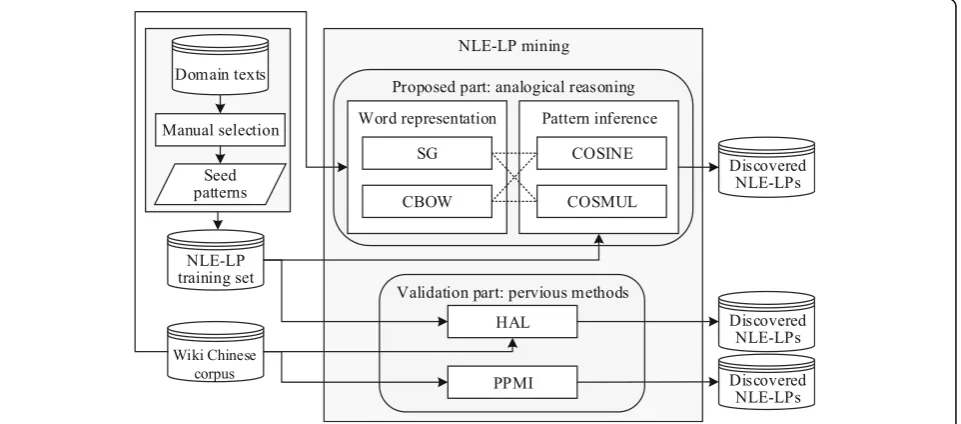
The overall system framework is shown in Fig.1. First, a seed NLE-LP annotation processing uses manual anno-tation to identify NLE-LPs as queries from a domain text corpus. Second, NLE-LP mining is divided into a pro-posed part and a validation part. For the validation part, we use the previous HAL model and the positive point-wise mutual information model to extract NLE-LPs. The experimental results section compares mining perform-ance for the NLE-LP task among the different methods.
To mine NLE-LPs, this section first introduces seed NLE-LP annotation, previous mining methods such as PPMI and HAL, and our proposed analogical reasoning framework. Given the seed NLE-LP <α:β>, the object of analogical reasoning is to infer another mined NLE-LP as <α∗:β∗> where α and α∗ are known subjects, β is a known action, andβ∗is the action we want to infer using the proposed framework. Therefore, the query is defined as <α:β> : : <α∗: ? >.
Seed NLE-LP annotation
To extract the seed NLE-LPs, each seed NLE-LP was di-vided into a subject set and an action set. We designed a logical relationship matrixLRwhich is action by subject.
The values of theLRmatrix were provided by three domain expert annotators based on the following principle: if there exists a logical relationship between a subject and an action, then make a symbol at the intersection of subject and ac-tion, otherwise, no logical relationship exists. The annota-tion process by the three experts produced three LR matrices. To combine the three LR matrices by element-wise counting, if the symbol count is equal to 3, the corre-sponding subject and action are a seed NLE-LP. Table 1 shows the annotation example of aLRmatrix. For example, both“be_sick” and“quarrel” have a logical relationship for all subjects. In addition, the four actions“divorce”,“break_ up”,“drop_out”and“resign”have a logical relationship with some subjects.
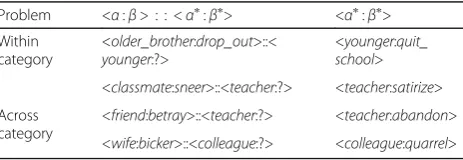
For the NLE-LP mining problem, an analogical infer-ence query assumes the form of <α:β> : : <α∗:β∗> where β∗ is the target word (action) to be inferred. In addition, we designed two experimental problems in which, if the two subjects ofα and α∗are the same cat-egory (e.g., older_brother and younger_brother) this problem is called a within-category; otherwise it is called an across-category. Table 2 shows NLE-LP examples of queries for within-category and across-category problems.
To evaluate the language patterns discovered by differ-ent word represdiffer-entations, a standard answer must be established. In this experiment, a standard answer is de-fined such that the actionβ∗is a negative life event which could reasonably occur in conjunction with the subjectα∗.
PPMI model
In the fields of data mining or information retrieval, pointwise mutual information is usually used to measure
the correlation between the two concepts (word). PMI as expressed by Eq. (1) to compute the information be-tweenxandy.
PMI x;ð yÞ ¼ log p x;ð yÞ
p xð Þp yð Þ ð1Þ
where p(x) and p(y) respectively denote the probability of objects x and y appearing in the corpus. p(x,y) de-notes the probability ofx and y simultaneously appear-ing in a specific context. Accordappear-ing to probability theory, if x and y are independent, then the value of PMI(x,y) is equal to 0. Otherwise, the value ofPMI(x,y) is positive or negative. To avoid an insufficiently large rate of co-occurrence, we apply common positive point-wise mutual information to measure the relevance of two words, the PPMI is defined by Eq. (2).
PPMI x;ð yÞ ¼ 0PMI x;; ifPMI xð ;yÞ≤0 y
ð Þ; ifPMI x;ð yÞ>0
ð2Þ
where thePPMI(x,y) values are directly calculated from the preprocessed wiki Chinese corpus, and then applied to measure their mutual correlation.
HAL model
HAL uses a high-dimensional semantic space [39, 40] and the word representation of HAL is called the HAL-VEC. This model uses a vector to represent each word in the vocabulary. Each dimension denotes the weight of a word in the context of the target word. The weights are calculated by considering the syntactic properties, such as the location and distance of words. In principle, a word that is contextually closer to the target word will
have a greater weight, while those further away will have a low weight. To capture information for co-occurring words, an observation window length must be set to es-tablish an effective scope. For example, for a target word wt, the window size isn. There aren-1 preceding words
need to compute its weights such as fromwt-n+ 1 towt-1 Therefore, the weight of the first word wt-n+ 1 in this window length is set to 1 and the previous word is set to n. Following this principle, we can slide the window over the entire sentence to calculate the word vector for each word. Figure 2shows the weighting scheme of the HAL model.
HAL also is an information inference used to discover information flows using high dimensional conceptual space such HAL-VEC [41, 42], and is called the HAL-INF. HAL-INF uses the characteristics of HAL semantic space to capture the semantic features from the context of the word using a co-occurrence matrix constructed from the whole corpus. HAL-INF can then be used to infer semantically similar words by vector comparison. It is also a kind of analogical reasoning. Therefore, we can use the HAL-INF method to mine NLE-LPs. The degree of similarity sim(β∗,λ) of the HAL model is determined by Eq. (3).
simðβ;λÞ ¼
X
i∈ðQPð Þ∩λ QP Vð ð ÞβÞÞ Vð Þβ i X
j∈QPð Þλ λj
ð3Þ
where λ is a vector and denotes the calculation result of three given vectors by λ=V(β)−V(α) +V(α∗). This definition ensures that a majority of the most import-ant quality properties on word vectors are captured. Here, we use a threshold δ to filter the position of a dimension which satisfies the δ. The numerator calcu-lates the accumulation of weights of those quality properties appearing in both λ and β∗. The denomin-ator is the sum of all quality property weights of v such as λ and β∗. The QP is an index set and calcu-lated by Eq. (4) and Eq. (5).
QP vð Þ ¼ arg k
vk >δ ð4Þ
δ¼ 1
v
k k
X
k
vk ð5Þ
wherevis word vectors andδis scale.
The NLE-LPs mining performances of the PPMI and HAL baseline methods will compare to our proposed ana-logical framework in the experimental results section.
Table 1Example of seed NLE-LPs annotation
Subject
parents boyfriend classmate colleague friend
Action be_sick ✓ ✓ ✓ ✓ ✓
quarrel ✓ ✓ ✓ ✓ ✓
divorce ✓
break_up ✓
drop_out ✓ ✓ ✓
resign ✓ ✓ ✓ ✓
Table 2NLE-LP example of query and answer
Problem <α:β> : : <α∗:β∗> <α∗:β∗>
Within category
<older_brother:drop_out>::<
younger:?>
<younger:quit_ school>
<classmate:sneer>::<teacher:?> <teacher:satirize>
Across category
<friend:betray>::<teacher:?> <teacher:abandon>
Method
Overview
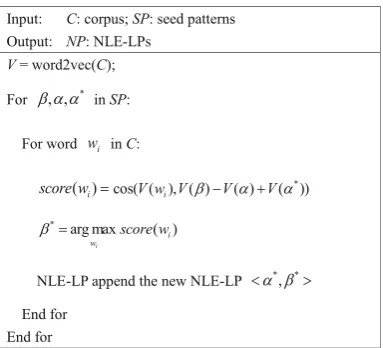
Figure 1 shows our proposed analogical reasoning framework in the proposed part and infers NLE-LPs in a pipeline process including word representation and pat-tern inference. Two word presentation approaches are trained from the Wiki Chinese corpus and domain text corpus: CBOW and SG. Two pattern inference methods are then used to infer corresponding NLE-LPs: COSINE and COSMUL. The analogical reasoning processes are presented in Algorithm 1; through the algorithm we can obtain the final NLE-LP set. The detailed computations of word representation approach and pattern inference method are described in the following sections.
Word representation approach
The two word representation approaches include skip-gram and continuous bag-of-words.
Skip-gram (SG) and continuous bag-of-words (CBOW) The neural network language model (NNLM) was formally proposed by Bengio et al. [43] to construct a language model through a three-layer neural network architecture. Mikolov et al. [25, 26] proposed two new architectures for learning distributed representations of words: skip-gram and continuous bag-of-words. The two models are simplified neural network language models,
removing the hidden layer, and changing from a neural network architecture to the log-linear architecture, greatly reducing computational complexity and increas-ing trainincreas-ing efficiency on large datasets. The CBOW model is similar to the feedforward NNLM, where the hidden layer is removed and the projection layer is shared for all words. All words in context have the same weights for the impact on the probability of current word occurrence, and the projection is not influenced by the lack of consideration of word order. The CBOW model predicts the current word based on the text while Skip-gram uses each word as an input and predicts words within a certain range before and after the current word. SG considers that non-continuous words have a weaker relationship with the current word than those close to it, so distant words are given less weight. Since the two models can effectively train from a large corpus and obtain a distributed word representation, we use them to learn word embeddings from the Chinese Wiki-pedia corpus.
For the CBOW model, given the context C= {wt−(n−
1)/2, ..,wt−1,wt+ 1,…,wt+ (n−1)/2} of the current word wt,
the hidden feature h is calculated using the mean for each word in contextCas input, defined by Eq. (6).
h¼ 1 C
k k
Xk kC
j¼1
V wj ð6Þ
where thewjdenotes the word vector of thejth word in contextC.V∈ℜddenotes the weight of the word vector as trainable parameters. We then compute the output vector from the input ash, defined by Eq. (7):
u¼wh ð7Þ
where the w∈Rv×d denotes the trainable weight of the output layer.
For the SG model, given the context C of the target wordwt, the target word is moved to the input layer and
the context word is moved to the output layer. There-fore, in the SG model, the context words are the target words.
Pattern inference method
Based on word representation, there are two methods to infer NLE-LPs. The query includes four words: α, β, α∗ andβ∗. We use the analogical relationship ofα,βandα∗to inferβ∗. The <α∗:β∗> infers the NLE-LP. The word in the vocabulary is represented as a vector using either word representation approach for analogical reasoning by vector calculation. The relationship expressed for analogical rea-soning is mathematically defined by Eq. (8):
Vð Þβ−Vð Þα ≈Vð Þβ −Vð Þα ð8Þ
where V(⋅) denotes the word vector of (⋅), the target word vectorV(β∗) can be obtained by Eq. (9):
Vð Þ ¼β Vð Þβ −Vð Þ þα Vð Þα ð9Þ
The problem of analogical reasoning can be trans-formed into a problem of calculating the similarity be-tween a candidate and given words. The analogy methods can also use different methods for calculating similarity. For the analogy query <α:β> : : <α∗:β∗>, the aim is to find a word β∗based on a subject α∗ which is most similar to <α:β>. A general form of similaritysim is defined by Eq. (10):
similarity¼simðβ;fα;β;αgÞ ð10Þ
There are two methods for calculating vector similar-ity, and a detailed process for calculating the similarity of the two methods is as follows:
Cosine similarity (COSINE) First, we adopt the most common function as cosine similarity. The similarity is 1 when the angle between the two vectors is equal to 0, and 0 when the angle is 90 degrees. The cosine similarity is defined by Eq. (11).
simðβ;fα;β;αgÞ ¼ cosðVð Þβ ;Vð Þβ−Vð Þ þα Vð Þα Þ
ð11Þ
Cosine multiplication similarity (COSMUL) Accord-ing to Levy et al. [31], the Eq. (8) is equivalent to Eq. (12).
simðβ;fα;β;αgÞ ¼ cosðVð Þβ;Vð ÞβÞ−cosðVð Þβ;Vð ÞαÞ
þcosðVð ÞβVð ÞαÞ
ð12Þ
Therefore, Eq.7is revised from an additive to a multi-plicative combination:
simðβ;fα;β;αgÞ ¼ cosV β
ð Þ;Vð Þβ
ð Þ cosðVð ÞVβ ð ÞαÞ
cosðVð Þβ ;Vð ÞαÞ þε
ð13Þ
whereεis a very small value in order to prevent division by zero, and setting to 0.001.
Results
This section introduces the experimental NLE-LP data-set, implementation mining models, evaluation metrics, experimental results and discussion.
NLE-LP dataset
Many online resources exist for the discussion of psychi-atric issues and depression. Psychipsychi-atric consultation re-cords contain meaningful descriptions about stress, anxiety, and other negative emotions. No personal infor-mation on the users was provided. The content of these texts include many negative life events language pat-terns, but these are typically difficult to detect automat-ically due to the use of natural language expressions. NLE-LPs can appear in both continuous and discontinu-ous text strings, and multiple NLE-LPs may be included or overlap in a sentence. To identify potential NLE-LPs, we first analyze the raw sentence’s semantics. Table 3 shows two real world NLE-LPs by matching the sen-tences in the corpus with the mined language patterns.
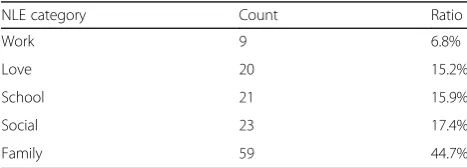
NLE-LPs are considered only to consist of noun-verb pairs. The noun is the person, and the verb is related to negative events taken from the daily life corpus. NLE-LPs must have a logical relationship with the person and negative life events; that is, the pairing of the subject and the action must be logically reasonable. To facilitate an-notators in identifying logically reasonable pairs of sub-jects and actions, we create a logical relationship matrix LR (as shown in Table1) in the annotation process. For example, the annotation results presented in Table 1 show that some actions (e.g., divorce) are not well paired with some subjects (e.g., boyfriend, classmate, etc.). The initial set of 132 seed NLE-LPs is obtained by manual re-view of 500 sentences from a psychiatric text for appro-priate subject/action pairs (respectively a total of 54 subjects and 152 negative life events). As shown in Table4, all seed NLE-LPs are divided into five categories including family, love, school, work and social. Seed NLE-LP identify 6002 reasonable NLE-LPs out of 8208 (152*54) LPs.
To capture more possible NLE-LP queries, we apply a knowledge-based as an ontology by extended-HowNet ontology1(E-HowNet). As shown in Table 5, the action words are expanded, e.g., the term“complain”can be ex-panded to“beef”and“blame”.
The knowledge-based expansion operation produces a total of 318,106 queries. Each of the five categories (fam-ily, love, school, work and social) are subdivided into 5
1E-HowNet: an ontology for Chinese knowledge representation.http://
subject pair subsets. The query set is divided into 25 subsets according to the category to which the two sub-jects belong. There are 5 within-category analogy query sets of the same class, and the other 20 are across-cat-egory analogy query sets. For the analogical reasoning experiments, we randomly select 1000 NLE-LPs from each subset and another 2000 NLE-LPs as a test set without duplication from each subset. Finally, there are a total of 25,000 NLE-LPs in the training set and 50,000 NLE-LPs in the test set.
Implementation details
We implement PPMI and HAL with the four proposed analogical reasoning models: SG with COSINE, CBOW with COSINE, SG with COSMUL, CBOW with COS-MUL. We also implement the four improved HAL models: HAL-VEC with COSINE, HAL-VEC with COS-MUL, SG with HAL-INF and COBW with HAL-INF.
Baseline methods
PPMI: This is a traditional language pattern mining
model used as a baseline using previous PPMI method
HAL: This is another baseline language pattern
mining model using previous HAL-based model
Analogical reasoning models
Here, we present four NLE-LP mining models using COBW and SG word representation approaches and COSINE and COSMUL pattern inference methods.
CBOW + COSINE: This model combines CBOW word representation and COSINE pattern inference.
SG + COSINE: This model combines SG word representation and COSINE pattern inference.
CBOW + COSMUL: This model combines CBOW word representation and COSMUL pattern inference.
SG + COSMUL: This model combines SG word representation and COSMUL pattern inference.
Improved-HAL models
We use an analogical approach of COSINE and COS-MUL, along with word embedding of SG and COBW to improve the HAL model.
HAL-VEC + COSINE: This model combines the HAL-VEC word vector and COSINE pattern inference, which the COSINE replacing the HAL-INF.
HAL-VEC + COSMUL: This model combines the HAL-VEC word vector and COSMUL for pattern inference, which the COSMUL replacing the HAL-INF.
CBOW + HAL-INF: This model combines the CBOW word representation and HAL-INF pattern inference, which the CBOW replacing the HAL-VEC.
SG + HAL-INF: This model combines SG word representation and HAL-INF pattern inference, which the SG replacing the HAL-VEC.
Evaluation metrics
To evaluate NLR-LP mining performance, we propose two metrics to evaluate all experiments of the NLE-LP mining problem, including mean reciprocal rank (MRR) and precision (prec@n).
MRR
MRR is a general measure of quality and is the average of the reciprocal ranks of results for a sample of queries Q[44]. TheMRRis defined by Eq. (14).
MRR¼ 1
Q
j j
XQ
q¼1
1
rankq ð14Þ
where Q denotes the query set, and rankq denotes the rank position of the first relevant NLE-LP for the q-th query.
Table 4Distribution of seed NLE-LPs
NLE category Count Ratio
Work 9 6.8%
Love 20 15.2%
School 21 15.9%
Social 23 17.4%
Family 59 44.7%
Table 5Example of expanded word as action using E-HowNet
Seed action Expanded action
Complain Beef, blame
Deceive Lie, cheat
Denounce Condemn, denounce
Table 3Examples of original sentences with NLE-LPs
No. Original sentence NLE-LP
1 It makes me very uncomfortable when myparents
only see their own view point when theycriticize
me.
<parents:
criticize>
2 Myboyfriendof 3 years suddenlybroke upwith me and I’m really sad.
<boyfriend:
Prec@n
prec@n is a top n measuring for a query. We select n items as NLE-LPs from the intersection of two sets which are extracted NLE-LPs and relevant NLE-LPs (gold standard NLE-LPs). The prec@n is defined by Eq. (15).
prec@n¼kNSðfextracted NLE‐LPsgÞ∩frelevant NLE‐LPsg;nÞk
n
ð15Þ
where ‖⋅‖ denotes the number of documents in the set, and NS denotes a selection operation for selecting n NLE-LPs, given intersection set andn.
Comparative results
To obtain experimental results, the candidate words are filtered by part-of-speech, and only nouns and verbs are respectively considered as relevant for the person and negative life events. The target of NLE-LP < subject:ac-tion> is <noun:verb>. Table6presents the results of dif-ferent methods for NLE-LP mining on within-category and across-category problems. Two baseline methods (PPMI and HAL) are used along with four analogical reasoning methods: COBW + COSINE, SG + COSINE, CBOW + COSMUL and SG + COSMUL. Prior to NLE-LP mining, the NLE-NLE-LP analogy query set is divided into two parts: a training set used to adjust the parameters for the word representation training process, and a test set used to mine NLE-LPs. Each method is evaluated using 50,000 examples in the test set, where 10,000 ex-amples are used for the within-category setting and 40, 000 for the across-category setting.
We run experiments with two baselines of NLE-LP mining methods. The PPMI model as a baseline method is used for NLE-LP mining using only term frequency and term co-occurrence but without the word represen-tation approach. Therefore, we directly compute the re-lationship between subject word and action word by PPMI. For a given subject, the composition of the NLE-LP is determined by calculating the value of the PPMI with other action words. PPMI is the process of dedu-cing one word from another. Compared to the analogical reasoning query set, there is only one subject for each query in pattern statistical induction, and the definitions of the standard answers are consistent with the answers to the analogical reasoning query. The mining perform-ance of the PPMI model is not well suited for NLE-LP extraction, providing only 0.1296 prec@5, 0.1241 prec@10 and 0.2589 MRR. The HAL model is another baseline method used to mine NLE-LPs using the HAL-VEC and HAL-INF. This model obtained 0.2034prec@5, 0.1842 prec@10 and 0.3921 MMR on the within-cat-egory problem, and 0.2116 prec@5 0.1872 prec@10 and
0.3820MMRon the across-category problem. Therefore, the HAL model presents only a very small difference for the three metrics in the two problems. However, the HAL model outperformed the PPMI model on the across-category problem.
Among the four mining methods in our proposed ana-logical reasoning framework, COBOW + COSINE pro-vides the best mining performance with results of 0.4904 prec@5, 0.43 prec@10 and 0.7287MRR on the category analogy problem, and 0.4684 prec@5, 0.4129 prec@10 and 0.7037 MRR on the non-category analogy problem. SG + COSINE provides the second best mining perform-ance with results of 0.4345prec@5, 0.3824prec@10 and 0.0.6683 MRR on the category analogy problem, and 0.4215prec@5, 0.3.705prec@10 and 0.6683MRRon the non-category analogy problem. CBOW + COSMUL fol-lows with 0.4272 prec@5, 0.3809 prec@10 and 0.6654 MRR on the category analogy problem, and 0.4004 prec@5, 0.3589 prec@10 and 0.6278 MRR on the non-category analogy problem. SG + COSMUL provides the lowest mining performance.
Based on the performance of these six methods, four methods of the analogical framework outperformed the traditional PPMI and HAL models, because the two word embeddings set by COBW and SG were trained using data from the Chinese version of Wikipedia which provides semantic and syntactic relationship informa-tion. Therefore, COSINE and COSMUL based on word embeddings can obtain sufficient information to infer pattern similarity. In addition, two pattern inference methods are considered to compute the similarity by all values of two word vectors instead of partial values of two word vectors such as in the HAL model.
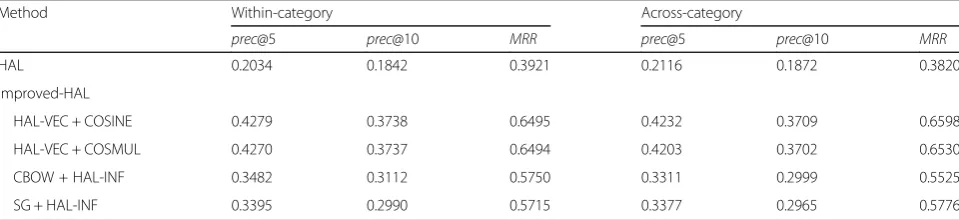
Improved-HAL results
and 0.575 MRR on the within-category problem, and 0.3311prec@5, 0.2999prec@10 and 0.5525MRRon the across-category problem. The SG word representation approach slightly underperforms CBOW. In terms of improving word representation and pattern method for the HAL model, the two pattern inference methods pro-vide better improvement than the two word representa-tion approaches. This is because COSINE and COSMUL are applied to compute similarity using all values of the two vectors. By replacing HAL-INF, which only uses partial vector values, with either COSINE or COSMUL we can compute the full range of information. However, all improved-HAL methods outperform traditional the HAL and PPMI models for the two NLE-LP mining problems.
Sensitivity analysis for vector dimension and windows size
The dimension size of the hyper-parameter is a major issue in the SG and CBOW models, and is used in the training set to determine the optimal vector di-mension size. Figure 3 shows the results of dimension size sensitivity analysis for the SG and CBOW models. The horizontal axis represents the dimension size and the vertical axis represents the mining per-formance of the two metrics. Six dimension sizes are used from 100 to 600 for SG and CBOW. In Fig. 3(a), the curve of precision@5 shows that the best dimen-sion is obtained using 500 and 300 on the COBW model and 300 on the SG model. The MRR curve in
Fig. 3(b) shows that optimal mining performance is achieved using 500 dimensions in the SG model and 400 dimensions in the CBOW model. In addition, the COBW model consistently outperforms the SG model according to precsion@5 and MRR.
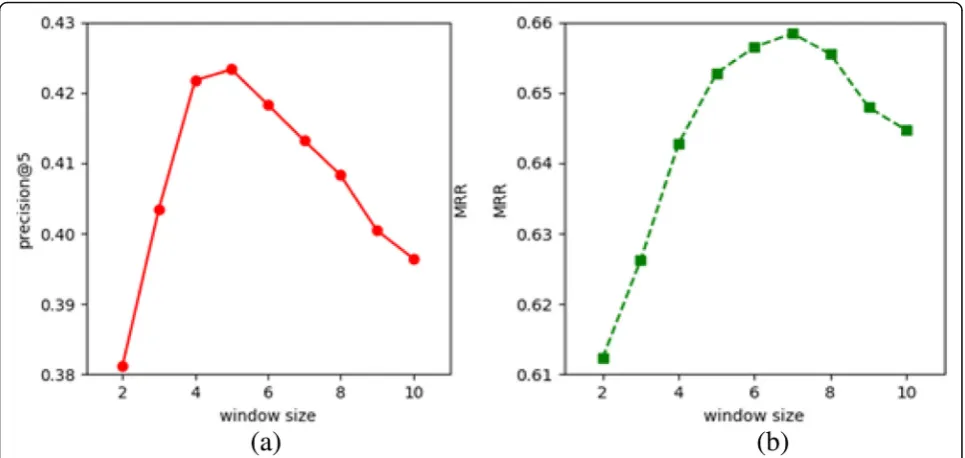
The window size is another important hyper-param-eter when building word vectors using the HAL-VEC word representation approach. We apply different win-dows sizes ranging from two to ten to evaluate the min-ing performance usmin-ing the COSINE pattern inference method on the non-category analogy problem. Figure4 shows the two performance curves for nine different window sizes using the HAL-INF pattern inference model. In Fig.4(a), the highest score for theprecision@5 curve is 0.4232 with a window size of five. For the curve of MRR scores in Fig. 4(b), the highest MRR score is 0.6598 with a window size of 7.
Discussion
Experimental results demonstrate the proposed ap-proach provides acceptable performance for the NLE-LP mining problem. The four combined analogical reason-ing models outperform the PPMI and HAL models for NLE-LP mining task. Optimal NLE-LP mining perform-ance is obtained using the CBOW word representation approach with the COSINE pattern inference method. In this paper, the analogical reasoning framework is used to effectively mine NLE-LPs. SG and CBOW are popular low-dimensional distributed word embedding ap-proaches, HAL-VEC is a high-dimensional semantic
Table 6Comparative results of different methods for NLE-LP mining task
Method Within-category Across-category
prec@5 prec@10 MRR prec@5 prec@10 MRR
Traditional induction PPMI – – – 0.1296 0.1241 0.2589
HAL 0.2034 0.1842 0.3921 0.2116 0.1872 0.3820
Analogical Reasoning CBOW + COSINE 0.4904 0.4300 0.7287 0.4684 0.4129 0.7037
SG + COSINE 0.4345 0.3824 0.6683 0.4215 0.3705 0.6683
CBOW + COSMUL 0.4272 0.3809 0.6654 0.4004 0.3589 0.6278
SG + COSMUL 0.3961 0.3516 0.6286 0.3751 0.3321 0.6197
Table 7Comparative results of improved-HAL methods for NLE-LP mining task
Method Within-category Across-category
prec@5 prec@10 MRR prec@5 prec@10 MRR
HAL 0.2034 0.1842 0.3921 0.2116 0.1872 0.3820
Improved-HAL
HAL-VEC + COSINE 0.4279 0.3738 0.6495 0.4232 0.3709 0.6598
HAL-VEC + COSMUL 0.4270 0.3737 0.6494 0.4203 0.3702 0.6530
CBOW + HAL-INF 0.3482 0.3112 0.5750 0.3311 0.2999 0.5525
space, but replacing HAL-VEC with either SG or CBOW outperforms the traditional HAL model. Analogical rea-soning is the most common cosine similarity calculation for two semantic and syntactic tasks. COSMUL is a modified cosine similarity calculation method, which does not match cosine’s mining performance. The
HAL-INF of HAL is an inspired information inference model, but replacing HAL-INF with either COSINE or COS-MUL outperforms traditional the HAL model. Among these two pattern inference methods, the common co-sine similarity COSINE provides the best performance for the NLE-LP mining task.
Fig. 3Performance compassion using different dimension sizes for SG and CBOW with COSINE pattern inference on the across-category analogy problem. Performances: (a) precision, (b) MMR
Conclusion
This paper proposes a novel analogical reasoning frame-work to mine negative life event language patterns using word representation with pattern inferences. This is the first instance of using the analogical reasoning frame-work to infer NLE-LP. The frameframe-work of analogical rea-soning uses two word representation approaches and two pattern inference methods which outperform the traditional PPMI model and HAL model. PMMI is very simple and quickly mines NLE-LPs, but with poor infer-ence performance. While word representation training requires extra time to learn word embeddings, it ac-counts for semantic relationships in the corpus and thus is more effective in mining NLE-LPs. The COSINE method outperforms other pattern inference methods such as COSMUL and HAL-INF. It also provides a very simple matching function based on these word represen-tation approaches. In addition, COBW, SG, COSINE and COSMUL are applied to significantly improve the HAL model mining performance.
Mining performance for the NLE-LP task is still low and, to obtain high-precision semantic relationships, we propose using the advanced word representation ap-proach such Doc2Vec, which consider document infor-mation to learn word embeddings. In addition, pattern inference precision can be further improved by using more professional depression corpora which include additional depressive words for training word embed-ding. However, there are two constraints of our pro-posed analogical reasoning framework in NLE-LP task, one is word representation learning needs a larger cor-pus related to NLE because NLE-LPs are logically rea-sonable pair, such as an incorrect sample < boyfriend: divorce>. Second, the pattern inference needs significant word vectors for inference because all word vectors should be embedded in highly precise semantic relation-ships using the word representation approach.
Abbreviations
CBOW:Continuous bag-of-words; COSINE: Cosine similarity; COSMUL: Cosine multiplication similarity; HAL: Hyperspace analog to language; MI: Mutual information; MRR: Mean reciprocal rank; NLE: Negative life events; NLE-LP: Negative life event language patterns; NNLE-LP: Natural language processing; PMI: Pointwise mutual information; PPMI: Positive pointwise mutual information; prec@n: precision; SG: Skip-gram
Acknowledgements
Not applicable.
Authors’contributions
JLW designed the experiment, interpreted experiment results, and contributed to writing the paper. XX collected the corpus and designed the experiment. LCY designed the study, interpreted experiment results, and contributed to writing the paper. SZY and KRL restructured the paper and contributed to writing the paper. All of authors read and approved the final manuscript.
Funding
This work was supported by the Ministry of Science and Technology, Taiwan, ROC, under Grant No. MOST 107–2628-E-155-002-MY3 and MOST 107– 2218-E-031 -002 -MY2. No sponsors of funding source played a role in:“study design and the collection, analysis, and interpretation of data and the writing of the article and the decision to submit it for publication.”All researchers are independent from funders.
Availability of data and materials
The datasets generated during the current study are available in thehttps:// github.com/jlwustudio/nle-lp_arf.
Ethics approval and consent to participate
Not applicable.
Consent for publication
Not applicable.
Competing interests
The authors declare that they have no competing interests.
Author details
1School of Big Data Management, Soochow University, Taipei City, Taiwan. 2
Department of Computer Science and Engineering, Yuan Ze University, Taoyuan City, Taiwan.3Innovation Center for Big Data and Digital Convergence, Yuan Ze University, Taoyuan City, Taiwan.4College of Mathematics and Computer Science, FuZhou University, FuZhou City, China. 5
Department of Information Management, Yuan Ze University, Taoyuan City, Taiwan.
Received: 8 September 2018 Accepted: 14 August 2019
References
1. Drake KE, Sheffield D, Shingler D. The relationship between adult romantic attachment anxiety, negative life events, and compliance. Personal Individ Differ. 2011;50(5):742–6.
2. Bakhiyiabc CL, Jaussentc I, Beziatc S, Cohende R, Gentyacd C, Kahnde JP, Leboyerdf M, Vaoug PL, Guillaumeacd S, Courtetacd P. Positive and negative life events and reasons for living modulate suicidal ideation in a sample of patients with history of suicide attempts. J Psychiatr Res. 2017;88: 64–71.
3. Bodella LP, Smitha AR, Holm-Denomab JM, Gordonc KH, Joinera TE. The impact of perceived social support and negative life events on bulimic symptoms. Eat Behav. 2011;12(1):44–18.
4. Wang J, Yu LC, Lai KR, Zhang X. Dimensional sentiment analysis using a regional CNN-LSTM model. In: 54th Annual Meeting of the Association for Computational Linguistics (ACL 2016); 2016. p. 225–30.
5. Yu LC, Lee LH, Hao S, Hu J, Lai KR. Building Chinese affective resources in Valence-Arousal dimensions. In: 15th Annual Conference of the North American Chapter of the Association for Computational Linguistics: Human Language Technologies (NAACL-HLT 2016); 2016. p. 540–5.
6. Gentner D, Holyoak KJ, Kokinov BN. The Analogical Mind: Perspectives from Cognitive Science. Cambridge: MIT Press; 2001.
7. Cambria E, Gastaldo P, Bisio F, Zunino R. An ELM-based model for affective analogical reasoning. Neurocomputing. 2015;149(A):443–55.
8. Melis E, Veloso M. Analogy in problem solving. Handbook of practical reasoning: computational and theoretical aspects. Oxford: Oxford University Press; 1998.
9. Prade H, Richard G. A short introduction to computational trends in analogical reasoning. Computational Approaches to Analogical Reasoning: Curr Trends. 2014;548:1–22.
10. Toba HA, Manurung M, HM. Predicting answer location using shallow semantic analogical reasoning in a factoid question answering system. In: 26th Pacific Asia Conference on Language, Information, and Computation (PACLIC-12); 2012. p. 246–53.
11. Tu X, Feng D, Wang XJ, Zhang L. Analogical reasoning for answer ranking in social question answering. IEEE Intell Syst. 2012;27(5):28–35.
13. Hug N, Prade H, Richard G. Experimenting analogical reasoning in recommendation. In: 1st International Symposium on Methodologies for Intelligent Systems (ISMIS-14); 2015. p. 69–78.
14. Duc NTB, Ishizuka D, M. Using relational similarity between word pairs for latent relational search on the web. In: 2010 IEEE/WIC/ACM International Conference on Web Intelligence and Intelligent Agent Technology (WI-IAT-10); 2010. p. 196–9.
15. Liang CLZ. Chinese analogy search considering multi relations. In: 3rd International Conference on Cloud and Service Computing (CSC-12); 2012. p. 193–7. 16. Zheng ZW, Lepage Y, Y. Chinese word segmentation based on analogy and
majority voting. In: 29th Pacific Asia Conference on Language, Information and Computation (PACLIC 2015); 2015. p. 151–6.
17. Turney PD. Similarity of semantic relations. Comput Linguist. 2006;32(3):379–416. 18. Tang B, Cao H, Wu Y, Jiang M, Xu H. Recognizing clinical entities in hospital
discharge summaries using structural support vector machines with word representation features. BMC Med Inform Decis Mak. 2013;13(Suppl 1):S1. 19. Rahmaninia M, Moradi P. OSFSMI: online stream feature selection method
based on mutual information. Appl Soft Comput. 2018;68:733–46. 20. Recchia G, Jones MN. More data trumps smarter algorithms comparing
pointwise mutual information with latent semantic analysis. Behav Res Methods. 2009;41(3):647–56.
21. Terra E, Clarke CL. Frequency estimates for statistical word similarity measures. In: 2003 Conference of the North American Chapter of the Association for Computational Linguistics on Human Language Technology (NAACL-03); 2003. p. 165–72.
22. Van de Cruys T. Two multivariate generalizations of pointwise mutual information. In: 2011 Workshop on Distributional Semantics and Compositionality (DiSCo-11); 2011. p. 16–20.
23. Pramanik S, Biswas P, Giri BC. Hybrid vector similarity measures and their applications to multi-attribute decision making under neutrosophic environment. Neural Comput & Applic. 2017;28(5):1163–76.
24. Dong JY, Chen Y, Wan SP. A cosine similarity based QUALIFLEX approach with hesitant fuzzy linguistic term sets for financial performance evaluation. Appl Soft Comput. 2018;69:316–29.
25. Mikolov T, Chen K, Corrado G, Dean J. Efficient estimation of word representations in vector space. In: International Conference on Learning Representations (ICLR-13); 2013. p. 1–12.
26. Mikolov T, Sutskever I, Chen K, Corrado G, Dean J. Distributed
representations of words and phrases and their compositionality. In: 26th Advances in neural information processing systems (NIPS-13); 2013. p. 1–9. 27. Du J, Zhang Y, Luo J, Jia Y, Wei Q, Tao C, Xu H. Extracting psychiatric
stressors for suicide from social media using deep learning. BMC Med Inform Decis Mak. 2018;18(Suppl 2):43.
28. Choia H, Chob K, Bengioc Y. Context-dependent word representation for neural machine translation. Comput Speech Lang. 2017;45:149–60. 29. Turner CA, Jacobs AD, Marques CK, Oates JC, Kamen DL, Anderson PE,
Obeid JS. Word2Vec inversion and traditional text classifiers for phenotyping lupus. BMC Med Inform Decis Mak. 2017;17:126.
30. Yu LC, Wang J, Lai KR, Zhang X. Refining word embeddings using intensity scores for sentiment analysis. IEEE/ACM trans. Audio Speech Lang Process. 2018;26(3):671–81.
31. Levy O, Goldberg Y, Ramat-Gan I. Linguistic regularities in sparse and explicit word representations. In: 18th Conference on Computational Natural Language Learning (CoNLL-14); 2014. p. 171–80.
32. Qiu L, Zhang Y, Lu Y. Syntactic dependencies and distributed word representations for Chinese analogy detection and mining. In: 2015 Conference on Empirical Methods on Natural Language Processing (EMNLP-15); 2015. p. 2441–50.
33. Chien JT. Association pattern language modeling. IEEE Trans Audio Speech Lang Process. 2006;14(5):1719–28.
34. Mendes AC, Antunes C. Pattern mining with natural language processing: An exploratory approach. In: 6th International Conference on Machine Learning and Data Mining in Pattern Recognition; 2009. p. 266–79. 35. Yu LC, Chan CL, Wu CH, Lin CC. Mining association language patterns for negative
life event classification. In: Joint Conference of the 47th Annual Meeting of the Association for Computational Linguistics and the 4th International Joint Conference on Natural Language (ACL-IJCNLP-09); 2009. p. 201–4.
36. Yu LC, Chan CL, Lin CC, Lin IC. Mining association language patterns using a distributional semantic model for negative life event classification. J Biomed Inform. 2011;44:509–18.
37. Yu LC, Wu CH, Yeh JF, Jang FL. HAL-based evolutionary inference for pattern induction from psychiatry web resources. IEEE Trans Evol Comput. 2008;12(2):160–70.
38. Linzen T. Issues in evaluating semantic spaces using word analogies. In: The 1st Workshop on Evaluating Vector-Space Representations for NLP; 2016. p. 13–8.
39. Lund K, Burgess C. Producing high-dimensional semantic spaces from lexical co-occurrence. Behav Res Methods Instrum Comput. 1996;28(2):203–8. 40. Burgess C, Livesay K, Lund K. Explorations in context space words,
sentences, discourse. Discourse Process. 1998;25(2–3):211–57. 41. Song D, Bruza PD. Discovering information flow suing high dimensional
conceptual space. In: 24th Annual International ACM SIGIR Conference on Research and Development in Information Retrieval (SIGIR-01); 2001. p. 327–33. 42. Song D, Bruza PD. Towards context sensitive information inference. J Assoc
Inf Sci Technol. 2003;54(4):321–34.
43. Bengio Y, Ducharme R, Vincent P, Jauvin C. A neural probabilistic language model. J Mach Learn Res. 2003;3:1137–55.
44. Radev DR, Qi H, Wu H, Fan W. Evaluating web-based question answering systems. In: Third International Conference on Language Resources and Evaluation (LREC-02); 2002. p. 1153–6.
Publisher’s Note