SHORT REPORT
Validation of a self-reported HIV
symptoms list: the ISS-HIV symptoms scale
Raffaella Bucciardini
1, Katherina Pugliese
1*, Daniela Francisci
2, Andrea Costantini
3, Elisabetta Schiaroli
2,
Miriam Cognigni
3, Chiara Tontini
3, Stefano Lucattini
1, Luca Fucili
1, Massimiliano Di Gregorio
1, Marco Mirra
1,
Vincenzo Fragola
1, Sara Pompili
4, Rita Murri
5and Stefano Vella
1Abstract
Background: To describe the development and the psychometric properties of the Istituto Superiore di Sanità-HIV symptoms scale (lSS-HIV symptoms scale).
Methods: The ISS-HIV symptom scale was developed by an Italian working team including researchers, physicians and people living with HIV. The development process went through the following steps: (1) review of HIV/AIDS litera-ture; (2) focus group; (3) pre-test analysis; (4) scale validation.
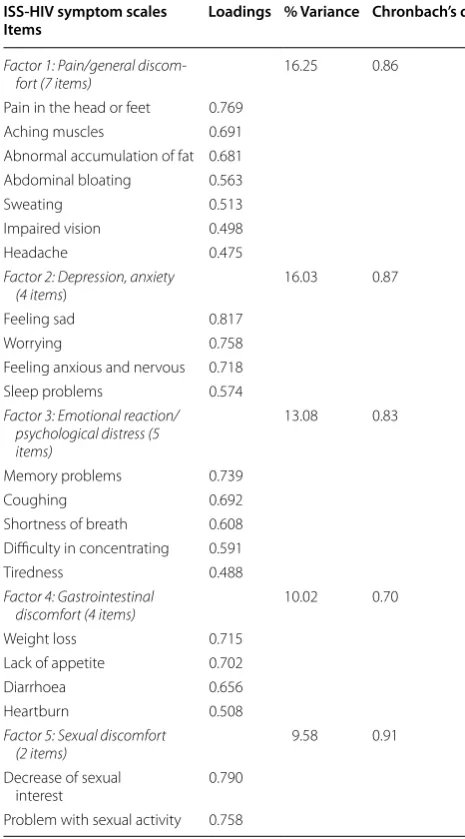
Results: The 22 symptoms of HIV-ISS symptoms scale were clustered in five factors: pain/general discomfort (7 items); depression/anxiety (4 items); emotional reaction/psychological distress (5 items); gastrointestinal discomfort (4 items); sexual discomfort (2 items). The internal consistence reliability was for all factors within the minimum accepted standard of 0.70.
Conclusions: The results of this study provide a preliminary evidence of the reliability and validity of the ISS-HIV symptoms scale. In the new era where HIV infection has been transformed into a chronic diseases and patients are experiencing a complex range of symptoms, the ISS-HIV symptoms scale may represent an useful tool for a compre-hensive symptom assessment with the advantage of being easy to fill out by patients and potentially attractive to physicians mainly because it is easy to understand and requires short time to interpret the results.
Keywords: Patients reported outcomes, Health related quality of life, HIV-symptoms list
© 2016 Bucciardini et al. This article is distributed under the terms of the Creative Commons Attribution 4.0 International License (http://creativecommons.org/licenses/by/4.0/), which permits unrestricted use, distribution, and reproduction in any medium, provided you give appropriate credit to the original author(s) and the source, provide a link to the Creative Commons license, and indicate if changes were made. The Creative Commons Public Domain Dedication waiver (http://creativecommons.org/ publicdomain/zero/1.0/) applies to the data made available in this article, unless otherwise stated.
Background
The physician’s assessment was for a long time the only factor that affected health care decisions, however in more recent years the necessity for a closer coopera-tion between physician and patient has been recognized. In this contest a key role is represented by the patient reported outcomes (PROs). Food and Drug Administra-tion (FDA) defined PROs as any report coming directly from patients about their health condition and treat-ment [1]. PROs can be used to measure overall concepts (e.g. state of general health), presence and intensity of specific symptoms, complex concepts, like the health related quality of life (HRQoL) [2–11]. In the field of HIV
disease, symptoms play a central role in the life of HIV patients: they are the first reason the patient asks for care; they are strongly associated with HRQoL; they represent the patients experience of the drug adverse effects and disease effects [12–16]. Effective symptom management, aimed to decrease the burden of symptoms, could have a direct impact on improving the HRQoL and also an indirect impact on improving the adherence to antiret-roviral therapy (ART) with expected positive impact on the efficacy of the treatment [17–20]. Moreover the clini-cal interpretation of the symptoms is easily understood by physicians with a likely immediate effect in clinical practice [21]. It has also been shown that the symptoms reported directly by patients are more complete and more strongly associated with HRQoL than provider-reported symptoms. [6]. It is therefore necessary that the presence and impact of symptoms are reported directly
Open Access
*Correspondence: [email protected] 1 Istituto Superiore di Sanità, Rome, Italy
by the patient through the use of specific tools. An HIV specific symptom checklist might be the most suitable tool for routine clinical use [21]. In the present paper we describe the development and the psychometric prop-erties of the Istituto Superiore di Sanità-HIV symptoms scale (lSS-HIV symptoms scale).
Methods
The ISS-HIV symptom scale was developed by an Italian working team (coordinated by the Italian National Insti-tute of Health, the ISS), including researchers, physicians and people living with HIV. The development process went through the following steps:
1. Review of existing HIV/AIDS literature
The first step in the development of the ISS-HIV symp-toms scale was to review the sympsymp-toms measures avail-able in literature. As a result of regular meeting the working team identified a list of symptoms to be included in the instrument.
2. Focus group
Two focus groups were conducted on independent groups of approximately 10 HIV infected people. The patients were recruited both in clinical centers and patients’ associations. The work done by focus groups resulted in a first draft of 38 HIV-related symptoms including.
3. Pre‑test analysis
The first draft of the symptoms list was tested in a cross-sectional study on a group of 200 HIV + people, taking ART, recruited in two Italian clinical centers (Azienda Ospedaliera Universitaria Ospedali Riuniti, Ancona; Ospedale S. Maria della Misericordia, Perugia). Fre-quency analysis of symptoms and an exploratory princi-pal components factor analysis were conducted. Based on these results, the preliminary item list has then been modified. Twenty-two of the 38 original symptoms were retained for the final version of the symptoms list.
4. HIV‑ISS symptoms scale validation and final structure A sample of 161 HIV + people on ART, enrolled in a cross-sectional study, from the two Italian clinical cent-ers (Azienda Ospedaliera Univcent-ersitaria Ospedali Riuniti, Ancona; Ospedale S. Maria della Misericordia, Perugia), was used to carry out the validation analysis. This study received ethics approval, and all patients provided writ-ten informed consent (name of the Ethical Committee: Istituto Superiore di Sanità, Ethical Review Board). The sample was defined on the basis of common practice in psychometric studies, according to which at least five
cases for each item should be provided. In this study the case-to-item ration was approximately 7.3. The final version of HIV-ISS symptoms scale resulted in a self- administered list of 22 symptoms. A Likert five-point intensity scale was used to evaluate the impact of symp-toms (Appendix).
Statistical analysis
The statistical analyses reported in this study refer to validation analysis of HIV-ISS symptom scale includ-ing psychometric assumptions of validity and reliabil-ity [22]. An instrument is said to be valid if it measures what it is supposed to measure. For this purpose we focused on the concurrent validity and construct valid-ity. The construct validity of the HIV-ISS symptoms scale was assessed using principal components fac-tor analysis with varimax rotation. As for concurrent validity, a step-wise multiple regressions were used to examine the relationship between the HIV-ISS symp-toms scale and an external and independent measure of HRQoL. For this purpose the ISSQoL (Istituto Superi-ore di Sanità-Quality of Life), a validated specific ques-tionnaire designed for people living with HIV, was used [23, 24]. The ISSQoL questionnaire includes 9 domains: physical functioning, role functioning, depression/ anxiety, energy/vitality, health distress, cognitive func-tioning, social funcfunc-tioning, sexual life and satisfaction with quality of life. Reliability is defined as the degree to which repeated administration of a measurement instrument produces equivalent results under con-trolled conditions. In the present study the Cronbach’s α coiffecient was used as an estimate of the test reliabil-ity. The range between 0.70 and 0.90 is considered as the minimum required value.
Results—validation analysis Description of the sample
The characteristics of the sample used for the valida-tion analysis are shown in Table 1. The majority were men (75.8 %); 42.9 % were heterosexual. Median age was 49 years old. About more than half of the participants were asymptomatic (56.5 %) and they were HIV infected for a median of 13.5 years. Median HIV viral load was 1.6 log and median CD4 cell count was 611 cells/mm3.
Construct validity
Reliability
The Chronbach’s α scores were for all factors within the minimum accepted standard of 0.70 (Table 2).
Concurrent validity
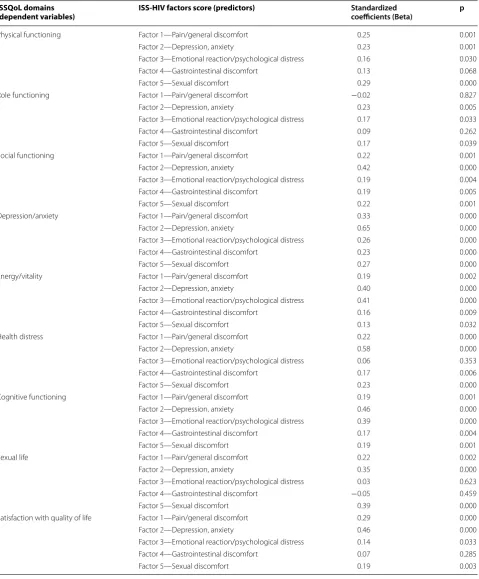
Step-wise multiple regressions were used for each ISSQoL domain as dependent variable and the five fac-tors of the HIV-ISS symptoms scale as predictor vari-ables. The HIV-ISS symptoms scale concurrent validity was tested based on the following hypothesized sig-nificant relationships: (1) pain/general discomfort with physical functioning, social functioning, depression/ anxiety, energy/vitality, sexual life and satisfaction with quality of life; (2) depression/anxiety with all ISSQoL domains; (3) emotional reaction/psychological distress with social functioning, depression/anxiety, energy/ vitality, cognitive functioning, satisfaction with quality of life; (4) gastrointestinal discomfort with social func-tioning, depression/anxiety, energy/vitality; (5) sexual discomfort with social functioning, depression/anxiety, sexual life, satisfaction with quality of life. All hypoth-esized relationships were confirmed (Table 3).
Discussion
The results of this study provide a preliminary evidence of the reliability and validity of the 22-item ISS-HIV symptoms scale. Factor analysis showed a good evidence for construct validity and internal consistency reliability. A good concurrent validity was also demonstrated. The regression analysis supported the evidence for the con-current validity of the ISS-HIV symptoms scale factors with the ISSQoL domains. In the new era where HIV infection has been transformed into a chronic diseases and patients are experiencing a complex range of symp-toms due to HIV infection, side effects of antiretroviral therapy (ART) and also associated comorbidities, the Table 1 Characteristics of the population used for the
vali-dation analysis
Sex n (%)
Female 39 (24.2)
Male 122 (75.8)
Age (years)
Mean ± SD (n, range) 49.0 ± 9.8 (161, 25–77)
Median 49.0
Transmission route, n (%)
Men having sex with men 60 (37.3) Intravenous drug users 26 (16.1)
Heterosexual 69 (42.9)
Other 6 (3.7)
HIV status, n (%)
Asymptomatic (CDC A) 91 (56.5) Symptomatic (CDC B 47 (29.2)
AIDS (CDC C) 23 (14.3)
Time from HIV diagnosis (years)
Mean ± SD (n, range) 13.4 ± 9.2 (160, 0–30)
Median 13.5
CD4 (cells/mm3)
Mean ± SD (n, range) 652 ± 312 (161, 24–1686)
Median 611
HIV-RNA cp/ml (log10)
Mean ± SD (n, range) 1.76 ± 0.6 (161, 1–6)
Median 1.60
Table 2 Factor structure and reliability estimates
ISS‑HIV symptom scales
Items Loadings % Variance Chronbach’s α
Factor 1: Pain/general
discom-fort (7 items) 16.25 0.86 Pain in the head or feet 0.769
Aching muscles 0.691 Abnormal accumulation of fat 0.681 Abdominal bloating 0.563
Sweating 0.513
Impaired vision 0.498
Headache 0.475
Factor 2: Depression, anxiety
(4 items) 16.03 0.87
Feeling sad 0.817
Worrying 0.758
Feeling anxious and nervous 0.718 Sleep problems 0.574 Factor 3: Emotional reaction/
psychological distress (5 items)
13.08 0.83
Memory problems 0.739
Coughing 0.692
Shortness of breath 0.608 Difficulty in concentrating 0.591
Tiredness 0.488
Factor 4: Gastrointestinal
discomfort (4 items) 10.02 0.70 Weight loss 0.715
Lack of appetite 0.702
Diarrhoea 0.656
Heartburn 0.508
Factor 5: Sexual discomfort
(2 items) 9.58 0.91
Decrease of sexual
interest 0.790
Table 3 Regression analysis between ISS-HIV factors scores and ISS-Qol questionnaire ISSQoL domains
(dependent variables) ISS-HIV factors score (predictors) Standardizedcoefficients (Beta) p
Physical functioning Factor 1—Pain/general discomfort 0.25 0.001
Factor 2—Depression, anxiety 0.23 0.001
Factor 3—Emotional reaction/psychological distress 0.16 0.030
Factor 4—Gastrointestinal discomfort 0.13 0.068
Factor 5—Sexual discomfort 0.29 0.000
Role functioning Factor 1—Pain/general discomfort −0.02 0.827
Factor 2—Depression, anxiety 0.23 0.005
Factor 3—Emotional reaction/psychological distress 0.17 0.033
Factor 4—Gastrointestinal discomfort 0.09 0.262
Factor 5—Sexual discomfort 0.17 0.039
Social functioning Factor 1—Pain/general discomfort 0.22 0.001
Factor 2—Depression, anxiety 0.42 0.000
Factor 3—Emotional reaction/psychological distress 0.19 0.004
Factor 4—Gastrointestinal discomfort 0.19 0.005
Factor 5—Sexual discomfort 0.22 0.001
Depression/anxiety Factor 1—Pain/general discomfort 0.33 0.000
Factor 2—Depression, anxiety 0.65 0.000
Factor 3—Emotional reaction/psychological distress 0.26 0.000
Factor 4—Gastrointestinal discomfort 0.23 0.000
Factor 5—Sexual discomfort 0.27 0.000
Energy/vitality Factor 1—Pain/general discomfort 0.19 0.002
Factor 2—Depression, anxiety 0.40 0.000
Factor 3—Emotional reaction/psychological distress 0.41 0.000
Factor 4—Gastrointestinal discomfort 0.16 0.009
Factor 5—Sexual discomfort 0.13 0.032
Health distress Factor 1—Pain/general discomfort 0.22 0.000
Factor 2—Depression, anxiety 0.58 0.000
Factor 3—Emotional reaction/psychological distress 0.06 0.353
Factor 4—Gastrointestinal discomfort 0.17 0.006
Factor 5—Sexual discomfort 0.23 0.000
Cognitive functioning Factor 1—Pain/general discomfort 0.19 0.001
Factor 2—Depression, anxiety 0.46 0.000
Factor 3—Emotional reaction/psychological distress 0.39 0.000
Factor 4—Gastrointestinal discomfort 0.17 0.004
Factor 5—Sexual discomfort 0.19 0.001
Sexual life Factor 1—Pain/general discomfort 0.22 0.002
Factor 2—Depression, anxiety 0.35 0.000
Factor 3—Emotional reaction/psychological distress 0.03 0.623 Factor 4—Gastrointestinal discomfort −0.05 0.459
Factor 5—Sexual discomfort 0.39 0.000
Satisfaction with quality of life Factor 1—Pain/general discomfort 0.29 0.000
Factor 2—Depression, anxiety 0.46 0.000
Factor 3—Emotional reaction/psychological distress 0.14 0.033
Factor 4—Gastrointestinal discomfort 0.07 0.285
ISS-HIV symptoms scale may represent an updated and useful tool for a comprehensive symptom assessment and control in clinical practice.
Routine use of the symptoms assessment in the clini-cal practice could improve the communication between patient and clinician and this would make it possible to take targeted actions to manage the presence of particu-lar symptom clusters [3, 25]. The use of patient-reported symptoms in clinical practice could not only improve clinician-patient communication, but also would allow to understand the changes in patient well-being over time, leading clinicians to therapeutic choices targeted to indi-vidual patients with a positive effect on indiindi-vidual patient management and outcomes [26–29]. The ISS-HIV symp-toms scale has the advantage of being easy to fill out by patients and potentially attractive to physicians mainly because it is easy to understand and requires short time to interpret the results. The ISS-HIV Symptom Scale can be suitable for routine use in clinical practice, both as a single screening tool and in conjunction with other specific instruments. The simultaneous use of multiple instruments can be strategically significant in the pres-ence of high-impact specific symptoms. The ISS-HIV Symptom Scale is able to detect the most frequent symp-toms, as well as symptoms that may highly affect the patient’s quality of life. More specific instruments, such as those for pain or anxiety detection, could then be used to achieve more accurate information.
Considering also the recent agenda by the Patient-Cen-tered Outcomes Research Institute (PCORI) that calls for a greater involvement of patients in assessing health care options, the systematic collection of PROs should be widely recommended [30]. As some experts in outcomes research have already experienced, a website, where PRO measures are collected in electronic health records (EHR) and linked to electronic medical record (EMR), can be a useful innovative tool to improve and stimulate the use of patient reported data in clinical practice [31, 32]. Clini-cians would have the advantage to use PROs measure as a part of patients information along with laboratory and clinical data. The HIV-ISS symptoms scale, a short and comphrensive list of symptoms and easy to administer both by patients and clinicians, may be suitable for this purpose. The present study has several limitations. First, the construct validity of HIV-ISS Symptoms scale has not been supported by a confirmatory factor analysis. Moreo-ver, a responsiveness assessment of the instrument would also be necessary. Generalization of results is limited to
the Italian context where the validation analysis has been performed. Additional studies should address the repro-ducibility of index symptoms.
Conclusions
The results of this study show that ISS-HIV symptoms scale is a self-administered tool, with characteristics of validity and reliability, able to provide useful measures patient-centered. A more complete detection of symp-toms and their appropriate management may positively impact on the HRQoL of the patients and, indirectly, increase adherence to ART with expected positive impact on the efficacy of the treatment.
Abbrevations
PROs: patient reported outcomes; HRQoL: health related quality of life; ART: antiretroviral therapy; lSS-HIV symptoms scale: Istituto Superiore di Sanità-HIV symptoms scale; ISSQoL: Istituto Superiore di Sanità-Quality of Life; PCORI: Patient-Centered Outcomes Research Institute; EHR: electronic health records; EMR: electronic medical records.
Authors’ contributions
Conceived and designed the study: RB, RM, SV. Technical support to research: KP. Performed the study: RB, DF, AC, ES, MC, CT. Analyzed the data: RB. Wrote the paper: RB, VF, SP, SV. Designed the software used in analysis: SL, LF, MDG, MM. All authors read and approved the final manuscript.
Author details
1 Istituto Superiore di Sanità, Rome, Italy. 2 Ospedale S. Maria della Misericordia, Perugia, Italy. 3 Azienda Ospedaliera Universitaria Ospedali Riuniti, Ancona, Italy. 4 University of Rome “La Sapienza”, Rome, Italy. 5 Institute of Infectious Diseases, Catholic University of Rome, Rome, Italy.
Acknowledgements
We thank all the patients participating in this study, the clinical centers, the university of Rome “la Sapienza” and the ISS–team.
ISS-Team R. Bucciardini, K. Pugliese, S. Lucattini, L. Fucili, M. Di Gregorio, M. Mirra, V. Fragola, S. Vella. Istituto Superiore di Sanità, Rome, Italy;
Contact person: Raffaella Bucciardini, [email protected].
Clinical centers D. Francisci, E. Schiaroli. Ospedale S. Maria della Misericordia, Perugia, Italy. A. Costantini. M. Cognigni. C. Tontini.
Azienda Ospedaliera Universitaria Ospedali Riuniti, Ancona, Italy.
Institute of Infectious Diseases, Catholic University of Rome, Rome, Italy R. Murri.
University of Rome “La Sapienza”, Rome, Italy S. Pompili.
This work was supported by the National Institute of Health (Istituto Superi-ore di Sanità), Rome, Italy.
Competing interests
The authors declare that they have no competing interests.
Ethical standard
There is no competing interest; Researches involved human participants; Informed consent has been signed.
Appendix
Received: 18 January 2016 Accepted: 30 March 2016
References
1. Food and Drug Administration (US). Federal Register. Guidance for Industry on Patient Reported Outcome Measures: Use in Medical Product Development to Support Labeling Claims.2009; Available at: https:// www.federalregister.gov/articles/2009/12/09/.
2. Webb A, Norton M. Clinical assessment of symptom-focused health-related quality of life in HIV/AIDS. J Assoc Nurses AIDS Care. 2004;. doi:10.1016/S1055-3290(05)60051-9.
3. Detmer SB, Muller MJ, Schornagel JH, Wever LDV, Aaronson NK. Health-related quality-of-life assessments and patient-physician communication: a randomized controlled trial. J Am Med Assoc. 2002;2002:3027–34. doi:10.1001/jama.288.23.3027.
4. Wu AW. Quality-of-life assessment comes of age in the era of highly active antiretroviral therapy. AIDS. 2000;14:1449–51.
5. Wu AW, Rubin HR. Measuring health status and quality of life in HIV and AIDS. Psychol Health. 1992;6:251–64.
6. Sanjay B, Chwastiak LA, Bruce RD. Clinical management of depression and anxiety in HIV-infected adults. AIDS. 2005;19(18):2057–67. 7. Justice AC, Chang CH, Rabeneck L, et al. Clinical importance of
provider-reported HIV symptoms compared with patient-report. Med Care. 2001;39(4):397–408.
8. Fayer PM, Machin D.(2007).Quality of life. The assessment, analysis and interpretation of patient-reported outcomes, 2nd Edition: http://eu.wiley. com/WileyCDA/WileyTitle/productCd-047002450X.html. Accessed 10 Nov 2015.
9. Garratt A, Schmidt L, Mackintosh A, Fitzpatrick R. Quality of life measure-ment: bibliographic study of patient assessed health outcome measures. BMJ. 2002;324:1417–9.
10. Spilker B. Quality of life and pharmaeconomics in clinical trials. New York: Lippincott- Raven Publishers; 1996. p. 1996659–68.
11. Wu AW, Snyder CF, Clancy CM, Steinwachs DM. Adding the patient perspective to comparative effectiveness research. Health Aff. 2010;29(10):1863–71. doi:10.1377/hlthaff.2010.0660PMID:20921487. 12. Kroenke K, Price RK. Symptoms in the community prevalence,
classifica-tion, and psychiatric comorbidity. Arch Intern Me. 1993;153(21):2474–80. 13. Justice AC, Rabeneck L, Hays RD, Wu AW, Bozzette SA, For the Outcomes
Committee of the AIDS Clinical Trials Group. Sensitivity, specific-ity, reliabilspecific-ity, and clinical validity of provider-reported symptoms: a comparison with self-reported symptoms. J Acquir Immune Defic Synd. 1999;21:126–33.
14. Cunningham WE, Shapiro MF, Hays RD, Dixon WJ, Visscher BR, George WL. Constitutional symptoms and health-related quality of life in patients with symptomatic HIV disease. Am J Med. 1998;104(2):129–36.
15. Lorenz KA, Cunningham WE, Spritzer KL, Hays RD. Changes in symptoms and health related quality of life in a nationally representative sample of adults in treatment for HIV. Qual Life Res. 2006;15(6):951–8.
16. Lorenz KA, Shapiro MF, Asch SM, Bozzette SA, Hays RD. Associations of symptoms and health-related quality of life: findings from a national study of persons with HIV infection. Ann Intern Med. 2001;134(9 Pt 2):854–60.
17. Franchi D, Wenzel RP. Measuring health-related quality of life among patients infected with human immunodeficiency virus. Clinical Infectious Dis. 1998;26(1):20–6.
18. Haynes RB, Taylor DW, Sackett DL. Compliance in health care. Baltimore: Johns Hopkins University Press; 1979.
19. Barnhoorn F, Adriaanse H. In search of factors responsible for noncompli-ance among tuberculosis patients in Wardha District. India Soc Sci Med. 1992;34(3):291–306.
20. Ammassari A, Murri R, Pezzotti P, Trotta MP, Ravasio L, De Longis P, et al. Self-reported symptoms and medication side effects influence adher-ence to highly active antiretroviral therapy in patients with HIV infection. J Acquir Immune Defic Syndr. 2001;28(5):445–9.
Table 4 Have you suffered from any of the following symptoms over the past 4 weeks? A very great deal
Not at all A little Moderately A lot A very great deal
1. Tiredness □ □ □ □ □
2. Lack of appetite □ □ □ □ □
3. Weight loss □ □ □ □ □
4. Diarrhoea □ □ □ □ □
5. Heartburn □ □ □ □ □
6. Mental confusion □ □ □ □ □
7. Memory problems □ □ □ □ □
8. Sleep problems □ □ □ □ □
9. Impaired vision □ □ □ □ □
10. Coughing □ □ □ □ □
11. Shortness of breath □ □ □ □ □
12. Sweating □ □ □ □ □
13. Problems with sexual activity □ □ □ □ □
14. Decrease of sexual interest □ □ □ □ □
15. Abdominal bloating □ □ □ □ □
16. Abnormal accumulation of fat □ □ □ □ □
17. Headache □ □ □ □ □
18. Aching muscles □ □ □ □ □
19. Pain in the hands or feet □ □ □ □ □
20. Worrying □ □ □ □ □
21. Feeling sad □ □ □ □ □
• We accept pre-submission inquiries
• Our selector tool helps you to find the most relevant journal
• We provide round the clock customer support
• Convenient online submission
• Thorough peer review
• Inclusion in PubMed and all major indexing services
• Maximum visibility for your research
Submit your manuscript at www.biomedcentral.com/submit
Submit your next manuscript to BioMed Central
and we will help you at every step:
21. Grossman HA, Sullivan PS, Wu AW. Quality of life and HIV: current assess-ment tools and future directions for clinical practice. AIDS Read. 2003; 13(12): 583–590. http://www.medscape.com/viewarticle/467037_2 22. Nunnaly JO. Psycometric Theory. New York: McGrav-Hill; 1978. 23. Bucciardini R, Murri R, Guarinieri M, Starace F, Martini M, Vatrella A, et al.
ISSQoL: a new questionnaire for evaluating the quality of life of people living with HIV in the HAART era. Qual Life Res. 2006;15(3):377–90. 24. Lauriola M, Murri R, Massella M, Mirra M, Donnini S, Fragola V, et al. A
Factor Analytic Study of the Italian National Institute of Health Quality of Life—Core Evaluation Form (ISSQoL-CEF). Patient Prefer Adherence. 2010;4:33–44.
25. Edelman EJ, Gordon K, Justice AC. Patient and provider-reported symp-toms in the Post-cART Era. AIDS Behav. 2011;15(4):853–61. doi:10.1007/ s10461-010-9706-z.
26. Valderas JM, Kotzeva A, Espallargues M, Guyatt G, Ferrans CE, Halyard MY, et al. The impact of measuring patientreported outcomes in clinical prac-tice: a systematic review of the literature. Qual Life Res. 2008;17(2):179–93. doi:10.1007/s11136-007-9295-0.
27. Boyce MB, Browne JP. Does providing feedback on patient-reported out-comes to healthcare professionals result in better outout-comes for patients? A systematic review. Qual Life Res. 2013;22(9):2265–78. doi:10.1007/ s11136-013-0390-0.
28. Marshall S, Haywood K, Fitzpatrick R. Impact of patient-reported outcome measures on routine practice: a structured review. J Evaluation Clinical Pract. 2006;12(5):559–68.
29. Greenhalgh J, Long AF, Flynn R. The use of patient reported outcome measures in routine clinical practice: Lack of impact or lack of theory? Soc Sci Med. 2005;60(4):833–43.
30. Selby JV, Beal AC, Frank L. The Patient-Centered Outcomes Research Insti-tute (PCORI) National priorities for research and initial research agenda. JAMA. 2012;307(15):1583–4. doi:10.1001/jama.2012.500.
31. Wu AW. advances in the use of patient reported outcome measures in electronic health records. Including case Studies. Nov 7 2013. Available link: http://www.pcori.org/assets/2013/11/PCORI-PRO-Workshop-EHR-Landscape-Review-111913.pdf.