SMART DRIVING COMPETENCY ASSESSMENT APP USING
ANDROID PHONE
Workineh Geleta Negasa*1, Ravindra Babu B.2 and Berhanu Endesha Bekele3
1
Department of Electrical Electronics Technology Wonji TVET College, Ethiopia.
2
Associate Professor, CSE Department, ASTU, Ethiopia.
3
Academic and Research Assistant Adama Science and Technology University.
Article Received on 10/01/2019 Article Revised on 30/01/2019 Article Accepted on 20/02/2019
ABSTRACT
Beginner drivers are at greatest crash risk. Drivers training is one of
the interventions aimed at mitigating the number of crashes that
involve young drivers. The failure to understand what is really
important for learners, in terms of higher level competent driving, is
one of the many reasons constraining the building of better training
programs. It is not possible for trainers and driving mentors to simultaneously assess drivers’
actions accurately, cognitive skill and vehicle control, relative to environmental
circumstances. Driver’s driving abilities also play a vital role in judging the road environment
and reacting in time to avoid any possible collision. This research is to design and develop a
mobile application and a web portal that would assist technicians and drivers assessor in
decision making through access of relevant information in relation to Road Transport
Authority criteria for drivers’ performance assessment and admission requirements. In
addition to that, a web portal is also incorporated into the system to ease information access
and decision making from administrator. Moreover, it aims to collate and avail such
information on a platform accessible to the assessor, as well as other authorized parties, via
mobile phones and web platforms. The service can parse out the incoming data, validate the
data, and store that data in a database for retrieval and reporting purposes. The interaction
between the driver’s examiner or assessor smart phone and the web service will be
implemented via Wi-Fi or 3G/GSM networks. The network connection is automatically
World Journal of Engineering Research and Technology
WJERT
www.wjert.org
SJIF Impact Factor: 5.218*Corresponding Author Workineh Geleta Negasa
Department of Electrical
Electronics Technology
Wonji TVET College,
selected depending on the availability of such technology, which is directly related with the
examiner’s location.
KEYWORDS: Android Studio, Mobile Office System, Driver Performance, GSM and
Shimmer Sensors.
INTRODUCTION
Today, people follow the news, check train timetables and the weather, chat with friends and
plan their routes even as on the move. People tend to use their Smartphone’s many times
during the day to obtain short news updates, to send massages and to check social media
sites.[1] Smartphone’s allow social examination data to be collected in a relatively quick and
easy way. Vehicles have greatly improved the transportation of commodities and
communities around the globe. Crashes have been the most outstanding danger associated
with vehicles and often result in serious injuries or loss of human life. Training does improve
the driving performance required for road and public safety. The training program resulted in
important road and public safety messages being relayed and adopted in a relatively short
time period. The field of road safety should consider the potential benefits of training. One of
the key aspects of driver training programs has been assessment or feedback on the driving
tasks.[2] The research findings clearly support the contention that the driver training program effects positive changes in driving attitudes and behaviors’. To provide an effective feedback
to the drivers, it is necessary that the massive amount of data related to the driving tasks is
presented in an efficient and user friendly manner. The current data processing and reporting
of driving competence assessment result from the drivers and technicians training and
competency assurance center to the regional or federal transport authority; the reports that
will be generated will be much delayed and error prone. Manual entry consumes more time.
It is difficult to maintain bulk of record in manual. Not easy to prepare the daily reports. Lack
of accuracy and error prone; overall efficiency is less, lot of paperwork, non-secure; no
perfect maintenance of report, no method to trace detail, human errors, searching is more
time consuming. This intern would make the decision making process of the road transport
authority late from taking action issuing driving license for the candidates each day and each
year.
LITERATURE
Driver assessment from a human perspective is multitask, observing complex behavior that
choice, navigating and hazard detection. Monitoring all these abilities requires excessive and
complex processing on behalf of driver trainer. Smartphone’s in vehicles are being widely
utilized for the aggregation and exploitation of traffic information. Providing drivers and
other transport user’s information with respect to the quality their route is another useful
application for Smartphone-based sensing and specific relevance for collaborative driving
systems.[3] The automated detection of lane departure warning system, aggressive driving,
driving style characterization, drunk driving detection, eco-driving assistant, dangerous
concerning, scoring and feedback, fuzzy logic driving risk level scoring have been attempted
by multiple mobile machine to machine systems.[4-5] Guru,[6,7] by identifying traffic signal
light colors through Smartphone-based cameras. Smartphone-based vehicle information
monitoring is mainly used for vehicle diagnostics and other vehicle health related
applications. Systems proposed by Zaldivar et al.[8] and Yang et al.[9] respectively, interface
with a vehicle's electronic control unit (ECU) to retrieve and process information relevant to
the vehicle operator and provide a user friendly interface. Providing drivers and other
transport user’s information with respect to the quality their transport route is another useful
application for Smartphone-based sensing and is of specific relevance for collaborative
driving systems. Eriksson et al.[10] Mednis et al.[11] and Ghose et al.[12] have developed
systems that detect road condition indicators such as potholes, bumps, rough- and uneven
roads, using GPS and accelerometers. Fazeen et al.[13] experimented with road condition
characterization and mapping to a Google Earth map. The Nericell application developed by
Trivedi et al.[14] is also designed to identify driving conditions such as potholes, bumps and
honking at chaotic intersections. In 2010 Dai et al.[15] developed a drunken driving detection
system that aims at detecting drunken driving manoeuvres using only a Smartphone-based
accelerometer. In the following year Johnson and Trivedi.[16] developed a Smartphone-based
driver behavior monitoring system that attempts to classify several aggressive and
non-aggressive driving manoeuvres using only Smartphone-based sensors (MEMS-sensors and
GPS). Drive Gain.[17] is an example of an application that attempts to improve driver fuel
economy by advising the driver of bad driving habits according to the detected driving style.
Vehicle insurance telemetric aids insurance companies in quantifying the actuarial risk
associated with a driver. Händel et al.[18] provides a detailed investigation into the necessary
characteristics of a Smartphone-based insurance telemetric system.
METHODOLOGY AND DESIGN
platform examination on this application is fully functioned. Hence, solution design approach
in this case can be generally grouped into the performance criteria (response time and
throughput), dependability criteria (modifiability and portability), maintenance criteria
(robustness, reliability and security) and end user criteria (utility, usability and availability).
A. Architecture of the system
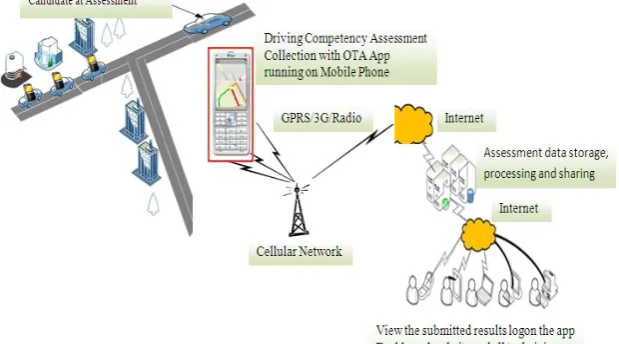
Centralized client-server architecture has been chosen for this system. However, the use of
web services makes it hybrid. The system has few users hence there was no need to have it
distributed. Only the Director of Drivers Competence department has access to it plus a web
interface that allows Transport Authority to give updates on the driving competence
assessment identified by the driver trainer. Nevertheless, this architecture is determined by
portability, data sharing and distributed processing. An attempt to maintain the accuracy and
integrity of the data (assessments) collected from the exercise area and sent to a central server
over a 3G network. The 3G wireless network is the mobile broadband internet connection of
choice. Data collection is done on a native mobile application. The central server offers
storage and processing functions. The server also offers an interface for sharing data with
other related systems. Data received from the mobile application is processed by PHP scripts
and stored on MySQL database. An apache HTTP web server application provides an
interface for smart phones to connect to the central server. Now the assessor or director of
drivers and technicians competency can view scores and also visualize competent and not yet
as a graph (line chart). The scores, now stored on the central server are also accessible to
administrator for monitoring and evaluation purpose.
B. Algorithm of Smart Driving Assessment Mechanism
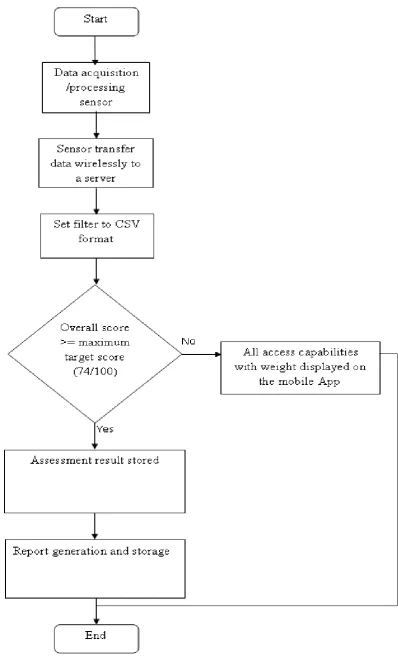
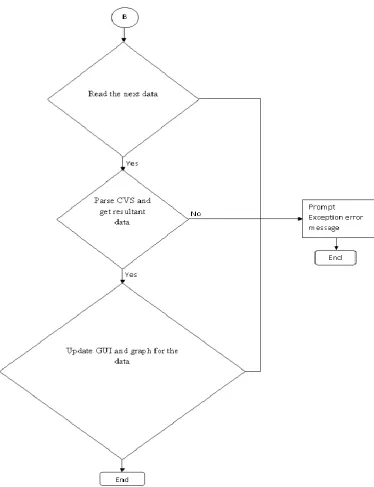
In order to develop the smart driving assessment system the algorithm has been developed
and presented below. The algorithm followed what the OTA app aimed accurately tell the
amount of skills of the driver.
Figure 4: Algorithm for Driver’s Permit Road Exercise Assessment.
C. Assessment Mechanism
As mentioned, the system that as the ability to identify and access driving competency and
has potential to provide feedback on the strength and weakness of a driver is needed. The
identified competency assessment consist two parts, the handling exercise and road exercise.
The selected access capabilities were under supervision of drivers’ assessor and the drivers
driving competency assessment system. The system able to segment out the selected access
capabilities and the associated variables recorded during the performed driving competency.
based assessment. In order to present these assessments and feedback to trainees and their
assessor, an interactive user interface highlighting the strength and weakness of the drivers
and technicians was designed. The validation of the assessment was made by comparing to
the subjective assessments of the driver assessor for particular access capabilities. Benefit of
the system framework includes identifying and sharpening driving abilities those are required
for skilled driving.
Implementation
Implementation was divided into OTA-app-mobile application and centralized view-web
application. Different tools will be used for different purposes in the analysis, design and
implementation of the system. Among these toolsl; XML for frame design and Android SDK
through Eclipse IDE for developing front end, Java, WAMP synchronisation (Apache server,
MySQL, PHP) for back end and MySQL for developing the backend database, a computer
system with specification higher or equal to the minimum specitfication mentioned to
XAMP OR WAMP and android studio and mobile phone for debugging while development .
After development, the application is compiled and tested using Software Development Kit
(SDK) emulator on windows and a HUAWEI Smartphone device. The web system receives
interfaces with the mobile client to receive requests from end users, and it also provides
front-end for presenting assessment result data to administrators. Driving competency assessment
data was stored in MySQL database.
RESULTS AND DISCUSSION
The android mobile application runs on a tablet and its main purpose is to enable users, the
assessor or trainer officers, to collect driving competency assessment data and then send it to
the server. The Smartphone running the application requires an internet connection. In a
nutshell, the mobile application is aimed collecting assessment, recording driving
competency assessment details. The web application retrieves and presents assessment
information that is sent by the mobile client to the database. It resides on the HTTP web
server and is linked to the database. In addition, user accounts are managed using the web
interface. Using the web interface, driving competency assessment result can be linked to
Figure 7: Assessed capabilities details.
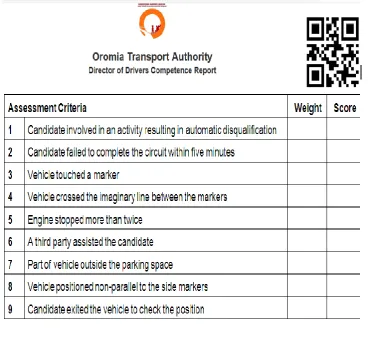
Figure 8: Drivers permit road and handling exercise assessment checklist screenshots.
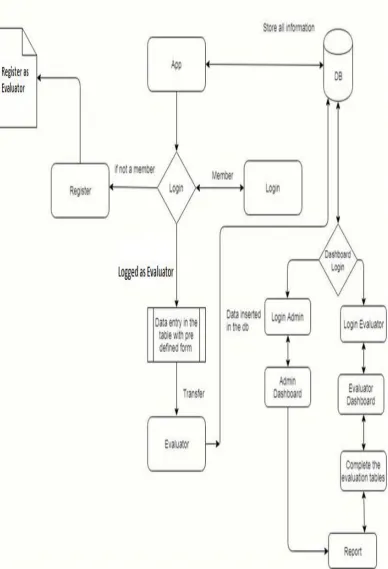
The main role of the web component is to allow access to the collected candidates driving
competence assessment data. With it, the following can be done:
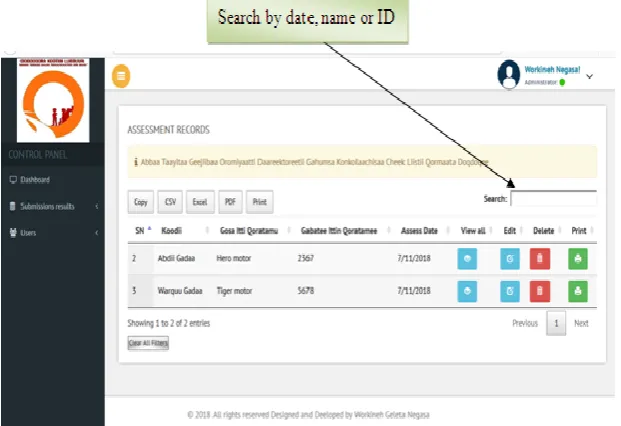
1. Search candidate’s assessment result by date, name and Vehicle plate number, to show
2. Add follow up assessment and recommendation to selected candidate.
3. Generate tabular and graphical reports from the stored data.
4. Give updates on the progress and condition of the driving competency assessment result
causalities.
The kinds of reports that are generated by OTA application include the following;
a. Graphical representation of assessed driver per day, month and year Distribution.
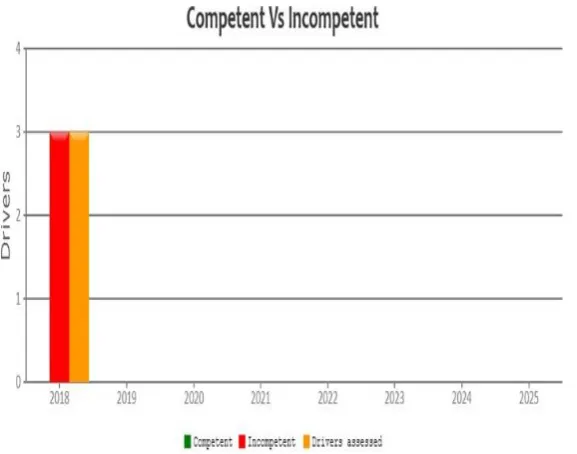
b. Graphical Distribution of competent and not yet competent candidates.
c. Tabular Distribution of candidates driving competence assessment result.
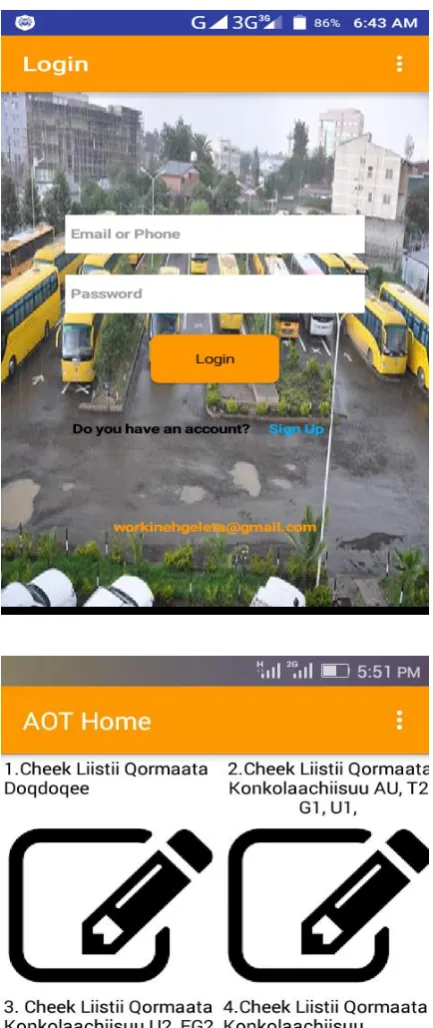
Figure 9: Web service login screenshots.
Figure 12: Graphical Distribution of competent, not yet competent and assessed candidates.
Performance Assessment Analysis
The driver’s assessment system that was designed will help the driver’s assessor in judging a
series of moves requiring skill and care. This system contained the core components which
were the data registration, physical movement identification and the assessment. These
components work together to synchronize, analyze and assess the safety of driving
competency assessment (handling exercise and the road exercise). The results from the
driving experiment indicated that significant difference existed between fresh and
experienced drivers in terms their road exercise assessment criteria while performing.
Interestingly there is significant difference were found for the indicating before turn. This
suggests that young or fresh drivers who participated in the study had not same judgment of
distance calculations as experienced drivers. These results help to identify competency
assessment that can differentiate low/high level of driving competency for the assessment
criteria. The competency assessment system designed helped identify driving abilities that are
required for skilled driving. These automated assessments will act as an assisting tool for the
driver’s trainers and trainees to identify the driving competencies required and understand
Testing
Before the experiments and results, let us think of how-to the measure the functional and
non-functional requirements and how successful results were measured. A use case was used to
present functional requirements of the system. Here the platform is fully checked whether the
complete system had the features that were promised in the use case. The test cases were
simulations on real-life scenario. The outputs from the tests were then compared with what
was expected. There were two non-functional requirements that were tested i.e. user interface
and usability. A questionnaire was used to measure usability satisfaction from the users. The
test questionnaire was presented to the users after they had used the application. Acceptance
tests were done on the final system to find out whether the system met functional
requirements. One real life case was used to determine whether the mobile application and
the web system delivered its promised functionality.
CONCLUSIONS
There has been successfully designed and developed a mobile application and web service
that offers great benefits in driving competency assessment assurance data collection. An
automated mobile solution for driving competence assessment reporting system can provide a
number of benefits over the current reporting system used by Drivers and Technicians
Training and Competency Assurance Center. These benefits are lower costs of processing and
report communication, centralized data which is easy to secure, backup and share, updates
can be made easily. Almost always up to date, than a year long update, increased availability
at any time any where, automatic generation of different reports with different formats and
reduction of erroneous report generation. However, the solution presented in this paper can
only be successful if it is backed up by the government.
ACKNOWLEDGEMENT
I acknowledge the Oromia Transport Authority Adama Drivers and Technicians Training and
Competency Assurance Center for the valuable support in terms of information and driving
competency assessment data collection processes. I am also thankful to Dr. Negasa Basha
Teshale for helping optimistically. To justify it, it is beyond a word to explain the way he
guides, the way he shares me his experience that couldn’t be explained only imprinted in my
REFERENCES
1. C. Campolo, A. Iera, A. Molinaro, S. Y. Paratore, and G. Ruggeri, SMaRTCaR: An
integrated Smartphone-based platform to support traffic management applications, in
First International Workshop on Vehicular Traffic Management for Smart Cities (VTM).
IEEE, 2012; 1-6.
2. O. Briante, C. Campolo, A. Iera, A. Molinaro, S. Y. Paratore, G. Ruggeri, and M. J.
Booysen, ITSPhone: An integrated platform for participatory ITS data collection and
opportunistic transfer, IEEE Infocom, 2013; 1420-1421.
3. K. Ali, D. Al Yaseen, A. Ejaz, T. Javed, and H. S. Hassanein, CrowdITS:
Crowd-sourcing in Intelligent Transportation Systems, in Wireless Communications and
Networking Conference (WCNC). IEEE, 2012; 3307-3311.
4. P. Händel, J. Ohlsson, M. Ohlsson, I. Skog, and E. Nygren, Smartphone-based
measurement systems for road vehicle traffic monitoring and usage-based insurance,
IEEE Systems Journal, 2014; 8(4): 1238-1248.
5. X. Zhang, H. Gong, Z. Xu, J. Tang, and B. Liu, Jam eyes: A traffic jam awareness and
observation system using mobile phones, International Journal of Distributed Sensor
Networks, 2012.
6. E. Koukoumidis, M. Martonosi, and L. S. Peh, Leveraging Smartphone cameras for
collaborative road advisories,IEEE Transactions on Mobile Computing, 2012; 11(5):
707-723.
7. E. Koukoumidis, L. S. Peh, and M. R. Martonosi, Signalguru: leveraging mobilephones
for collaborative traffic signal schedule advisory, in Proceedings of the 9thinternational
conference on Mobile systems, applications, and services. ACM, 2011; 127-140.
8. J. Zaldivar, C. T. Calafate, J. C. Cano, and P. Manzoni, Providing accident detection in
vehicular networks through OBD-II devices and Android-based smart-phones, in 36th
Conference on Local Computer Networks (LCN). IEEE, 2011; 813-819.
9. Y. Yang, B. Chen, L. Su, and D. Qin, Research and development of hybrid electric
vehicles can-bus data monitor and diagnostic system through obd-ii and android-based
Smartphone, Advances in Mechanical Engineering, 2013.
10.J. Eriksson, L. Girod, B. Hull, R. Newton, S. Madden, and H. Balakrishnan, The pothole
patrol: using a mobile sensor network for road surface monitoring, in Proceedings of the
6th international conference on Mobile systems, applications, and services. ACM, 2008;
11.A. Mednis, G. Strazdins, R. Zviedris, G. Kanonirs, and L. Selavo, Real time pothole
detection using android Smartphone with accelerometers,in Distributed Computing in
Sensor Systems and Workshops (DCOSS), International Conference on. IEEE, 2011; 16.
12.A. Ghose, P. Biswas, C. Bhaumik, M. Sharma, A. Pal, and A. Jha, Road condition
monitoring and alert application: Using in-vehicle Smartphone as internet connected
sensor,in 10th International Conference on Pervasive Computing and Communications
Workshops (PerCom Workshops). IEEE, 2012; 489-491.
13.M. Fazeen, B. Gozick, R. Dantu, M. Bhukhiya, and M. C. González, Safe driving using
mobile phones, IEEE Transactions on Intelligent Transportation Systems, 2012; 13(3):
1462-1468.
14.P. Mohan, V. N. Padmanabhan, and R. Ramjee, Nericell: rich monitoring of road and
traffic conditions using mobile Smartphone, in Proceedings of the 6th ACM conference
on Embedded Network Sensor Systems. ACM, 2008; 323336.
15.J. Dai, J. Teng, X. Bai, Z. Shen, and D. Xuan, Mobile phone based drunk driving
detection, in 4th International Conference on Pervasive Computing Technologies for
Healthcare (PervasiveHealth). IEEE, 2010; 18.
16.D. A. Johnson and M. M. Trivedi, Driving style recognition using a Smartphone as a
sensor platform, in 14th International Conference on Intelligent Transportation Systems
(ITSC). IEEE, 2011; 1609-1615.
17.J. Tulusan, T. Staake, and E. Fleisch, Providing eco-driving feedback to corporate car
drivers: What impact does a Smartphone application have on their fuel efficiency? In
Proceedings of the ACM Conference on Ubiquitous Computing. ACM, 2012; 212-215.
18.K. Perera and D. Dias, An intelligent driver guidance tool using location based services,
in 1st International Conference on Spatial Data Mining and Geographical Knowledge
Services (ICSDM). IEEE, 2011; 246251.
19.G. Castignani, T. Derrmann, R. Frank, and T. Engel, Driver behavior proling using
Smartphone: A low-cost platform for driver monitoring, Intelligent Transportation