WWJMRD 2018; 4(1): 140-151 www.wwjmrd.com
International Journal Peer Reviewed Journal Refereed Journal Indexed Journal UGC Approved Journal Impact Factor MJIF: 4.25
e-ISSN: 2454-6615
Safarov Ismail Ibrahimovich Department of “Mathematics”, Tashkent
Chemical-Technological Institute, Tashkent, Uzbekistan
Teshayev Muhsin Khudoyberdiyevich
Department of “Mathematics”, Bukhara Engineering-Technological Institute, Bukhara, Uzbekistan
Boltayev Zafar Ixtiyorovich Department of “Mathematics”, Bukhara Engineering-Technological Institute, Bukhara, Uzbekistan
Nuriddinov Baxtiyir Zafarovich Department of “Mathematics”, Bukhara Engineering-Technological Institute, Bukhara, Uzbekistan
Correspondence:
Safarov Ismail Ibrahimovich Department of “Mathematics”, Tashkent
Chemical-Technological Institute, Tashkent, Uzbekistan
Own Waves in a Cylindrical Shell in Contact with a
Viscous Liquid
Safarov Ismail Ibrahimovich, Teshayev Muhsin Khudoyberdiyevich,
Boltayev Zafar Ixtiyorovich, Nuriddinov Baxtiyir Zafarovich
Abstract
This article focuses on the dynamic behavior of a cylindrical shell (elastic or visco-elastic) contacting with ideal (or viscous) liquid. The problem of wave propagation in a cylindrical shell filled or submerged liquid has great practical importance. The phenomenon of wave-like motion of the fluid in the elastic cylindrical shells attracted the attention of many researchers [1, 2, 3, 4, 5, 6]. In these works devoted to wave processes in the elastic cylindrical shell - ideal liquid, used and refined classical equations of shells, consider the influence of the radial and longitudinal inertial forces, considered the average density of the flow of liquid or gas. In works [7, 8, 9] analyzes the laws of wave processes in an elastic shell with viscous fluid in the model of the linear equations of hydrodynamics of a viscous compressible fluid. Unlike other systems are cylindrical shell (elastic or viscoelastic) and liquid (ideal or viscous) is regarded as inhomogeneous dissipative mechanical system [10, 11, 12].
Keywords: The cylindrical shell, viscous barotropic liquid, wave process, dissipative non-uniform, wavy motion.
Introduction
Statement of the problem.
An infinite length of deformable (viscoelastic) cylindrical shell of radius R with constant
thickness
h
0, density
0, Poisson's ratio
0, filled with a viscous fluid with density at equilibrium. Fluctuations of a shell under a load, the density of which is denoted p1, p2, pn respectively, can be described by following [1, 2, 4], equations:
1
1
1
2,
2
0 2 0 0 0
0 2 0
t
u
E
р
h
E
u
i
L
С R S R
(1)Here
u
u
u
r,
u
,
u
z
- displacement vector points of the middle surface of the shell and membranes for Kirchhoff - Love it has a dimension equal to three
u
r
u
;
u
v
;
u
z
w
, and to membranes such as the dimension of Timoshenkou
is five. Here, in addition to the axial, circumferential and normal movements added more angles of rotation normal to the middle surface in the axial and circumferential directions
[12];
u
v
w
T- the displacement vector with axial, radial and circumferential components, respectively ("+" sign in front of pn and the sign "-" before the last component of the inertial member says that is considered positive motion towards the center ofcurvature);
R
E
t
– the core of relaxation;E
0– instantaneous modulus of elasticity. The amplitudes of the oscillations are considered small, which allows you to record the basic relations in the framework of the linear theory. The system of linear equations of motion of a viscous barotropic liquid can be written as [12]:~ 141 ~
0
3
1
0
div
grad
P
grad
t
.
,
,
,
,
,
.
,
;
0
1
0 2 0 0
r r r rz z r r z zp
q
p
q
p
q
u
u
u
const
a
a
P
div
t
(2).
1
;
2
;
r
r
r
p
r
r
z
r
p
p
z
r
p
z r r r z r rr r z rz
(б)Here, in the equations (2)
=
(
r,
,
z)
- the velocity vector of fluid particles;
and Р- disturbancedensity and fluid pressure;
0 and а0 – density and sound velocity in the fluid at rest;
,
- kinematic anddynamic viscosity; for the second viscosity coefficient
accepted ratio
=
3
2
;
р
rz,
р
rr,
р
r - componentsof the stress tensor in the fluid. Equation (1), respectively, kinematic and dynamic boundary conditions, which, because of the thin-walled shell, we will meet on the middle surface (r=R). Equations (1) and (2) is a closed
system of relations hydro visco elastic cylindrical shell for containing a viscous compressible fluid. This for shell obeying Kirchhoff-Love hypotheses. Be investigated joint shell and liquid fluctuations, harmonic of the axial coordinate z and decay exponentially over time, or time-harmonic and damped with respect to z.
Method of solution.
We accept the integral terms in (1) small, then the function
i Rte
t
r
t
r
u
,
,
, where
r
,
t
- slowly varying function of time,
R- real constant. Next, using the procedure of freezing [18], then the integral-differential equation (1) takes the form
1
1
1
2,
2 0 2 0 0 0 0 2 0
t
u
E
р
h
E
u
i
L
С R S R
(3)Where, for shell Kirchhoff - Love
,
1
1
2
1
2
1
1
4
1
2
1
2
1
2
1
2
1
2 2 2 2 2 2 2 3 3 2 2 3 2 3 3 2 2 3 2 2 2 2 2 2 2 2 2 2 2 2
R
x
a
R
R
a
x
a
R
x
R
R
a
x
a
R
a
x
a
x
R
x
R
x
R
R
x
L
0cos
RR
Rd
C ,
0sin
RR
Rd
S
-
- Respectively, cosine and sine Fourier transforms relaxation kernel material. As an example, the viscoelastic material take three parametric kernel relaxation
1/
t
Ae
t
R
t , ρ – material density shell; E –Young's modulus; ν – Poisson's ratio,
a
h
2/
12
R
2.
Let's move on to the dimensionless axial coordinate
R
x
/
and multiply by R2 system (3). The matrix of
.
1
1
2
2
1
4
1
2
1
2
1
2
1
2
1
2 2 2 2 2 2 2 3 3 2 2 3 3 3 2 3 2 2 2 2 2 2 2 2 2 2
R
a
R
R
a
a
a
a
a
a
L
(4)Expanding equation (2) and (3) in coordinate form, it is easy to see that the relations (2) - (3) break up into independent boundary value problems:
- Torsional vibrations:
R
S R С r r z r z r r
i
Е
E
p
r
v
E
G
u
h
z
u
h
G
R
r
r
p
r
r
p
z
p
r
p
r
p
1
,
0
:
0
,
)
1
(
2
,
0
)
(
:
,
,
,
2
0 0 0 2 2 0 1 0
(5)- Longitudinal transverse vibrations:
t
z
p
r
p
r
p
t
z
p
r
p
p
r
р
z zz rz rz r rz rr rr
0 0z
div
p
p
r
div
p
p
r
div
k
p
p
z zz r r rr
2
2
,
2
(6) 2 00
0
,
,
1
,
а
p
z
r
r
div
div
t
r
r
r
р
z
r
р
z r r r z r r z rz
,
0
)
(
,
0
:
2 2 0 0 0 2 2 2 2 0 0 0 1 1 4 4 1
t
u
h
p
z
u
R
v
z
u
C
t
u
h
p
z
u
R
u
R
C
z
u
D
R
r
z rz r r r rr z r r
Let the wave process is periodic in z and fades over time, then is given a real wave number k, and the complex frequency is the desired characteristic value. Solution of (2)
~ 143 ~
mТ m
m m
zm rm
Т r
rz
rr
р
р
u
t
t
t
u
t
t
р
,
,
,
,
)
(
,
,
,
,
,
,
,
,
,
,
,
,
,
,
)
(
, (7)Where
u
m
,
,
t
u
m
U
m,
V
m,
W
m
T,
,
,
t
m
rm,
m,
zm
T,
.Expressions (7) in the form
,
,
,
,
,
,
,
,
)
cos
,
cos
,
sin
,
(
rm
t
zm
t
m
t
Т
rm
zm
m
Te
iккit
T iкк i tz r
m m
m
Т m
m
e
m
m
m
m
W
m
V
m
U
t
t
u
cos
,
cos
,
cos
,
cos
,
sin
,
cos
)
,
,
,
,
,
(
,
where
r,
z,
,U
m,
V
m,
W
m,
r,
,
z- Amplitude integrated vector - function; к– wavy number; С - phase velocity; ω – complex frequency; m – circumferential wave number (the number of district-wave), takes values m = 1, 2, 3… .When m = 0 , happening Ax symmetrical vibrations. This approach allows you to seek a solution for every fixed value of the wave number of the district mindependently.
In this way С, k,
it is well-known real and complex spectral parameters of the type of problem.To elucidate their physical meaning consider two cases: 1)
к
к
R ; С = СR +iCi, Then the solution of (5) hasthe form of a sine wave х, whose amplitude decays over time;
2)
к
к
R
iк
I; С = СR, Then at each point х fluctuations established, but х attenuate.In the case of axially symmetric on the axis r = 0 conditions must be satisfied conditions
р
r
р
rz
0
,r
=0. If the outer surface г=R assumed stationary, then ur=uz=uφ=0. The superposition of the solutions (8) forms an exponentially decaying over time the standing wave that describes the natural oscillations of a liquid and a cylindrical shell of finite length with boundary conditions. With infinite length sheath similarly specified type of movement (8) will be called private or free fluctuations. In the case of steady-state over time and fading coordinate the process, in contrast, is a well-known real rate of
, as desired be a complex wave number k. In contrast to their own, these fluctuations will be called the established.Actual values of the
in the first case, and k, second frequency have the physical meaning of the process in time and the coordinate, respectively. Imaginary part - the rate of decay of wave processes in time and Z, respectively [13]. The value of 1/Imk sometimes defined as the interval damped wave propagation. In the extreme case, the elastic range spread endless. The degree of attenuation of wave process in the time period is characterized by the logarithmic decrement
c
2
Im
/
Re
(8)Decrement is similar to the spatial
k
k
y2
Im
/
Re
.You can also introduce the concept of phase velocity of its own and steady motions
k
c
R
c
c yRe
,
Re
The values Сс and Су have physical sense speeds of zero state at its own and steady oscillations, respectively, and, in contrast to the elastic (real) case, do not coincide with each other at the same frequencies. Two types of oscillations (and set their own), you can put two different formulations of the problem. And in the non-stationary case, namely the Cauchy problem for an infinite shell and boundary value problem for the semi-infinite interval changes Z. In either case, the solution is using the integral transformation of the decisions of the respective steady-state problems. For example, in the case of the Cauchy problem, the main
vector of unknown’s
c
Y
.It can be in a superposition of waves
n
n c
n c
dk
t
k
kz
t
k
r
Y
t
z
r
Y
(
,
,
)
(
,
)
exp[
(
(
)
)]
, (9)Where vectors
Y
cn are their own form of the problem ofnatural oscillations, normalized so that the spatial Fourier
spectrum of the initial disturbance
f
(
r
,
z
)
Y
c(
r
,
z
,
0
)
forms a linear combination
n c n ikz
k
r
Y
k
r
f
dk
e
k
r
F
z
r
f
(
,
)
(
,
)
,
(
,
)
(
,
)
(10)Similarly, the main vector of unknown’s
y
Y
boundary value problem is calculated according to the expression
n y k y
d
t
z
ik
r
Y
t
z
r
Y
)
exp[
(
)
]
,
(
)
,
,
(
(11)where
Y
yk - forms steady-state oscillation, the linear
n y n t
i y
r
Y
r
q
d
e
r
q
t
r
q
t
r
Y
t
r
q
(
,
)
(
,
0
,
),
(
,
)
(
,
)
,
(
,
)
(
,
)
Obviously, the solutions (8) and (9) have a meaning only when there are (10) and (11). So, there are four possible variants of steady motions, which are discussed below, and established their own systems fluctuations shell - fluid inside and outside the sheath liquid [15]. Substituting the solution (7) in the system of differential equations (2) - (6) we obtain a system of ordinary differential equations with complex coefficients, which is solved by Godunov’s orthogonal sweep method with a combination of method of
Muller [18] in the complex arithmetic.
Torsional vibrations.
After performing in (5) the change of variables (7) permitting relations describing stationary torsional vibrations of the shell liquid, formulated in the form of the spectral boundary value problem for a system of two ordinary differential equations
0
:
0
0
)
(
:
2
)
(
2 0 2 0 1
2 2 2 0
r
G
h
R
r
i
r
dr
dv
r
i
dr
d
(12)
First investigate fluctuations of fluid in the walls. Equations (12) can be converted to a single equation for the
displacement v
0 2
2 2
2
;
0
)
1
(
v
r
v
i
rdr
d
dr
d
(13)
The solution of equation (13) is limited at r = 0 has the form
0
)
(
21
1
v
i
k
r
J
A
v
(14)where J1- Bessel function of the first order, and A is an arbitrary constant. Given the immobility of the shell, we
obtain the dispersion equation
0
)
(
1 21
v
i
k
R
J
(15)From whence
)
(
2 т2n
i
v
k
Г
(16)in the case of natural oscillations and
v
i
n
Г
k
n 2
(17)in the case of steady-state oscillations. Here, through the Гn marked the roots of Bessel functions assigned to R. As it can be seen from (15), (16) own motion aperiodicity always on time, with the anchor points are fixed (the phase velocity Со=0), while the steady motion are oscillatory in nature, as the nodal point move at the speed of Су, a monotonically increasing from zero to indefinitely with an
increase in viscosity or
. These characteristic features of the motion of a viscous medium will appear in the following more complex example.Let us now consider the relation (12) in the case of the internal arrangement of the liquid. This problem can be
solved in the same way using special features and have a dispersion equation
0
)
2
)
(
)
(
(
~
~
1 0 2
3 2
2
2
z
J
z
J
z
R
h
p
a
v
a
k
(18)which was first obtained in A. Guz [7]. Here we have introduced new designations
0 2
1 1
0
;
;
~
;
~
G
a
v
i
k
R
z
R
h
h
p
~ 145 ~
shear wave velocity shell: Jo- Bessel function of zero order. The direct solution of the equation (18) comes up against certain difficulties caused by the need to calculate the Bessel functions of complex argument. Therefore we examine (18) by means of asymptotic representations of these functions at small and large arguments z. The smallness of z occurs in the low-frequency vibrations. According to the known expansion J0 and J1 power series
...);
8
1
(
2
)
(
...;
4
1
2 1
2
0
z
z
z
J
z
J
(19)
Hold the expansions (19) only the first term, we obtain
0
2 2
a
k
dispersion equation of torsional vibrations or dry shell filled with an ideal liquid, keeping in (19) on the first two
terms, we have the equation
0
)
(
~
~
4
2 2
2 2
2
v
i
k
h
p
a
v
i
a
k
(20)the root of which, for example, in the case of steady-state oscillations is given by
2 / 1
2
~
~
)
4
1
/(
)
~
~
4
1
1
(
h
p
a
v
h
p
a
k
(21)The physical interpretation of (18) is provided below. Consider now the situation when z is large enough, which corresponds to a high-frequency vibrations and low viscosity. In this case the asymptotic formulas for the Bessel functions have the form
)
4
sin(
)
2
(
)
(
),
4
cos(
)
2
(
)
(
1/2 1 1/20
z
z
z
J
z
z
z
J
On the basis of (20) and (21) it is easy to show that for sufficiently large positive imaginary part z:
.
)
(
/
)
(
10
z
J
z
i
J
Substituting (1) and further assumingsmallness
in comparison with the 2k
, to obtain an
approximate dispersion equation, which is also contained in the[7]
0
)
41
.
1
~
~
1
(
3 2
2
l
i
R
h
р
v
a
k
(22)
Where, in the pursuit of the viscosity
v
to zero (and alsotends
to infinity), we have a trivial result
0
k
,
which was obtained at low
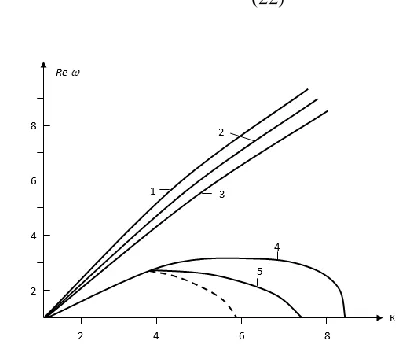
from equation (20). Equation (22) when an unacceptably high viscosities. In this case, the phase velocity C unlimited increases with ω. This example shows inconsistencies of various asymptotic estimates in the mid-frequency vibrations. Thus, the analysis of wave processes asymptotic methods in the first approximation is not possible to establish the limits of applicability of formulas and calculations to estimate the error. In this paper for solving spectral problems using a direct numerical integration of permitting relations of the type (12) by the method of orthogonal shooting in complex arithmetic. This approach avoids the above difficulties associated with the calculation of Bessel functions of complex argument. Another advantage is due to the specificity of the orthogonal sweep method, which is due to the procedure orthonormality can solve highly rigid system with a boundary layer. As a result of a numerical study has found that the problem of natural oscillations (12) admits no more than one complex value ω, corresponding vibrations of the shell together with the adjacent liquid layers to it. The rest found the Eigen values appeared purely imaginary. They correspond to the a periodic motion of a fluid with almost stationary shell. Proper form corresponding complex values also are complex, that is, the phase of joint oscillations of the shell and liquid is not the same along the radius. In the case of steady-state oscillations all the calculated Eigen values k and their own forms be complex.Fig. 1: Dependence of the real part of the complex frequencies (Re
) towave numbers (k) for different values of η. 1-0.0009; 2-0.0018; 3-0.18, 4-0.19, 5-according to the formula (20); By the formula (22).
Fig. 2: Dependence of the logarithmic decrement (
с) on the waveFig. 3: Dependence of
on the wave number r, for different values of the viscosity of a liquid 1-0.0009; 2-0.0018 ; 3-0.18;4-0.19.
Fig. 4: Dependence of the imaginary part of the complex frequencies (Im) to wave numbers (k) for different values of
η:1-0.0009;2-0.0018;3-0.18; 4-0.19;--- by the formula (22)
Fig. 5: Dependence of the spatial decrement on the wave number k for different values of η: 1-0.0009; 2-0.0018; 3-0.18; 4-0.19.
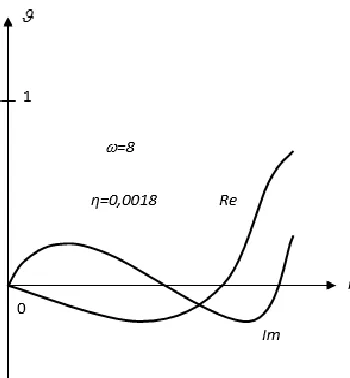
Fig. 6: Dependence of on the wave number r. When
Fig. 7: Dependence of
on the wave number. When018
,
0
,
8
Fig. 8: Dependence of
on the wave number r. When0018
,
0
,
16
.Fig. 9: Dependence of
on the wave number r. When018
,
0
,
16
~ 147 ~
Numerical results
Consider the case of natural oscillations, when the shell is filled with liquid. In Figure 1,2,3,4,6,7,8 c and 1,2,4,5 show, respectively, depending on the dispersion curves Re ω, Im ω,
the wave number k- the first mode, in which the damping coefficients of the smallest, and the Eigen values are complex Bat. In accordance with the numbering of graphs asked four different values of the coefficient η 1) 0.0009: 2) 0.0018 3)0.15 4)0.018 (а= 0.6199;25
.
0
;
1
;
0101
.
0
~
;
0529
.
0
~
0
h
R
.) for theremaining parameters according to (1) In Fig. 3,6,7,8,9 to show their own forms Rev for values k equal to 1 and 8, respectively. It is easy to notice the difference in the behavior characteristic of the dispersion curves 1.2 and 3.4. In the last two cases, there is a wave number since a variable with only takes purely imaginary values corresponding to a periodic motion of the system. For curves 1.2 with less viscosity real part of the Eigen values Re
nonzero at all wave numbers and the damping rate has a finite limit at infinity. The greater the viscosity, the earlier start a periodic traffic (curves 3,4) and the higher limit of the damping rate (curves 1,2). It follows that where is a minimum critical viscosity ηk, above which a zone of high wave numbers of the first mode, there are a periodic wave number. As a result of numerical experiment, it was found that the critical values of the coefficient of viscosity ηk, is in the range
0.0120
0.0125
. Analyzing the dependence of energy dissipation on the wave number, two opposite tendencies should be noted. As the wave number increases, at a fixed amplitude, tangential stresses linearlyincrease according to (6): c another, as shown in Fig. 3, localization of the fluid motion amplitudes near the shell simultaneously results, which leads to a decrease in the mass of fluid involved in the motion, as well as tangential stresses. The difference in the behavior of curves 1,2 and 3,4 is due to which of the two tendencies prevails. At small wave numbers, a linear dependence of the eigenfunction v on the radius is observed, that is, the entire mass of the liquid is involved in the motion. Ask increases, the central part of the liquid begins to "not keep up" with the vibrations of the shell, which leads to the localization of the amplitudes. The rate of localization depends on the viscosity of the liquid. If the localization occurs slowly, then starting from some k (owing to the growth of stresses), the self-motions become aperiodic (curves 3,4). If, on the other hand, the average amplitude of the fluid oscillation decreases rapidly enough, the motions will always remain oscillatory (curves 1,2). In this case, large voltage wave numbers prevail over voltages, and increase with increasing localization. In view of the latter circumstance, the damping coefficient always increases with increasing k. The linear dependence of the shape on the radius at small k also indicates the fulfillment of the flat-section hypothesis on which the elementary theory of viscoelastic rods is based. Using the Ritz method one can find the parameters of the Feucht core model and determine the limits of applicability of this model in the framework of the hydrodynamic theory, but for a narrower class of straight rods of circular cross section. Variational equation of the principle of possible displacements, equivalent to the relations
0
)
(
)
(
22
0 1
1
u
rd
drdz
z
u
dz
d
R
u
z
u
z
u
z
u
h
v
z z r r v
(23) Has the form. Choosing a linear function as the basis
,
)
,
(
)
,
,
(
r
z
t
z
t
r
u
(24)and after substituting (24) into (23) and the standard procedure, we obtain where the parameters β and a0 are expressed in terms of the polar moments of inertia of the shell I1 and liquid I0 as follows
2 1
1 0 0
1
0
)
~
1
/(
;
I
I
a
a
GI
I
Equation (23) describes the torsional vibrations of a viscoelastic Feucht rod according to the relations
,
1
1
22 2 0 2 2
t
a
z
t
(25)where is the coefficient of viscosity.
The solution of (25) is represented in the form
))
(
exp(
)
,
(
z
t
0i
kz
t
.Where the following relations satisfy
1
20
.
2 2
0
к
i
а
(26)Taking into account the relation I1 / I0 = 4h, it is easy to see
that equation (26) coincides with equation (22), which was obtained for the asymptotic solution of problem (16) for small oscillation frequencies. In Fig.1,4 The dotted lines show the dispersion curves of natural oscillations found from Eq. (22). As follows from the figures, a satisfactory coincidence of dotted and continuous lines is observed in the region of small wave numbers whose upper bound exceeds unity in this case and increases with increasing viscosity of the liquid. In the short-wavelength range, there is a discrepancy due to the localization of the oscillation amplitudes near the shell. Small wave numbers correspond to the natural vibrations of long finite tubes. We now turn to an analysis of the steady-state oscillations of a shell filled with a liquid. Figure 1-9 shows the dispersion curves and waveforms for two values of the viscosity coefficient (below and above the critical value) 1) 0.0018, 2) 0.018 and the same values of the remaining parameters as in (22). In the first case of relatively low viscosity, the results of the calculation are in good agreement with the asymptotic solutions of the Goose equation (18) at high frequencies.
Longitudinal - transverse vibrations
(6) can be described by a system of four ordinary differential equations
r
ik
ik
dr
d
k
dr
d
ik
r
dr
d
i
dr
d
ik
dr
d
p
ik
r
dr
d
z r z
r z
z
z r
r z
r
ў r
z
z r r
)
(
2
)
(
2
1
2 0
2 0
(27)
With the boundary conditions
.
1
;
0
)
(
;
0
)
(
:
;
0
,
0
:
0
2 0 0 2
1 2
0
2 1 0
4
Eh
C
w
h
u
R
u
k
iv
C
u
h
kw
iv
R
u
R
C
u
D
R
r
r
z
r z
r
(28)
The value of р in the first equation of system (27) is defined through the main unknowns according to the expression
)
2
(
2
2 0
0
k
i
C
r
iku
i
p
r r
(29)
The spectral problems (27), (28), as in the case of longitudinal - transverse vibrations were solved by orthogonal shooting. To find the roots of the characteristic equation method were used Mueller.
Numerical results.
The results of numerical study of natural oscillations. Figure 10 shows the dispersion curves
Re
the wave number k - for the case of an incompressible (С0 =
- dot-dash line) and compressible (С0=0,1 - solid line) of the liquid. Shell parameters and coefficients of viscosity taken following: h0 = 0,05; р=1,8; v0 = 0,25; h=6,011*10( -4);к=-2 η/3. Here and henceforth given dimensionless quantities for which the units of length and mass density
are
0 2 1 0
,
1
,
E
R
R
. For an incompressible fluid, thereare two modes, corresponding mainly longitudinal (curve 1) and preferably a cross (curve 2) fluctuations in the shell, with complex Eigen values. All other traffic have their own imaginary Eigen values that is a periodic in time. The dashed lines in Figure 10 are designated the dispersion curves corresponding to the vibrations of a shell with an ideal incompressible fluid. The solution of the latter
problem is given below. It should be noted that, unlike the dry shell joint oscillations transverse vibrations of said sheath fluid density p1, It takes place on a smaller compared to the frequency of longitudinal vibrations in the entire range of the wave number. When administered viscosity oscillation frequency of the first mode decreases, apparently due to the involvement of additional masses in movement of fluid in the boundary layer and in the second mode appears critical wave number restricting oscillatory motions bottom region. In [15], who investigated the steady oscillations, noted the desire for zero phase velocity of the lowest mode with decreasing frequency. Proper motion of the shell and the viscous compressible fluid has an infinite number of modes. The paper S. Vasin et al. [16] using asymptotic methods of solving, the latter effect could not be found. Fig.11 shows the dispersion curves for the first four events with a minimum of vibration frequencies (curves 3, 4, 5, 6) in ascending order of magnitude
Re
. Comparing curves 1.2 and 3.4 together, we can see that the second worse than the first few vibration modes of the shell - compressible fluid to the selected parameters are satisfactorily described by a model of an incompressible fluid in the region of wave numbers k < 1. This gives grounds for the study of the said system in the first approximation neglect the compressibility of the fluid. System elastic shell - is a viscous liquid dissipations- inhomogeneous viscoelastic body at a radial coordinate. Moreover, in contrast to the earlier torsional vibrations here for an incompressible fluid, there are two, and compressible - unlimited number of vibration modes. It is interesting to find out how this system can be shown a synergistic effect. Figure 11 shows the dispersion curves (2) for the following parameters of the shell and liquid:
0 4 3
80
;
0
,
25
;
7
,
071
10
;
;
05
,
0
v
t
C
h
Dash-dotted lines correspond to fluctuations in the dry shell. The dashed lines show the frequency dependence for
~ 149 ~
case partial frequency (v = 0) of the longitudinal and transverse vibrations of the shell with a perfect fluid intersect. It is natural to expect that the v near the intersection of partial frequencies will be a strong connectedness of both modes, leading to increased energy, resulting in a synergistic effect. Indeed, the presence of events demonstrates the effect of the conversion of Vina- longitudinal mode in transverse and longitudinal cross-section in a change of the wave number in the vicinity of the intersection of partial frequencies. Violation of the monotony of growth and synergies. Compared to the previous description of this effect there are two features. Firstly, the effect is far from the place of approximation curves of two modes, secondly, damping factor curves do not intersect. Yu. Novichkov in [17] investigated the coherence of joint oscillations of ideal compressible gas and the shell with the help of diagrams wines. As he examined the frequency of partial oscillations of gas in rigid walls and an empty shell.
Returning to Figure 11, we note a similar manifestation of the effect of wines in places of convergence curves 4.5 and 5.6. In these areas in Fig. 3 there is a synergistic effect for the curves. It is interesting to trace the influence of fluid viscosity on connectivity modes. 3.4 Curves in Figure 4 correspond to the value of the viscosity coefficient η=0,11 at constant other parameters. In this case, fashion predominantly transverse vibrations are defined on a finite interval of the wave of change, and the effect of guilt is not observed, indicating a loose coupling modes. Another large increase in viscosity (η=0,13, curve 5) leads to the fact that fashion is everywhere transverse vibrations becomes a periodic and у longitudinal oscillations appear critical wave numbers, limiting the scope of the vibration motions of the top. The physical nature of the observed effect is revealed when analyzing the vibrations of a shell filled with a perfect fluid. The equations of harmonic oscillations of an ideal liquid is easy to deduce from (27), formally putting viscosity coefficients equal to zero.
z r
z r r
i
dr
d
C
ik
r
dr
d
20 2
0 2
0 0
,
,
(30)General solution of (26) satisfying the finiteness condition unknown at zero, has the form
2 0 2 0 2 2 1
0 2 0 0
);
(
)
(
);
(
k
C
q
qr
AI
R
q
i
qr
AI
k
i
qr
AJ
z z
(31)
Where А arbitrary constant:J0, Jl,- Bessel functions of zero and first order, respectively. The boundary conditions at the
r=R similarly written conditions (28)
;
0
)
(
;
0
)
(
2 1 2
0
2 1 0
4
w
h
u
R
u
k
iv
C
u
h
kw
iv
R
u
R
C
u
D
r
(32)
Where w - axial movement of the shell, which is not now coincides with the axial movement of the liquid. After substitution of the solutions (22) of (23) there is a system of homogeneous linear algebraic equations in the unknown А
Fig. 10: Addiction Re with the wave number k in the case of an incompressible fluid
~ 151 ~
For an incompressible fluid, there are two real own Bessel functions I0 and I1
21
1 1 1
1 4
1 2 1 1 2 2 1
1 1
)
(
)
(
1
/
1
;
к
kR
I
h
kR
I
к
R
h
R
Е
E
R
n
(33)Unlike dry shell here second frequency locking is absent and the phase speed at low k equal to the
2 1
1 0
2
R
Eh
C
R
(34)Which coincides with the speed of the wave Rezalya (see. the review at the beginning of this chapter). In the case of a
compressible fluid
0
and limiting the phase velocity of the transverse mode oscillation in the shell k —> 0 is the velocity of waves Korteweg Zhukovsky.2 1 2 2 0
0
)
(
RR k
C
C
C
C
C
(35)Numerical study showed that the critical value Ck does not depend on the viscosity of the liquid, but with increasing η weakening the dependence of oscillations of Poisson's ratio, so that the ratio
(max
im
)
/(min
im
)
1
and own form U It becomes flat. As follows from the above results, generally within the engineering problem statement, we cannot adequately describe the longitudinal vibrations of the cylindrical shell filled with a viscous fluid via rod theory.References
1. Ter-Hakobyan GL Refinement of the results of the effect of the fluid on the propagation of waves in an elastic cylindrical shell // Journal. Basic research, engineering Sciences №10, 2013. P.516-520.
2. Sorokin S.V. Fluid-Structure Interaction and Structural Acoustics. Book of Lecture Notes. – Technical University of Denmark, 1997. – 188 p.
3. Vijay Prakash S., Venkata R. Sonti Asymptotic expansions for the structural wave numbers of isotropic and orthotropic fl edify lled circular cylindrical shells in the intermediate frequency range// Journal of Sound and Vibration. Manuscript Draft. Manuscript Number: JSV-D-12-01440. – 15 с.
4. Volmir A.S. Skins in the flow of liquid and gas: Challenges hydro elasticity. - Mascow.1979. 320p. 5. Amenzade R.Y, Salmanov G.M, Murtuz Zadeh T.M.
The pulsating liquid flow in the sheath for the effect of the stiffness of the environment. //Journal. Baku. №1, 2013 P.70-78
6. Amenzade R.Y. Do not axially symmetric oscillations of an ideal liquid in an elastic shell. // Dokl. t. 229, №3, 1976, p. 566-568.
7. A.N. Guz. Wave propagation in a cylindrical shell with a viscous compressible fluid // Prikl. Mehanika.-1980-16, №10.-p.10-20
8. Schuruk G.I. On the issue Distribution Axisymmetrical waves in hydro elastic system shell - a viscous liquid. // Journal. Sistemnye Technology, 3 (62) p. 76-81 9. Mokeev V., Pavlyuk Y.S. The approximate account of
compressibility in problems of hydro-elasticity // Problems of mechanical engineering and reliability of
the machines. 1999. N 5. p. 85-95.
10. Oscillations and waves in dissipative not homogeneous environments and structures. Tashkent. 1992. 250p. 11. Safarov I.I, Teshaev M.H, Boltaev Z.I. Wave processes
in mechanical waveguide. LAP LAMBERT Academic publishing (Germany). 2012. 217 p.
12. Bozorov M.B, Safarov I.I, Shokin Y.I. Numerical simulation of vibrations dissipative homogeneous and heterogeneous mechanical systems. Moscow. 1966. 188p.
13. Kayumov S.S, Safarov I.I. Propagation and diffraction of waves in dissipative - inhomogeneous cylindrical deformable mechanical systems. Tashkent: 2002, 214p.
14. Grinchenko V.T, V.V. Myaleshka. Harmonic Waves in elastic bodies. - Kiev: 1981, p. 284.
15. Frolov K.V., Antonov A.N. Vibrations of a shell of liquid-Moscow: Science, 1983. 365p.
16. S.V. Vasin, V.V. Mikolyuk. Free oscillations tolerable cylindrical shells separated by a viscous fluid Hydro Aeromechanics. And the theory of elasticity. 1983. №3. p.108-116.
17. Beginners Y.N. The study of the spectra of natural frequencies of cylindrical shells containing a compressible fluid. Science. 1996y. -74p.
18. Koltunov M.A. Creep and relaksatsiya. Moscow: Higher School, 1976.