Pages 243-297
CORINTH:
ROMAN
HORIZONS
ABSTRACT
This article reviews the investigation of Late Roman Corinth, including the recent excavations in the Panayia field. A series of four assemblages that range in date from the fifth through the seventh century, presenting approximately 50 similar objects from each and establishing relative sequences for some hith
erto undated classes, is outlined. The sequences for lamps, fine wares, ampho
ras, cooking pots, and plain wares can be clearly established at Corinth. It is more difficult to tie together the independent chronologies of each class to
assess the absolute dates for the four horizons, but the conclusions require major revisions to the monumental history of the Late Roman city.
INTRODUCTION: LATE ROMAN CORINTH
Several large gaps exist in our knowledge of Late Roman (LR) Corinth. These lacunae appear to be related to constraints imposed by the accep tance of historical inference over archaeological data and by the assump tion that the geographical extent of the LR city is related to the area of excavations.1 Unjustified confidence in the historical record encouraged
1. This report draws on the excava tions east of the Theater that were con
ducted by Charles K. Williams II in the
1980s, on earlier excavations by Wil liams in the forum and the Lechaion Road, and on excavations by Guy D. R.
Sanders in the Panayia field in 1997
and 1998 for
assemblages 1,2, and 4. We
happily acknowledge our debt to Charles Williams, not
only for allowing us access to this material but also for many years of mentoring us both. We
also thank the 6th Ephorate of Byzan tine
Antiquities for permission to use the material from Demetrios Pallas's
excavations in the Baths of Aphrodite, published here as assemblage 3. Orestes Zervos, numismatist of the Corinth Excavations, kindly reexamined the
coins, and Benjamin Millis provided readings of the graffiti preserved on vessels in
assemblages 3 and 4. The pottery profiles are largely the work of Karen Sotiriou, although a few in assem
blage 4 were drawn by Sanders; James Herbst, architect of the excavations, was
responsible for the scanning and layout of the profiles and for the plans. All
photographs were taken by Lenio Bartzioti and Ino Ioannidou. The
authors also wish to thank Jodi Magness and Paul Reynolds for discussion of the Palestinian amphora types. The initial work for this article was carried out while Slane held a Research Leave from
the University of Missouri-Columbia, and the first draft was written while she
held a Solow Art and Architecture
Foundation fellowship in the summer
of 2001. She wishes to thank both
institutions for their support, and also the staff of the Corinth Excavations, both past and current, without whose continuing interest and help the project could not have been completed.
? The American School of Classical Studies at Athens
American School of Classical Studies at Athens is collaborating with JSTOR to digitize, preserve, and extend access to
Hesperia
Figure 1 (opposite). Plan of Corinth,
showing areas mentioned in the text
most previous scholars to tie LR material culture to catastrophes, such as
earthquakes and postulated sacks due to barbarian invasions.2 Their historical conclusions for events of the late fourth and late sixth centu ries were apparently confirmed by the numismatic record, which showed a marked reduction of coin losses in the first half of the fifth century and at the end of the sixth. A more critical examination of the recorded events, a better understanding of the dynamics of minting and of the
significance of coins in a given context, and much more developed knowl edge of the chronologies of fine-ware pottery now indicate that the his tory of Corinth was less episodic than previously thought and that sev eral associations between earthquakes or barbarian sacks and deposits
were
premature.3
Although much of the central area of the archaeological site had been excavated in the 1920s and 1930s, extensive areas of the LR city were ex cavated under more controlled conditions from the late 1950s through the 1970s (Fig. 1). Henry Robinson excavated along the south and west sides of the forum, near the Baths of Aphrodite, and on Temple Hill.4 Excava tions by James Wiseman for the University of Texas in the area south and west of the Asklepieion produced quantities of LR material including buri
als, an important deposit of votive lamps, and massive but incompletely understood architectural features.5 Demetrios Pallas began a program of
systematic exploration of LR Corinth by resuming excavations at the Kraneion basilica and by uncovering the Lechaion basilica; material from
one of his smaller projects at the Baths of Aphrodite comprises most of assemblage 3, presented here.6 In the same general period the Kodratos basilica, the Skoutela basilica, a fountain near Lechaion, and a LR build ing south of the South Stoa were also excavated by Greek teams.7 The published preliminary reports of these excavations present little detailed
2. See Finley 1932 for a history of
Corinth that has been
generally ac cepted by scholars, including as re cently as Ivison 1996 and Avramea 1997. The invasions cited are those of the Heruli in a.d. 267, the Ostrogoths in A.D. 395, and the Slavs in the 580s. The earthquakes receiving the greatest scholarly attention are those of a.d.
365, 375, and 552. Although the
sources that document the last of these nowhere mention Corinth, it is credited with widespread devastation in the
region. The effects of the fourth-cen tury earthquakes have recently been
questioned by Rothaus (2000, pp. 16
21); those of the sixth-century earth
quake, by Sanders (1999, pp. 474-475).
3. For instance, the Herulian de struction of the South Stoa
proposed in Corinth 1.4, pp. 143-144,151, should now be discounted, because the mate
rial within the crucial deposits proves to be late fourth rather than late third century; see Corinth XVIII.2, pp. 4-5 with n. 8; p. 309, n. 27.
4. South and west of the forum (Agora southwest) and Baths of Aphrodite: Robinson and Weinberg
1960, p. 231; Robinson 1962, pp. 99 100,109-111,122-124,132. Temple
Hill: Robinson 1976a, pp. 221-223; 1976b, pp. 256-259.
5. Final publication of the stra tigraphy and context material is still pending, but three preliminary reports
(Wiseman 1967,1969,1972) and three
full reports on aspects of the finds
(Wesolowsky 1973; Garnett 1975; Dengate 1981) have been published in
Hesperia.
6. At the time of excavation in 1956
Pallas incorporated his finds into the
American School's inventory and
storerooms at Corinth, and the inven tory book was housed in the excava tions' archives.
7. Pallas and E. G. Stikas published detailed annual reports in ArchDelt For
the Kraneion basilica, see Pallas 1972,
1974,1978,1980; for the Lechaion basilica, Pallas 1959,1961,1962,1963,
1964,1965a, 1965b, 1967,1970; the
Kodratos basilica, Stikas 1964,1965,
1966; the Skoutela basilica, Pallas 1956,
1957,1960; the fountain at Lechaion,
Philadelpheus 1921 and Stikas 1962. For the location of the LR building
south of the South Stoa, see Sanders
1999, p. 441, fig. 1 (at A); and for
Corinthian basilicas and monuments in general, see Pallas 1963,1966,1980,
1981, and Reallexikon zur byzantini schen Kunst IV, pp. 746-811, s.v.
.v;-,^ ;r_ ; ^v
LECHAION BASILICA
??EjSHAIjQN^
"HARBORf
-
LR WALL- SURVEYED
-
LR WALL- RESTORED
+ LR GRAVES
SKOUTELA BASILICA
SKOUTELA
KRITIKA
FOUNTAIN
+* KODRATOS BASILICA FOUNTAIN OF
THE LAMPS
ANAPLOGA
AMPHITHEATER
f1930 TOWER
EXCAVATION ?KRANEION , BASILICA
chronology, because the fieldwork was largely completed before the ap pearance of John Hayes's Late Roman Pottery (henceforth LRP) in 1972. This resource proved useful in Charles Williams's later investigations of
sixth-century buildings and tombs in Forum Southwest and in Jane Biers's study of the Great Baths on the Lechaion Road.8 Williams's excavations east of the Theater produced the contexts incorporated into this article as assemblages 1 and 2, and his excavations in the forum produced material that contributed to assemblages 3 and 4. Finally, in 1999, a remote sensing survey of some peripheral areas was begun; areas south and west of the Asklepieion, south and southwest of the amphitheater, and south of the Panayia field had been investigated by 2003.9 This project has further de fined the LR city beyond the area of the central excavations.
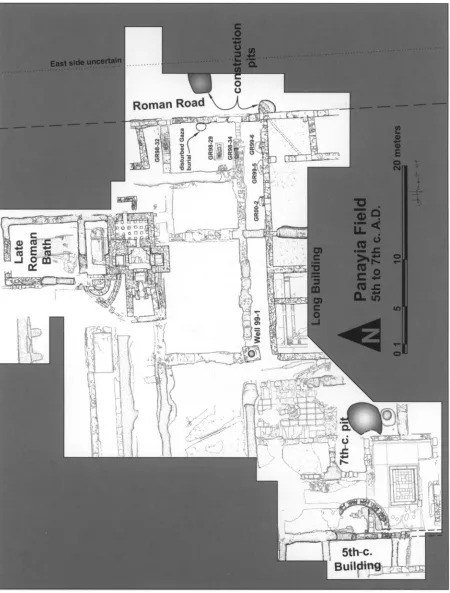
In 1996 work was undertaken in the Panayia field about 100 m southeast of the forum, where quantities of material of the second through eighth century have been excavated (Fig. 2). Among the buildings uncov ered is a large urban domus?with mosaic and marble floors, pools, wall painting, and small-scale sculpture?that was erected after ca. 260 and destroyed after ca. 360; unfortunately, the floors had been kept scrup ulously clean and the quantity of contemporary pottery recovered is tiny.
In one of the structures built over the domus a sequence of floors with associated cooking pots provided the first indication that reassessment of Corinth's LR pottery was required: the pottery and coins in the upper
levels all appeared to be late fourth century in date, but on the lowest floor was found a mid-fifth-century coin.10 The revised chronology for
cooking pots suggested by this sequence is confirmed by material from east of the Theater (assemblage 1 below). Such fifth-century levels in the Panayia field were largely disturbed by the construction of a small, well-appointed bath and a long building of uncertain function in the mid
sixth century.11 Use of the bath for its original purpose stopped at the be ginning of the seventh century, although occupation continued, perhaps for some decades. A large, dumped fill of seventh-century pottery (assem blage 4 below) was found in a pit at the west end of the long building. Both the bath and the long building were finally dismantled in the late
eighth or early ninth century.12
8. Forum Southwest: Williams, Macintosh, and Fisher 1974, pp. 9-10; Williams and Fisher 1975, pp. 1-2,14
17; Williams 1978, pp. 25-28. Great Baths: Corinth XVII.
9. The remote
sensing project is being conducted by Guy Sanders and
by Michael Boyd of the Fitch Labora
tory of the British School at Athens. Results have been briefly reported in
Blackman 2002, pp. 19-20; Whitley
2003, p. 20; and Sanders 2004, pp. 176 179.
10. Sanders 1999, p. 458. 11. Excavation under the cement
floor of the entrance hall of the bath indicated its sixth-century construction; see Sanders 1999, pp. 458-460. A rob bing trench for a large north-south wall contained pottery of the second half of the fifth to
early sixth century. Con
structed over the fill of the robbing
trench was a
building, represented by a corner defined by two walls, that was demolished in its turn before the bath was built; its foundations were covered by successive construction layers of the bath. A full architectural
phase exists, therefore, between the robbing oper ation and the construction of the bath.
12. A
deep layer of broken-up cement derived from the demolition of the two structures
yielded two almost complete and several fragmentary cooking vessels and fragments of table amphoras. These do not belong either to known seventh- or late-ninth-cen tury types but rather appear to be tran sitional forms and probably date to the
eighth or early ninth century. An
Abbasid coin of the second half of the
eighth or first quarter of the ninth cen
tury (95-377) was found in a demo
lition context in the bath's
^^^^^^^^^^^^^^^^H~^::^:
W
| (
^^^^^^^^^^^^^^^|
^^^^^^^^^^^^^^^^^^^H
?fj
|m
%
1
disturbed
Gaza
Si 7)
^^^^^^^^^^|
__^__^__^__^__^__^__^__^__^__^__^__^H^\V>S^^
v"Ll
E-?
?I
(burial-?\
M
O
^^^^^^^^^^^^M
^^^^^^^^^^^^^^^^^H
-_^-_^-_^--^--^--^--^--^--^--^--^--^--^--^--^--^--^--H'
, "~"\
/
?ju^j
rGR98-29
>^\Q >^^I^^^^^^^^^H
__^__^__^__^__^__^__^__^__^H^^^^^^^^^^H
.i
\v
?
:'
r4
^
ti ?
__i-_i-_i-_i-_i-H
-_^-_^--^--^--^--^--^--^--l ?.J '?-?? ,-i?S S?iS?4 fi' V __^__^__^__^__i __^__^__^__^__^__^__^^/::___---_-^~'-- t4wTT-r^T?^f^^^^ ( COn__^-_^-_^-_l
^Mg^^^l ft:-;-?3*"?^ ?
- -
^^^^^^^^^^^^^^^^^^^^^^^^^^^^^^^^^^^^^^^^^^^^^^H
^H^I^^^^^^^_^^^^^^^^^^^^^^^^^^^^^^^^^^^^^^H
FOUR LATE ROMAN HORIZONS
Up to the early fourth century the chronology of Corinthian lamps and of cooking wares and plain wares is based on deposits in which they were as sociated with datable fine wares and amphoras, as well as with coins. These deposits had usually been dumped at a single moment in time (frequently following a destruction by earthquake) and the chronological range of their contents is therefore clearly limited. The Tiberian floor deposit, the cellar fill, and the Tetrarchic pit in the Per?bolos of Apollo are examples of such deposits.13 Unfortunately, for the three centuries after the time of Con
stantine no such deposits can be identified in the LR city. In this article we have used other types of deposits from recent excavations east of the The
ater and in the Panayia field to establish a series of four assemblages that maybe tested as chronological horizons at Corinth and elsewhere in Greece.
By selecting 45 to 50 objects from several unrelated contexts in which the same types occur, we can begin to establish the relative sequences for some hitherto undated classes. The relative sequences for fine wares, lamps, amphoras, cooking pots, and plain wares can be clearly established, and general trends have become apparent. It is more difficult to tie together
the independent chronologies of each type and class, which are frequently long-lived, in order to assess the absolute dates for the four horizons. Our preliminary assessment is that these assemblages define horizons of the first half of the fifth century, the second half of the fifth century to 500 or later, the end of the sixth century, and the middle of the seventh century.
For each assemblage we present a brief description of the context or contexts from which the material has been drawn. It is followed by a list of associated coins, and by a numbered list of lamps, fine wares, amphoras, cooking pots, and plain wares that make up the assemblage. We should emphasize that this is a summary list of well-known or locally abundant types rather than a fully descriptive catalogue; our goal has been to stress the typological sequences. Description is limited to a descriptive name or type, diameter or height if it is measurable,14 a fabric description if the
ware is unusual, and
parallels from well-dated contexts.15
13. Wright 1980; Slane 1986,1994,
respectively.
14. In the summary list, "D." is the diameter of the rim, measured on the resting surface; on small frag ments
precise measurement is not possible beyond two decimal points. Items in
brackets?e.g., [C-1982 126]?are complete pieces from other contexts selected for illustration in preference to the more fragmentary
specimens in the groups from which our material is primarily drawn.
15. We take for granted the defini
tions of African Red Slip (AfRS, here
all fabric D from northern Tunisia),
Late Roman C (LRC), Cypriot Red Slip (CypRS), the best-known im
ported amphora types (see further n. 57 below), and the fabrics of Co rinthian and Attic
lamps. Other fre quently occurring fabrics are defined at the appropriate points in our list; see in particular LR micaceous Aegean cooking ware (n. 21), Boiotian RS
(n. 25), and the Palestinian amphoras in
assemblage 2.
Many of the cooking and plain wares described here are of "Corin thian cooking fabric" (C.c.f). This fabric displays a considerable range of color, from pink to red to gray, but
has a consistent variety and quantity of inclusions. Coarser examples are medium hard with a
hackly break.
They are often red (10R-2.5YR 5/6)
and may have sharp firing-layers
ranging from pink (7.5YR 6/4) or reddish yellow (5YR 5-6/6) at both
surfaces or exterior only to light red
dish brown and reddish brown (5YR
5-6/3) at the core and/or interior sur face. Some cooking pots have been
burned gray (5YR 5/1) and reddish
brown (5-7.5YR 5/3) on the exterior surface. These coarser vessels have a few
Assemblage 1: First Half of the Fifth Century When the retaining walls of the terrace on the east side of East Theater
Street were dismantled sometime around 460, a deep fill was dumped over the street itself. The robbing trenches were partly filled by the same dumped debris; eventually their sides collapsed, filling the trenches with the earlier debris within the terrace. Because there had been no activities in the area
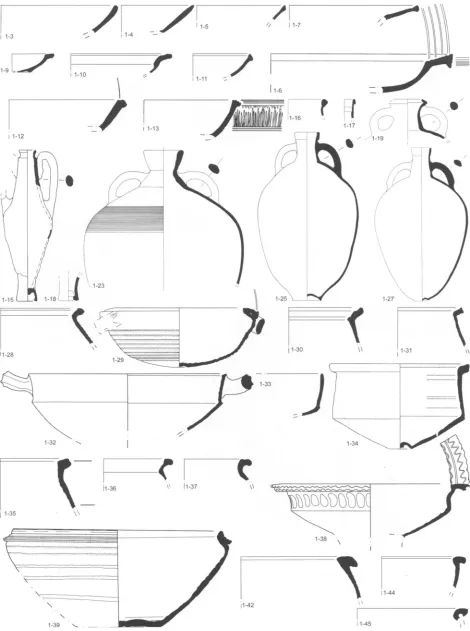
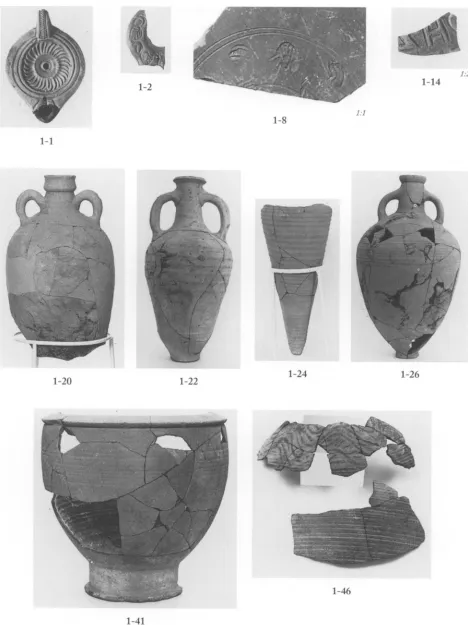
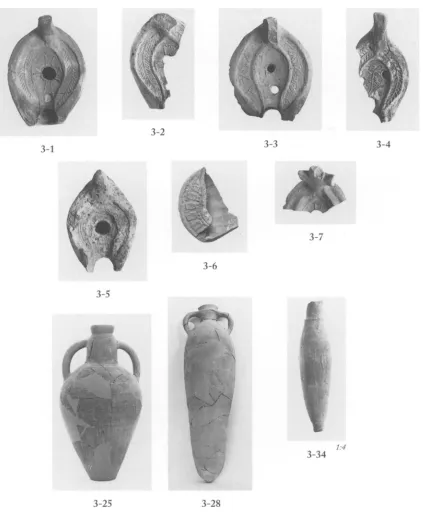
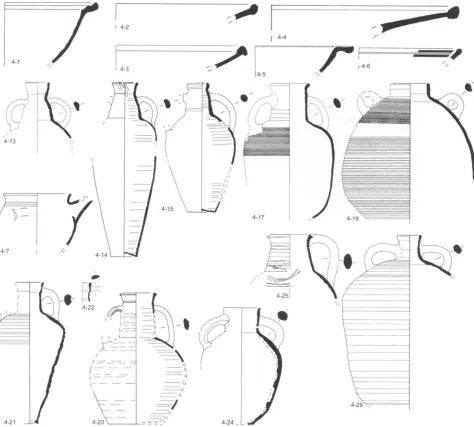
since the beginning of the fourth century, however, it is relatively easy to separate sherds that survive from the earlier phase from those contempo rary with the stone robbing. The finds reported below (see Figs. 3,4) come primarily from the deep dump over the street (lots 88-60, 88-67, and 88-68; also 88-58?), supplemented by larger, more complete pieces from the robbing trenches and from well 1982-1.16 In assigning types to this horizon, we have assumed that any which begin in the fourth century and are not found in the earlier destruction debris of ca. 310 are part of the fifth-century horizon. The only form that appears in the early-fourth
century contexts and continues into the sixth century or later is the local folded rim bowl. It is worth noting that no Attic glazed lamps are found in
the early-fourth-century contexts east of the Theater,17 and those in the mid-fifth-century contexts are part of the late material (and their types
confirm it; see below).
Coins
Eight coins and & jeton were found in the dump over East Theater Street.18 88-130 jeton, counter of E. L. S. Lauer (1762-1833)
(Williams and Zervos 1989, no. 97) 88-133 Maximian Hercules (295/6), mint of Heraclea
(Williams and Zervos 1989, no. 47)
spherical and tabular calcite(?); sparse, medium spherical, rounded, milky white and gray quartz; and occasional medium, tabular, subrounded, orange
red
grits; there may be occasional fine, laminar pores parallel with surfaces. Finer pieces are medium hard, red
(10R-2.5YR 5/6) with a smooth to
conchoidal break and
display a few small, spherical, rounded, hollow yellow (lime?) inclusions; sparse medium, milky white inclusions; and tiny, round
pores. This is the local fabric used for cooking pots, wheelmade lamps, and several series of
pitchers in the first to fourth centuries, and it
replaces the Corinthian buff fabric for many
plain ware
types in the LR period. Slane
(Wright 1980, pp. 169-170) originally
described the fabric as Corinthian,
and Sanders (1999, p. 464, fabrics F and G) considered it a local fabric
made from a mixture of clays found on the shoulder of Acrocorinth. Recently, George Viele identified some of the white inclusions as
potassium feldspar, which originates in a volcanic environ ment, and suggested that Methana may be the closest potential source.
16. Lots 88-61 and 88-63 are from the
robbing trench over the west wall
of Building 7; lots 84-10, 84-41, and
84-42 are from the same robbing trench west of Building 5; and lot 83-33 is from the robbing trench of the terrace wall that formed the north
side of Building 5. Lamp 1-1 and the
whole
amphoras 1-15,1-22,1-23, and
1-25 (published in Williams and
Zervos 1983, nos. 73, 70, 68, 72, and 69, respectively) are from the bottom of well 1982-1, as are the
amphoras 1-20,1-24,1-26, and 1-27. Williams's preliminary suggestion that this well
should be dated ca. A.D. 395 must be modified. Parallels for all these whole
amphoras are found in the east of Theater fill and
robbing trenches pub lished here and in mid-fifth-century contexts elsewhere. The
dumped fill higher up in the well can be dated in
the later sixth century. 17. The latest lamps in the
early fourth-century destruction debris are Attic unglazed lamps, Corinthian
glazed type XXVII lamps, and Corin thian imitations of Attic
unglazed lamps, providing a precise parallel
to the Peribolos of Apollo deposit of
ca. 310; see Slane 1994. 18. For
assemblages 1 and 2, we cite the coin
specimens as they were pub
lished in Williams and Zervos 1982,
88-134 Honorius or Theodosius II, mint uncertain
(Williams and Zervos 1989, no. 67)
88-136 Theodosius II or Valentinian III (425-450), mint of Cyzicus (Williams and Zervos 1989, no. 65)
88-141 Marcian (450-457), mint uncertain (Williams and Zervos 1989, no. 66) 88-135, 88-137, 88-138, 88-140 four minimi
(of which three are Williams and Zervos 1989, no. 67)19
Four coins come from the robbing trenches.
84-145 Corinth, Pegasos/trident (400-146 b.c.) (Williams and Zervos 1985, no. 10) 84-146 Constantius II (348-361), mint uncertain
(Williams and Zervos 1985, no. 106)
84-147 Theodosius I or II (379-395 or 402-450), mint uncertain (Williams and Zervos 1985, no. 123)
88-142 Arcadius (388-395), mint of Cyzicus (Williams and Zervos 1989, no. 61)
The presence of the jeton and a fragment of a modern plate in lot 88-68 show that the removal of modern surface levels above it was not quite complete. The other coins suggest a date of deposit sometime after 425. Lamps
1-1 L-1982-34 Fig. 4
Attic glazed lamp with twisting rosette on disk and plain rim with six in
cuse circles; on base, A within a circle (Williams and Zervos 1983, no. 73, p. 26 [found with the whole amphoras in well 1982-1]). W. 0.078 m. The A-work shop may have operated only into the early fifth century; see Kerameikos XVI, pp. 74-75.
1-2 Lot 88-63:8 Fig. 4
Attic post-glazing lamp with plain disk and vine pattern on rim. Although
the discus is
missing, it is clear that it was continuous with the rim, marked off
only by the outline of the vine. Cf. Agora VII, no. 2603, p. 184, pi. 41 (first half of fifth century); Karivieri 1996, nos. 122,123, p. 198, pi. 10 (mid- and second half of fifth century); and Kerameikos XVI, nos. 4599, 4600, p. 286, pi. 78 (late first
quarter and middle of fifth century).
The dumped fill over the street (lot 88-67) had two Attic glazed lamp handles and two Attic post-glazing handles and a sherd; the latest lamps in lots 88-60 and 88-68 were of the early fourth century. In addition to lamp 1-2, the robbing trenches also had one glazed Attic lamp (lot 84-42), three Attic post-glazing handles (lots 83-33, 84-42), and a single frag ment of a LR Corinthian lamp (lot 84-42). The latter is the only one
found on the slope east of the Theater, although such fragments are com mon in the LR levels to the north; it therefore seems that they were not
yet being manufactured in the first half of the fifth century.
19. Zervos notes that 88-140 is
Fine Wares
AfRS
1-3 C-1988-27 Fig. 3
Rim, Hayes form 64 (from lot 88-58). D. 0.326 m. Gritty, relatively coarse fabric, thick slip on interior and splashed over lip, with turning marks visible on
interior and exterior. Cf. LRP, no. 64.4, p. Ill, fig. 18; Reynolds 1995, fig. 5. 1-4 C-1984-222 Fig. 3
Rim, Hayes form 50B/64 (from lot 84-42). D. 0.206 m. 1-5 C-1988-116 Fig. 3
Rim, LRP, no. 50.61. D. 0.246 m. Fine fabric, thick
slip on interior and over
rim. Cf. Reynolds 1995, p. 145 (where this late variant of form 50 is dated 400 450), figs. 7, 8.
1-6 C-1988-26 Fig. 3
Rim, Hayes form 69 variant (from lot 88-58). D. 0.508 m. Fine fabric but
thick-walled, very thin slip overall.
1-7 C-1988-115 Fig. 3
Rim, Hayes form 76. D. 0.360 m. Badly burned; similar to 1-6? 1-8 C-1984-221 Fig. 4
Style D stamped plate floor with row of cocks between thin grooves (from lot 84-42).
LRC
1-9 C-1988-28 Fig. 3
Rim, Hayes form 2B. D. 0.118 m. 1-10 C-1988-114 Fig. 3
Rim, Hayes form 2C. D. 0.285 m. 1-11 C-1983-125 Fig. 3
Rim, LRP, no. 3.32 (from lot 83-33; same form in lot 88-67). D. 0.160 m. Unusually fine, gritty orange fabric with thin, matte slip.
LR Attic
1-12 Lot 88-60:1 Fig. 3
Plate rim, probably an imitation of AfRS form 83/84. Est. D. 0.31 m.
Miscellaneous
1-13 C-1988-113 Fig. 3
CypRS rim, LRP, no. 2.1, p. 373, fig. 80 (middle). D. 0.250 m. 1-14 C-1988-117 Fig. 4
Local or unidentified red slip moldmade signature: [-]AHO[-] or [-]
1-39
1-2 1-14 1:2
1-8
1:1
1-1
1-20 1-22 1-24 1-26
1-46
1-41
The following other forms appear in the deep fill: AfRS forms 5OB, 59B, 67, 68, 82, fourth-century grill stamp no. 69; LRC forms 1,1A, small 3,4 (all from lot 88-67 with the fifth-century AfRS). From the robbing trenches: lot 84-41:1, an unidentified AfRS rim; C-1988-110, ?andarli Hayes form 5 (lot 88-61); C-1988-112, AfRS style C stamp 13n and a fringed hexa
gon; Macedonian t.s. grise.
Amphoras
1-15 Lot 84-42:3 [C-1982-126] Fig. 3
Rim, very late Niederbieber 77 (Keay XII) (Williams and Zervos 1983,
no. 70, p. 26). H. 0.434, D. 0.046 m.
1-16 Lot 88-63:1 Fig. 3
Rim as Riley 1979, no. D298. Est. D. 0.085 m. Gritty, light reddish brown fabric (5YR 6/4) with abundant tiny rounded sand and mineral grains, occasional larger angular black and red, and one large hematite(?). Probably Keay XXVY. Keay 1984, pp. 189 and 198, fig. 85, a late-fourth- to mid-fifth-century Tunisian
form.
1-17 Lot 88-67:5 Fig. 3
Rim, possibly African (LR Amphora 8a?). Micaceous reddish yellow fabric (5YR 7/6) with moderate small voids and angular white grains in equal amounts;
surface fired very
pale brown.
1-18 Lot 88-68:6 Fig. 3
Toe, MR Amphora 12 (Algerian?); separate plug seals cylindrical toe. Light reddish yellow fabric (5YR 7.5/6) with sparse to moderate large, subangular red and dark pebbles (many missing) and abundant tiny, round, light-colored grits; traces of very pale brown slip (10YR 8/3) on exterior.
1-19 Lot 88-68:7 Fig. 3
Amphora top, related to Keay XXIII/Almagro 51C (Portuguese) but the
handles are circular in section. (Three
examples.) Reddish yellow fabric (7.5YR 6/ 6) with a moderate amount of tiny grits: irregular yellow, rounded white, and gray in equal numbers, a few black splinters and one shell; surface badly encrusted inside and out.
1-20 C-1982-157 Fig. 4
Portuguese, Keay XIX. D. 0.093 m. Abundant, poorly sorted reddish brown
and black inclusions in a reddish yellow fabric (7.5YR 7/4) with a lighter sur
face.
1-21 Lot 88-68:8b
Handle, Spanish? Bright red fabric with white slip. 1-22 Lot 84-41:1 [C-1982-124] Fig. 4
Sicilian? amphora, Keay LII, as Agora V, no. M 234 (Williams and Zervos 1983, no. 68, p. 25, pi. 10). H. 0.496, D. 0.093 m. Micaceous reddish yellow to light brown fabric (5YR 7/5; 7.5YR 6/4 inside) with very pale brown wash on
exterior and
dripped on interior; a moderate amount of angular gray grains and
1-23 C-1982-128 Fig. 3
LR Amphora 2 (Williams and Zervos 1983, no. 72, p. 26, pi. 10). P.H. 0.385,
D. 0.102, max. D. 0.431 m. Normal, fine, red southern
Argolid fabric with large
lime inclusions; surface fired reddish yellow. Cf. Kenchreai IV, no. RC 14, pp. 114 115, pi. 26.
1-24 C-1982-251 Fig. 4
Carrot-shaped amphora with peg toe. RH. 0.430 m. Fabric probably Palestin ian, by comparison with baggy Palestinian amphoras. 2-24 and 4-21 may be related.
Cf. Arthur and Orem 1998, p. 201 and fig. 7:3. 1-25 C-1982-127 Fig. 3
Unidentified amphora with outward-thickened band at rim (Williams and Zervos 1983, no. 69, p. 25). H. 0.478, D. 0.072 m (toe and handle fragments). Micaceous brown fabric (7.5YR 5/2) fired reddish yellow (5YR 6/6) over whole
surface; sparse to moderate amount of tiny rounded white and dark inclusions and a few large elongated orange grains.
1-26 C-1982-158 Fig. 4
Regional amphora with thickened rim with deep groove on upper surface;
linear grooving on body. H. 0.513, D. 0.076 m. Light reddish brown fabric (5YR 6/5) fired redder on inner half of section; abundant angular and subrounded inclu
sions in two sizes. Cf. 2-30.
1-27 C-1982-250 Fig. 3
C.c.f.
amphora as Agora V, no. M 325. H. 0.452, D. 0.058 m. One of three
examples found with the nearly identical piece C-1982-125 Williams ( and Zervos 1983, no. 67, p. 25, pi. 10). Cf. Corinth XVIII.2, no. 259, p. 117, fig. 29. See also
3-25.
Other types present in the dump are Niederbieber 77; a micaceous water jar (m.w.j.) toe as Agora V, no. M 373; LR Amphora 1 handle; LR Am phora 2 rims; Palestinian handle; rim of Keay XXVB (lot 88-68:8a, Tuni sian); Afr. Illf Ostia III form III (Tunisian, mid-third to fifth century); Gaza amphora rim (lot 88-60); red-slipped fragments like Corinth XVII, no. 127, p. 80, pi. 33. From the robbing trenches, we could add two handles and body fragments of Gaza amphoras (lots 84-10, 84-41); a rim as Riley 1979, no. D384 (lot 84-42:4); a handle of a small Palestinian amphora with vertical wall (lot 84-41; cf. 2-23a, 3-21); another Palestinian handle (lot 83-33); an unidentified amphora handle (lot 84-10:5); one sherd pos sibly from a Samos cistern amphora in lot 84-41.20
Cooking Wares
LR micaceous Aegean ware21 1-28 Lot 84-42:1 Fig. 3
Casserole with inset groove on
top of rim (three examples). D. 0.214 m. Cf.
2-35 and Gregory 1986, fig. 12:10. 1-29 C-1982-149 Fig. 3
Bowl with thick horizontal rim and ribbon handles (lot 88-63:4 and a second example). D. 0.180 m. Cf. Reynolds 1995, fig. 119:614.W6.1.
20. Note also a MR Amphora 18 handle
(possibly a predecessor of LR
Amphora 2?) (lot 84-10:4) and late
Spanish garum jar rims as Ostia III, fig. 656, which Slane classes with the early-fourth-century finds.
21. The fabric is soft, reddish brown
(5YR 4/4) to yellowish red (5YR 5/6) at the core and gray to dark gray (5YR
5/1 to 4/1) at the extreme edges. Most examples have a smooth conchoidal break, but some have a granular break. There are
sparse, fine to small angular, sparkling calcite or mica inclusions; sparse, larger, rounded, spherical, black grits; and occasional, rounded, spheri
cal, medium milky white inclusions.
1-30 Lot 84-42:2 Fig. 3
Probable stewpot with everted rim (from robbing trenches, but probably early).
D. 0.200 m.
1-31 Lot 88-63:3 Fig. 3
Probable stewpot with everted rim (from robbing trenches, but probably early).
D. 0.178 m.
Other imports
1-32 C-1988-96 Fig. 3
Palestinian casserole. D. 0.278 m. Cf. Johnson 1988, casserole type 1 with carinated side, nos. 630-634, pp. 200-201,
fig. 7.43.
1-33 Lot 88-68:2 Fig. 3
Rim, casserole. Probably also Palestinian, although the fabric more closely resembles the Palestinian
carrot-shaped amphoras than 1-32.
1-34 C-1988-121a, b Fig. 3
Casserole without handles (five rims). D. 0.193 m. Orange cooking fabric with very large white grits.
1-35 Lot 88-68:3 Fig. 3
Baggy stewpot with squared rim. Same fabric as 1-34.
C.cf.
1-36 Lot 88-68:9 Fig. 3
Stewpot with everted rim and slight collar at neck (four rims). D. 0.172 m. Cf. Corinth XVIII.2, no. 186, p. 85, fig. 21, and 2-38.
1-37 Lot 88-67:2 Fig. 3
Stewpot with short neck, broad groove on top of ledge rim (four rims and one handle). D. 0.160 m.
From the robbing trenches: LR micaceous Aegean fabric bowl like 1-29 (lot 84-10:2) and a casserole base; casserole rims as 1-28 (lot 83-33); an unidentified imported handle (lot 84-10:1). A funnel rim in C.cf.
(C-1988-118) and a late local casserole (C-1988-119) are assigned to the period before the early fourth century.
Plain Wares
1-38 C-1988-97a,b Fig. 3
Bowl with
piecrust decoration, dimples on upper wall. D. 0.230 m. Fine red
dish yellow fabric (5YR 6/6) with sparse rounded inclusions and sparkling
bits.
C.cf.
1-39 [C-74-76] Fig. 3
1-40 Lot 88-68:1
Lekane with hooked rim (six rims). Profile like 1-39 but without grooves. 1-41 Lot 88-68:4 [C-2000-24] Fig. 4
Wheel-ridged krater with outturned rim (and pedestal foot). D. 0.270 m.
Gray surfaces, red core. Cf. the profile of 1-42.
1-42 Lot 84-10:3 Fig. 3
Pedestal krater with
heavy everted rim (four rims). Cf. 1-41.
1-43 Lot 88-67:1
Micaceous basin rim. D. 0.20 m.
1-44-45 Lot 88-67:6 and lot 88-67:3 Fig. 3
Basin or lekane rims. D. 0.28 m.
1-46 Lot 88-68:5 Fig. 4
Stamnos shoulder with
white-painted waves and bands; lower attachment of
vertical (not loop) handle at upper edge. Angular wheel ridging from midshoulder
as far as
preserved.22 Fabric identical to that of 1-41; shoulder has reddish brown
core, belly wall is fired gray throughout. 1-47 Lot 88-67:4
Folded rim bowls of which only this one has a heavy rim. Cf. 2-43.
Other C.c.f. shapes include bowls like C-1984-139 (Williams and Zervos 1985, no. 17, pi. 10), but these are probably early fourth century (five rims, three bases).
Assemblage 2: Second Half of the Fifth Century to 500 or Later
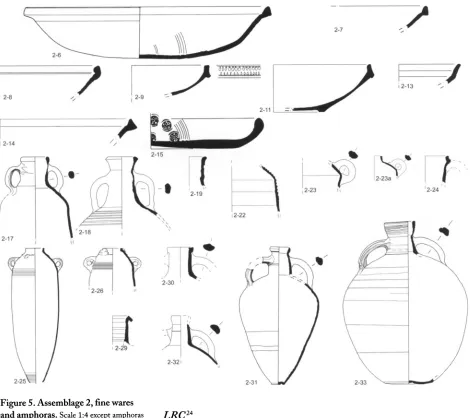
A later horizon is defined by a dumped fill excavated east of the Theater in 1981 (lot 81-19) (see Figs. 5-7).23 It filled the robbing trench of a major east-west wall that extended from the east side of East Theater Street and formed the north side of a shop as it was rebuilt in the fifth century. Wil liams recorded 115 kg of pottery in the main fill; there were 3,400 sherds after mending, including many restored vessels. A northward extension at the west end of this trench is also included here because it had pottery of the same date (lot 81-49). As is commonly the case, none of the coins was datable later than the fourth or early fifth century and the AfRS may also be residual, but the forms of the lamps and of the LRC show that the fill should be dated later than the mid-fifth century, probably as late as the early sixth century.
22. We have considered and dis
carded the possibility that this is the
body of a gray Beisan amphora (Sara? hane type 7A) because the painted decoration is horizontal and confined
to the shoulder, because of the location
of the
ridging, and because the fabric is
indistinguishable with a hand lens from
that of 1-41.
23. The trench was described, and a
preliminary catalogue published,
by Williams in Williams and Zervos
1982, pp. 135-143, fig. 2, pis. 44-46. The conclusions
reported here incor porate a quantified r??valuation of
the pottery, carried out
Coins
81-52 Constantius II (355-361), mint of Siscia (Williams and Zervos 1982, no. 56)
81-53 Constantius II or Julian, mint uncertain
(Williams and Zervos 1982, no. 68a) 81-182 Late Roman
81-183 Late Roman
81-117 and 81-318 illegible fragments
Lamps
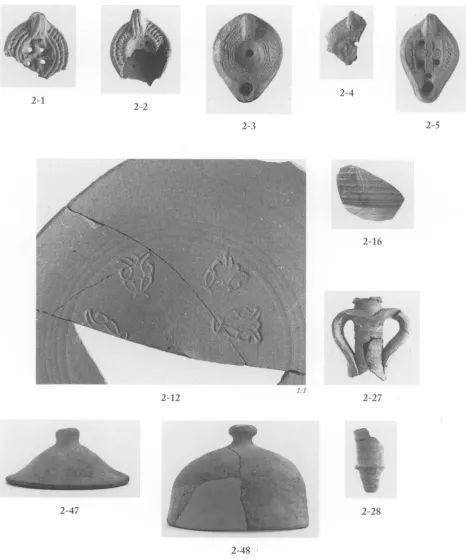
2-1 L-1981-17 Fig. 7
Attic post-glazing lamp with cross monogram on disk and four filling holes (Williams and Zervos 1982, no. 81, p. 142, pi. 45).
2-2 L-1981-16 Fig. 7
Attic post-glazing lamp with plain disk and multiple filling holes (Williams and Zervos 1982, no. 82, p. 143, pi. 45). Signed ET7l|OA within an almond-shaped
double groove; cf. the
glazed lamp Agora VII, no. 938, p. 129. For the top, cf. either
Agora VII, no. 2699 (circular disk) or 2710 (tear-shaped disk), pp. 187-188, pi. 42. 2-3 L-1981-4 Fig. 7
LR Corinthian, imitation of a Corinthian lamp with retouched wreath and panels (Williams and Zervos 1982, no. 79, p. 142, pi. 45); base has an incised cross
within a
single circular groove and indistinct circles in each quadrant.
2-4 L-1981-18 Fig. 7
LR Corinthian, imitation of an Attic lamp with gladiators and two filling holes (Williams and Zervos 1982, no. 80, p. 142, pi. 45). For the discus, cf. the LR Corinthian lamps Corinth IV.2, nos. 1192,1193, fig. 179; Agora VII, no. 320, pi. 9. 2-5 L-1981-3 Fig. 7
LR Corinthian, imitating an Attic post-glazing lamp with cross in a square disk and multiple filling holes (Williams and Zervos 1982, no. 83, p. 143, pi. 45);
base is defined by almond-shaped double grooves that frame an incised branch.
Remaining with the context pottery are four type XXVII and five late type XXVII lamps, which must date no later than the early fourth century; one Attic glazed handle; six Attic post-glazing; three unidentified post-glazing;
four LR Corinthian plus two possible LR Corinthian (including one base imitating a North African lamp, which is contemporary with the pottery but not illustrated).
Fine Wares
AfRS
2-6 C-1981-16 Fig. 5
Dish, Hayes form 61B/87A (Williams and Zervos 1982, no. 61, p. 135, fig. 2,
stamps pi. 45). D. 0.351 m.
7*
^r?
Figure 5. Assemblage 2, fine wares
and
amphoras. Scale 1:4 except amphoras 1:8
LRC24
2-8 C-1981-240 Fig. 5
Rim, Antioch 944p. D. 0.278 m. Cf. also Sara?hane, 27.2, fig. 37 (late fifth
century).
2-9 Lot 81-19:21 Fig. 5
Rouletted rim, Hayes form 3B. D. 0.216 m. 2-10 C-1981-4a,b
Hayes form 3C (Williams and Zervos 1982, no. 62, pi. 44). D. 0.320 m. Half-preserved dish (multiple fragments).
2-11 C-1981-22 Fig. 5
Hayes form 3C (Williams and Zervos 1982, no. 64, p. 137, not illustrated). D. 0.280 m. Dish with nearly complete profile (multiple fragments).
2-12 C-1981-7 Fig. 7
Plate floor with kantharos stamps, Hayes no. 59 (multiple fragments). D. foot
0.118 m.
24. C-1981-17, LRC form 3B
(Williams and Zervos 1982, no. 65,
p. 137, fig. 2), and C-1981-21, LRC form 3C (Williams and Zervos 1982,
no. 63, p. 137, fig. 2), reported as com ing from this fill, come from the stra tum above it and have been omitted here, although they are probably con
? I 2-34 11
i 2-37 \
\ I 2-36 ^
I
t 2-38
j 2-39a \
! 2-39b
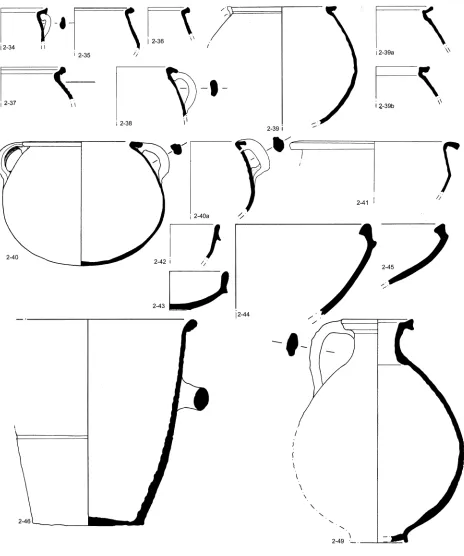
Figure 6. Assemblage 2, cooking pots
and
2-1
2-2
?
2-4
2-3 2-5
2-16
2-12 2-27
2-47 2-28
Figure 7. Assemblage 2. Scale 1:4
except lamps 1:3 and as indicated
Boiotian RS25
2-13 Lot 81-19:34 Fig. 5
Bowl rim. D. 0.168 m. Cf. C-1989-11 (Williams and Zervos 1990, no. 5, p. 339, pi. 61) and 3-16; see also Gregory 1986, fig. 12:3 (Askra ware?).
Imitation AfllS
2-14 Lot 81-19:33 Fig. 5
Rim imitating AfRS Hayes form 82 or 87 or CypRS form 2. D. 0.370 m.
LR Attic
2-15 C-1981-136 Fig. 5
Stamped plate, imitating AfRS forms 61-64 (Williams and Zervos 1982,
no. 66, p. 137, stamps pi. 45).
2-16 Lot 81-19:35 Fig. 7
Partly glazed, wheel-ridged jug with gouged decoration on wall. Cf. Agora V, nos. M 320 or M 357 and M 361, pp. 114,117, pis. 31,33,42, of the early and late
sixth century.
The following other fine wares are also recorded but are probably residual in this robbing trench: AfRS forms 14/17 (lot 81-19:22), 32/58, 50, 59, 53, 61? (stamp no. 36), 62, 67?, 68; LRC forms 1, 3C (Williams and Zervos 1982, fig. 2: D. 0.278 m), 3/4, stamp no. 8e (which could belong to the second half of the fifth century, contemporary with assemblage 2); LR Attic rims as Agora V, nos. M 289 and L 61 (imitations of AfRS forms
59 and 61), and as Agora V, no. M 290.
Amphoras
2-17 C-1981-5 Fig. 5
White, micaceous, cylindrical amphora with red dipinti under both handles
and at base of neck on both sides; regular wheel ridging begins about 0.08 m below edge of shoulder (Slane 2000, p. 304, fig. 6:b). D. 0.068 m. Micaceous, very pale brown fabric (10YR 8/3) fired light reddish yellow (5 YR 7-8/6) on the inte
rior; moderate to abundant, fine, well-sorted, white, gray and red/black26 inclu sions and sparse
larger white grits. Cf. Kenchreai IV, some or all of no. RC 22,
pi. 27\ Arthur 1998, pp. 170-171, fig. 9:1;27 Bowden, Hodges, and Lako 2002, p. 221, fig. 21:13 (from Butrint).
2-18 C-1981-18 Fig. 5
Amphora with widely spaced grooves on shoulder, probably like Agora V, no. M 327, p. 115, pi. 32. D. 0.073 m. Red fabric (2.5YR 5/8) fired light red on
25. The ware is fine, medium hard,
reddish yellow (5YR 6/4 to 6/8 to 7/6)
with a smooth, slightly conchoidal break; sparse, fine, platy, sparkling in
clusions and sparse, rounded, small to medium, spherical, milky white grit.
Some
examples also contain occasional,
small, spherical, subrounded yellow in clusions. Sanders (1999, p.463, fabrics
D and E) had described the fabric as
"probably Attic," but this suggestion has now been superseded by finds from Askra in Boiotia (see n. 53 below).
26. All black where fired very pale
brown; red and black where fired reddish yellow.
27. We have been unable to sub stantiate that the dipinti refer to Icaria (by S amos?), as suggested by Adam
surface; moderate, fine, highly sorted, white, gray, red, and black inclusions and
sparse large white grits; highly micaceous in break parallel to wall but little visible
on wet-smoothed surface. The form of the top is reminiscent of LR
Amphora 2, but the fabric, the
widely spaced grooves on the shoulder, and the narrow body distinguish it. An example of this type was found in a repair of the Roman wall at
Salona (Cambi 1989, fig. 37) and another in the courtyard of the Palace of Galerius in Thessaloniki (Petsas 1968, pi. 343:6 [right], where it is called Byzantine). 2-19 C-1981-139 Fig. 5
LR Amphora 1 rim. Also lot 81-19:1-6, a rim and five handles, all single
fragments.
2-20-22 Lot 81-19:7-9 Fig. 5 (2-22 only)
Loop handles and angular shoulder of Palestinian baggy amphoras. Medium hard, reddish yellow fabric (5YR 6/8) with large pinkish gray or very pale brown
(7.5-10YR 7-8/2) flash outside, granular break; common, small to medium, gray to
orange, glassy, subrounded to rounded, platy to tabular inclusions.
2-23 Lot 81-19:10 Fig. 5
Fractional Palestinian amphoras with collar rim, wheel-ridged shoulder, and
vertical wall. D. 0.070 m. Medium hard, light red (2.5YR 6-7/8) fabric with red dish yellow (7.5YR 7/6) flashes outside, granular break; common, small to me
dium, glassy, orange, subrounded to rounded inclusions; tabular to
spherical and rare
large subrounded, spherical, milky white inclusions. For the complete shape,
see Williams, Macintosh, and Fisher 1974, no. 50, p. 32, pi. 8, with characteristic
vertically painted design; cf. also 3-21,4-20.
2-23a ([C-1981-191], Fig. 5) shows the rim. 2-24 Lot 81-19:11 Fig. 5
Palestinian
carrot-amphora rim; see also 1-24, 4-21. D. 0.119 m. Medium
hard, light red to reddish yellow fabric (2.5-5YR 6/8) with hackly to granular
break; common to abundant, small to medium rounded, spherical, glassy, pale brown sand, rare medium angular, tabular white inclusions. Cf. Bass and van Doorninck
1982, no. P80, p. 186, figs. 8.20, S.22; Agora V, no. M 334, p. 115, pi. 33; Arthur and Orem 1998, fig. 7:3; Maioli and Stoppioni 1989, fig. 8; Reynolds 2000, pp. 390-391, 395, fig. 8:46; Hayes 2003, no. 234, p. 489, fig. 27 (deposit 11, not closely dated).
2-25-26 C-1981-8 and C-1981-19 Fig. 5
Gaza amphoras (Williams and Zervos 1982, nos. 73, 74, p. 140, fig. 3, pi. 44 [nos. 73 and 74 are interchanged in fig. 3]). P.H. 0.752 (2-25); D. 0.107 (2-25), 0.109 m (2-26). Normal brown fabric with sand. These pieces are listed in Majche rek 1995 as examples of his form 3, dated late fifth to late sixth century. 2-27-28 C-1981-141 and C-1981-142 Fig. 7
Double-handled neck and closed toe of m.w.j. (from lot 81-49) (Williams and Zervos 1982, nos. 75, 76, p. 140, not illustrated). Cf. Kenchreai IV, nos. RC 41a, b, p. 124, pi. 35 (mislabeled RC 40a, b).
2-29 Lot 81-19:36a Fig. 5
Amphora with triangular rim. Hard red fabric (2.5YR 4/8) with moder
ate, tiny rounded sand and dark