Cloth Simulation with Adaptive Force Model in Three-
Dimensional Space
Xuan Luo, Gaoming Jiang, Honglian Cong, Yan Zhao
Jiangnan University, Wuxi, Jiangsu CHINA
Correspondence to:
Xuan Luo email: [email protected] ABSTRACT
An adaptive force model is proposed to achieve better performance between the accuracy and the speed of cloth simulation in three-dimensional (3D) space. The proposed force model can be expressed with a general mathematical form demonstrated by the distance between the clothing and the human body. This paper defines how a continuous adaptive area can be established with a shape “block”. It is clarified that, within a specific block, a force model is expressed with the gravity of the clothing, the forces of the adjacent blocks and the anti-force of the human body to the block. In this manner, the force model of the desired clothing can be obtained through a general mathematical expression. The simulations and experimental results demonstrate that the acceptable clothing simulation in 3D space can be achieved with higher speed by saving about 20.2% runtime, and the efficiency of the proposed scheme can be verified.
Keywords: Garment simulation, Force model, General expression, block
INTRODUCTION
Clothing simulation in three-dimensional (3D) space has become increasingly popular in the fields of virtual reality (VR) related to the clothing design, clothing demonstration and computer animation, etc. In addition, along with the development of the internet, applications such as virtual try-on of clothing and 3D games require that efficient and highly accurate models simulate clothing at speeds as high as possible.
In general, clothing simulation can be cataloged into two different types: micro and macro clothing simulation. Micro clothing simulation refers to a demonstration of clothing by simulating the physical characteristics of the internal structures in the yarns [1-3]. Macro clothing simulation neglects the internal physical structures and shows the characteristics of the relationship between the clothing and the human body. This paper proposes the macro clothing
simulation plan.
interpolation based on the determined key parameters. This method speeds up the simulation, but the effectiveness decreases accordingly. Cordier divided clothing into three types using a hybrid model: tight, loose and floating clothes [18]. Different types are related to different models. This method improves the accuracy of the simulation to some extent. Jian Dong Yang solved the corresponding equations with fourth-order Runge-Kutta method [19]. However, the inherent high computation of the fourth-order Runge-Kutta method is still not solved. Chuan Zhou focused on an algorithm for the folding of clothing simulation using a mass-spring model [20]. Matthias Muller provided a method named position based dynamic, which performs according to the position of the vertex of the clothing. It analyzes gravity while ignoring other forces [21]. Apart from gravity, this method does not demonstrate the fold of the clothing in detail due to the absence of other forces. In order to simulate clothing, Dongyong Zhu segmented the human body into different segmentation models and demonstrated it requires more computation [22].
In summary of macro clothing simulation, the above methods require more computation because of different equations involved. They introduce negative effects into the development of clothing simulation in real-time situation such as virtual try-on via the internet.
This paper proposes an adaptive force model in 3D space based on the distance between the desired clothing and the human body to alleviate the problem. The distance is expressed in a general mathematical form. Unlike conventional methods [18, 22], the proposed plan should not classify the segmentation of clothing according to the human body in advance. The distance can be determined by the lower and upper range in the proposed general expression. With the distance, a force model in 3D space is also derived considering all possible forces including gravity, which can be beneficial to demonstration of the folding of the clothing. Using the force model, the displacement along each axis in 3D space can be computed. In this manner, the deformation of the clothing on the human can be demonstrated. By adjusting the corresponding parameters, a faster and more accurate simulation can be achieved. Experimental results confirm the efficiency of the proposed scheme.
MODEL AND ALGORITHM
As claimed above, the proposed scheme in this paper aims to demonstrate a more accurate and faster simulation in 3D space. This method is performed in different steps. A derivation of a general
mathematical expression for the distance between the clothing and the human body should be determined. For clarity, a concept 'block' is defined by referring to the continuous area. A block can be formulated as a force model expressed with a general mathematical form considering all possible forces including gravity and other forces within it. By solving the force model of the block, the displacement of the clothing simulation can be computed so a demonstration of clothing deformation in 3D space can be formed. In the end, the corresponding parameters in the general expression can be slightly adjusted until optimum performance is obtained.
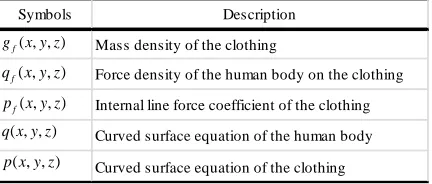
For further clarity, some symbols are defined in Table I.
Block Determination
In order to obtain improved accuracy speed of the simulation, a “block” is defined in this paper. This indicates a continuous area which represents the distance between the clothing and the human body. To be specific, for the kthblock, the corresponding set Sk can be expressed by Eq. (1), where
krepresents the index of a block, || ||⋅ 2 denotes
2-norm, ( )k L
V is the predefined value for the lower range and ( )k
H
V is for the upper range, respectively.
( ) ( )
2 ( , , )
arg min || ( , , ) ( , , ) ||
k k
k k
L H
x y z S S
V p x y z q x y z V
⊂
≤ − ≤
(1)
From Eq. (1), one can clearly see that the size of the
kth block can be increased and decreased by
adjusting the lower range value and the upper range value
( )k H V
. For example, by increasing the upper
value
( )k H V
or decreasing the lower value
( )k L V
, the continuous area of the kth block can be expanded. As a result, the simulation can speed up while the accuracy of the simulation decreases accordingly. In this manner, a better balance between the accuracy and the speed of the simulation can be achieved by
presetting the parameters
( )k L V
and
( )k H V
TABLE I. Symbols and Description.
Symbols Description
Mass density of the clothing
Force density of the human body on the clothing Internal line force coefficient of the clothing Curved surface equation of the human body Curved surface equation of the clothing
( , , )
f
g x y z
( , , )
f
q x y z
( , , )
f
p x y z
( , , ) q x y z
( , , ) p x y z
Force Model of a Block
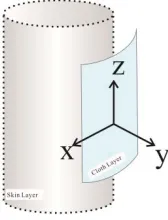
In general, a block can be modeled in 3D space as depicted in Figure 1, where the z-axis is in the opposite direction of gravity, and thex-axis andy -axis constitute a plane perpendicular to z-axis.
For discussion purposes, a block has the same displacement along a given axis, that is, ∆x( )k represents the displacement of thekthblock along the
x -axis, ∆y( )k and ( )k z
∆ denote the displacements
along y− and z -axis. A curve as an equation describing the boundary in the kth block is written as
( )
( , , )
k
p x y z
derived from the curved surface equation of the clothing p x y z( , , ) in Table I. The curved surface equation of the human body in thekthblock is
expressed with the symbol
( )
( , , )
k
q x y z
, which is identical to the expression q x y z( , , ) where the coordinate pair ( , , )x y z is in the set Sk from Eq. (1).
FIGURE 1. Force model in 3D space.
From the curved surface of the human bodyq x y z( , , ), the normal vector of the surfaceeq can be computed
based on Eq. (2).
( , , )
q
q q q
x y z
∂ ∂ ∂ =
∂ ∂ ∂
e (2)
Subsequently, the angles of the vector eqalong the x−,y−and z−axes, that is, αq,βqandγq, can be
obtained using Eq. (3).
2 2 2 / arccos( ) || || / arccos( ) || || / arccos( ) || || q q q q q q q x e q y e q z e α β γ ∂ ∂ = ∂ ∂ = ∂ ∂ = (3)
Similarly from the curved surface of the clothingp x y z( , , ), the normal vector of the surface,
p e
, and the corresponding angles along three axes,
p
α ,βpandγp, can be determined using Eq. (4).
2 2 2 ( , , ) / arccos( ) || || / arccos( ) || || / arccos( ) || || p p p p p p p
p p p
x y z
p x e p y e p z e α β γ ∂ ∂ ∂ = ∂ ∂ ∂ ∂ ∂ = ∂ ∂ = ∂ ∂ = e (4)
To maintain the balance of force along z−axis, Eq. (5) can be deduced for the kth block with set Sk ,
where gis the gravity constant g=9.8N kg/ .
( , , )
( , , )
( ) ( ) ( , , )
( , , ) cos( ) ( , , )
( , , ) cos( ) ( , , ) 0
k
k
k
f q
x y z S
f x y z S
k k
f p
x y z S
q x y z dxdydz
g g x y z dxdydz
p x y z q x y z dxdydz z
γ γ ⊂ ⊂ ⊂ − ⋅ − ⋅ ∆ =
∫∫∫
∫∫∫
∫∫∫
(5)To simplify the expression of displacement the along
z-axis, let
( , , )
( , , )
( )
( , , )
( , , ) cos( )
( , , )
( , , ) cos( ) ( , , )
k
k
k
Fz f q
x y z S
Fz f
x y z S
k
Fz f p
x y z S
Q q x y z dxdydz
G g g x y z dxdydz
P p x y z q x y z dxdydz
Rewriting Eq. (5) in a simpler form, the following can be obtained:
( )k Fz Fz
Fz
Q G
z
P
−
∆ = (6)
The displacements along the x and y axes, ( )k x
∆ and
( )k y
∆ , can be expressed as in Eq. (7) and the corresponding symbols can be defined using Eq. (8).
( )
( )
k Fx
Fx Fy k
Fy
Q x
P Q y
P
∆ = −
∆ = −
(7)
( , , )
( )
( , , )
( , , )
( )
( , , )
( , , ) cos( )
( , , ) cos( ) ( , , )
( , , ) cos( )
( , , ) cos( ) ( , , )
k
k
k
k
Fx f q
x y z S
k
Fx f p
x y z S
Fy f q
x y z S
k
Fy f p
x y z S
Q q x y z dxdydz
P p x y z q x y z dxdydz
Q q x y z dxdydz
P p x y z q x y z dxdydz
α
α
β
β ⊂
⊂
⊂
⊂
=
=
=
=
∫∫∫
∫∫∫
∫∫∫
∫∫∫
(8)
A Special Case
In most cases, the clothing does not contact the human body, as with the bottom of a skirt as shown in Figure 2. In this case, the displacements along the three axes can be expressed using Eq. (9).
( )
( )
( ) 0 0
k k
k Fz
Fz
x y
G y
P
∆ =
∆ =
∆ = −
(9)
From Figure 2 and Eq. (10), it is deduced that the force components of the human body on the clothing are zeroes along two directions, which makes ( )k
x ∆
and ( )k y
∆ becoming equal to zero. The displacement that exists along z-axis is determined by the gravity and the boundary of this block.
FIGURE 2. A special case force model in 3D space.
The actual clothing simulation in this case is shown in Figure 3. From the figure, it is observed that there are folds in the bottom part of the skirt, with the distance in this part being larger than a specific value. When this part is described as a block using Eq. (1), the effects of the fold in the bottom part of the skirt will be lost. Therefore, in this case, the lower and upper range in the general expression for the distance in Eq. (2) should be set in advance more accurately so that the effects of the fold in the clothing will be accurate and abundant as shown in Figure 3.
FIGURE 3. Bottom of the skirt in 3D space.
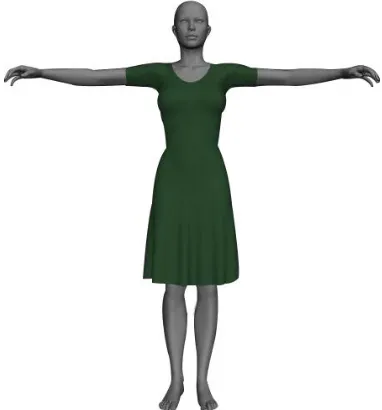
EXPRIMENTAL RESULTS AND SIMULATION To verify the performance of the proposed scheme, a skirt is chosen to demonstrate the effects of the algorithm.
Distance and Block Determination
TABLE II. Range values for the general expression of the distance. Index Lower range value Upper range value
1 0 0.05
2 0.05 0.075
3 0.075 0.1
4 0.1 0.15
5 0.15 0.2
6 0.2 0.25
7 0.25 0.35
8 0.35 0.45
9 0.45 0.5
10 0.5 0.75
11 0.75 1
12 1 1.25
13 1.25 1.5
14 1.5 1.75
15 1.75 2.5
16 2.5 3.5
17 3.5 5
18 5 7
19 7 9
20 9 ∞
Using Eq. (1) and the lower and upper range values in Table II, the desired blocks of the clothing can be computed and illustrated, as shown in Figure 4. From
Figure 4, it is obvious that the shapes of different blocks vary accordingly Compared to the conventional methods like triangulated surfaces in [2], the proposed scheme forms different and irregular shapes since the block is a continuous area expressed in Eq. (1) constrained by the lower and upper range values in Table II. The sizes and shapes can vary accordingly to the lower and upper range values preset in Table II.
FIGURE 4. Block determination using the proposed scheme.
Force Model and Clothing Simulation
The force model in 3D space can be computed using Eq. (2) to Eq. (9). To illustrate the resultant forces of the clothing intuitively, a color demonstration legend is used, as shown in Figure 5. From the legend in
Figure 5, it can be seen that the color lying in the bottom of the legend represents a small resultant force, while the color at the top of the legend denotes a large force. When all material in the skirt is assumed to be identical, the forces on the shoulder and the chest are large. The clothing located in these parts is tight to the human body; therefore, the major forces impacting the clothing are gravitational force on the clothing and the counterforce of the human body on the clothing. The bottom of the clothing does contact the human body, thus the major force on the clothing is gravity. From the above analysis, the resultant forces on the shoulder and chest should be larger than those located at the bottom of the skirt. From Figure 5,the results are in accordance with the analysis.
FIGURE 5. Force distribution of the clothing.
Subsequently, the displacement along the three axes from Eq. (6) and Eq. (9) can be observed at the bottom of the skirt using the simulation results depicted in Figure 6.
Simulation Speed Comparison
desired skirt, the total time for simulation is 630 ms with the method in [22]. In a similar manner, the proposed scheme in this paper requires 503ms, a savings of about 20.2% in time.
Comparison of the experimental results and the simulation show that the proposed scheme can achieve acceptable simulation effects and effectively demonstrate the folds of clothing. In addition, the speed of the simulation is faster than that of the referring method. In summary, the proposed scheme demonstates improved accuracy and simulation time.
FIGURE 6. Clothing simulation in 3D space.
CONCLUSION
In this paper, an adaptive force model is proposed to obtain improved simulation accuracy and time. The distance can be determined using the lower and upper range in the proposed general expression. Using this distance range, a force model in 3D space is derived considering all the possible forces including gravity. This model effectively demonstrates the folds in clothing. Using this force model, the displacement along each axis in 3D space can be computed. In this manner, the deformation of the clothing on the human can be demonstrated. By adjusting the corresponding parameters, improved accuracy and shorter simulation times can be achieved. Experimental results show that the proposed scheme effectively simulates clothing in 3D space and simulation run time can be reduced as much as 38% compared to a reference method.
ACKNOWLEDGEMENT
The authors acknowledge the financial support from the Standard and mode of intelligent manufacturing, Ministry of Industry and Information Technology of the People’s Republic of China1064130201160660, Innovation fund project of CIUI (Cooperation among Industries, Universities & Research Institutes) Jiangsu Province BY 2016022-09, National Science Foundation of China 61602212 and A Project Funded by the Priority Academic Program Development of Jiangsu Higher Education Institutions (PAPD)
REFERENCES
[1] Choi, K., Aid Lo, T. An energy model of plain knitted fabric, Textile Research Journal. 2003, 73:739–748.
[2] Gabriel Curio, Jorge Lopez-Moreno Efficient Simulation of knitted cloth using persistent contacts, SCA’S15 Proceedings of the 14th ACM SIGGRAPH 2015 55-61.
[3] Kaldor J.M, James D L, And Marcher Efficient yarn-based cloth with adaptive contact linearization. ACM T Graph (SIGGRAPH 10)29, 4, 105.
[4] Provot. Deformation constraints in a mass-spring mode to describe rigid cloth behaviour, Proctor Graphics Interface Quebec, 1995, 147-154.
[5] Zhong Yue-qi. Redressing three-dimensional garments based on pose duplication, Textile Research Journal, 2010, 80(10):904-916. [6] Liu Hui, Chen Chun Shi, Bailee, simulation of
3D garment based on improved spring-mass model, Journal of Software, 2003, 14(3):619-627.
[7] Li Ji-tome Jun-Tao, Wang Yang-shingled al. Fitting 3D garment models onto individual human models, Computers and Graphics, 2010, 34(6):742-755.
[8] Baraff D, Witkin A Large steps in cloth simulation. Proceedings of the 25th Annual conference on Computer Graphics and Interactive Techniques. New York; ACM Press.1988:43-54.
[10] Choi, KJ, Ko, HS Stable but responsive cloth, ACM Transactions on Graphics.2002, 21(3):604-611.
[11] Terzopoulos D, Platt J, Barr A, Fleischer K, Elastically deformable models , Computer Graphics (SIGGRAPH’870,1987,21(4):205-214.
[12] M. Aono, D.E. Breen and M.J.Wozny. Fitting a Woven Cloth Model to a Curved surface: Dart Insertion., Computer Graphics and Applications,1996,16:60-70.
[13] M. Carignan, Y. Yang, N. M. Thalmann and D.Thalmann.Dress Animated synthetic actors with complex deformable clothes.,Computer Graphics,1992, 26(2): 99-104.
[14] N-Magnenat, Thalmann, Y.Yang, Techniques for cloth animation. New trends in animation and visualization, 1991, 243-256. [15] Yang Ying, Thalmann NM, Thalmann
D,Three-Dimensional garment design and animation, anew design tool for the garment industry,Computers in Industry, 1992, 19(3):185~191.
[16] Y.M. Kang, H.G.Cho, Bilayered approximate integration for rapid and plausible animation of virtual cloth with realistic wrinkles, Proceedings of Computer.2001, 17(3):147-157.
[17] Huamin Wang Example-Based wrinkle synthesis for clothing animation, ACM SIGGRAPH 2010 conference proceedings 2010 107:1-8.
[18] F.Cordier, N.Magnenat-Thalmann. Real-time animation of dressed virtual humans, Computer Graphics Forum 2002, 21(3): 327-336.
[19] Yang Jian dong, Shang Shuyuan. Cloth modeling simulation based on mass spring model, Applied Mechanics, 2013, 310:676-683.
[20] Zhou Chuan, Jin Xiaogang, Plausible cloth animation using dynamic bending model, Progress in Natural Science18 (2008):879-885.
[21] Müller M, Chentanez N, Wrikle meshes. Proceedings of rhe 2010 ACM.
[22] Dongyong Zhu,Zhong Li. Dynamic Garment simulation based on hybrid bounding volume hierarchy, Autex Research Journal, 2016, 16(4):241-249.
AUTHORS’ ADDRESSES Xuan Luo
Gaoming Jiang Honglian Cong Yan Zhao