
Volume-6 Issue-1
International Journal of Intellectual Advancements
and Research in Engineering Computations
Synthesis and Characterization of AA6063-3 wt. % TiC Composites
N.Nithin Nanda
1, M.Parthiban
1, A.V.Balan
1, S.Saravanan
2.1
Department of Mechanical Engineering, K.S.R College of Engineering, Tiruchengode - 637 215.
2
Department of Mechanical Engineering, St. Joseph’s College of Engineering and Technology,
Tanjore-624 204.
[email protected].
Abstract-The present work aims to synthesize AA6063-3 wt. % TiC composite through stir casting route and to analysis the microstructure. These combinations are expected to be used in transportation, construction and similar engineering industries. The addition of 3 wt. % of TiC as the particulate in the properties of AA6063, the microstructure can be greatly changed. A detail study of the structure of the composites was carried out.
Index words - Al-TiC composite, stir casting, SEM.
I. INTRODUCTION
Composite refers to a material system which is composed of a reinforcement distributed in a matrix and which derives its distinguishing characteristics from the properties of its reinforcement, from the geometry and architecture of the reinforcement as well as from the properties of the interfaces between different reinforcement [1]. Metal matrix composites (MMCs) have many advantages over monolithic metals including higher specific modules, higher specific strength, better properties at elevated temperatures, and lower coefficient of thermal expansion, in addition to better wear resistance. Aluminium is favored as matrix materials in MMCs because of its low density, easy fabricability and good engineering properties. Aluminium MMCs can be reinforced with various oxides, carbides, nitrides and borides in particulate such as SiC, Al2O3, B4C, TiC, MgO, TiO2, AlN, BN and Si3N4[2-6]. Where as in reinforcement TiC particles projected significance due its predominant wettability and strong interfacial bonding with matrix
blocky type Al3Ti forms. The temperature is increased the blocky nature of Al3Ti changes to needle like indicating release of Ti to a greater extent and as a result more and more TiC particles form. Al-TiC composites were produced by a casting route assisted by self-propagating high-temperature synthesis [14]. Fluxes were used to activate in reaction in the aluminum melt and promote higher Ti and C yield in the composites. The TiC stoichiometry corresponded to C/Ti ratios from 1.0 to 0.8. The in situ synthesized TiC particles possess a metastable FCC crystal structure with an atomic composition of TiC08 and a lattice parameter of 0.431nm [15]. The typical ingot metallurgy microstructures exhibit aggregates of TiC particle phase segregated generally at the Al sub grain or grain boundaries and consisted of fine particles of 0.2-1.0nm. After re-melting of the ingots and hence rapid solidification, the microstructures formed under certain thermal history conditions contained uniform fine-scale dispersion of TiC phase particles an aluminum supersaturated matrix.
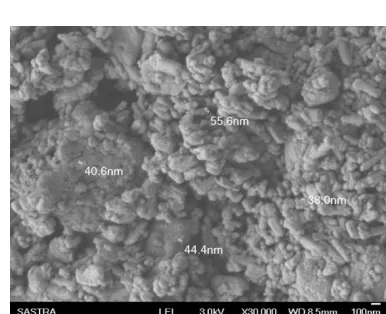
II. EXPERIMENTAL WORK A typical chemical composition and properties of AA6063 is presented in Table 1 and 2 respectively. The SEM image of TiC powder is shown in figure 1 and the size of the particles is noted in the image and properties are presented in table 2.The reinforcement based on TiC particulate is attractive for the aluminum matrix because of its good wettabilityby aluminum, which can result in a clean and strong interface [15]. The Al: TiC composite at a temperature close to the melting point of aluminum, the strength and modulus can be increased substantially along with a corresponding decrease in ductility. The quantity of AA6063 and TiC particles required to produce composites having 3 wt. % of TiC. AA6063 was melted in a crucible by heating it in a furnace at 750°C for three to four
AA6063-3 wt. % TiC composite is shown in figure 2. The TiC particles were preheated at 1000ºC to make their surfaces oxidized. The furnace temperature was first raised above the liquidus temperature of Aluminum near about 750ºC to melt the AA6063 completely and was then cooled down just below the liquidus to keep the slurry in semi solid state. The preheated TiC was added at this temperature and stirring of slurry was performed manually for 3-5 minutes. The composite slurry was then super heated to 720oC and a second stirring performed by mechanical stirrer to improve the distribution of the TiC particles in the molten of AA6063. The molten composite was then cast into prepared steel molds. The presence of reinforcement throughout the specimen was inspected by cutting the casting at different locations and under microscopic examination [8].
Table1. Chemical composition of the AA 6063
AA6063 Si Mg Fe Cu Mn Al
Weight
(%) 0.44 0.56 0.46 0.02 0.03 Bal.
Table 2. Properties of AA6063 and TiC powder
III. RESULTS AND DISCUSSION
Figures 3-5 show the microstructures of as cast AA6063-3 wt. % TiC composite. The reinforcement particles have shown little clusters forming fairly uniform particle distribution in composite containing 3 wt. % TiC.
AA6063 TiC
Density ( kg/m3) 2700 4935
Melting point (°C) 650 3075
Yield Strength(MPa) 48 114
Fig. 2 Experimental setup of stir casting process [9].
However, at lower magnifications of optical microscope (Figure 3a & b), the samples seem to have a more uniform distribution of the TiC reinforcement. But with an increase in the magnification, the presence of particle agglomerations is clearly visible as in Figure 4a & b. Another observation in Figure 5a & b images is the breakdown of TiC aggregates into smaller individual particles. The shear force applied on the composite mixture by the impeller is the main reason to break down most of the TiC aggregates and overcome its cohesive force. The rotation of the stirrer generates a vortex through which the TiC particles are drawn into the melt. Moreover, the rotation of stirrer can create high and local shear forces that are exerted on the clusters helping to break down TiC cluster particles. Under a high shear and high intensity of turbulence, liquid metal can penetrate into the clusters of the particles and displace the individual particles apart. During the stirring and mixing process, the air bubbles are sucked into the melt via the vortex created. The TiC particles tend to become attached to these air bubbles would envelope the reinforced particles, leading to the formation of particle porosity clusters. The interfaces between TiC and the AA6063 matrix are atomically abrupt, and no impurities were detected.
It is suggested that the interfacial characteristics depend on the size of the particles and on their orientation with respect to neighboring Aluminum grains. Figures 5 can be seen that TiC reinforcement particles were broken to smaller particulates. Most of the particulates may not appear in the figure because their sizes are less. It shows the micrograph of as cast AA6063-3 wt. %TiC, the light gray areas indicate the TiC particles that are embedded in the AA6063. The starting coarse TiC particles are broken down to lesser size and their distributions are more uniform compared to as cast structure shown in Figure 4. It achieved a homogeneous distribution of TiC in the AA6063, as it is one of the problems associated with the production of cast MMCs.
Fig. 3 SEM micrographs of AA6063-3 wt. % composite at magnification of 1µm.
Fig.4 SEM micrographs of AA6063-3 wt. % composite at magnification of 10µm.
Fig.5 SEM micrographs of AA6063-3 wt. % composite at magnification of 100µm.
IV. CONCLUSIONS
The conclusions drawn from the present investigation are as follows:
AA6063-3 wt. % composite have been successfully synthesized using stir casting technique.
The uniform distribution of the reinforcement is seen in the microstructure of the AA6063-3 wt. % composite was carried out using optical microscope.
REFERENCES
[1]. A.Albiter, C.A.Leon, R.A.L.Drew, and E.Bedolla, (2000). “Microstructure and
heat-treatment response of Al-2024: TiC
composites”, Materials Science and
Engineering, A289, pp. 109-115.
[2]. Muhammad Hayat Jokhio, Muhammad Ibrahim Panhwar, and Mukhtiar Ali Unar, (2011). “Manufacturing of aluminum
composite material using stir casting
process” Mehran University Research
Journal of Engineering & Technology, Vol. 30(1), ISSN 0254-7821.
[3]. Peijie Li, Kandalova, Nikitin, Makarenko, A.R.Luts, and Zhang Yanfei, (2003).
“Preparation of Al-TiC composites by self-propagating high-temperature synthesis”,
Scripta Materialia 49, pp. 699-703.
[4]. Rai, R.N. Rao, A.K.P. Dutta, G.L. Chakraborty, (2013). “Forming behavior of
Al-TiC in-situ composites”, Mater. Sci.
Forum, 765, pp. n418-422.
[5]. Ram Naresh Rai, G.L.Datta, Chakraborty, and A.B.Chattopadhyay, (2006). “A study on
the machinability behavior of Al-TiC
composite prepared by in situ technique”,
Materials Science and Engineering A 428, pp. 34-40.
[6]. Ranjit Bauri, (2009). “Synthesis of Al -TiC
in-situ composites: Effect of processing
temperature and Ti:C ratio,” Trans. IIM Vol.
62(4-5), pp. 391-39.
cold upset forging”, Rare Metals, 33:6 pp. 686-696.
[8]. M.Ravichandran, A.Naveen Sait and V.Anandakrishnan, (2015). “Synthesis and
forming characteristics of Al-TiO2 powder metallurgy composites during cold upsetting
under plane stress conditions”, Journal of
Sandwich Structure and Materials, 17:3 pp. 278-294.
[9]. Saravanan, S., Senthilkumar, P., Palanisamy, T., Ravichandran, M., Anandakrishnan,V., Sankar, S., Balan, A.V, (2017). “Accelerated
short-term techniques to evaluate corrosion
in TiC reinforced AA6063 composites”, J.
Adv. Chem. 13(10), 5905-5913.
[10].Saravanan S, Senthilkumar P, Ravichandran M, Anandakrishnan V, (2017). “Mechanical,
electrical and corrosion behavior of
AA6063/TiC composites synthesized via stir
casting route”, J. Mater. Res. 32(3), 606-614.
[11].Surappa, MK, (2003). “Aluminum matrix
composites: challenges and opportunities,”
Sadhana Vol. 28, Parts 1 & 2, pp. 319-334. [12].X.C.Tong, (1998). “Fabrication of in situ
TiC reinforced aluminum matrix composites: part I microstructural characterization”,
Journal of Materials Science 33, pp. 5365-5374.
[13].G.S.Vinod Kumar, B.S.Murty, and M.Chakraborty, (2005). “Development of
Al-Ti-C grain refiners and study of their grain
refining efficiency on Al and Al-7Si Alloy”, J.
Alloys Compd., 396, pp.143-150.
[14].M.N.Wahab, A.R.Daud and M.J.Ghazali, (2009). “Preparation and characterization of
stir cast-aluminum nitride reinforced
aluminum metal matrix composites”,
International Journal of Mechanical and Materials Engineering, Vol. 4(2), pp. 115-117.
[15].B. Yang, Y.Q. Wang, and B.L. Zhou, (1998). “The mechanism of formation of TiB2
particulates prepared by in situ reaction in
molten aluminum”, met. Mater. Trans. B, 29,
![Fig. 2 Experimental setup of stir casting process [9].](https://thumb-us.123doks.com/thumbv2/123dok_us/8382931.1679293/3.612.334.532.421.604/fig-experimental-setup-stir-casting-process.webp)
