Effect of Elastane Denier and Draft Ratio
of Core-Spun Cotton Weft Yarns on the
Mechanical Properties of Woven Fabrics
Bilal Qadir, Tanveer Hussain, PhD, Mumtaz Malik, PhD
National Textile University, Faisalabad, Punjab PAKISTAN
Correspondence to:
Tanveer Hussain email: [email protected]
ABSTRACT
Elastane percentage in the core-spun cotton yarn of a specific linear density can be affected in two ways: either by changing the elastane denier or the draft ratio. The purpose of this study was to find out whether different mechanical properties of fabrics woven from such yarns simply depend upon the elastane percentage or whether the method of achieving a desired elastane percentage has specific effects. It was found through regression analyses that both the elastane denier and the draft ratio are almost equally important for fabric tear strength and stretchability, whereas the fabric tensile strength is predominantly influenced by the elastane denier while the fabric recovery after stretch is mainly influenced by the elastane draft ratio.
Keywords: elastane fibers; core-spun yarn; cotton;
mechanical properties; woven fabrics
INTRODUCTION
Elastane fibers belong to the class of synthetic fibers comprising at least 85% by weight of segmented polyurethane. Elastane fibers are characterized by superior stretch (up to a factor of 4 to 8) and excellent elastic recovery properties. Elastane fibers are mostly used in conjunction with other fibers to achieve controlled stretch and recovery properties and to protect the elastane from mechanical damage [1, 2, 3]. Core-spun cotton yarns, with elastane component in the core and cotton in the sheath, have become quite popular in the textile industry, because of enhanced comfort and performance characteristics as compared to the conventional yarns. The elastane filament in the core provides the stretch and recovery properties which allow the wearer free movement even in tight-fitting attire. The cotton fibers covering the elastane core provide the necessary tactile aesthetics to the wearer along with thermo-physiological comfort.
Core-spun yarns have been the subject of investigation by several researchers in the past. Core ring spinning on a modified ring frame, with special guiding devices and feeder rollers, is the most commonly used method to produce core-spun yarns containing elastane as a core [4]. The effect of elastane draw ratio, fineness, feed-in angle and migration of elastane inside the core yarn was investigated on the structure and elastic recovery of the core-spun cotton yarns [5, 6]. Lou et al. [7] used a
multi-section drawing frame and ring spinning frame to produce core-spun polyester yarns under various processing conditions, and elastane draw ratio was optimized to improve the breaking tenacity and elongation of the yarn. Babaarslan [8] compared the mechanical properties of polyester/viscose core spun yarns and conventional polyester/viscose staple yarns. Babaarslan and Celik [9] also studied the effect of feeding position of elastane filament inside the core yarn on the properties, structure and performance of yarns. Miao et al. studied the
influence of spinning parameters on core yarn sheath slippage [10]. Dhouib et al. studied the effect of
elastane ratio on the mechanical properties of cotton covered elastane core-spun yarns [11]. Other researchers have also worked on the spinning methods other than modified ring spinning for producing core-spun yarns [12-14]. In rheological modeling of elastane core-spun yarns, it has been established that their viscoelastic behavior is significantly affected by the elastane draft during spinning [15].
elastane-containing yarns has also been investigated [17]. In a study on stretch and bagging behavior of denim containing elastane yarns, it was concluded that the amount of elastane significantly improves the denim comfort [18]. In another study on the effect of elastane draft ratio and yarn twist coefficient, it was found that the bagging fatigue of woven fabrics is reduced by using higher elastane draft and lower twist coefficient [19]. The effect of elastane fiber on the structural mobility of the woven fabrics has also been studied, and it is reported that the fabric structural mobility may be guaranteed by using elastane fibers in both fabric directions [20].
The aim of this study was to investigate the effect of elastane denier and draft ratio on the tensile, tear, stretch and recovery properties of woven fabrics containing elastane yarn along the weft direction. The purpose was to determine not only the positive or negative effect of elastane percentage on the mechanical properties of the fabric but also to see whether the method of changing the elastane percentage also has some significance.
EXPERIMENTAL
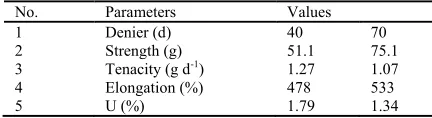
The properties of cotton and elastane fibers used for making the weft yarn for this study are given in Table I and Table II respectively. The raw cotton was
processed through the blow room line (Trutzschler), card machine (Trutzschler), breaker drawing frame (Toyoda DX-8), finisher drawing frame (Rieter RSB D-22), rovings frame (Toyada FL-16) and ring frame
(Toyoda RY) with special core-yarn insertion attachment by PINTER SA, Spain.
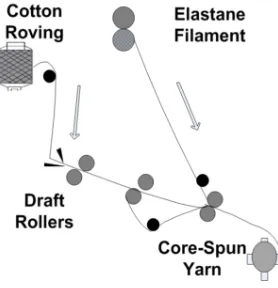
The principle of core-spinning is depicted in Figure 1. The elastane filament goes in the core of the yarn
while the fibers coming from the cotton roving provide a sheath to the elastane core. Two major parameters which were investigated in this study were the linear density or the denier of the elastane filament and the draft or draw ratio of the elastane filament used in the yarns. Two different elastane deniers (40 and 70) were used, each at five different draft ratios to make the core-spun weft yarns of 16/1 Ne (36.9 tex) linear density. For warp, 16/1 Ne (36.9 tex) conventional cotton yarns (without elastane) were used for making the woven fabric samples.
TABLE I. Properties of cotton fibers used in this study.
No. Parameters Values
1 UHML (mm) 27.5
2 Micronaire (µg in-1) 4.6
3 Tenacity (g d-1) 3.3
4 Elongation (%) 4.4
5 Maturity index 0.89
6 Uniformity Index (%) 83.3
7 Rd value 74.2
8 +b value 9.1
TABLE II. Properties of elastane fibers used in this study.
No. Parameters Values
1 Denier (d) 40 70
2 Strength (g) 51.1 75.1
3 Tenacity (g d-1) 1.27 1.07
4 Elongation (%) 478 533
5 U (%) 1.79 1.34
TABLE III. Properties of core-spun weft yarns produced with different denier and draft ratios.
No. Elastane Denier
Elastane Draft
Elastane (%)
Yarn Tenacity
(cN tex-1) Yarn Elongation (%) Yarn Lea Strength (Kg) Yarn IPI Yarn Hairiness
1 40 2.1 5.74 12.47 5.08 55.338 67.30 8.21
2 40 2.4 5.02 12.61 5.29 56.699 95.80 8.01
3 40 2.7 4.46 12.76 5.83 57.606 90.70 7.86
4 40 3.0 4.02 12.98 5.99 58.060 110.0 7.68
5 40 3.3 3.65 12.68 5.22 56.699 55.70 8.06
6 70 2.7 7.81 11.85 5.91 45.813 122.9 7.69
7 70 3.0 7.03 12.07 6.23 47.627 136.6 7.53
8 70 3.3 6.39 12.30 6.48 48.988 112.5 7.17
9 70 3.6 5.86 12.12 6.32 48.081 152.6 7.29
FIGURE 1. Core-spinning principle.
For weaving, warping of the 16/1 Ne (36.9 tex) carded cotton warp yarn was done on BENNINGER BEN-DIRECT warping machine at a warping speed of 800 meters/minute. Warp sizing was done on BENNINGER BEN-SIZETEC sizing machine. The amount of warp sizing (comprising starch and PVA) was 8%. All the fabric samples were woven on TSUDAKOMA ZAX PROFESSIONAL 9100 loom at a speed of 700 picks per minute. Warp ends per cm were 274, picks per cm 122, warp and weft yarn counts 16Ne (36.9 tex), weave design 3/1 Z-Twill and fabric width 63 inches. Ten fabric samples were woven, each with different weft yarns containing elastane as given in Table III. All the ten woven
fabric samples were desized together at 90°C, followed by rinsing and washing.
The desized fabric samples were conditioned in standard atmospheric conditions (temperature 20 ± 2 °C, 65 ± 2% relative humidity) for 24 hours. Mass per unit area of the fabric samples in g/m2 (GSM) was determined in accordance with ASTM D3776. Tear strength measurements of the fabric samples were carried out on Elmendorf tear tester (Thwing Albert TA-300) in accordance with ASTM D1424. Tensile strength and elongation measurements of the fabric samples were carried out on tensile tester (SDL ATLAS) in accordance with ASTM D5035. Stretch and growth measurements of the fabric samples were carried out on Win-Tex instrument in accordance with ASTM D3107.
Multiple linear regression equations were used to estimate relationship of the elastane denier and draft with fabric properties. The regression equations were estimated using general regression option of the MINITAB® 16.1.0 statistical software package. The general regression option uses the ordinary least squares (OLS) method for estimating the regression equations. In this method, the estimated equation is calculated by determining the equation that minimizes the sum of the squared distances between the sample's data points and the values predicted by the equation.
RESULTS AND DISCUSSION
A summary of the results depicting the effect of different elastane deniers and draft ratios of the weft yarns on various mechanical properties of the woven fabrics is given in Table IV.
TABLE IV. Effect of elastane denier and draft of the weft yarn on the mechanical properties of the woven fabric.
No. Denier Draft Ratio
Elastane (%) Fabric GSM
Tear Strength (N)
Tensile Strength (N)
Stretch (%) Recovery (%)
1 40 2.1 5.74 351 (1.4*) 20.0 (0.5) 338 (3.9) 21.8 (0.3) 93.1 (0.1)
2 40 2.4 5.02 355 (1.3) 18.7 (0.3) 352 (4.3) 23.1 (0.3) 92.8 (0.1)
3 40 2.7 4.46 361 (2.6) 16.5 (0.4) 365 (3.4) 24.4 (0.3) 92.4 (0.1)
4 40 3.0 4.02 368 (2.0) 15.1 (0.4) 374 (3.1) 25.8 (0.3) 92.0 (0.1)
5 40 3.3 3.65 372 (1.3) 12.4 (0.5) 384 (3.3) 27.2 (0.3) 91.5 (0.1)
6 70 2.7 7.81 419 (1.5) 22.6 (0.5) 299 (4.1) 32.5 (0.3) 93.3 (0.0)
7 70 3.0 7.03 422 (1.3) 20.2 (0.5) 312 (2.8) 33.8 (0.3) 93.1 (0.1)
8 70 3.3 6.39 426 (1.8) 18.7 (0.5) 320 (2.7) 35.1 (0.3) 92.7 (0.1)
9 70 3.6 5.86 432 (2.5) 17.1 (0.4) 333 (3.3) 36.5 (0.3) 92.3 (0.1)
10 70 3.9 5.41 440 (2.5) 15.3 (0.4) 351 (2.9) 37.3 (0.3) 91.9 (0.0)
Effect of Elastane Denier and Draft on Fabric Areal Density
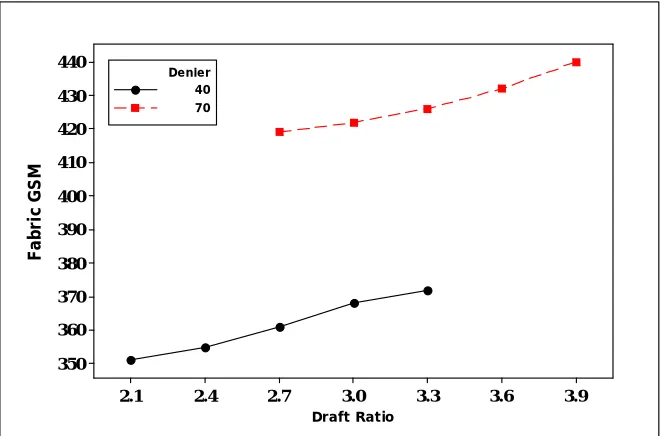
The effect of elastane denier and draft ratio in the weft yarn on the fabric areal density in g m-2 (GSM) is given in Figure 2. It is clear that the fabric GSM
increases by increasing the elastane denier and draft ratio. Different regression equations for fabric GSM are given in Table V. It is evident from the equations
and the R-Sq values that the both the elastane denier and the draft have significant influence on the fabric GSM (indicated by p-values < 0.05 and high percentage of R-Sq). The positive (+) sign with the denier and draft coefficients in the regression equations indicate their positive correlation with the
fabric GSM. R-Sq % is the coefficient of determination and its value gives the percentage of change in the GSM that can be explained by the factors included in a regression equation. The increase in fabric GSM by increasing the elastane denier may be attributed to increase in elastane percentage at higher denier, which results in higher retraction force and fabric contraction in the weft direction when the fabric is taken off the loom after weaving. Although the elastane percentage decreases by increasing elastane draft ratio but the higher draft ratio result in higher retraction force for fabric contraction leading to higher fabric GSM [21].
3.9 3.6
3.3 3.0
2.7 2.4
2.1 440
430
420
410
400
390
380
370
360
350
Draft Ratio
Fa
b
ri
c G
S
M
40 70 Denier
FIGURE 2. Effect of Elastane Denier and Draft Ratio of the Weft on Fabric GSM.
TABLE V. Regression equations for fabric areal density in g/m2 (GSM).
Property Regression Equations R-Sq % p-value Remarks
GSM 239 + 1.86 Denier + 17.8 Draft 99.8 0.000 Statistically Significant
GSM 273 + 2.21 Denier 95.0 0.000 Statistically Significant
GSM 248 + 48.8 Draft 55.3 0.014 Statistically Significant
Effect of Elastane Denier and Draft on Fabric Tensile Strength
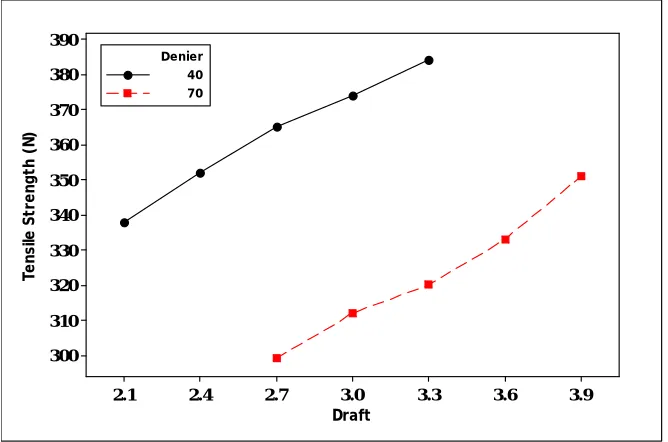
The effect of elastane denier and draft ratio of the weft yarn on the fabric tensile strength in weft direction is given in Figure 3. It is clear that the
fabric tensile strength increases by increasing the draft ratio. The increase in draft ratio results in a decrease in elastane (%) in the fabric. The tenacity of cotton fibers (3.3 g/d i.e 27cN/tex) around the elastane core is higher than that of the elastane (1.27 g/d i.e. 11.2 cN/tex for 40d elastane; 1.07 i.e. 9.4 cN/tex for 70d elastane). Yarns of the same count
tensile strength (Pearson correlation = 0.808; p-value = 0.005). It is also observed that the fabric tensile strength in the elastane-containing yarn is lower for higher denier of the elastane. The elastane (%) of the yarn is greater in case of 70d elastane as compared to 40d elastane. The higher percentage of elastane results in poor tensile strength due to the reasons explained above. Furthermore, fabric having yarns of almost same elastane percentage have almost same tensile strength irrespective of the elastane denier and the draft (e.g. it can be observed in Figure 3 that
fabric containing yarn of 40d elastane and 2.1 draft with 5.74% elastane have almost same strength as the fabric containing yarn of 70d elastane and 3.6 draft with 5.86% elastane). Table VI gives regression
equations for fabric tensile strength taking different predictors. It is clear from the R-sq % values that the effect of elastane denier on fabric tensile strength is far greater as compared to that of the draft ratio, and that the fabric tensile strength increases with increase in draft ratio but decrease with increase in elastane denier.
3.9 3.6
3.3 3.0
2.7 2.4
2.1 390
380
370
360
350
340
330
320
310
300
Draft
Te
ns
ile
St
re
ng
th
(
N
)
40 70 Denier
FIGURE 3. Effect of Elastane Denier and Draft Ratio of the Weft on Fabric Tensile Strength.
TABLE VI. Regression equations for fabric tensile strength.
Property Regression Equations R-Sq % p-value Remarks
Tensile Strength (N) 340 - 2.12 Denier + 39.8 Draft 99.3 0.000 Statistically Significant Tensile Strength (N) 415 - 1.32 Denier 57.5 0.011 Statistically Significant
Tensile Strength (N) 329 + 4.6 Draft 0.80 0.803 Not Significant
Effect of Elastane Denier and Draft on Fabric Tear Strength
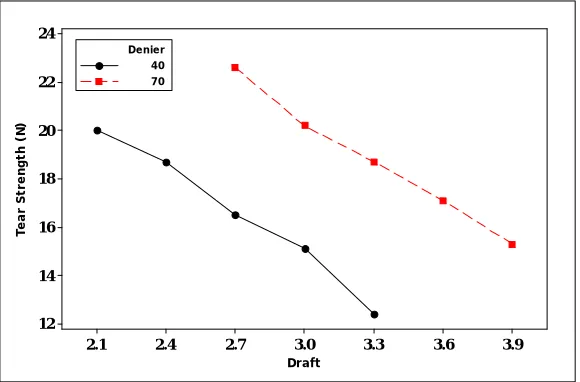
Figure 4 shows the effect of elastane denier and draft
of the weft on the fabric tear strength in the weft direction. It is clear that the fabric tear strength increases by increasing the elastane denier and decreasing the draft ratio, and that the trends are opposite to those in case of fabric tensile strength. It was found that there was a strong positive correlation between the yarn elastane percentage and the fabric tear strength (Pearson correlation = 0.879; p-value = 0.001), and that the correlation between the yarn tenacity and fabric tear strength was not statistically significant (Pearson correlation = - 0.547; p-value = 0.102). The tear strength of a fabric is highly
dependent on the easiness of the yarn slippage in the fabric under the influence of the tearing force, which allows the yarns to come closer together at the tearing point to support each other [22]. The yarn slippage is better in case of the fabrics which contain higher amount of elastane percentage in the yarns. Hence, tear strength of the fabrics increases with increase in elastane percentage, which in turn increases with increase in elastane denier and decrease in draft ratio.
Table VII gives the regression equations for fabric
the yarn core and thus reduces the elastane thickness, and the folded and twisted soft segments in the filament. Hence the stretchability of the yarns with higher elastane draft decreases, resulting in the reduction of the fabric tear strength. Whereas the fabric tensile strength predominantly depends upon the yarn elastane percentage whether it is changed by changing elastane denier or the draft, it is not the case
with the fabric tear strength. Fabric tear strength increases more when the elastane percentage is kept higher by using a lower draft than it increases by using a higher denier. Fabric with yarns of 40d/2.1 (denier/draft) has almost same elastane as 70d/3.6 (5.74% and 5.86% respectively) but the tearing strength of the yarn with lower draft i.e. 2.1 is higher in comparison, as can be seen in Figure 4.
3.9 3.6
3.3 3.0
2.7 2.4
2.1 24
22
20
18
16
14
12
Draft
Te
a
r S
tr
e
n
g
th
(
N
)
40 70 Denier
FIGURE 4. Effect of Elastane Denier and Draft Ratio of the Weft on Fabric Tear Strength.
TABLE VII. Regression equations for fabric tear strength.
Properties Regression Equations R-Sq % p-value Remarks
Tear Strength (N) 25.1 + 0.196 Denier - 6.08 Draft 99.0 0.000 Statistically Significant
Tear Strength (N) 13.6 + 0.0747 Denier 15.7 0.257 Not Significant
Tear Strength (N) 26.1 - 2.81 Draft 26.7 0.126 Not Significant
Effect of Elastane Denier and Draft on Fabric Stretch
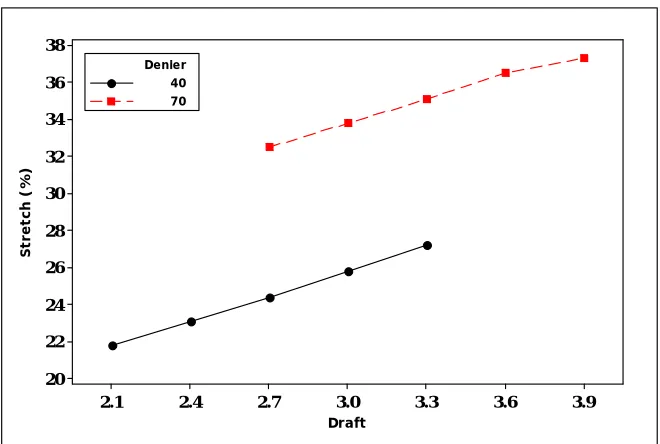
The effect of different elastane denier and draft ratios in the weft yarn on the fabric stretch in the weft direction is depicted in Figure 5. It is clear that the
fabric stretch percentage increases by increasing the elastane denier as well as the draft. The regression equations and the R-Sq values given in Table VIII
indicate that both the elastane denier and draft have significant effect on the fabric strecthability, which is directly proportional to the denier and draft. The increase in elastane denier results in increase in yarn elastane percentage, resulting in higher fabric stretchability. Although the elastane percentage decreases by increasing the elastane draft, the fabric stretch percentage increases with an increase in draft. This can be explained by the higher retraction force and hence the higher crimp of the wrapping fibers in case of yarns spun with higher elastane draft [23]. When a fabric containing elastane yarns spun with
3.9 3.6
3.3 3.0
2.7 2.4
2.1 38
36
34
32
30
28
26
24
22
20
Draft
St
re
tc
h
(
%
)
40 70 Denier
FIGURE 5. Effect of Elastane Denier and Draft Ratio of the Weft on Fabric Stretch.
TABLE VIII. Regression equations for fabric stretch %.
Properties Regression Equations R-Sq % p-value Remarks
Stretch (%) 2.18 + 0.267 Denier + 4.30 Draft 99.9 0.000 Statistically Significant
Stretch (%) 10.4 + 0.353 Denier 89.3 0.000 Statistically Significant
Stretch (%) 3.52 + 8.74 Draft 65.9 0.004 Statistically Significant
Effect of Elastane Denier and Draft on Fabric Recovery after Stretch
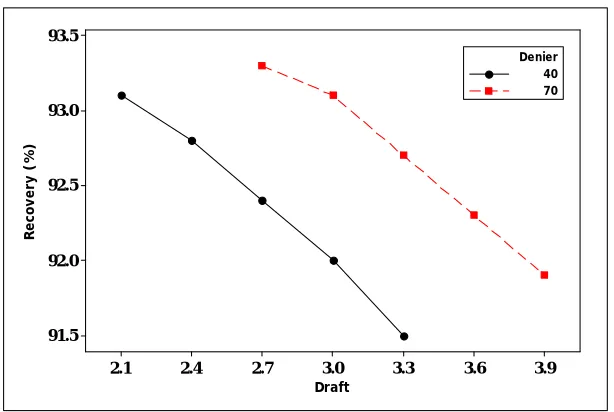
The effect of elastane denier and draft in the weft on fabric recovery after stretch in the weft direction is shown in Figure 6. It is clear that at a same draft
setting, the fabric recovery after stretch is better in case of yarns containing higher-denier elastane. This may be attributed to the higher elastane percentage in yarns with higher-denier elastane. However, as can be seen from the regression equations and R-Sq values given in Table IX, the effect of elastane denier
is not as significant as is that of the draft on the fabric recovery after stretch. The fabric recovery decreases by increasing the draft, i.e. by decreasing elastane percentage. The increase in draft ratio results in
3.9 3.6
3.3 3.0
2.7 2.4
2.1 93.5
93.0
92.5
92.0
91.5
Draft
Re
co
v
e
ry
(
%
)
40 70 Denier
FIGURE 6. Effect of Elastane Denier and Draft Ratio of the Weft on Fabric Recovery after Stretch.
TABLE IX. Regression equations for fabric recovery percentage after stretch.
Properties Regression Equations R-Sq % p-value Remarks
Recovery (%) 94.4 + 0.0353 Denier - 1.27 Draft 98.9 0.000 Statistically Significant
Recovery (%) 92.0 + 0.0100 Denier 7.1 0.455 Not Significant
Recovery (%) 94.5 - 0.678 Draft 39.4 0.052 May be Significant
CONCLUSIONS
It was concluded in this study that by using a higher-denier elastane in the core-spun cotton yarn, the fabric tear strength, stretchability and recovery after stretch increases but the fabric tensile strength decreases. Furthermore, by increasing the elastane draft ratio, the fabric tensile strength and stretchability increases whereas the fabric tear strength and recovery after stretch decreases. The elastane percentage in the core-spun yarn has a strong positive correlation with fabric tear strength and recovery after stretch, and a strong negative correlation with fabric tensile strength. The correlation of elastane percentage and fabric stretchability was found statistically significant only with 88% confidence. The fabric stretchability was found to be dependant not simply on the elastane percentage but on the initial fabric contraction in the weft when the fabric is taken off the loom after weaving. In a future work, the authors will determine the optimum elastane denier and draft ratio for a particular yarn count that give best overall tensile, tear, and stretch and recovery properties.
REFERENCES
[1] DuPont Bulletin, Combined Elastic Yarns With Lycra Used in Weaving, L-531, 1997, 7-9.
[2] Senthikumar, M.; Anbumani, N. and
Hayavadana, J.; Indian Journal of Fiber and Textile Research, 2011, 36(3), 300-307.
[3] Mihailovic, T.; Asanovic, K.; Simovic, L. and Skundric, P.; Journal of Applied Polymer Science, 2007, 103(6), 4012–4019.
[4] www.dorlastan.com, April 28, 2012, [Online] [5] Su, C. I.; Maa, M. C. and Yang, H. Y.; Textile
Research Journal, 2004, 74(7), 607–610.
[6] Su, C. I. and Yang, H. Y.; Textile Research Journal, 2004, 74(12), 1041-1044.
[7] Ortlek, H. G.; Fibres and Textiles in Eastern Europe, 2006, 14(3), 42-44.
[8] Babaarslan, O.; Textile Research Journal, 2001,
71(4), 367-371.
[9] Babaarslan, O. and Celik, N.; Textile Asia,
2001, 32(4), 35-40.
[10] Miao, M.; How, Y, and Ho, S.; Textile Research Journal, 1996, 66(11), 676-684.
[11] Dhouib, A. B.; El-Ghezal, S. and
Cheikhrouhou, M.; Journal of the Textile Institute, 2006, 97(2), 167-172.
[12] Lin, J. H.; Chang, C. W.; ou, C. W. and Hsing, W. H.; Textile Research Journal, 2004,
[13] Ortlek, H. G. and Ulku, S.; Textile Research Journal, 2007, 77(6), 432-436.
[14] Dang, M.; Zhang, Z. and Wang, S.; Fibres and Polymers, 2006, 17(4), 420-423.
[15] Taylor, P.; Helali, H.; Babay, A. D. and Msahli, S.; Journal of the Textile Institute, 2012,
103(4), 451-457.
[16] Gorjanc, D. S. and Bukosec, V. Fibres and Textiles in Eastern Europe, 2008, 16(3),
63-68.
[17] Meulemeester, S. D.; Langenhove, L. V. and Kiekens, P.; Autex Research Journal, 2009,
9(2), 54-60.
[18] Ozdil, N.; Fibres and Textiles in Eastern Europe, 2008, 16(3), 63-67.
[19] Baghaei, B.; Shanbeh, M. and Ghareaghaji, A. A.; Indian Journal of Fiber and Textile Research, 2010, 35, 298-302.
[20] Sacevičienė, V.; Masteikaitė, V.; Klevaitytė, R. and Audzevičiūtė, I.; Materials Science,
2011, 17, 413-416. 2011.
[21] Rahman, M. A.; Journal of American Science,
2011, 7(12), 63-67.
[22] Triki, E.; Nguyen-tri, P.; Boukehili, H. and Vu-khanh, T.; Polymer Composites, 2012, 33,
1578-1585.
[23] Mourad, M. M.; Elshakankery, M. H. and
Almetwally, A.; Journal of American
Science, 2012, 8(4), 567-572.
AUTHORS’ ADDRESSES Bilal Qadir
Tanveer Hussain, PhD Mumtaz Malik, PhD
National Textile University Sheikhupura Road