Volume 39, 2012
82
MODERN DIDACTIC TOOLS AND THE
POSSIBILITIES OF THEIR
IMPLEMENTATION INTO THE
EDUCATIONAL PROCESS
Milan Klement
Palacký University, Olomouc, Czech Republic E-mail: [email protected]
Abstract
I���������� ���� ������������� ������������� ����� � ����� ������ �� ��������� �������� ���� ������������������������ ���� ������������� ������������� ����� � ����� ������ �� ��������� �������� ���� �������������� ������ ���� �������� ����������. T�� ���������� ���������� ����� ��� ��� ����������� �� ��w ������ ���� ������������ ������������� �� ��� ������������ ��������� ������ ���������� �� ��������� �������� ��� ��� ������������ �� ������������ ����������. A�� � ������� �� ����� ����, �� ��� ������������ �� ������� ��w ������������ ������q���� ���� ��������� ��������� ���� ���� ���� ����� ����� �������� � q�������� w������ ���������, ��������� ���� ���������-��-�� ��� ������� ��� ����� � �����. S���� ��� �������� �� ��� ����������� �������� ��� ��� �w��� �� ���� ��������� ����������� �������� w��� ����� �������, w� ���� ����������, ������� �� ��������� ��� � ���������, �� ���������� ��� ��������� ���� ��������������� �� ��������� �� ���������, ���������� ���������-��-��, �� ��� �������������� �� ������� ���������� ������ ���� ��� ������������ �������� �� ���� �� ����������� w������������. T�� ����������� �������� ������������ ��� ����������, ��������� ���� ������� �� ����� ������������ ���������.
Key words: ���������� ������,�������� �������������, ����������� ���� ������������� �������������, ����������� ������, �����������, ����������� �������������, ���������.
Introduction
Didactic tools (compare Průcha, 1995; Maňák, 2003; Janiš, 2006) are part of tuition since the beginning of cultural history of mankind and can be generally defined as “��� ������ ���� ��������� ���� ��������, ��q���� ���� ������� ��� ����������� �� ������� ���� w��� ��� ������ �� ����������� ������������ ��������� ���� ��������������� ������; ����� ��������� �� �������� ��� ������������-������������ ������” (Průcha, 2009). The aim of didactic tools is especially to apply the principles of clearness (Nikl, 2002), as in tuition, if possible, all the senses should be involved in getting to know the reality. The recent researches relate to this fact and they have confirmed that the visual processing of information is more effective because we receive information in 87 % by sight, 9 % by hearing and 4 % by other senses (Průcha, 2009).
in the 21 century Volume 39, 2012 83
consists of several basic parts enabling the full usage of digital technologies in the educational process. The basic parts of multimedia presentation consist of (1) hypertext; (2) the graphics of images; (3) sound; (4) video; (5) animation (Chapman, Chapman, 2004) and can be defined as: “��� �� ��w ������������ ������������� w���� ������ �������� ������ �� ������������ ����������� ���� �������� ������ ��������� �� ������ �� ����� ��� ������������ ����������� ���� ������ ��������� ��� �������������� ���� ������������ ��������� (��������� �� �� ���������� ����) ���� �������������� �������� �� ��� ����� ��� ��� ��������� ���������� ���� ������ ���������” (T. Svatoš, in Průcha, 2009). Interactive boards are a suitable technological means of presentation for multimedia presentations created and structured in this way (Dostál, 2011). These boards are in short called i-boards (Finney, England, 2002). An interactive board is thus one of the ways to innovate the teaching process and make use of all the possibilities of multimedia presentations. “T�� w���� ���������� ��� ��������� ���������� ��� � ������������ ���� ��������� �������������� �� ��w ��������� ���� ��� ������������ ���� �������� ���������. T�� ��� �� ��� ���������� ��� �� ������� ��� q������� �� ����� ���������.” (Skalková, 2007).
All the presented facts make new demands on teachers who have to be prepared to work with modern didactic tools and technologies and create appropriate educational materials for such tuition. This need stems not only from the practice but also from the necessity to accept modern paradigms of teaching where constructivism is its flagship (Průcha, Walterová, Mareš, 2003) and it perceives the importance of student’s inner conditions of learning as well as their contact or interaction with the environment. That is why in this modern teaching paradigm new demands are made on a teacher and even though the teachers do not necessarily need to be ICT experts they should be able to make use of them in tuition where their role should be, above all, students’ advisor (Jonassen et al., 2003). These demands can be defined via the TPCK model (Technological Pedagogical Content Knowledge) by L. Shulman (1986), in Czech – technological-didactic knowledge of content, according to Zounek and Šeďová (2009) or Janík (2005) who was further elaborated by P. Mishra and M. Koehler (Mishra, Koehler, 2006). This model uses three dimensions: (1) pedagogical dimension; (2) content dimension; (3) and technological dimension that all accept the fact that teaching is a complex activity requiring various types of knowledge (understanding, skills and attitudes), “���� ���������������� ���� ��������� ������ �� ��������� ���� ��� ������x ��� �� ����� �����-���������������” (Šimonová et al., 2010).
According to Brdička (B. Brdička, in Sojka, Rambousek eds., 2009), integration of ICT in the tuition is possible only based on a real modification of teaching processes. Newly outlined content that educates teachers is composed of, according to above given TPCK, four parts. The first one is the earlier mentioned didactic knowledge of content (Pedagogical Content Knowledge – PCK) that stems from the original Schulman’s concept. This concept, according to Mishra and Koehler, contains knowledge how to approach the educational content and organise it in order to be transmitted as effectively as possible.
The second part deals with the interconnection of teaching and technologies (Mishra, Koehler, 2006). As a result, technological knowledge of the content is formed there (Technological Content Knowledge – TCK), to be more specific, this knowledge describes which technologies are appropriate for the particular educational content. This means that the principle is not only in the knowledge of the taught subject or issue, but also in the way the subject is adjusted using the ICT.
The next part connects the field of didactic knowledge with the technological knowledge (Mishra, Koehler, 2006), which results in a new educational field, so called technical-didactic knowledge (Technological Pedagogical Knowledge – TPK). This field represents not only the knowledge of the existence of various technologies usable in education, but also the knowledge of the fact that these technologies have various tools and possibilities applicable in tuition. This means that it is necessary for the teacher not only to know of the various technologies, but also be familiar with their possibilities and limits that can be brought in the tuition.
Volume 39, 2012
84 (2008) talk about so called technological-didactic knowledge of the content (Technological Pedagogical Content Knowledge – TPCK) made by a new form extending significantly further then its three parts. Technological-didactic knowledge of the content is according to earlier mentioned authors (Mishra, Koehler, 2006, 2008) the foundation of effective education that requires from the teacher, above all, understanding the usage of technologies. “O���� ��� ����������� �� ��� ������������ k��w������ (�������������-����������-����j���) ��k��� ��� ������� � ���q�� ���� ������������� ������� �� ����� ������ w�� ��� ���� �� ���� ��������� �������� ��w������ ������ ������ �� ��� ������� w����� ������������.” (Brdička, 2009). One of the groups of knowledge required for exploration of truly modern and effective tuition at schools is, indeed, multimedia presentation preparation and its usage in the educational process through an interactive board.
Interactive Whiteboard in Tuition
Interactive board is a touch-sensitive surface that enables active mutual communication between the user and the computer aiming at providing the maximal possible objectivity of the presented content (Dostál, 2009). It is usually used together with a computer and a projector and, with the help of the interactive board; the users are able to influence the computer and the running programs. Thanks to the projected image on the interactive board (especially where the changes are in progress) it is possible to follow the current state on the computer output in the real time (J. Dostál, in Klement et al., 2011a).
The traditional connection interactive “board - projector - computer” is still accompanied by other features such as voting machine through which we can very quickly and precisely find out the rate of gained knowledge and consequently involve students in the tuition.
Based on a series of direct tuition observations where the interactive board has been used (Klement et al., 2011b) the following advantages of interactive boards usage can be deduced (J. Dostál, in Klement et al., 2011a):
• students can be motivated more effectively using the interactive boardtudents can be motivated more effectively using the interactive board appropriately;
• the study material can be visualised, it is possible to use animations, move objects, the principle of objectivity is applied;
• enables to keep the longer attention of students;
• earlier created materials can be reused or easily corrected;
• students can get actively involved in the tuition more easily ;
• the text written in the actual tuition can be easily saved and shared with other students through the internet;
• students develop their information and computer literacy, that is crucial nowadays, while working with the board.
in the 21 century Volume 39, 2012 85
Although there is a generally declared need for incorporating new media (i.e. multimedia) and new educational technologies (i.e. interactive board and its accessories) and promote new educational approaches and methods derived from them, the question is whether schools are ready for that at all. Since the authors of the presented study are not aware of an overall analysis dealing with this issue, we have decided, based on carrying out a research, to identify the interest and preparedness of schools and teachers in implementation of modern didactic tools and digital technologies. The progress, process and results of this analysis are presented in the following study.
Methodology of Research
Based on frequent impulses from primary schools that closely cooperate with Faculty of Education at Palacký University in Olomouc, the possibility of an explorationof a research which would monitor the interest in new technologies and educational methods of these schools was taken into consideration. On the basis of these starting points, a decision to carry out a thorough analysis of the needs for the exploration of education supported by modern didactic tools and digital technologies in three basic fields was made:
• the interest of the primary schools headmasters in the issue of interactive whiteboards and multimedia presentations incorporation into educational process,
• the interest of teachers from these schools in tuition focused on interactive board usage and necessary multimedia presentations forming,
• the interest and the preparedness of the Faculty of Education of Palacký University students in and with respect to the tuition supported by the use of an interactive whiteboard and the creation of the multimedia presentations related to its use
A form of questionnaire has been chosen as the basis of data collection that would enable to gather reliable and valid results (Foddy, 1994). This questionnaire has been formed for either each of the 3 fields investigated separately. The questionnaire was anonymous, which ensured the maximal real value. These questionnaires were distributed among particular target groups and after handing in continuously evaluated.
Two types of questionnaires have been used for every target group of the analysis separately. The research respondents could answer the specific presented questions only in a dichotomy scale – YES/NO (Horák, Chráska, 1983). It was assumed that this method was sufficient in this case and provided an adequate overview of teachers’ and headmasters’ interest in a particular type of activities that could enhance the education quality. The validity of that is supported by the fact that for the statistic results‘ evaluation an analysis of particular answers frequency in form of graphs and charts has been used. For the above mentioned reasons the standard research hypotheses were not formed, however, specific closed questions were defined with a dichotomy answer that was marked by the respondents in the questionnaire. Based on these facts in the next parts of the analysis, consider the conclusive outcome value when 60 and more per cent of the relevant research sample answered the asked question YES or NO was taken into consideration. In that case the question was evaluated in two ways – the target group either is or is not interested in the particular field and the further concern is or is not useful. In this area of the analysis, the collection of necessary data was started with the questionnaires distribution in regular meetings of faculty school headmasters, on the occasion of the beginning of academic term 2010/2011. Faculty school headmasters and headmistresses had the opportunity to fill in a questionnaire.
Volume 39, 2012
86 headmasters and headmistresses from these schools have been addressed and they have been given the questionnaire mentioned above. Again, we can claim that the return of questionnaires reached 100.0 %. The composition of the respondents sample in this area of analysis is shown in the table below:
Table 1. The composition of research sample of headmasters and headmistress-es dealing with primary education.
Filled in questionnaires
in total Schools in total Faculty schools “Common schools”
The number 50 50 18 32
in % 100.0 100.0 36.0 64.0
In another field of research the collection of the needed data was started by a questionnaires’ distribution in 50 school institutions whose headmistresses or headmasters got involved in the first phase of the research. Even though this measure significantly narrowed the space for obtaining research data, it provided us with the possibility to compare the opinions of the headmasters and teachers working there. The questionnaire was aimed at the primary school teachers, in particular in two regions of the Czech Republic. In total, these questions were answered by 134 teachers teaching at both primary and secondary sub stages of primary schools and the questionnaire return rate was, in this part of the research sample, 59.6 %. The research sample composition in this part of the analysis is shown in the table 2 below.
Table 2. The teachers’ research sample composition.
Distributed questionnaires
in total
Filled in
question-naires in total Men Women
The number 225 134 33 101
in % 100.0 59.6 24.6 75.4
The last phase of the investigation research was started by the collection of the needed data through a distribution of a questionnaire to the students of the crushing majority of the study fields accredited at the Faculty of Education of Palacký University, which represented 11.2 of the total number of the students. Thus a total of 586 studentsof the Faculty of Education of Palacký University answered the questions and the return rate of the questionnaire for this part of the research sample reached the percentage of 85.1%. The research sample composition in this field of analysis is shown by the table number 3 below.
Table 3. The research sample composition with the students.
Distributed questionnaires
in total
Filled in questionnaires
in total Men Women
The number 689 586 184 402
in the 21 century Volume 39, 2012 87
Results of Research
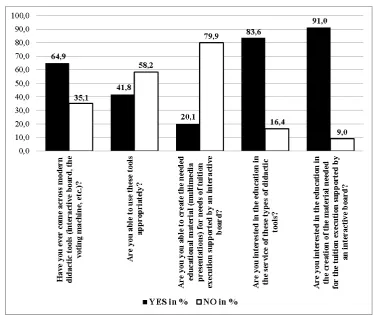
The carried out analysis clearly shows the interest of school headmistresses or headmasters in modern didactic tools and technologies, since 84.0 % of them stated that they do have modern technology but only 22.0 % of their teachers are able to work with this technology. Furthermore, only 10.0 % of the schools have teachers that are able to create adequate educational material for the tuition organized in this way. In addition, 92.0 % of headmistresses or headmasters stated that they are definitely keen on pedagogical faculty graduates who would be able to use didactic tools and digital technologies, which means to operate interactive boards and create such multimedia presentations. The whole situation is even more obvious in this Figure 1.
Figure 1: The research results with the group of school headmistress and head-masters.
According to the obtained results, shown in the previous text, there is an obvious interest of school institutions in teachers who are able to use modern didactic tools and digital technologies in tuition, which means to operate interactive boards and create multimedia presentations for them.
Volume 39, 2012
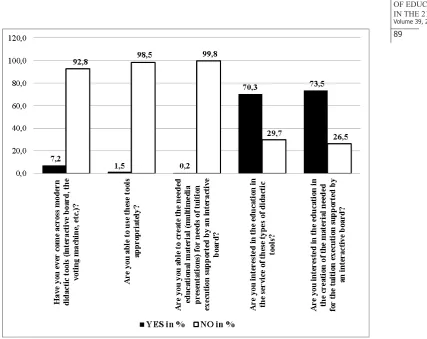
88 in the education in appropriate educational material preparation. The whole situation is far more evident in the Figure 2 bellow.
Figure 2. The research results with the group of teachers.
According to the obtained results there is a clear interest of primary school teachers in the field of modern didactic tools and digital technologies. What is more, they would be interested not only in the education in this field and the preparedness for their new role in the educational process but also in tuition which they execute themselves and that will be supported by interactive educational materials and tools.
in the 21 century Volume 39, 2012 89
Figure 3. The research results with the group of students.
The above stated research results clearly demonstrate a definite interest of the students in the area of the didactic tools and digital technologies. The students would appreciate further education in this area which would help them in the process of the preparation for their future role in the educational process.
Furthermore, the informational value of the results is supported by the carried out analysis of the reliability of the questionnaires used. The former was assessed using the Cronbach`s alpha coefficient. With the first questionnaire (headmasters and headmistresses), the coefficient reached the value of 0.92, the second questionnaire (teachers, both male and female) showed the value of 0.94, and with the third questionnaire (students- teachers to be), the value of 0.87 was obtained. The acquired results were also examined from the point of the view of their potential dependence of the gender and age of the respondents via Student’s t-test for independent groups. In neither case, the dependence of the results was not proved.
The outputs of the analysis thus suggest that modern educational tools have become an integral part of the educational reality. Headmasters as well as teachers come across such tools in everyday practice and make use of them. However, there is a gap between the expectations of school principals with respect to the extent to which teachers should, according to the former ones, be ready to make use of the above mentioned educational tools and prepare the corresponding support material, and the level to which teachers are actually ready to do so. The discrepancy could result from the fact that however well schools are equipped with the necessary devices and technology, the teachers themselves have not been well trained as regards the use of the latter in the educational process.
Volume 39, 2012
90 studies, and are therefore prepared neither to adequately handle them, nor to create the necessary support materials. This situation is probably due to the fact that the use of modern educational tools has not so far be focused on enough within the framework of the professional training of the future teachers. All the three groups of respondents declared their clear interest in the education of future and current teachers in this area. This agreement stems probably from the absence of a lifelong learning program for teachers and from the lack of emphasis on the application and use of modern didactic tools within the framework of the preparation of pregraduate students.
Discussion
The idea of natural ICT usage, which means modern didactic tools, among nowadays students is a fact supported by two main arguments. The first one draws from the fact that nowadays children use and handle modern IT with absolute certainty and self-confidence.
The second reason comes from the ICT usage statistics based on age showing that unlike the older generations, almost all children use the Internet and computer (Lupač, 2011). American author Don Tapscott (1998) based his theory on these two arguments in 1998 claiming that the powerful family model is corrupt because it is the children who educate their parents how to live in the digital environment. His label N/GEN and �������� ���������� was soon supported by others: �������� �������� (Prensky, 2001), ����-z�������� (Veen, Vrakking, 2006), ����������� ���� (Palfrey, Glasser, 2008) and others. “D������ �������� ��� ������ �� ������� ����������� ����� q���k���. T���� ��k� ������ ���� ����������� �� ��� ����� ���� (���������k���). T���� ������ w��k��� w��� ��� ������� �������� ������ ��x�. T���� ����� ������ ������� ��������� ��w������ ����������� (��������x�) ���� ����� ��k� w��k��� �� ��� ��� ����������� (������) �����. T���� �x���� ���������� ������� ���� ���q���� ������������ �� ����� �w� w��k (Prensky, 2001). Prensky’s and Tapscott’s ideas have become very influential and several researchers have tried to support or disprove their thoughts with variable success (Bennett, Maton, Kervin, 2008).
Although the author of the presented study does not either support or disprove the idea of different approach to “digital natives” education, he thinks that through monitoring the educational reality and the opinions of the people involved, an appropriate space for developing professional discussion of this phenomenon can be created. This issue goes hand in hand with “new” role of the teacher in the educational process based on thorough usage of modern didactic tools in form of interactive boards or multimedia presentations. As the presented research showed, not all teachers are prepared for their new role and they are not able to fully use the possibility modern didactic tools offers. In this respect, it is stunning that more than 64.9 % of primary schools teachers have come across these tools but only 20.1 % is capable of creating the needed multimedia presentations without which the usage of interactive board in tuition makes no sense (Klement et al, 2011b). In contrast with this fact there are high expectations from school headmasters, where more than 92 % of them expect their teachers-to-be to manage and commonly use these technologies in practice.
Conclusions
All target groups of the carried out research showed real interest in the exploration of tuition supported by modern didactic tools and the usage of multimedia presentations.
in the 21 century Volume 39, 2012 91
A possible way to achieve the desired shift towards more effective and more fun teaching is a targeted training of current and future teachers in the field of the use of modern didactic tools and the creation of digital presentations so that the concept of teaching corresponds to the interests and preference of their pupils.
In such a rapidly developing field like this one we cannot keep our distance necessary for “evaluating carefully and impartially”, which is necessary for supported professional discussion. As a result, we perceive the above mentioned facts as an impulse to develop further discussions and as a stimulus to responsible and balanced attitude towards the needs of primary schools both sub stages’ pupils. Even if it is possible that they are not in fact the digital natives and the current issues connected with school systems and the following results originate elsewhere, we cannot disprove this fact. Thus it is necessary to constantly watch this field, continuously evaluate attitudes of participants of such tuition and we should try to look for the best ways to come up to their expectations.
Acknowledgements
The paper was written within the framework of the no P407/11/1306 project entitled „Evaluation of study materials designed for distance education and learning“, supported by GAČR.
References
Bártek, K. (2010). Využívání interaktivní tabule ve výuce: očekávání a reflexe českých učitelů v kontextu výzkumů v ČR a zahraničí. In PROTECH 2010. Olomouc: Velfel. pp. 24-39.
Bennett, S., Maton, K., Kervin, L. (2008). The ‘digitalnatives’ debate: A critical review of the evidence.view of the evidence. B������� J������ �� E����������� T����������, 39(5).
Betcher, Ch., Lee, M. (2009). T�� ����������� w���������� ����������: �������� w��� IWB�� Camberwell, Vic.: ACER Press.
Brdička, B. (2009). Jak učit ve všudy přítomném mraku informací? In P. Sojka, J. Rambousek (Eds.), SCO 2009, sborník 6. ročníku konference o elektronické podpoře výuky. Brno: Masarykova univerzita. Dostál, J. (2009). Interaktivní tabule - významný přínos pro vzdělávání. In Česká škola (on-line), Praha:
Computer Press.
Dostál, J. (2011) Nové technologie ve vzdělávání - vzdělávací software a interaktivní tabule. Olomouc, Vydavatelství Univerzity Palackého.
Finney, A., England, E. (2002). M�������M����������: P��j��� M��������� ���I���������� M�����. Boston: Addison-Wesley.
Foddy, W. H. (1994). C������������ q���������� ��� ��������w�� ���� q���������������: T������ ���� �������� �� ������� ���������. Cambridge, UK: Cambridge University Press.
Horák, F., Chráska, M. (1983). M����������� ���������k��. Olomouc: Vydavatelství Univerzity Palackého, pp. 94-96.
Chapman, N., Chapman, J. (2001). D������ M����������. Boston: Addison-Wesley. Chapman, N., Chapman, J. (2004). D������ M����������. Mississauga: John Wiley & Sons. Janík, T. (2005). Znalost jako klíčová kategorie učitelského vzdělávání. Brno: Paido. Janiš, K. (2006). Slovník pojmů z obecné didaktiky. Opava: Slezská univerzita v Opavě.
Jonnasen, D. H., Peck, K. L., Wilson, B. G. (2003). L������� �� S���� P�������� w��� �����������: A C��������������� P�����������. New Jersey: Merill Prentice Hall.
Klement, M., Dostál, J., Bártek, K., Lavrinčík, J. (2011). Učebnice interaktivní výuky s využitím multimediální učebny. Olomouc, Velfel.
Volume 39, 2012
92 Lupač, P. (2011). Mýty (a realita) digitální generace. Retrieved 25. 3. 2011 from: http://www.lupa.cz/ clanky/myty-a-realita-digitalni-generace/
Maňák, J. (1997). A����������í �������� � ���������. Brno: Masarykova Univerzita. Maňák, J. (2003). Nárys didaktiky. Brno: Masarykova Univerzita.
Mishra, P., Koehler, M. J. (2006). T������������ ������������ C������ K��w������: A F����w��k ��� T������ K��w������.Retrieved 6. 8. 2011 from: http://punya.edic.msu.edu/reserch/tcpk
Mishra, P., Koehler, M. J. (2008). Technological Pedagogical Content Knowledge: A Framework for Pedagogical Content Knowledge: A Framework forPedagogical Content Knowledge: A Framework for Content Knowledge: A Framework forContent Knowledge: A Framework for Knowledge: A Framework forKnowledge: A Framework for Teacher Knowledge. Knowledge.Knowledge. T������ C������ R������, 108(6), 1017-1054
Nikl, J. (2002). Didaktické aspekty technických výukových prostředků. Liberec: Technická univerzita. Palfrey, J., Glasser, U. (2008). B��� D������: U������������������ F����� G����������� D������ N�������. basic
Books.
Prensky, M. (2001). Digital Natives, Digital Immigrants: Do They Really Think Differently? O� ��� H���z�� 9(5), pp 7-11. Retrieved from: http://www.marcprensky.com/writing/Prensky%20-%20 Digital%20Natives,%20Digital%20Immigrants%20-%20Part2.pdf
Průcha, J. (1995). Pedagogický slovník. Praha: Portál. Průcha, J. (2009). Pedagogická encyklopedie. Praha: Portál.
Průcha, J., Walterová, E., Mareš, J. (2003). Pedagogický slovník. Praha: Portál.Praha: Portál.
Shulman, L. S. (1986). Paradigms and reserchprograms in the study ofteaching. In M. Wittrock, H�������k �� ��������� �� ��������. New York: MacMillan.
Skalková, J. (2007). Obecná didaktika. Praha, Grada.
Sokolowsky, P., Šedivá, Z. (1994). Multimédia - současnost budoucnosti. Praha: Grada.
Šimonová, I. et al. (2010). Styly učení v aplikacích eLearningu. Hradec Králové: M & V Hradec Králové.
Tapscott, D. (1998). G��w��� U� D������: T�� R���� �� ��� N�� G���������. New York: McGraw-Hill. Veen, W., Vrakking, B. (2006). H��� Z��������. G��w��� U� I� A D������ A��. Network
ContinnumEducation.
Zounek, J., Šeďová, K. (2009). Šeďová, K. (2009).Šeďová, K. (2009). Učitelé a technologie: mezi tradičním a moderním pojetí. Brno: Paido.
A��������� ��� N������ Š���k���, SMC “S������� E�����������”, L��������
Received: J������� 13, 2012 accepted: J������� 30, 2012
Milan Klement Vice-Dean for Information and Educational Technologies, Faculty of Education,
Palacký University, Žižkovo nám. Č. 5, Olomouc, 771 40, Czech Republic.
E-mail: [email protected]