Volume 46, 2012
74
PATTERNS IN SYMMETRY BREAKING
TRANSITIONS
Samo Kralj, Robert Repnik University of Maribor, Slovenia E-mail: [email protected], [email protected]
Abstract
It is now well accepted that we all have amazing capabilities in recognizing faces in a fraction of a second. This specific pattern recognition ability could be by appropriate training transferred to some other field of expertise. At the same time pattern recognition skills are becoming increasingly important “survival” strategy in the modern competitive world which faces information overload. In the paper we demonstrate an example of pattern-recognition type of lecturing modern physics. By using already absorbed knowledge and analogies we exploit our innate pattern recognition brain capabilities for more effective learning of new concepts in physics.
Key words: pattern recognition, universalities, liquid crystals, cosmology.
Introduction
recent years face dramatic advances in all branches of science. new measuring methods and discoveries gradually widen our horizon on how the nature and also minor subpart of it – humans– work (ross, 2003; ericsson et al., 2006). these advances will soon have dramatic impact on future educational approaches. in particular, available methods of measuring neural excitations, for example functional magnetic resonance imaging (fmri), enable insight into our brain activities (ross, 2003). such measurements are gradually revealing how our brain software works and how our learning capabilities could be improved.
75
as discussed above we are well evolutionary equipped with mechanism yielding us potential capability of efficient pattern recognition. this capability is becoming increasingly important in the world progressively entering ”information brain overload” era, in which sole data storage is becoming useless. therefore, it would be advantageous to encourage improving of these skills in our existing educational programs. furthermore, mastering pattern recognition mechanisms could allow us to efficiently transfer knowledge from one field, which we already know, to another previously unknown area. in this process we need just to “rename” relevant variables and we skip learning process which is often time consuming and necessary to understand the pattern structure.
this teaching by analogy technique is in particular suitable to widen knowledge in physics. namely, the main purpose of physics is to understand key mechanisms driving natural phenomena. our nature displays rich diversity, behind which often relatively simple universal concepts are hidden. in this paper we give an example how exploitation of understanding of a relatively simple phenomenon, with which we are all familiar, opens gates to understanding of some physics relevant to the field of liquid crystals, basic origin of electrical charges, annihilation of particles and antiparticles, and also early universe. all these phenomena have in common the same pattern. due to limited space we just emphasize basic facts. more technical
details are given in refs (Repnik et al., 2003; Kaučič et al., 2004; Krašna et al., 2006; Bradač et
al., 2011; repnik et al., 2012; Jesenek et al., 2012).
Teaching by Analogy
in the following we present the key mechanism giving rise to domain-type structures, which are often encountered in nature. a domain is region in space, where similar degree of ordering is observed.
as a simple illustrative example we consider a large crowd of people of approximately same height standing in a dessert. We assume that the environment looks the same in all directions and people are randomly oriented within a desert plane. typical separation among nearby people is far less than the average height of people. We also assume that number of people is large enough, so that the relative number of people in the outer (boundary) region of the group is negligible small. therefore, the system exhibits on average isotropic symmetry
within the desert plane. then the people are commanded to fall down and to be aligned along a single, the so called symmetry breaking direction. We say that in this event continuous symmetry
of the system is broken. People are allowed to realize fall within the time interval τQ. We refer to a locally selected direction as director (mathematically it could be presented by a unit vector). if neighbors are not aligned along a single direction, they will be charged a penalty. the high of penalty is linearly proportional to the relative angle between these neighbours. for example, penalty is 1 eur per person if a pair is aligned antiparallel and 0.5 eur, if they are oriented perpendicularly. if they are parallel, no penalty is imposed. furthermore, let us assume that
we are checking relative orientation of people each second after the elapsed timeτQ. they are
allowed to correct their orientation if it is unfavourable; however they have to remain straight all the time.
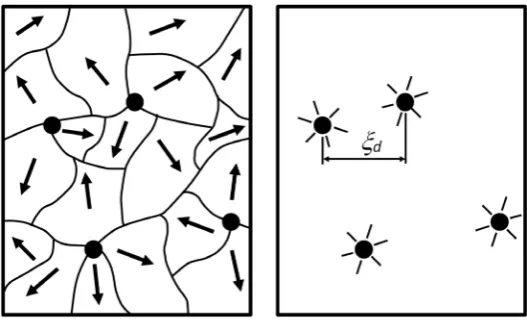
The time evolution of the orientational pattern of people is as follows. If τQ is short enough well separated people do not have enough time to communicate. consequently, in different places people will in general select different falling directions. if looking from above one would observe two dimensional domain patterns, where we refer to domain as a connected region in space, where orientation of people is similar (for example, relative orientation of neighbours is less than 10 degrees). a typical pattern is shown in figure 1. it is interesting that at a given time a domain pattern could be well characterized by a single linear domain length
Volume 46, 2012
76 refer to these regions, which are relatively costly, as topological defects (mermin, 1976) in
orientational ordering.
Figure 1: Left: a typical domain pattern of lying people. With arrow we indicate an average orientation within a domain. With bullets we mark defects, where orientational ordering is not uniquely defined. Right: we draw only the positions of defects within the system.
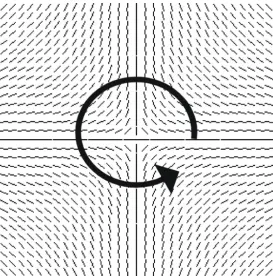
due to topological reasons one could not get rid of isolated defects, if along any circle surrounding a defect director orientation is fixed. one can get rid of defects only if appropriate different defects meet (the so called defect and ant defect) and annihilate each other. one can assign the winding number M to these defects, which is defined by the orientational field (directors) surrounding a defect. it counts total orientation of director divided by 2 ( on encircling a defect clockwise using an arbitrary path. using such definition M equals an integer value if a defect is encircled and otherwise it equals zero. one conventionally refers to
defects with positive values of M as defects, and those with negative value as antidefects. in figure 2 we show a typical defect exhibiting m=1, and in figure 3 the corresponding antidefect
77
Figure 2: Topological defect with M=1.
Volume 46, 2012
78 With time increasing number of people will be aligned along common directions in order
to reduce penalties due to misalignment. this growth is mostly enabled by annihilation of pairs
defect-antidefect. Consequently, the average value ξd monotonously grows with time, until the whole system is aligned along a single symmetry breaking direction.
note that the described domain growth, also referred to as coarsening dynamics, is extremely ubiquitous in nature. the only required conditions (Zurek, 1996) for the behaviour described above are i) continuous symmetry breaking, ii) causality (i.e., a cause triggers a consequence and not vice versa), iii) finite speed of information propagation. next we refer to analogous systems in nature, which are of technological and fundamental science interest.
We consider first liquid crystals (lcs), which are typical representatives of soft condensed matter system (de Gennes & prost, 1993; repnik et al., 2003). lcs are ubiquitous in nature and without them life would be impossible. for example, they form membranes of biological cells. in addition, they present key working material in lc displays of most laptops. in general a molecule exhibiting a lc phase should have anisotropic shape and interactions among them should be dominated by van der Waals interactions. We confine our interest to the
nematic phase, representing simplest lc ordering, formed by rod-like molecules at mesoscopic perspective (i.e., molecular details are averaged out by fast enough dynamics and consequently they do not affect macroscopic behaviour).average local orientation is given again by director.
note that in lcs parallel and antiparallel orientations are equivalent. in thermotropic lcs the
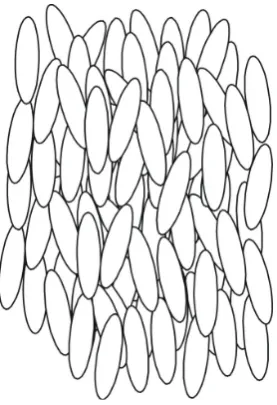
nematic phase is reached from the isotropic (ordinary liquid) phase by lowering the temperature via a weakly first order phase transition. in addition to a liquid-like behaviour (it flows) the substance also exhibits orientational long-range ordering: the molecules tend to be parallel, at least locally. in bulk samples (in which the influence of confining boundaries is negligible) the molecules are on the average aligned homogeneously along a single symmetry breaking, as
schematically shown in Figure 4.
Figure 4: In the nematic phase rod like molecules tends to be locally parallel.
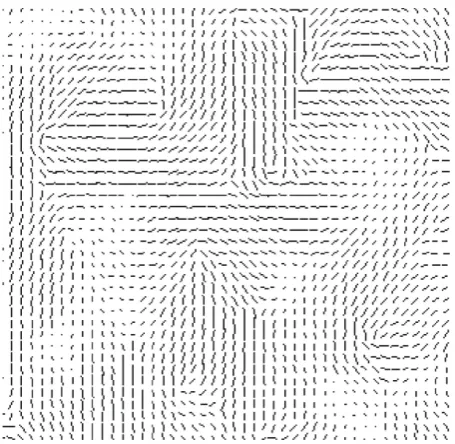
79 (Krašna et al., 2006; Bradač et al., 2011) we studied numerically in detail domain coarsening dynamics using a relatively simple semi-microscopic model. in figure 5 we plot time evolution of domain size growth as a function of time for a quench, for which τQ∼0. a typical pattern at a given time in shown in figure 6.a two dimensional presentation is given in a (x,y) plane of the cartesian coordinate system. therefore, a point indicates that a lc molecule is aligned along the z direction. note that soon after the phase transition the scaling regime is entered, where domains exhibit exponential growth with time t. it holds ξd∝tγ (see figure 5) where γ∼1/2 is a critical exponent, which is independent of a lc material. therefore, the time evolution is universal.
Figure 5: Time dependence of typical domain size length ξd. The quantities a0 determines average distance among neighbouring LC molecules, and ∆t determines of sweep time unit (within it orientations of all mol-ecules are updated in the numerical simulation).
Volume 46, 2012
80 as already discussed the domain growth is enabled by annihilation of topological defects.
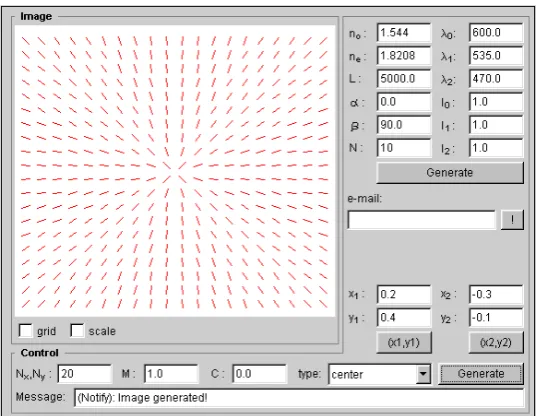
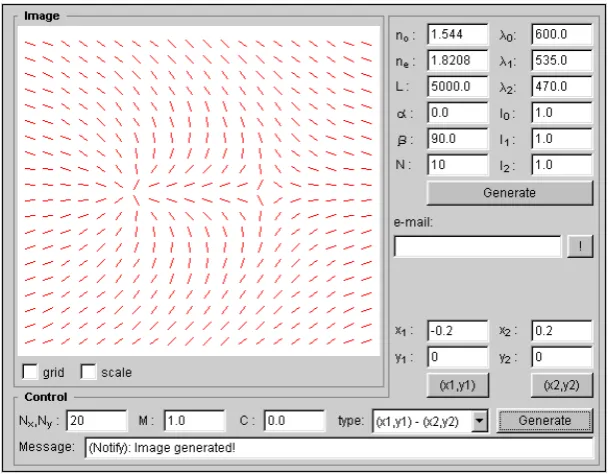
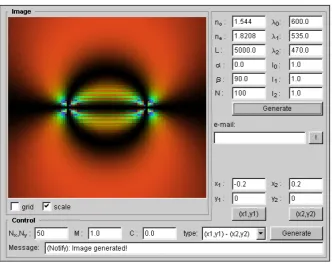
in planar lc systems they are well characterized by winding number M defined above. note that m plays similar role as electrical charges. pairs (m, m) of defects repeal each other, pairs (m,-m) attract and in general tend to annihilate into defect less, “neutral” state. furthermore, total topological winding number is conserved similar to electrical charge conservation in electrostatics. note that in 3d lc systems the topological charge q is introduced instead of m, which exhibits in 3d similar behaviour as electrical charge in electrostatics. only in 2d quantities q and m are equivalent (mermin, 1976). lcs are particularly adequate system to study topological defects, because they can be relatively simple optically visualized using optical microscopy. We designed an applet for this purpose to study different director structures and related optical interference pattern. some examples are given in figures 7-10. We show
director profiles of a defect with m=1 (figure 7), its characteristic optical pattern (figure 8). furthermore a pair of defects (m=1, m=-1) is depicted in figure 9 and the corresponding optical pattern in figure 10.
81
Figure 8: Typical optical interference pattern of a defect with M=1.
Figure 9: Typical director pattern of a pair defect-antidefect with winding num-bers M=1 and M=-1, respectively.
Volume 46, 2012
82 higgs field (spergel, turok, 1992). the existence of this field has still not been experimentallyspergel, turok, 1992). the existence of this field has still not been experimentally. the existence of this field has still not been experimentally
proved and was introduced theoretically to explain vast differences in masses of fundamental particles. from a qualitative point of view the scenario of domain coarsening is essentially the same as in case of the i-n sudden phase transition. Domains differ now by different values of the higgs field value and at domain intersection defects in the higgs field resides. in the case of the universe an important quantity of interest is the initial density of line defects (so called
cosmological strings) which are believed to influence the current large scale structure of the cosmos. but this quantity is hard to be determined because the only “window” to the past we use is the em radiation coming to us from the universe.
Figure 10: Typical optical interference pattern of a pair defect-antidefect shown in Figure 9.
this “window” is useful for events taking place in the time period after the “brick wall”, a time equal to approximately 300000 years after the big bang. after this time the universe is transparent for electromagnetic radiation. before that era particles and radiation were strongly coupled and consequently the radiation born in this period cannot provide useful information. a possible way to go beyond the “brick wall” is to study conditions in this regime in an analogous system.
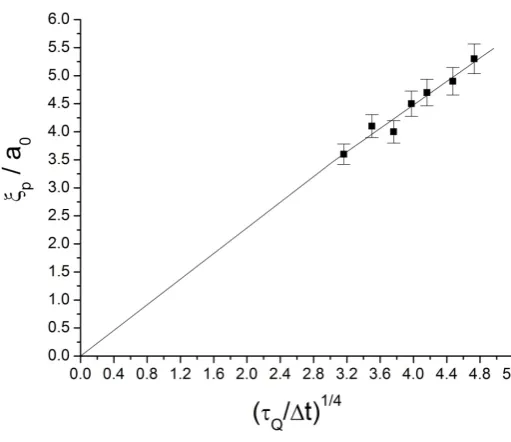
the strong universality of the domain coarsening phenomenon after a rapid symmetry breaking phase transition allows us to test some hypothesis of cosmological models on nematic liquid crystals. For example, in Ref. (Bradač et al., 2011) we studied the size ξf of the so called
protodomains (domains that just become discernible after a phase transition). theory, which focused on size protodomains in the early universe, predicts, that ξf∝(τQ)ν/(1+η). here ν and η
are the so called critical exponent of the relevant symmetry breaking phase transition and τQ
measures inflation time during the big bang (Zurek, 1996). for liquid crystals it holds ν∼1/2 and η∼1, consequently ξf∝(τQ)1/4. our simulation performed in lcs confirms validity of this
83
Figure 11: Size of protodomains as a function of phase transition time τQ. Ob-served relationship was first predicted in cosmology.
Conclusions
nature exhibits rich diversity of different structures and phenomena. however, behind this complexity often relatively simple universal laws and patterns are hidden. in this contribution we demonstrate how we stimulate pattern recognition skills in teaching physics. We have focused on domain growth following a symmetry breaking phase transition. the sole conditions for the observed dynamical behaviour are i) continuous symmetry breaking, ii) causality and iii) finite speed of information propagation. typical scenario has been given on a simple case, which is familiar to ordinary people. Domain coarsening and topological defects
have been introduced. then we have copied recognized pattern to domain coarsening following a fast i-n phase transition in liquid crystals. lcs are in particular suitable experimental testing ground to study topological defects. the behaviour of defects is very reminiscent to behaviour of electrical charges. finally, we have mapped domain coarsening dynamics from lcs to coarsening dynamics in the higgs field in the early universe. note that cosmological strings
and magnetic monopoles in the field of cosmology have not yet been experimentally confirmed. however, their analogues in lcs (line and point defects, respectively), can be relatively easily studied.
References
Bradač, Z., Kralj, S., Žumer, S. (2011). �arly stage domain coarsening of the isotropic�nematic phaseearly stage domain coarsening of the isotropic-nematic phase transition. Journal of Chemical Physics,135, 024506�024516. doi: 10.1063/1.3609102
de Gennes, p. G., prost, J. (1993). The Physics of Liquid Crystals. oxford: oxford university press. ericsson, K. a., feltovick, p. J., hoffman, r. r., charness, n. (2006). The Expert Mind, The Cambridge
Handbook of Expertise and Expert Performance. cambridge university press.
Jesenek, d., Gerlic, i., Visnikar, a., repnik, r., Kralj, s. (2012). thin nematic films: laboratory ofthin nematic films: laboratory of physics for topological defects, Molecular Crystal Liquid Crystals, 553, 153–16, doi: 10.1080/
Volume 46, 2012
84 Kaučič, B., Ambrožič, M., Kralj, S. (2004). Interference textures of defects in a thin nematicfilm : an
applet presentation. European Journal of Physics,25, 515�524.
Krašna, M., Repnik, R., Bradač Z., Kralj S. (2006). Sudden Isotropic�Nematic phase transition within a
plan-parallel cell. Molecular Crystal Liquid Crystals, 449, 127-136.
mermin, n. d. (1976). the topological theory of defects in ordered media. Review of Modern Physics,51,
591�648. doi:10.1103/revmodphys.51.591.
repnik, r., mathelitsch, l., svetec, m., Kralj, s. (2003). physics of defects in nematic liquid crystals. European Journal of Physics, 24, 481�491
repnik, r., popa-nita, V., Kralj, s. (2012). mixtures of nanoparticles and liquid crystal phasesmixtures of nanoparticles and liquid crystal phases exhibiting topological defects. Molecular Crystal Liquid Crystals, 560, 115-122.
ross. p. (2003) mind readers. Molecular Crystal Liquid Crystals, September, 74�78.
spergel, d. n., turok, n. G. (1992). textures and cosmic structure.textures and cosmic structure. Scientific American, 266, 52-59. doi: 10.1038/scientificamerican0392-52
Zurek, W. h. (1996). cosmological experiments in condensed matter. Physics Report,276, 177-221.
Advised by Boris Aberšek, �niversity of Maribor, Slovenia, �niversity of Maribor, Slovenia
received: May 16, 2012 accepted: September 30, 2012
Samo Kralj PhD Physics, Full Professor, Faculty of Natural Sciences and Mathematics, Koroška 160, 2000 Maribor, Slovenia.
E-mail: [email protected]
Website: http://samo.kralj.fnm.uni-mb.si/
Robert Repnik PhD Physics, Lecturer, Faculty of Natural Sciences and Mathematics, Koroška 160, 2000 Maribor, Slovenia.