Development of a Sewing Machine Controller for
Seam Pucker Reduction using
Online Measurement Feedback System
Minkyung Kim1, In Hwan Sul2, Sungmin Kim3
1
Chonnam National University, Gwangju KOREA
2
Kumoh National Institute of Technology, Gumi, Gyeongbuk KOREA
3
Seoul National University, Department of Textiles, Merchandising, and Fashion Design, Seoul KOREA
Correspondence to:
Sungmin Kim email: [email protected]
ABSTRACT
An automated sewing machine controller and a three-dimensional measurement system have been developed to find the optimum sewing condition that minimizes seam pucker. It is already known that there are various factors affecting the seam pucker. However, the selection of sewing conditions for reducing seam pucker has relied on the experience of skilled workers. In this study, thread tension, presser foot pressure, and stitch length were chosen as the parameters. Parameter settings were controlled by a computer, which enabled the automatic generation of samples with various combinations of sewing conditions. The seam pucker grade was determined from the scanned three-dimensional sample using a fractal dimension calculation. The optimum sewing conditions for a given sample can be determined from this result. The efficiency of the system was verified by comparing the newly developed method with the existing subjective evaluation method.
INTRODUCTION
Seam pucker, as defined in the Oxford English Dictionary, is “a ridge, wrinkle or corrugation of the material or a number of small wrinkles running across and into one another, which appear in sewing together two pieces of cloth” [1]. Seam pucker is one of the most serious problems in the garment production process. It reduces the aesthetic value and overall qualities of garment. Recently, due to increased interest in apparel production, the appearance and performance of clothing and sewing techniques, especially seam pucker problems, have become important [2, 3].
There are various factors affecting seam pucker, such as stitching density, presser foot pressure, sewing speed, thread tension, type of yarns used in the fabric, thickness of the yarn used in the fabric, sewing machine, fabric handling technique, and others [1,4-6, 11].
Currently, well-trained experts evaluate the fabric seam pucker according to AATCC (American Association of Textile Chemists and Colorists) standards. In AATCC method, grade 1 means the worst puckering and grade 5 means the best fabric with little or no puckering [7]. However, this evaluation method is subjective and non-uniform. The selection of sewing conditions for reducing seam pucker still relies on the judgment of skilled workers.
In this study, an automated sewing machine controller has been developed to find the optimum sewing conditions that minimize seam pucker. A laser scanning based objective seam pucker evaluation system has been developed. The grade of seam pucker was evaluated by fractal dimension calculation based on the three-dimensional shape of the specimen.
AUTOMATION OF SEWING MACHINE Hardware
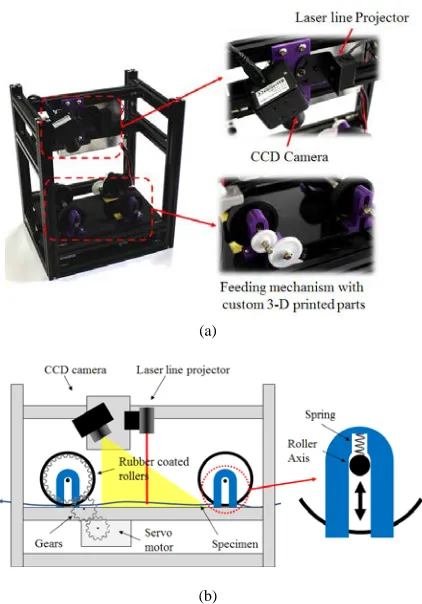
as the variable parameters. Parameter settings were controlled by a computer, which enabled the generation of samples with various combinations ofsewing conditions automatically. Three servo motors and several 3-D printed custom parts such as gear boxes and couplings were used to make the system as shown Figure 1.
FIGURE 1. Automation of sewing machine.
Software
A software has been developed to control the sewing machine and to evaluate the seam pucker in real-time using image analysis. The overview of software is as shown in Figure 2.
SEAM PUCKER EVALUATION SYSTEM Hardware
A seam pucker evaluation system has been developed as shown in Figure 3. The system consists of a sample plate, two pairs of feeding wheels, a high speed CCD camera, and a laser projector. It was connected to a PC through a USB port.
FIGURE 2. Overview of seam pucker measurement software.
(a)
(b)
Software
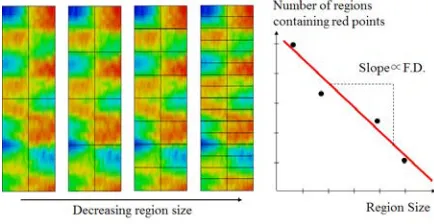
Software has been developed to control the sewing machine and evaluate the grade of seam pucker. A laser scanning system was used to capture the three-dimensional shape of the specimen. A color value was assigned to each point on the specimen according to its height from the base plate. Color varied from blue to red according to the height. The fractal dimension of each specimen was calculated using a modified box counting method as shown in Figure 4.
In this method, the three dimensional model was divided into many regions and the number of regions containing several red points were counted. The fractal dimension was obtained from the regression graph plotted using the dimension of region and the number of regions as x and y values [8-10]. The overview of the software is as shown in Figure 5.
FIGURE 4. Schematic diagram of modified box counting.
FIGURE 5. Overview of Seam Pucker Measurement software.
EXPERIMENTAL Preparation of Specimens
The objective of this research was the development of an online seam pucker measurement system that can determine the optimum sewing conditions using automatically controllable machine parameters. For
this reason, the relationship between seam pucker and the physical properties of specimens (ex. fabric density, weight, thickness, yarn count etc.) was not taken into account and only one kind of material was used. The specimens were prepared using a polyester fabric (polyester 100%, plain weave) and 100% spun polyester sewing threads. Two pieces of ironed fabric were cut to the size of 30×8 cm. Five levels of thread tension and stitch length three levels of and the presser foot pressure were used to produce fabric samples. A total of 75 samples were prepared by the automated sewing machine under various sewing condition combinations of presser foot pressure, thread tension, and stitch lengths.
Scanning of Specimen
Specimens were fed into the laser scanning system by a pair of rollers driven by a computer controlled precision stepping motor. A laser line was projected onto the specimen and a total of 50 images were captured by a high speed CCD camera during the feeding process.
The profile shape of the laser line in each image was extracted using image analysis method. A three-dimensional model of the specimen was reconstructed by combining all those shapes together.
RESULTS AND DISCUSSION Reconstruction of Specimens
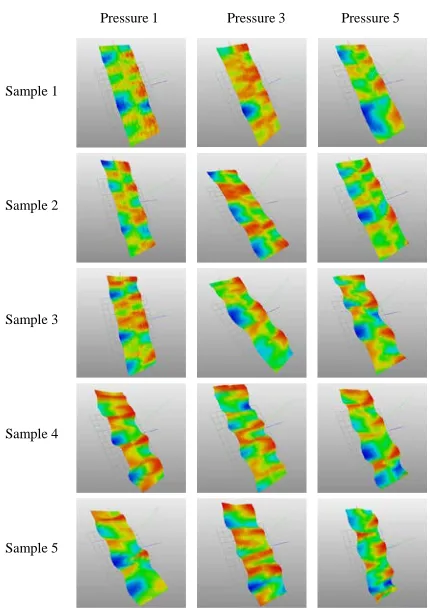
FIGURE 6. Example of reconstructed specimen images with tension level 1.
Regression Analysis
A regression analysis was made using SPSS software in order to investigate the relationship between the fractal dimension and the stitch length, the presser foot pressure, and the thread tension. \Pearson correlation analysis results are shown in Table I. The results show that there is a high correlation (0.650) at the 99% confidence level between fractal dimension and the stitch length. The positive correlation between these two parameters indicates that the fractal dimension is proportional to the stitch length.
As can be seen in the following graphs, the seam pucker grade was reduced as the stitch length increased as shown in Figure 7.
TABLE I. Results of regression analysis between fractal dimension and sewing parameters.
**Correlation is significant at the 0.01 level (2-tailed)
FIGURE 7. Seam pucker grade vs presser foot pressure under fixed tension level
Comparison of Subjective and Newly proposed Seam Pucker Grading results
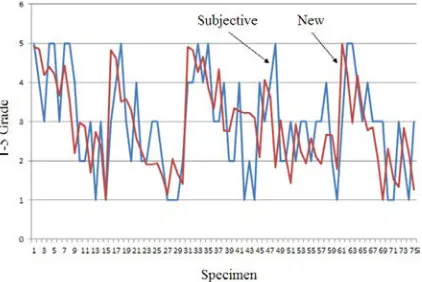
The fractal dimension values ranging from 1 to 2 were converted into values ranging from 1 to 5 in order to compare with the traditional subjective grading system. Results showed that values obtained using the newly proposed grading method agreed well with values obtained from the subjective evaluation method as shown in Figure 8.
Pressure 1 Pressure 3 Pressure 5
Sample 1
Sample 2
Sample 3
Sample 4
Sample 5
Dimension Stitch Presser foot
Pressure Tension
Pearson Correlation 1 .650** -0.188 -0.188
Sig. (2-tailed) 0 0.106 0.106
N 75 75 75 75
Pearson Correlation .650** 1 0 0
Sig. (2-tailed) 0 1 1
N 75 75 75 75
Presser Foot Pearson Correlation -0.188 0 1 0
Pressure Sig. (2-tailed) 0.106 1 1
N 75 75 75 75
Pearson Correlation -0.188 0 0 1
Sig. (2-tailed) 0.106 1 1
N 75 75 75 75
Dimension
Stitch
Tension
Correlations
G
ra
d
e
Presser Foot Pressure Level
Stitch 1
Stitch 2
Stitch 3
Stitch 4
Stitch 5
Tension Level 1 Tension Level 2
Tension Level 3 Tension Level 4
FIGURE 8. Comparison results of subjective and newly proposed grading method.
CONCLUSION
In this study, an automated sewing machine controller and a real time seam pucker evaluation system have been developed in order to determine conditions that minimize seam pucker, which is one of the most serious problems in the garment production process. Thread tension, presser foot pressure and stitch length were chosen as the sewing parameters. Parameter settings were controlled by a computer and specimens were automatically produced with various combinations of sewing conditions. Seam pucker grades were assigned using a fractal dimension calculation based on the three-dimensional shape of the specimen.
The correlation between the fractal dimension and sewing parameters was analyzed using SPSS software. The results showed that seam pucker was most strongly affected by the stitch length. Finally, the efficiency of the system was verified by comparing the results with subjective evaluation results.
ACKNOWLEDGEMENT
This work was supported by the Technology Innovation Program funded by the Ministry of Trade, Industry, and Energy (MOTIE, Korea) [10065244, Development of Pattern Matching Platform Participating on Design Creators and Prosumer, and Fashion Cluster Services based on Image Orchestration Technology]
REFERENCES
[1] As defined in "The Shorter Oxford Dictionary", 3rd ed., II, Oxford Univ. Press, U.K. 1967. [2] C. K. Park and J. Y. Ha, "A process for
optimizing sewing conditions to minimize seam pucker using the Taguchi method", Textile Research Journal, 75(3), 2005, pp. 245-252.
[3] N. A. A. Nassif, "Evaluation of seam pucker of woven cotton fabrics using two different methods", Journal of American Science, 9(4), 2013, pp. 205-210
[4] A. M. Bertoldi and D. L. Munden, "The effects of sewing variables on fabric pucker", Clothing Research Journal, 2(2), 1974, p. 81. [5] W. E. Rosenblad and M. Cednas, "The
influence of fabric properties on seam puckering", Clothing Research Journal, 1(3), 1973, pp. 20-26.
[6] C. K. Park and T. J. Kang, "Objective evaluation of seam pucker using artificial intelligence part II: Method of evaluating seam pucker", Textile Research Journal, 69(11), 1999, pp. 835-845.
[7] AATCC Test Methods 88B," Smoothness of seams in fabrics after repeated home laundering", 2011
[8] B. B. Mandelbrot, "The fractal geometry of nature", Macmillan, 1983.
[9] K. Foroutan-Pour, P. Dutilleul, and D. L. Smith, "Advances in the implementation of the box-counting method of fractal dimension estimation", Applied Mathematics and Computation, 105(2), 1999, pp. 195-210. [10] C. Gallissà, X. Capdevila, J. Valldeperas, and H.
Abril, "New approach to assessing fabric drape based on the fractal dimension", Fibres and Textiles in Eastern Europe, 23(5), 2015, pp. 66-70
AUTHORS’ ADDRESSES Minkyung Kim
Chonnam National University Gwangju 500757
KOREA
In Hwan Sul
Kumoh National Institute of Technology 61 Daehak-ro, Yangho-dong
Gumi, Gyeongbuk 730-701 KOREA
Sungmin Kim
Seoul National University
Department of Textiles, Merchandising, and Fashion Design