Volume-5 Issue-1
International Journal of Intellectual Advancements
and Research in Engineering Computations
Low convolution HEVC for video compression
*L.Vigneash,**Manikandan.B,**Nantha kumar.C,**Prakash.N,**Selvaganapathi.N
*
Assistant Professor, Department of Electronics and Communication Engineering, Maharaja Engineering College, Avinashi.
Email: [email protected]
**
Students,
Department of Electronics and Communication Engineering, Maharaja Engineering College, Avinashi.
Email: [email protected]
ABSTRACT
The main goal of the HEVC standardization effort is to enable significantly
Improved compression performance relative to existing standards in the range of few reduction of bit rate for equal perceptual video quality, the HEVC standard is used to achieve multiple goals coding efficiency, transport system integration and data loss resilience, as well as adoptability using parallel processing architectures.
Current video coding techniques provide good performance both in terms of compression ratio as well as image quality. In this project the design of high efficiency video codec with significantly low convolution is shown particularly suited and optimized for mobile environments. HEVC has been designed to address essentially all existing applications of H.264/MPEG4 AVC and to particularly focus on two key issues increased video resolution and increased use of parallel processing architectures. This project provides an overview of the technical features and characteristics of the HEVC standard used in mobile video conferencing.
KEYWORDS: Video compression, Standards, HEVC, JCT-VC, MPEG, VCEG, H.264, MPEG-4, AVC.
1.INTRODUCTION
1.1 HEVC
The High Efficiency Video Coding (HEVC) standard is the most recent joint video project of the ITU-T Video Coding Experts Group (VCEG) and the ISO/IEC Moving Picture Experts
Group (MPEG) standardization organizations, working together in a partnership known as the Joint
Collaborative Team on Video Coding (JCT-VC). The first edition of the HEVC standard is expected to be finalized in January 2013, resulting in an aligned text that will be published by both ITU-T and ISO/IEC.
Additional work is planned to extend the standard to support several additional application scenarios, including extended-range uses with enhanced precision and color format support, scalable video coding, and 3-D/stereo/multiview video coding. In ISO/IEC, the HEVC standard will become MPEG-H and in ITU-T it is likely to become ITU-T Recommendation H.265.
Video coding standards have evolved primarily through the development of the well-known ITU-T and ISO/IEC standards .The two standards that were jointly produced have had a particularly strong impact and have found their way into a wide variety of products that are increasingly prevalent in our daily lives. Throughout this evolution, continued efforts have been made to maximize compression capability and improve other characteristics such as data loss robustness, while considering the computational resources that were practical for use in products at the time of anticipated deployment of each standard
1.2 Video compression
present an example of a difficult environment for implementation of video data communications. Modern example of video encoding approaches include MPEG-4 and H.264.The major video coding standard directly preceding the HEVC was H.264 /MPEG-4 advance video coding. It is widely used for many applications, including video content acquisition, camcorders. It also used in real time conversational applications such as video-chat, video-conferencing and telepresence system.
2 .H.264
Digital communication and storage of image data is a difficult task due to the sheer volume of digital data required to accurately describe a single frame of an image. In video, the amount of data is exorbitant. Image coding seeks to make the communication and/or storage image data manageable .Communication resources, for example, have limited bandwidth. This is especially true in wireless communication media. There are tradeoffs in image data coding. Reducing the size of the data should not for example, degrade the image quality beyond an acceptable metric.
Also, the computational cost and speed must be managed, especially in devices where computational resources and power resources are to be conserved. Wireless handsets present an example of a difficult environment for implementation of video data communications .Modern examples of video encoding approaches includeMPEG.4 and H.264. In particular the latter has been specially designed for video transmission over packet networks.
However, these video standards are designed and optimized for broadcasting scenarios (server and client transmission).Both MPEG.4 and H.264 have been designed as highly asymmetric codecs, where the encoder complexity is much higher than that of the decoder. Such design enables fairly simple decoder implementations, suitable for the integration on mobile applications. However in a two way real time communication application, both the encoder and the decoder need to be integrated on the same platform.
The optimization of an H.264 video codec is a challenging problem. For example an assembly. Optimized version of the reference H.264 on an Intel Pentium4 achieves: 0.85 frames per second encoding a (352x240) CIF sequence, but 30 frames per second decoding the same sequence. This paper details the design of a symmetric codec with signicantly low complexity. This video codec is
particularly suited and optimized for mobile environments.
Memory footprints of the encoder can be controlled to match the resource availability of current wireless terminals. As far as the complexity is concerned, being able to control the rate without the need for any recoding step decreases the computational requirements on the encoder side; on the other hand, this also leads to a reduction of rate allocator output buffer size.
3. HEVC
HEVC, the High Efficiency Video Coding standard, is the most recent joint video project of the ITU-T VCEG and ISO/IEC MPEG standardization organizations, working together in a partnership known as the Joint Collaborative Team on Video Coding. The first edition of the HEVC standard is expected to be finalized in January 2013, resulting in an aligned text that will be published by both ITU-T and ISO/IEC.
Additional work is planned to extend the standard to support several additional application scenarios including professional uses with enhanced precision and color format support, scalable video coding, and 3D multiview video coding. In ISO/IEC, the HEVC standard will become MPEG-H Part 2 (ISO/IEC 23008-2) and in ITU-T it is likely to become ITU-T Recommendation H.265. Video coding standards have evolved primarily through the development of the well-known ITU-T and ISO/IEC standards
It is widely used for many applications, including
broadcast of high definition (HD) TV signals over satellite, cable, and terrestrial transmission systems, video content acquisition and editing systems, camcorders, security applications, Internet and mobile network video, Blu-ray discs, and real-time conversational applications such as video chat, video conferencing, and telepresence systems.
3.1VIDEO CODING TECHNIQUE
majority of its significant improvement in compression efficiency in relation to prior video coding standards. It is, rather, a plurality of smaller improvements that add up to the significant gain.
For representing color video signals, HEVC typically uses atri-stimulus YCbCr color space with 4:2:0 sampling. This separates a color representation into three components called Y, Cb, and Cr. The Y component is also called luma, and represents brightness. The two Chroma components CB and Cr represent the extent to which the color deviates from gray toward blue and red, respectively. Because the human visual system is more sensitive to luma than Chroma, the ―4:2:0‖ sampling structure is typically used, in which each Chroma component has one fourth of the number of samples of the luma component.
3.2 PROCESS
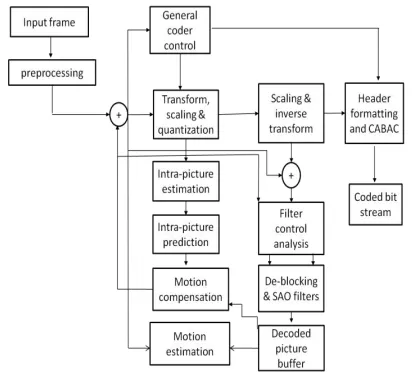
The HEVC standard is designed to achieve multiple goals: coding efficiency, transport system integration and data loss resilience, as well as implement ability using parallel processing architectures. The following sub-sections describe at a glance the key elements of the design by which these goals are achieved, and the typical encoder operation which would generate a valid bit stream.
To assist the industry community in learning how to use the standard, the standardization effort not only includes the development of a text specification document, but also reference software source code as an example of how HEVC video can be encoded and decoded.
The draft reference software has been used as a research tool for the internal work of the committee during the design of the standard, and can also be used as a general research tool and as the basis of products. A standard test data suite is also being developed for testing conformance to the standard.
The residual signal of the intra or inter prediction, which is the difference between the original block and its prediction, is transformed by a linear spatial transform. The transform coefficients are then scaled, quantized, entropy coded, and transmitted together with the prediction information
3.2.1Transform Units and Transform Blocks
The prediction residual is coded using block transforms. A transform unit (TU) tree structure has its root at the CU level. The luma CB
residual may be identical to the luma transform block (TB) or may be further split into smaller luma TBs.
The same applies to the Chroma TBs. Integer basis functions similar to those of a discrete cosine transform (DCT) are defined for the square TB sizes 4×4, 8×8, 16×16, and32×32. For the 4×4 transform of intra-
Discrete sine transform (DST) is alternatively specified.
Fig 3. Block diagram h.265 video codec
3.2.2Prediction Units and Prediction Blocks
The decision whether to code a picture area using inter-picture or intra-picture prediction is made at the CU level. A prediction unit (PU) partitioning structure has its root at the CU level. Depending on the basic prediction type decision, the luma and Chroma CBs can then be further split in size and predicted from luma and Chroma prediction blocks (PBs). HEVC supports variable PB sizes from 64×64 down to 4×4 samples.
3.2.3Motion compensation
Quarter-sample precision is used for the MVs, and 7-tap or 8-tap filters are used for Interpolation of fractional-sample positions (compared to 6-tap filtering of half-sample positions followed by bi-linear interpolation of quarter-sample positions in H.264/MPEG-4 AVC).
scaling and offset operation may be applied to the prediction signal(s) in a manner known as weighted prediction.
3.2.4Quantization control
As in H.264/MPEG-4 AVC, uniform reconstruction quantization (URQ) is used in HEVC, with quantization scaling matrices supported for the various transform block sizes. To quantize the data and given the original signal.
3.2.5 Division of pictures into coding tree
A picture is partitioned into coding tree units (CTUs), which each contain luma CTBs and Chroma CTBs. A luma CTB covers a rectangular picture area of L×L samples of the luma component and the corresponding Chroma CTBs cover each samples of each of the two Chroma components. The value of L may be equal to 16, 32, or 64 as determined by an encoded syntax element specified in the SPS.
Compared with the traditional macro block using a fixed array size of 16×16 luma samples, as used by all previous ITU-T and ISO/IEC JTC 1 video coding standards since H.261, HEVC supports variable-size CTBs selected according to the needs of encoders in terms of memory and computational requirements. The support of larger CTBs than in previous standards is particularly beneficial when encoding high-resolution video content. The luma CTB and the two Chroma CTBs together with the associated syntax form a coding tree unit (CTU). The CTU is the basic processing unit used in the standard to specify the decoding process.
3.2.6 Division of Coding Tree Block into Block
The blocks specified as luma and Chroma CTBs can be directly used as coding blocks (CBs) or can be further partitioned into multiple CBs. The partitioning is achieved using tree structures. The tree partitioning in HEVC is generally applied simultaneously to both luma and Chroma, although exceptions apply when certain minimum sizes are reached for Chroma. CTU contains a quad tree syntax that allows for splitting the CBs to a selected appropriate size based on the signal characteristics of the region that is covered by the CTB.
The quad tree splitting process can be iterated until the size for a luma CB reaches a minimum allowed luma CB size that is selected by the encoder using syntax in the SPS and is always 8×8 or larger (in units of luma samples).The boundaries of the picture are defined in units of the
minimum picture, some CTUs may cover regions that are partly outside the boundaries of the picture. This condition is detected by the decoder, and the CTU quad tree is implicitly split as necessary to reduce the CB size to the point where the entire CB will fit into the picture.
3.2.7 Intra Picture Prediction
For intra prediction, previously decoded boundary samples from adjacent PUs must be used. Directional prediction with 33different directional orientations is defined for (square) PU sizes from 4×4 up to 32×32. The possible prediction shown in Fig. 6; alternatively, planar prediction (assuming an amplitude surface with a horizontal and vertical slope derived from the boundaries) and DC prediction (a flat surface with a value matching the mean value of boundary) can also be used.
For Chroma, the horizontal, vertical, planar, and modes can be explicitly signaled, or the Chroma prediction mode can be indicated to be the same as the luma prediction mode (and, as a special case to avoid redundant signaling, when one of the first four choices is indicated and is the same as the luma prediction mode, the Intra Angular [34] mode is applied instead).
3.2.8 Inter Picture Prediction
Compared with intra-coded CBs, HEVC supports more PB partition shapes for inter-coded CBs. The partitioning modes ofPART_2N×2N, PART_2N×N and PART_N×2N indicate the cases when the CB is not split, split into two equal-size PB short horizontally and split into two equal-size PBs vertically, respectively. PART_N×N specifies that the CB is split into four equal-size PBs, but this mode is only supported when the CB size is equal to the smallest allowed CB size.
Additionally, there are four partitioning types that support splitting the CB into two PBs having different size .These types are known as ―asymmetric motion partitions compared with intra-coded CBs, HEVC supports more PB partition shapes for inter-coded CBs. The partitioning modes ofPART_2N×2N, PART_2N×N and PART_N×2N indicate the cases when the CB is not split, split into two equal-size PBs horizontally and split into two equal-size PBs vertically,
Respectively.
partitioning types that support splitting the CB into two PBs having different sizes: PART_2N×nU, PART_2N×nD, PART_nL×2N and PART_nR×2N. These types are known as ―asymmetric motion partitions process by first generating the values of one or two neighboring samples at half-sample positions using 6-tap filtering, rounding the intermediate results, and then averaging two values at Integer or half-sample positions.
HEVC instead uses a single consistent separable interpolation process to generate all fractional positions without intermediate rounding operations, which improves precision and simplifies the architecture of the fractional sample interpolation. The interpolation precision is also improved in HEVC by using longer filters
Result:
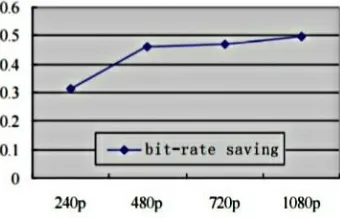
Fig 1. Bit-rate saving compared with H.264/AVC
In simulation we have consider standard video sequence .Motion compensation is an algorithm technique used to predict a frame in a video. In H.264/AVC application requires higher throughput is achieved by using CABAC algorithm so the bit rate is changed. Motion compensation describes a picture in terms of the transformation of a reference picture to current picture.
(a) (b)
Fig 2.The share of each component in decoder (a) All-intra (b) random-access
Conclusion:
This paper analysis the key features of HEVC video coding standard in video compression.
HEVC represents a number of advances in video coding technology. Its video coding layer design is
based on conventional block-based
motion-compensated hybrid video coding concepts, but with some important differences relative to prior standards.
When used well together, the features of the new design provide approximately a 50% bit rate savings for equivalent perceptual quality relative to the performance of prior standards .It is of interest to obtain object statistical data which might contribute to the improvement of the existing approach.
Referances:
[1] Joint Video Team of ITU-T and ISO/IEC JTC 1, ‖Draft ITU-T Recommendation and Final Draft InternationalStandard of Joint Video
Specification (ITU-T Rec. H.264 — ISO/IEC 14496-10 AVC)‖, Joint Video Team (JVT) of ISO/IEC MPEG and ITU-T VCEG, JVT-G050, March 2003.
[2] J. Tian and R. O. Wells, Jr. ‖Embedded Image Coding Using Wavelet Difference Reduction‖, Wavelet Imageand Video Compression, P. Topiwala, Editor, 289-301, Kluwer Academic Publishers, 1998.
[3]H. Schwarz, D. Marpe, and T. Wiegand,
―Overview of the scalable video coding extension of the H. 264/AVC standard, ‖ IEEE Trans. on Circuits and Syst. for Video Tech., vol.17, no. 9, pp. 1103-1120, Sep. 2007.
[5]G. J. Sullivan, ―Meeting report for 26th VCEG meeting,‖ ITU-T SG16/Q6 document VCEG-Z01, Apr. 2005.